The Autobiography of an Ex-Colored Man Summary and Analysis
The Autobiography of an Ex-Colored Man is James Weldon Johnson’s fictional life narrative of a biracial man who can pass as white and must decide what that power costs him. The book follows his journey through childhood, music, race consciousness, Southern violence, European travel, love, marriage, and material success.
Its central question is not only who the narrator is, but what America allows him to be. Written with restraint and irony, it studies racial identity as both a social label and an inner wound, showing how talent, ambition, fear, and survival can push a person away from the self he once hoped to claim.
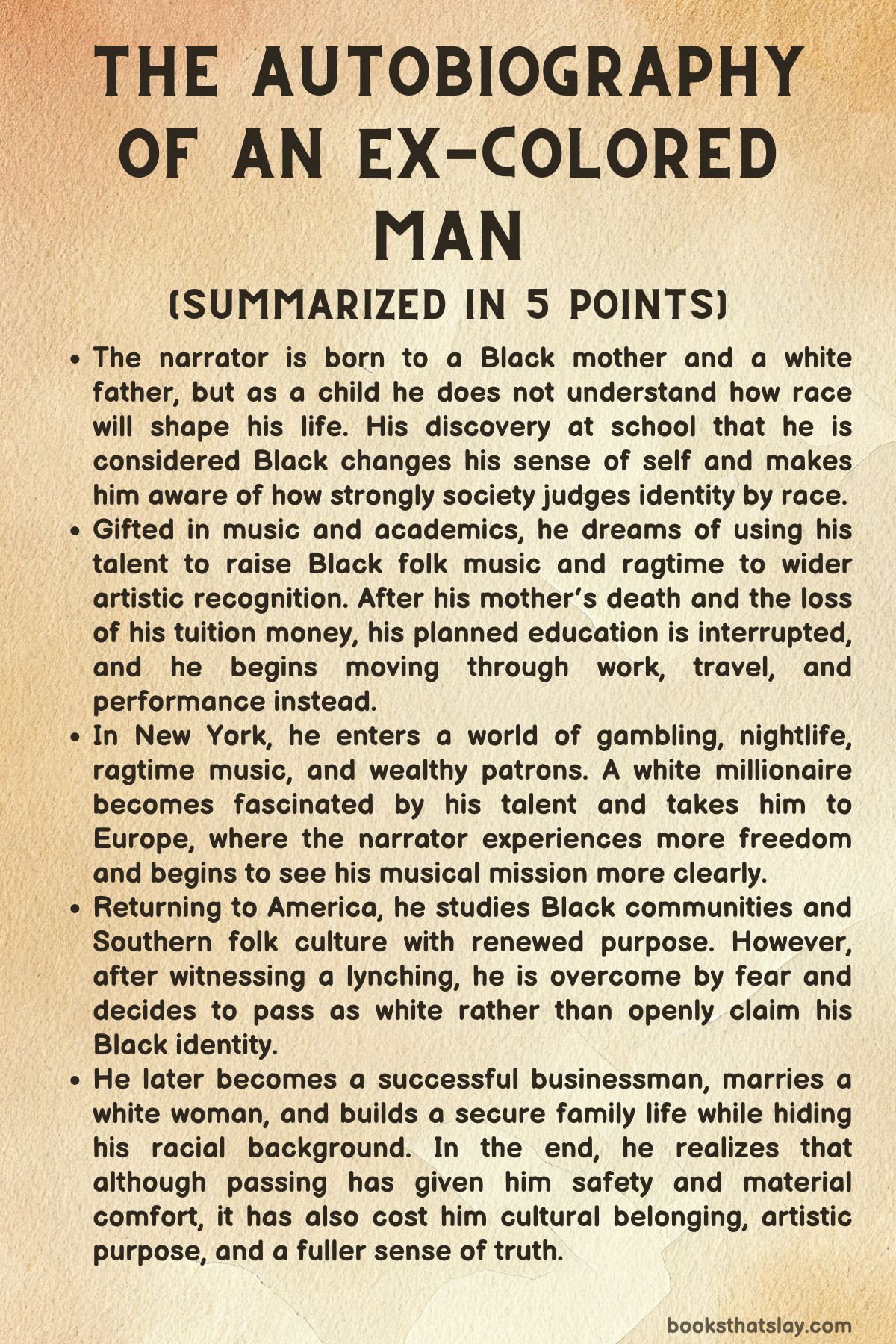
Summary
The Autobiography of an Ex-Colored Man begins with a framing note that presents the narrative as a rare exposure of racial reality in America, especially the pressure placed on Black people who are light-skinned enough to pass as white. The central narrator then takes over and explains that he feels compelled to tell the truth about his life, though doing so means admitting how he chose to become, socially and publicly, a white man.
His story is not offered as a simple confession but as an attempt to understand the choices, fears, injuries, and ambitions that shaped him.
The narrator is born in Georgia to a Black mother and a powerful white father. His father is largely absent from his early life, and the narrator remembers him more through impressions than through intimacy.
When the father sends the narrator and his mother North, the boy’s life changes completely. His early childhood is gentle and secure.
He lives with his mother in modest comfort, learns to read early, and shows a remarkable gift for music. His mother sings Southern songs and hums melodies that become part of his emotional memory.
During these years, he does not understand himself through race. Because of his appearance, he assumes he belongs among the white children around him.
That innocence ends at school when he discovers that other people consider him Black. The revelation shocks him, not because he has been taught to hate Blackness, but because it suddenly changes his position in the eyes of the world.
He begins to withdraw socially, and as he grows older, white classmates become more distant. His identity becomes something he must watch, explain, and defend, even before he fully understands it himself.
He becomes aware that the world will not simply see his intelligence, talent, or personality. It will read him through race.
As he enters adolescence, the narrator continues to develop as a musician and student. He has a first crush, thinks seriously about his future, and begins to imagine himself as an artist.
His father visits when he is twelve, but the meeting is uncomfortable. The father gives him a ten-dollar gold piece, a token the narrator keeps for years, though it cannot replace real closeness.
At school, the narrator watches the social meanings of race with growing seriousness. He admires Shiny, a Black classmate whose brilliance and dignity command respect from students across racial lines.
Shiny represents a form of Black achievement that does not depend on disguise. Through him, the narrator sees that excellence can challenge prejudice, even if it cannot erase it.
Books further shape the narrator’s understanding of race. After reading abolitionist literature and works by Black authors, he begins to think of his own music as a possible contribution to Black cultural life.
He dreams of bringing Black folk music and popular music to wider recognition. His mother works hard as a seamstress and saves money so that he can study and cultivate his talent.
He considers attending a major university known for Black education and achievement. Yet his future is disrupted when his mother dies.
Her illness consumes much of their savings, but with support from the local community and benefit concerts, he gathers enough money to begin his journey South.
He travels to Atlanta with high expectations, eager to see the region connected to his birth and family history. Instead, the poverty and roughness he observes disappoint him.
He finds temporary lodging, but his tuition money is stolen, along with a treasured tie. When he later sees the porter who helped him wearing the stolen tie, he realizes he has been deceived.
This loss destroys his immediate plan for education and becomes a major turning point. Rather than enrolling in school, he goes to Jacksonville to work.
In Jacksonville, he works in a cigar factory and gradually improves his position. He considers the practical possibility of becoming a skilled cigar maker, a steady and respectable trade.
At the same time, his musical life continues. Through church and music lessons, he encounters affluent Black communities.
He notices that educated and upwardly mobile Black people often spend immense energy resisting racist stereotypes. Their lives are shaped not only by ambition but by the constant need to prove dignity in a society determined to deny it.
He wonders what such people might accomplish if they did not have to carry that burden. He also becomes more deeply interested in Southern Black folk music and dance.
The power and originality of these forms convince him that his true artistic mission is to interpret them for the wider world.
With that goal, he goes to New York. The city dazzles him immediately, but instead of finding stable work at once, he is drawn into nightlife.
He visits gambling rooms and clubs where money, music, and performance create an intense world of risk and excitement. He wins money at gambling and becomes fascinated by ragtime, a musical style that strikes him as one of the great artistic achievements of the age.
He studies the piano players around him and learns how to perform the music himself. For a time, he works by day in a cigar factory and gambles by night, but the rhythm of club life overtakes him.
He loses his day job and becomes a full-time gambler before eventually turning away from gambling to earn money as a pianist.
His musical ability attracts a wealthy white millionaire, who becomes his patron. The millionaire is strange, reserved, and possessive, but he gives the narrator access to a new world of luxury.
The narrator plays at parties for rich white guests, interpreting classical music through ragtime and thrilling audiences who are hungry for novelty. The millionaire often pushes him to play beyond exhaustion, yet the narrator admires him and sees in him a model of power, refinement, and masculine independence.
This period brings opportunity, but it also keeps the narrator dependent on another man’s fascination with him.
The danger of New York nightlife becomes clear when the narrator becomes connected to a rich white widow who flirts with him. Others warn him that she may be using him to provoke a jealous lover.
One night, while the narrator is sitting with her, the lover stabs her to death. Terrified that he may be attacked next, the narrator flees through the city.
He eventually encounters the millionaire, who offers him a way out by taking him to Europe as a valet and companion.
Europe gives the narrator a new perspective. In Paris, he feels freer than he ever has in the United States.
People tend to see him as American rather than as a racial problem. He studies French through daily life, enjoys art, wears fine clothes supplied by the millionaire, and moves through the city with money and leisure.
Yet even in Paris, loneliness finds him. At the opera, he sees his father and half-sister, a reminder of the family and inheritance from which he has been excluded.
Later, he and the millionaire travel to London and Berlin. In Berlin, a German pianist transforms the narrator’s ragtime into a classical-style composition, inspiring the narrator to rethink his artistic mission.
Instead of adapting classical music into ragtime, he wants to raise ragtime and Black folk music to the level of recognized art.
This ambition sends him back to America. The millionaire tries to dissuade him, arguing that the United States has no secure place for a highly cultured, white-presenting Black man.
He offers to fund the narrator’s musical education in Europe, but the narrator refuses. He returns with money from the millionaire and a renewed desire to study Black folk culture at its source.
On the voyage home, the narrator befriends a Black doctor who believes deeply in racial progress and justice. Through letters of introduction, the narrator gains access to educated Black communities in Washington, Maryland, and Nashville.
He is surprised by their formality and strict social codes, which seem designed to counter racist assumptions. Traveling farther South, he overhears white men debating Black life and racial politics.
A Union veteran supports equality but still avoids social closeness with Black people, while a Texan loudly defends white supremacy. The narrator is disturbed by the Texan’s ideas but struck by his forceful loyalty to the South.
He still believes that injustice cannot last forever because it demands too much cruelty and falsehood to maintain.
In Macon, the narrator witnesses Black folk culture with fresh seriousness. At religious gatherings, he hears call-and-response preaching, spirituals, and communal music that move him deeply.
He becomes convinced that these songs contain a beauty the nation has not properly understood. He believes a trained artist could bring this music to public recognition.
Yet this hope is shattered when he witnesses a lynching. A Black man accused of rape is hunted and burned to death by white men with terrible order and purpose.
The narrator is horrified, enraged, and ashamed that he belongs to a people upon whom such violence can be inflicted without consequence. In that moment, fear overwhelms his artistic mission.
He decides he will no longer openly claim Black identity. If others take him for white, he will accept it.
He returns to New York and builds a new life as a white businessman. He begins modestly, works in commerce, saves money carefully, and invests successfully in real estate.
Passing first feels to him like a private joke against white racists who unknowingly accept him as one of their own. But the emotional cost becomes clear when he falls in love with a white woman, the daughter of a business acquaintance.
She is musical, refined, and beautiful, and their bond grows through piano playing. For the first time, he fears being discovered.
He wonders if some feature, gesture, or past connection might reveal him.
After an encounter with Shiny, he confesses the truth of his racial background to the woman he loves. She cuts off contact.
Her rejection makes him hate, briefly and bitterly, the Black heritage he has spent his life trying to understand. Later, however, they reunite through music, marry, and have children.
Their happiness is brief. She dies giving birth to their second child.
The narrator continues to pass, now partly to protect his children’s futures. In later life, he hears Black spirituals performed and listens to Booker T. Washington speak.
These experiences stir regret. He recognizes that he traded artistic purpose and racial inheritance for comfort and safety.
His final judgment of himself is marked by loss: he has gained security, but he may have sold his birthright for it.
Key Figures
The Narrator
The narrator is the central figure of The Autobiography of an Ex-Colored Man, and his character is built around divided identity, artistic promise, fear, and self-protection. As a child, he does not initially understand race as a defining force, which makes his discovery at school especially painful.
From that point onward, he becomes intensely aware of how other people read him. His light complexion gives him unusual social mobility, but it also places him in a constant state of observation and uncertainty.
He is intelligent, talented, and sensitive, especially in relation to music, and for much of the book he imagines that his artistic gift might allow him to serve Black culture in a meaningful way. Yet his confidence is repeatedly shaken by economic loss, social pressure, and racial violence.
The lynching he witnesses becomes the decisive wound in his life. After it, he chooses safety over open racial identification.
His passing is not shown as simple cowardice; it is also the act of a man terrified by what America does to Black bodies. Still, the story does not let him escape moral judgment.
His final regret suggests that he knows material success has cost him artistic greatness, cultural belonging, and a fuller sense of self.
The Narrator’s Mother
The narrator’s mother is one of the quiet moral centers of The Autobiography of an Ex-Colored Man. She raises him with tenderness, discipline, and devotion, creating a childhood that feels secure despite the unstable circumstances of his birth.
Her relationship with his white father places her in a socially vulnerable position, yet she does not allow that vulnerability to define the atmosphere of her home. She gives her son affection, education, and exposure to music, especially through the Southern songs and melodies that remain in his memory.
Her labor as a seamstress also shows her sacrifice. She works not merely to survive but to prepare a future for him, saving money so he can study and develop his gifts.
At the same time, her silence about his father reflects both pain and protection. She understands more about race, class, and gender than she can fully explain to a child.
Her death removes the narrator’s deepest emotional anchor. Without her, he loses not only a parent but also the person who connected love, music, and identity in his earliest life.
The Narrator’s Father
The narrator’s father represents privilege, distance, and the unequal power relations that shape the narrator’s birth. He is a wealthy and powerful white man who has a relationship with the narrator’s Black mother but does not form a stable family with her or their son.
His support is financial and occasional rather than intimate. Sending the mother and child North gives them a degree of safety and material possibility, but it also removes him from daily responsibility.
His brief visit when the narrator is twelve is awkward because he is more symbol than parent. The ten-dollar gold piece he gives his son becomes memorable precisely because there is so little real affection to accompany it.
Later, when the narrator sees him in Europe with his legitimate white family, the emotional wound becomes sharper. The father’s life displays the social order that allows a white man to have a Black child without publicly claiming him.
In the book, he is not a melodramatic villain; he is more troubling because he behaves within the accepted rules of a society built on racial and sexual inequality.
Shiny
Shiny is one of the most important counterpoints to the narrator in The Autobiography of an Ex-Colored Man. As a young Black student, he embodies excellence without concealment.
He is admired by others because of his intelligence, dignity, and conduct, and his presence complicates the narrator’s assumptions about social value. Shiny shows that Black achievement can command respect, even in a racist environment, though that respect remains limited by the society around him.
To the narrator, Shiny becomes a living example of what it might mean to stand openly within Black identity and still be distinguished. Later, when the narrator meets him as an adult, Shiny’s discretion becomes crucial.
He recognizes the narrator but does not expose him, showing tact and moral intelligence. This moment also forces the narrator to confront the life he has chosen.
Shiny does not need to accuse him; his very presence reminds the narrator of another possible path. He represents public integrity, racial pride, and the kind of earned honor the narrator both admires and fears.
The White Millionaire
The white millionaire is a strange and powerful patron whose relationship with the narrator is marked by fascination, control, generosity, and emotional ambiguity. He discovers the narrator through music and gives him access to wealth, travel, fine clothing, and elite social spaces.
Yet his patronage is not purely benevolent. He treats the narrator almost as a possession, demanding performances even when the narrator is exhausted and shaping the conditions of his life.
The millionaire’s silence and detachment make him appear self-contained, and the narrator admires him as a model of worldly success. At the same time, his attachment to the narrator carries a sense of possessiveness that complicates their bond.
He appreciates the narrator’s talent but also keeps him within a role that serves his own pleasure. His philosophy is deeply individualistic; he believes life should be organized around personal satisfaction rather than duty to race, art, or society.
When he advises the narrator to remain in Europe, he is partly practical and partly selfish. He sees the danger awaiting the narrator in America, but he also wants to preserve the arrangement that benefits him.
The Pullman Porter
The Pullman porter is a minor but significant figure because he becomes connected to one of the narrator’s first major reversals. At first, he appears helpful, guiding the narrator toward lodging in Atlanta.
Soon after, the narrator’s money and tie disappear, and when he later sees the porter wearing the stolen tie, the betrayal becomes clear. This incident does more than show ordinary dishonesty.
It changes the direction of the narrator’s life by preventing him from enrolling in school as planned. The porter therefore functions as an agent of chance and misfortune.
His act pushes the narrator away from formal education and toward work in Jacksonville, where he encounters new forms of Black life, labor, music, and class distinction. The porter also shows that the narrator’s journey is shaped not only by large racial structures but by sudden personal losses.
A single theft redirects ambition, delaying or perhaps permanently changing the artistic future the narrator had imagined for himself.
The Black Doctor
The Black doctor the narrator meets on the voyage back to the United States represents faith in progress, education, and justice. He is confident that Black advancement is not merely possible but inevitable because justice is on its side.
His optimism contrasts sharply with the narrator’s more unstable sense of identity. Through the doctor’s letters of introduction, the narrator gains access to respected Black communities, suggesting that the doctor is socially connected and trusted.
He belongs to a professional class that sees racial uplift as both a moral and practical project. His importance lies not only in what he says but in what he opens for the narrator.
He helps the narrator move through Black elite circles and observe the discipline, refinement, and pressure that define them. The doctor’s worldview is noble, but the book later tests it against brutal reality.
After the narrator sees racial violence in the South, the doctor’s belief in inevitable justice seems tragically difficult to sustain. Still, the doctor remains an image of principled hope.
The Young Black Teacher
The young Black teacher who lodges with the narrator in the South reflects the burden placed on educated Black people in a racist society. Like other upwardly mobile Black figures the narrator encounters, he appears deeply shaped by the need to answer prejudice with discipline and achievement.
His life is not simply his own; it is lived under the pressure of representing a race. This makes him admirable, but it also makes him constrained.
He cannot move through the world casually, because every gesture may be judged through racist expectation. His warning to the narrator on the night of the lynching shows both fear and practical knowledge.
He understands the danger in ways the narrator, still partly protected by appearance and mobility, does not fully grasp until he sees the violence himself. The teacher’s character reveals how Black education and aspiration exist beside constant vulnerability.
He is a figure of promise, but also of the emotional exhaustion created by having to remain careful in a world where reason and morality do not guarantee safety.
The Rich White Widow
The rich white widow belongs to the dangerous, theatrical world of New York nightlife. She is attracted to the narrator, or at least to the excitement and social risk associated with him, but her behavior is shaped by manipulation and jealousy rather than stable affection.
Others warn the narrator that she may be using him to provoke her lover, and this warning proves justified when the situation turns deadly. Her flirtation exposes the narrator to the volatile intersection of race, desire, class, and performance.
In the club world, white fascination with Black music and Black men can appear glamorous, but it is also exploitative and unsafe. The widow treats the narrator as part of a drama she is staging for someone else.
Her death is shocking, but it also marks a turning point in the narrator’s life. It forces him out of the nightlife circuit and into the millionaire’s protection, eventually sending him to Europe.
She is therefore a brief but consequential character whose actions reveal the danger beneath the surface excitement of the city.
The Widow’s Lover
The widow’s lover is a figure of possessive violence. He does not receive extensive development, but his action changes the narrator’s path.
His murder of the widow reveals how quickly the world of flirtation, jealousy, and social display can become fatal. For the narrator, the stabbing is not only a crime he witnesses; it is an immediate threat to his own survival.
He believes he may be the next target and runs in terror. The lover’s importance is therefore tied to the atmosphere of danger surrounding the narrator’s New York period.
He represents the unpredictable violence that can erupt when people treat others as objects in contests of pride and desire. His presence also breaks the narrator’s illusion that he can remain safely entertained by the nightlife around him.
The narrator has been gambling, playing music, and moving through a world of spectacle, but the murder shows that spectacle can carry deadly consequences. This incident sends him toward a new life abroad.
The Wife
The narrator’s wife is central to the emotional and moral consequences of passing. She first appears as a refined white woman connected to his business world, and their shared love of music allows intimacy to grow between them.
Her piano playing and sensitivity attract him because they seem to promise companionship beyond racial secrecy. Yet when he tells her the truth about his racial background, she withdraws.
Her reaction shows the power of racial conditioning even in someone capable of love and artistic feeling. She is not portrayed as cruel in a simple way, but her rejection wounds him deeply and briefly turns his feelings about his Black ancestry into self-hatred.
Their later reconciliation and marriage suggest that love can overcome some inherited prejudice, but not without pain. Her death in childbirth transforms the narrator’s private life again.
After losing her, he continues to pass for the sake of their children, fearing that public knowledge of his background would damage their futures. Through her, the book connects love, secrecy, race, and family inheritance.
The Texan
The Texan is the loudest defender of white supremacy in the debate the narrator overhears while traveling through the South. His ideas are racist and brutal, yet the narrator is struck by the force of his loyalty to the Southern social order.
This reaction reveals something important about the narrator: he can be intellectually fascinated even by people whose beliefs threaten him. The Texan speaks with confidence and regional pride, defending domination as if it were civilization.
His role is to give voice to the ideology that supports racial violence. He does not need to commit violence directly in the scene to be dangerous; his language helps justify the world in which such violence becomes possible.
The narrator initially believes that facts, justice, and moral progress will eventually defeat men like him. That belief is later shaken by the lynching.
The Texan therefore prepares the reader for the harsher reality the narrator is about to face: racist ideas are not only opinions but social forces with deadly consequences.
The Union Veteran
The Union veteran offers a more moderate view than the Texan, but the limits of his sympathy are revealing. He supports equality in principle and rejects the idea that Anglo-Saxon culture is uniquely superior.
His past as someone who fought for the Union gives him moral authority in the conversation, and he seems far more reasonable than the openly racist Texan. Yet he still does not desire social intimacy between Black and white people.
This limitation matters because it shows that even anti-slavery or pro-equality attitudes can stop short of full human fellowship. The veteran believes in justice at a public level, but not necessarily in shared private life.
He reflects a form of racial liberalism that opposes extreme cruelty while preserving distance. For the narrator, this is instructive.
The veteran’s position suggests that Black progress may gain legal or political support while still facing social exclusion. His character helps the book distinguish between abstract fairness and genuine equality.
Themes
Racial Identity and Social Performance
Identity in the story is never treated as a private fact alone. It is something created through appearance, public recognition, law, custom, fear, and opportunity.
The narrator’s early shock at discovering that he is considered Black shows how race is imposed from the outside before it is fully understood from within. His light complexion allows him to cross social boundaries that would otherwise be closed to him, yet that same ability turns life into performance.
Passing gives him safety, money, and access, but it also requires silence and self-erasure. He must monitor speech, relationships, memories, and emotional reactions.
The tragedy is that neither identity available to him is free from pressure. Openly claiming Blackness exposes him to racism and violence; living as white gives him comfort but separates him from ancestry, artistic purpose, and truth.
The Autobiography of an Ex-Colored Man presents race as a social fiction with real consequences, a fiction powerful enough to shape love, work, art, family, and self-respect. The narrator’s life becomes a study of what happens when survival demands concealment.
Art, Music, and Cultural Inheritance
Music carries the narrator’s deepest sense of possibility. From his mother’s songs to ragtime clubs, spirituals, folk dances, and classical performance, music offers him a way to understand history and emotion beyond ordinary speech.
His talent gives him confidence, social mobility, and moments of genuine artistic insight. At first, he imitates and adapts, interpreting classical music through ragtime for wealthy audiences.
Later, after hearing ragtime transformed into a classical mode in Europe, he recognizes a larger mission: Black music should not be treated as novelty or entertainment alone, but as art worthy of serious recognition. His response to spirituals in the South confirms this belief.
He hears beauty, sorrow, faith, and communal memory in them. Yet his artistic calling collapses after he witnesses racial violence.
This failure is one of the book’s central losses. The narrator does not lack talent; he lacks the courage, or perhaps the emotional safety, to remain publicly connected to the people whose music he hoped to honor.
Art becomes the road he might have taken toward greatness, but fear redirects him toward respectability.
Fear, Violence, and the Price of Safety
The lynching scene changes the narrator’s life because it converts racial injustice from an idea into an unbearable physical reality. Before that moment, he studies race through books, conversations, social observation, and personal discomfort.
He knows prejudice exists, and he has seen its effects, but he still believes that progress, reason, and justice may overcome it. Watching a Black man burned to death destroys that confidence.
The violence is not chaotic; it is organized, public, and socially permitted. That is what terrifies him most.
The narrator realizes that Black life can be subjected to extreme cruelty without protection from law or morality. His decision to pass as white comes directly from this fear.
Safety becomes more important than artistic ambition or racial loyalty. Yet the safety he gains is incomplete.
He survives, prospers, marries, and protects his children, but he also lives under the shadow of concealment. The book shows that violence harms not only its direct victims but also those who witness it, those who flee from it, and those who reshape their lives around avoiding it.
Ambition, Success, and Regret
The narrator repeatedly pursues advancement, but the meaning of success changes throughout his life. At first, success means education, artistic development, and cultural contribution.
After his money is stolen, success becomes work and survival. In New York, it becomes excitement, skill, and social access.
Under the millionaire’s patronage, it becomes luxury and refinement. After the lynching, it becomes business, wealth, and security.
Each version of success answers a real need, but each also moves him farther from the artistic and moral purpose that once gave his life direction. His final material prosperity is therefore deeply ambiguous.
By ordinary standards, he has done well. He has money, status, and children whose futures he hopes to protect.
Yet he cannot fully silence the knowledge that he abandoned something essential. His regret after hearing spirituals and listening to Black leadership reveals that he still measures himself against the artist and cultural interpreter he might have become.
The book’s final emotional force comes from this gap between comfort and fulfillment. The narrator gains a stable life, but he suspects that he has traded greatness, truth, and belonging for safety.