The Autobiography of Alice B. Toklas Summary and Analysis
The Autobiography of Alice B. Toklas by Gertrude Stein is a modernist autobiographical work told through the invented voice of Stein’s lifelong companion, Alice B. Toklas. Although it presents itself as Toklas’s life story, the book mainly becomes a portrait of Stein herself, her creative world, and the artistic community of Paris in the early twentieth century.
It records encounters with painters, writers, dancers, musicians, and soldiers while also tracing Stein’s growth as a writer. The book is witty, self-aware, and unusual because it turns autobiography into both personal history and artistic performance.
Summary
The Autobiography of Alice B. Toklas begins by presenting Alice B. Toklas’s early life before she arrives in Paris. She is born in San Francisco into a family with a striking sense of history, including ancestors connected to early California and Napoleonic Europe.
Yet Alice’s own temperament is not warlike or public. She is drawn instead to art, music, domestic order, and cultivated conversation.
As a young woman, she admires literature, especially Henry James, and even imagines adapting one of his novels for the stage. Music occupies much of her youth, and for a time she seriously studies the piano.
The death of her mother changes her relationship with music, making her recognize that it is not the central calling of her life. Her life in San Francisco is active enough, but she feels no deep attachment to it.
A decisive change comes after the San Francisco fire, when members of the Stein family return from Paris. Alice is fascinated by the paintings they bring with them, especially works by Matisse, and by their descriptions of Parisian artistic life.
The idea of Paris begins to take hold of her imagination. She tells her father that she is going there, and this decision brings her into the world that will define the rest of her life.
When she meets Gertrude Stein, she is struck immediately by Stein’s presence, voice, and intelligence. Alice begins to see Stein not only as an extraordinary person but as the center of a new existence.
In Paris, Alice enters a social and artistic circle unlike anything she has known before. Stein’s home at 27 rue de Fleurus becomes the central setting of the book.
It is both a household and a meeting place for painters, writers, collectors, and visitors eager to see new art. At first, Alice finds the paintings around Stein almost shocking.
Works by Picasso, Matisse, and others seem strange, difficult, and even intimidating. Yet she soon learns that this sense of strangeness is part of the new artistic movement forming around them.
The home is open to people who arrive through personal connections, and the atmosphere is informal but charged with cultural energy.
Alice meets Pablo Picasso and Fernande Olivier early in her Paris life. Picasso impresses her with his sharp gaze and his ability to observe people deeply.
Stein is already important to him, and he is working on a portrait of her. He believes that the portrait captures something true about Stein, even if it does not resemble her in an ordinary way.
Alice also spends time with Fernande, who is beautiful and socially important in the circle, though Alice sees limits in her depth. Through these early meetings, Alice becomes aware of her own role: she often sits with the wives and companions of famous men while Stein talks to the men themselves.
This role gives her a special angle on the social life surrounding genius.
The book then shifts to Gertrude Stein’s earlier years and her arrival in Paris. Stein had studied at Johns Hopkins Medical School after being encouraged by William James and after earlier work in psychology at Radcliffe.
Her intellectual formation includes philosophy, psychology, automatic writing, and close attention to language. She eventually leaves medicine behind, finding it dull and unsuitable, and turns toward writing.
Her brother Leo introduces her to the work of Paul Cézanne, whose paintings strongly affect her. In Paris, Stein and Leo begin buying modern art, particularly works by Cézanne, Matisse, and later Picasso.
Looking carefully at Cézanne helps Stein begin developing her own literary method, especially in the writing of Three Lives.
Stein’s writing life is shown as disciplined, demanding, and experimental. She writes late at night, often continuing until dawn, and she is interested in changing the structure of sentences.
Her work grows alongside the paintings she collects. The book repeatedly suggests that modern painting and modern writing are part of the same larger transformation.
Stein’s innovations in prose are presented as parallel to the innovations of painters such as Cézanne, Matisse, and Picasso. She is not only a collector or hostess but an artist whose understanding of form allows her to recognize greatness before it is widely accepted.
Matisse becomes an important figure in the early artistic circle. His painting of a woman in a hat shocks viewers, but the Steins buy it, helping confirm their commitment to the new art.
Stein visits the Matisses often and develops a friendship with them. Matisse is portrayed as a serious innovator in color, someone who changes painting through the intensity of his pigments and the freedom of his forms.
Over time, people begin coming to the Stein home to see the Matisses, Cézannes, and Picassos. The house becomes a small museum of the future before the wider public understands what it is seeing.
Picasso’s place in the book is even more central. Stein first encounters his work through a dealer and eventually meets him in person.
He paints her portrait, and during this period he passes through several artistic phases before moving toward Cubism. The book describes the influence of African sculpture on Picasso and the development of Cubism through his work and that of Braque, Derain, and others.
Stein presents Cubism as especially connected to Spanish vision and structure, particularly through Picasso and Juan Gris. The relationship between Matisse and Picasso is marked by admiration, rivalry, and tension.
They study each other, compete with each other, and help define the artistic climate of the time.
As Alice becomes part of Stein’s household, she also becomes Stein’s helper, typist, companion, and social partner. She assists with proofs, types manuscripts, manages aspects of daily life, and helps receive visitors.
Their home becomes increasingly known among Americans in Paris. Saturday evenings bring a stream of people who want to meet Stein and see the art.
The prewar years are filled with painters, writers, dancers, and intellectuals. Stein writes portraits of people she knows, and her work moves further from conventional narrative toward experiments in language and perception.
Travels in Spain are especially important for both women. Alice loves Spain deeply, while Stein uses the experience to think about the visible world and the relation between inner life and outward form.
The years before the First World War also bring signs of change. Picasso and Fernande separate after Fernande introduces him to Eve, who becomes his new companion and inspiration.
The old friendships begin to shift. Stein’s brother Leo leaves for Florence, and the siblings divide their art collection.
Stein keeps the Cézannes and Picassos, while Leo takes the Matisses and Renoirs. This separation marks the end of an earlier phase of Stein’s life.
By the summer before the war, Alice senses that the old Parisian rhythm is ending.
The outbreak of the First World War changes everything. Stein and Toklas are in England when the war begins and fear they may not be able to return to Paris.
They are deeply distressed by the threat to France. After returning to Paris, they experience fear during German air attacks.
Seeking safety, they spend time in Mallorca, where Stein continues writing and Alice knits for soldiers. But the war’s violence, especially the attack on Verdun, draws them emotionally back toward France.
Stein becomes determined to obtain a vehicle, and the two women join relief work for the American Fund for French Wounded.
Their Ford truck, named Auntie, becomes one of the memorable presences of the war section. Stein drives, and Alice assists with nursing and practical service.
They travel through France helping hospitals, transporting supplies, and assisting soldiers. They form bonds with young soldiers, whom they call military godsons, and try to support them materially and emotionally.
The war gives their lives a new sense of public usefulness. Even amid hardship, illness, cold, and fear, Stein continues to write.
The book shows her creativity as persistent under pressure rather than dependent on comfort.
After the Armistice, Paris changes again. The prewar circle has scattered.
Matisse lives in Nice; Picasso is still present but more distant; the intensity of the earlier artistic community has faded. Stein struggles for literary recognition, even though she writes constantly.
She develops the habit of writing in the car, using the rhythm of street sounds and movement as a guide for sentences. New artistic movements and new personalities arrive.
Dadaists, photographers, poets, publishers, and American expatriates appear at the Stein home. Sylvia Beach becomes part of the world of Paris literary culture.
Man Ray photographs Stein. Ezra Pound visits but does not remain close to her.
T. S. Eliot talks with her about poetry but does not publish her work.
The postwar years also introduce Ernest Hemingway, one of the young writers who gather around Stein. Stein advises him on writing, telling him to abandon journalism if he wants to see the world clearly as an artist.
Alice is more suspicious of Hemingway’s character and literary value, though she and Stein become godmothers to his child. Their friendship eventually cools, as many such literary friendships do.
F. Scott Fitzgerald also appears, and Stein respects his ability to write naturally in sentences. She sees his work as capturing the tone of the new era.
Stein continues publishing difficult and ambitious works, including The Making of Americans, Tender Buttons, essays, plays, and writing about language. Alice works to support the publication and circulation of Stein’s writing.
The book also shows Stein’s limitations, especially in her condescending and racist comments about Paul Robeson and African culture. These moments reveal that her brilliance as an artist exists alongside serious failures of judgment and prejudice.
The book ends by returning to the oddity of its own form. Alice has supposedly told her autobiography, but the final joke is that Stein has written it for her.
Alice presents herself as too busy being Stein’s companion, helper, and witness to write her own life. Stein therefore writes Alice’s autobiography in Alice’s voice.
This ending exposes the book’s central trick. It is Alice’s story, Stein’s self-portrait, a record of modern art, and a comic performance of authorship all at once.
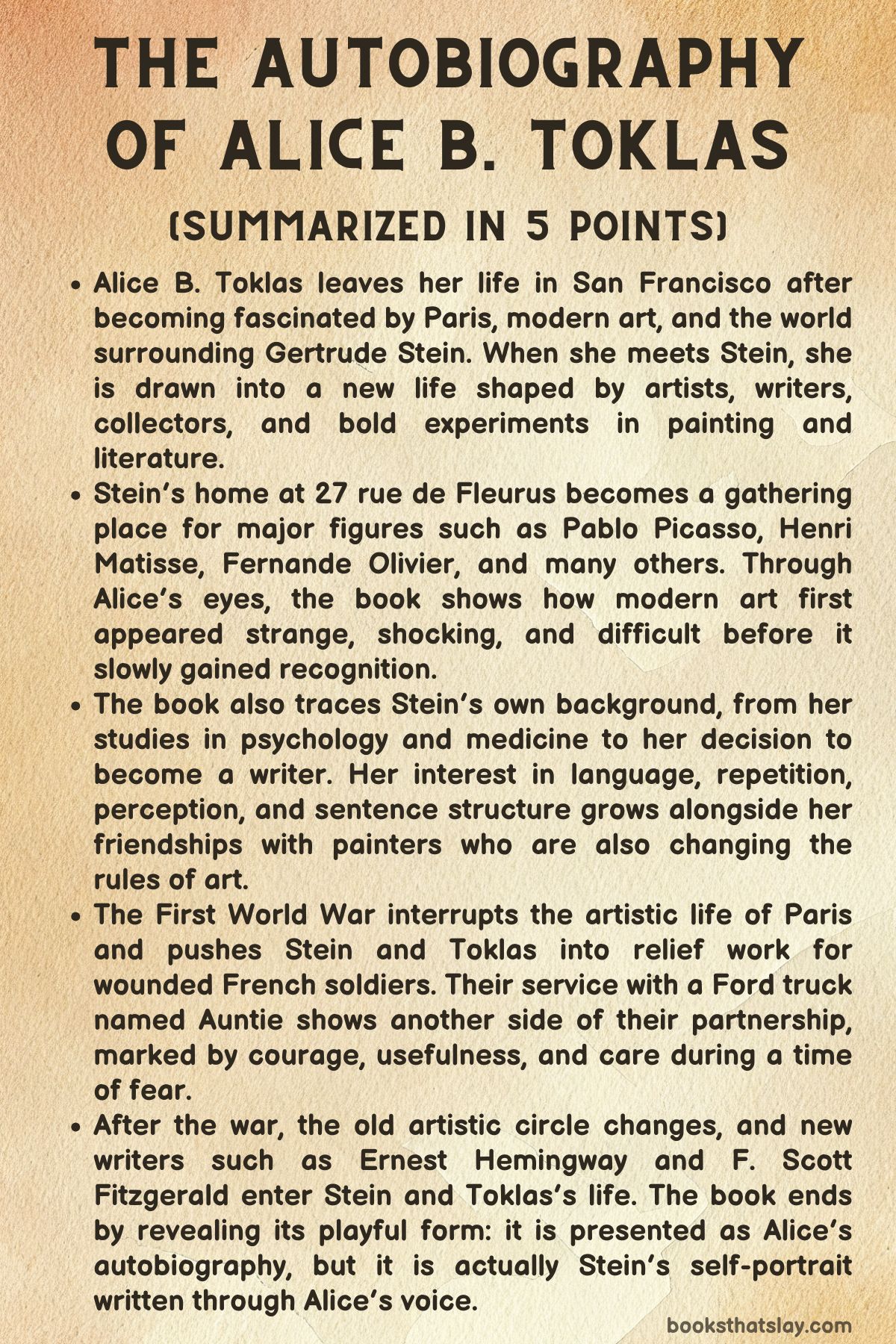
Key Figures
Alice B. Toklas
Alice B. Toklas is the narrator-figure and the lens through which the reader enters the world of Gertrude Stein, Paris, and modern art. In The Autobiography of Alice B. Toklas, she appears at first as a cultivated woman from San Francisco whose early interests lie in music, literature, and domestic life.
Her decision to go to Paris marks a complete change in direction, not because she seeks fame for herself, but because she finds in Stein and her circle a life of greater intensity. Alice’s character is shaped by attentiveness.
She watches people carefully, remembers gestures, notices social arrangements, and often understands the emotional texture of a scene through small details.
Alice is also a manager of relationships. She sits with the wives and companions of famous men, receives visitors, types manuscripts, assists with proofs, supports Stein’s publishing efforts, and helps maintain the household that becomes a cultural meeting point.
Her position may appear secondary, but the book makes it clear that her labor allows Stein’s artistic life to function. During the war, Alice’s practical strength becomes even clearer.
She knits for soldiers, helps with nursing duties, accompanies Stein through difficult relief work, and forms attachments to young soldiers they assist. Her devotion to Stein is complete, but it is not empty or passive.
She has strong opinions, especially about figures such as Hemingway, Fernande, and Spain. She often speaks with wit, judgment, and a quiet firmness.
The paradox of Alice is that the book seems to make her central while also using her voice to celebrate Stein. Her identity is therefore both present and partly absorbed into the life of the person she admires most.
Gertrude Stein
Gertrude Stein is the dominant figure in the book, even though she writes through Alice’s voice. She is presented as a genius, a collector, a conversational force, a literary innovator, and a person with a powerful belief in her own judgment.
Her childhood across America and Europe gives her a wide cultural background, but she chooses English as her true language and protects it fiercely. Even while living in Paris, she avoids reading French literature and prefers to remain surrounded by foreign speech because it leaves her alone with English.
This idea is central to her artistic identity: language is not merely a tool for Stein but the material of her deepest work.
Stein’s intellectual formation at Radcliffe and Johns Hopkins shapes her interest in psychology, perception, repetition, consciousness, and the structure of thought. Her admiration for William James and her experiments with automatic writing influence the way she later approaches prose.
In the book, she is not shown as a conventional author trying to tell stories in familiar ways. She is trying to rebuild the sentence, rethink description, and create writing that matches the modern world as radically as Picasso and Matisse change painting.
Her belief in newness makes her value artists before they become publicly accepted. Once an artist is widely praised, some of the adventure disappears for her.
Stein is generous, commanding, funny, proud, and difficult. She supports unknown artists, advises young writers, and recognizes creative power early.
Yet she can also be dismissive, possessive, and prejudiced. Her treatment of Paul Robeson reveals an ugly racial condescension that complicates any simple admiration of her.
In The Autobiography of Alice B. Toklas, Stein becomes both subject and author, both person and performance. The book’s unusual structure shows her need to control the story of her own importance while pretending to hand the story to Alice.
Pablo Picasso
Pablo Picasso is one of the major artistic presences in the book and one of the clearest examples of creative intensity. He is introduced as a man with exceptional powers of observation.
Alice notices how sharply he looks at others, and this quality becomes central to his role as an artist. His portrait of Stein is important not because it follows ordinary likeness but because it claims to reveal a deeper truth.
Picasso’s statement that Stein would come to resemble the portrait suggests his confidence that art can see ahead of life.
Picasso is restless, experimental, competitive, and emotionally changeable. The book follows him through different artistic phases and places him near the birth of Cubism.
His contact with African sculpture, his rivalry and friendship with Matisse, and his working relationship with Braque all show him as someone constantly absorbing, revising, and challenging artistic forms. He is also presented as socially complicated.
His relationship with Fernande ends after Eve enters his life, and later he moves through grief, marriage, fatherhood, and renewed social contact with Stein. His friendships can be tender but unstable.
In The Autobiography of Alice B. Toklas, Picasso matters not only as a famous painter but as a living example of the modern artist: brilliant, difficult, self-involved, and always moving toward a new visual language.
Henri Matisse
Henri Matisse represents another path into modern painting. He is associated with color, boldness, and the shock of public misunderstanding.
His painting of a woman in a hat becomes a key moment because it reveals the gap between the new art and the old expectations of viewers. Many people mock what they do not understand, but the Steins purchase the painting, recognizing its importance.
Through this purchase, Matisse becomes part of the Stein household’s artistic identity.
Matisse is portrayed as an innovator whose work changes the value of color in painting. His method of intensifying pigments makes his art appear daring and unfamiliar.
At the same time, he is shown as socially sensitive and somewhat vulnerable to rivalry. His relationship with Stein cools as she becomes more closely associated with Picasso.
Matisse seems to feel that attention and loyalty matter, and the shifting balance of Stein’s admiration hurts him. His character is therefore not simply that of a great painter but of an artist living in a competitive environment where friendship, recognition, and artistic judgment are hard to separate.
Leo Stein
Leo Stein is crucial to the early formation of Gertrude Stein’s Paris life. He introduces her to Cézanne and helps build the collection that makes the rue de Fleurus home famous.
His judgment matters in the early years, especially when he argues for keeping Picasso’s painting of the nude girl with flowers after Gertrude initially dislikes it. Leo’s role is that of a catalyst: he helps bring modern art into Stein’s life and into their shared household.
Yet Leo’s significance also lies in departure. When he decides to live in Florence, the division of the art collection becomes symbolic.
Gertrude keeps the Cézannes and Picassos, while Leo takes the Matisses and Renoirs. This division marks a break in both family and artistic life.
Leo belongs to the foundation of the story, but not to its later center. His exit clears the way for the household to become more fully Gertrude and Alice’s world.
He is intelligent and artistically alert, but the book ultimately places him behind Gertrude’s stronger personality and more enduring cultural role.
Fernande Olivier
Fernande Olivier is introduced through her connection to Picasso, but she also becomes part of Alice’s social world. Alice spends time with her because Alice often occupies the space beside the wives and companions of male geniuses.
Fernande is described as beautiful and socially important, though Alice regards her as limited in depth. This judgment may reveal as much about Alice’s standards as it does about Fernande herself.
Fernande’s character is tied to the emotional instability of the artistic circle. Her relationship with Picasso is long and significant, but it ends after she introduces him to Eve.
This event changes not only Picasso’s private life but also Fernande’s relationship with Stein and Toklas. Once Fernande is no longer Picasso’s companion, her place in the circle weakens.
She represents the vulnerable position of women attached to famous men: visible, admired, and socially necessary, but often displaced when the man’s affection or artistic attention moves elsewhere.
Eve
Eve enters the book as the woman who replaces Fernande in Picasso’s life. She becomes his lover and muse, inspiring the painting titled Ma Jolie.
Her role is brief but important because she marks a transition in Picasso’s emotional and artistic life. Through Eve, the book shows how personal relationships feed into artistic production, especially in Picasso’s case.
Eve’s later death affects the atmosphere around Picasso, though the book notes that he soon pursues other women. This response presents Picasso as emotionally mobile, perhaps even callous, and it adds a sharper edge to his character.
Eve herself is not developed as deeply as Alice, Stein, or Picasso, but she matters as a figure of replacement, inspiration, and loss. Her presence changes the arrangement of relationships within the circle and helps close one phase of the prewar Paris world.
Juan Gris
Juan Gris is presented as one of the true Cubists and as a Spanish artist whose work supports Stein’s claim that Cubism has a special connection to Spanish structure and vision. He is less socially dominant than Picasso, but he carries artistic weight.
His presence helps broaden the book’s account of modern painting beyond the more famous rivalry of Picasso and Matisse.
The response to Juan Gris’s death reveals his emotional importance to Stein. Picasso joins Stein for a day of mourning, and Stein writes a tribute to Gris that Alice considers one of her most moving works.
Gris therefore becomes a figure through whom the book addresses artistic friendship, loss, and respect. His character is not built through many scenes, but through the seriousness of the response he inspires.
He stands for a kind of artistic purity and for the sadness of a generation marked by early death, change, and fading alliances.
Ernest Hemingway
Ernest Hemingway appears as one of the young American men who come into Stein and Toklas’s postwar Paris circle. He is energetic, ambitious, and eager to learn.
Stein advises him directly about writing, especially warning him that journalism may damage his ability to see things as an artist. Her guidance suggests that she recognizes his talent but also sees weaknesses in his method.
Hemingway’s early dependence on Stein’s opinion places him, for a time, in the role of student.
Alice is more skeptical of Hemingway than Stein is. She questions both his writing and his character, and her doubts grow more meaningful as his career advances.
The godparent relationship between Stein, Toklas, and Hemingway’s child briefly creates intimacy, but the book suggests that such bonds between writers rarely last. Hemingway becomes a sign of the postwar literary generation: talented, self-promoting, competitive, and eventually independent of the mentors who helped him.
His rise also shows how quickly artistic friendships can become rivalries or disappointments.
F. Scott Fitzgerald
F. Scott Fitzgerald appears more briefly than Hemingway, but Stein’s judgment of him is striking. She credits him with writing naturally in sentences and sees his fiction as expressing the mood of a new era.
This praise matters because Stein values sentence-making deeply. For her to recognize Fitzgerald’s sentence style means that she sees an authentic literary gift in him.
Fitzgerald’s role in the book is less personal and more critical. He represents a younger American literature that emerges after the war and defines a changed cultural atmosphere.
Through him, the book acknowledges that the center of modern writing is not only in Stein’s own experiments but also in writers who capture social rhythm, generational feeling, and the new tone of the 1920s. Fitzgerald’s character is therefore that of a literary marker: he signals a new age and earns Stein’s respect in a way few younger writers do.
Sylvia Beach
Sylvia Beach is part of the postwar literary world in Paris. Her presence connects Stein and Toklas to the growing network of English-language publishing, bookselling, and expatriate culture.
She represents the practical and social infrastructure that allows modern literature to circulate. While painters gather around salons and studios, writers need publishers, bookshops, editors, and readers; Beach belongs to that world.
Her character is important because she shows that modernism is not created by artists alone. It also depends on people who build spaces where books can be read, discussed, sold, and promoted.
Beach’s role is quieter than Stein’s or Picasso’s, but it reflects a different kind of cultural power. She helps define Paris as a literary capital for English-speaking writers and readers after the war.
Carl Van Vechten
Carl Van Vechten is presented as an admirer and supporter of Stein. He accompanies Stein and Toklas to the controversial performance of The Rite of Spring and remains connected to their cultural life.
His admiration gives him a place among those who recognize Stein’s importance before broader literary acceptance arrives. He is socially mobile, curious, and drawn to artistic excitement.
Van Vechten also introduces prominent African Americans to Stein and Toklas, including Paul Robeson. This role places him at an important but uncomfortable point in the book, because it leads to the exposure of Stein’s racist and condescending views.
Van Vechten’s character therefore functions partly as a connector. He brings people together, opens social channels, and helps extend Stein’s circle beyond its earlier European avant-garde setting.
Paul Robeson
Paul Robeson appears briefly, but his presence is powerful because of how Stein responds to him. He is presented as a singer and actor capable of critical thought about American life and values.
Stein is interested in him, yet her comments about him reveal serious prejudice. She reduces him through racial assumptions and speaks dismissively about spirituals and African culture.
Robeson’s character is not developed from his own point of view, which is part of the problem the scene exposes. He appears through the gaze of Stein and Toklas, and that gaze is limited by racial condescension.
His presence therefore challenges the reader’s view of Stein. The same person who can recognize artistic innovation in painting and literature can fail morally and intellectually when confronting race.
Robeson becomes a figure whose dignity is visible despite the narrowness of the account around him.
Ezra Pound
Ezra Pound appears as one of the postwar literary visitors to Stein and Toklas. Stein dislikes him and calls him dull in a way that offends him, ending their closeness.
His presence highlights the argumentative nature of the modernist literary world. Writers are not presented as a harmonious group but as proud, sensitive, and often difficult personalities.
Pound’s character is useful because he shows Stein’s sharpness as a social judge. She is not eager to praise every famous person who enters her home.
Her dismissal of Pound also reflects her impatience with explanation that feels lifeless to her. In the book, he stands for a kind of literary authority Stein refuses to accept.
His wounded reaction reveals the vanity and fragility that can accompany artistic reputation.
T. S. Eliot
T. S. Eliot appears as a serious literary figure who speaks with Stein about poetic technique but hesitates to publish her work. This makes him part of the pattern in which Stein is recognized socially and intellectually but still struggles to gain institutional support for her writing.
Eliot’s presence shows the difference between private respect and public endorsement.
His interaction with Stein also brings a comic side story through the correspondence between Alice and Eliot’s secretary, who address each other as “Sir.” This episode fits the book’s playful handling of literary manners and gendered expectations. Eliot’s character is restrained, formal, and cautious.
He represents a literary establishment that can appreciate Stein’s mind without fully making room for her work.
Guillaume Apollinaire
Guillaume Apollinaire appears as part of Picasso’s intimate post-Montmartre circle. He is not developed extensively, but his presence matters because he connects painting and writing in the Paris avant-garde.
He belongs to the group of figures who help define the artistic climate around Picasso and Stein.
As a character, Apollinaire stands for the closeness between poets, painters, critics, and collectors during this period. The modernist world in the book is not divided neatly by artistic medium.
Writers discuss painters, painters influence writers, and friendships help ideas travel. Apollinaire’s role is therefore atmospheric but meaningful.
He helps show the social density of the Parisian art world before and after the war.
Erik Satie
Erik Satie enters through Picasso and belongs to the wider field of modern music and performance. His presence helps expand the book beyond painting and literature into music and theatrical culture.
He is one of the figures who show that Parisian modernism is a broad artistic environment rather than a single movement.
Satie’s role is brief, but he represents a spirit of experiment similar to the one Stein values. The book’s world includes people who are changing sound, movement, color, prose, and performance.
Satie’s presence reinforces the idea that Stein and Toklas are living at the center of many artistic changes at once.
Jean Cocteau
Jean Cocteau is another figure connected to Picasso and the broader French avant-garde. As an artist and playwright, he represents the mixed artistic culture of the time, where people often move across forms and social circles.
His appearance shows how Stein and Toklas’s network keeps expanding after the war.
Cocteau’s character is not explored deeply, but his inclusion matters because he reflects the fashionable and theatrical side of modern Paris. He is part of a scene in which reputation, collaboration, performance, and innovation are closely linked.
His presence adds to the sense that the Stein household remains connected to artistic change even after the earlier prewar circle has broken apart.
Alfred North Whitehead and Mrs. Whitehead
Alfred North Whitehead and Mrs. Whitehead appear during the outbreak of the First World War, when Stein and Toklas are visiting England. Their household becomes the place from which the women first confront the practical difficulty of returning to Paris.
Mrs. Whitehead’s warning that travel may be hard marks the sudden intrusion of war into cultivated social life.
Their role is brief but important. They show how quickly intellectual and domestic spaces are overshadowed by historical crisis.
Before the war, the book is largely concerned with art, conversation, travel, and writing. With the Whiteheads, the mood changes.
The private world of visits and literary connections gives way to anxiety, borders, danger, and uncertainty.
Abel
Abel is one of the military godsons Stein and Toklas support during the war. He represents the many young soldiers who enter their lives through relief work.
Unlike famous artists and writers, Abel belongs to the ordinary human cost of war. His presence helps shift the book’s attention from salons and studios to hospitals, roads, and military need.
Abel’s importance lies in the affection and responsibility he draws from Stein and Toklas. By supporting soldiers like him, the two women become involved in a practical moral world beyond art.
Abel shows their capacity for care, loyalty, and service. He also makes the war section more personal, because the conflict is not only a political event but a series of human attachments.
Themes
Art as a New Way of Seeing
Modern art in the book is not treated as decoration or fashionable rebellion. It becomes a new way of looking at the world.
The paintings that first shock Alice are difficult because they refuse familiar habits of beauty. Picasso, Matisse, Cézanne, and Gris are important because their work changes perception itself.
Cézanne teaches Stein how repeated looking can alter thought. Matisse changes the force of color.
Picasso changes form so radically that likeness becomes less important than inner truth. Stein’s own writing follows a similar path.
She does not want prose to behave in the old way; she wants sentences to create new relations between words, perception, and reality. This theme makes the book a record of artistic education.
Alice begins as a newcomer who finds the paintings strange, but she gradually learns to inhabit a world where difficulty is not a flaw. Difficulty becomes proof that art is ahead of public taste.
In The Autobiography of Alice B. Toklas, the new artwork asks viewers and readers to become new kinds of observers.
Genius, Recognition, and Social Power
Creative genius in the book is never isolated from society. Stein, Picasso, Matisse, Hemingway, Fitzgerald, and others depend on networks of friendship, rivalry, conversation, collecting, publication, and reputation.
A painting needs someone willing to buy it before the public understands it. A manuscript needs typists, publishers, editors, advocates, and readers.
A young writer often needs an older figure to judge, advise, and promote him. Stein’s home becomes powerful because it gathers people, objects, and opinions in one place.
Yet recognition is uneven. Painters such as Picasso and Matisse gradually gain fame, while Stein struggles for literary publication despite her confidence in her own importance.
The book also shows the competitive edge of genius. Artists admire one another but fear being displaced.
Friendships cool when attention shifts. Younger writers seek guidance and then outgrow or reject those who helped them.
Fame is shown as a social process, not simply a reward for talent. The book suggests that genius may begin privately, but it becomes history only when a community argues over it, preserves it, and repeats its name.
Companionship, Labor, and Hidden Support
The relationship between Alice and Stein reveals how much creative life depends on forms of labor that are easy to overlook. Alice types manuscripts, helps with proofs, receives visitors, manages social obligations, assists during travel, and supports Stein’s public and private work.
Her role is emotional, domestic, practical, and intellectual. The book’s central joke is that Alice’s autobiography is actually written by Stein, but the deeper truth is that Stein’s life as an author is made possible by Alice’s constant presence.
This theme also applies beyond their relationship. The companions of famous men, such as Fernande and Eve, help shape the emotional and social worlds in which art is made, even when they are not granted equal artistic status.
Publishers, booksellers, secretaries, collectors, and friends also sustain the careers of major figures. The book asks the reader to notice the support structures behind celebrated creativity.
Alice may present herself modestly, but the narrative repeatedly shows her importance. Her life is not separate from Stein’s work; it is one of the conditions that allows that work to exist.
War, Change, and the End of an Era
The First World War marks a clear break in the book’s world. Before the war, Paris is defined by studios, salons, paintings, conversations, and artistic discovery.
After the war, that earlier world cannot be recovered. Friendships have shifted, people have moved away, and the mood of cultural life has changed.
The war forces Stein and Toklas out of the protected space of art and into relief work, hospitals, roads, soldiers, fear, and public service. Their Ford truck becomes a symbol of movement through a damaged country.
The war does not stop Stein from writing, but it changes the conditions around her work. It also changes the meaning of community.
Before the war, community is built through artistic recognition; during the war, it is built through care, transport, nursing, and loyalty to soldiers in need. The postwar years bring new writers and movements, but they do not restore the older intimacy of the prewar circle.
The theme of change is therefore historical and personal at once. The book remembers a cultural moment while also showing why that moment could not last.