Abduction Summary, Characters and Themes | Peg Kehre
Abduction by Peg Kehret is a suspenseful young adult novel about a family torn apart by a sudden kidnapping and the courage required to overcome fear. The story follows Bonnie, a thirteen-year-old girl whose younger brother Matt disappears after school one day.
As the search for him begins, the truth about the kidnapper becomes increasingly disturbing. While Bonnie and her mother struggle with uncertainty and worry, Matt must cope with being held by a dangerous man who claims to be his father. Through determination, quick thinking, and bravery, Bonnie and Matt fight to survive and reunite with their family.
Summary
The story begins with Denny Thurman preparing a plan to kidnap his young son, Matt. Disguised as a delivery driver, he approaches the home of his former wife, Anita Sholter.
He lures the family dog, Pookie, into his car with food and drives to Matt’s elementary school. Denny believes the dog will help him trick Matt into trusting him.
Meanwhile, Bonnie Sholter, Matt’s thirteen-year-old sister, is at school with her friend Nancy. Bonnie talks about nightmares she used to have when she was younger, after her father died.
The dreams involved running through endless grass while calling for help that never came. Although the nightmares stopped years ago, thinking about them again makes Bonnie uneasy, as if something terrible is about to happen.
Denny spends several days watching the school to identify Matt. Because he has never met his son, he studies the children leaving the building and notices Bonnie standing with a small blond boy he assumes is Matt.
He realizes he must intercept the boy before he reaches Bonnie after school. Wearing his disguise, Denny enters the school office and signs in as a delivery driver.
By chance, he finds Matt in the hallway. He tells Matt that Pookie has been hit by a car and needs to go to the veterinarian.
Although Matt hesitates to leave with a stranger, Denny seems to know details about his family and dog. Worried about Pookie, Matt finally agrees to go with him.
After school, Bonnie expects to meet Matt at the bus. When he does not appear, she becomes worried.
Teachers and school staff search the building but cannot find him. Eventually, the school contacts Bonnie’s mother, Anita, and the police are called.
While this search begins, Matt rides in the back seat of Denny’s car with Pookie. He quickly notices that the dog does not appear injured.
As Matt asks questions about where they are going, Denny distracts him with chocolate. Unfortunately, Matt is allergic and soon develops hives.
When Matt asks for his allergy medication, Denny ignores the request. Matt also becomes uneasy when Denny removes his disguise and admits that he is Matt’s father.
During the drive, Denny stops at a park and ties Pookie to a post, leaving the dog behind. Matt realizes something is wrong and becomes frightened.
Denny eventually reveals a gun, making it clear that Matt has no choice but to obey him.
At the school and later at home, Bonnie and Anita speak with police officers about Matt’s disappearance. The school staff remember a delivery driver who entered earlier but never checked out.
A description of the man includes a rose tattoo on his arm. Police issue an alert and begin searching for clues.
When Bonnie returns home, she discovers that Pookie is also missing.
Detectives learn about Anita’s former husband, Denny Thurman. Anita dismisses the idea that he would take Matt because he had never shown interest in being a parent.
However, the police begin investigating him anyway.
Denny brings Matt to his apartment in Seattle. To keep Matt from trying to escape, he pretends to call Anita and then tells Matt that his mother and sister died in a car accident.
The news devastates Matt, leaving him feeling completely alone. Denny secretly washes off the fake tattoo he used during the kidnapping.
Meanwhile, Bonnie and Anita spread the word about Matt’s disappearance. Friends, neighbors, and volunteers help search for him.
Bonnie creates posters and sends messages online asking people to look for Matt. Despite the support from the community, the lack of progress makes Bonnie feel hopeless.
In the park where Denny abandoned Pookie, an elderly couple named Fred and Ruth Faulkner discover the dog tied to a post. Since the dog has no collar, they take it home temporarily, leaving a note behind.
Back at home, Bonnie eventually finds Pookie’s collar in the yard, which becomes evidence for the police. Bonnie’s anxiety grows as the days pass without news.
She begins having nightmares again and regrets complaining about caring for Matt the day he disappeared.
The police later receive a tip about the dog found at the park. Fred and Ruth watch the news and realize the dog they rescued belongs to Bonnie and Matt.
They return Pookie to the family, bringing a moment of relief during a stressful time.
While Bonnie and Anita continue their search, Denny’s behavior toward Matt becomes unpredictable. His moods change depending on whether he wins or loses money while gambling.
Sometimes he acts cheerful and buys Matt gifts, but other times he becomes angry and takes the items away.
Eventually, Denny decides to take Matt to a Mariners baseball game. He plans to visit his sister Celia afterward and convince her to give him money by pretending that raising Matt is too expensive.
He even considers lying about Matt needing surgery to gain sympathy.
Before leaving for the game, Denny disguises Matt by darkening his hair and making him wear glasses. He tells Matt to use the name Travis.
Coincidentally, Bonnie attends the same baseball game with Nancy and friends. During the game, Bonnie scans the crowd with binoculars and spots a boy who looks like Matt.
At first she doubts herself, but then she sees Denny with him and realizes her brother has been kidnapped by their father.
Bonnie decides to follow them instead of immediately calling the police, fearing they will escape before help arrives. When Matt sees Bonnie in the crowd, he calls out to her.
Denny pulls a gun and forces both children to leave the stadium with him.
During a stop at a restaurant, Bonnie tries to alert people in the restroom that she and Matt have been kidnapped. Unfortunately, the restaurant is hosting a murder mystery event, and the women assume Bonnie is part of the entertainment.
Bonnie writes a message on the mirror asking for help, but it is ignored and later erased.
Bonnie and Matt manage to escape through a restroom window and attempt to get help from passing cars. However, drivers either ignore them or misunderstand the situation.
Denny soon catches up with them and forces them into a taxi heading toward a ferry.
On the ferry, Bonnie tries again to warn someone, but no one responds in time. Denny continues with his plan to visit his sister and ask for money.
At one point, he considers killing Bonnie to avoid complications.
Later on the ferry’s lower deck, Bonnie secretly gives Matt a baseball she bought for him at the game. When Denny threatens Bonnie with the gun and forces her toward the edge of the boat, she quickly thinks of a plan.
She shouts the word “Zinger,” a signal from their old game of catch. Matt throws the baseball as hard as he can, striking Denny in the neck.
The impact causes Denny to drop the gun. Bonnie throws it into the water while Matt screams for help.
Ferry workers rush to the scene and restrain Denny before he can harm them. He is arrested, and Bonnie and Matt are finally safe.
News of their rescue spreads quickly, and the children return home to Anita and Pookie. The community celebrates their safe return.
Several people who encountered Bonnie and Matt during the ordeal feel guilty for not recognizing the danger sooner.
Fred and Ruth adopt two dogs from the animal shelter, inspired by the experience with Pookie. Bonnie eventually returns to school and resumes her normal life.
Her nightmares disappear now that Matt is safe.
When Nancy invites her to go shopping after school again, Bonnie declines. Instead, she looks forward to spending time with Matt at home until their mother returns from work, grateful that her brother is safe and that their family is together again.
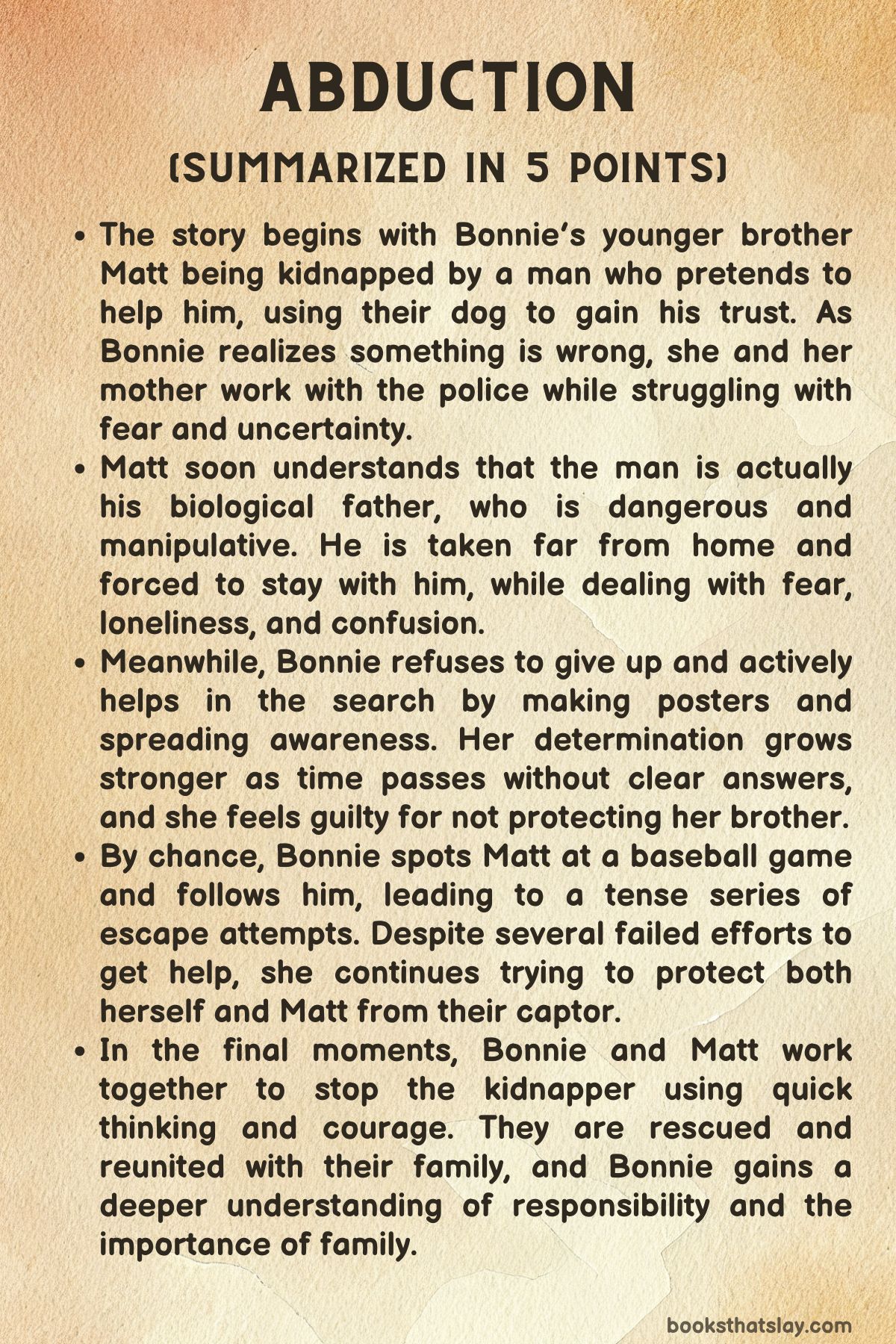
Characters
Bonnie Sholter
Bonnie Sholter is the central character whose determination and courage shape much of the story’s outcome. At thirteen, she carries responsibilities that many teenagers would find overwhelming.
She often helps care for her younger brother Matt while their mother works, which shows that she is already used to acting responsibly within her family. Bonnie is thoughtful and protective, but she also struggles with feelings of guilt after Matt disappears, especially because she had once complained about babysitting him.
These emotions deepen her determination to help find him.
Her intelligence and quick thinking become especially important as the situation develops. Instead of remaining passive, Bonnie actively participates in the search for Matt by distributing posters, contacting people online, and helping the police gather information.
She refuses to give up hope even when the search grows difficult and public attention fades. Bonnie’s persistence reflects her strong emotional connection with her brother and her refusal to accept the idea that he might be gone.
Bonnie also shows remarkable bravery when she eventually finds Matt with their kidnapper. Rather than panicking, she follows them and tries multiple ways to alert others about the danger.
Even when adults misunderstand her warnings, she continues trying to escape and protect her brother. Her ability to think clearly in a dangerous situation ultimately saves both of them.
By the end of Abduction, Bonnie grows into someone who understands the value of family and responsibility even more deeply than before.
Matt Sholter
Matt Sholter is Bonnie’s younger brother and the victim of the kidnapping. As a kindergarten-aged child, he represents innocence and vulnerability, which makes his situation especially tense.
Matt is trusting at first, believing the man who claims his dog is injured. This reaction is natural for a young child who wants to help his pet.
However, once he begins to notice inconsistencies, his instincts tell him something is wrong.
Throughout his captivity, Matt experiences fear, confusion, and loneliness. When Denny tells him that his mother and sister have died, Matt feels completely abandoned.
Despite this emotional manipulation, Matt slowly realizes that the man holding him does not truly care about him. His growing awareness shows that even young children can sense dishonesty and danger.
Matt’s resilience becomes clear as he adapts to the frightening circumstances. He learns to avoid angering Denny and tries to cooperate in order to stay safe.
When Bonnie finally finds him, Matt quickly works with her to escape. His willingness to follow Bonnie’s lead demonstrates his trust in his sister.
In the final moment on the ferry, Matt plays a crucial role by throwing the baseball that helps stop Denny, proving that even a child can show bravery under pressure.
Denny Thurman
Denny Thurman is the main antagonist and the biological father of Matt. His personality is marked by selfishness, manipulation, and a lack of empathy.
Years earlier, he abandoned Anita before Matt was born, showing that he had little interest in responsibility or family life. When he later decides to kidnap Matt, his motivations are not emotional but practical.
He believes having a child will help him gain money and sympathy from relatives.
Denny is manipulative and calculating. He carefully plans the kidnapping by studying Matt’s school, disguising himself as a delivery driver, and inventing a believable story about the family dog being injured.
His ability to deceive people demonstrates how easily trust can be exploited when someone appears authoritative or familiar.
Despite his planning, Denny’s unstable personality frequently disrupts his own schemes. His gambling addiction causes constant financial pressure, which contributes to his reckless decisions.
His moods shift dramatically depending on whether he wins or loses money. At times he acts friendly toward Matt, buying gifts or taking him to a baseball game, but these moments never reflect genuine affection.
Instead, they reveal how unpredictable and emotionally detached he is.
Denny’s lack of empathy is especially clear when he lies about the deaths of Matt’s family members in order to control him. This cruel deception highlights his willingness to harm others emotionally if it benefits him.
His violent behavior and willingness to threaten children show that he is driven purely by self-interest. In Abduction, Denny represents the danger of individuals who manipulate trust and authority for personal gain.
Anita Sholter
Anita Sholter is the mother of Bonnie and Matt and represents strength during a crisis. As a single parent, she balances work and family responsibilities while trying to provide stability for her children.
When Matt disappears, Anita immediately takes action by working with the police, speaking to reporters, and organizing search efforts. Her determination reflects the deep bond she shares with her children.
Anita’s past relationship with Denny adds complexity to the situation. She once believed that Denny would never want to be involved with a child, which initially makes it difficult for her to accept that he could be responsible for the kidnapping.
This disbelief reveals how people often struggle to reconcile past experiences with new evidence.
Despite her fear and uncertainty, Anita remains focused on finding Matt. She supports Bonnie emotionally while also encouraging the community to keep searching.
Her strength helps Bonnie continue hoping even when the investigation slows down. Anita’s character emphasizes the resilience of a parent who refuses to stop fighting for her child.
Nancy Tagg
Nancy Tagg is Bonnie’s closest friend and an important source of emotional support. Although she does not play a direct role in the kidnapping itself, her presence helps Bonnie cope with the stress of the situation.
Nancy listens when Bonnie talks about her fears and worries, showing that she is a compassionate and loyal friend.
Nancy also represents normal teenage life outside the crisis. She invites Bonnie to social activities like shopping or attending the baseball game, reminding readers of the ordinary experiences Bonnie temporarily loses during the search for Matt.
Nancy’s attempts to include Bonnie demonstrate her understanding that friendship can provide comfort during difficult times.
Through Nancy, the story highlights the importance of supportive relationships. She does not pressure Bonnie to act cheerful or ignore her fears.
Instead, she remains patient and available whenever Bonnie needs someone to talk to.
Officer Calvin
Officer Calvin is one of the first law enforcement officers involved in the investigation. He approaches the case carefully, gathering details about Matt’s appearance and circumstances in order to issue alerts and begin the search.
His calm and professional attitude helps guide Bonnie and Anita through the confusing early stages of the investigation.
Calvin also demonstrates the structured process that police follow in missing child cases. He collects evidence, interviews witnesses, and organizes search efforts.
His role shows how investigations rely on careful documentation and cooperation from the community.
Although he does not solve the case alone, his involvement highlights the importance of teamwork between families, police officers, and volunteers when searching for a missing person.
Detective Morrison
Detective Morrison becomes involved as the investigation develops further. Unlike the early uncertainty surrounding the kidnapping, Morrison focuses on examining possible suspects and motivations.
His analytical approach leads the police to investigate Denny Thurman’s past.
Morrison’s questioning reveals important information about Denny’s criminal history, gambling addiction, and psychological diagnosis. These discoveries help explain why Denny might be capable of kidnapping his own child.
Morrison’s careful reasoning shows how detectives use evidence and background information to build a clearer picture of a crime.
His role also reflects the persistence required in investigations. Even when leads appear weak or unlikely, Morrison continues exploring them because every possibility matters when a child is missing.
Fred and Ruth Faulkner
Fred and Ruth Faulkner are an elderly couple who accidentally become part of the story when they discover Pookie tied to a post in a park. Their actions initially seem small, but they play a meaningful role in returning the dog safely to Bonnie and Anita.
This reunion offers emotional comfort to the family during an otherwise frightening time.
The Faulkners represent kindness and responsibility within the community. Instead of ignoring the abandoned dog, they take care of it and try to find its owners.
Their reaction shows that small acts of compassion can make a difference during a crisis.
Later, their decision to adopt elderly dogs from a shelter reflects their caring nature. Their involvement emphasizes how communities can come together to help families during difficult situations.
Celia and Winston
Celia and Winston are Denny’s sister and brother-in-law. Although they do not directly participate in the kidnapping, they play a significant role in Denny’s motivations.
Denny envies their stable family life and often feels inferior when they boast about their children. His desire to impress them contributes to his decision to kidnap Matt.
Celia’s concern about Denny’s behavior suggests that she recognizes his problems. She encourages him to seek help and control his anger, which indicates that his troubling personality has been evident for a long time.
Winston represents the financial success that Denny lacks, which intensifies Denny’s resentment and insecurity.
Their existence highlights how jealousy and insecurity can push someone toward destructive choices. In Abduction, they indirectly reveal the emotional conflicts that contribute to Denny’s actions.
Themes
Courage and Quick Thinking in Dangerous Situations
Fear and uncertainty shape much of the tension in Abduction, yet courage and quick thinking repeatedly determine whether the characters survive dangerous moments. Bonnie’s actions illustrate how bravery is not simply the absence of fear but the ability to act despite it.
When she realizes that the boy at the baseball stadium is her missing brother, she faces a sudden and terrifying situation. Instead of freezing or assuming someone else will intervene, she decides to follow him and the kidnapper.
This choice places her in danger, but it also becomes the turning point that leads to Matt’s rescue.
Bonnie’s courage is shown not only in large dramatic moments but also in smaller decisions. She repeatedly attempts to alert adults to the danger, even when they misunderstand her warnings.
Writing a message on the restroom mirror, asking strangers for help, and attempting to escape through the window all demonstrate her determination to act. Each effort reflects her refusal to accept helplessness.
Even when the people around her dismiss her concerns, she continues searching for ways to protect herself and her brother.
The climax on the ferry further highlights how courage combines with quick thinking. Bonnie does not have physical power or authority to defeat Denny, but she relies on memory and creativity.
By shouting the familiar word from the game she and Matt played together, she signals him to throw the baseball as hard as he can. This simple plan works because Bonnie remains calm enough to use something ordinary as a strategy in an extraordinary situation.
Matt’s role in this moment also shows how courage can appear in unexpected forms. Despite being frightened and young, he responds immediately to Bonnie’s signal and throws the ball with all his strength.
His action demonstrates that bravery is not limited by age. Together, the siblings’ cooperation shows how courage often emerges through trust and teamwork.
The theme emphasizes that ordinary people can display remarkable strength when confronted with danger. The story presents bravery not as a heroic trait reserved for adults or trained professionals but as a quality that anyone can show when protecting the people they love.
The Strength of Family Bonds
Family relationships shape the emotional core of Abduction. The bond between Bonnie and Matt drives the story and explains many of the choices both characters make.
At the beginning, Bonnie sometimes feels frustrated by the responsibility of watching her younger brother after school. These everyday annoyances reflect a normal sibling relationship, yet the kidnapping forces her to recognize how deeply she cares about him.
Once Matt disappears, Bonnie’s attitude toward her brother changes dramatically. The small complaints she once had become sources of guilt and regret.
She constantly replays her last interactions with him, wishing she had been more patient. This emotional response reveals how crises often bring hidden feelings to the surface.
What once seemed like a routine responsibility becomes a powerful reminder of how important family members are.
Matt also demonstrates the strength of this bond during his captivity. After Denny tells him that his mother and sister have died, Matt experiences overwhelming grief.
His sadness is not only about losing his family but also about the realization that the man holding him does not truly care for him. Matt’s emotional reactions highlight the difference between genuine family love and relationships based on selfish motives.
The reunion between Bonnie and Matt at the baseball stadium reinforces this connection. Even though Matt is frightened and confused, he immediately calls out to Bonnie when he sees her.
His instinctive trust in his sister shows how strong their relationship remains despite the danger surrounding them. Bonnie’s determination to protect him also reflects a sense of responsibility that goes beyond ordinary sibling affection.
The story also portrays Anita’s role as a parent who refuses to give up on her child. Her cooperation with the police, her communication with the media, and her constant hope show the depth of parental devotion.
The combined efforts of mother and sister illustrate how family members support one another during times of crisis.
Through these relationships, the narrative suggests that family bonds provide emotional strength during the most difficult experiences. Love, loyalty, and shared history create a foundation that helps individuals endure fear and uncertainty.
Manipulation and the Abuse of Trust
Trust plays a central role in everyday life, especially for children who rely on adults for safety and guidance. The events in Abduction show how dangerous it can be when someone deliberately exploits that trust.
Denny’s entire plan depends on his ability to manipulate appearances and authority. By dressing as a delivery driver and entering the school confidently, he creates the impression that he belongs there.
This deception allows him to move through the building without raising suspicion.
Matt’s decision to follow Denny also reflects the natural trust children place in adults. When Denny claims that Pookie has been injured and that Matt’s mother asked him to help, the story sounds believable.
Matt hesitates at first, showing some awareness of stranger danger, but Denny’s knowledge of family details convinces him that the situation must be legitimate. The moment illustrates how easily a determined person can manipulate trust by combining authority with personal information.
Denny continues to control Matt through emotional manipulation as well. His lie about Bonnie and Anita dying in a car accident is particularly cruel because it isolates Matt psychologically.
By making Matt believe he has lost his family, Denny attempts to remove any hope of rescue or return. This tactic reveals how manipulation can extend beyond physical control into emotional and psychological influence.
The reactions of bystanders also highlight how trust and misunderstanding affect people’s responses to danger. When Bonnie tries to alert women in the restroom about the kidnapping, they assume she is participating in a game.
Their interpretation is shaped by the environment around them rather than the seriousness of her message. Similarly, other individuals who encounter Bonnie and Matt fail to recognize the situation because it does not match their expectations.
These moments show how manipulation and misunderstanding can allow dangerous situations to continue longer than they should. The story encourages readers to think critically about appearances and authority.
Trust remains important in society, but the narrative suggests that awareness and caution are necessary when something feels wrong.
Community Responsibility and Missed Opportunities
A strong sense of community appears throughout the story, yet it is often complicated by hesitation and misunderstanding. Many people genuinely want to help find Matt, and the community response shows how collective effort can support a family during a crisis.
Volunteers distribute posters, neighbors share information, and media coverage spreads awareness of the missing child. These actions demonstrate the positive impact of community involvement.
At the same time, the story also presents several moments where opportunities for intervention are missed. Bonnie repeatedly tries to communicate that she and Matt are in danger, but her warnings are dismissed or misunderstood.
The women in the restaurant restroom believe her message is part of a game. Drivers on the road hesitate to offer help.
Workers at the ferry terminal overlook signs that something may be wrong. In each situation, the possibility of assistance exists, yet it fails to materialize in time.
These missed opportunities do not necessarily come from cruelty or indifference. Instead, they often result from ordinary assumptions.
People tend to interpret events based on familiar patterns, and situations that appear unusual or confusing may be dismissed as harmless. This pattern highlights how easily serious problems can be overlooked when they do not match expectations.
After Bonnie and Matt are rescued, several individuals reflect on their earlier choices with regret. They realize that their hesitation prevented them from helping when it mattered most.
These reflections create an important moral message about awareness and responsibility. The narrative suggests that communities play a crucial role in protecting vulnerable individuals, especially children.
The contrast between active support and missed opportunities encourages readers to consider their own responses in uncertain situations. Paying attention to unusual signs, asking questions, and offering assistance when something seems wrong can make a significant difference.
Through these examples, Abduction emphasizes that community safety depends not only on authorities but also on the awareness and actions of ordinary people.