Fall of Ruin and Wrath Summary, Characters and Themes
Fall of Ruin and Wrath by Jennifer L. Armentrout is a fantasy novel that blends danger, power, and forbidden desire in a world ruled by immortal beings. At its heart is Calista, a young woman with the gift of foresight and intuition, who is both shielded and endangered by her abilities.
Her path collides with Thorne, a Hyhborn prince whose presence unsettles kingdoms as much as it unsettles her. Their connection draws them into political intrigue, looming war, and personal struggles between survival and temptation. What begins as a chance encounter deepens into a bond that may alter the fate of Caelum itself.
Summary
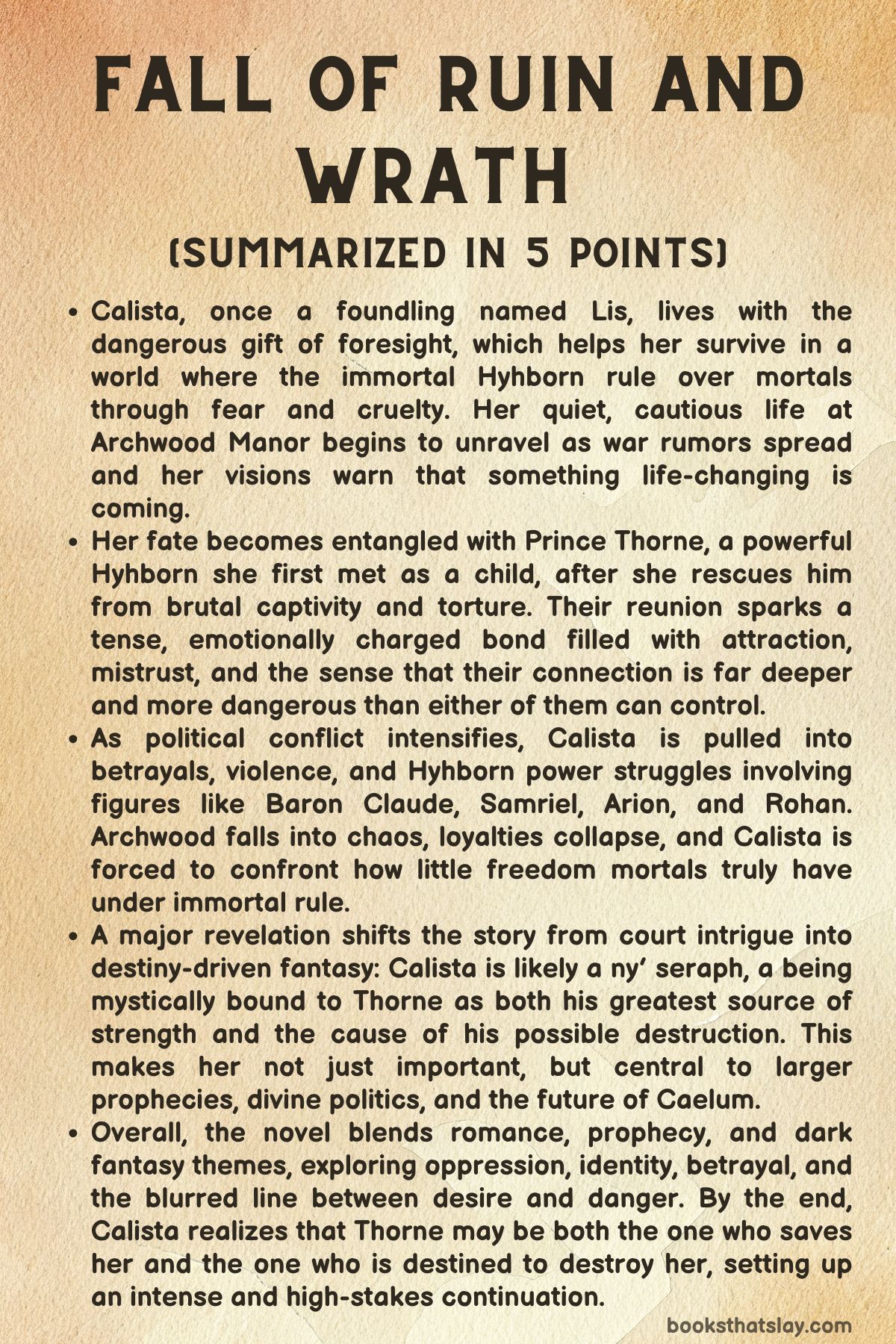
The story begins in a foundling home, where Lis, a young girl with uncanny intuition, senses something unnatural in the stillness of the night. Lanterns extinguish, fires die, and dread spreads as the Hyhborn—immortal children of gods who rule Caelum—arrive.
The children are terrified, for Hyhborn do not visit the poor districts like the Rook without reason. Lord Samriel leads the inspection, suspecting one of the children might be a seraph.
The cruel caretaker, known as the Mister, points out Lis as unusual. A young Hyhborn with striking, star-flecked eyes studies her closely.
He spares her friend Grady, punishes the Mister, and declares Lis “clear” before departing. Though the children tremble, Lis feels an odd certainty that she will see the Hyhborn again.
Years later, Lis lives under Baron Claude Huntington, a wealthy caelestia, part mortal and part Hyhborn. Now called Calista, she has spent six years as Claude’s favored companion.
Her ability to foresee glimpses of the future has kept her safe, though her powers risk suspicion of forbidden magic. Her closest friend Naomi seeks her help to foresee whether her sister will survive an illness.
Calista reveals recovery is likely but withholds a darker truth—that death waits before the Feasts.
As Archwood Manor prepares for the annual Feasts, rumors of war stir. Claude’s guests discuss violent events: chancellors mutilated, alliances forming, and rebel Iron Knights threatening Visalia.
Calista’s intuition delivers a chilling message—“He’s coming.” That night, she overhears guards boasting about capturing a Hyhborn, drugging him, and harvesting his blood. Though reluctant, her instincts push her to act.
She finds the tortured Hyhborn pinned with lunea spikes in a barn, bleeding into buckets. To her shock, it is the same Hyhborn from her childhood—the one who spared her and Grady.
Calista frees him, enduring his initial rage when he mistakes her for an enemy. Despite his feral attack, he restrains himself, apologizing after killing his torturer.
Still poisoned and weakened, he relies on her help. She takes him to a blacksmith’s house, cleanses his wounds, and learns of the dangers of Hyhborn blood in bone magic.
Their exchanges balance sharp tension and unexpected intimacy. He calls her na’laa, meaning brave, and vanishes after vengeance consumes the tavern and smithy where he had been held.
The next day, Calista struggles with her memories. Grady confronts her, alarmed by her reckless rescue.
She confides in Claude, warning him of treachery among his guards. That evening, during the manor’s decadent Feast, Calista feels unease as her intuition whispers again.
Her fears prove valid when Prince Thorne appears in her chambers, unsettling her with bold remarks and unexpected familiarity. He hints that their connection is deeper than she admits.
Soon after, he arrives at a formal dinner, flanked by other Hyhborn lords. The evening brims with tension as Claude drinks heavily while Thorne directs pointed attention toward Calista, even mocking Claude by using the term “na’laa.” Thorne warns of war: the Westlands and Iron Knights march on Archwood.
The city will fall unless they prepare. In private, the rivalry between Claude and Thorne sharpens, culminating in Thorne demanding Calista as his companion during his stay.
Though she protests, Claude agrees, rationalizing that Thorne’s protection is vital.
As tensions rise, betrayal erupts within Archwood. Calista, Grady, and others attempt escape when Hyhborn forces led by Samriel attack the manor.
Terrifying creatures, the ni’meres, pursue them. Calista kills one instinctively, shocking even herself.
They hide, but Allyson, one of their companions, is captured and killed despite her pleas. Samriel forces Calista to swear obedience to save Grady’s life, binding her to Hyhborn will.
Hymel, Claude’s cousin, reveals his betrayal, claiming allegiance to Prince Rohan. He exposes Calista as tied to Hyhborn politics, bound to Prince Thorne by destiny.
Samriel explains she is likely a ny’ seraph, born as a Hyhborn’s ny’chora—their connection to humanity. This bond makes her both Thorne’s strength and greatest danger, meaning he must kill her to survive.
She learns her childhood glamour hid her true identity, placed by the Priory to protect her.
Hymel seeks validation for his treachery but is executed by Lord Arion, Samriel’s brother, who confirms Calista’s unbound state. She and Grady are forced into a march through the Midlands.
In an inn, they witness the Hyhborn knights slaughter innocents with cold brutality. Arion strikes and compels her, showing how easily her mind can be controlled.
They continue their journey, passing through ravaged villages, until an ambush comes. An arrow pierces Arion’s skull, and a swarm of ravens reforms into Thorne.
Calista envisions him killing her, yet instinct compels her to run. Thorne captures her effortlessly, whispering that he will always catch her.
She realizes with chilling clarity that he is both her salvation and her doom.
Characters
Calista (Lis)
Calista is the heart of Fall of Ruin and Wrath, a character defined by intuition, resilience, and an almost reluctant courage. As a child in the foundling home, she already stood apart from others with her strange foresight, a gift both feared and misunderstood.
This sense of being different shaped her into someone deeply cautious, yet also fiercely observant. Over time, her abilities to glimpse future events matured, though she learned to conceal them in a world where bone magic is condemned.
At Archwood Manor, she occupies a precarious position—protected because of her usefulness but never truly free. Calista is haunted by her childhood encounter with the Hyhborn lord who spared her, and this tether of fate becomes central to her choices.
Though wary and skeptical of power, she cannot resist being drawn into the Hyhborn’s orbit, particularly Thorne’s, where desire and danger blur together. Calista’s strength lies not in physical power but in her persistence, adaptability, and quiet defiance.
Even when manipulated, betrayed, or forced into submission, she resists losing herself, making her both vulnerable and formidable in equal measure.
Grady
Grady is Calista’s steadfast companion from childhood, first introduced as her protector in the foundling home and later continuing in that role at Archwood Manor. His bond with her is built on loyalty and survival, forged in the cruel conditions of their youth.
Grady embodies strength, both physical and emotional, often taking on danger to shield her. Despite the immense threats surrounding them, he never abandons his protective instincts, even when facing Hyhborn lords far beyond his mortal abilities.
His relationship with Calista is one of deep trust and near-brotherly devotion, though it is tinged with his frustration at her choices—especially her entanglements with Thorne. Grady represents the grounding force in her life, a reminder of her humanity and the ties that existed before she became enmeshed in Hyhborn politics.
His steadfastness contrasts sharply with the volatile passion and peril that Thorne embodies, making him an anchor amid chaos.
Prince Thorne
Prince Thorne is both a savior and a threat, a Hyhborn lord whose presence radiates power, sensuality, and danger. From his first reappearance in Calista’s life, he unsettles her with a mixture of cruelty and tenderness.
Thorne is layered: he is feral and ruthless when wounded, yet capable of restraint, apology, and surprising vulnerability. His attraction to Calista is undeniable, though he frames it as more than mere Hyhborn allure, insisting that what binds them is something deeper.
Politically, he is pragmatic and calculating, aware of looming war and unafraid to make bold claims—including declaring Calista as his own before a stunned audience. Yet beneath his authority and cold edges lies a complexity born of loneliness and inevitability: he is bound by destiny to Calista as her Deminyen, a tie that makes her both his strength and his undoing.
This paradox—desire intertwined with destruction—renders Thorne one of the most compelling figures in the novel, torn between instinct, duty, and a bond he cannot sever.
Baron Claude Huntington
Claude is a figure of excess, indulgence, and crumbling authority. As the baron of Archwood, he shelters Calista, but his protection is rooted in possession rather than altruism.
He revels in decadence and drunkenness, seeking pleasure and distraction while the world around him edges toward war. His relationship with Calista is transactional; she is his “favorite,” valued for her abilities and companionship, yet he allows others to taunt or demean her.
Claude’s weakness becomes increasingly evident as he struggles to maintain composure before the Hyhborn, his drinking exposing his instability. Even his political connections, such as his distant tie to Vayne Beylen, serve as hollow shields against the threats that mount.
Claude is a man torn between the role of a leader and the temptations of indulgence, ultimately symbolizing the corruption and fragility of mortal nobility in contrast to Hyhborn dominance.
Naomi
Naomi is Calista’s closest friend and confidante at Archwood Manor, providing companionship and humor in a life otherwise filled with uncertainty. Her presence is a reminder of human intimacy and loyalty, as she cares deeply for her family—particularly her sister Laurelin—and seeks Calista’s help to foresee her fate.
Naomi balances lighthearted banter with protective instincts, often attempting to shield Calista from the manor’s darker elements and the baron’s instability. She embodies warmth and humanity, grounding Calista in friendship and emotional connection when her world becomes increasingly consumed by Hyhborn forces.
Through Naomi, the story highlights the bonds of chosen family and the solace of trust in a setting where betrayal is constant.
Lord Samriel
Lord Samriel is first introduced in the foundling home as a terrifying presence, a Hyhborn lord who brings dread and awe in equal measure. His inspection of the children—and his focus on Calista—marks the beginning of her entanglement with the Hyhborn.
Samriel is calm and commanding, wielding his authority with quiet menace. Later, he reveals a manipulative and political side, interrogating Calista about her abilities and explaining the truths of her nature.
Though outwardly less volatile than Thorne, his actions and alliances mark him as dangerous, working alongside his brother Arion and Prince Rohan to use Calista as a pawn. Samriel embodies the Hyhborn’s blend of beauty, cruelty, and inevitability, serving as both a guide and a threat in Calista’s path toward discovering her true identity.
Lord Arion
Lord Arion, Samriel’s brother, is colder and crueler, embodying the ruthlessness of Hyhborn power. He exerts control through violence and compulsion, striking Calista and bending her will with magic to demonstrate dominance.
Arion treats mortals with disdain, their lives disposable for the smallest inconveniences. His murder of Hymel after the latter’s betrayal illustrates his pragmatic brutality—alliances mean nothing compared to Hyhborn authority.
To Calista, he is a tormentor and an obstacle, someone who strips her of autonomy while affirming her identity as a ny’ seraph. Arion’s character underscores the inhuman cruelty of the Hyhborn, contrasting with Thorne’s conflicted humanity and adding urgency to Calista’s peril.
Prince Rohan
Prince Rohan emerges as an embodiment of merciless Hyhborn cruelty. Unlike Thorne, who grapples with restraint, Rohan indulges in sadism, using Allyson as bait and tormenting her until Calista submits.
His actions reveal a calculated malice, making him an unyielding antagonist. Rohan represents the darkest aspects of Hyhborn dominance—their exploitation of mortal fragility and their lack of remorse for suffering.
His insistence that Calista belongs to the Prince of Vytrus deepens the web of political intrigue, situating her as a key figure in struggles beyond her control. Rohan’s character amplifies the stakes, emphasizing the danger of Hyhborn who do not mask their cruelty with charm or restraint.
Hymel
Hymel is a figure of duplicity and bitterness, a man consumed by resentment toward Claude and desperate for power. As Captain of the Guard, he initially appears as a sneering antagonist to Calista, but his betrayal reveals the depth of his ambitions and insecurities.
Aligning himself with the Hyhborn, he seeks influence and survival, but his miscalculation is fatal—Arion kills him without hesitation, underscoring his expendability. Hymel’s character reflects the weakness of mortals who, rather than resisting Hyhborn dominance, seek to profit through treachery.
His downfall serves as a cautionary contrast to Calista’s defiance, showing that submission to power without strength or honor leads only to ruin.
Allyson
Allyson represents innocence caught in the web of Hyhborn cruelty. Though her role is smaller, her fate is deeply significant, particularly to Calista.
Allyson’s trust and vulnerability highlight the mercilessness of figures like Rohan, who use her suffering to manipulate Calista. Her death becomes a devastating moment that forces Calista to confront the true cost of the Hyhborn’s games.
Allyson’s character underscores the stakes of Calista’s struggle: she is not merely protecting herself but bearing the weight of lives destroyed in the Hyhborn’s pursuit of power.
Themes
Power and Oppression
The world of Fall of Ruin and Wrath is defined by hierarchies where power is exercised through fear, control, and violence. The Hyhborn, as immortal beings descended from the gods, dominate mortal society with their strength, wealth, and indifference to human suffering.
Their power is not benevolent but rather absolute, enforced through threats, glamours, and ruthless punishment. This imbalance of authority becomes evident from Lis’s childhood, where the Mister cowers before the Hyhborn while simultaneously abusing the children in his care.
The cycle of oppression flows downward: those with a little power, such as Claude or Hymel, exploit the vulnerable to secure their position under the Hyhborn. The presence of Rae and ni’meres—wraithlike or monstrous entities serving the Hyhborn—further represents the reach of their dominance, reducing mortals to expendable bodies in their endless conflicts.
Yet within this system, Lis’s intuition and visions threaten to disrupt the natural order, granting her a form of agency that rivals the gods’ children themselves. The theme underscores how oppressive power systems perpetuate themselves not just through brute force but also through manipulation, alliances, and fear of reprisal.
The tension lies in whether individuals like Lis, Grady, and even certain Hyhborn like Thorne can resist or redefine these structures without being consumed by them.
Fate and Prophecy
The motif of foresight runs throughout the novel, shaping both the heroine’s choices and the larger political conflicts. Lis’s ability to glimpse the future blurs the line between destiny and free will, raising the question of whether her visions are inevitable truths or warnings meant to guide action.
Her intuition acts less as a gift than as a burden, often forcing her into moral dilemmas: whether to tell Naomi the whole truth about her sister’s impending death, or whether to intervene in the capture of the Hyhborn despite her desire to remain uninvolved. The Hyhborn themselves are bound by prophecies and ancient bonds, with Calista’s existence as a ny’ seraph predestining her role as both Thorne’s strength and destruction.
This inevitability is reinforced by recurring visions—her certainty of future encounters, the warnings whispered by her instincts, and the flashes of inevitable death surrounding those she loves. Yet the tension of the narrative emerges from resistance: she constantly tries to alter or avoid these outcomes, only to be drawn closer to them.
Fate becomes both a prison and a guide, reflecting the novel’s central struggle between acceptance of destiny and the desperate yearning to shape one’s own path.
Love, Desire, and Dangerous Intimacy
Romantic and physical desire in Fall of Ruin and Wrath is rarely straightforward; it is charged with peril, manipulation, and unequal dynamics. The relationship between Lis and Thorne illustrates this complexity: it oscillates between passion and threat, attraction and coercion.
Thorne’s Hyhborn nature amplifies the intensity of their encounters, making it unclear how much of Lis’s desire is her own and how much stems from his supernatural influence. At the same time, her intuition, which normally shields her from unwanted advances, is curiously absent in his presence, leaving her both vulnerable and strangely liberated.
The erotic tension at Claude’s dinner table exemplifies how intimacy can become a contest of dominance, with Calista caught between mortal and immortal men who see her body as both prize and battlefield. Yet intimacy also reveals unexpected truths: the shower scene, where Lis’s touch soothes Thorne, exposes not just sensual connection but also mutual recognition of wounds and vulnerability.
Love and desire are thus never isolated from power—they are dangerous, transformative forces that blur the line between salvation and destruction.
Betrayal and Loyalty
The characters’ fates are shaped as much by betrayals as by alliances. From the Mister’s cruelty in Lis’s childhood to Hymel’s treachery against Claude, betrayal corrodes trust at every level of society.
Even those closest to Calista, like Claude himself, use her for their own survival, trading her safety in exchange for appeasing stronger forces. Loyalty, by contrast, is rare and precious, embodied in Grady’s unwavering protection and Naomi’s friendship.
The Hyhborn world amplifies these betrayals by making loyalty transactional; oaths are bound by compulsion, and obedience is enforced through fear of death or destruction. What makes betrayal particularly devastating in this story is that it is often masked as protection.
Hymel insists his betrayal was necessary to prevent greater losses, but his motives are rooted in self-interest. Likewise, Claude frames his surrender of Calista to Thorne as the best way to keep her safe, though it strips her of choice.
This theme highlights how fragile trust becomes in a world where survival often requires sacrifice, and it raises the question of whether true loyalty can exist in a society built on exploitation and manipulation.
Identity and Transformation
Lis’s journey is marked by the search for self, shaped by revelations about her origins, her abilities, and her bond with the Hyhborn. Initially, she defines herself by her survival, her intuition, and her position under Claude’s patronage.
But as the story unfolds, her identity shifts dramatically: she is no longer just a mortal woman with foresight but a ny’ seraph, a being bound by divine law to serve as Thorne’s weakness and strength. This discovery transforms not only how others perceive her but also how she perceives herself.
Her visions, once confusing and burdensome, become part of a larger divine scheme. Her sense of self is further complicated by intimacy with Thorne, who sees in her both vulnerability and power.
Identity in this narrative is not stable but constantly challenged—by glamour, by prophecy, by betrayal, and by desire. Even physical transformation plays a role: Thorne regenerating his body after torture, Lis’s eyes seeming to change color, and the Hyhborn shifting between majestic and monstrous forms.
Transformation thus becomes a metaphor for the instability of identity in a world where bloodlines, divine heritage, and hidden truths can redefine who someone truly is.