A Tempest of Tea Summary, Characters and Themes
A Tempest of Tea by Hafsah Faizal is a fantasy novel set in the city of White Roaring, where tea, blood, power, and colonial violence shape everyday life. At its center is Arthie Casimir, a sharp, guarded young woman who runs an elegant teahouse that hides a dangerous secret.
Beneath its polished surface, the story builds into a high-stakes tale of crime, loyalty, revenge, and survival. The novel brings together a memorable cast, simmering tension, and a world marked by political cruelty and social division. It is both a heist story and a deeply personal account of found family, grief, identity, and the cost of choosing who to protect.
Summary
In White Roaring, Arthie Casimir has built a life out of nerve, planning, and refusal to submit. She runs Spindrift, a teahouse that serves as more than it seems.
By day it appears respectable, but by night it becomes a hidden refuge where vampires can buy blood safely, away from the violence and exploitation of the city. Arthie and her adopted brother, Jin, have made Spindrift into a place for outsiders, strays, and people with nowhere else to go.
Their work is risky, especially as the city grows more hostile to vampires under the rule of the Ram, a masked figure whose politics have made an already fragile peace feel close to collapse.
When Arthie and Jin track down Matteo Andoni, a wealthy painter who owes them money, the visit turns ugly. Matteo reveals that he knows Spindrift’s secret and shows that he has stolen proof that could destroy Arthie.
He is also a vampire, a fact Jin did not know. Before the confrontation can settle, Arthie learns that the Horned Guard are on their way to raid Spindrift.
She and Jin rush back and, with the help of their staff, transform the bloodhouse into an innocent teahouse moments before the Guard arrives. The raid fails, but the visit reveals a worse problem: Spindrift is no longer secure.
Soon after, Arthie and Jin learn that the building has been sold to the Ram. They have only two weeks before they lose everything.
For Arthie, Spindrift is not just a business. It is revenge against the empire that destroyed her homeland of Ceylan, murdered her parents, and profited from tea while crushing the lives behind it.
It is also the one place she has made for herself in a city that treats immigrants and the colonized as disposable. Saving it becomes urgent.
At this desperate moment, Arthie is approached by Laith Sayaad, a captain in the Horned Guard. He offers her a bargain.
If she helps steal a secret ledger from the Athereum, the powerful center of vampire society, they may gain leverage over the Ram and perhaps save Spindrift. The ledger contains records of illegal trade and corruption.
Arthie agrees, though she does not trust Laith. She decides to keep him close, building a crew for the job so she can control the danger as much as possible.
The team comes together from people who are all carrying their own wounds and secrets. Jin stays by Arthie’s side, though he fears the plan is too big and too dangerous.
Flick, a talented forger and the neglected adopted daughter of the influential Lady Linden, is drawn in next. She has her own reasons for joining and quietly considers using what she learns to regain her mother’s approval.
Matteo is brought in because of his knowledge of the Athereum, though his relationship with Arthie is tense, flirtatious, and full of hidden history. Laith becomes both a partner and a threat.
As they prepare, the group also reveals more of themselves: Jin’s parents were researchers who studied vampires and coconut water as a possible substitute for blood, and they died, or seemed to die, in a fire that left Jin scarred and alone before Arthie found him.
The heist plan is elaborate. They must infiltrate the Athereum during a major auction, forge entry markers, manipulate records, distract guards, and reach the office where the ledger is held.
To do that, they need handwriting samples, access codes, and real markers stolen from corrupt officials. Several dangerous missions follow.
Jin and Flick break into the home of two women who control entry records and barely escape after being discovered, with Jin taking a bullet while protecting Flick. Arthie blackmails an official for his marker, survives an attack, and learns again that her strange weapon, Calibore, is no ordinary gun.
It can change form at will and carries its own legend, making Arthie even more of a target in a country that resents her existence.
As the preparations continue, the emotional bonds inside the group deepen and fray at the same time. Jin and Flick grow close, each seeing in the other a version of the self they might have been in a kinder world.
Matteo watches Arthie with a mix of frustration, concern, and affection that becomes harder to hide. Laith and Arthie circle each other with suspicion, attraction, and the knowledge that both are capable of betrayal.
Every member of the crew is performing a role, but the closer they get to the job, the harder it becomes to separate performance from truth.
On the night of the heist, the plan begins to work. Jin enters the Athereum with the help of a vampire named Rose who owes him a favor.
Flick carries out the forged marker scheme and slips into the archives. Matteo creates diversions.
Laith handles the physical risks. Arthie allows herself to be captured because it is the only route into the deeper parts of the building.
Once inside, the team reaches the private office and hidden vault where the ledger is kept. But the success comes with a cost.
Arthie betrays Laith, leaving him behind so she can secure the real ledger for herself.
The truth they uncover is far worse than expected. Penn Arundel, the leader of the Athereum, appears and reveals that he is Arthie’s foster father, a man from her past she had abandoned.
He explains that the ledger exposes a horrific system in which vampires are trafficked, starved, and used as weapons in war. The fear surrounding vampires in White Roaring was not natural but engineered.
The notorious Wolf of White Roaring, blamed for terrorizing the city years earlier, was part of a staged plan that allowed the Ram’s anti-vampire politics to rise. Flick is shattered to learn that the East Ettenia Company, tied to her mother, is involved in this trade.
Jin learns that his parents may not be dead after all, but instead may have been taken because of their knowledge.
Penn wants to use the evidence legally, but Arthie knows that power rarely yields to truth on its own. Still, the team leaves with more purpose than before.
Then everything collapses. The Ram confronts Arthie directly and offers to return Spindrift in exchange for the ledger.
Arthie refuses. Soon after, armed attackers descend on Spindrift and set it ablaze.
Jin, who has long feared fire because of his childhood trauma, fights through the flames to save Arthie. The building is destroyed, and with it the place that held their found family together.
In the aftermath, Arthie’s deepest secret comes to light. She is not fully human.
As a child, after being gravely ill or dying, she was given blood that transformed her into a half-vampire. Fleeing the slaughter in her homeland, she fed on those around her during the voyage to Ettenia.
Penn once tried to shelter her, but her hunger led to more death, and she ran from him in horror. She built Spindrift in part as a way to control herself and give others a safer path than the one she had known.
When she loses that anchor, her restraint begins to crack.
Matteo, instead of condemning her, understands what she is carrying. He tells her that accepting herself is not the same as surrendering to her worst instincts.
That clarity helps Arthie shape a final plan: expose the Ram publicly in front of the press and force the truth into the open. The team gathers at the Athereum for the confrontation, dressed for respectability and war alike.
Flick tries one last time to reach her mother, thinking there may still be conscience left in her.
At the meeting, the final betrayal is revealed. The Ram is Lady Linden.
Before the truth can be cleanly exposed, violence erupts. Armed men storm the hall and begin killing guests.
In the chaos, Laith returns, still tangled in his own obsession with revenge and with Calibore. Penn is shot while protecting Arthie and dies in her arms after reminding her that family is made by sacrifice, not blood alone.
Jin is shot as well. To save him, Matteo and Arthie act, and Jin awakens transformed into a vampire, finally understanding what Arthie has been all along.
Broken by loss and fury, Arthie goes after Laith. In their final confrontation, each blames the other and each carries the weight of ruined trust.
They shoot at the same time and both fall. As Arthie bleeds out, the mysterious Wolf appears, carries her away, and promises retribution, leaving the story on the edge of further reckoning.
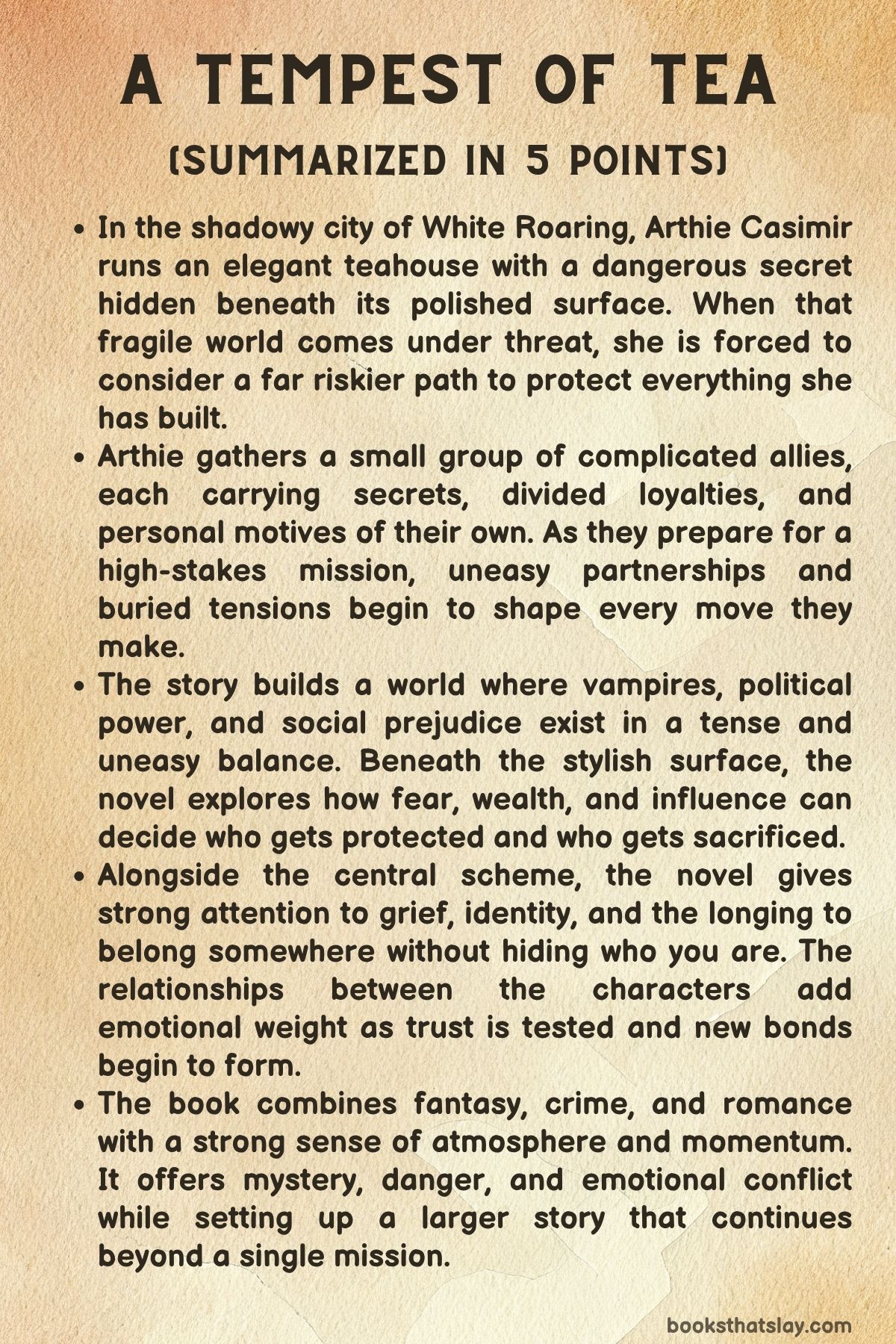
Characters
Arthie Casimir
Arthie is the force around which the entire story moves. She is clever, controlled, proud, and always thinking several steps ahead, but those strengths are tied to pain she has never truly escaped.
She has built herself into someone who can survive anything: a business owner, strategist, protector, smuggler, and liar when necessary. At first, her confidence seems almost unshakable.
She faces vampires, corrupt officials, and armed guards with the same sharp composure. Yet this poise is not natural ease.
It is discipline formed under pressure. She has survived colonial brutality, the murder of her parents, displacement, hunger, and the terror of becoming something she fears.
Because of that history, Arthie treats vulnerability as a danger. She controls information, withholds her past, and keeps even the people she loves at a careful distance.
Her role as the owner of Spindrift reveals the moral core beneath her hard exterior. She is not simply running a criminal enterprise.
She has created a refuge in a city that denies dignity to those without power, especially vampires, immigrants, and the poor. The teahouse represents her talent for turning survival into resistance.
She takes what the ruling order has built and reshapes it into something that protects the people it would rather exploit or erase. That makes her far more than a rebel figure.
She is someone trying to construct justice in a world that offers none. Even her anger is purposeful.
She does not rage aimlessly; she uses fury as fuel, as focus, as a way to move forward when grief would otherwise consume her.
Arthie’s deepest conflict lies in her divided sense of self. She wants to believe that control can save her from what she is, yet the story repeatedly tests that belief.
Her half-vampire identity is not just a hidden fact; it is the center of her shame, fear, and self-punishment. She has spent years trying to define herself by restraint, by refusal, by the life she built instead of the blood she craves.
This is why the loss of Spindrift devastates her so completely. It is not merely the destruction of a home or business.
It is the destruction of the structure that allowed her to believe she could remain separate from her own hunger and history. Once that structure falls, she is forced to confront the truth that self-denial has never healed her.
Her relationships reveal different sides of her character. With Jin, she is fiercely protective, almost to a fault, because he represents the family she chose and the innocence she wants to preserve.
With Matteo, she meets someone who understands her without demanding that she simplify herself. With Laith, she is drawn toward someone who reflects her own damage, which is why their connection feels both intense and doomed.
With Penn, she is confronted by the part of her life she abandoned but never resolved. Across all these relationships, Arthie remains difficult, secretive, and often frustrating, but she is never emotionally empty.
She loves deeply. She is simply terrified of what love can cost.
By the end, Arthie stands as a character shaped by contradiction in the best way. She is ruthless and compassionate, manipulative and loyal, self-protective and self-sacrificing.
She wants revenge, but she also wants community. She wants control, but she also wants to be known.
Her complexity makes her compelling because the novel does not reduce her to a single role. She is neither only hero nor only monster.
She is a survivor trying to decide whether survival alone is enough, and whether a person can build a future without first making peace with the parts of themselves they fear most.
Jin Casimir
Jin is often the emotional counterweight to Arthie’s severity. Where she is sharp-edged and guarded, he appears warmer, more expressive, and more immediately accessible.
But that first impression can hide how much depth and hurt he carries. Jin has his own discipline, his own intelligence, and his own capacity for danger.
He is not merely the softer sibling figure beside a more dramatic protagonist. He is essential to the moral and emotional center of the story.
His loyalty to Arthie is absolute, but it is not blind. He questions her choices, resists plans he thinks are reckless, and notices the truths she tries to conceal.
That gives him a vital role: he is not only her partner but also one of the few people capable of challenging her from a place of love.
His past explains much of his inner life. Raised in privilege by brilliant parents, Jin was expected to excel, and his early life had structure, education, and social standing.
The destruction of that world leaves a wound that never fully closes. The fire that took his parents, scarred his body, and threw him into the streets becomes the event that divides his life into before and after.
It also creates one of his defining traits: his fear of fire. Importantly, this fear is not presented as weakness.
It is a trauma response, one that follows him into adulthood and shapes how he reacts to danger. That makes his later decision to run back into the burning building for Arthie one of the clearest signs of his growth.
He does not stop being afraid. He acts in spite of fear, which gives the moment emotional weight.
Jin’s intelligence is quieter than Arthie’s but no less significant. He understands systems, notices patterns, and contributes crucially to every stage of the heist.
He is observant, practical, and capable of improvisation under pressure. His work with the forged markers, his role in gaining access to the Athereum, and his handling of difficult situations all show that he is far more than support.
At the same time, he carries a deep emotional hunger for connection and truth. He keeps tokens from his past, including the burnt handkerchief, because some part of him cannot fully accept that his parents are gone.
This hope makes him vulnerable, but it also keeps alive a tenderness that the world has not managed to crush.
His relationship with Flick brings out a particularly important side of him. Around her, Jin becomes shy, defensive, admiring, and protective all at once.
He sees her uncertainty and wants to shield her from the kinds of compromises that have shaped him and Arthie. Yet his affection is not sentimental.
It is tied to recognition. He sees in Flick a person caught between who she is and who the world expects her to be.
That is likely why he is drawn to her so strongly. Their bond allows Jin to imagine a life not defined only by crisis, duty, or grief.
Jin’s final transformation is one of the most tragic and powerful developments in the story because it changes not only his body but also his relationship to everything he thought he knew. The revelation that Arthie has been a vampire all along reframes his memories, his trust, and even his parents’ research.
His becoming a vampire places him directly inside the reality he once stood beside. That ending suggests that his story is moving into a new phase, one where innocence is fully gone and identity must be rebuilt from the ground up.
Until that point, he represents loyalty, endurance, and emotional honesty. He is the person who most clearly shows that love can be fierce without becoming possessive and that gentleness and strength are not opposites.
Matteo Andoni
Matteo enters the story with style, provocation, and a taste for performance. He initially appears as someone arrogant, theatrical, and difficult to trust.
He likes verbal games, enjoys unsettling other people, and moves through social spaces with practiced ease. Because of that, it would be easy to read him only as a charming complication or a source of romantic tension.
But his function is much richer than that. Matteo is one of the characters who most clearly exposes how appearances distort judgment in this world.
He is accepted more easily than Arthie because of the way he looks, yet he remains vulnerable because he is still a vampire and still outside the city’s accepted order in a deeper sense. His elegance becomes a kind of armor, a way to control how others interpret him.
One of the most interesting parts of Matteo’s characterization is the contrast between the persona he performs and the loneliness beneath it. He has wit, beauty, and social skill, but he is not emotionally detached.
His connection to Penn and his eventual understanding of Arthie reveal a person capable of real feeling, care, and grief. He is drawn to Arthie not simply because she is beautiful or formidable, but because they share a painful knowledge of what it means to live under hunger, secrecy, and self-control.
He recognizes her before she is ready to be recognized. That gives his role emotional significance.
He is one of the few people who sees past the surface Arthie offers the world and understands the cost of what she is doing to herself.
Matteo also serves an important thematic purpose in relation to vampirism. Unlike Arthie, he is not defined by self-denial in the same way.
He knows what he is, understands his desires, and does not pretend they can be erased. That gives him a perspective that is both dangerous and clarifying.
At times he can seem reckless or predatory, especially in moments when his hunger presses close to the surface. Yet the story does not frame him as morally simple.
He is capable of menace, but he is also capable of insight and restraint. His warning to Arthie after she feeds is one of the clearest expressions of the difference between acceptance and surrender.
He understands that shame can become its own kind of prison, and he refuses to let her confuse self-knowledge with corruption.
His friction with Laith is also telling. The tension between them is personal, but it also reflects two different forms of obsession.
Matteo is driven by longing and by unresolved ties to Penn and Arthie, while Laith is driven by vengeance and possession. Matteo’s reactions, though often sarcastic or biting, are rooted in perception.
He sees danger where others are still making excuses for it. This makes him seem jealous at times, but it also makes him one of the more accurate readers of character in the group.
By the later sections, Matteo becomes emotionally crucial because he offers Arthie something rare: understanding without idealization. He does not ask her to become harmless in order to deserve care.
He does not deny her darkness, but he also does not define her by it. That balance makes him far more than a flirtatious side figure.
He stands for the possibility that intimacy can be based on recognition rather than rescue. In A Tempest of Tea, he emerges as one of the most layered characters, someone whose poise hides pain, whose vanity hides vulnerability, and whose sharpness masks a capacity for loyalty that becomes increasingly clear.
Flick
Flick begins as a character caught between performance and desire. She is clever, talented, and deeply lonely, yet much of her energy is spent trying to earn approval from a mother who withholds love as a form of control.
Her skill as a forger already tells us something important about her. She is someone who understands imitation, surface, and the systems by which legitimacy is granted.
That is not accidental. She has grown up inside a world where social identity is constantly staged, where respectability matters, and where affection feels conditional.
Forgery becomes more than a criminal ability. It reflects her experience of living in spaces where she has had to shape herself to fit what others want.
Her emotional conflict is one of the most painful in the novel because it is so recognizable. Flick knows that Lady Linden neglects her, dismisses her, and values reputation over relationship.
Yet Flick still longs for her love. That longing drives many of her early choices, including her willingness to betray the people who rescue and trust her.
The story treats this with nuance. Flick is not mocked for wanting maternal approval, nor is she excused from the moral danger of pursuing it.
Instead, the novel shows how deeply control can shape desire. She has been trained to believe that being wanted must be earned through usefulness, obedience, and presentation.
This is why her growing attachment to the crew matters so much. For perhaps the first time, she is being valued not as an ornament or extension of someone powerful, but as herself.
Her relationship with Jin plays a major part in this development. Around him, Flick is still uncertain, but she is also more honest.
He sees her talent, her fear, and her emotional fragility without reducing her to any of them. Their closeness helps Flick begin to imagine a self that does not depend on her mother’s judgment.
Even so, her internal struggle continues for much of the book. She keeps trying to reconcile the impossible: to remain loyal to the new people who care for her while still hoping the old relationship can be repaired.
That tension makes her one of the most psychologically believable characters in the story.
Flick’s confrontation with the truth about her mother is devastating because it destroys the illusion she has been protecting. Learning that Lady Linden is connected to atrocities against vampires forces Flick to see that emotional neglect was only one aspect of a much deeper moral failure.
What hurts her is not just the crime itself, but the realization that the person she wanted to impress is implicated in a system of exploitation and death. From that point onward, Flick’s development becomes less about seeking approval and more about reclaiming moral agency.
She starts choosing based on what she believes rather than on what might win affection.
Her growth is especially visible in the final movement of the story. She becomes more self-possessed, more direct, and more willing to act from conviction.
She still hurts, still doubts, and still hopes, but she is no longer guided primarily by need. Her final choices show that she has begun to separate her identity from the power structures that raised her.
She becomes not simply a skilled accomplice in the heist but a person remaking herself under pressure. That is why she matters so much.
She represents what it means to discover that love offered as control is not love at all, and to begin building a self beyond it.
Laith Sayaad
Laith is one of the most unstable presences in the narrative, not because he lacks discipline, but because his discipline is in service of motives that are never fully shared. He arrives with an offer, a plan, and enough useful information to make himself indispensable, but from the beginning there is a sense that he is also a threat waiting for the right moment.
He is highly trained, physically capable, and cool under pressure, which makes him well suited to the heist plot. Yet his deeper function is emotional and symbolic.
He represents the dangerous attraction of recognition between damaged people. Arthie sees in him someone who understands vengeance, exile, and loneliness.
He sees in her someone who mirrors his own fractures. That shared damage gives their connection intensity, but it also makes trust nearly impossible.
Laith’s history explains the force of his obsession. He comes from another land, carries the grief of his sister’s death, and has spent years trying to direct that grief toward a target.
At first, his stated motive is political and personal: he wants Calibore so he can kill his king, whom he blames for the mission that cost his sister her life. This backstory gives him pathos, but the novel gradually reveals that his sense of purpose is built on distortion.
He has made revenge into structure, identity, and justification. Without it, he seems unsure of who he is.
That makes him compelling because he is not only dangerous to others; he is also trapped inside his own need for a story that will explain his suffering.
His relationship with Arthie is built on mutual fascination, desire, and deception. They are drawn to one another because each senses the violence the other carries.
Their scenes together are charged not simply because of attraction, but because both are measuring risk at the same time they are feeling closeness. Arthie wants him near enough to monitor, far enough to survive.
Laith wants access, intimacy, and ultimately possession. This is why their bond cannot hold.
It is rooted in real feeling, but it is corrupted by competing agendas and by his inability to separate desire from acquisition.
Laith’s moral complexity lies in the fact that he is not purely false. His grief is real.
His attraction is real. His tenderness, in certain moments, is real.
But these truths do not cancel the manipulation. He repeatedly crosses the boundary between connection and use.
Even when he seems most open, there is something withheld, some private intention still shaping his choices. That makes him tragic in a specific way.
He might have become a different kind of person if he had allowed himself to mourn rather than convert every wound into a weapon. Instead, he remains trapped in the logic of retaliation.
His final role confirms this tragedy. Rather than moving toward peace, he returns to the object and the conflict that have defined him.
His confrontation with Arthie becomes the collapse of a relationship that was never able to exist outside betrayal. He is not merely a villainous twist in the plot.
He is an example of what happens when pain is worshipped rather than healed. He is charismatic, intelligent, and at moments sincere, but he cannot choose love over vengeance or personhood over obsession.
That failure gives his character much of its power.
Penn Arundel
Penn is a figure of authority, history, and buried intimacy. For much of the story, he exists more as an absence than as a presence, since his connection to Arthie is hidden until a crucial turning point.
When he finally steps fully into the narrative, he alters its emotional and political scale at once. He is not only the leader of the Athereum but also a man tied to Arthie’s past, to the city’s myths, and to the machinery of fear that has shaped public life.
This combination makes him one of the most important structural characters in the novel. Through him, private history and public corruption come into direct contact.
Penn’s backstory is central to understanding the book’s politics. He is a person transformed by accident, violence, and exile, someone whose life was shaped by forces larger than himself long before he gained power.
His account of becoming a vampire and of the so-called Wolf shows how governments and dominant institutions create monsters when it serves them. He is living evidence that the official stories told about fear, danger, and social order are lies built for control.
Yet Penn is not presented as a distant symbol. His relationship with Arthie brings warmth, regret, and tenderness into his characterization.
He once sheltered her and called her daughter, and though she ran from him, he has not ceased to care.
That care matters because Penn offers a model of family different from both biological inheritance and social utility. He does not love Arthie because she is useful, obedient, or easy to understand.
He loves her with knowledge of what she has done and what she fears herself to be. This makes his presence especially significant in a story full of chosen bonds and broken households.
He stands as a possibility of acceptance that does not depend on denial. At the same time, he is not idealized.
He is flawed, burdened, and operating within systems of power that he has not fully defeated. He believes in legal process and formal evidence more than Arthie does, and that difference reveals a generational tension between reform and direct action.
Penn also plays a major role in Jin’s arc by reopening the mystery of Jin’s parents and showing that the past Arthie and Jin thought fixed is still alive in unexpected ways. He becomes a bridge between separate lives and hidden truths.
His knowledge changes what the others understand about themselves and the world around them.
His death carries enormous emotional force because it confirms the values he represents. He dies protecting Arthie, and his final words define family through sacrifice rather than bloodline or proximity.
That statement resonates because he has lived it. He may be a powerful vampire and a leader, but he is at his most meaningful when he acts as a father, protector, and witness to the pain of those he loves.
His loss deepens the story’s tragedy while also leaving behind a moral inheritance. He reminds the surviving characters, and the reader, that care is not made less real by complexity, secrecy, or prior failure.
Reni
Reni does not occupy as much page space as the central figures, but his presence contributes to the social world and moral atmosphere of Spindrift. As a vampire employed there, he is one of the clearest examples of what the teahouse means beyond its role in the plot.
He embodies the practical vulnerability of ordinary vampires living under a system that criminalizes their needs while also refusing to provide humane ways to meet them. His work in maintaining the teahouse’s public appearance during raids and tense moments shows how survival depends on coordination, improvisation, and trust among people who are already under pressure.
Because he is part of the daily life of Spindrift, Reni helps show that Arthie’s project is communal rather than purely personal. The place is not sustained by Arthie and Jin alone.
It depends on workers, routines, loyalties, and the small acts of labor that create refuge. Reni’s presence gives substance to the larger claim that safe space is built, not imagined.
He also reflects the class dimensions of the story. Wealthy vampires may still find ways to navigate the city, but those without status or money need places like Spindrift simply to exist without becoming prey to law, hunger, or fear.
In that sense, Reni matters less as an individual psychological study and more as a representative of the many lives at stake in the conflict. His role reminds the reader that the struggle is not only about the central characters’ secrets or ambitions.
It is also about a wider population whose safety depends on fragile networks of protection.
Chester
Chester occupies the position of a younger worker on the edges of larger events, but that position gives him importance. He represents both the trust Arthie inspires and the way Spindrift gathers people who might otherwise be left exposed to danger.
His warnings, errands, and quick involvement in crucial moments show that he is woven into the practical functioning of the household, not merely placed there for atmosphere. Arthie’s willingness to involve him in intelligence work also shows how the world of the novel blurs childhood and adulthood under conditions of instability.
Young people are expected to notice, adapt, and survive.
At the same time, Chester’s presence sharpens the emotional stakes of what Spindrift means. It is not only a place for adults carrying old griefs and dangerous secrets.
It is also a place where younger lives are being shaped, protected, and perhaps given a chance they would not otherwise have. That matters when the building is attacked and destroyed.
The loss becomes not only symbolic but practical. It removes a sheltering structure from everyone connected to it, including the youngest and least powerful.
Lady Linden
Lady Linden is one of the most revealing embodiments of control in the story. At first, she is defined primarily through Flick’s longing for her approval.
This means that for a long stretch of the book she appears less as a fully seen person and more as an emotional authority haunting Flick’s decisions. That is appropriate, because this is exactly how she functions in Flick’s life.
She is not warm, available, or consistently present. She governs through distance, standards, and selective recognition.
Even before her deeper crimes are exposed, she represents a form of power that is emotionally extractive. She keeps affection scarce, ensuring that those around her remain eager to please.
As her role expands, she comes to represent something even larger: the smooth social face of exploitation. She is not chaotic or openly monstrous.
She is respectable, influential, and practiced in the language of necessity. This makes her more chilling because she shows how violence is often maintained not by wild cruelty alone, but by polished people who treat lives as assets and suffering as administrative cost.
Her connection to trade, status, and political control places her at the center of the systems the novel condemns. She is both a mother who has failed her child and a public figure implicated in mass harm.
What makes her especially effective as a character is that she can still perform a version of vulnerability when needed. In her scenes with Flick, she uses ambiguity, partial confession, and emotional pressure to regain influence.
She does not suddenly become loving, but she knows how to make remorse appear plausible. This matters because it shows how systems of domination reproduce themselves through intimate relationships.
The same manipulative habits that govern her household also govern her politics. She wants obedience framed as reconciliation.
The revelation that she is the Ram brings everything into alignment. It confirms that private neglect, corporate power, and political violence have always been connected in her character.
She is the mask over the system, but she is also the system in personal form. Through her, the novel argues that oppression often wears elegance, legitimacy, and maternal language while arranging devastation behind the curtain.
Rose Ashby
Rose appears briefly, but her role is meaningful because she expands the moral world of the vampires beyond simple categories of predator or victim. Her family history, especially the practice of systematically turning children at a chosen age, suggests forms of violence and control that exist within vampire society itself.
Rose’s earlier decision to ask Jin for help in order to spare her brother reveals her as someone capable of desperate, morally painful choices in the name of mercy. That history gives depth to her short appearance during the heist.
Her interaction with Jin is marked by sincerity and emotional intelligence. She worries for him, helps him gain entry, and responds with compassion when he pretends to be distressed.
This small exchange matters because it shows the existence of mutual obligation, memory, and care within a world under siege. Rose is not just a convenient contact.
She carries her own tragedy and her own ethical burden, and she helps remind the reader that many lives continue beyond the frame of the central plot.
The Ram
The Ram operates for much of the novel as a looming political force rather than a fully visible person. This masked ruler shapes the atmosphere of fear around vampires, threatens Spindrift, and embodies the violence of the state.
As long as the Ram remains hidden, the figure functions almost like a political myth, an unseen authority whose power grows through secrecy and intimidation. This distance is effective because it mirrors how ordinary people often experience oppressive systems: not always through direct encounter, but through raids, laws, rumors, disappearances, and pressure.
Once the Ram’s identity is revealed, the figure shifts from symbol to concentrated embodiment of the book’s political argument. The revelation matters because it shows that tyranny here is not separate from wealth, trade, and domestic control.
The same person who manages public fear also governs a household through emotional manipulation and a company through exploitation. The Ram is therefore not only an antagonist but a structure made personal.
The mask suggests mystery, but the truth behind it suggests continuity. The violence was never abstract.
It was always tied to class power, colonial logic, and the ability to decide whose suffering counts.
The Ram’s actions show a deep understanding of spectacle. Fear is manufactured, narratives are controlled, and enemies are positioned so that repression can appear justified.
That strategy makes the character particularly effective. The Ram does not merely react to danger but produces the conditions that make domination seem necessary.
In this way, the character becomes the clearest expression of systemic cruelty in the novel.
Themes
Found Family as Survival and Moral Choice
The emotional structure of A Tempest of Tea depends heavily on the idea that family can be made rather than inherited, and that this making is neither sentimental nor easy. Nearly every major character has some form of damaged or incomplete connection to conventional family.
Arthie loses her parents to colonial violence and then runs from the one foster relationship that might have offered safety because she cannot bear what she becomes. Jin is orphaned by fire and lives in a suspended state between grief and hope.
Flick grows up materially privileged but emotionally starved under a mother who treats care as leverage. Laith is left with a dead sister and a life organized around that loss.
Penn has history, memory, and attachment, but no stable household untouched by pain. Because of this, the novel refuses the idea that family is naturally secure, nurturing, or morally reliable.
What emerges instead is a view of family as active commitment under pressure. Spindrift is the clearest expression of this.
It is not just a business, hideout, or headquarters. It is the place where broken lives are gathered into a temporary structure of care.
Arthie and Jin do not create a perfect home, but they create a functioning one, and that matters. The workers there, the routines they maintain, and the risks they take for one another all suggest that belonging is built through labor, trust, and shared protection.
Family here is not proven by blood but by who shows up, who hides you, who feeds you, who lies for you when it means keeping you alive.
The theme becomes even more powerful because the novel does not pretend that chosen family eliminates betrayal. Flick almost betrays the crew.
Arthie withholds major truths from Jin and betrays Laith. Laith himself turns intimacy into strategy.
These fractures are important because they keep the theme honest. Belonging does not remove fear, secrecy, or human failure.
What matters is that despite these failures, the characters continue to return to one another, to risk for one another, and to redefine loyalty beyond ownership. Penn’s final statement about family carries weight precisely because the story has tested that idea again and again through conflict, not comfort.
By the end, family becomes the moral counterforce to the systems of the state and the market. The Ram turns people into assets, tools, and disposable bodies.
The found families in the novel, by contrast, insist on seeing people as irreplaceable. This is why Penn’s death, Jin’s transformation, and Arthie’s grief feel so central.
The story argues that survival alone is not enough. What makes survival meaningful is the network of chosen attachments that gives it direction.
Family, in this sense, is not only emotional shelter. It is resistance to a world built on extraction and hierarchy.
Colonial Violence, Exploitation, and the Politics of Respectability
Colonial violence shapes the world of the novel at every level, not simply as backstory but as an active force structuring the present. Arthie’s homeland has been exploited for tea, her people have been slaughtered, and her personal losses cannot be separated from empire’s appetite.
The city in which she now lives is sustained by systems that depend on theft, occupation, and the transformation of living communities into profitable resources. This matters because the novel does not isolate colonial harm in distant memory.
It shows how empire continues through trade, urban institutions, policing, and social hierarchy. White Roaring is not merely a fantasy city with prejudice; it is a place ordered by extraction.
Tea itself becomes one of the most effective symbols in this framework. It is refined, elegant, and socially valued, yet its history in the story is bound to bloodshed and conquest.
Spindrift takes that symbol and reclaims it. Arthie turns a site associated with stolen wealth into a refuge for the people the ruling order marginalizes.
That act gives the teahouse political meaning. It is not just personal revenge or clever repurposing.
It is a refusal to let the colonizer’s symbols remain pure, polished, and untouched by the truth of what made them possible.
The theme grows more disturbing when the story expands from the exploitation of colonized lands to the trafficking of vampires. The ledger reveals a system in which bodies are starved, controlled, and deployed as weapons.
This is empire in another form: not only seizing resources, but manufacturing categories of less-than-human life in order to justify control. The novel is careful to show that propaganda is essential to this process.
Fear of vampires is cultivated so that their abuse can be accepted, or at least ignored. This mirrors how oppressive regimes depend on stories about danger, savagery, or inferiority to make violence seem necessary.
Respectability also plays an important role within this theme. Certain characters are treated more favorably because they look right, speak right, or move correctly through elite spaces.
Matteo benefits from this in some ways. Flick is trained within it.
Lady Linden masters it. Arthie understands its power well enough to manipulate it, but she also knows that it can never fully protect someone like her.
Public elegance and social refinement are exposed as masks that help violence move undisturbed. The polished face of power, whether in trade, politics, or family life, is often the very thing that conceals brutality most effectively.
The result is a theme that feels wide in scope without losing personal force. Colonial violence is not abstract ideology in the novel.
It is grief, migration, hunger, secrecy, and anger carried inside the characters’ bodies. It shapes who gets seen as civilized, who gets hunted, whose labor is valuable, and whose death is acceptable.
By tying political structures to intimate pain, the story shows that empire is not just something governments do. It becomes a condition people are forced to live inside, resist, and sometimes reproduce unless they actively refuse it.
Hunger, Self-Control, and the Fear of the Self
Hunger in the novel functions on several levels at once. It is physical, emotional, social, and political.
Vampires require blood, and that creates immediate tension and danger, but the story uses this need to ask deeper questions about desire, restraint, and identity. Arthie’s entire life is organized around the effort to separate herself from hunger.
She builds systems to contain it, denies it, fears it, and judges herself through it. For her, the problem is not simply appetite but the possibility that appetite reveals a truth about who she is.
That is what gives the theme so much power. Hunger becomes a language for the parts of the self a person most wants to reject.
Arthie’s half-vampire identity makes this especially complicated. She is not dealing with a manageable social condition alone.
She is dealing with a fear that if she relaxes control, she will become monstrous in the most literal sense. Her past reinforces that fear.
She has harmed people, and she knows what she is capable of under the pressure of need. Because of this, her self-restraint is not just admirable discipline.
It is also self-punishment. She does not simply regulate hunger; she builds her life around proving that she can deny it.
Spindrift helps her do that because it gives her structure, purpose, and a way to transform private danger into communal protection. Once Spindrift is destroyed, the emotional architecture supporting her self-control also collapses.
Matteo provides an important counterpoint here. He does not treat vampirism as something that can or should be wished out of existence.
His understanding introduces a crucial distinction between acknowledging one’s nature and surrendering to one’s worst impulses. That difference is central to the theme.
The novel is not arguing that desire itself is corruption. Rather, it suggests that shame and repression can become destructive when they prevent honest self-knowledge.
Arthie’s crisis comes partly from the fact that she has defined morality as refusal alone. She has not allowed herself a way to live with what she is except through constant denial.
This theme extends beyond blood. Many characters are hungry for things they cannot safely admit.
Flick hungers for recognition and affection. Jin hungers for truth and stability.
Laith hungers for vengeance so completely that it becomes the structure of his being. Lady Linden hungers for control, status, and preservation of power.
These forms of hunger differ morally, but all of them reveal how desire can shape action long before it is spoken aloud. The story is interested in what people do when what they need, want, or crave threatens the identities they prefer to inhabit.
That is why hunger becomes tied to the fear of the self. The most painful realizations in the novel are not only about what the world is doing but about what the characters themselves may be capable of becoming.
Arthie’s journey is especially powerful because she must eventually face the fact that she cannot build a life only by running from her own nature. The challenge is not to become pure.
It is to become conscious, responsible, and whole without pretending the darkness does not exist. In this way, hunger becomes one of the richest themes in the novel: a force that threatens collapse, but also the point from which real self-understanding might begin.
Performance, Secrecy, and the Cost of Reinvention
The story is full of people who survive by managing how they are seen. Names, clothes, forged documents, social roles, masks, class codes, flirtation, and lies all shape the movement of the plot.
Yet performance in the novel is not shallow deception. It is a survival skill in a world where visibility is dangerous and misrecognition can kill.
Arthie dyes her hair in a way that redirects attention before people can fully register her racial identity. Flick has built a life around forgery, which is both literal craft and symbolic expression of how legitimacy is manufactured.
Matteo turns performance into social power, using charm and elegance as defense. The Ram’s authority itself depends on a mask.
Even the city’s political order is built on staged narratives, especially the manufactured myth around the Wolf.
What makes this theme so compelling is that the novel never treats performance as merely false. Reinvention is often necessary.
Arthie becomes who she needs to be because the world has offered her very few safe options. Jin learns to move through danger by adapting his manners, tone, and posture depending on the room he enters.
Flick must decide whether the identity shaped by her mother has any truth left in it. In all of these cases, performance is not the opposite of authenticity.
It is often the form authenticity takes under pressure. A person may conceal themselves not because they are empty, but because exposure is expensive.
At the same time, secrecy carries cost. The more the characters hide, the more strain their relationships must bear.
Arthie’s refusal to tell Jin the full truth about her past and her nature protects her in one sense, but it also isolates her and leaves Jin hurt when the truth emerges. Flick’s internal plan to use the crew for her own ends weakens her sense of belonging because she cannot fully participate in trust while preserving that secret.
Laith’s hidden motives destroy any chance that his connection with Arthie could become something sustaining. The novel shows that secrecy can preserve life in the short term while damaging intimacy in the long term.
This theme also operates politically. Public order in the story depends on performance at the highest levels.
The state performs legitimacy while organizing abuse. Elite households perform civility while hiding cruelty.
Institutions perform law while enabling trafficking and dispossession. Respectability is repeatedly shown to be an aesthetic that conceals violence rather than a proof of virtue.
That is why exposure matters so much in the later sections. Bringing in the press is not just a tactical move.
It is an attempt to break the hold of staged appearances and force reality into public view.
Still, the novel does not suggest that revelation solves everything. Some truths arrive too late, and some masks fall only after immense damage is done.
What remains significant is the characters’ growing struggle to live with less distortion between who they are and how they must appear. The cost of reinvention is that one may forget where the role ends and the self begins.
The hope the novel offers is modest but meaningful: not a life without disguise, but a life in which chosen bonds make disguise less necessary and truth less fatal.