The Wrong Daughter by Dandy Smith Summary, Characters and Themes
The Wrong Daughter by Dandy Smith is a dark psychological thriller exploring the haunting consequences of trauma, identity, and family secrets. Set between the tranquil landscapes of Somerset and the eerie halls of Ledbury Hall, the novel traces the life of Caitlin Arden, whose sister Olivia vanished sixteen years ago under mysterious circumstances—only to return suddenly, alive but transformed.
Through Caitlin’s eyes, the story unfolds as a tense exploration of memory and trust, blurring the line between truth and deception. Smith crafts a chilling portrait of obsession and survival that challenges the very idea of what it means to come home.
Summary
The story begins on a warm summer evening in the small Somerset town of Stonemill. Thirteen-year-old Olivia Arden and her ten-year-old sister Caitlin are left alone at Blossom Hill House while their parents are out.
Ignoring instructions to stay inside, the girls spend a carefree afternoon in the meadow, laughing and eating sandwiches under the sun. Their happiness is short-lived.
That night, as Caitlin drifts to sleep, a masked man breaks into their unlocked home and kidnaps Olivia before Caitlin’s terrified eyes. She hides in silence, paralyzed by fear, until her parents return to find Olivia gone.
Despite police involvement and desperate searches, Olivia’s velvet journal and the girl herself vanish without a trace. Caitlin, consumed by guilt, senses her sister will never come back.
Sixteen years later, Caitlin Arden lives in Bath under the name Miss Fairview, a teacher who keeps her identity secret to escape being “the sister of the missing girl. ” Her life is built on routine and distance, held together by her engagement to Oscar, a steady but guarded man.
Everything changes when she encounters Laura, a former classmate of Olivia’s, who recognizes her. This encounter reopens old wounds just as the anniversary of Olivia’s disappearance approaches.
That night, Caitlin meets Florence, Olivia’s childhood best friend and now her own confidante, but the weight of the past continues to shadow her.
Then, in the early hours of the morning, Caitlin receives a phone call from her father—Olivia has returned. At Blossom Hill House, Caitlin finds her sister sitting calmly in the living room, older but composed, claiming to need “time” before speaking to the police.
Their parents, overjoyed, ignore Caitlin’s insistence on contacting authorities. Olivia’s demeanor is oddly detached; she avoids questions and acts as if nothing has happened.
When Caitlin presses her about the mysterious “boy on the bus” and the missing journal, Olivia deflects or parrots vague answers. Fear and suspicion begin to erode Caitlin’s relief.
Caitlin’s unease deepens as her parents protect Olivia from any inquiry. She confides in Florence, revealing that her sister’s return feels wrong—that this Olivia is too calm, too rehearsed.
When she later sees a masked man resembling the kidnapper from years before, Caitlin’s fear ignites. Against her parents’ wishes, she calls the police, reawakening public interest in the Arden case.
Meanwhile, a parallel narrative unfolds centuries earlier at Ledbury Hall, a decaying estate where Elinor Ledbury suffers under the control of her domineering uncle, Robert. Her brother Heath rebels against their uncle’s tyranny, and Elinor’s jealousy and shame erupt during a party that ends in fire and violence.
This subplot, initially disconnected, foreshadows the later revelations about the modern-day abduction.
In the present, media attention swarms Blossom Hill House. Olivia cooperates with investigators but offers little information about her captor.
She seems serene, even playful, unsettling Caitlin further. Olivia’s charm disarms everyone—including Caitlin’s mother, whom she manipulates with subtle affection.
When Olivia convinces Caitlin to go shopping, she leads her through the very woods where she was taken. In Bath, Olivia behaves recklessly, spending money and probing Caitlin’s insecurities about her life choices and engagement.
Over lunch, she alludes cryptically to being “married” during her captivity. Caitlin’s horror grows as Olivia’s moods swing between tenderness and menace.
Soon after, Caitlin confides in her therapist, Gideon, that she suspects the woman claiming to be Olivia is an impostor. He advises her to trust her instincts but offers no proof.
That night, Caitlin catches “Olivia” on a secret phone call and notices inconsistencies in her memories—details only the real Olivia would know. Their confrontation turns threatening when Olivia toys with a knife, mocking Caitlin’s fear.
The psychological tension escalates as Caitlin begins to question her sanity.
Her doubts intensify when she sees the masked man again, but once more, there is no evidence. Her family begins to see her as unstable.
Even Oscar, her fiancé, grows distant, and Olivia’s influence over him becomes uncomfortably close. Caitlin discovers that Olivia’s stories don’t align with the past; she knows about a shed built years after her disappearance.
Yet every attempt Caitlin makes to expose her sister only deepens the family’s distrust.
When the supposed abductor, Simon Briggs, is found dead—apparently by suicide—Caitlin senses something far more sinister. How could the man she recently saw be dead?
She confronts Oscar, whose evasiveness and hidden connections with Olivia make her suspect betrayal. After discovering inconsistencies in Oscar’s background, Caitlin realizes her entire life has been manipulated.
Determined to uncover the truth, she searches Olivia’s belongings and finds blue contact lenses—proof that her sister’s distinctive eyes were faked. Caitlin secretly collects DNA samples for testing.
Before she can act, she is attacked in her home by the masked man and taken captive.
Caitlin wakes in a locked, lavish room tended by Bryony, a woman who claims to have been imprisoned for seventeen years. Bryony reveals that Heath Ledbury—the same name from the earlier narrative—is alive and that Olivia is also held there.
Caitlin learns that Heath, a wealthy and sadistic man, abducts women who resemble his dead sister, Elinor, whom he once killed. Bryony confesses that years earlier she told Heath to “find another girl” to save herself—leading to Olivia’s kidnapping.
Heath appears, unmasking himself as Gideon, Caitlin’s therapist. He calmly explains that he orchestrated everything, including Briggs’s death, to close the police case and keep Caitlin under control.
He confesses that Olivia helped him manipulate Caitlin’s mind and that he plans to stage her suicide to ensure no one searches for her again.
Bryony, weary and scarred, agrees to help Caitlin escape. Together they devise a plan: Caitlin will steal Heath’s key tin during a tour of the house.
When Olivia shows her around, Caitlin locks her in the wine cellar and frees Bryony. Heath returns unexpectedly, and a violent struggle ensues.
Caitlin strikes him with a marble bust, killing him.
As the house collapses into chaos, Caitlin releases Olivia, who, broken by grief, attacks her. The two sisters fight on a rain-swept terrace until Olivia’s sanity flickers back—moments before Bryony intervenes and pushes her over the railing.
Caitlin holds Olivia as she dies, finally understanding her sister’s torment and love.
A year later, Caitlin lives with her parents, healing slowly. The remains of Heath’s victims are recovered, and Bryony reunites with her family.
Caitlin writes to Olivia in a sunflower-yellow journal, reclaiming the childhood bond that was stolen from them. Though she has lost nearly everything—her fiancé, her friends, her illusions—she finds peace in remembering her sister truthfully.
Preparing to travel the world, Caitlin returns once more to the meadow where it all began, saying goodbye to Olivia and choosing, at last, to live freely.
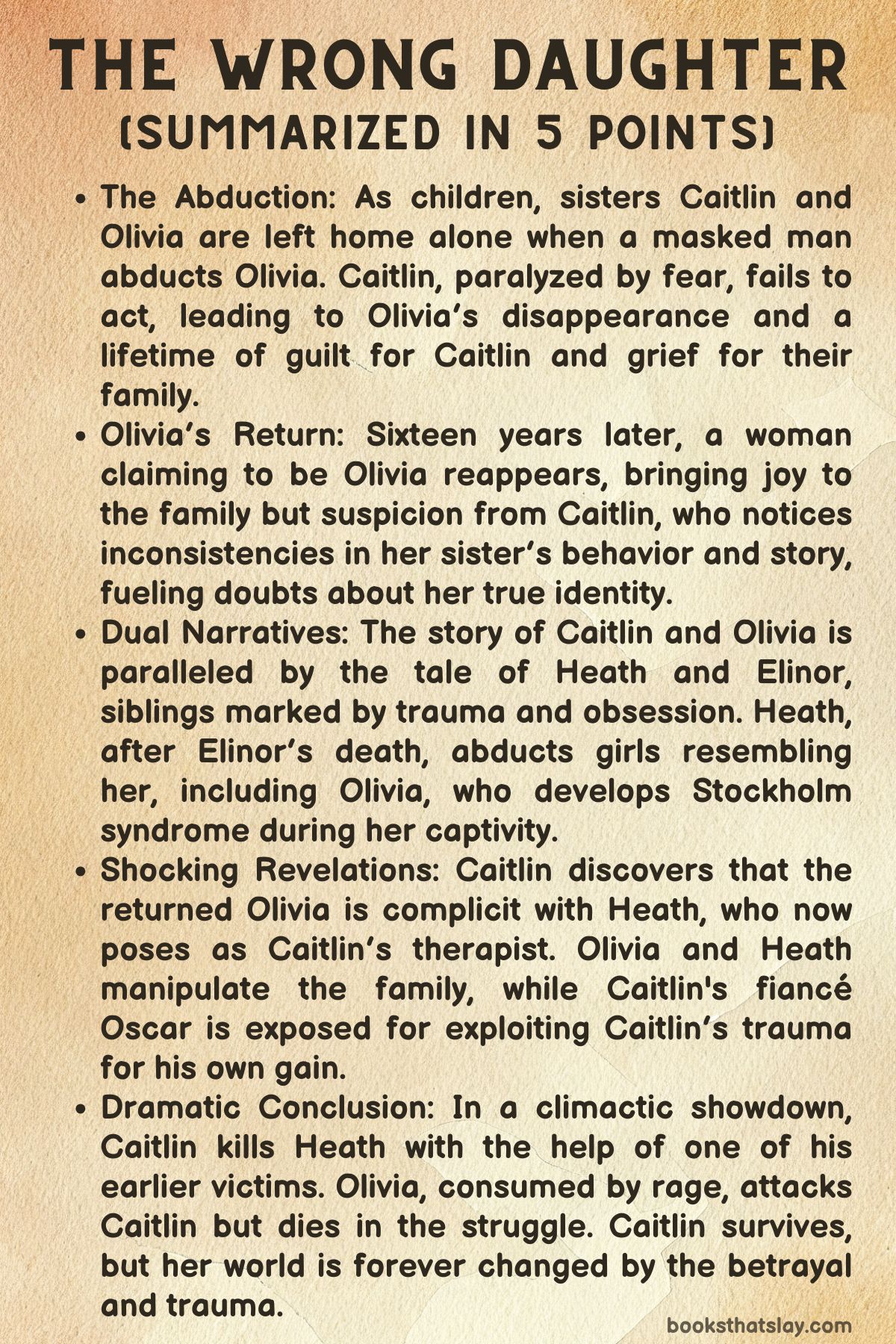
Characters
Caitlin Arden
Caitlin Arden stands at the emotional core of The Wrong Daughter, embodying the long shadow of trauma and guilt that defines the novel. As a child, Caitlin’s life was shattered the night her sister Olivia was abducted, an event that left her frozen with fear and forever questioning her own inaction.
This childhood paralysis matures into an adult life marked by repression, self-doubt, and an obsessive desire for normalcy. Living under an assumed name, she becomes Miss Fairview—a teacher and fiancée who hides behind a carefully curated identity.
Yet beneath the veneer of composure, Caitlin remains deeply fractured, consumed by survivor’s guilt and haunted by the belief that she could have saved Olivia. Her emotional fragility manifests in paranoia and isolation, particularly after Olivia’s return, when her intuition tells her something is wrong.
As she unravels the layers of deceit surrounding her sister’s reappearance, Caitlin evolves from a passive victim to a determined truth-seeker. Her courage in confronting both external danger and her own psychological scars transforms her into a resilient figure of rebirth and redemption by the story’s end.
Olivia Arden
Olivia, the “wrong daughter” of the title, is a complex and ambiguous presence whose reappearance drives the novel’s suspense. Once a carefree and loving older sister, she returns after sixteen years profoundly changed—detached, composed, and emotionally opaque.
Her behavior oscillates between vulnerability and manipulation, suggesting both deep trauma and moral decay. The Olivia who comes back to Blossom Hill House is not merely a survivor; she is a woman reshaped by captivity and psychological conditioning under her abductor, Heath Ledbury.
Her calm deflections and subtle dominance over Caitlin reflect years of grooming and control, turning her into both victim and accomplice. Yet beneath her chilling composure lies a tragic yearning for connection and freedom.
Olivia’s ultimate recognition of her love for Caitlin, even in her final moments, restores a measure of her lost humanity. Her death becomes both an act of release and an acknowledgment of the irreparable damage wrought by manipulation and misplaced devotion.
Heath Ledbury (Gideon)
Heath Ledbury, masquerading as the therapist Gideon, is the novel’s chilling embodiment of control and corruption. A master manipulator, he weaponizes charm and intellect to dominate others, constructing elaborate deceptions that span years.
His obsession with power originates in a twisted family past, symbolized by the death of his sister Elinor—a trauma he attempts to rewrite through domination of women who resemble her. Heath’s psychological complexity lies in his ability to mask monstrosity with sophistication.
His dual role as both captor and pseudo-healer exposes the dangers of unchecked authority and charisma. By orchestrating Olivia’s abduction, manipulating Simon Briggs, and infiltrating Caitlin’s life, Heath turns human relationships into a cruel experiment in possession.
His eventual death at Caitlin’s hands is poetic justice—a physical manifestation of his psychological unraveling and the destruction of his delusional empire of control.
Bryony Ledbury
Bryony, the longest-standing captive in Heath’s world, represents endurance shaped by despair. Taken as a teenager and held prisoner for seventeen years, she survives by surrendering her autonomy outwardly while retaining a flicker of resistance within.
Her marriage to Heath, forced and perverse, symbolizes both her captivity and her ability to endure unimaginable subjugation. Despite her bitterness, Bryony’s actions reveal deep moral courage; her decision to help Caitlin escape and her final act of killing Olivia to save her mark the culmination of years of suppressed rebellion.
Bryony’s story runs parallel to Caitlin’s—a portrait of survival through silence and eventual defiance. In freeing Caitlin and later reuniting with her own sister, she breaks her cycle of entrapment, becoming a quiet but powerful symbol of liberation from coercion.
Oscar
Oscar, Caitlin’s fiancé, at first appears as a stabilizing force—a patient, understanding man offering her the safety she craves. Yet as the story progresses, his role becomes more ambiguous, shaded by secrecy and emotional distance.
He functions as a mirror for Caitlin’s longing for normalcy, but also as a representation of her denial. His inability or unwillingness to fully believe Caitlin during her unraveling reflects societal tendencies to dismiss women’s fears as hysteria.
While not a villain, Oscar’s emotional detachment and complicity in Caitlin’s repression reveal the subtle, everyday dynamics of control that contrast with Heath’s overt violence. His gradual disappearance from Caitlin’s life symbolizes her rejection of dependence and her movement toward self-defined healing.
Florence
Florence evolves from Olivia’s childhood best friend to Caitlin’s adult confidante, linking the past and present emotional worlds of the sisters. Her loyalty to Caitlin initially appears unwavering, but her empathy becomes clouded when Olivia returns, reigniting old attachments and rivalries.
Florence’s shifting alliances illustrate the fragility of trust when memory and identity are questioned. Through her, the novel explores how friendship can both heal and wound, and how even well-meaning people can become pawns in larger manipulations.
Florence’s eventual withdrawal from Caitlin’s life underscores the loneliness of survival and the social cost of confronting trauma that others prefer to forget.
Elinor Ledbury
Elinor, though dead long before the main events, haunts the narrative as the psychological root of Heath’s obsession. Her presence lingers through memory, portrait, and the uncanny resemblance of the women he later imprisons.
Elinor’s life and death expose the generational rot of the Ledbury family—the cycle of control, repression, and guilt that births monsters like Heath. She is both victim and ghost, a silent catalyst for the entire chain of tragedies.
Her discovery in the estate’s grounds brings closure to the story, forcing acknowledgment of the past crimes that shaped all subsequent horrors.
Simon Briggs
Simon Briggs serves as a red herring in the narrative—a scapegoat manipulated by Heath to misdirect both the characters and the reader. Initially believed to be Olivia’s abductor, Briggs represents society’s hunger for simple explanations.
His portrayal as a lonely recluse, later revealed as an unwilling accomplice in Heath’s greater scheme, reflects how evil often hides behind layers of deception and moral ambiguity. His death by poisoning marks the moment when the illusion collapses and the true depth of Heath’s manipulation is exposed.
Themes
Identity and the Fractured Self
The heart of The Wrong Daughter rests on the fragile construction of identity and the struggle to reclaim or redefine it after trauma. Caitlin’s life, lived under a false name, is an attempt to escape the ghost of her sister’s disappearance, but her new persona becomes another kind of imprisonment — a carefully constructed facade that denies her past rather than healing it.
Her sister’s return shatters that fragile stability. Olivia’s reappearance, veiled in mystery and manipulation, challenges the very notion of who she is.
Is she the same person who vanished sixteen years ago, or has she been entirely reshaped by her captivity? The narrative interrogates how trauma rewires memory, personality, and even perception.
Caitlin’s fear that Olivia might be an imposter mirrors her own fractured sense of self — she no longer knows who she is without her sister’s absence defining her. The novel pushes this exploration further by revealing that Olivia’s captor deliberately engineered identities, forcing victims to perform roles that fit his twisted fantasies.
The imposed identities blur the line between self and performance, showing how control and manipulation can hollow out individuality. In the end, Caitlin’s rediscovery of her name, her voice, and her independence becomes a reclamation of identity not only for herself but also for the sister she lost twice — first to abduction, then to the illusion of return.
The theme underscores that identity is not static; it can be fractured, stolen, and rebuilt, but its core truth always seeks recognition.
The Haunting Weight of Guilt and Survival
Guilt threads through every choice Caitlin makes. Her paralysis the night of Olivia’s abduction becomes the origin of a lifelong self-condemnation that corrodes her ability to live freely.
Even as an adult, she exists in penance, marrying a man she does not fully love, choosing a career that pleases others, and burying her desires under layers of self-restraint. The novel portrays guilt not as a fleeting emotion but as a psychological inheritance — an invisible chain that binds survivors more tightly than grief.
Caitlin’s guilt transforms into suspicion when Olivia returns; her inability to trust her sister is a distorted reflection of her own self-blame. This emotional conflict mirrors the broader human struggle of surviving tragedy while feeling undeserving of survival itself.
Olivia, too, embodies guilt — her complicity in her captor’s crimes and her manipulation of Caitlin stem from a warped survival instinct twisted by years of abuse. The story suggests that guilt and survival often coexist in impossible tension; one feeds on the other until the boundary between victim and enabler dissolves.
The eventual reconciliation, as Caitlin writes to Olivia after her death, releases that guilt not through forgiveness but through understanding. The novel argues that survival is not a moral victory but an act of endurance — one that requires the courage to face both what was done to you and what you did to endure it.
The Illusion of Family and the Corruption of Trust
Family, in The Wrong Daughter, becomes both sanctuary and battlefield. The Arden household, outwardly loving, fractures under the strain of loss and unspoken resentment.
Parental denial shields the family from unbearable truths but simultaneously erodes its moral foundation. When Olivia returns, her parents’ desperate need to believe overrides reason, and their refusal to question her authenticity reflects a collective blindness born of grief.
The family’s dysfunction deepens as trust collapses — Caitlin’s warnings are dismissed as hysteria, and her father’s anger becomes a defense against his own guilt. This breakdown reveals how families often prioritize appearances of unity over emotional honesty, mistaking silence for healing.
The corruption of trust extends beyond blood ties. Caitlin’s fiancé, Oscar, and her therapist, Gideon, both embody deceit disguised as care.
The men around her exploit her vulnerability, replicating on a smaller scale the manipulative power dynamic of Olivia’s captivity. The novel exposes how trust can become a weapon when used by those who understand another’s emotional wounds.
By the end, family no longer represents safety but a complex web of denial, love, and betrayal. Yet, Caitlin’s final act — writing to Olivia and reconciling with her parents — suggests that genuine trust can only emerge after truth dismantles illusion.
The Enduring Scars of Trauma and Control
Trauma in the novel operates as an invisible architecture shaping every life it touches. Caitlin’s anxiety, hyper-vigilance, and fragmented memories reflect the long-term psychological cost of unresolved horror.
The return of her sister reactivates old wounds, demonstrating how trauma is never truly past but constantly resurrected by reminders and resemblances. Olivia’s captivity, meanwhile, exposes the mechanics of control — how a victim’s world can be systematically reduced until obedience feels like safety.
Her captor, Heath Ledbury, symbolizes the ultimate distortion of love into dominance. He doesn’t merely imprison his victims; he reconstructs their identities to mirror his own trauma and desire for possession.
The cyclical nature of abuse becomes clear through Bryony’s story — another woman broken and reshaped by the same hand, showing how trauma replicates itself across victims. The novel presents trauma as contagious; even those who were never directly harmed, like Caitlin’s parents or Oscar, are drawn into its psychological gravity.
Yet, the closing scenes reframe trauma not as an ending but as a terrain that can be navigated. Caitlin’s survival is not triumphal but grounded in the quiet realization that healing requires confronting control with truth.
The scars remain, but they no longer define her future.
Reality, Deception, and the Fragility of Perception
Throughout The Wrong Daughter, reality is unstable, filtered through Caitlin’s traumatized consciousness. Her perception oscillates between clarity and confusion, leaving readers unsure what is real.
This uncertainty mirrors the disorientation experienced by survivors of prolonged fear — when memory, intuition, and paranoia blur into one. Olivia’s return intensifies this distortion; her calmness, contradictions, and cryptic behavior create an atmosphere where truth is perpetually deferred.
The novel manipulates this instability to question how easily deception can mimic authenticity. Heath’s elaborate manipulation — posing as a therapist, staging deaths, rewriting identities — underscores how control often begins with the distortion of another’s reality.
Caitlin’s descent into doubt, mirrored by her family’s disbelief, dramatizes how truth can be gaslighted into silence. Yet, the revelation of Heath’s crimes and Olivia’s tragic fate restores perspective not through external validation but through Caitlin’s inner certainty.
By reclaiming her trust in her own perception, she reclaims power. The novel closes with this subtle shift — from the chaos of deception to the fragile clarity of self-awareness.
Reality remains imperfect, haunted, and shifting, but it is now hers to define.