The Boyfriend by Freida McFadden Summary, Characters and Themes
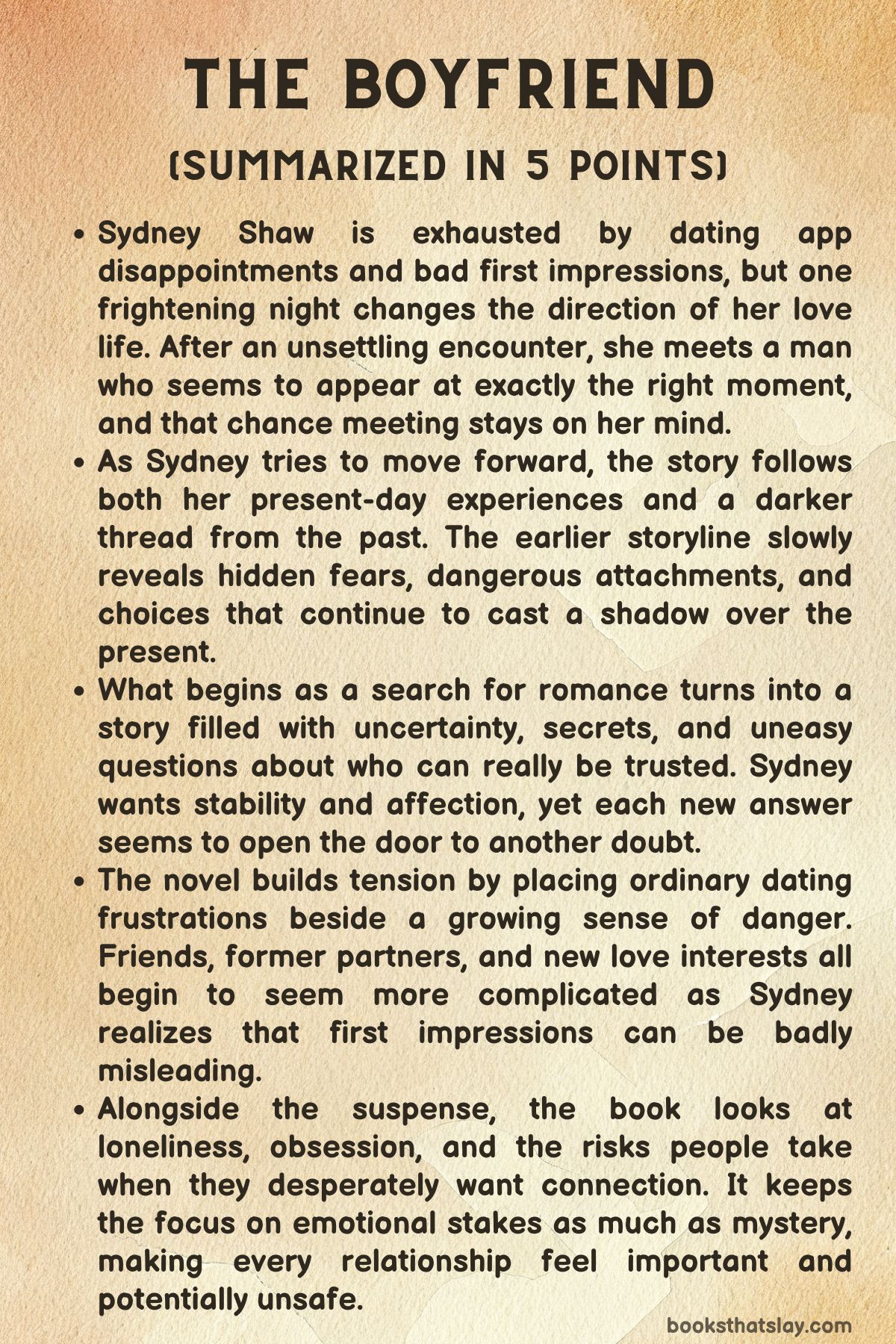
The Boyfriend by Freida McFadden is a fast-moving psychological thriller about trust, attraction, and the danger of believing what you most want to be true. The story follows Sydney Shaw, a woman tired of bad dates and lonely routines, who thinks she may have finally met the perfect man after a frightening encounter.
At the same time, the novel slowly reveals the buried past of Tom Brewer, whose teenage years were shaped by obsession, violence, and dark secrets. As the present-day mystery tightens, romance and fear begin to overlap, and the book keeps asking a sharp question: how well can anyone really know the person they love?
Summary
Sydney Shaw is a single woman in New York who is exhausted by dating apps and disappointing men. On one especially awful date, she meets Kevin, whose real appearance is nothing like his online profile.
He is rude, pushy, and increasingly aggressive. When Sydney tries to get away from him, Kevin follows her and physically corners her outside an apartment building.
She is saved by a stranger who intervenes at exactly the right moment. Sydney is instantly drawn to him and cannot stop thinking about the brief, charged connection they share.
But he walks away before she can learn anything about him.
Shaken by the attack, Sydney returns to her normal life, leaning on her friends Gretchen and Bonnie. Bonnie is warm, chatty, and eager to believe she may have found a promising man of her own, a handsome doctor she has been seeing.
Gretchen, more polished and career-focused, tries to support Sydney while balancing her own relationship with Randy, the superintendent of their building. Sydney is still lonely and insecure about her future, especially as she compares herself to women around her who seem to be moving into marriage and motherhood.
Her fear of ending up alone makes her long even more for a meaningful relationship.
Then Bonnie is murdered in her apartment in a brutal attack. Sydney is the one who discovers the body, and the shock of it changes everything.
The detective assigned to the case is Jake Sousa, Sydney’s former boyfriend and the only man she ever truly loved. Their breakup had been painful, caused by his emotional distance and dedication to police work, but the old bond between them is still there.
Jake tells Sydney that Bonnie had been involved with a man who used a burner phone and left little trace behind. There are signs that Bonnie’s death is not an isolated crime.
Soon it becomes clear that other women connected to dating apps have also been murdered in similar ways, with the same disturbing details left behind. A serial killer may be targeting women who are looking for love online.
While this investigation develops, another thread of the novel reaches into the past. These sections reveal Tom Brewer as a teenager.
He is deeply obsessed with Daisy Driscoll, a girl he has known since childhood. Tom loves her intensely but is also frightened by his own thoughts.
He is fascinated by blood, injury, and the human body, and dreams of becoming a surgeon. His home life is full of violence because his father is abusive, cruel, and often drunk.
Tom’s only close friend is Slug, an unsettling boy who shares his outsider status and often encourages his darkest ideas.
Tom’s relationship with Daisy grows, but it is shadowed by danger. Another girl, Brandi, has feelings for him, and when she goes missing and is later found dead, suspicion begins to gather around Tom.
Daisy’s best friend Allison distrusts him and notices too much. Tom’s fear increases as police questions intensify, especially because Daisy’s father is the local chief of police.
At the same time, Tom’s father becomes more threatening at home. In a moment of terror and fury, Tom kills him while trying to stop him.
Slug helps Tom dispose of the body, but this only binds them tighter to violence and secrecy. Soon Allison also disappears and is later found murdered.
Tom realizes that Slug may be responsible for more than he first understood. Eventually Daisy reveals a horrifying truth: she has committed murders herself out of jealousy and loyalty to Tom, including killing Allison and Brandi.
She wants them bound together by what they know and have done. Tom is horrified.
Although he agrees to support her version of events to save himself, he decides he must never truly be with her.
Back in the present, two months after Bonnie’s death, Sydney finally begins dating again. During a date with another man, she suddenly encounters the stranger who once rescued her from Kevin.
He helps when Sydney’s medical condition causes a nosebleed, and this time he introduces himself as Tom Brown. He is handsome, intelligent, calm under pressure, and works in medicine.
Their chemistry is immediate. Sydney feels that after so many disappointments, she has at last met someone exceptional.
Tom seems almost too good to be true. He knows a lot about her blood disorder, treats her with gentleness, and creates a feeling of safety that Sydney has badly needed.
Their relationship moves quickly. Sydney falls hard for him, imagining a future that finally seems possible.
But even as she becomes happier, small inconsistencies begin to appear. Tom gives conflicting details about his work and his name.
He avoids meeting her friends. He reacts strongly when he learns about Bonnie’s murder and about the building where Sydney lives.
Sydney notices secretive behavior, including a burner phone. At first she explains these things away because she wants to believe in him.
Her suspicion grows when she discovers evidence suggesting that Tom knew Bonnie. She finds a black scrunchie in his apartment and begins to fear that he may have been Bonnie’s mystery doctor.
Quietly, she takes one of his belongings so Jake can run fingerprints. Jake confirms that Tom’s prints were found at Bonnie’s apartment and at another crime scene.
Yet Tom has solid alibis for the murders, which leaves the case in a confusing state. Sydney feels humiliated and terrified.
She had trusted him completely, and now it seems possible that she invited a killer into her life and bed.
Tom later appears at Sydney’s apartment trying to explain himself. He admits some lies but insists there is more to the story.
Before Sydney can sort out what to believe, events push toward a final confrontation. Sydney has already learned that Gretchen once lied to police to protect Randy, who has a troubling past.
Then, during a dinner with Gretchen and Randy, Sydney finds hidden locks of women’s hair in the toilet tank and concludes Randy must be the serial killer. At the same time, she starts feeling physically weak and dizzy, suggesting she has been drugged.
In the middle of this panic, Tom arrives and calls Gretchen by another name: Daisy. The truth finally comes out.
Gretchen is Daisy from Tom’s past, and she has remained fixated on him for years. She attached herself to Bonnie after learning Bonnie was seeing Tom, then murdered her out of jealousy.
According to Tom, Daisy has been destroying the women in his life for a very long time. She even began dating Randy not out of love but to place suspicion on him and give herself cover.
When confronted, Daisy confirms her obsession and argues that she and Tom belong together. To prove her loyalty, she kills Randy without hesitation.
Sydney now understands that Tom was not the serial killer she believed him to be, though he is still far from innocent. He has hidden much of his past, and his life has been shaped by violence, secrecy, and morally twisted choices.
Even so, in this moment he is trying to stop Daisy rather than join her. He has already called the police.
Daisy urges Tom to flee with her and start over. Tom admits that he cannot fully let go of her.
He agrees to leave with Daisy only after making her promise not to kill Sydney. The pair escape before police can catch them, leaving Sydney to collapse as officers finally enter the scene.
A month later, Sydney is recovering. Jake remains close to her and spends evenings at her apartment, suggesting that their relationship may have another chance.
The authorities, including the FBI, are searching for Tom and Gretchen across the country. Then Sydney receives an envelope containing a lock of blonde hair and a note from Tom saying that Kevin will not bother her anymore.
The message is both protective and threatening, proof that Tom is still out there, still watching in his own way, and still impossible to place neatly into the role of villain, rescuer, or lost love. The novel ends with Sydney keeping this secret to herself, leaving the door open to danger long after the main case appears to be over.
Characters
Sydney Shaw
Sydney is the emotional center of the story because the reader experiences most of the present-day danger through her fear, hope, and misjudgment. She begins as someone worn down by modern dating, disappointed by men, and quietly anxious about ending up alone.
That insecurity shapes many of her choices. She ignores red flags at first because she wants connection badly enough to keep giving people chances.
Her loneliness is not written as simple weakness, though. It makes her human, and it explains why she is so vulnerable to charm, attention, and the fantasy of finally being chosen.
What makes Sydney compelling is the tension between her instincts and her desires. Again and again, she senses that something is off, but she also talks herself out of certainty.
She does this with Kevin, with Tom, and even with the shifting dynamics among her friends. Her mind is active and observant, yet her longing for safety and love keeps interfering with her judgment.
This contradiction gives her character depth. She is neither foolish nor purely perceptive.
She is a believable person trying to build a future while carrying emotional hunger, social pressure, and the memory of disappointment.
Sydney also develops through guilt. Bonnie’s murder affects her not only because she loses a friend, but because she feels she should have known more, asked more, and seen more.
That guilt sharpens her awareness and gradually pushes her from passive romantic hope into active suspicion. By the later part of the story, she is no longer simply reacting to events.
She starts testing reality, saving evidence, contacting Jake, and questioning appearances. Her arc is not about becoming fearless.
It is about becoming less willing to let fantasy override danger.
By the end, Sydney remains emotionally complex rather than neatly transformed. She survives, but she is not restored to innocence.
She has seen how attraction can distort perception and how protection can come from morally compromised people. Her choice to hide Tom’s final note suggests that she still lives in ambiguity, still holding private feelings and private fears.
That ending suits her character because she has always existed in the uncomfortable space between what she knows and what she wants to believe.
Tom Brewer
Tom is the most psychologically layered figure in the novel because he is written as both deeply threatening and strangely sympathetic. His childhood and adolescence reveal a boy shaped by violence, obsession, secrecy, and abnormal impulses he does not fully trust in himself.
He loves Daisy intensely, but his love is mixed with intrusive thoughts, fascination with blood, and a capacity for emotional detachment. From early on, he understands that there is something dangerous in him, and that self-awareness becomes one of the most unsettling parts of his character.
He is not blind to darkness. He lives beside it every day.
His early life explains much about him without fully excusing him. An abusive father, a terrified mother, and a home full of fear teach him that violence solves problems, removes threats, and restores control.
When he kills his father, the act is partly defensive, partly desperate, but it also becomes a turning point. After that, death becomes tied to survival in a more permanent way.
His friendship with Slug reinforces this logic by normalizing concealment, disposal, and silence. Tom is intelligent enough to see the horror of what is happening, but he is also adaptable enough to keep moving through it.
Tom’s relationship with Daisy reveals another key part of his nature: he wants love, but he fears what love becomes when possession enters it. As a teenager, he believes Daisy is the answer to his longing, yet when he learns what she has done in his name, he recoils.
That response matters because it distinguishes him from pure monstrosity. He is capable of violence, lies, and concealment, but he is still horrified by a total surrender to cruelty.
Even later in life, that conflict remains. He can hide the truth, manipulate names, and maintain burner phones, but he still seems to want some version of ordinary affection.
In adulthood, Tom becomes dangerous precisely because he appears controlled. He is educated, handsome, articulate, and professionally respectable.
He knows how to perform safety. That makes him effective both as romantic ideal and as source of dread.
Sydney falls for him because he offers competence and calm after chaos. Yet the same qualities make him hard to read.
The novel uses him to explore how evil does not always appear chaotic or visibly unstable. Sometimes it arrives in a polished form, wrapped in intelligence and restraint.
At the same time, Tom is not reduced to a single role. He is not only predator, not only victim, not only rescuer.
He has genuinely protective impulses, especially toward Sydney, but those impulses exist beside secrecy and a moral code that is badly damaged. His final message to Sydney captures that contradiction.
He may have eliminated a threat to her, but he does so in a way that confirms he still operates outside normal ethics. He remains someone who can care, but whose care is contaminated by violence, surveillance, and control.
That complexity is what makes him memorable.
Gretchen Driscoll / Daisy
Gretchen, who is eventually revealed to be Daisy, is the most startling character because she transforms from supportive friend into the hidden force behind much of the story’s bloodshed. In the present, she appears polished, socially functional, and emotionally available to Sydney.
She seems like the kind of friend who offers advice, shares personal updates, and remains woven into everyday life. This ordinary presentation is essential to her character.
She hides in plain sight not by seeming dramatic, but by seeming familiar.
As Daisy in the past, she begins as Tom’s idealized first love, but even then she is more forceful and more dangerous than she first appears. What looks like teenage romance slowly becomes a setting for possession, jealousy, and calculated violence.
She does not simply love Tom. She wants to define his world, remove rivals, and secure permanent emotional ownership.
Her willingness to kill Brandi and Allison shows that she experiences other girls not as people but as obstacles. This is not impulsive violence alone.
It is violence shaped by entitlement and emotional absolutism.
What makes Daisy especially disturbing is that she can merge romance and brutality without feeling contradiction. In her mind, murder becomes proof of devotion.
Sacrifice, loyalty, and destruction all belong to the same emotional language. Years later, as Gretchen, she is still operating from that same logic.
Bonnie dies because she becomes attached to Tom. Randy is useful only as cover and disposable once his role is finished.
Sydney becomes another woman who has wandered too close to what Daisy believes is hers. Her psychology is rooted in obsession, but it is strengthened by patience, social intelligence, and long-term planning.
She also functions as a dark mirror to Sydney. Both women want love, closeness, and certainty, but where Sydney doubts herself, Daisy never does.
Where Sydney hesitates, Daisy acts. Where Sydney still sees other people as morally real, Daisy reduces them to pieces in a private story about destiny and belonging.
This contrast makes Daisy more than just a twist villain. She represents the nightmare version of romantic fixation, the point at which desire becomes ownership and loyalty becomes justification for murder.
Her final scenes underline how fully she inhabits her delusion. She does not see herself as evil.
She sees herself as the one person who truly understands Tom and is willing to do what love requires. That warped sincerity makes her more frightening than a character who kills only for pleasure or profit.
She kills with conviction, and conviction often leaves the deepest damage.
Jake Sousa
Jake serves as both emotional history and moral contrast. As Sydney’s former boyfriend and the detective investigating the murders, he occupies two roles that keep colliding.
Personally, he represents unfinished love and unresolved disappointment. Professionally, he represents procedure, evidence, and the possibility of truth.
This dual position gives him quiet importance because Sydney’s interactions with him are never only about the case. They are also about memory, regret, and the question of whether people can change.
Jake is defined by steadiness. Unlike Tom, who is layered in mystery, Jake is direct and legible.
He works too much, he stays focused, and he cares in a practical rather than theatrical way. That practicality is part of why the earlier relationship failed.
Sydney wanted emotional availability, while Jake was pulled toward duty and work. Yet in the present, those same traits become reassuring.
He takes her concerns seriously, follows evidence, and acts to protect her without much performance. In a novel full of misleading appearances, his consistency becomes a form of value.
At the same time, Jake is not idealized. He is capable of intensity and possessiveness, especially when Sydney may be in danger.
His statement that he would kill Tom if Tom hurt her shows that he is not untouched by violent emotion. But the difference is that Jake treats violent feeling as something alarming, not romantic.
He belongs to the world of law, even when his emotions strain against it. This makes him an important counterweight to the novel’s many characters who justify private violence in the name of love.
His relationship with Sydney gains strength because it is rooted in history rather than fantasy. They know each other’s flaws.
He does not arrive as an ideal man but as someone who once failed her and may now be trying, awkwardly, to do better. By the end, he offers the possibility of a more grounded connection, one built on presence rather than illusion.
Whether or not that future is secure, Jake stands for the kind of love that is imperfect but real.
Bonnie
Bonnie plays a smaller role in terms of page time, but she is central to the emotional and structural movement of the plot. She embodies optimism, vulnerability, and the ordinary hope that dating might lead to happiness.
She is friendly, open, and talkative in a way that makes her immediately recognizable as someone who wants life to improve and expects romance to help it along. Because of that, her death lands with force.
It is not only a murder in the plot. It is the destruction of a simple, relatable hope.
Her character also exposes one of the book’s major concerns: how little people may know about the intimate lives of those around them. Sydney likes Bonnie, spends time with her, and still knows almost nothing meaningful about the man Bonnie is seeing.
That gap becomes a source of guilt after Bonnie dies. In that sense, Bonnie’s character continues to matter even after her murder.
She becomes the emotional measure of what was missed, overlooked, or dismissed too easily.
Bonnie’s role also sharpens the fear around dating culture. She is not reckless in an exaggerated way.
She is simply trusting enough to believe she may have found someone promising. That makes her feel less like a warning symbol and more like a tragic ordinary person.
The story uses her death to shift the atmosphere from romantic frustration to mortal danger. Once she is gone, the novel’s world no longer allows the reader to treat bad dates and deception as merely embarrassing.
They have become deadly.
Kevin
Kevin represents the obvious face of menace, especially in contrast to the more polished dangers elsewhere in the story. From the moment he appears, he is dishonest, entitled, and hostile.
His fake photos establish him as someone willing to manipulate from the start, and his behavior on the date quickly moves from unpleasant to threatening. He insults Sydney, ignores her discomfort, and treats her boundaries as negotiable.
This makes him the clearest example of everyday misogynistic aggression in the novel.
His importance lies partly in how recognizable he is. He is not hidden behind charm or emotional complexity at first.
He is the kind of man many women are trained to manage carefully rather than confront openly, precisely because such men can turn aggressive when rejected. His attack on Sydney early in the story sets the emotional frame for much of what follows.
It teaches Sydney, and the reader, that danger may emerge during moments that are supposed to be routine.
Later, Kevin continues to haunt the story through harassment and intimidation. He refuses to disappear, uses deception to get near Sydney again, and creates a sense that women are never fully free once certain men fixate on them.
He also serves a structural purpose by distracting attention from more hidden threats. Because Kevin is so clearly awful, he draws suspicion naturally, while other characters benefit from seeming less openly dangerous.
Even so, he remains significant in his own right as the embodiment of coercive male entitlement.
Randy
Randy initially appears on the edge of the story as Gretchen’s boyfriend and the building superintendent, but he gradually becomes more important because he carries an unsettling energy that never fully resolves until late. He is presented as socially off in a way that makes both Sydney and Bonnie uncomfortable.
His presence in the building gives him access, and access in a thriller quickly becomes suspicious. He is the kind of character whose awkwardness can be read either as harmless or dangerous, and the story deliberately uses that uncertainty.
Randy’s history of stalking and assault, once revealed, darkens him considerably. Even though he is not the central killer behind the novel’s events, he is not innocent in a moral sense.
The story makes use of that distinction. He can be both not guilty of the main murders and still be a man whose past justifies fear.
This creates effective tension because Sydney’s suspicion is not irrational. She has real reasons to distrust him, especially after finding the hidden bag of hair.
What is interesting about Randy is how he becomes a useful cover for someone else’s crimes. Gretchen understands that his reputation makes him an easy vessel for blame.
His awkwardness, lack of alibi, and prior behavior all make him believable as a killer. That manipulation says as much about Gretchen as it does about Randy, but Randy’s character still matters because he shows how predatory men can exist within a story without being the central villain.
He is another reminder that danger is widespread, varied, and often enabled by what others choose not to confront.
Slug
Slug is Tom’s closest friend in youth and one of the earliest signs that Tom’s world is morally corrupted far beyond what appears on the surface. He is socially strange, fascinated by insects, and treated as an outsider, but those traits alone do not define him.
More important is his comfort with death, cruelty, and concealment. He encourages Tom’s violent fantasies instead of challenging them and reacts to murder not with horror but with practicality.
In this way, he becomes both accomplice and corrupting influence.
Slug’s role is especially important because he reflects a path Tom might fully have taken. He lacks Tom’s hesitation and capacity for internal conflict.
He treats bodies, threats, and evidence as logistical problems. That makes him frightening, but it also helps define Tom by contrast.
Tom may cross terrible lines, yet he still experiences fear, guilt, and revulsion. Slug seems to move through violence with far less emotional resistance.
He is what happens when conscience is almost entirely replaced by instinct for self-preservation and domination.
He also fuels paranoia in the past timeline. Once Allison disappears and other girls are dead, Slug becomes the most likely source of escalating horror.
Tom realizes too late that the person who helped him solve one terrible problem may be capable of many more. This shift in Tom’s understanding deepens the sense that evil can grow through companionship as much as through isolation.
Slug is not just a bad friend. He is the person who normalizes the unthinkable until it becomes action.
Daisy’s Father / Chief Driscoll
Chief Driscoll serves as law, suspicion, and paternal authority in the past sections. As Daisy’s father and the town’s police chief, he is both personally and institutionally threatening to Tom.
He senses that something is wrong long before he can prove it, and his presence keeps pressure on every scene connected to the earlier murders. He is not a richly intimate character in the same way as Tom or Daisy, but he is crucial as the figure of scrutiny that closes in whenever secrets begin to leak.
His significance also comes from irony. He is a police chief trying to protect his daughter from dangerous boys, yet the worst danger is inside his own household and under his own roof in ways he does not fully perceive.
He suspects Tom and Slug, and not without reason, but he cannot imagine the full truth about Daisy. This limitation makes him effective as more than a simple authority figure.
He stands for the incomplete reach of law. He can observe, question, and intimidate, but he cannot fully see the emotional pathology shaping the crimes around him.
Tom’s Mother
Tom’s mother is one of the quieter tragic figures in the story. She lives under long-term abuse and has been worn down into fear, denial, and dependence.
Her suffering helps explain the emotional climate in which Tom grows up. She is not able to protect him, and she is not able to save herself, but the story does not frame her as uncaring.
Instead, she feels like a person damaged by survival. She sees more than she admits, suspects more than she says, and endures more than anyone should have to.
After Tom kills his father, her role becomes even more painful. She appears to sense the truth or at least the outline of it, yet she remains partly trapped by shame, confusion, and a desire not to pull the family into open ruin.
Her reaction suggests a woman who has spent so long managing chaos that she can no longer respond to horror in healthy ways. She matters because she shows how violence inside a family reshapes everyone, not only the person who commits it most openly.
Allison
Allison is important because she is one of the few people in the past who sees Tom with relative clarity and refuses to be charmed by appearances. As Daisy’s best friend, she acts as observer, skeptic, and reluctant truth-teller.
She notices Tom’s connection to Brandi, distrusts his behavior, and pushes against Daisy’s romantic idealization. In many thrillers, characters who question the romantic lead are dismissed as jealous or difficult.
Here, Allison’s suspicion is largely justified, which makes her role especially valuable.
She also represents the danger of speaking too close to the truth. Allison sees fragments rather than the whole picture, but even fragments are enough to put her at risk.
Her fate shows how vulnerable clear-sighted people can be in a world governed by secrecy and obsession. She is not simply a victim dropped into the plot for shock.
She is one of the story’s moral witnesses, someone whose refusal to look away makes her threatening to those with something to hide.
Brandi Healy
Brandi functions as an early casualty of desire, projection, and jealousy. She is less fully developed than some others, but that is part of her narrative effect.
She is seen largely through what others fear, hide, or resent about her. Her crush on Tom and her private meetings with him become pieces of a dangerous emotional triangle.
She matters because she reveals how quickly young affection can become fatal in a world where possessiveness is already taking root.
Her murder also helps establish the long history of violence surrounding Tom and Daisy. Brandi is one of the first clear signs that what looks like teenage longing is in fact already becoming lethal.
She is not treated as a grand mystery personality. Instead, she is memorable because her death reveals what jealousy can justify in Daisy’s mind and what Tom is willing to conceal once survival becomes more important than truth.
Themes
Trust, Misjudgment, and the Danger of Appearances
Sydney’s experience shows how badly human beings want to believe that other people are what they seem, especially when loneliness, attraction, and hope are involved. Nearly every major relationship in the story is shaped by false impressions, withheld truths, or emotionally convenient assumptions.
Sydney keeps trying to read character through surface behavior, chemistry, gestures, and fragments of personal history, but those signs repeatedly fail her. Kevin is openly unpleasant, which makes him easy to classify as dangerous, but the story becomes more unsettling when danger also appears in polished, intelligent, socially successful forms.
Tom is appealing because he seems calm, capable, and attentive, and those qualities allow Sydney to lower her guard. Gretchen appears supportive and stable, which makes her betrayal even more disturbing.
The point is not simply that people lie. It is that desire can make lies easier to accept, especially when the lie matches what someone emotionally needs.
This theme is strengthened by the way the plot places Sydney between different kinds of uncertainty. She wants love, safety, and clarity, but the world around her refuses to give her easy categories.
A rescuer may also be deceptive. A friend may be watching more than she admits.
A former boyfriend may be emotionally distant but still dependable. The novel keeps forcing Sydney to question her own judgment, which is one of its sharpest psychological effects.
Fear does not come only from the threat of violence. It also comes from the collapse of confidence in one’s ability to identify danger correctly.
Once that confidence is broken, even ordinary interactions feel unstable.
What makes this theme especially effective is that the narrative does not present Sydney as foolish. Instead, it shows how ordinary her assumptions are.
Most people do trust charm, consistency of tone, social status, professional success, or familiar friendship more than they trust vague unease. That makes the story feel less like an extreme nightmare and more like an exaggerated version of daily emotional risk.
The Boyfriend uses suspense not just to reveal hidden crimes, but to expose how often human beings mistake access for intimacy and performance for truth. The result is a world where appearances are not simply unreliable.
They are one of the most dangerous forces in the story.
Love as Possession Rather Than Care
Much of the emotional violence in the story comes from people confusing love with ownership. The relationships are filled with longing, attachment, jealousy, and devotion, but those feelings are often distorted into control rather than mutual care.
Daisy, later known as Gretchen, is the clearest example of this theme. She does not love in a way that recognizes Tom as an independent person with a separate will.
She loves him as something that belongs to her, something that must be protected from rivals, claimed, and preserved through force if necessary. Her murders grow out of that possessive logic.
In her mind, removing other women is not cruelty. It is loyalty.
Her emotional world is built on the belief that intensity proves truth, and that the willingness to destroy for someone is evidence of the purity of feeling.
Tom’s character also complicates this theme because he is both repelled by and drawn into that same emotional pattern. He understands that Daisy’s version of love is monstrous, yet he is not entirely free of his own controlling impulses.
His secrecy, surveillance, and final message to Sydney suggest that even his protective gestures contain domination. He may care, but his care is shaped by private judgment and violent action carried out without consent.
In this way, the novel refuses to separate tenderness and danger too neatly. It suggests that affection becomes morally unstable when one person decides they know what is best for another and acts on that belief through concealment or force.
Sydney’s emotional arc provides the strongest contrast to this distorted form of attachment. What she wants is not possession but partnership, recognition, and emotional security.
Yet her longing makes her vulnerable to people who present obsession as devotion. That contrast matters because it reveals how possessive love often disguises itself as intensity, certainty, and absolute commitment.
In romantic terms, those qualities can appear flattering before they become frightening. The story exposes how easily the language of soulmates, protection, and destiny can slip into entitlement.
By centering multiple relationships around this issue, the novel broadens the theme beyond one villainous character. It is not only Daisy who mistakes love for possession.
Several characters cross boundaries, monitor others, or claim emotional rights they have not earned. The Boyfriend turns romance into a site of moral danger by showing that love becomes destructive when it stops respecting another person’s freedom.
What remains then is not intimacy, but appetite wearing the mask of devotion.
Violence, Trauma, and the Persistence of the Past
The present-day plot is driven by crimes happening now, but the emotional structure of the novel depends just as heavily on old damage that never truly ended. Tom’s past is not a separate backstory placed beside the main action.
It is the foundation beneath everything that follows. His childhood home is marked by abuse, fear, humiliation, and physical threat, and those conditions shape his way of thinking long before the more sensational crimes occur.
He learns early that home is not a place of safety but of unpredictability. He learns that violence may erupt without warning and that survival may require silence, concealment, or force.
Once he kills his father, that lesson becomes permanent. The event is not treated as a single traumatic rupture after which life continues.
It becomes part of the logic by which he understands control, danger, and self-preservation.
This theme matters because the novel does not present trauma as something noble, cleansing, or easily interpretable. It leaves stains on judgment, intimacy, and moral boundaries.
Tom’s later behavior cannot be reduced to childhood suffering, but it cannot be understood apart from it either. He becomes a man who can function professionally, charm others, and maintain routines, yet the past remains active inside him.
He is always carrying earlier fear, earlier guilt, and earlier emotional distortion into new relationships. Daisy’s survival into adulthood intensifies this effect because she is not just a memory.
She is a living continuation of the same buried history. With her return, the past does not merely influence the present.
It invades it directly.
Sydney’s storyline also reflects this theme in a different register. Bonnie’s murder, Kevin’s attack, and Sydney’s own repeated exposure to fear change how she moves through the world.
She becomes more suspicious, more alert, and less able to separate daily life from threat. Trauma here is shown as repetition, not closure.
One frightening event does not end before another begins. Even when Sydney tries to move forward, earlier fear shapes how she interprets what comes next.
Her body, emotions, and decisions all become part of that continuing strain.
The novel’s ending reinforces the persistence of the past by refusing neat resolution. The killers are not fully gone, emotional entanglements remain unresolved, and Sydney herself chooses silence about Tom’s final message.
That choice suggests that the past will continue to live privately inside the present, even after the main crisis seems over. The Boyfriend presents trauma not as a solved problem or a dramatic explanation, but as an enduring force that keeps altering how characters love, fear, and remember.
Female Vulnerability, Social Pressure, and the Cost of Wanting a Future
Sydney’s life is shaped not only by immediate danger but by the quieter pressure of what she feels she should have by now. Her loneliness is sharpened by comparison, by expectations about marriage and children, and by the constant cultural suggestion that adult success includes romantic completion.
The novel uses this pressure to explain why dating is not just casual for her. It feels urgent.
Every bad date is more than an inconvenience. It becomes another reminder that time is moving, other people seem to be progressing, and she may be left behind.
That emotional context is crucial because it makes her more likely to endure discomfort, second-guess her instincts, and remain open to men who present themselves as opportunities. Her vulnerability is therefore not just physical.
It is social and psychological.
Bonnie reflects this same pressure in a slightly different form. She wants the promise of commitment, and her optimism makes her easy to exploit.
Her death turns ordinary romantic hope into a source of terror. This is one of the novel’s most unsettling achievements.
It shows that women are asked to remain open, trusting, attractive, emotionally available, and future-oriented, while also somehow protecting themselves from manipulation, coercion, and violence. Those demands are often incompatible.
A woman who remains too cautious risks isolation. A woman who chooses openness risks harm.
The story does not solve this tension because the tension itself is part of what it is examining.
Gretchen offers a darker response to the same pressures. Rather than fearing exclusion from romantic fulfillment, she turns desire into ruthless competition.
She treats other women not as companions in the same difficult world, but as threats to be removed. Her violence can be read partly as an extreme and pathological version of possessive longing, but it also emerges from a world where romantic centrality matters too much.
She would rather destroy than be displaced. In that sense, the novel connects female vulnerability not only to victimhood but also to the ways social pressure can warp female desire into something predatory.
What gives this theme lasting force is that it is grounded in ordinary emotional material: bad dates, app fatigue, comparison with peers, anxious phone calls from family, the hope that the next person will finally be different. Those details make the larger horror feel connected to real social experience.
The Boyfriend suggests that danger grows more easily in spaces where women are taught to keep trying, keep hoping, and keep making themselves available to love, even when the search itself has become exhausting and unsafe.