The Last One at the Wedding Summary, Characters and Themes
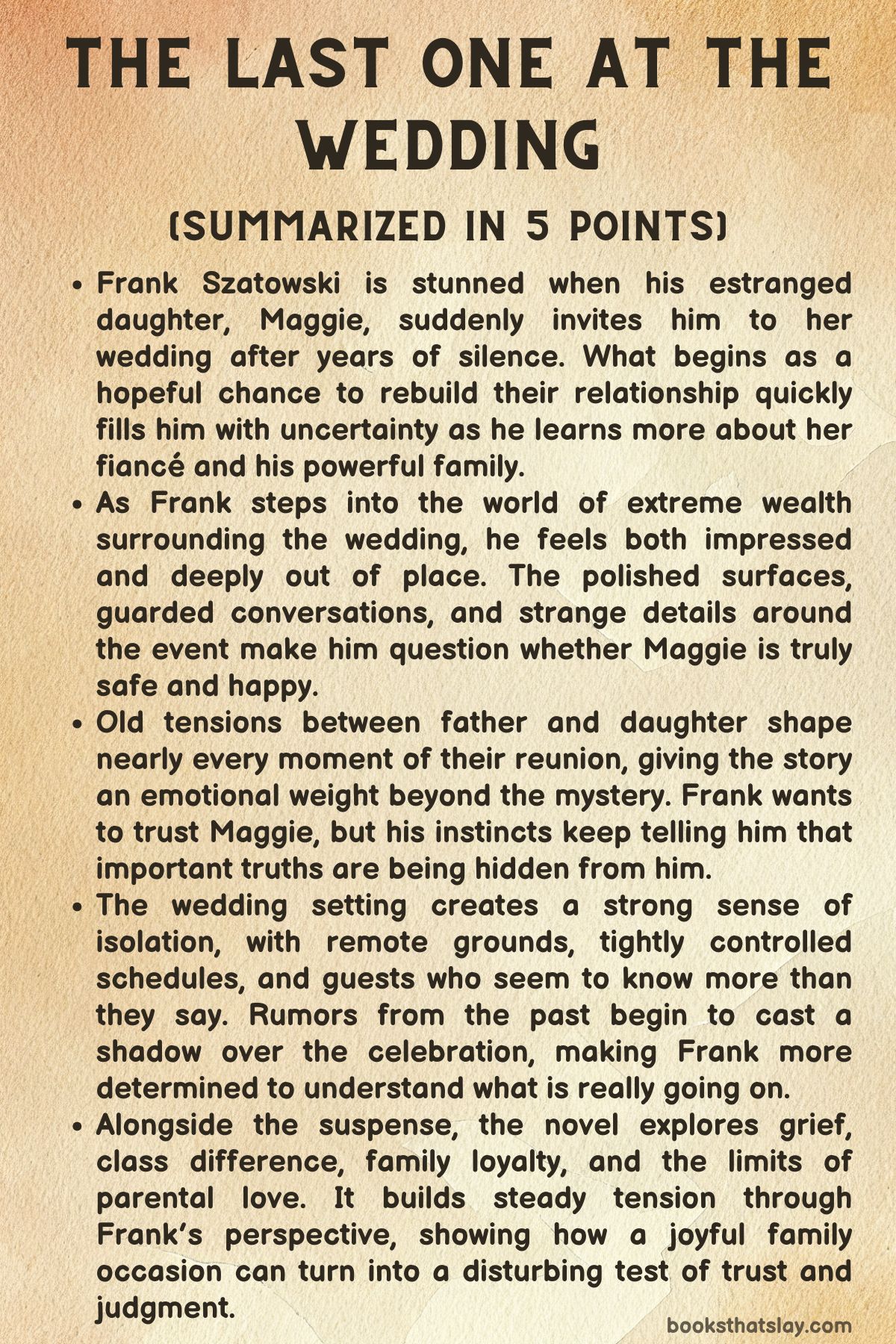
The Last One at the Wedding by Jason Rekulak is a suspense novel about family, class, power, and the painful gap between how well we think we know the people we love and who they really are. At its center is Frank Szatowski, a working-class father who is thrilled when his estranged daughter, Maggie, invites him to her wedding after years of silence.
What should be a chance to repair their relationship becomes a tense visit to the world of her wealthy future in-laws, where secrets, lies, and old crimes begin to surface. The book blends domestic drama with mystery, building its tension through Frank’s growing dread and moral struggle.
Summary
Frank Szatowski is stunned when his daughter Maggie calls after more than three years of silence. He has long carried the pain of their estrangement and still hopes that one day they might repair what was broken between them.
During the call, Maggie tells him she is getting married and wants him at the wedding. The news fills him with relief and joy, but his happiness is mixed with unease.
He learns that her fiancé, Aidan Gardner, comes from extraordinary wealth, and the wedding will take place at the Gardner family’s property in New Hampshire. Frank, a practical man who has spent his life working as a UPS driver, is wary from the start.
He wants Maggie to be secure and loved, but he distrusts how quickly the relationship has moved and how little she tells him about the family she is marrying into.
When Frank visits Maggie and Aidan in Boston, his suspicions deepen. Instead of a modest apartment, he finds a penthouse filled with expensive art, luxury finishes, and staff.
The revelation that Aidan’s father is the CEO of Maggie’s company unsettles him further. Maggie seems happy, polished, and fully at ease in this new life, while Aidan remains distant and hard to read.
Frank notices odd details that bother him, including Aidan’s nervous manner and a hidden black plastic package taped beneath a toilet tank lid. He leaves the visit unsure what to make of any of it, but convinced that something is off.
As the wedding approaches, Frank tries to reconnect with Maggie and get to know Aidan, but both remain emotionally unavailable. Then he receives an anonymous photograph showing Aidan with another woman, with a message asking, “Where is Dawn Taggart?” Maggie explains that Dawn is Aidan’s former girlfriend, now missing, and dismisses Dawn’s family as opportunists looking for money.
Frank is disturbed by Maggie’s coldness and by how quickly she brushes away the accusation. The name stays with him, and what was already a nervous trip to a rich family wedding begins to feel like something darker.
Frank sets out for New Hampshire with his sister Tammy, who helped him raise Maggie after his wife Colleen died. Tammy unexpectedly brings along Abigail, a foster child in her care.
Frank is irritated by the complication, but the girl joins them anyway. On the drive, they stop in a nearby town and encounter Dawn’s uncle, who angrily claims that Aidan murdered Dawn after she became pregnant and that the Gardner family covered it up.
A police officer interrupts and reassures them that the Gardners are respectable people, but Frank is not convinced.
At the Gardner property, a sprawling and polished former summer camp now used as a retreat for wealthy guests, Frank feels immediately out of place. Guests are asked to sign lengthy privacy agreements and install an app that grants access to buildings instead of ordinary keys.
The formality and secrecy only feed his growing mistrust. Maggie asks Abigail to serve as flower girl, and Frank tries to settle in, but he feels ignored by Maggie, dismissed by Aidan, and kept at a distance by the entire family.
As he explores the grounds, Frank sees Aidan meeting privately with a red-haired woman named Gwendolyn. He follows them and overhears a tense argument in which she threatens to tell Maggie something.
Aidan later claims Gwendolyn is an old friend who dislikes the family’s wealth, but the explanation sounds thin. During drinks with Errol Gardner, Aidan, and the family lawyer Gerry Levinson, Frank brings up the photo and Dawn’s disappearance.
They insist the image is fake and present a tidy story in which Aidan barely knew Dawn. Frank listens, but the details do not add up.
At dinner that night, Frank is further isolated. He notices that none of Maggie’s old friends are present and that the atmosphere around the younger guests is chaotic, careless, and drug-fueled.
He also learns that Catherine, Aidan’s mother, is staying apart from the celebration and refuses visitors. Gwendolyn quietly tells Frank she will explain the family’s real story the next day, when the others are out on a group hike.
Before that can happen, Frank spots Catherine at a window, watching from a distance, another silent sign that all is not well inside the family.
The next morning, Frank and Maggie go canoeing, and he again tries to warn her that something is wrong with Aidan and the family around him. Maggie dismisses every concern.
Then the camp is thrown into chaos when a body is found floating in the cove. It is Gwendolyn.
People immediately begin spreading rumors that she was a drug user and died because she was intoxicated. Frank notices marks on her neck and suspects foul play, but those around him dismiss what he saw.
To him, Gwendolyn’s death feels like the silencing of someone who knew too much.
Determined to learn more, Frank skips the group outing and goes to meet Dawn’s mother. Instead of the bitter, unstable woman Maggie described, he finds someone serious and credible.
She tells him that Dawn and Aidan had a real relationship over the course of a summer, though Aidan kept her hidden from his social world. Dawn later became pregnant and went to the Gardner property shortly before she disappeared.
Her mother believes Dawn died there and that the family, with the help of compliant local authorities, made the evidence vanish. Frank leaves more convinced than ever that Maggie is in danger.
When he confronts Maggie again, she produces what appears to be proof that the photo of Aidan and Dawn was manipulated. Frank feels foolish and briefly wonders if his fear has made him too ready to believe the worst.
He tries to set his suspicions aside and be the supportive father Maggie wants. But he cannot let go of the larger pattern of secrecy, intimidation, and missing pieces.
His doubts return with full force when he steals access to Catherine’s quarters and finds her drunk enough to talk.
Catherine reveals the truth. Dawn was not involved with Aidan at all, but with Errol.
She had become pregnant by him and came to demand money and expose details of the affair. Catherine, enraged and humiliated, attacked Dawn, throwing a heavy battery at her head.
Dawn tried to flee and fell down the stairs. Before Catherine can explain the full aftermath, Aidan and Hugo arrive.
Outside, Aidan tells Frank that Maggie has known everything from the beginning. He also reveals the family’s larger corruption, including Hugo’s violent past and ties to abuse in the Gardner mining operations.
He warns Frank to stay quiet and leave as soon as the wedding is over.
Shaken, Frank goes to Maggie’s cabin looking for answers and instead finds her having sex with Errol. The discovery destroys the last of his illusions.
Maggie attacks him, Hugo appears, and Frank loses consciousness. When he wakes the next day, battered and humiliated, he tells Tammy everything.
Tammy believes him, but her response is cold. She says Maggie has always been manipulative and that Frank has refused to see it.
She has also been drawn in by the Gardners’ money and security. Frank realizes he is losing not only his daughter, but also the moral certainty he once had about his family.
At last, past events fall into place. Frank remembers a suspicious incident from Maggie’s first job after college, when she appeared at his house under strange circumstances and later became implicated in an arson case.
At the time, he refused to believe she could be guilty. Now he begins to understand that her deceit and calculation did not begin with the Gardners.
Maggie confirms it herself. She explains that her affair with Errol is strategic, that her marriage to Aidan is essentially a financial scheme, and that she knowingly helped conceal Dawn’s death.
She intends to collect wealth through the marriage and has secretly recorded incriminating conversations as protection. Frank is horrified, but trapped.
Maggie tells him he cannot leave without permission and that no one will believe him if he speaks.
On the wedding day, Aidan disappears. Frank finds him in a bunker beneath his studio, armed and desperate.
Frank tries to persuade him to go to the police or flee, but Aidan sees no way out. When Errol and Hugo close in, Aidan runs deeper into the shelter and shoots himself.
The family immediately begins arranging the story they will tell authorities. Frank watches in disgust as Errol treats his son’s death as another problem to manage.
He even admits that Aidan was not his biological child, a final sign of his emptiness and cruelty.
Frank returns home broken. He withdraws from Vicky, a kind woman who had shown interest in him, and sinks into shame and grief.
Distracted at work, he crashes his truck and ends up hospitalized. During his recovery, Tammy asks him to help care for Abigail, and this unexpected responsibility slowly gives his life structure again.
Spending time with Abigail softens him. He begins to enjoy her company and finds a sense of purpose he thought he had lost.
Then Abigail reveals that Aidan left a map in her suitcase. Marked with a red X, it appears to indicate the location of Dawn’s body in the cove.
Frank considers destroying it but instead decides to give it to Maggie as leverage, hoping in some damaged corner of his heart that helping her might still repair something between them. When he brings it to Boston, he discovers Maggie is still fully aligned with Errol, Gerry, and Hugo.
Errol burns the map and openly suggests that Abigail is now a liability who may need to be eliminated.
Faced with the immediate threat to a child, Frank finally acts with clarity. Pretending to cooperate, he phones Tammy and warns her to take Abigail somewhere safe.
Then he retrieves the hidden package from the toilet tank in Maggie’s apartment: Maggie’s flash drive of recorded conversations. When Hugo pulls a gun and demands it, Frank manages to escape during a moment of confusion and flees to Vicky’s salon.
There he apologizes, tells her the truth, and with her help opens the recordings. The files confirm the conspiracy, including Maggie’s role and the family’s efforts to intimidate or silence people around them.
Months later, the aftermath settles into place. Tammy adopts Abigail, and together she, Frank, and the girl build a stable family life.
Frank becomes a steady and loving presence in Abigail’s world, and for the first time in a long while he feels useful, trusted, and decent again. Maggie ends up in prison, the only major figure to serve time for Dawn’s death, while others evade full accountability.
Frank cannot repair his relationship with her, but he no longer builds his life around that hope. Instead, he moves toward a quieter future with Vicky, Tammy, and Abigail, carrying the pain of what he learned but also a hard-won sense of peace.
Characters
Frank Szatowski
Frank is the emotional center of the story and the character through whom the reader measures nearly every shock, doubt, and betrayal. He is an aging working-class father who has built his identity around reliability, effort, and sacrifice.
He is proud of the life he made without wealth or status, and he carries the quiet confidence of a man who has spent decades doing hard, necessary work. At the same time, he is deeply lonely.
The death of his wife and the long estrangement from his daughter have left him with a sense of failure that he tries to keep buried under routine, practical tasks, and hopeful fantasies about reconciliation. His invitation to the wedding seems to offer him a second chance, and that hope shapes many of his early decisions.
What makes Frank compelling is the conflict between his instincts and his denial. He notices things that do not fit, asks the right questions, and senses danger well before he can prove it.
Yet his longing to regain Maggie’s love keeps slowing him down. He wants to believe that if he behaves properly, stays calm, and gives people the benefit of the doubt, everything can still be repaired.
This makes him vulnerable not because he is foolish, but because he is emotionally invested in a comforting version of reality. His character arc is built around the painful destruction of that illusion.
He must accept that love for a child does not guarantee moral blindness can be sustained forever.
Frank is also shaped by guilt. He constantly reviews his parenting, wondering where he failed Maggie after Colleen’s death.
He fears that his shortcomings as a father created the distance between them and perhaps even enabled parts of her personality that he refused to confront. This self-questioning gives him emotional depth because he is not merely judging others; he is judging himself throughout the story.
He tries to be fair, and even when evidence against Maggie grows overwhelming, he reaches for explanations that preserve her innocence. That tendency makes his eventual recognition of who she is especially devastating.
By the end, Frank becomes stronger not because he defeats every corrupt person around him, but because he stops lying to himself. He cannot save Maggie, but he can protect Abigail, accept Vicky’s care, and build a more honest life.
His final growth comes through choosing responsibility over fantasy. In The Last One at the Wedding, he begins as a man desperate to reclaim the past and ends as a man who has finally learned to face the truth, however painful it may be.
Maggie Szatowski
Maggie is the most unsettling character in the novel because she first appears as a lost daughter returning to her father’s life and gradually reveals herself to be something far more calculating. At the beginning, she seems to occupy a familiar role in a family drama: the distant child who may be angry, wounded, or misunderstood.
This framing encourages sympathy, especially through Frank’s perspective, because he misses her so intensely that he reads her invitation as a sign of possible healing. As the story continues, however, Maggie emerges as someone whose emotional detachment is not temporary or defensive, but central to who she is.
One of Maggie’s defining traits is control. She manages impressions carefully, withholds information, and reveals only what benefits her in a given moment.
She knows how to sound reassuring, how to redirect her father, and how to turn social class into a weapon when useful. Her dismissive attitude toward Dawn’s family and her polished adaptation to the Gardner world show that she is not simply overwhelmed by wealth; she has embraced its logic.
She understands power, leverage, and self-advancement with chilling clarity. The affair with Errol and the sham marriage are not moments of impulsive moral collapse but part of a larger strategy.
She sees relationships as transactions and people as assets, risks, or obstacles.
What makes Maggie especially tragic is that she is not presented as irrational or chaotic. She is intelligent, disciplined, and sharply aware of what she is doing.
This makes her far more dangerous than a character driven only by emotion. She records conversations as insurance, negotiates her own future within a corrupt system, and treats human intimacy as something she can convert into security.
In another kind of story, those traits might look like ambition. Here, they are stripped of conscience.
Her choices reveal not merely selfishness but a profound inability or refusal to value other people except in relation to her own gain.
Her relationship with Frank is central to understanding her. She knows exactly how much power she has over him and uses that knowledge without hesitation.
His guilt and love become tools she can exploit, whether by drawing him into silence, reframing his suspicions, or making him question his own judgment. At the same time, the novel suggests that Frank’s long refusal to see her clearly helped make this manipulation possible.
Maggie did not become deceptive overnight. There were warning signs in her youth, and part of the horror of her character lies in the gradual realization that she has been this way for a long time.
Maggie is not written as a simple villain because her emotional coldness is tied to social aspiration, resentment, and a hunger to escape vulnerability forever. She wants a life where she cannot be hurt, controlled, or made ordinary.
That desire hardens into ruthless opportunism. Her imprisonment at the end gives legal closure, but it does not restore the father-daughter bond she destroyed.
She remains one of the most disturbing presences in The Last One at the Wedding because she turns the hope of reconciliation into the novel’s deepest wound.
Aidan Gardner
Aidan is introduced as a possible threat, then slowly revealed as something more complicated: weak, trapped, compromised, and morally damaged, but not identical to the people surrounding him. Early on, he is difficult to read.
He is remote, awkward, and dismissive, and his nervousness makes him seem suspicious from the start. Frank’s distrust of him is understandable because Aidan offers so little warmth or transparency.
He appears to be a privileged young man insulated by money, one whose artistic identity and emotional distance suggest vanity or dishonesty. The mystery around Dawn intensifies that impression.
As the story progresses, Aidan becomes a study in passivity under pressure. He has grown up inside a family system built on manipulation, image management, and corruption.
Rather than becoming a forceful heir to that world, he seems bent by it. His art matters because it suggests a buried desire to observe reality honestly, to hold onto something human and specific in a setting ruled by wealth and secrecy.
His paintings of ordinary people hint at a sensibility at odds with the Gardner machinery. Yet that sensitivity does not turn into courage soon enough.
He knows terrible things, participates in lies, and allows harm to continue because resistance feels impossible to him.
Aidan’s role in the cover-up surrounding Dawn is morally serious even if he is not the central architect of her death. He becomes the public face of a false story and helps preserve the system that protects Errol and Catherine.
He also enables Maggie’s scheme by going along with the marriage arrangement. His choices are those of a person who has surrendered his agency in increments, accepting one compromise after another until he can barely imagine a way out.
That is why his eventual honesty with Frank feels both important and inadequate. He can reveal pieces of the truth, but he cannot save himself or anyone else through decisive action.
His relationship with Maggie is built on mutual exploitation. Neither truly loves the other, and each understands that the marriage serves a purpose beyond affection.
Yet Maggie is stronger, colder, and more adaptive, while Aidan is exhausted and fraying. He is one of the few characters who seems to feel the weight of what has happened, even if he lacks the will to confront it publicly.
That internal collapse leads to his death. His suicide is not framed as redemption, but as the final act of someone who cannot imagine surviving either the family’s control or exposure of the truth.
Aidan works best as a character because he complicates the novel’s moral structure. He is neither innocent nor fully monstrous.
He is privileged but powerless in crucial ways, complicit but frightened, damaged by his parents and then damaging to others in turn. His tragedy lies in the fact that he sees enough to understand the nightmare around him, but not enough to escape it.
Tammy
Tammy initially appears to be a source of steadiness in Frank’s life. She helped him raise Maggie after Colleen died, and she seems practical, competent, and emotionally resilient.
Because Frank trusts her history and loyalty, both he and the reader are inclined to see her as one of the few stable presences in the story. She is direct where Frank is hesitant, more adaptable in social situations, and less sentimental in the way she reads people.
Her experience as a foster parent also suggests compassion and toughness, qualities that seem admirable in contrast to Frank’s tendency to second-guess himself.
What makes Tammy interesting is that her realism gradually shades into moral compromise. She sees Maggie more clearly than Frank does and is less vulnerable to the fantasy that Maggie is simply misunderstood.
In that sense, Tammy is often correct. She understands that Maggie can manipulate, lie, and pursue advantage without remorse.
However, Tammy’s clarity does not automatically make her ethically strong. When confronted with the Gardner family’s wealth and influence, she responds not with horror but with accommodation.
She begins measuring reality in terms of what can be survived, endured, or benefited from. Her desire for financial security becomes the point at which her pragmatism turns sour.
Tammy’s reaction after Frank tells her what he saw is one of the most revealing moments in the novel. She believes him, yet she chooses detachment over action.
That choice shows that she is not blinded by innocence but persuaded by self-interest. She does not deny corruption; she accepts it as something powerful people get away with and something ordinary people may as well work around.
This does not make her evil in the same way as Maggie or Errol, but it does expose a capacity for surrender that is morally disappointing. She becomes a reminder that corruption thrives not only through predators, but also through bystanders willing to rationalize.
Even so, Tammy is not left in a wholly negative light. Her adoption of Abigail and the life she later shares with Frank suggest that she remains capable of commitment, care, and family feeling.
She is flawed rather than hollow. Her bond with Frank survives because, for all her compromises, she is still connected to ordinary responsibilities in a way the Gardners are not.
Tammy represents a grounded but morally compromised realism, and that tension gives her character weight.
Abigail
Abigail begins as an inconvenience. Frank sees her as an unexpected burden on a tense trip, and her chatter, unpredictability, and dependence irritate him.
That first impression is important because it shows how little he expects from her presence. She enters the story from the margins, not as a grand symbolic figure, but as a foster child who seems likely to complicate an already stressful wedding weekend.
Yet she gradually becomes one of the most important characters in the novel because she opens a path toward renewal that the main adult relationships can no longer provide.
Her role is partly disruptive and partly restorative. She is curious, impulsive, and difficult to control, which often creates comic or chaotic moments.
But those qualities also make her perceptive in unexpected ways. She sees things adults overlook, moves through spaces with a freedom others do not, and carries pieces of the truth without fully understanding their significance.
The map Aidan leaves in her suitcase becomes crucial, and the fact that it reaches Frank through her is fitting. Abigail is not part of the adult world of ambition, secrecy, and sexual bargaining.
She represents a more direct and uncorrupted way of being in the world.
Emotionally, Abigail matters because she gives Frank someone to protect after his illusions about Maggie collapse. He cannot rescue his daughter from her choices, but he can choose to show up for Abigail.
This changes him. Caring for her pulls him out of self-pity and moral paralysis.
Through ordinary acts of companionship, meals, outings, and attention, he begins to rediscover tenderness without denial. Abigail’s trust in him is especially moving because it is unearned by old guilt or family obligation; it develops through presence and care.
Abigail also reframes the theme of fatherhood. Frank spends much of the novel revisiting what he did wrong with Maggie, but with Abigail he gets a second chance to practice a humbler, steadier form of care.
He cannot rewrite the past, yet he can still become meaningful in a child’s life. Her view of him as a hero is powerful not because it flatters him, but because it shows that goodness can still be recognized and built in the aftermath of failure.
She is the clearest sign that the story believes damaged people can still create something decent.
Errol Gardner
Errol is the novel’s clearest embodiment of wealth without conscience. He is charming when it serves him, informal when he wants to disarm others, and utterly ruthless beneath that polish.
His power is not expressed through loud theatrical cruelty, but through the smooth confidence of a man who assumes rules exist for other people. He can trade fatherly anecdotes with Frank, host luxurious events, and maintain an image of civilized authority while standing at the center of exploitation, violence, and cover-up.
This duality is what makes him so effective as an antagonist.
At the core of Errol’s character is entitlement. He believes his status gives him access not just to comfort and influence, but to other people’s bodies, futures, and silence.
His affair with Dawn, his relationship with Maggie, and his expectation that legal systems and employees will protect him all spring from the same worldview. He does not simply commit wrongs; he assumes he can absorb their consequences into the machinery of privilege.
That is why his calm is so unsettling. He is rarely panicked because he has spent a lifetime learning that money, law, reputation, and fear can be arranged in his favor.
As a father, Errol is equally revealing. He is emotionally vacant, transactional, and incapable of offering moral shelter.
His relationship with Aidan is marked by control rather than care, and even in the face of his son’s collapse and death, he responds with damage management. The revelation that Aidan is not his biological son sharpens rather than changes this portrait.
Biology is irrelevant because Errol’s failure is not about blood, but about his inability to value human beings outside utility and possession. He is a patriarch in the most corrosive sense: a man whose authority poisons everyone around him.
Errol is also important because he exposes the social dimension of the novel’s horror. The danger he poses is larger than private cruelty.
He has lawyers, business allies, local influence, and international ties that connect personal sin to structural abuse. The mention of the mining operation extends his character beyond family scandal into a wider system of extraction and harm.
He is not just a bad man in a rich household; he is the kind of powerful figure whose private conduct is protected by public reach. In The Last One at the Wedding, he stands for a version of elite power that treats accountability as a problem to be negotiated rather than a moral demand.
Catherine Gardner
Catherine is one of the story’s most disturbing figures because she combines fragility and violence in a way that keeps others off balance. At first, she seems like a shadowy presence: reclusive, unwell, and hidden from guests.
Her migraines, her isolation, and the strange atmosphere around her encourage the impression that she may be more victim than threat. She appears to live within the Gardner family’s dysfunction while also shrinking from it.
That partial invisibility gives her a ghostlike quality early in the story.
When Frank finally speaks with her, that impression shifts dramatically. Catherine is deeply damaged, often drunk, and emotionally unstable, but she is not passive.
She participated directly in the chain of events that led to Dawn’s death, and her confession reveals how resentment, humiliation, and dependence can turn into lethal violence. She lives under the pressure of Errol’s infidelity and domination, yet instead of resisting the man who degrades her, she directs her rage toward a younger woman with less power.
That displacement is central to her character. She is both trapped by the system and willing to enforce it violently.
Catherine represents the corruption of the spouse who stays close to power long enough to absorb its logic. She knows what kind of man Errol is, knows the moral rot at the center of the family, and still participates in maintaining appearances.
Her alcoholism suggests unbearable internal strain, but it does not excuse her actions. She is pitiable in some moments, horrifying in others, and that instability makes her vivid.
She is not a mastermind like Errol or a strategist like Maggie. Instead, she is a person whose weakness has curdled into complicity and destructiveness.
Her scenes also deepen the novel’s treatment of class and image. Catherine belongs to a world that hides damage behind privacy, medication, polished surfaces, and controlled narratives.
Her breakdown does not puncture that world completely, but it lets the truth leak out long enough for Frank to see that the family’s elegance has always rested on fear, denial, and suppressed scandal.
Vicky
Vicky serves as a moral and emotional counterweight to the manipulative world Frank enters. She is not flashy, wealthy, or strategically important in the way the Gardners are, yet she becomes essential because she offers something almost no one else does: straightforward human care.
Early on, she appears as a warm possibility in Frank’s ordinary life, someone with whom he might have companionship if he allowed himself to want it. He is awkward around her, hopeful but uncertain, and their connection carries the tenderness of late-life vulnerability.
What distinguishes Vicky is her patience. Frank pushes her away, speaks harshly to her, and tries to shut her out after the wedding because he is overwhelmed by shame and grief.
She does not respond with pride or melodrama. Instead, she remains open, perceptive, and quietly firm.
That steadiness matters because it contrasts sharply with the manipulative emotional economy that governs Maggie and the Gardners. Vicky does not bargain for intimacy or weaponize knowledge.
She simply shows up.
Her role grows larger in the final section because she becomes the person Frank finally trusts with the truth. The salon scene is important not only for plot reasons, but because it marks Frank’s return to honesty and relationship.
By telling Vicky what happened, he steps back into the human world after drifting through secrecy and fear. Her willingness to help him review the recordings and listen to the whole story makes her more than a romantic interest.
She becomes a witness, an ally, and a reminder that decency is still possible.
Vicky also deepens the theme of grief. Her own experience with loss and addiction gives her an understanding of parental pain that allows her to speak to Frank without sentimentality.
She cannot fix what happened with Maggie, but she offers him a future not defined by that ruin alone. Her presence at the end signals that healing in The Last One at the Wedding does not come through dramatic triumph, but through trust, companionship, and a return to ordinary goodness.
Dawn Taggart
Dawn is absent for almost the entire story, yet her presence shapes the plot from beginning to end. She begins as a mystery and an accusation, a missing woman whose name appears in an anonymous warning.
Because so much of what Frank first hears about her is filtered through hostile or self-serving voices, she is initially easy for others to dismiss. Maggie reduces her to class stereotypes, the Gardners minimize her significance, and local authority figures seem willing to let her vanish into rumor.
This attempted erasure is part of her function in the story: she represents the kind of person powerful families assume can be made invisible.
As Frank learns more, Dawn becomes morally central. She was not a manipulative schemer or a disposable nuisance, but a young woman caught in the orbit of wealthy people who expected her to remain silent and manageable.
The details of her relationship with Errol and the pregnancy reveal how profoundly unequal her situation was. Even the conflicting stories told about whether she was with Errol or Aidan matter less than the larger truth that she became vulnerable to a family that treated inconvenience as something to be contained.
Dawn’s character is built through absence, but not emptiness. The fragments others share about her suggest dignity, normalcy, and an ordinary future interrupted by predatory power.
Her significance grows because Frank increasingly understands that the central issue is not whether she fits the Gardners’ slanders, but that her life mattered and was treated as though it did not. The struggle to uncover what happened to her becomes the clearest test of whether truth can survive money and intimidation.
She also serves as a mirror to Maggie. Dawn’s vulnerability and Maggie’s opportunism sit at opposite ends of the moral spectrum of the story.
One is used and erased; the other chooses to align herself with the erasers. That contrast sharpens the novel’s sense of injustice and gives Dawn a force that extends well beyond the page time she receives.
Hugo
Hugo is the physical enforcer of the Gardner world. As caretaker of the property, he appears at first to be merely one more employee serving a rich family’s elaborate lifestyle.
But his presence quickly takes on a darker quality. He controls movement, manages access, watches guests, and subtly communicates that the camp is not simply a venue but a contained environment.
His calm efficiency masks menace. He is the kind of character whose danger lies in obedience.
What gives Hugo his weight is the way he links domestic secrecy to global exploitation. The revelation of his past in the cobalt mining operations expands his role beyond that of a household fixer.
He embodies the violence that underwrites wealth at multiple levels, from distant labor abuse to immediate intimidation at the family compound. He is loyal because he has been made useful by power, protected by it, and absorbed into its interests.
He is not polished like Errol or strategic like Maggie, but he is indispensable to the system because he is willing to do what others prefer not to name.
Hugo’s interactions with Frank are effective because they are often controlled rather than explosive. He blocks, delays, watches, and intervenes with measured force.
That restraint makes him more frightening. He does not need elaborate speeches.
His role is to make escape feel difficult and resistance feel dangerous. By the end, he is one of the clearest signs that the family’s crimes are not only social or financial, but backed by the threat of direct violence.
Gwendolyn
Gwendolyn functions as the near-revelation that the story then brutally cuts short. She is one of the first people at the camp who seems willing to hint that the public image of the family is false.
Her conversation with Aidan, her visible discomfort, and her promise to tell Frank the truth position her as a potential truth-teller. She is therefore dangerous to the Gardners not because she holds institutional power, but because she may break the silence on which the family depends.
Her character is sketched with economy but strong effect. She appears intelligent, uneasy, and morally alert enough to recognize that something is deeply wrong.
The rumors spread after her death attempt to rewrite her as unstable and drug-ridden, which is exactly the kind of posthumous character assassination that the novel repeatedly exposes. Frank’s refusal to accept that easy story is crucial because it shows he is learning to distrust narratives designed to protect the powerful.
Gwendolyn’s death marks an important shift in the novel. Before that moment, Frank’s suspicions still allow some space for misunderstanding.
Afterward, the possibility of real murder at the camp becomes undeniable to him. She is the character whose silencing confirms that the danger is immediate, not historical.
Even with limited page presence, she leaves a strong impression because she stands for the voices that almost break through and are punished for it.
Gerry Levinson
Gerry is less flamboyant than Errol and less physically threatening than Hugo, but he is essential because he represents how corruption gets cleaned up, translated, and made respectable. As the family’s attorney and longtime associate, he gives legal polish to morally rotten situations.
He does not create the original sins, but he specializes in shaping narratives, reducing risk, and turning scandal into something administratively manageable. He is the bureaucratic face of moral decay.
What makes Gerry effective is his normalcy. He is not written as a theatrical villain.
He drinks, socializes, and participates in wedding events while also quietly helping maintain false stories around disappearance and death. That blend of banality and complicity is important.
He shows how elite wrongdoing survives not only through charismatic monsters, but through professionals who make themselves useful by treating ethics as secondary to client protection.
Gerry also contributes to the atmosphere of social disorientation Frank feels. Seated among the powerful but not one of them, Frank senses that Gerry knows more than he says and is always calibrating what should be admitted, denied, or redirected.
He is a character of containment. His presence reminds the reader that families like the Gardners do not rely on secrecy alone; they rely on expert intermediaries who know how to turn secrecy into strategy.
Colleen Szatowski
Though Colleen is dead before the story begins, she remains important because she shapes Frank’s emotional life and his understanding of what was lost. She is the standard against which he measures his failures as a parent and the person he imagines might have changed Maggie’s development had she lived.
That belief may be partly idealized, but it reveals how much of Frank’s guilt is tied to widowhood as well as fatherhood. He is not only mourning a wife; he is mourning the family structure that disappeared with her.
Colleen’s significance lies in absence. She represents warmth, stability, and a version of home that Frank cannot recover.
Because he misses her so deeply, he often interprets later problems through the lens of her death, wondering what might have been different if Maggie had grown up with her mother’s guidance. This tendency adds tenderness to Frank, but it also suggests how grief can become a way of simplifying the past.
Colleen becomes, in his mind, both beloved person and lost answer.
Her memory helps explain why Frank is so vulnerable to the hope of reunion. The wedding invitation feels like a chance not just to regain Maggie, but to restore some broken fragment of the family life he shared with Colleen.
That emotional background gives the novel much of its sadness. Even characters who never appear directly can exert powerful force, and Colleen’s absence is one of the story’s quiet engines.
Themes
Family Love and the Failure of Moral Blindness
At the center of The Last One at the Wedding is the painful question of what love can and cannot survive. Frank’s love for Maggie is constant, but the novel refuses to treat parental devotion as pure wisdom.
Instead, it shows how love can become entangled with denial, guilt, and self-deception. Frank does not simply miss his daughter; he needs to believe that she is recoverable in the exact way he has imagined during their years of estrangement.
That need shapes how he interprets nearly everything around him. Even when he notices lies, inconsistencies, and warning signs, he keeps looking for explanations that will preserve the version of Maggie he wants to save.
The emotional force of the story comes from watching that hope slowly collapse.
What gives this theme its strength is that the novel does not mock Frank for loving too deeply. His desire to protect Maggie is moving and recognizably human.
He remembers her childhood, feels responsible for their fractured bond, and constantly wonders whether his failures as a father helped create the distance between them. After the death of his wife, he raised Maggie while carrying grief, financial pressure, and the fear that he could never give her what Colleen would have given.
Because of that history, his concern is never simple suspicion. It is tied to shame.
He keeps asking whether his mistrust comes from genuine danger or from his own inability to understand who Maggie has become.
The story gradually makes clear that love without moral clarity can become a liability. Frank’s refusal to judge Maggie honestly does not protect her.
It only leaves him easier to manipulate. She understands his guilt and uses it, presenting just enough warmth and vulnerability to keep him hoping.
That is one of the novel’s hardest truths: family love can be exploited most effectively by the person who knows exactly where it hurts. Frank wants reunion, while Maggie wants control.
The difference between those aims gives their relationship its tragic shape.
By the end, the novel does not suggest that Frank stops loving his daughter. What changes is that he finally sees that love does not require lying to himself.
He cannot rescue Maggie by refusing reality. The emotional maturity he reaches is not coldness, but a more painful and honest form of care, one that accepts that someone can be your child and still be dangerous, manipulative, and morally lost.
That recognition is devastating, yet it is also the beginning of his freedom. The book argues that family bonds are powerful, but not sacred enough to erase truth.
Wealth, Power, and the Manufacture of Reality
The world Frank enters is not threatening merely because it is rich. It is threatening because wealth has become a system for controlling narratives, access, and consequences.
The Gardner family does not just own beautiful property and expensive homes. They shape the environment around them so thoroughly that ordinary people begin to doubt their own judgment in their presence.
Privacy agreements, controlled spaces, polished hospitality, legal intermediaries, and social prestige all work together to create a sealed world where power decides what counts as truth. This is what makes Frank so uneasy long before he knows the full story.
He senses that he has stepped into a place where appearances are not just decorative; they are defensive weapons.
The novel pays close attention to how class difference affects perception. Frank is practical, observant, and often right, but he is constantly made to feel crude, suspicious, or out of place.
The Gardner world teaches him that discomfort should be read as personal inadequacy rather than evidence of danger. He notices secrecy and is told he is being embarrassing.
He asks questions and is treated as socially incompetent. This pattern matters because it shows how privilege protects itself.
It does not always need overt threats at first. It can operate through atmosphere, making the outsider feel as though he lacks the refinement to understand what he is seeing.
As the story progresses, wealth is shown to purchase more than comfort. It purchases silence, legal protection, institutional loyalty, and the ability to redefine victims.
Dawn can be dismissed. Gwendolyn can be smeared.
Police can seem incurious. Lawyers can smooth over contradictions.
Even after death, those at the center of power are treated as people whose reputations matter more than truth. The family’s influence reaches from local authorities to corporate networks, making it believable that Frank could feel trapped even when he knows terrible things.
The issue is not simply that rich people are corrupt. It is that corruption becomes harder to challenge when it is wrapped in respectability, procedure, and confidence.
The novel also makes an important point by showing that not everyone responds to wealth in the same way. Frank is disturbed by it, Maggie is seduced by it, Tammy is softened by it, and Aidan is damaged by growing up inside it.
This range of responses gives the theme more depth. Wealth is not presented as a magical force that changes everyone identically.
Instead, it amplifies what is already fragile or compromised in each character. For Maggie, it offers freedom from ordinary limits.
For Tammy, it offers security. For Frank, it poses a moral test.
The Last One at the Wedding presents power not just as possession, but as the ability to make wrongdoing appear normal, manageable, and untouchable.
Reinvention, Self-Advancement, and the Cost of Treating People as Instruments
Much of the story turns on the desire to escape ordinary vulnerability. Several characters want to reinvent themselves, but the novel sharply distinguishes between healthy change and predatory self-advancement.
Maggie is the clearest example. She does not simply want success, comfort, or independence.
She wants absolute insulation from precarity, embarrassment, and dependence. Her decisions are driven by the belief that people, relationships, and even moral boundaries can be used as tools in the construction of a better future for herself.
That ambition gives her a chilling focus. She does not drift into corruption by accident.
She studies leverage, calculates outcomes, and treats intimacy as an opportunity.
What makes this theme especially effective is that the novel places Maggie’s choices within a recognizable social hunger. She comes from a background far less privileged than the Gardner world, and she has clearly decided that she will never again be small, uncertain, or exposed to instability.
That impulse is understandable in abstract terms. Many people want to move upward, gain safety, and escape hardship.
The novel does not deny that desire. What it exposes is the point at which aspiration loses all ethical content.
Maggie does not want a better life built through effort, talent, or relationship. She wants access at any cost.
Once that becomes her governing principle, every human bond becomes transactional.
This theme extends beyond Maggie. Errol treats women as disposable extensions of his appetite and authority.
Gerry treats truth as something to manage professionally. Even Aidan, though far more morally conflicted, goes along with arrangements that reduce marriage and identity to performance.
Across these characters, the novel shows a world in which sincerity is weak currency and calculation is rewarded. The emotional horror of the story comes partly from seeing how easily language associated with opportunity, protection, and future planning can hide exploitation.
Maggie speaks of investment, leverage, and security, but what she is really describing is the systematic removal of empathy from her choices.
Frank stands in sharp contrast to this mentality. He is not sophisticated, but he still believes that relationships carry duties that cannot be priced.
His shock is not only at the crimes themselves, but at the way so many people around him speak as though everything can be negotiated. That contrast gives the novel moral force.
It argues that the deepest corruption is not always dramatic violence, but the habit of seeing others as useful objects in the pursuit of one’s preferred life. Once that habit takes hold, betrayal becomes rational, tenderness becomes weakness, and guilt becomes a problem to outmaneuver.
The story’s bleakest insight is that self-reinvention can become monstrous when it demands not growth, but the surrender of conscience.
Fatherhood, Protection, and the Possibility of Repair
The novel keeps returning to the question of what it means to be a father when love is mixed with failure, confusion, and regret. Frank measures himself constantly against an ideal he believes he did not meet, especially after Colleen’s death.
He worries that he was too harsh in some moments, too unaware in others, and too limited by grief to give Maggie the balance she needed. Because of that, fatherhood in the novel is not a stable identity but an ongoing moral reckoning.
Frank does not move through the story with authority. He moves through it with doubt.
He wants to protect his daughter, yet he does not know whether protection means trusting her, confronting her, forgiving her, or exposing her. That uncertainty makes his role more emotionally complex than the straightforward image of the self-sacrificing father.
The story deepens this theme by presenting multiple distorted versions of fatherhood around him. Errol is powerful, wealthy, and socially commanding, but as a father he is hollow.
He uses influence rather than care, control rather than guidance. His relationship to Aidan is one of pressure, secrecy, and emotional vacancy.
He also extends his predatory entitlement outward, showing that his failure as a father is inseparable from his broader moral corruption. Against him, Frank’s imperfections become more meaningful.
Frank may be flawed, but he still understands that fatherhood carries responsibility beyond possession or image. He feels answerable to the people he loves, even when he does not know how to help them.
Aidan’s fate adds another layer to this theme. He is the product of a family structure in which truth is suppressed and emotional honesty is dangerous.
His collapse suggests what happens when children are raised in an environment where appearance matters more than moral safety. Frank sees this and begins, too late, to pity him.
That pity matters because it shows that fatherhood in the novel is not restricted to biology. It is also about whether an adult can offer steadiness, protection, and moral presence to someone more vulnerable.
The most hopeful development comes through Abigail. After Frank’s bond with Maggie is shattered, he is given an unexpected chance to matter in a child’s life again.
This does not erase his past with Maggie, and the novel is careful not to pretend that new affection cancels old pain. What it does offer is a quieter idea of repair.
Frank cannot go back and become a different father to his daughter, but he can show up faithfully for Abigail. He can listen, protect, and participate in daily care without grand illusions.
That is why the ending feels earned rather than sentimental. It suggests that while some relationships cannot be restored, the capacity to act with love and responsibility can still survive.
In that sense, fatherhood becomes not a verdict on the past, but a practice of attention in the present.