Kiss of the Basilisk Summary, Characters and Themes
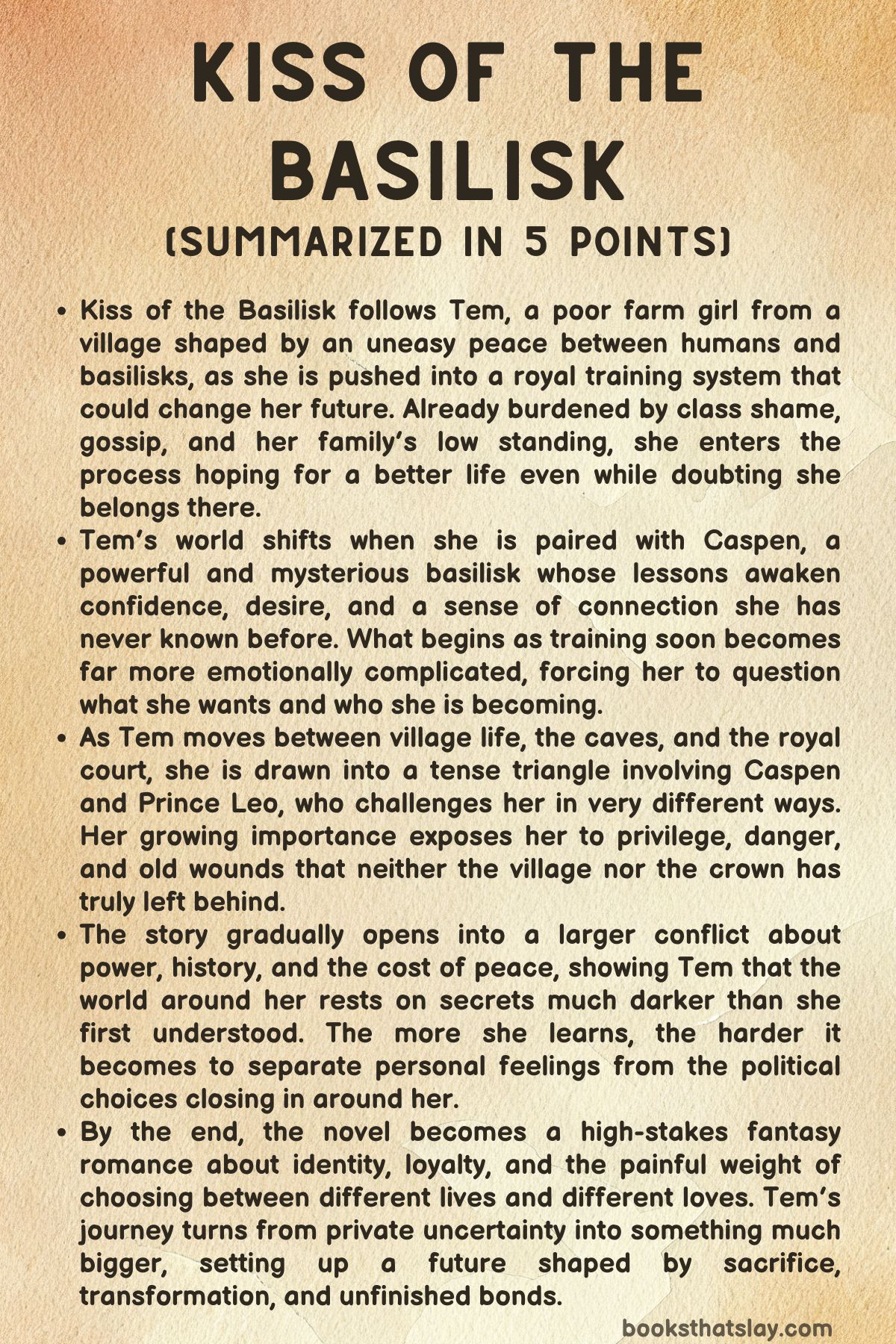
Kiss of the Basilisk by Lindsay Straube is a fantasy romance built around power, class, desire, and divided loyalties. It begins in a small village where one young woman’s future seems tightly controlled by poverty, custom, and the expectations placed on girls chosen for royal competition.
From there, the story grows into something much larger, bringing together human politics, ancient grudges, dangerous attraction, and a brutal struggle over who gets to rule and who gets sacrificed. What starts as a coming-of-age story soon becomes a tale of hidden histories, impossible choices, and a heroine forced to decide what kind of future she can live with. It’s the first book of the Split or Swallow series.
Summary
Tem lives with her mother on a poor chicken farm and is painfully aware of how little respect their family receives in the village. Her insecurity worsens when she visits the bakery and is cornered by Vera, a cruel and smug girl who boasts about her sexual experience with Jonathan and mocks Tem for her innocence.
Vera also reminds her that the basilisk training is meant to prepare girls to compete for the prince’s hand in marriage, and she makes it clear that she sees Tem as beneath the contest. Humiliated and hurt, Tem leaves in tears.
As she walks home, the larger world of the story comes into focus. The village once fought a bloody war with basilisks, shape-shifting beings who can appear either as beautiful humans or as monstrous serpents.
The villagers eventually discovered that mirrors could kill them, and after years of violence a truce was established. The basilisks were given the land beyond the village wall, and in return they agreed to train selected girls in seduction and intimacy so the prince could choose a wife capable of producing an heir.
That agreement still shapes village life, and Tem knows the competition may be her only chance to rise above her low status.
At home, Tem’s mother senses her fear about the upcoming training. Tem wants badly to make her mother proud and to escape the limits of her life, though she cannot imagine truly winning.
Later, her best friend Gabriel takes her to the tavern to lighten her mood. Unlike Vera, Gabriel is affectionate, funny, and loyal, and he encourages Tem when she starts doubting herself.
Even so, seeing Vera openly kissing Jonathan and moving easily among the other girls makes Tem feel even more inadequate. That night she returns home anxious and restless, and she dreams of a strange, harmless fire warming her from within.
The next evening, after being bathed in ritual oils by her mother, Tem joins the other chosen girls and crosses beyond the village wall into the forbidden caves of the basilisks. Terrified but determined, she follows a sense of warmth into the farthest cave.
There she meets Caspen, who is impossibly beautiful and commanding. He soon reveals that he is not merely a basilisk trainer but Caspenon, the Serpent King himself.
Tem is stunned that someone so important has been assigned to her, but Caspen speaks with calm confidence and promises she will not fail.
Their first lesson is intense and unsettling. Caspen asks about her fears and discovers she has never even been kissed.
Instead of rushing into touch, he tells her he needs to see her, and when she nervously challenges him to undress first, he agrees. The encounter becomes a charged lesson in vulnerability and desire.
Caspen studies her body, comments on what the prince may prefer, and has her explore her own pleasure while he watches. He becomes aroused as well, and the experience builds until they climax together without actually touching.
Afterward, Caspen magically shapes part of what he released into a claw-like object and tells Tem to keep it hidden inside her body. When she asks if he will think of her after she leaves, he answers not with words but by making the object pulse inside her so powerfully that she collapses in pleasure.
The next morning Tem feels permanently changed. She cannot eat or think clearly because the claw pulses whenever Caspen is thinking of her.
Even in church she cannot escape him. While the village prays to Kora, goddess of fertility, Caspen’s voice enters her mind and warns her not to make a sound.
The pleasure comes in waves so intense that Tem can barely sit still beside her mother. She also notices Vera secretly touching Jonathan beneath a pew, and the sight only heightens her arousal until she finally reaches climax in the middle of the service while desperately trying to remain composed.
Afterward, Gabriel immediately notices that something is different about her. Tem later tells him most of what happened in the cave, though she keeps the claw secret.
At the bakery, Vera continues to boast about her own basilisk and the prince’s supposed preferences, but Tem privately enjoys knowing she has something Vera does not: she knows the name of the Serpent King. That evening she returns eagerly to Caspen.
Their second lesson is more physical. He removes the claw, teaches her about her own body in practical detail, and shows her how a man may touch her.
Then he guides her in learning his body as well, placing her hand on him and teaching her how to pleasure him. Tem gradually gains confidence as she sees the effect she has on him.
When the lesson ends, Caspen uses the claw on her again and pushes her into another overwhelming climax.
Afterward he feeds her luxurious food, and the tenderness of the moment deepens their bond. He tells her he can sense her fear through her heartbeat and the way she flinches, and she admits that despite her fear she likes his touch.
Then he informs her that they will not meet the next day because the prince wishes to see the possible future wives at the castle. The reminder that Tem is being prepared for another man wounds her more than she expects.
The next day, after more mockery from Vera, Tem finds a beautiful emerald silk dress and a gold necklace with a tiny claw charm waiting for her. The gifts are clearly from Caspen, and she is deeply moved.
A royal carriage then arrives to take her to the castle. There she is dazzled by the scale of wealth and ceremony.
She meets the prince’s sister, Lilibet, who is quick-witted and perceptive. Later, Tem wanders into a study and nearly touches a fanged skull displayed as a trophy, but Caspen’s angry voice in her mind stops her.
Through him she receives flashes of the old war and glimpses the suffering his people endured.
Soon after, she meets the prince himself, Leo. Their conversation is sharp, tense, and unexpectedly intimate.
Leo is not what she anticipated. He provokes her, but Tem refuses to flatter him.
Back in the ballroom, Leo conducts an early elimination of the girls. He humiliates Tem by leaving her until the end and then ranking her last.
Furious, she confronts him directly. Instead of backing down, she forces him to admit that he does want her there.
The encounter leaves a charged connection between them.
Tem’s world shifts again when Caspen later shows her a memorial stone covered with the names of missing basilisks. She realizes they did not simply vanish after the war.
Caspen reveals that the royals have secretly captured basilisks for generations, drained their blood, and turned it into gold. Even the golden claw necklace he gave her was made from his own blood.
Tem is horrified to learn that the royal family’s splendor is built on this hidden cruelty. Caspen warns her that one day she may have to choose between humans and basilisks.
Tem does not want such a choice, especially as her feelings for both Caspen and Leo deepen.
As unrest in the kingdom grows, Tem learns more painful truths. Caspen admits that in the past he killed on his father’s orders, showing her how far love and loyalty can push a person.
Tem speaks with her mother, who finally reveals that Tem’s parents were kept apart because of family opposition. Her mother tells her that real love means sacrificing your own happiness for someone else.
The words stay with Tem as she thinks about both men.
During the Passing of the Crown, public tension explodes. Villagers outraged by recent deaths demand revenge against the basilisks, and the ceremony collapses into violence.
Tem warns Caspen that revolt is coming, but he tells her war has already begun. Soon after, Leo comes to her cottage to make sure she is safe.
Their feelings are impossible to ignore, and Tem kisses him even though she is still bound emotionally to Caspen.
Then Tem agrees to undergo a basilisk ritual in hopes of gaining influence among them and protecting those she loves. Only afterward does she learn the full horror of what it demands: the rite will be public, before hundreds of basilisks, and she is expected to submit first to Caspen’s father and then to Caspen himself to receive the king’s blessing.
Shocked and frightened, she still resolves to go through with it. Caspen leads her into a vast underground chamber where the ritual begins before the gathered crowd.
What follows turns into catastrophe and battle. Leo and Caspen share a brief moment of understanding amid the chaos.
Tem refuses to flee when violence erupts around them. Caspen is badly injured, and when he admits he is too weak to transform, Tem turns inward and forces the divided parts of herself back into balance.
In doing so, she restores her strength, heals her basilisk side, and regains her full power. Through their connection she commands Caspen to transition, and he transforms at once, tearing through the attacking basilisks.
But the danger is not over. Bastian seizes Tem and tries to dominate her through the crest, then bites into her shoulder with devastating force, nearly destroying her.
Caspen reaches them and kills Bastian in a savage act of vengeance, but Tem is left dying. Neither her own power nor Caspen’s can heal her.
Caspen says the only way to save her is for her to draw power through the crest from a human, and that human must be Leo. Tem resists because she will not bind him without consent, but when Leo arrives and sees her condition, he willingly gives that consent.
With Caspen helping her, Tem reaches into Leo through the crest and draws power from him. The bond is intimate and overwhelming, but it works: her body heals fully, her wounds close, and her strength returns.
When the fighting finally ends, the clearing is full of corpses, blood, and ruin. Caspen raises Bastian’s body and claims victory as the new Serpent King.
Later, Tem and Leo share a quiet goodbye. Though he is now permanently linked to her through the crest, she refuses to use that bond to control him.
Instead, she tells him to find Evelyn and choose his own future. They admit that what they shared was real and kiss one last time before parting.
In the aftermath, Tem and Caspen accept their new roles as queen and king. Together they talk about Leo, about loss, and about what comes next.
Tem creates a golden claw of her own and gives it to Caspen, sealing their union in the private way basilisk marriage is recognized. In the epilogue, Leo takes power as king, imprisons his father Maximus, frees the captive basilisks, and learns where Evelyn is.
He rides through the night to find her, carrying the memory of Tem and the hope of a different future.
Characters
Tem
Tem stands at the center of the story of Kiss of the Basilisk – as a young woman shaped by shame, hunger for dignity, and a growing awareness of her own power. At the beginning, she sees herself through the harsh judgments of her village.
She is poor, inexperienced, and constantly reminded that she comes from a family with little status. Vera’s taunts wound her so deeply because they touch every insecurity Tem already carries within herself.
She wants a better life for herself and her mother, but she does not begin with confidence or grand ambition. Instead, she enters the basilisk training with fear, uncertainty, and the hope that she might simply survive it well enough to improve her future.
That modest beginning makes her later transformation far more striking, because every step forward feels earned through pain, learning, and choice.
What makes Tem compelling is the way her emotional and physical awakening is tied to her moral awakening. Her connection with Caspen teaches her desire, confidence, and self-knowledge, but it also opens her eyes to hidden truths about the world around her.
She does not remain a passive student being shaped by stronger forces. She grows increasingly capable of questioning both basilisk and human systems of power.
Her relationship with Leo complicates her even further, because she is not simply choosing between two lovers but between two worlds, two loyalties, and two versions of justice. Tem becomes strongest when she stops thinking of herself as broken or divided.
In the climax, her restoration comes from accepting all parts of herself and reclaiming her power from those who want to define or use her. By the end, she is no longer a frightened village girl hoping to be chosen.
She becomes someone who chooses for herself, carries immense authority, and still refuses to surrender her emotional complexity.
Caspen
Caspen begins as an object of awe and desire, but he becomes far more layered as the story progresses. As the Serpent King, he carries enormous symbolic weight from the moment Tem meets him.
He is beautiful, commanding, mysterious, and deeply practiced in control, which makes his early interactions with Tem feel both dangerous and strangely tender. He guides her with confidence, yet he is rarely careless with her fear.
Even in moments of intense intimacy, he watches closely, studies her reactions, and seems determined not merely to use her but to draw her into a connection that matters to him. That balance between dominance and attentiveness defines much of his character.
He is powerful enough to overwhelm, yet the story repeatedly shows that he is also vulnerable in ways Tem slowly uncovers.
His deepest complexity lies in the burden of history. Caspen is not just a seductive teacher or forbidden lover; he is a survivor of a political order built on violence against his people.
The revelation that the royals have been harvesting basilisk blood gives his actions an entirely different dimension. His gifts, his anger, and his possessiveness all become inseparable from centuries of exploitation and grief.
He is capable of tenderness, but he is also capable of ruthlessness, and the story never hides that darker side. His confession about killing Rowe’s father at his own father’s order reveals a man shaped by impossible loyalties and moral compromise.
He loves fiercely, but his love has always existed in a world where survival requires brutality. That is why his bond with Tem feels so intense: she becomes one of the few people before whom he can be both king and wounded son, both dangerous creature and devoted partner.
By the end, when he claims power after defeating Bastian, he is not simply triumphant. He is a man who has paid heavily for survival and now faces the challenge of building something different from the violence that formed him.
Leo
Leo is introduced under the shadow of royalty, competition, and public humiliation, yet he quickly proves more interesting than the role Tem expects him to play. At first he appears to be the prince overseeing a cruel system in which women are ranked and displayed for his benefit.
His decision to place Tem last in the early elimination makes him seem arrogant and manipulative. Yet even in that scene, there is a tension between performance and sincerity.
He is clearly provoked by Tem because she refuses to flatter him, and his interest in her grows out of that defiance. Leo is drawn to her not because she fits the role expected of a future bride, but because she unsettles him and forces him to speak honestly.
As the story unfolds, Leo becomes a character defined by conflict between inheritance and conscience. He stands inside the machinery of royal power, but he is not fully at ease within it.
The strain between him and Maximus during the Passing of the Crown suggests that he is already at odds with the world he is supposed to lead. Tem’s growing awareness of the royals’ crimes casts suspicion over him, and that tension is essential to his character.
He is never allowed the comfort of being merely noble or merely guilty. Instead, he occupies a painful middle space where affection, privilege, ignorance, and responsibility collide.
His care for Tem is real, and his willingness to consent to the bond that saves her shows extraordinary trust and emotional courage. What is especially moving about Leo is that he does not fight to possess her at any cost.
In the end, even though he is bound to her, she frees him to choose his own path, and he accepts that loss with dignity. His later actions as king, including imprisoning Maximus and freeing the captive basilisks, suggest that love and suffering have changed him into someone more morally awake than the prince Tem first met.
Gabriel
Gabriel serves as Tem’s closest emotional refuge in the human world. He brings warmth, humor, and irreverence to scenes that might otherwise be dominated by fear or humiliation.
From the beginning, he offers the kind of friendship Tem desperately needs: affectionate, teasing, and free of cruelty. He does not belittle her inexperience or reinforce the village’s hierarchy.
Instead, he helps her feel seen and valued when others make her feel small. That emotional steadiness is one of his most important functions in the story.
He keeps Tem tethered to ordinary affection and loyalty even as her life becomes entangled with royal and basilisk power.
Yet Gabriel is more than comic relief or supportive company. His presence also reveals important things about Tem.
With him, she can confess, joke, and react honestly, which highlights how constrained she feels elsewhere. He becomes a witness to her transformation, noticing almost immediately when something inside her has changed.
His teasing about Caspen never feels malicious; it is his way of giving Tem room to acknowledge her own desires without shame. Gabriel also represents a more humane version of village life, one built on companionship rather than judgment.
In a story filled with intense romantic and political bonds, his friendship remains one of the purest relationships Tem has. That makes his survival matter, and it reminds the reader that Tem’s stakes are never only romantic or symbolic.
She is also fighting for the ordinary people she loves.
Vera
Vera is one of the clearest embodiments of social cruelty in the village, but she is not effective simply because she is unkind. She matters because she represents a model of femininity that Tem is told she should envy or imitate.
Vera is sexually experienced, socially confident, and eager to weaponize both traits against other girls. Her early conversations with Tem are designed to humiliate, reduce, and establish dominance.
She understands exactly where Tem feels most vulnerable and attacks there without hesitation. In that sense, Vera is not just a personal antagonist.
She is an extension of the world’s shallow values, where desirability, status, and competition shape how girls see themselves and one another.
At the same time, Vera’s jealousy when she learns that Tem is being trained by Caspen reveals her insecurity. For all her confidence, she is deeply invested in rank and validation.
She boasts because she needs to be seen as superior. Once Tem possesses something rare and powerful, Vera’s smug certainty cracks.
That shift is important because it shows that Vera’s cruelty is built on a fragile foundation. She is not powerful in any lasting way; she is simply skilled at operating within a narrow, vicious system.
Her character sharpens the reader’s understanding of Tem’s growth. As Tem changes, Vera’s insults begin to lose their hold, and that emotional shift signals that Tem is no longer trapped inside the village’s judgment.
Daphne
Tem’s mother, Daphne, is a quieter character in Kiss of the Basilisk, but she carries great emotional significance. She begins as a figure of care, ritual, and endurance.
She prepares Tem for the training with tenderness, shares what comfort she can, and tries to offer courage despite their difficult circumstances. Much of her importance lies in what she does not initially say.
Her silence about Tem’s father, about love, and about the past suggests a life shaped by disappointment and sacrifice. She has learned to survive through restraint, and Tem grows up sensing both her love and her secrecy.
As the story progresses, Daphne becomes one of the clearest sources of moral wisdom. Her explanation that love means sacrificing one’s own happiness for someone else’s gives Tem a way to understand both Caspen and Leo, but it also reveals Daphne’s own history.
Her past relationship was not lost because affection failed, but because the world around them made it impossible. That history gives her scenes with Tem a quiet ache.
She understands better than Tem does what it means to love across divisions shaped by power, family, and social rules. In the epilogue, her reunion with Kronos suggests that her story is not merely one of loss, but of deferred truth and unfinished emotional life.
Daphne grounds the novel’s larger conflicts in the intimate reality of what women endure, remember, and pass down.
Lilibet
Lilibet brings a lively and perceptive energy to the royal side of the story. Her first interaction with Tem in the bathroom immediately sets her apart from the more rigid performances of court life.
She is teasing, observant, and socially intelligent, quickly recognizing Tem’s unusual position in the prince’s orbit. Unlike characters who simply reinforce hierarchy, Lilibet seems to enjoy cutting through pretense.
She reads people well and speaks with a kind of mischievous directness that makes her memorable even in limited page time.
Her importance lies partly in how she softens the image of the royal family without fully cleansing it. Through Lilibet, the palace becomes more than a cold place of spectacle and cruelty.
She suggests that individual warmth and wit can survive even inside corrupt institutions. At the same time, her presence also highlights Tem’s outsider status.
Lilibet can move through courtly spaces with ease, while Tem experiences them as foreign and threatening. Later, when she is present during Tem’s near death and healing, her inclusion reinforces the sense that the emotional stakes now cross old political boundaries.
She is not central in the same way as Tem, Caspen, or Leo, but she helps widen the world and complicate easy judgments about the humans on the royal side.
Bastian
Bastian functions as one of the story’s most terrifying embodiments of domination and corruption. He is not merely an enemy in the final conflict; he represents a perverse relationship to power itself.
His attack on Tem is horrifying because it is both physical and spiritual. He does not simply try to kill her.
He tries to seize her strength, invade her identity, and reduce her to a source of energy he can consume and control. That makes him a particularly effective villain in a story so concerned with bodily autonomy, consent, and divided loyalties.
What makes Bastian especially chilling is the way he stands against Tem’s hard-won self-integration. Just as she restores balance within herself, he attempts to fracture her again by targeting the source of that restored power.
His violence is not random rage but calculated violation. Caspen’s savage killing of him feels extreme, but the story frames it as the destruction of a predator whose existence is tied to devouring others.
Bastian thus serves an important structural role: he becomes the figure against whom Tem and Caspen’s bond is tested most brutally, and his defeat marks the end of one kind of tyrannical order.
Maximus
Maximus represents the old human order at its most compromised and decayed. As king and father, he should embody stability and legitimacy, but instead he appears increasingly as a figure of mistrust, hidden cruelty, and weakened authority.
His hesitation during Leo’s crowning is a small but revealing moment, suggesting that succession is not a smooth transfer of honorable power but a strained and unstable performance. By this point, the rot within the monarchy has already been exposed through the secret exploitation of basilisks, and Maximus stands as one of the chief inheritors and protectors of that system.
He matters most as a contrast to Leo. Where Leo still has the capacity for change, Maximus seems bound to the old logic of rule through secrecy and violence.
He is part of the reason Tem cannot trust royal love or royal promises without suspicion. In the epilogue, Leo’s decision to imprison him is symbolically powerful because it marks a rejection of paternal and political inheritance.
Maximus is therefore less emotionally nuanced than some other characters, but his role is vital. He embodies the corrupt weight of the past that younger characters must confront if anything is to change.
Jonathan
Jonathan is a minor figure, but he plays an important role in establishing the social atmosphere around Tem. He is first presented through Vera’s boasting, which turns him into a symbol of sexual validation and status rather than a fully developed individual.
His presence shows how desire in the village is constantly performed, discussed, and used competitively. The fact that Tem feels embarrassed and excluded in relation to him says more about her insecurity and the village’s culture than it does about Jonathan himself.
Later, when Tem sees Vera secretly touching him in church, he becomes part of a moment that intensifies both Tem’s arousal and her awareness of how public and private desire can blur. He remains more symbolic than substantial, but that symbolism matters.
He helps define the ordinary human world of gossip, coupling, and social comparison that Tem is beginning to outgrow even as it still wounds her.
Evelyn
Evelyn appears most clearly at the end, yet her importance extends beyond page time because she represents unfinished destiny for Leo. Her presence in the epilogue reframes his future.
After all that has happened with Tem, the story does not leave him isolated in loss. Instead, Evelyn stands as the next step in his emotional and political life, someone whose significance has been delayed but not erased.
Leo riding through the night to find her gives his ending movement and possibility rather than mere grief.
Because she enters so late, Evelyn functions less as a fully analyzed personality and more as a horizon of renewal. Still, that role matters.
She prevents Leo’s story from closing entirely around what he could not have, and she reinforces the idea that love in this narrative is rarely singular or simple. People are changed by one bond and carried forward into another.
Kronos
Kronos remains mostly in the background, but his significance rests in what he reveals about the hidden past. His connection to Daphne suggests a history of love divided by family, power, and secrecy, mirroring the younger generation’s struggles in a different form.
The fact that he is found imprisoned in the dungeon ties him directly to the machinery of suppression that shapes the larger world. He is both a lost man and a living remnant of truths long buried.
His reunion with Daphne in the epilogue gives emotional weight to the idea that the older generation has not simply disappeared into tragedy. Their story continues to matter, and its recovery hints that healing the present requires recovering what was silenced in the past.
Even as a secondary figure, Kronos adds depth to the novel’s sense of inherited pain and delayed reconciliation.
Themes
Desire as Power, Knowledge, and Vulnerability
Sexual awakening in this story is never treated as a simple private experience. It becomes a force that shapes hierarchy, identity, and political conflict.
Tem begins as someone who has been made to feel ashamed of her inexperience. Vera uses sexual knowledge as a weapon to humiliate her, and the village itself frames the training as preparation for pleasing a prince and securing an heir.
From the beginning, desire is tied to judgment, competition, and social worth. What makes Tem’s journey compelling is that she slowly takes ownership of a part of herself that others first tried to define for her.
Her early encounters with Caspen are intense, but they are also educational. He teaches her about her body, her reactions, and the effect she can have on another person.
That growing awareness changes her from a girl driven by embarrassment into someone who can move through the world with more confidence.
At the same time, the novel refuses to present desire as uncomplicated freedom. Tem’s body becomes a site where outside forces act on her, whether through the claw, the public expectations surrounding the prince’s contest, or the ceremonial demands of basilisk culture.
Pleasure can be intimate and affirming, but it can also expose her to manipulation, pressure, and emotional confusion. Her bond with Caspen gives her access to connection and strength, yet it also deepens the stakes of every choice she makes.
Later, when she draws power from Leo in order to survive, intimacy becomes directly linked to life, healing, and permanent consequence. The novel keeps showing that desire creates closeness, but also obligation.
It opens Tem to joy, yet it also leaves her vulnerable to loss and conflict. That tension gives the book much of its emotional force.
Physical longing is never isolated from the larger questions of trust, consent, selfhood, and power. Instead, it becomes one of the main ways the story explores how a young woman learns what she wants, what she fears, and what she is willing to risk.
Love Divided by Loyalty and History
The emotional center of the novel is built around divided love. Tem does not stand between two men in a shallow or decorative way.
She is caught between two worlds, two histories, and two forms of attachment that each demand something different from her. Her feelings for Caspen grow through intimacy, shared secrets, and a sense of being deeply seen.
He recognizes her fear, her desire, and her potential long before she fully understands herself. With Leo, the connection is shaped by confrontation, resistance, and unexpected tenderness.
He is part of the royal line that benefits from basilisk suffering, yet he is also capable of care, vulnerability, and moral change. Because of that, Tem’s conflict is not simply about choosing which man she prefers.
It is about trying to reconcile affection with justice, and private feeling with public consequence.
This theme becomes more painful as the truths of the kingdom emerge. Once Tem learns that royal wealth has been built through the torture and exploitation of basilisks, love can no longer remain separate from history.
Her attachment to Leo becomes morally complicated. Her bond with Caspen becomes burdened by the reality of inherited violence and old wounds.
Neither relationship is pure escape. Each carries responsibility, memory, and danger.
The novel handles this conflict with unusual seriousness because it does not let romance erase political reality. Tem may love both men, but love does not cancel harm, nor does it solve centuries of mistrust.
The story also keeps returning to sacrifice as the test of love. Tem’s mother describes love as the willingness to surrender one’s own happiness for another person’s sake, and that idea echoes through the major relationships.
Caspen has already been shaped by impossible choices made in the name of loyalty. Leo must confront what it means to care for Tem while belonging to a system that has brutalized those she now stands with.
Tem herself is repeatedly pushed toward forms of sacrifice, whether emotional, physical, or political. By the end, love is not presented as possession or victory.
It is marked by grief, restraint, and the painful recognition that caring for someone may mean refusing to control them. That gives the romantic elements a tragic maturity.
The story suggests that love matters most not when it secures certainty, but when it survives conflict without becoming selfish.
Class, Status, and the Hunger to Become More
Tem’s social position shapes nearly every part of her early life. She is a poor farmer’s daughter who has internalized the village’s contempt, and her sense of inferiority is reinforced through daily humiliations.
Vera mocks her smell, her lack of polish, and her inexperience. The training for the prince is presented as one of the only possible routes upward, which means Tem’s body and performance become tied to social advancement.
This creates a world in which class is not just economic. It is emotional and psychological.
Tem has learned to measure herself against standards set by people who already hold more beauty, wealth, and confidence than she does. Even when others tell her she is worthy, she struggles to believe it.
What makes this theme especially rich is that the story keeps exposing the fragility and corruption beneath visible status. The royal court appears dazzling, full of luxury and ceremony, but that display is sustained by hidden cruelty.
Gold, jewels, and grandeur are shown to rest on bloodletting and secret imprisonment. In the same way, the village’s supposed moral order is full of hypocrisy, resentment, and lust.
The institutions that define value are deeply compromised. As Tem moves between cottage, cave, church, and castle, she begins to see that prestige is often built on violence or performance.
This changes her understanding of what it means to rise. Advancement is no longer a simple dream of becoming chosen.
It becomes entangled with the question of what kind of world she would be entering, and what that world has cost others.
Her transformation, then, is not only from poor girl to queen. It is from someone who longs for approval into someone who begins to define worth on her own terms.
She gains beauty, confidence, and power, but more importantly, she gains the ability to see through the false authority of inherited status. Even public humiliation by Leo does not destroy her because she eventually learns that rank can be manipulated and that judgment from above is not always legitimate.
By the end, the story has shifted the meaning of elevation. True change does not come from being adorned by a corrupt system.
It comes from surviving it, understanding it, and becoming capable of reshaping it.
Inheritance, Violence, and the Struggle to Break Cycles
The world of Kiss of the Basilisk is driven by old wounds that refuse to stay buried. The war between humans and basilisks is not merely background history.
Its consequences shape law, desire, wealth, custom, and fear in the present. Every major institution in the novel is touched by inherited violence.
The village wall, the training rituals, the royal succession, the missing basilisks, and even the treasures displayed in the castle all carry traces of a conflict that was never truly resolved. This creates a central tension: characters are constantly forced to live inside structures built by earlier generations, even when they did not choose them.
Tem becomes important partly because she stands at the point where several lineages and loyalties meet. Her absent father, her unusual freckles, her connection to human and basilisk power, and her eventual restoration all suggest that identity itself carries the weight of inheritance.
Yet the story does not treat inheritance as destiny alone. It is also a burden that must be interpreted and resisted.
Caspen has been shaped by his father’s ambition and cruelty. Leo inherits a crown bound to a legacy of exploitation.
Tem inherits not only bloodlines but also the consequences of decisions she never made. This makes adulthood in the novel feel like a confrontation with the past.
To grow into power, the characters must decide whether they will repeat what came before or break it.
The climax brings this theme into sharp focus. Bastian represents a monstrous version of inheritance, a ruler who consumes others in order to preserve dominance.
Caspen’s killing of his father is not just personal revenge; it is the violent destruction of an old order that has corrupted love, kinship, and rule. Leo’s later actions as king matter for the same reason.
By imprisoning Maximus and freeing the basilisks, he attempts to end a cycle rather than benefit from it. Tem’s final choices also reflect this struggle.
She refuses to use her bond with Leo as a tool of possession, even though she has the power to do so. That refusal matters because it breaks the logic of domination that has governed the kingdom for generations.
The novel ultimately argues that inherited systems are powerful, but they are not absolute. People may be formed by violence, secrecy, and old loyalties, yet they still have moments in which they can choose differently and create the conditions for a less brutal future.