The Bones Beneath My Skin Summary, Characters and Themes
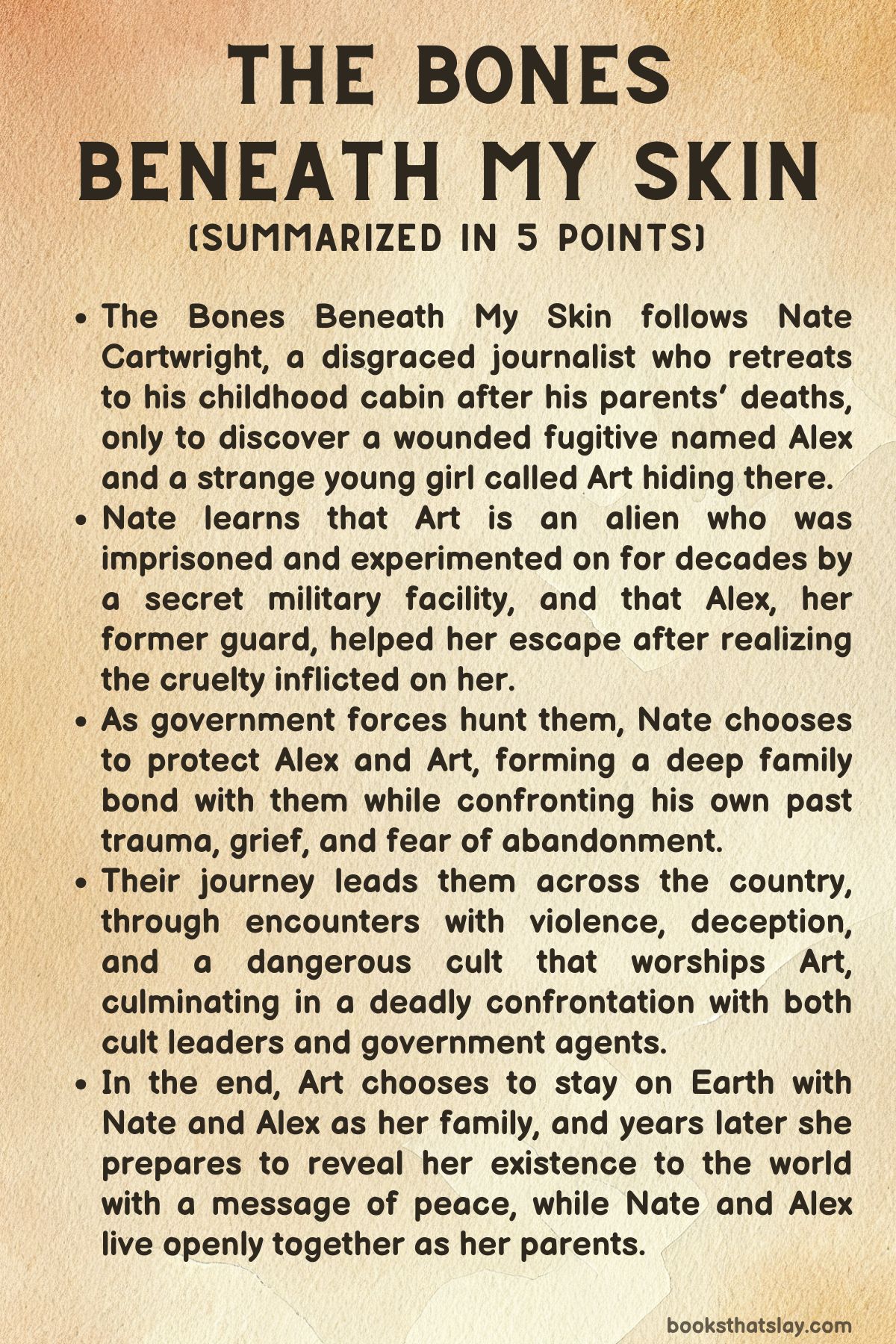
The Bones Beneath My Skin by TJ Klune is a road-trip thriller with a sci-fi edge, built around grief, found family, and the cost of feeling safe in your own skin. After a personal tragedy, Nate Cartwright retreats to an inherited cabin in rural Oregon hoping for quiet and distance from his old life.
Instead, he finds two strangers already inside: Alex, a wounded ex-Marine who refuses to explain why he’s hiding, and Art, a strange, sharp, and funny little girl who seems to know things she shouldn’t. As danger closes in, Nate is pulled into their flight—and into a bond that changes what he thinks he knows about people, love, and belonging.
Summary
On March 31, 1995, Nate Cartwright drives south through Oregon with the radio for company and grim news updates breaking up the miles. He is heading to Roseland, a small mountain town tied to childhood memories of a family cabin near Herschel Lake.
The trip isn’t nostalgic. Nate’s parents are dead—his father killed his mother and then himself—and the only thing left to Nate is an old truck and the isolated cabin.
Nate, a journalist living in Washington, D.C., has packed his life into storage and come here to disappear for a while.
In Roseland, he stops at Big Eddie’s Gas and Convenience. Eddie Green greets him warmly, remembers him instantly, and offers quiet sympathy.
Eddie mentions something that unsettles Nate: last September, Nate’s mother came up to the cabin with a friend named Joy and seemed happy. Nate doesn’t know what to do with that information.
His last clear memory of the cabin is from years earlier, when his parents caught him with a boyfriend. His father’s reaction was violent and cruel, and his mother’s silence stung almost as much.
Nate left and never went back, never repaired what broke that day.
He drives into the forest, follows the hidden turn toward Herschel Lake, and reaches the cabin after dark. The place looks unchanged: cramped rooms, an old kitchen, shelves full of books he once loved.
Tired and raw, he unloads only what he needs and heads to the shed to start the generator. That’s when the first wrong detail lands—there is warm air in the shed, and the generator is hot, as if it has already been running.
Before he can think it through, a gun is pressed to the back of his head. A rough male voice orders him to drop the flashlight, lace his fingers behind his neck, and stay still.
Nate tries to talk his way out. He offers his wallet.
He explains the cabin is his inheritance and that hardly anyone knows he is here. The man doesn’t sound convinced and asks pointed questions about who Nate works for and how he “found” them.
Then a small voice interrupts—calm, bright, and oddly assured. A blonde girl steps into view wearing a Care Bear shirt and announces her name as “Artemis Darth Vader.” She calls herself Art.
She also reveals she has Nate’s wallet and somehow knows his full name and where he lived, details she should not have. The armed man—Alex—looks exhausted and badly hurt, with a bandage around his side.
While Nate is trying to make sense of any of this, Alex suddenly collapses. Nate’s shock spikes into dizziness, and he passes out too.
He wakes on the couch under an afghan, with Alex sitting nearby and keeping him covered with the gun. Nate threatens to call the police.
Alex responds with a warning shot that tears into the wall close enough to make the message clear. Art tries to smooth things over, insisting Alex is hurt and that they can’t go to a hospital because they’re running.
When Art offers Nate the gun as a show of trust, Nate points it at them—only to have Alex disarm him with practiced speed despite his injury. Nate bolts outside to call for help, but his phone has no signal.
When he decides to drive to town, he realizes his keys are missing. Art admits she dropped them by the shed in the scramble to move Nate when he fainted.
Nate finds the keys, but he doesn’t leave. Some part of him can’t ignore Alex’s condition, and Art keeps asking for food with blunt urgency.
Back inside, Nate examines Alex’s side and notices something that doesn’t add up: the wound looks both severe and oddly improved, as if healing faster than it should. Alex is evasive about when he was shot, even denying he ever claimed he was.
Nate retreats to his room furious and shaken, spending the night pacing, listening for movement, and wondering if grief has scrambled his sense of reality.
Morning brings more evidence that Alex and Art are capable and careful. Nate finds his belongings unpacked and stacked in the living room, and his groceries organized neatly in the pantry and fridge.
Alex stands in the kitchen with coffee like he belongs there. Nate demands answers and catches sight of a USMC tattoo on Alex’s arm.
He cooks breakfast, but his attempt at a simple omelet turns into an oversized scramble with a full dozen eggs, bacon, and toast—partly stress, partly an attempt to take control of the moment.
Art appears in loud pajamas and oversized neon-green sunglasses, fascinated by everything and especially by bacon. She peppers them with questions about where food comes from, what animals become what meals, and how any of it makes sense.
Alex is guarded, tense, and alert, but he also keeps an eye on Art with the focus of someone who has been responsible for her survival. The odd domestic scene is cut short by a knock at the door.
Alex’s reaction is immediate: gun in hand, Art swept into his arms, eyes narrowed like a trap is already closing. Nate insists only a few people know he’s here.
The visitor is Randy from Douglas County Public Works, early for an appointment to turn on the cabin’s water. Nate goes outside, improvising calm while Art silently pulls faces and mimes wrestling moves from behind the curtains.
Randy chatters about the area and politics, takes Nate’s signature, and turns the water on. A crash from inside nearly exposes everything, but Nate lies quickly, blaming pipes and inventing an aggressive dog named Fido.
Randy leaves, and Nate returns to find Art has broken a lamp. Alex checks the perimeter like Randy might not be what he seemed.
Despite anger and fear, Nate agrees to let them stay briefly. Art argues for the simplest comforts—water, a bed, books—and Alex doesn’t contradict her.
The arrangement turns into motion. Soon they are traveling together, avoiding major highways as Alex insists it’s safer on back roads.
Nate keeps asking what they’re running from, and Alex keeps keeping the answer just out of reach.
On the road, Art’s personality fills the spaces where explanations should be. She is funny, too observant, and occasionally frightening.
When they stop in Montana to watch a herd of bison, Art is openly amazed, and Alex allows the stop, revealing a sliver of his own past—how he once saw bison as a kid on a trip through national parks. Nate watches them and feels the shift happening in him: the cabin was supposed to be an escape from people, but these two are now taking up real space in his life.
Then Art casually confirms something Nate has half-joked about: aliens are real. Her certainty is immediate, and her details are too specific.
Alex cuts her off fast. The warning isn’t only about what she might reveal—it’s about how dangerous the truth is.
Their routine becomes strict at gas stations and roadside stops: one adult goes in while the others stay low in the truck, Art hidden on the floor. In Havre, Montana, Alex goes inside while Nate stays with Art.
A sheriff’s deputy pulls in and takes interest. Nate’s panic spikes.
When Alex steps back outside, the deputy follows him, and suddenly Nate experiences something impossible—Art’s voice in his head, then Alex’s, along with a surge of images and emotions that aren’t his. He sees fragments like snapshots: the cabin, water, a dark-haired woman, a boy, loneliness so sharp it feels physical.
He realizes Art has created a mental connection, a “bond,” linking them.
The deputy questions Alex in a friendly way that still feels like pressure: where they’re headed, why they’re taking certain routes, whether Alex served. Alex keeps his answers controlled.
Afterward, the truck won’t start until Alex snaps at Art to “let go.” When she does, the connection drops and the engine catches. Alex confronts her for linking Nate without permission.
Art insists Nate “fits,” that he belongs with them, and that Alex will need Nate later. The idea of an “after” hangs over Nate like a shadow.
The deputy follows them and pulls them over again. Alex tells Nate to grab the gun but keep it hidden.
When the deputy approaches, Art performs innocence so convincingly it turns the moment on its head, calling Alex her “daddy” and turning on tears at just the right time. The deputy’s suspicion softens into concern; the stop becomes about a broken taillight, not fugitives.
They’re allowed to leave with a warning.
That night, Nate demands the truth about the bond and about what he heard. Alex explains it isn’t simple mind reading, more like a channel Art can open, sharing only what someone lets through—or what slips out in fear.
Under pressure, Alex admits that on the first night he considered killing Nate, then held back because Art argued Nate might be someone who could protect her if Alex failed. Nate is shaken, but he also recognizes the shape of Alex’s conflict: violent competence pressed into service of a promise he can’t afford to break.
The flight eventually narrows into a siege. Nate, Alex, and Art end up trapped in a farmhouse basement while soldiers tear at a reinforced steel door, trying to reach them.
The threat is organized and overwhelming, and it has a name: the Mountain. In the tight space, the emotional truth finally comes out.
Alex’s focus has always been getting Art “home,” even if that means leaving everything else behind. Art refuses to accept that, furious at the idea of being delivered like cargo while the people she loves are sacrificed.
Nate, who started this journey trying to be alone, realizes he has already chosen them.
When the door is nearly breached, Art walks up and knocks as if she’s calling on a neighbor. She asks if “Randy” is there.
The soldiers’ reaction flips into panic the moment they understand who she is. Art’s power erupts: she bends the air and rips the steel door off its hinges, sending it down the hall with force that crushes anyone who can’t move fast enough.
She throws attackers aside with a flick of her hand. Alex grabs a rifle.
Nate arms himself with a baton and moves with the urgency of someone who has run out of places to retreat.
Outside, the yard is packed with troops, armored vehicles, and a Black Hawk overhead. Randy steps forward with a bullhorn, no longer a county worker but a handler.
Art answers him through a walkie-talkie, confirming a man named Oren Schraeder is dead. Randy admits the Mountain has been watching them, treating their lives like an experiment—especially once Nate joined them.
He calls Art an alien presence that infects minds and must be contained “for humanity.” He tries to pull Nate back by bringing up Nate’s brother and home, but Nate refuses. He tells Randy his family is here, on this porch.
Randy escalates. Laser dots bloom across Nate and Alex’s chests as snipers take aim.
He threatens to kill Alex and take Art unless she surrenders. Gunfire erupts.
Nate shuts his eyes, and a flood of memory and sensation pours through him—pieces of Alex’s past, pieces of Art’s origin, the first contact between a lonely nonhuman presence and a human who chose control over care.
When Nate opens his eyes, he isn’t bleeding. None of them are.
Hundreds of bullets hang in the air, frozen around them, held by Art’s will. Art is furious enough to turn the attack back on every person in the yard.
Alex pleads with her to stop. After a long beat, she releases the bullets, letting them fall harmlessly to the ground—proof that she could end the fight, and also proof that she is choosing not to become what they fear.
Characters
Nate Cartwright
Nate Cartwright is the emotional center of The Bones Beneath My Skin, a man who arrives at Herschel Lake hoping grief and isolation will quiet the noise of his life, only to be forced into connection again. His parents’ violent deaths don’t just reopen old wounds; they underline how thoroughly Nate has been shaped by abandonment, silence, and shame—especially the memory of being expelled by his father and emotionally deserted by his mother when he was caught with a boyfriend.
Nate’s instincts are practical and wary: he thinks in logistics (supplies, signals, keys, exits), and his first responses to threat are control and containment. Yet the same person who wants to disappear also can’t ignore suffering when it is right in front of him, which is why he keeps feeding Alex, keeps listening to Art, and keeps returning to the cabin even when every rational part of him says to run.
Over time, Nate’s arc becomes a deliberate redefinition of family: he moves from inherited loneliness to chosen loyalty, and his decision to claim Alex and Art as “right here” family is not naïve heroism but a hard-won refusal to let violent people and systems decide what he deserves.
Alex
Alex is built like a weapon and behaves like one at first—controlled, suspicious, and prepared to kill if that’s what survival requires—but his hardness is as much armor as it is temperament. The gun-to-the-head introduction isn’t just intimidation; it’s evidence of a life where trust is a liability and hesitation gets you captured.
He carries the stamp of service and training (the USMC tattoo, tactical routines, highway avoidance, and rapid threat assessment), and he treats the world like a map of angles and exits. What complicates Alex is the mismatch between his claimed injury and his apparent recovery, hinting that the danger surrounding him is not simply criminal but abnormal—something that has altered the usual rules of bodies, healing, and time.
His bond with Art exposes the tenderness he tries to bury: he is protective to the point of ferocity, but also deeply afraid of failing her, which is why he speaks in absolutes about “the mission” and “getting her home.” The emotional breakthrough—admitting he loves both Art and Nate—reframes him as someone whose strength is not only in violence but in commitment, and his most defining moment is arguably restraint: when Art could turn suspended bullets into massacre, Alex’s plea becomes an act of moral leadership, choosing humanity not through institutions but through relationship.
Artemis “Art” (Artemis Darth Vader)
Art is the story’s wild, luminous contradiction: a child who behaves like a child—obsessed with bacon, costumes, waitress routines, and silly wrestling mimes—while also possessing terrifying, reality-bending power and a mind that can touch other minds. Her humor and odd specificity are not just comic relief; they create a protective layer that keeps her from being reduced to an experiment or a weapon.
Art’s insistence on names, performance, and play reads like self-authorship: she refuses to be defined by the people hunting her, and she refuses to be handled as an object even when adults around her try to control the narrative. The “bond” she creates is one of the most revealing tools in The Bones Beneath My Skin because it makes intimacy unavoidable—Nate is forced to feel what he usually keeps at a distance, and Alex is exposed beyond his guarded exterior.
Art’s moral compass is strongly relational: she is capable of catastrophic violence, but she also craves belonging so intensely that she will risk everything to keep her small unit intact. Her power peaks in moments that mirror her emotional state—she bends air, tears doors from hinges, suspends bullets—yet what ultimately matters is that she can choose not to retaliate.
That choice, guided by love rather than obedience, is what makes her more than “alien” or “thing”: she is a person asserting agency, boundaries, and mercy in a world determined to deny her all three.
Eddie Green
Eddie Green functions as the story’s early proof that kindness still exists in the places Nate associates with pain. He is warm, observant, and anchored in community, recognizing Nate immediately and offering help without demanding intimacy or explanation.
Eddie’s condolences are sincere, but what makes him important is his small, practical generosity: giving his number, filling the truck, talking like someone who expects people to look after each other. He also serves as a bridge to Nate’s past, providing details Nate didn’t know—like his mother’s visit with Joy—which complicates Nate’s rigid view of his mother as only silent and complicit.
Eddie represents the life Nate could have had in Roseland if he’d been met with acceptance instead of cruelty, and his presence quietly challenges Nate’s assumption that returning to this place must mean returning to harm.
Benji
Benji appears briefly, but he matters as a symbol of ordinary childhood—homework, routine, safety—set against the extraordinary child in the cabin who is anything but safe. Where Art’s childhood is surveilled, weaponized, and hunted, Benji’s is protected and mundane, and that contrast sharpens the tragedy of what has been done to Art.
His presence also deepens Eddie’s character as a father, which indirectly highlights the absence of nurturing fatherhood in Nate’s life and the fierce, improvised fatherhood Alex tries to provide.
Joy
Joy is mostly seen through Eddie’s recollection, but her role is significant because she represents a version of Nate’s mother that Nate never got to witness: happy, social, proud, and possibly trying to build a life outside the gravitational pull of Nate’s father. Joy becomes a destabilizing fact in Nate’s grief—evidence that his mother’s story might include choices, friendships, and courage that Nate never knew about.
That ambiguity is emotionally potent because it forces Nate to grieve not only the mother he had, but the mother she might have been if fear and abuse hadn’t shaped her.
Nate’s Mother
Nate’s mother is defined by absence and silence, but her silence is not simple. In Nate’s memory, she is the parent who didn’t defend him when he was thrown out, which marks her as complicit in his trauma.
Yet the later detail of her visiting the cabin with Joy and seeming happy introduces the possibility that she was also surviving—finding brief pockets of freedom, trying to maintain pride in her son at a distance, and perhaps constrained by fear in a way Nate couldn’t fully see at twenty-one. Her death becomes more than a plot catalyst; it is a final closing of any chance at reconciliation, leaving Nate to build his own meaning from incomplete evidence and unanswered questions.
Nate’s Father
Nate’s father is the story’s most direct embodiment of violence, prejudice, and destructive control. His drunken rage and murder-suicide are not just horrific acts; they are the culmination of a worldview that treats love as weakness and difference as something to punish.
He represents the kind of authority that demands obedience and uses shame as a weapon, and his cruelty shapes Nate’s self-protective instincts long after Nate leaves home. In a narrative filled with institutions that claim they act “for protection,” Nate’s father is a personal version of the same logic: he destroys what he claims to own, insisting it is justified.
Rick
Rick, Nate’s brother, remains mostly offstage, but he exerts pressure because he is tied to the part of Nate’s past that Nate avoided by leaving. He handled the aftermath of the parents’ deaths, which positions him as both a buffer and a reminder: Rick stayed close enough to deal with the mess Nate couldn’t face.
When Randy tries to leverage Rick as a hook back into Nate’s old identity, it exposes how vulnerable Nate still is to the idea of family approval and obligation. Rick’s importance lies in what he represents—unfinished family conflict, the possibility of connection, and the threat of being pulled back into a life defined by other people’s decisions.
Randy (Douglas County Public Works / The Mountain)
Randy is one of the story’s sharpest manipulations because he first appears as a mundane civil worker—chatty, political, slightly invasive in that small-town way—before being revealed as an agent of a larger apparatus. His friendliness is a tactic, and his casual probing about Nate’s presence is reconnaissance masquerading as conversation.
Later, his role expands into the voice of institutional justification: he frames Art as contamination, claims moral necessity, and uses the language of national protection to rationalize cages, experimentation, and lethal threats. Randy’s most chilling trait is adaptability; when one angle fails, he pivots—religion, patriotism, family leverage, snipers—whatever will crack Nate or isolate Art.
In The Bones Beneath My Skin, he is not merely a villain but an argument embodied: the idea that fear grants permission to dehumanize, and that power can call itself virtue while doing monstrous things.
Oren Schraeder
Oren Schraeder exists at the intersection of origin story and institutional sin. His first contact with a lonely, nonhuman presence in the woods hints at discovery that could have become wonder or compassion, but the later context suggests it was folded into control, secrecy, and exploitation.
Oren’s apparent death and the dispute over whether it was truly suicide indicate that even within the system, truth is unstable and weaponized. He becomes the ghost in the machine—proof that this operation has history, that Art’s situation is not an accident, and that the Mountain’s narrative is built on buried facts.
Peter Williams
Peter Williams is primarily defined by the space around him—an office in a farmhouse, soldiers moving through his domain, a fortified steel door—marking him as a local node of power within the broader machine. The fact that violence erupts from “Peter’s office” as they escape frames him as a manager of containment, someone whose authority is expressed through infrastructure and armed force rather than direct intimacy.
He represents the bureaucratic face of cruelty: the kind of person who can call an operation “necessary,” sign off on it, and let others do the bleeding.
The Soldiers of the Mountain
The soldiers operate as the story’s faceless pressure—uniformed, armed, and coordinated—reducing human complexity into targets, objectives, and containment protocols. Their swarm of vehicles and helicopter presence turns the environment into a war zone and reveals how massively disproportionate the response to Art is, which undercuts any claim of humane intent.
They also highlight the moral imbalance at the heart of The Bones Beneath My Skin: a child and two fugitives are treated as an existential threat, while the organization pointing rifles at them insists it is the protector. As a collective force, they are less individual characters than an atmosphere of sanctioned violence, the physical manifestation of a system that cannot imagine coexistence and therefore defaults to domination.
Themes
Grief, inheritance, and the search for a place to stand
Nate arrives at the cabin carrying an inheritance that feels less like a gift and more like an aftershock. The truck, the property, the lake road he remembers from childhood—none of it offers comfort at first, because every object is tied to a violent ending and to the long silence that came before it.
His parents’ deaths don’t close the story of his family; they rip it open again, forcing him to face what he avoided by leaving. The cabin is supposed to be a quiet refuge where he can disappear from Washington, D.C., but the setting refuses to cooperate with the fantasy of isolation.
Even before Alex and Art fully enter his life, the cabin is already “occupied” by memory: the books he loved as a teen, the layout he knows by muscle memory, the familiar routines that clash with the fact that he is no longer the son who once belonged there. The theme gains weight through how grief makes Nate both hyper-practical and emotionally disoriented.
He buys supplies, stores his life away, plans to live off-grid, yet he can’t even complete small rituals—like brushing his teeth or turning on the water—without being reminded that he is improvising a life from scraps. The sudden intrusion of Alex and Art turns mourning into immediate survival, but it also exposes something deeper: Nate’s attempt to be alone is not just about sadness, it is about self-protection.
The cabin becomes a pressure chamber where grief is stripped of ceremony and forced into direct choices—whether to flee, whether to call for help, whether to risk compassion. By the time Nate hears voices in his head and realizes the world is stranger and more dangerous than he believed, his private grief has already prepared him for a hard truth: safety is not the same as solitude, and the inheritance he thought was a retreat may actually be the first space where he can rebuild a family on different terms.
Chosen family as a deliberate commitment, not a consolation prize
The bond between Nate, Alex, and Art develops in a way that makes “family” feel like something constructed through repeated decisions rather than something granted by blood. Nate’s biological family is defined by betrayal, silence, and the lasting damage of being rejected for who he is.
That history shapes how he reads danger: a gun at the back of his head is terrifying, but emotional abandonment is already familiar. When Alex threatens him, Nate’s instincts tell him to protect himself, yet he also recognizes the exhausted logic of someone cornered.
Art accelerates everything by pushing intimacy into the open—calling out feelings, insisting that Alex likes Nate, and treating closeness as a fact rather than a risk. What makes this theme compelling is that the relationship is not soft or sentimental; it is negotiated under stress.
Nate doesn’t become their ally because he is naturally trusting. He becomes their ally because he keeps noticing details that don’t fit easy categories: Alex’s injury that heals too fast, Art’s unsettling knowledge, the paranoia around being seen, the way routine becomes their only temporary stability.
Over shared meals and cramped drives, the group practices the tiny behaviors that build belonging: putting supplies away, taking turns, deciding who goes inside, keeping each other out of sight. Those mundane patterns matter because they replace what Nate never got from home—consistent care without conditions.
The turning point is not a speech about loyalty; it is Nate refusing Randy’s attempt to redefine “family” as something that must pull Nate back toward his brother and the life he ran from. Randy tries to weaponize Nate’s old wounds by dangling the approval of people who were absent when it mattered.
Nate’s answer—placing his family “right here” with Alex and Art—lands as a conscious choice to stop measuring himself by the standards of the people who harmed him. In The Bones Beneath My Skin, chosen family is not portrayed as a backup plan for the unwanted; it is portrayed as a braver form of kinship because it requires clarity about harm, boundaries, and trust.
Nate, Alex, and Art don’t belong to each other by default. They become family by repeatedly deciding that protecting one another is worth the cost.
Power, fear, and the ethics of control in the name of protection
The conflict with Randy and the Mountain frames a moral struggle over what people will justify when they believe they are defending the greater good. Randy presents himself as practical, patriotic, and calm, using bureaucratic normalcy—public works visits, small talk, official authority—as a mask for surveillance and coercion.
When he later speaks openly, his language reduces Art from a person into a threat category, describing her as an infection and insisting that caging her is necessary for humanity’s safety. That framing is the engine of this theme: once someone is defined as a thing rather than a child, almost any action becomes easy to rationalize.
The soldiers, the armored vehicles, the helicopter, the snipers’ red dots—these are not just displays of force; they are arguments meant to make surrender feel inevitable and resistance feel immoral. Yet the story complicates “protection” by showing that fear does not stay neatly on one side.
Alex fears being caught and will threaten violence to avoid it. Nate fears being pulled back into a life of loss and powerlessness.
Art fears abandonment and captivity, and her fear is the most dangerous because she has the ability to make it everyone else’s problem. The ethical pressure peaks when Art suspends hundreds of bullets in midair.
It is a moment of absolute power that could become revenge, and the book uses that tension to ask what restraint actually costs. Art is capable of killing everyone in front of her, and she is furious enough to want to.
The fact that she releases the bullets harmlessly after Alex pleads with her is not simply kindness; it is a choice to refuse the logic Randy represents. Randy claims to protect the country by any means.
Art demonstrates that having the means does not require using them. This theme also exposes how authority manipulates intimacy: Randy tries to recruit Nate emotionally by referencing his brother, attempting to turn family into leverage.
The Mountain’s “experiment” shows a colder layer of control—tracking, observing, and engineering relationships to see what happens when people are pushed into dependency. The story’s critique is sharp: institutions that claim to secure the public can become addicted to containment, and the language of national safety can be used to excuse cruelty.
Against that, the trio’s insistence on staying together becomes a refusal to let fear set the rules for what is permissible.
Identity, belonging, and the struggle to be seen without being consumed
Nate’s identity is marked by the memory of being thrown out and labeled with hate, and that history shapes his relationship to visibility. He chose a public-facing career as a journalist, but at this point in his life he wants to vanish, to stop being looked at, judged, or forced into conflict.
Then Art arrives, and visibility becomes unavoidable in a new way. Her bond is not mind reading exactly, but it collapses privacy by turning thoughts, images, and emotional currents into shared space.
For Nate, who already learned that being “known” can be dangerous, this is both intimate and invasive. He is not simply afraid of the police or the Mountain; he is afraid of being entered, categorized, and used.
Art’s power makes that fear literal, and it forces Nate to figure out what consent and trust mean when connection can be created instantly. The theme becomes even more layered because Art herself sits at the edge of every category.
She looks like a child, talks like a child in some ways, and delights in bacon and waitresses, but she also carries knowledge she should not have and abilities that bend the laws of the world around her. People respond to her with the same reflex Nate faced from his father: if something does not fit the expected definition of “normal,” it becomes a target.
Randy’s claim that Art is an alien “thing” echoes the logic of dehumanization that has followed Nate, even though the surface details are wildly different. The story uses that parallel to show how quickly fear turns difference into justification for harm.
At the same time, belonging is not presented as pure acceptance without friction. Nate doesn’t always like what connection requires.
He resents having his space invaded, his keys taken, his belongings rearranged. Alex resists tenderness because tenderness makes him vulnerable.
Art resists being treated as an object of rescue because she wants agency, not just safety. The emotional payoff comes when Nate chooses identification over disavowal: he recognizes the familiar structure of prejudice in Randy’s rhetoric and refuses to participate in it.
When he says his family is with Alex and Art, he is also saying that identity does not need permission from the people who police it. In The Bones Beneath My Skin, being seen is not just about recognition; it is about refusing reduction.
Nate learns to hold complexity—his own, Alex’s, and Art’s—without turning it into a reason to run, control, or destroy.