The Business Trip by Jessie Garcia Summary, Characters and Themes
The Business Trip by Jessie Garcia is a twisty thriller about two women who start out as strangers on the same flight and end up connected by a shocking chain of deception. Jasmine Littleton is escaping an abusive boyfriend with nothing but a suitcase, cash, and a plan to disappear.
Stephanie Monroe is a seasoned news director heading to a work conference, tired and restless but still firmly in control of her life. What begins as an ordinary travel day becomes a high-stakes identity swap that spirals into a criminal investigation spanning multiple states and, eventually, Mexico—testing how easily a person can be erased, replaced, and blamed.
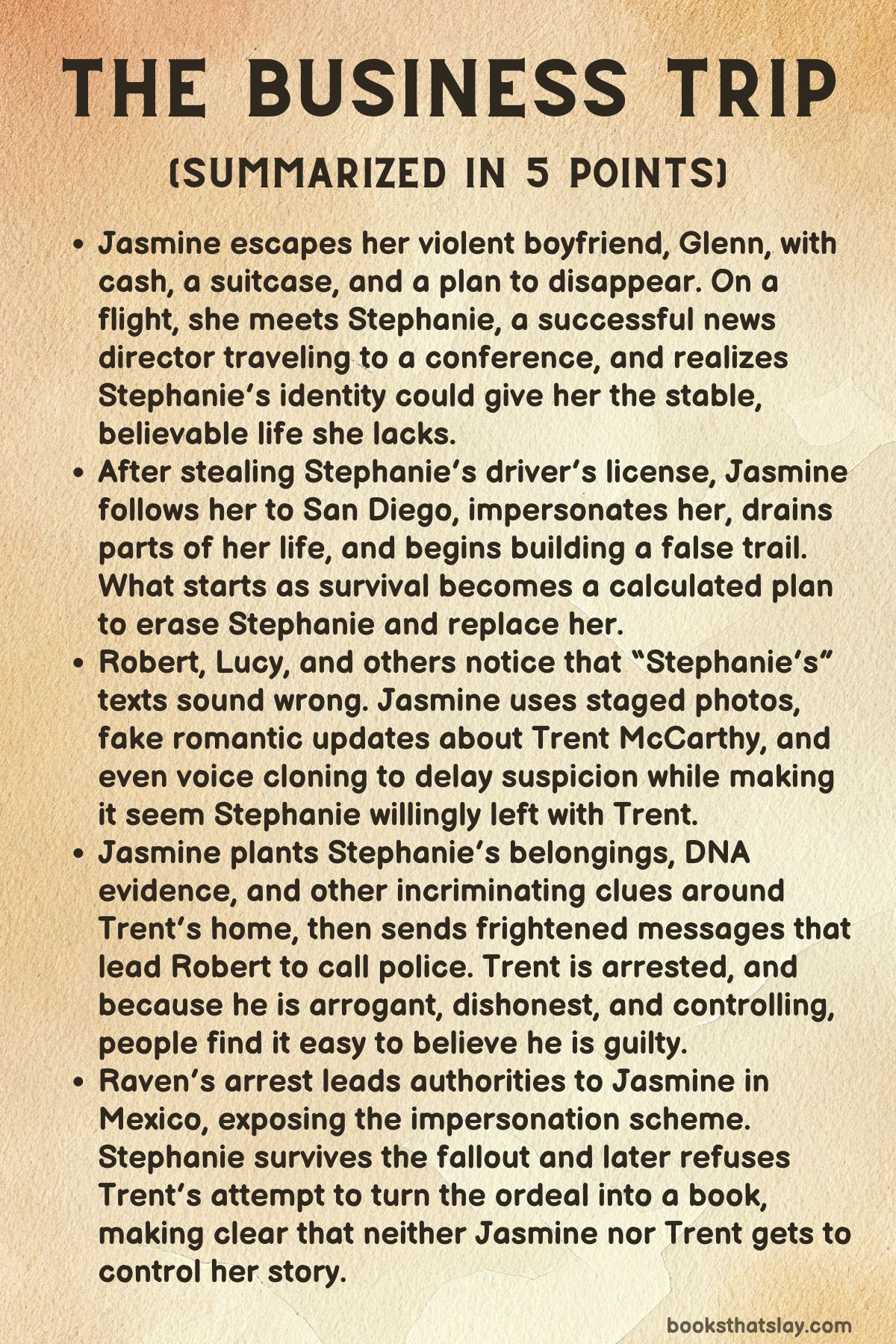
Summary
Jasmine Littleton leaves her Wisconsin trailer before dawn in the dead of winter, moving quietly so her boyfriend Glenn won’t wake. She drugs his beer with crushed black-market Ambien, then packs only what she can without making noise.
Bruises on her arm remind her why she has to go: Glenn’s jealousy, control, and violence have escalated over time, including sexual assault and threats that keep her trapped. With no family support and no car—because Glenn made sure she stayed dependent—Jasmine has spent more than a year secretly saving cash from bar tips and small thefts from his wallet.
Her plan is simple: get away, get to Denver, and survive long enough to start over.
Jasmine orders her first Uber with help from a coworker, Anna, who showed her how to install the app the night before. She rides to the airport and tells the driver she’s traveling for work, inventing a story about a pharmaceutical job and a trip to New York.
At the airport she disguises herself with a thrift-store Dodgers cap and round glasses, buys a one-way ticket to Denver with cash, and waits nervously, checking her phone for Glenn’s messages.
At the same time in Madison, Stephanie Monroe, forty-five and successful, prepares for her own work trip to a conference in San Diego. She’s a news director with a demanding schedule, divorced, and feeling the quiet emptiness of her life now that her son is in college.
She packs carefully—professional outfits, accessories, and Ambien—and leaves instructions for her neighbor and close friend, Robert Tayburn, to feed her cat, Fred, and collect a delivery. She takes Ambien to sleep, hoping the trip will bring some novelty, and plans to meet a friend named Diana during the conference.
Jasmine receives a text from Glenn mid-morning, asking where she is. She stalls by claiming she stepped out for groceries and promises a steak dinner later.
When boarding begins, she grips her bag and cash like a lifeline, gets on the plane, and—halfway down the jetway—removes her hat and lets her hair fall loose. For her, it’s a private signal that she’s finally doing it.
Stephanie reaches her gate as well and notices the usual airport scene, including a woman with a baseball cap pulled low. She boards and takes her seat.
During the flight, Jasmine ends up seated beside Stephanie. An elderly passenger comments that they look like sisters.
After the older woman moves, Jasmine and Stephanie talk. Stephanie shares details about her job and the conference, and Jasmine listens closely.
The conversation starts as small talk, but Jasmine’s attention sharpens as she compares their lives. Stephanie has stability, credit cards, a career, a clean identity.
Jasmine has fear, cash, and a man who will hunt her if he can. By the time Stephanie stands to go to the restroom, Jasmine has made a decision.
She steals Stephanie’s driver’s license from her wallet and hides it, then acts normal when Stephanie returns.
After landing in Denver, Jasmine moves fast. Instead of disappearing into Colorado as planned, she follows Stephanie’s trail and buys another ticket—this time continuing to San Diego.
She changes her look, keeps herself close enough to watch Stephanie without being noticed, and begins building an identity theft that is more than a quick grab: it’s a replacement.
Back in Wisconsin, Glenn wakes to an empty trailer and missing belongings. His reaction cycles through charm, rage, and threats.
He leaves escalating voicemails and fixates on the idea that Anna helped Jasmine escape. He intimidates Anna by phone and later waits for her outside the bar, demanding her phone so he can text Jasmine while pretending to be Anna.
When she refuses, he threatens her. Glenn sits at the bar watching her during her shift, makes a finger-gun gesture, and says “Bang bang.” Anna goes home shaking, checks locks repeatedly, and later sees Glenn’s truck idling outside her house.
She realizes he is capable of doing something worse.
Meanwhile, Robert goes to Stephanie’s townhouse to feed Fred and take care of the house. To his surprise, Stephanie texts that she met an amazing man at the conference and is going away with him for a week.
She asks Robert to keep watching the cat. Robert is confused but agrees, though he keeps pushing for details.
Over the next days, “Stephanie” sends more messages: the man’s name is Trent McCarthy from Atlanta, and they’re traveling together. She sends photos and notes about sightseeing spots in Atlanta and even a voice memo describing Trent as bossy.
Something about the messages feels off, but Robert doesn’t know what to do except keep responding and trying to reach her.
At Stephanie’s news station, her absence becomes a problem. She misses meetings, sends abrupt texts requesting extended time off, and tells her boss not to check in until the next week.
Her coworker Lucy tries friendly messages and immediately notices the tone is wrong—formal, flat, unlike Stephanie. Lucy and others begin sending “trap” messages to test whether the person texting is really Stephanie.
The replies don’t show normal curiosity or recognition, increasing their fear that someone else may have her phone.
Anna, desperate and frightened, reaches out to an old friend from high school named Raven in Atlanta after Glenn sends her photos of beer cans used for target practice with Jasmine’s and Anna’s pictures taped on. Raven takes the situation seriously and asks for Glenn’s address, saying she has contacts in Madison who can help.
Anna provides the address, hoping someone will stop him before he harms her or tracks down Jasmine.
Then a rumor spreads: Glenn has been beaten badly and hospitalized, and his trailer was robbed. Anna feels sudden relief, though she doesn’t know who did it.
Jasmine texts Anna acting upbeat and safe, saying she’s with a man named Trent McCarthy. Anna supports her and deletes the conversation so Glenn can’t find it if he forces his way into her phone.
Robert, however, receives messages that turn alarming. “Stephanie” says she is scared, that Trent yelled and then hit her, and that she thinks he might kill her.
Robert panics, calls 911, and gives the address “Stephanie” previously texted: a home on Horizon Lane in an Atlanta neighborhood called Peachtree Village. After that, Stephanie stops responding.
Robert is summoned to the station, where Lucy and management share their concerns that the texts may not be from Stephanie at all.
In Atlanta, police raid Trent McCarthy’s home at night. They find buried items in his backyard: a woman’s phone, wallet, jewelry.
The items are identified as Stephanie’s. Press conferences follow.
Trent is arrested, and investigators also mention Jasmine Littleton as a second potential victim after Jasmine’s DNA is connected to evidence linked to Trent. Trent, stunned and furious, insists he’s being framed.
In interrogation, detectives confront him with blood and hair found in his apartment, women’s underwear hidden in his clothing, and other physical evidence that suggests multiple victims. Trent has no solid alibi for key days, and he has lied to his boss about his whereabouts, which destroys his credibility.
Bail is set high. His employer cuts ties after learning he fabricated a story involving a reporter’s mental health crisis to impress advertisers.
Even his friends and ex-wife refuse to help.
As the case grows, Lucy keeps digging. A news director from another city, Dorothy Robinson, recalls odd details from the conference: Trent disappeared during a session and later behaved inappropriately.
Dorothy also remembers Trent claiming he ate chicken with Stephanie, but Stephanie is vegetarian. Dorothy examines the conference sign-in sheet and notices the signature doesn’t fit what she knows about Stephanie.
Dorothy compares voices and believes the woman she met at the conference didn’t sound like Stephanie. These details point to something bigger than a simple workplace romance gone wrong.
The story then reveals what actually happened. Jasmine’s escape turned into a calculated plan: steal Stephanie’s identity and build a believable trail that would point suspicion toward Trent.
In San Diego, Jasmine tracked Stephanie’s hotel, changed her hairstyle and clothing to look more like a professional woman, and prepared to enter Stephanie’s room. She also studied Trent’s movements and access.
She planted evidence in Trent’s space—hair, blood, and clothing—to create forensic links. She learned Trent’s flight details and planned to travel under Stephanie’s name so it would appear Stephanie went with him to Atlanta.
Jasmine abducted Stephanie and sealed her inside a weighted suitcase. She transported the suitcase using a rented vehicle with a wheelchair lift and drove to a secluded lagoon at night.
She pushed the suitcase into the water until it sank, then returned to her motel to continue the cover story. She withdrew money from Stephanie’s accounts, answered Robert’s texts as if she were Stephanie, and began constructing a narrative of a whirlwind romance with Trent.
Jasmine also contacted Raven for a new identity, paying for a fake passport and learning how to disappear. She used AI voice cloning from Stephanie’s online videos to send convincing voice messages.
She flew to Atlanta on the same flight as Trent but stayed out of his sight, tailed him home, and used Raven to drug him so he would appear sick and homebound while “Stephanie” stayed with him. Jasmine staged photos, souvenirs, and tourist scenes to support her story.
She escalated the messages to Robert, shifting them from romantic to fearful, until Robert called police—exactly as she intended.
After triggering the police response, Jasmine buried Stephanie’s belongings in Trent’s yard and disposed of phones and bags to hide her tracks. Then she left Atlanta by bus and eventually crossed into Mexico under her new identity.
For a few weeks, she lived cheaply, worked as a waitress, and followed the news, pleased that Trent was jailed and blamed.
The plan collapses when Raven is arrested in a passport operation and identifies Jasmine to reduce her own exposure. Authorities track Jasmine to Puerto Escondido, Mexico, and arrest her.
Stephanie later confirms Jasmine as the woman from the plane and explains a final twist: Stephanie had hired an actress named Diana through a service called “Find My Doppelganger,” intending for Diana to attend the conference while Stephanie traveled elsewhere. Diana disappeared, prompting Stephanie to go to police, which helped investigators realize that someone had been impersonating her and manipulating the case.
Months later, Stephanie leaves news work and moves into PR. Trent, still trying to regain control of the story, approaches her with a proposal to co-write a book about what happened.
Stephanie refuses. When he reacts with anger, she ends the conversation by making it clear he doesn’t get to rewrite the outcome to suit himself.
Characters
Jasmine Littleton
Jasmine is the story’s most volatile blend of survival instinct, trauma, and audacity, and her choices are shaped by the way danger has trained her to think several moves ahead. In The Business Trip, she begins as a victim of coercive control—meticulous, quiet, and constantly calculating risk—because she has learned that small sounds, small mistakes, and small delays can bring violence.
Her early actions, including drugging Glenn, sabotaging the door, and saving cash for a year, show an adaptive intelligence born from fear, but also a moral line she believes she still has, since she rejects killing Glenn despite imagining it. Once she meets Stephanie on the plane, Jasmine’s psychology pivots: envy and opportunity fuse into a radical strategy, and her need to disappear turns into a willingness to destroy someone else’s life to protect her own.
Her impersonation plot reveals a ruthless capacity for planning, manipulation, and compartmentalization—she can be tenderly nostalgic about her grandmother’s perfume in one moment and coldly clinical about planting DNA evidence in the next. Jasmine is ultimately a portrait of how prolonged abuse can warp “escape” into something predatory: she seeks freedom, but she chooses it through domination and deception, becoming a mirror-image of the control she ran from.
Glenn
Glenn is written as a textbook coercive abuser whose power comes less from a single outburst and more from the steady architecture of intimidation, isolation, and entitlement. He begins with a mask of courtesy—protective gestures and charm—then gradually replaces Jasmine’s autonomy with dependency by controlling transportation, money, clothing, and movement, which is central to why her escape requires secrecy rather than negotiation.
Glenn’s violence is not only physical; it is also sexual and psychological, as shown by forced sex, “jokes” that simulate suffocation, and the constant interrogations that make Jasmine monitor herself even when he is not present. After she leaves, his inner world collapses into obsession and grievance, and the narrative emphasizes how control, once threatened, becomes his drug: weapons, threats, and stalking restore the sensation of dominance he believes he is owed.
Glenn functions as the story’s first engine of fear, and even when the plot shifts away from him, his presence remains a shadow—proof that danger does not end simply because a victim runs.
Stephanie Monroe
Stephanie is introduced as competent, structured, and socially connected—a professional woman whose life looks stable from the outside, yet is threaded with loneliness, fatigue, and a craving for novelty. Her divorce, her empty nest, and the emotional distance from her son create a vulnerability that is not naivety so much as hunger: she wants a spark that interrupts routine, which makes the “Trent” storyline believable to those around her.
Stephanie’s character also carries the theme of identity as performance; she is a news director who understands narrative and optics, and later we learn she literally weaponizes that understanding by orchestrating a doppelganger swap. That twist reframes her as far more strategic than the early chapters suggest: she is someone who can be both emotionally driven and operationally calculating, capable of secrecy that rivals Jasmine’s.
By the end, Stephanie emerges as a survivor who is furious about being turned into a prop, refusing to let her suffering become someone else’s brand or redemption arc, which is why her final rejection of Trent lands as a reclamation of agency and voice.
Anna
Anna is the grounded moral center for much of the early suspense, a friend who recognizes danger and tries to protect Jasmine even when she lacks power to stop the larger forces at play. Her support is practical—helping install Uber, loaning money—and emotionally steady, especially given that her own history seems marked by past trauma and a community culture that failed people.
Once Glenn turns his attention to her, Anna becomes a study in fear-management: deleting texts, seeking escorts to her car, fortifying her home, and living with that exhausting hypervigilance that abuse by proxy creates. What makes Anna compelling is that she keeps choosing responsibility over self-preservation; she lies to Glenn to shield Jasmine, then later reaches out to Raven when she feels trapped, showing how desperate fear can push someone into alliances they don’t fully understand.
Anna’s arc also underlines the story’s critique of systems: she is a bystander forced into survival tactics because there is no immediate, reliable protection for someone being targeted by an enraged abuser.
Raven
Raven operates as a fixer with a dangerous network, someone whose help comes with a price and whose competence is inseparable from criminality. She believes Glenn is a threat and talks like someone used to solving problems through leverage rather than institutions, which makes her feel like a lifeline to Anna and, later, a resource to Jasmine.
Yet Raven’s role reveals the story’s cynicism about “escape” economies: fake documents, favors owed, and intimidation become an alternate system for people who feel the normal system won’t save them. Raven’s eventual arrest and cooperation show the fragility of living by illicit tools—loyalty is negotiable when prison is on the table.
She is both enabler and inadvertent undoing of Jasmine, the person who helps build the exit door and then becomes one of the reasons it slams shut.
Trent McCarthy
Trent is crafted as a charismatic predator of reputation, a man whose public image is a tool and whose private behavior relies on intimidation, deceit, and control. Professionally, he understands power hierarchies and uses performance—hero stories, quick lies, manufactured concern—to impress bosses and clients, and the “Hannah” lie captures how easily he exploits empathy narratives for advantage.
Interpersonally, he is “bossy” in a way that reads like early-stage coercion, where decisions, movement, and contact with others are subtly restricted until fear takes over. Even as the evidence mounts, Trent’s inner narration shows grandiosity and grievance: he fantasizes about lawsuits and media angles instead of focusing on the human horror.
At the same time, the plot’s later revelations complicate his role; he becomes both potential perpetrator and convenient scapegoat, and the story uses him to explore how a pattern of bullying and dishonesty can make someone easy to believe guilty. Whether viewed as villain, suspect, or casualty of Jasmine’s scheme, Trent represents the danger of a man who treats reality as something he can edit.
Robert Tayburn
Robert is the emotional anchor on Stephanie’s side of the story: attentive, reliable, and deeply human in the way he tries to be helpful without crossing boundaries. His caretaking—feeding Fred, watering plants, bringing packages in—establishes him as someone who shows love through action, which makes his growing alarm feel earned rather than melodramatic.
Robert’s arc is essentially a slow-motion recognition that something is wrong: he notices tone shifts, inconsistent behavior, and escalating red flags, and his persistence becomes the bridge between private suspicion and official intervention. When he finally calls 911, it is not heroism in the glamorous sense; it is a frightened friend doing the only responsible thing left, even at the risk of being wrong.
In The Business Trip, Robert embodies how real-world crisis often unfolds—through ordinary people noticing small inconsistencies and refusing to ignore them.
Lucy
Lucy functions as the story’s investigative mind inside the workplace, the person who realizes that “off” does not always mean “busy” but can mean “dangerous.” Her skepticism comes from intimacy: she knows Stephanie’s humor, habits, and rhythms, so the oddly formal texts read like an intruder wearing a familiar face. Lucy’s “trap” messages show a practical intelligence—testing identity through personal context rather than confrontation—and her willingness to involve others marks her as courageous and responsible.
Importantly, Lucy’s arc highlights how identity theft is rarely undone by a single dramatic clue; it is unraveled through social knowledge, pattern recognition, and careful verification. She also acts as a counterweight to institutional inertia, pushing colleagues and authorities to take anomalies seriously.
Dorothy Robinson
Dorothy is a late-arriving but pivotal truth-teller, the kind of character whose credibility comes from distance and specificity. She provides external perspective on Trent’s conference behavior and supplies concrete contradictions, such as his absences and the mismatch between what he claimed and what others observed.
Her attention to detail—remembering food choices, comparing voice tone, questioning signatures—illustrates how the smallest factual anchors can puncture a manufactured narrative. Dorothy also represents professional solidarity: she is not from Stephanie’s immediate circle, yet she recognizes the stakes and chooses to act, which helps shift the story from rumor to investigation.
Diana
Diana is the most haunting absence in the narrative, a character defined less by direct presence and more by the implications of what happens when someone becomes interchangeable. Her role as the hired look-alike underscores the book’s central obsession with identity—how a name, a phone, a hairstyle, and a set of documents can create a “person” others will accept.
Diana’s disappearance also complicates sympathy: Stephanie’s secret plan may be framed as strategic, but it introduces ethical fallout, because outsourcing risk to a stand-in treats another woman’s safety as a manageable variable. Diana’s shadow forces the reader to ask who pays the price when someone tries to rewrite their life through deception.
Bill
Bill is the corporate conscience under pressure, a manager forced to translate a moral catastrophe into operational decisions—press, HR, advertisers, staff panic, and law enforcement coordination. His narration shows how quickly reputation becomes triage: he must issue statements, manage client fallout, and stabilize the newsroom while grappling with personal shock and betrayal.
Bill’s growing realization that Trent lies reflexively reframes the case for him, not just as “did he do it,” but as “how much of our trust infrastructure did he poison.” Bill’s demand to fire Trent for deception illustrates a theme that runs throughout the book: lies create vulnerabilities that criminals and opportunists can exploit, and organizations often learn that only after damage is done.
Bruce
Bruce is a procedural authority figure whose initial reactions feel like standard workplace management—expecting a return from travel, needing meetings covered—until the pattern becomes too strange to ignore. He becomes an example of how institutions lag behind personal intuition: he needs evidence, not vibes, which is understandable but dangerous when the crisis is unfolding in real time.
Once he senses risk, he does what managers often do best in emergencies: he escalates appropriately, pulls in leadership, and tries to create a unified response.
Dave
Dave represents organizational alarm once the situation crosses from “employee behaving oddly” into “possible abduction or impersonation.” His actions focus on liability, safety, and coordination, and his call to Robert shows how workplace and personal networks merge when someone vanishes. Dave is part of the machinery that can either protect or fail people, and his role highlights how critical it is for leadership to treat irregular communication as a potential emergency rather than a scheduling inconvenience.
Renee
Renee’s role is small but emotionally meaningful, offering a glimpse of family support that contrasts with Jasmine’s isolation. Her supportive text to Stephanie establishes that Stephanie is not alone in the world, which increases the stakes of the later impersonation; Jasmine isn’t just stealing a name, she is infiltrating a real web of relationships.
Renee functions as a reminder that disappearance harms not only the missing person but also everyone who loves them.
Evan
Evan is a psychological pressure point rather than an active participant, embodying Stephanie’s anxiety about aging, relevance, and distance. His drift after leaving for college is one of the reasons Stephanie craves change and connection, and that craving becomes part of what makes the “romantic detour” plausible to observers.
Evan’s absence quietly motivates choices that ripple outward, showing how emotional emptiness can become a risk factor.
Jason
Jason appears mainly through Stephanie’s reflection on divorce, serving as context for why she is simultaneously independent and lonely. He is less a villain than a marker of a closed chapter, and his presence underscores the story’s interest in transitions—how people behave when a familiar life structure dissolves.
Carlos
Carlos, the Uber driver, is a brief but important reminder of how strangers can become accidental gatekeepers during escape. His interaction with Jasmine shows her ability to improvise plausible stories under pressure, and it also underlines the anonymity of modern flight: a person can vanish through ordinary services if they have cash and nerve.
Carlos is not deeply developed, but his role reinforces how thin the barrier is between someone being “on a business trip” and someone fleeing for their life.
Nora
Nora works as part of the workplace detection team, a collaborator who helps Lucy test the integrity of “Stephanie’s” responses. She represents the value of collective reasoning in crisis—multiple minds catching inconsistencies faster than one—and her presence supports the theme that social verification can be a powerful defense against impersonation.
Leigh
Leigh’s brief newsroom presence helps reveal Trent’s patterns: he barges in, performs authority, and expects the room to adjust to him. Leigh functions like a witness to normality being bent by a domineering personality, which becomes significant later when Bill is reconstructing how Trent’s lies moved through the organization.
Hannah
Hannah is used as a prop by Trent, which is exactly why she matters: her confusion exposes his fabrication and reveals how easily he weaponizes other people’s identities to cover his own behavior. Her reaction also signals that Trent’s relationship to mental health narratives is cynical and opportunistic, adding texture to why colleagues might believe he is capable of uglier harm.
Mary
Mary represents the administrative layer that powerful people often pressure into complicity. The mention that Trent asked her to lie shows how abusers and manipulators build small networks of forced loyalty, where employees fear consequences if they refuse.
Her role highlights how deception spreads through workplaces not just because one person lies, but because others are coerced into maintaining the lie.
Chief Reggie Newman
Chief Newman appears as the official voice of law enforcement contact, anchoring the public-facing reality of the crisis. His communication with Bill illustrates the shift from internal suspicion to formal accusation, and his role emphasizes how institutions respond once evidence is tangible, even if confusion and misdirection remain.
Katrina
Katrina, Trent’s ex-wife, offers a stark external judgment that cuts through Trent’s self-pity. Her refusal to help and her anger imply a history of harm, suggesting that Trent’s pattern is not new and that his current crisis is part of a longer trail of damage.
She functions as a moral mirror that Trent cannot manipulate, which is why her rejection lands as a rare moment where his performance fails completely.
Fred
Fred, Stephanie’s cat, is a domestic detail that becomes emotionally significant because caregiving routines are often the first sign something is wrong. The fact that Robert is feeding Fred and texting updates gives the disappearance a lived-in realism; it isn’t only a thriller plot, it is a home left unattended.
Fred also quietly symbolizes normal life continuing in the background while a person’s identity is being stolen.
Rocky
Rocky, Anna’s dog, represents the small comfort that fear does not erase—something warm and living that anchors Anna when she feels hunted. Rocky’s presence emphasizes how terror narrows a person’s world down to locks, shadows, and whatever can make them feel momentarily safe.
Rocky is a tiny but effective reminder that survival is not just escape plans; it is also finding reasons to keep breathing through the night.
Themes
Survival, Control, and the Cost of Escape
Jasmine’s decision to leave is not framed as a bold adventure but as a carefully measured act of survival shaped by long-term coercion. Every choice she makes in the trailer is influenced by the reality that Glenn monitors her movement, access to money, and even her ability to own a car.
The planning is patient and unglamorous: hiding tips for over a year, taking small amounts from his wallet, choosing clothes that can be grabbed silently, and engineering quiet exits because noise could trigger violence. This theme focuses on how control in an abusive relationship is not limited to physical harm; it is logistical and psychological.
Glenn’s behavior shows how dependency is manufactured—he keeps her without transportation, punishes perceived disobedience, and flips between charm and threats to keep her uncertain. Jasmine’s escape becomes a negotiation with fear: she doesn’t leave with the “right” bag, the “right” plan, or a support system, but with whatever she can carry without getting caught.
The story also explores the cost of escaping when someone has been isolated for years. Jasmine lacks family support and has learned that asking for help may bring judgment or rejection, so self-reliance becomes both strength and burden.
The loneliness of that reality pushes her to make risky choices—lying to strangers, buying a ticket with cash, adopting a disguise—because the alternative feels like being dragged back. This is where the theme turns sharper: the instinct to survive can evolve into a willingness to justify morally extreme decisions if they seem like the only way to stay free.
As the plot progresses, Jasmine’s survival mindset shifts from “get away safely” into “erase myself completely,” and the methods become colder and more systematic. The narrative highlights how fear can teach a person to think in terms of contingencies and evidence, almost like an investigator, except the purpose is self-preservation at any cost.
In The Business Trip, escape is not treated as a single moment of courage; it is treated as an extended campaign against control, and the longer it continues, the more it threatens to change the person who is running.
Identity as Currency and Weapon
The story treats identity not as a stable personal truth but as something that can be exchanged, copied, and exploited. Jasmine begins with small acts of camouflage—a cap, glasses, a fake story about a pharmaceutical job—because anonymity is protection.
But after she meets Stephanie, identity becomes an opportunity: Stephanie’s professional polish, her life stability, her access to credit and travel, and her social credibility represent a complete replacement for Jasmine’s vulnerability. What makes this theme unsettling is how quickly the logic becomes transactional.
Jasmine doesn’t only want money; she wants the permissions that come with being someone the world automatically believes. A new name is not just a label; it is access to airports, hotel desks, customer service phone lines, and the benefit of the doubt from strangers.
That is why the theft of Stephanie’s driver’s license is not a random crime; it is the opening move in converting a person into an escape route.
The narrative also shows how institutions and everyday social habits make identity theft easier. People accept surface cues—confident tone, appropriate clothing, plausible travel stories—because the systems are built for speed and convenience.
Jasmine leverages that reality repeatedly, moving through airports and hotels by performing what “Stephanie” looks and sounds like. The discovery of AI voice cloning deepens the theme, because it removes one of the last barriers to impersonation: voice, often treated as proof of self.
Once Jasmine can replicate Stephanie’s speech patterns from videos, the relationship between identity and evidence changes completely. A voice memo, a text message, a photo, even a casual check-in can be manufactured to persuade the people who care about Stephanie that she is alive, traveling willingly, and simply busy.
The result is a chilling suggestion that modern proof is often more performative than real.
At the same time, identity operates as a weapon against other people. Jasmine does not merely take Stephanie’s identity; she uses it to create a believable narrative that directs suspicion toward Trent.
The details are crafted with a strategist’s precision: planted DNA, staged tourism photos, timed messages, selective escalation from romance to fear, and finally the claim of impending murder to trigger a police response. Identity becomes a tool for blame assignment—who will be believed, who will be doubted, and who will be targeted.
The story presents identity as something that can be engineered like a story, and once it becomes a story, the person underneath can be erased, reframed, or sacrificed depending on what the storyteller needs.
Trust, Manipulation, and the Social Engineering of Belief
The plot depends on how ordinary trust operates in friendships, workplaces, and brief encounters, and how easily that trust can be redirected. Robert, Lucy, and the station staff react the way many people would: they want to believe Stephanie is fine because believing she is in danger is too alarming to accept quickly.
Jasmine exploits that hesitation by sending steady “normal” updates—tourist photos, souvenirs, casual messages—that mimic the reassuring habits of someone on a trip. The theme is not simply that characters are gullible; it is that social life runs on assumptions of sincerity.
When someone texts like a friend, names familiar places, and provides small concrete details, the default response is to accept it as real. This is how manipulation works best: it borrows the shape of normalcy.
The workplace portion intensifies the theme by showing trust as a professional necessity. In a newsroom environment, people rely on quick communication and familiar tone; the moment Stephanie’s messages become oddly formal, Lucy senses danger not because she has proof, but because the social fingerprint is off.
Her “trap” messages highlight something important: trust is partly linguistic. People know each other through rhythm, humor, annoyance, specificity, and the instinct to correct false details.
When those traits disappear, suspicion grows. This makes the threat feel modern and intimate.
It is not only that a phone can be stolen; it is that a person’s style of being can be imitated well enough to delay rescue. Jasmine’s use of cloned voice and controlled messaging demonstrates social engineering in its purest form: designing communication to steer other people’s decisions, especially the decision to wait rather than act.
Trent functions as a different kind of manipulation within the same theme. He performs competence and compassion at work, inventing stories about helping a reporter with a crisis because he understands what his boss and advertisers want to hear.
The lie works because it fits the values of the institution: leadership, care, decisiveness. That shows how organizations can reward the appearance of virtue even when the truth is thinner.
Later, when evidence stacks against him, Trent still clings to the belief that reputation and legal threats will restore control. His confidence reveals another angle of manipulation: entitlement can act like a shield, convincing someone they can talk their way out of reality.
Belief is not formed by truth alone; it is formed by emotional comfort, social habit, institutional incentives, and the narratives people most want to be real. The tragedy is that manipulation doesn’t need perfect lies—only lies that match what the audience expects.
Complicity, Accountability, and the Way Harm Spreads
Harm in the story is not contained within one relationship or one crime; it radiates outward, forcing others into roles they never wanted. Anna becomes a key example of coerced participation.
She is not directly attacked at first, but Glenn’s intimidation makes her life smaller: escorts to her car, constant checking of locks, fear sitting in her chest while she tries to work a normal shift. Her responses—lying to Glenn, deleting messages, contacting Raven—are shaped by immediate survival rather than moral clarity.
The theme here is that abuse creates secondary victims who must choose between honesty and safety. When someone dangerous demands information, everyone nearby becomes a potential target, and “doing the right thing” becomes complicated by the risk of being harmed next.
Raven introduces another form of complicity: opportunistic help that escalates the stakes. Raven offers protection through “favors” and connections, and later participates in building a new identity.
Even if her intentions are mixed—loyalty, profit, pride—the effect is the same: she helps transform a dangerous situation into a criminal operation. That progression shows how harm spreads through networks.
People who think they are helping someone escape can become enablers of something far worse when they don’t ask what escape will cost someone else. Meanwhile, the systems that should protect people struggle to keep up.
Police respond when the situation reaches a breaking point, but evidence is already contaminated by staging. Work colleagues are alert and caring, yet they are limited by what they can prove.
The story suggests that accountability often arrives late, after damage has already been multiplied.
The final reversals underline how accountability can become tangled with image management. Bill’s crisis response, HR decisions, advertiser panic, and public statements show that institutions often react first to reputational risk, then to human suffering.
Trent’s termination is explicitly tied to lying, not to proven violence, which highlights a grim reality: organizations act fastest when the harm threatens them directly. At the personal level, Stephanie’s later refusal to collaborate with Trent on a book is a reclaiming of agency, but it also reflects how trauma persists after legal outcomes.
The story examines how wrongdoing rarely stays isolated; it recruits bystanders, triggers institutional self-protection, and leaves people navigating consequences that do not neatly match who deserves blame.