The Keeper of Stars Summary, Characters and Themes
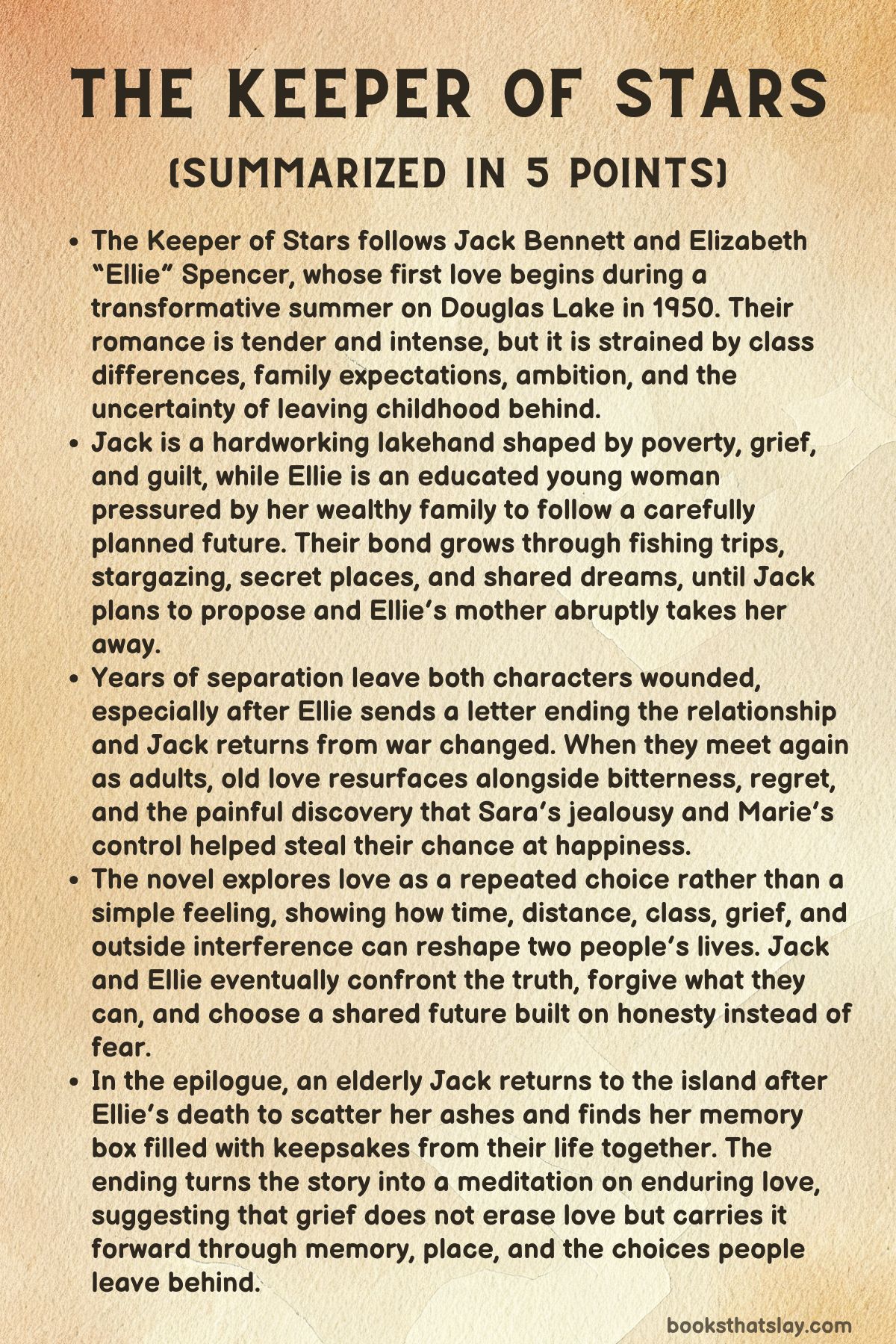
The Keeper of Stars by Buck Turner is a romantic, time-spanning story set against the quiet pull of East Tennessee and the wide-open promise of the night sky. It follows Jack Bennett, a lakehand with big hopes and a heavy past, and Elizabeth “Ellie” Spencer, a young woman from a wealthy Ohio family who arrives for a summer that changes her life.
Their first love is intense, complicated by class, ambition, and family control, then tested again years later when fate brings them back to the same water and the same memories. It’s a story about choices, consequences, and what love can survive.
Summary
In May 2020, an elderly man sits alone under a cold Tennessee sky, warming himself by a fire with a glass of whiskey. A call comes from his daughter: she has finished clearing out a house filled with decades of shared life, and a realtor’s sign will go up the next morning.
She couldn’t find a special memory box that belonged to her mother. The man says he’ll look for it himself.
After the call, he returns to the quiet night, watching the North Star as a comet flashes across the sky, and he steels himself for what comes next.
The story returns to May 1950. Eighteen-year-old Jack Bennett works on Douglas Lake with George Duncan, an older Black man who runs a small ferry service for tourists.
A storm barrels in fast, and Jack scrambles to get the boat’s engine running so they can cross the open water safely. They make it to shelter and pass the time talking.
George urges Jack to become a mechanic, something steady and reliable. Jack admits he’s saving for something bigger: his dream is a “house on the hill,” a place he’s admired for years.
George thinks that kind of dream is for people with money, not people like them, but Jack refuses to let that decide his future.
Jack heads home to a modest house where he lives with his mother, Helen. She scolds him for teasing George earlier with an engine trouble prank and reminds him that George is getting older.
Over a simple supper, Jack offers to spend some of his savings on groceries, but Helen won’t let him. She wants him building toward a better life.
That night Jack writes in his journal, mixing everyday worries with the stubborn hope that his life can become something more.
The next morning Jack is back at the dock for two tourist trips to a small island where visitors look for Cherokee artifacts and arrowheads. On the second trip, a young woman arrives at the last second and begs to come along, offering extra money when Jack says the boat is full.
Her name is Elizabeth “Ellie” Spencer. She is well dressed, clearly unused to lake life, and curious in a way that catches Jack’s attention.
On the island, Jack insists she swap her expensive shoes for waders, even kneeling to help her into them. Ellie ends the day muddy, bitten by mosquitoes, and empty-handed, joking that she deserves a refund.
Jack teases her but quietly offers to show her a better spot another time. When she leaves in a green Chevrolet, Jack stays behind fishing and writes that meeting her feels like the first page of a different life.
Ellie returns the next day. She’s staying with her aunt, Clara Sutton—who lives in the very house on the hill Jack has admired from a distance.
Ellie explains that her mother sent her south for a while, partly to reconnect with family, partly to get her out of the house. A sudden downpour traps Jack and Ellie in the dock shack, where they talk over sweet tea while thunder rolls.
Ellie shares her plans: she studies astronomy and dreams of teaching, inspired by women who made space for themselves in science. Jack shares his own history—his father died in the war, and he and his mother have scraped by ever since.
When the storm eases, Jack walks Ellie home, feeling both thrilled and uneasy about the gap between their worlds.
At Clara’s, Ellie faces her own pressures. Clara is warm and sharp-eyed, reading Ellie better than Ellie expects.
Ellie’s mother calls with new plans and expectations, including arranging a math tutor, Sara Coffee. Clara offers comfort, good food, and practical wisdom, but she also knows summer doesn’t last forever.
Days of rain keep Jack off the lake, and he distracts himself by painting Helen’s kitchen. Helen notices his mind is elsewhere, and Jack admits he’s interested in Ellie.
Helen allows him to see her but warns him not to ignore reality. When the skies clear, Jack teaches Ellie to fish on Flat Creek.
She surprises him with quick instincts and even catches a big bass he’s been chasing. She chooses to release it, and the choice tells Jack something about who she is.
Their evenings fill with fishing, quiet talks, and growing closeness. Jack worries his lack of money will matter; Ellie insists it shouldn’t.
One night, sitting at the dock with their feet in the water, Ellie takes Jack’s hand. Jack wants to kiss her but can’t push past his nerves.
He asks George for advice, and George tells him to pay attention to what a girl says and does—and to give a small, unexpected gift at the right moment.
Jack invites Ellie to Parrott Island, promising arrowheads. On the boat, he points out places tied to his childhood and shows her mockingbirds, telling her they mate for life and always find their way back.
On the island they explore carefully, wary of snakes, and discover a clearing beneath a beech tree that forms a natural arbor. Ellie playfully stages a wedding scene and asks Jack to kiss his “bride.” This time he does.
Later, with Ellie’s eyes closed, Jack places an arrowhead in her hand—his unexpected gift. Ellie is delighted, and the two finally say what’s been building between them: Jack is falling in love, and Ellie admits she is too, even though it scares her.
They swim in a hidden lagoon and leave the island changed.
As the summer continues, more pieces of Jack’s past surface. He brings Ellie to his brother Lewis’s grave and confesses the guilt he’s carried since childhood, blaming himself for Lewis’s drowning.
Ellie comforts him with tenderness and faith, leaving wildflowers on the grave and giving Jack a sense that he isn’t alone in his grief. Jack later shows her a secret pond where he feeds a mother duck and her ducklings, explaining he learned that bread can harm them and that he feels responsible for the little family.
The pond, like the island, becomes part of their private world.
Clara welcomes Jack, and the three share evenings on the porch with cobbler, music, and laughter. Ellie teaches Jack to dance.
Jack speaks of his dreams: he wants to write, and he wants enough money so Helen can rest and he can choose his own life. Ellie believes in him more than he believes in himself.
They make plans for a fair and fireworks in Knoxville, and for a moment it feels like nothing can touch them.
But jealousy and social lines creep in. Sara Coffee, Ellie’s tutor and Jack’s longtime friend, shows signs of wanting more than friendship.
Ellie hears a rumor Jack once kissed Sara; Jack insists it meant nothing and that Sara initiated it. Jack brings Ellie to supper with Helen, and Helen’s easy approval makes Jack feel both hopeful and afraid.
Ellie’s future is mapped out in years of school and a professional career; Jack’s path is less certain. Still, Jack promises Ellie that when the time is right, he’ll ask her to marry him.
Ellie promises they’ll find their way back to each other.
At the Knoxville fair, a young man harasses Ellie, and when he won’t stop, Jack fights him. Police whistles send them running, but Ellie stands by Jack afterward.
The night is exciting, but it also signals how easily trouble can find them.
As Ellie’s departure approaches, they try to avoid the topic, then finally face it. Ellie suggests Jack come closer to her school; Jack hesitates because of Helen and George.
Jack suggests she transfer; Ellie says it’s not simple. They decide to focus on their remaining time.
They go stargazing near Rock Island, Ellie naming constellations and sharing the language of the sky. Wanting one last perfect night, they return to Parrott Island, and their closeness becomes physical in a way that makes Jack feel the future has to be decided.
Jack buys a diamond ring with nearly all his savings, letting go of his house-on-the-hill fund. He plans a surprise proposal and asks Ellie to meet him at the dock dressed nicely.
Helen is moved but warns him that love sometimes demands sacrifice from one or both people.
Before Ellie can meet Jack, her mother, Marie Spencer, arrives unexpectedly three days early and takes Ellie away immediately. Ellie is stunned, forced into a sudden goodbye.
She writes Jack a rushed note, apologizing and promising she’ll call or write when she can, then watches the house on the hill disappear behind her, knowing her summer ended without closure.
The years that follow are marked by distance and damage. Ellie’s letters and journals reveal how hollow she feels, how the memory of Jack both sustains and torments her.
Eventually, under the strain of separation and pressure, she sends a letter ending their relationship, then later regrets it deeply. Jack goes to war and returns changed.
When they see each other again in 1953, the meeting turns bitter: Jack is furious, showing the scars he carries and accusing Ellie of destroying him. Ellie, cornered by guilt and fear, claims she loves another man even though she knows the truth in her own heart.
In February 1962, Ellie is now Dr. Spencer, living in a colder world of deadlines and academic success. A package arrives with no return address: it contains Jack’s book and a personal letter, dragging her back to who she was at nineteen.
Her friend Zora pushes her to face what she has avoided.
Then news hits: Aunt Clara has died. Ellie returns to Tennessee, named executor of Clara’s estate.
The visit forces her into old places and old losses. Jack’s childhood home is gone, burned after a lightning strike.
Jack himself appears again—older, steadier on the surface, but not untouched by what happened. Their conversations are careful, sometimes tense, always loaded.
Ellie learns Jack owns the charter business now, has educated himself, and has published his writing. She also learns he’s been seeing Sara, and Sara admits it directly to Ellie.
Ellie confronts Jack, and Jack admits he isn’t in love with Sara and never truly stopped loving Ellie. One night, after dinner and a storm, Jack and Ellie nearly cross a line, and Ellie leaves because she’s afraid of the fallout.
Soon after, Ellie pieces together a crucial truth: years earlier, someone must have warned her mother about Jack’s ring and the planned proposal. Ellie believes that person was Sara.
Jack confronts Sara, who eventually admits she called Marie out of jealousy and fear. Jack ends the relationship immediately, furious at the betrayal.
With Sara gone and Ellie’s mother back in Ohio, Jack and Ellie choose each other again. They return to their places on the water and speak honestly about what they lost and what they still want.
But another test appears: Ellie is offered a chance to join NASA’s lunar program, a job that would require moving to Houston and leaving her current life behind. Jack tries to consider it but admits he can’t move, tied to Tennessee and the life he built.
Ellie takes the job, heartbroken by his refusal, and leaves a letter saying she needs time.
Separated again, Ellie prepares to relocate. Her mother finally apologizes for controlling her life and admits past interference, urging Ellie to give Jack time.
On the morning Ellie is set to leave, Jack arrives and tells her he’s ready to go with her, realizing home is where she is. Ellie reveals she already turned down the NASA job, choosing Jack.
They reconcile, both understanding that love, too, is a decision.
Ellie then tries to buy a bookstore in Bloomington after learning it’s for sale, only to discover it has already been sold. Jack reveals he bought it for her as a surprise.
In a final answer to the moment stolen from them twelve years earlier, Jack produces the ring he kept and proposes. Ellie says yes.
They marry on an island at sunset, surrounded by the people who carried them through: Clara’s memory, friends, and Jack’s mother, Helen. Under the beech arbor, they exchange vows and rings, and Jack whispers a private word that holds their whole story.
In the epilogue, the narrative returns to May 2020. Jack travels by boat to the island to scatter Ellie’s ashes.
He speaks to her as if she’s beside him, guided by the comfort of a love that shaped his entire life. On the island he finally finds Ellie’s missing memory box, filled with keepsakes: a letter, the arrowhead, and their shared history.
Ellie’s letter asks him to return the arrowhead to the earth so someone else can find it one day, and reminds him that they chose their path together. Jack leaves the island looking toward the bright water, carrying grief, gratitude, and a quiet sense that love does not end where a life ends.
Characters
Jack Bennett
Jack is the emotional and moral center of the story, introduced as an eighteen-year-old whose hands-on competence (fixing engines, navigating storms, running tours) reflects an inner belief that life is something you build, not something that happens to you. His dream of the “house on the hill” begins as a symbol of escape from poverty and inherited limits, but it gradually evolves into a fuller vision of dignity, stability, and providing—first for his mother, then for a future with Ellie.
What makes Jack compelling is the tension between his confidence in practical spaces (the lake, the boat, the weather) and his insecurity in social ones, where class differences and the fear of being “not enough” haunt him. His tenderness shows up in small choices—kneeling to help Ellie into waders, protecting the ducks with proper food, saving keepsakes that hold meaning—and these gestures reveal that he loves through care, presence, and responsibility more than grand speeches.
The wound beneath his steadiness is grief and guilt, especially surrounding Lewis’s death; the hidden pond becomes a private shrine to his need to protect what he loves after learning, too young, that love can be lost. As an older man, Jack carries the long echo of those early choices: his life becomes proof of endurance, but also of how one interrupted moment can shape decades, until the epilogue reframes him not as someone abandoned by destiny, but as someone who kept choosing love—again and again—until the very end.
Elizabeth “Ellie” Spencer
Ellie arrives in Tennessee as a contrast to Jack—polished, educated, and raised inside a world of expectations—but the book steadily reveals that her structure is not certainty; it’s pressure. Her love of astronomy is more than a charming trait: the stars become her language for wonder, meaning, and perspective, and they also mirror her central conflict—living between what is vast and possible versus what is prescribed and “appropriate.” Ellie’s boldness is quiet but real: she steps onto a full boat, pushes herself into mud and mosquitoes, chooses to learn fishing, and later returns to Tennessee and faces the past she tried to survive by cutting away.
Yet her courage is complicated by fear, especially fear of losing herself to love or losing love to distance; the “Dear John” letter isn’t framed as cruelty so much as a desperate act of self-preservation, one she later regrets because it solves the immediate pain while planting a longer one. Adult Ellie, now accomplished and addressed as Dr. Spencer, is still wrestling with the same question—how to balance ambition with intimacy—except the stakes have grown: NASA represents not just a job but the life she was trained to want.
Her ultimate arc is not about giving up achievement; it’s about redefining success as something shared, chosen, and lived, rather than something won for approval. By the end, Ellie becomes the story’s clearest voice on love as an act of choosing—choosing to return, to tell the truth, to forgive, and finally to leave behind a letter that turns grief into continuity.
George Duncan
George functions as mentor, conscience, and steady witness, offering Jack guidance that is practical on the surface but deeply philosophical underneath. He is a working man who understands limits because he has been forced to live with them, and his skepticism about Jack’s “house on the hill” dream reflects not cynicism but survival knowledge shaped by race, age, and experience.
At the same time, George is not a dream-killer; he’s a reality-checker who wants Jack to build a future sturdy enough to last, which is why he pushes mechanics as a trade and warns against rushing into a proposal. His warmth shows in the way he makes space for Ellie on the boat and quietly accepts her payment, reading what she means to Jack before Jack fully can.
George’s role also carries symbolic weight: he is tied to the lake’s rhythms and becomes part of Jack’s moral inheritance—how to listen closely, how to offer an unexpected gift, how to measure love by what it does, not what it promises. Even when he doesn’t dominate the narrative, George’s presence gives the story a grounding sense of community and continuity, as if the lake itself has a guardian who has seen enough seasons to recognize what is fragile and what is real.
Helen Bennett
Helen embodies resilient love, a mother shaped by loss and scarcity who refuses to let hardship shrink her son’s horizon. Her parenting is a blend of stern practicality and deep tenderness: she scolds Jack when his “prank” frightens George because she recognizes time’s cost, yet she also refuses his grocery money because she understands that his future may be the only luxury they can afford.
Helen’s wisdom is consistently rooted in protection—protect the floors when you paint, protect your heart when you love, protect the people who depend on you—and that pattern reveals her core fear: that Jack’s hope will make him vulnerable to heartbreak or disappointment he can’t afford. Her response to Ellie is especially revealing; she approves quickly because she recognizes genuine kindness and compatibility, but she also sees the structural challenge Ellie represents, naming the sacrifice question before Jack is ready to face it.
Later, when Jack shows her the ring and she cries, the emotion reads as pride and grief mingled together—pride that her son can love so fully, grief because she senses the world may not make it easy. In the end, Helen represents the quiet architecture behind Jack’s character: his responsibility, his tenderness, and even his stubborn belief in building a life are learned first from watching her endure without surrendering dignity.
Clara Sutton
Clara is the story’s bridge between youthful romance and mature realism, offering Ellie both sanctuary and a more compassionate model of adulthood than the one Marie enforces. As the owner of the “house on the hill,” Clara also complicates the symbol that drives Jack: the house is not merely wealth or distance—it can be warmth, generosity, and a place where love is welcomed rather than judged.
Clara’s charm lies in how she sees people clearly without flattening them; she spots Jack’s goodness early, praises him without condescension, and supports Ellie’s happiness while still warning her that summer ends and choices have consequences. Her comparison of Jack and Ellie to her own youthful romance with Uncle Bill positions her as someone who understands that love can be both beautiful and precarious, and her warnings feel less like cautionary scolding and more like protective truth-telling.
Clara’s death is a narrative turning point not only because it summons Ellie back, but because it forces unfinished things into the open; by naming Ellie executor, Clara effectively insists that Ellie confront what she left behind. Even after she is gone, Clara’s role lingers as a kind of moral permission slip: she is the adult who affirmed that Ellie and Jack’s love was real, not foolish, and that affirmation matters when the past returns with sharp edges.
Sara Coffee
Sara is one of the most emotionally complex figures because she occupies the painful space between friendship, longing, and resentment. Initially she appears as Ellie’s potential rival—Jack’s childhood friend, a familiar connection who knows his world—and the narrative uses her to surface Ellie’s insecurity without turning Sara into a simple villain.
Sara’s jealousy is human: she has proximity to Jack, shared history, and enough intimacy to believe she might eventually become his choice. But as the story progresses, Sara becomes a portrait of what desire can distort when it is mixed with entitlement; her pointedness, the rumors, and her later relationship with Jack read like attempts to secure what she has always wanted before it slips away again.
The revelation that she tipped off Marie years earlier reframes her as someone capable of a deeply consequential betrayal—one motivated by love, yes, but also by fear and possessiveness. What makes this twist effective is that it doesn’t require Sara to be monstrous; it requires her to be desperate, and desperation often produces the most damaging decisions because it feels justified in the moment.
When Jack finally confronts her and ends things, the story treats that rupture as necessary—not just for Jack and Ellie’s reunion, but for Jack’s growth into a man who chooses honesty and accountability over convenience. Sara’s character ultimately highlights a central theme: love that tries to control outcomes stops being love and becomes interference, and interference can steal years.
Marie Spencer
Marie represents control disguised as care, a mother whose intensity is fueled by conviction that she knows what is best—and by fear of what she cannot manage. Her sudden arrival to remove Ellie is one of the story’s most decisive acts, and it positions her as the antagonist to Ellie’s autonomy, not because she is purely cruel, but because she treats Ellie’s life as a project to steer rather than a self to understand.
Marie’s coldness toward Jack is not about his moral worth; it’s about what he threatens: unpredictability, class crossing, and a future Marie cannot script. Later, when adult Ellie pieces together Marie’s early arrival as a deliberate prevention of Jack’s proposal, Marie’s control becomes not merely overbearing but life-shaping, the kind of parental intervention that doesn’t just guide but rewrites destiny.
Yet the novel complicates Marie by allowing her remorse and confession; when she apologizes sincerely and reveals she nurtured Ellie’s astronomy passion, she becomes a study in contradiction—someone who genuinely believed she was protecting Ellie’s brilliance while also harming Ellie’s happiness. Marie’s arc ultimately reinforces the book’s question about authorship: she tried to author Ellie’s life for her, and only late does she recognize that love must make room for choice, even when choice risks pain.
Amelia Spencer
Amelia functions as Ellie’s emotional safe room, the sibling who can hold Ellie’s truth without immediately turning it into a problem to solve. As a younger-sister voice on the phone during the Tennessee summer, Amelia provides playful pressure that helps Ellie admit what she feels, and that matters because Ellie is otherwise surrounded by adults who either manage her (Marie) or mentor her (Clara).
Years later, Amelia’s role becomes crucial in the investigation of the past; she provides memory, context, and a witness perspective that helps Ellie validate her suspicions about their mother’s interference. Amelia is not portrayed as the dramatic center, but her steadiness makes her important: she embodies a kind of familial love that is supportive rather than controlling.
In a story full of high-stakes choices, Amelia offers something quieter—permission to be honest, and someone to be honest with—which is often what makes courage possible.
Zora
Zora acts as Ellie’s mirror and moral catalyst, bringing humor, sharp observation, and emotional bluntness that cuts through Ellie’s tendency to intellectualize her feelings. Her love of romance novels and dramatic quoting isn’t just comic relief; it frames her as someone unashamed of longing, which contrasts with Ellie’s more guarded relationship with desire and vulnerability.
Zora pushes Ellie to admit what the mysterious package truly means, challenges her pattern of distancing herself from potential partners, and names the way grief can turn into self-isolation. Importantly, Zora doesn’t romanticize Jack simply because Ellie does; she urges action and truth, insisting Ellie stop treating her own heart like an inconvenient variable.
Later, when Ellie faces the NASA decision, Zora becomes the voice that warns ambition without connection can become an endless chase, not because ambition is wrong, but because it can become a substitute for intimacy if it’s always chosen at love’s expense. Zora’s role strengthens the book’s theme that destiny isn’t an abstract concept—it is shaped in conversations where someone finally tells you what you’re afraid to admit to yourself.
Matthew Malone
Matthew is a symbol of Jack’s life beyond Ellie, representing the chapter of hardship and brotherhood that formed Jack into the man Ellie meets again years later. As a war friend, he anchors the reality that Jack’s absence from Ellie’s life wasn’t simply romantic distance; it was shaped by violence, trauma, and a world that remade him.
When Ellie encounters Matthew at the dock, his words quietly confirm what Ellie needs to hear but can’t fully believe: Jack didn’t forget her, and her significance persisted even when life forced Jack to move forward. Matthew also helps widen the narrative’s lens, reminding the reader that Jack’s identity is not only “Ellie’s first love,” but also a veteran, a businessman, a man with scars and loyalties formed in places Ellie never saw.
He functions less as an active plot mover and more as credible testimony, the kind that makes the reunion feel grounded rather than purely sentimental.
Lewis Bennett
Lewis, though absent in the present action, is one of the most influential forces because his death defines the emotional architecture of Jack’s inner world. The drowning is not just a tragedy; it becomes Jack’s private origin story of guilt, the moment he learned that withholding love or protection—saying no, drawing a boundary—can still end in loss.
That guilt shapes Jack’s later instinct to sacrifice for the people he loves, and it explains why Clara fears Jack would give up too much for Ellie: Jack learned early that regret can last forever, so he overcorrects by trying to ensure the people he loves are safe and chosen. Lewis’s memory also deepens the theme of fate versus choice; the accident reads like fate, but Jack experiences it as a consequence of his choice, and that tension becomes part of why Jack is so determined to “author” his life afterward.
Lewis remains a quiet presence in the story’s tenderness—visible in the cemetery scene, in Jack’s need for hidden places, and in the way the past keeps asking to be acknowledged before the future can be honestly chosen.
Sam Hensley
Sam is a grounded, generous presence, a community figure whose bookstore becomes a crossroads for Ellie’s past and future. He serves a practical narrative function—handling the mysterious package, connecting Jack’s authorship to real-world success, offering the bookstore for sale—but his deeper role is to embody continuity and kindness without agenda.
Sam’s small acts, like facilitating Ellie’s purchases and later sharing a worn childhood copy of a star-themed book, underscore how objects can carry memory forward, which parallels Ellie’s memory box and Jack’s kept ring. By showing Jack’s book displayed and selling well, Sam also validates Jack’s dream of being a writer, turning what once sounded like a wistful hope into something concrete.
When the bookstore is ultimately bought as a surprise, Sam’s earlier openness to selling it makes that twist feel emotionally earned, and his character reinforces the story’s belief that communities—shopkeepers, neighbors, familiar places—quietly hold people’s histories until they’re ready to return.
Trey
Trey’s role in The Keeper of Stars is brief but pointed: he provides Jack with a modern, pragmatic model of partnership that is neither romantic fantasy nor bitter compromise. Through his relationship with Zora and his conversation with Jack, Trey articulates a simple truth the novel keeps circling—love often requires relocation, adaptation, and the willingness to let “home” become a person rather than a place.
He doesn’t pressure Jack with melodrama; instead, he normalizes the idea that following someone you love can be an act of strength, not surrender. In a story where Jack’s fear of leaving Tennessee is tied to loyalty, identity, and grief, Trey functions as an example of choosing differently without losing oneself, helping make Jack’s later decision feel less like a sudden reversal and more like a possible path he finally accepts.
Mike Pearson
Mike appears as a crucial offstage presence, less as a fully drawn romantic partner and more as a symbol of the life Ellie tried to inhabit after she ended things with Jack. His importance is structural: he becomes the name Ellie uses to prove to herself and to Jack that she can move on, and he becomes the evidence Jack witnesses that convinces him, wrongly but understandably, that Ellie’s love has been replaced.
In the painful café confrontation, Mike is not really the rival; the rival is time, distance, and Ellie’s attempt to survive by choosing what seems stable. Mike’s presence highlights Ellie’s divided self—her ability to perform forward motion while still being emotionally anchored to Jack—and that divide is what makes her eventual return and confession feel like a reclaiming of truth rather than a simple change of mind.
Bill
Bill functions as a narrative contrast, showing what “moving on” looks like when the heart is not available. As a patient option introduced through Zora’s matchmaking, he represents a reasonable, socially acceptable path toward companionship, but Ellie’s inability to show up for that possibility reveals how deeply unresolved Jack remains in her life.
Bill isn’t villainous or cruel; he simply refuses to remain an afterthought, and that refusal forces Zora’s anger and Ellie’s confession into the open. In that way, Bill’s role is catalytic: by failing, the blind date exposes the truth that Ellie can’t build anything new while she is still living inside the grief of the old.
Daisy
Daisy, the rescued mother duck, is a small but meaningful character-symbol, representing Jack’s instinct to protect and his need to believe that care can heal what harm and loss have broken. Jack’s insistence on feeding oats and cracked corn rather than bread signals his particular brand of love: attentive, informed, and responsibility-driven, shaped by the guilt of losing Lewis.
Daisy also anchors the hidden pond as a sacred private space, one Jack doesn’t share with anyone until he trusts Ellie enough to let her see it. When Ellie learns Jack rescued Daisy, she learns something essential about him—that he doesn’t just romanticize nature; he commits to it, and by extension, he commits to the fragile lives he chooses to love.
Daisy’s presence quietly reinforces the novel’s central emotional argument: tenderness is not weakness, and caretaking is one of love’s most truthful languages.
Themes
Choosing a Life When the World Pushes Back
From the first moment in the story, choice is framed as something deeply personal but never purely private. Jack’s desire for a “house on the hill” begins as a symbol of escape from scarcity, yet it quickly becomes a test of whether he will accept the limits that other people assign to him.
George’s skepticism is not cruelty; it is realism shaped by years of experience, the kind that teaches a person to protect themselves from disappointment. Jack refuses that protective instinct, and his refusal matters because it shows how aspiration can be both courage and risk.
The story keeps returning to the idea that a person can author their life, but it never treats that idea as easy motivation. Choices in the book are expensive.
Jack spends his savings on a ring, which is not just a romantic gesture; it is a decision to convert one dream into another, trading a long-held symbol of security for the chance at a shared future. Ellie’s choices carry a different weight: she has access to education, professional opportunity, and social approval, yet she is still constrained—by her mother’s control, by expectations about what an ambitious young woman should prioritize, and later by the relentless logic of career momentum.
What makes the theme powerful is that the book refuses to paint destiny as either fixed or imaginary. Ellie’s mother actively interferes, war intervenes, distance erodes certainty, and misunderstandings become turning points.
These are not mystical forces; they are human systems—family authority, class boundaries, institutional opportunity—that shape what choices are available and what consequences follow. Even when Jack and Ellie “choose” each other, that choice is constantly renegotiated against competing loyalties: Jack’s duty to Helen, Ellie’s commitment to her work, and both of their fear that love may require surrendering an essential part of themselves.
The ending reinforces the theme without pretending everything was under their control. Ellie’s letter near the end honors what they built together while acknowledging loss, time, and mortality.
Choice is presented as an ongoing practice: deciding, recommitting, and accepting that some costs can’t be refunded even when the decision was made with love.
Love Shaped by Time, Distance, and Power
The relationship between Jack and Ellie is not treated as a single romance that simply “returns” later; it is shown as something altered by every year that passes and by every person who holds influence over them. Their first summer carries the intensity of first love, but the story consistently signals how vulnerable that love is to forces that have nothing to do with affection.
Ellie’s mother wields the most obvious power, stepping in at the moment Jack intends to propose and using family authority to remove Ellie before she can even speak for herself. That intervention becomes more than a plot twist—it becomes a demonstration of how love can be redirected by someone else’s fear, ambition, or need for control.
The later revelation about Sara’s role adds another dimension: jealousy becomes a form of power too, especially when it exploits information and timing. The book shows how a single phone call can change the course of multiple lives, not because love was weak, but because the surrounding structure was strong.
Distance in the story is not just geography; it is the slow drift that happens when two people cannot build daily life together. Ellie’s “Dear John” letter is painful because it is not written from indifference.
It comes from exhaustion, isolation, and the creeping terror of forgetting someone who once felt like the center of the world. Jack’s response—hardening, leaving, forcing himself forward—shows another kind of distance: emotional self-protection that becomes identity.
When they meet again, their conversations are filled with what they can’t reclaim. The book is careful here: it does not pretend reunion erases the past.
Instead, it treats love as something that can persist alongside resentment, shame, and the fear of being second choice.
The later triangle with Sara also complicates the theme by refusing to make the “other woman” a simple villain. Sara is capable of tenderness and loyalty in the present while also being capable of a devastating act in the past.
That mix underscores a central message: love is not only about devotion; it is also about ethics, honesty, and the willingness to accept consequences. When Jack finally confronts Sara, the rupture is not only romantic; it is moral.
He is judging the harm done to Ellie’s agency and to his own future. Ultimately, the theme argues that love survives not by remaining untouched, but by being tested by time and by confronting the power dynamics that once controlled it.
Their final commitment feels earned because it comes after they speak plainly, accept hard truths, and choose partnership over fantasy.
Class, Belonging, and the Quiet Violence of “Knowing Your Place”
Class in The Keeper of Stars is not presented as a lecture; it is embedded in food, clothing, houses, and the unspoken rules about who gets to want what. Jack’s home is modest, his meals repetitive, and his mother’s pride is built around refusing help even when help would be practical.
Ellie arrives with expensive shoes, a structured academic path, and the kind of social confidence that comes from being told your future is meant to be large. Their connection is tender, but Jack’s anxiety about money is not a misunderstanding that love can magically solve; it is a lived reality that shapes his self-image.
When he grows quiet during dinner at his house because Ellie’s education will take years, the moment captures the core of the theme: he is not only fearing separation, he is measuring himself against a timeline and a world that were never designed for him.
The “house on the hill” operates as the clearest symbol of class aspiration, but the book does something sharper than making it a simple goal. It becomes a mirror that reflects who is allowed to dream without being laughed at.
George’s insistence that the house is “for rich people” is a survival statement from someone who understands how often society punishes ambition in poor communities, especially for a Black man of his generation. Jack’s refusal to accept that limit is inspiring, but it also sets him up for heartbreak because the story understands that optimism does not erase structural barriers.
Ellie’s mother embodies the gatekeeping side of class: she believes she is protecting Ellie’s future, but she is also enforcing a hierarchy that treats Jack as a summer story rather than a legitimate life partner. Even when Ellie becomes Dr. Spencer, her achievements do not free her from class expectations; they intensify them, because success comes with a new set of obligations and an even louder narrative about what she should choose.
The later conflict around NASA brings the theme to its most personal form: belonging is not only about where you live, but about what life you can imagine without feeling ashamed. Ellie’s opportunity is real and meaningful, yet the book refuses to treat career ambition as automatically superior to love.
Instead, it forces a question: what does it cost to always choose the next rung, and who gets left behind when you climb? Jack’s hesitation is not just stubbornness; it is the fear of losing himself, his roots, and the relationships that formed him.
Their eventual decision to build a life together, including the bookstore, is a redefinition of status: choosing a life that is meaningful rather than simply impressive. The theme lands because it shows class as pressure—sometimes gentle, sometimes brutal—shaping not only resources, but identity, dignity, and the right to feel at home.
Memory, Grief, and the Objects That Carry a Life
The book treats memory as something physical: kept in boxes, pressed into journal pages, stored in keepsakes, and attached to places that refuse to forget. In The Keeper of Stars, the present-day frame of Jack alone under the Tennessee sky immediately positions remembrance as both comfort and burden.
He is not simply recalling; he is preparing to face a house emptied of decades, a space that once held a shared life. The missing memory box becomes a quiet engine of suspense, but more importantly it becomes a statement about grief: the most precious parts of a life are often not the ones displayed.
They are hidden away, protected, and sometimes lost in the chaos of change. When the box reappears near the end, it is not just a tidy resolution.
It is a reminder that love is often preserved in small, ordinary objects that outlast the people who touched them.
Grief in the story begins early with Jack’s father’s death and intensifies with Lewis’s drowning, a loss that becomes a private wound Jack carries into every relationship. His guilt shapes the way he loves: fiercely, protectively, and sometimes with a readiness to sacrifice himself.
Ellie’s act of placing wildflowers on Lewis’s grave matters because it shows how memory can be shared, not just endured. She offers presence where there was absence, and the book suggests that this is one of love’s practical functions: to witness someone else’s pain without trying to erase it.
The hidden pond and Daisy the duck extend this theme in a subtle way. Jack’s care for Daisy is not sentimental; it is an attempt to repair something in himself, to protect a life after failing to protect his brother.
His insistence on feeding oats and corn rather than bread becomes symbolic of mindful care—love expressed as attention and responsibility rather than grand declarations.
Ellie’s journals and Jack’s letters reveal another side of memory: it can fade, distort, or become unbearable. Ellie’s fear that her memory of Jack is slipping is portrayed as a kind of mourning even while he is alive.
The act of writing becomes an anchor, but it also becomes evidence of regret when she rereads her own words and realizes what she set in motion. The final scenes bring the theme to completion through the scattering of ashes and Ellie’s letter.
The request to return the arrowhead to the earth is especially meaningful: it reframes memory as something meant to circulate rather than be hoarded. Their love is honored not by locking it away, but by allowing a piece of it to become someone else’s discovery.
The book ends with the idea that a life continues through story, place, and the objects we choose to leave behind—not as museum pieces, but as living reminders that love once happened here.