The Women on Platform Two Summary, Characters and Themes
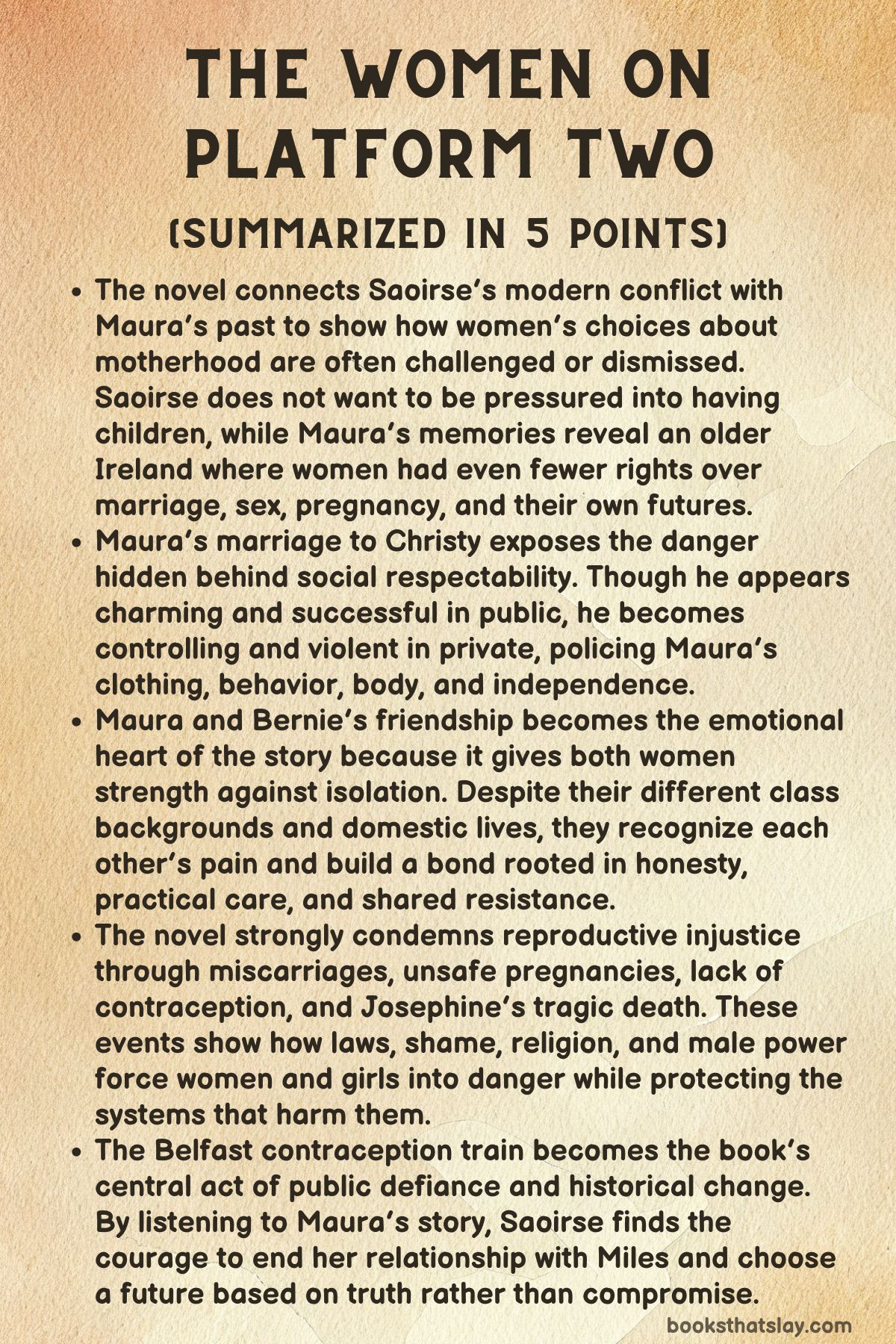
The Women on Platform Two by Laura Anthony is a dual-timeline novel set mostly in Ireland, moving between 2023 and the late 1960s–early 1970s. It begins with Saoirse, a Dublin nurse questioning whether motherhood is something she wants, and it expands into an older woman’s remembered life—one shaped by marriage, control, friendship, loss, and the quiet courage required to choose your own future.
Through a chance encounter on a train platform, Saoirse is handed a living history of women who fought for basic rights and dignity, and she’s forced to decide what she will and will not give up to keep peace.
Summary
Saoirse, a pediatric nurse in Dublin, takes a pregnancy test in her apartment and feels relief when it comes back negative. Her fiancé, Miles, reacts with visible disappointment and admits he had been hoping for a baby.
The conversation turns into a familiar argument: Saoirse insists she isn’t ready and may never want children, while Miles says time is running out and claims she’d change her mind once the baby arrived. Saoirse tries to explain that her work has made her fear what can happen to children—illness, suffering, death—and that she can’t switch those fears off just because someone expects her to.
Miles calls her selfish. Feeling cornered and exhausted, Saoirse walks out into the cold May day with no plan, just a need to breathe.
She wanders the city, watching shoppers, couples, and parents with their children. For a moment she notices a red-haired mother and daughter, and she imagines the warmth of that bond—what it might feel like to be loved that completely and to love back.
But the longing doesn’t erase her dread, and it doesn’t change her certainty that she cannot be pressured into a life she doesn’t choose. A sudden downpour pushes her into Connolly Station.
She buys coffee and chocolate and stands listening to the rhythm of announcements and arriving trains, half thinking that a short trip might reset her mind and help her talk to Miles again without anger.
As she prepares to leave, she spots an elderly woman with shining silver hair in a pink raincoat, hurrying along with a scrapbook clutched to her chest. The woman boards a train, and in the rush Saoirse notices something left behind: a black-and-white photograph on the ground.
It shows two young women in Connolly Station, arms around each other, grinning as if they’ve just won something. On the back is a date—22 May 1971—exactly fifty-two years earlier.
Saoirse calls out, but the woman doesn’t hear. Instead of handing the photo to staff, Saoirse runs for platform two, vaults the barrier, and jumps onto the train just as it pulls away.
Inside, she finds the elderly woman and returns the photograph. The woman’s relief is instant and intense.
She introduces herself as Maura and explains that the other woman in the photo is Bernie McCarthy—her closest friend for decades. Maura speaks of Bernie’s death with anger and affection tangled together, as if she’s still arguing with her friend for leaving first.
She tries to reward Saoirse with money, pressing a note into her hand, but Saoirse is more focused on the fact that she’s now on a moving train without a ticket or a plan. Maura calms her, saying the first stop is Drogheda and Saoirse can return easily.
She jokes that she can deal with any trouble because it’s hard to refuse an old woman who asks nicely.
Saoirse stays seated beside her, and Maura opens the scrapbook—marked as belonging to Bernie—and begins to tell Saoirse what the photo meant. The story moves back to November 1968.
Maura is a young woman working at Switzers on Grafton Street, living under strict family rules and surrounded by expectations about what a “good” life looks like. A charming, well-dressed man flirts with her at the store and calls her Doris Day.
He buys an expensive coat without blinking and invites her out. He is Christopher Davenport, a junior doctor, and he offers Maura the kind of future people admire.
Her coworker Geraldine, bold and politically awake, teases her that dating is just a conveyor belt toward marriage and babies, but Maura is swept up in the attention and the promise of security.
Maura and Christy begin seeing each other constantly. Her parents are thrilled once they learn he’s a doctor.
By May 1969 they are engaged, and the announcement appears in the newspaper. Geraldine warns Maura that once she’s married she’ll likely be expected to leave work, and she shares banned English newspapers and arguments about censorship, contraception, and women’s rights.
Maura listens but keeps choosing the safer dream she has been taught to want: a wedding, a home, children, and respectability.
The wedding in June 1969 is full of ceremony and applause, and Maura believes she is stepping into happiness. Then, almost immediately, the mask slips.
When Maura changes into a stylish trouser suit to leave the reception, Christy slaps her outside The Shelbourne, furious that she “embarrassed” him by dressing “like a man.” In public, he stays polished and pleasant. In private, he becomes controlling, deciding what she should wear, how she should behave, and what kind of wife she must be.
On their honeymoon on the Isle of Man, he alternates between sweetness and instruction. Maura, uneducated about sex and her own body, endures pain and confusion, telling herself it will improve and that this is simply what marriage is.
She privately promises that if she ever has a daughter, she will make sure her child knows more than she did.
Back in Dublin, Maura moves into Christy’s home in Rathmines and tries to make it hers. Her days settle into routine: cooking, cleaning, keeping him pleased, shrinking her needs to fit his moods.
Christy’s anger appears in sudden, terrifying bursts—smashing a cherished bowl over a breakfast he dislikes, then later replacing it with new china as if that cancels what happened. Maura begins to suspect she is pregnant and schedules a test, carrying her sample in a jam jar to the doctor’s office and being told she must wait for results.
At the same time, the scrapbook introduces Bernie McCarthy, living above her husband Dan’s butcher shop and struggling through pregnancy, poverty, and the relentless labor of caring for three young daughters. The flat is crowded and loud; money is tight; every smell and task feels heavier.
Bernie’s world is nothing like Maura’s tidy house, yet both women are trapped by expectations that leave little room for their own choices.
Their lives collide when Maura, limping after an accident involving Bernie’s pram, ends up walking with Bernie and the children. Maura buys the girls sweets and invites them into her home when an accident leaves one child wet and miserable.
Inside, Maura feeds them, helps with washing, and gives Bernie a rare moment of warmth and ease. Bernie, direct and unromantic, names the loneliness she sees in Maura and claims her as a friend.
For Maura, the visit is a breath of real companionship. Then Christy comes home early, hungry and furious, and Maura’s fear floods back.
He explodes over her speaking to Dan and accepting free meat, turns violent, and Maura falls down the stairs. She begins bleeding heavily and realizes she is losing the pregnancy.
Christy cries and rewrites the event as an accident, then leaves her to cope alone, demanding dinner when he returns.
Bernie’s own pregnancy ends in tragedy when her premature baby dies. The hospital’s cold procedures and the lack of care for a grieving mother leave her hollowed out.
At home, Dan is terrified of losing her too, and he decides to separate himself from her physically to prevent another pregnancy. Bernie, desperate for closeness and furious at being treated like a risk to manage, tries everything to bring him back.
Her anger grows into action when she and Maura, guided by Geraldine, find illegal condoms—“French letters”—through a pub connection. Bernie confronts Dan with them, insisting they deserve intimacy and choice.
Dan is frightened of scandal but finally yields, admitting he wants her too.
As Maura’s miscarriages continue—some caused by Christy’s violence—she reaches a turning point. She confesses she no longer wants a baby, not because she lacks love, but because she cannot protect a child in the home she lives in.
Bernie tries to help her find a way to avoid pregnancy, but Christy controls access to contraception. They hear of a woman known as Mrs. Stitch who secretly “helps women,” and Maura goes seeking a permanent solution.
Instead she is mocked and turned away for not being pregnant, told to keep her legs closed. Outside, Maura and Bernie find a terrified fifteen-year-old girl, Josephine, pregnant by an older man with power in her life.
She has nowhere safe to go and has tried to harm herself with a dangerous potion to avoid being sent away to an institution. Maura takes Josie home, feeds her, lets her bathe, and shields her under the lie that she is family.
Josie’s fear doesn’t ease. The potion doesn’t work.
In a moment of desperation, she steals pills from Maura’s medicine cupboard and overdoses. Christy attempts resuscitation but cannot save her.
The police dismiss Josie as a runaway, and Christy pushes Maura to distance themselves from the girl, treating her death as an inconvenience. Maura is shattered by the loss and by what it reveals: the world protects men, punishes girls, and expects women to stay quiet.
Maura’s life begins to shift toward public resistance. She leaves Christy and lives with other women—Nuala and Sharon—who are organizing around women’s rights.
After Maura speaks on television, letters arrive in sacks: mothers angry that benefits go through husbands, young women terrified of pregnancy, women asking for help they can’t safely ask for in their own lives. Maura understands that what trapped her isn’t only one cruel man, but an entire system built to keep women dependent and ashamed.
Bernie watches Maura become known, admired and hated in equal measure, even while Bernie risks her own family’s livelihood by associating with the movement. Still, Bernie keeps going, telling herself she is doing it for her daughters.
The group’s meetings grow—from dozens to hundreds. They face harassment, being thrown out of venues, being ordered away by police, yet they persist.
When the question of contraception rises, Maura points out that it is available in Northern Ireland. The idea forms into a plan: women will take the train to Belfast, buy contraception, and return openly, forcing the country to confront the law.
Maura’s home becomes a workshop for posters and banners, and she even cuts up Christy’s belongings to make the movement’s message visible. When a solicitor arrives to say Christy intends to sell the house and Maura must leave, she refuses to let him pull her focus away from what she is building.
On 22 May 1971, the women board the train under the eyes of journalists and cameras. Bernie joins too, pushed by Dan’s belief that their daughters deserve better.
In Belfast, the women split into groups. Some manage to buy condoms.
The pill requires prescriptions, so Maura and others improvise by buying aspirin and hiding the tablets as if they are the pill, determined not to return empty-handed. On the journey back, anxiety takes over.
In Dublin, customs officers search handbags, find condoms, and prepare to act. Nuala produces her “pills,” and when pressure mounts she prompts everyone to swallow a tablet at once—aspirin, but the officials don’t know.
Cameras flash, supporters chant, and the authorities ultimately allow the women through. Outside the station, there is celebration, relief, and the sense that something irreversible has begun.
Amid the chaos, a garda quietly tells Maura that Christy died that same afternoon, found in his car outside the hospital, apparently from a heart attack. The papers about selling the house were not signed, meaning her immediate situation has shifted again.
Maura is stunned, but she understands she will survive. The future she once imagined is gone, yet she has made a different future possible—for herself and for countless others.
Back in 2023, Saoirse listens to Maura’s full story as they travel by train with Marie, Bernie’s daughter. Seeing what Maura and Bernie endured—and what they fought for—forces Saoirse to recognize her own choice with more clarity.
In Belfast, Maura reunites with members of the McCarthy family, and Saoirse takes in the ordinary tenderness of that meeting on a platform. Afterward, Saoirse steps away, sits outside a Boots, messages Miles, and calls him.
She ends the relationship with honesty: he may be a wonderful father someday, but not with her. She doesn’t want children, and she won’t be argued into it.
The decision hurts, but it is clean and certain. Like Maura before her, Saoirse walks forward knowing she will be okay.
Characters
Saoirse
Saoirse is the contemporary anchor of The Women on Platform Two, and her interior conflict drives the novel’s emotional question: whether a woman can choose a life that doesn’t include motherhood without being cast as incomplete or selfish. As a paediatric nurse, she carries the accumulated grief of witnessing children suffer and die, and that professional proximity to loss turns “what if” into a lived reality rather than an abstract fear.
Her argument with Miles is not simply about timing; it is about bodily autonomy, identity, and the right to define love and fulfillment on her own terms. The chance encounter with Maura becomes a mirror that reflects both continuity and change across generations, and Saoirse’s arc moves from reactive overwhelm to deliberate self-definition.
By the end, she chooses honesty over compromise, accepting heartbreak as the cost of living truthfully, and she emerges with a quiet steadiness that contrasts with the panic that first sends her into the station.
Miles
Miles functions as a believable, modern face of a very old pressure: the expectation that a woman will eventually “come around” to motherhood if she is partnered with the right man. His disappointment at Saoirse’s negative pregnancy test reveals that his desire for a child has already begun to shape the relationship as a future plan rather than a shared choice.
He frames parenthood as inevitable and reframes Saoirse’s fear as selfishness, which exposes how easily care can become coercion when one partner assumes their vision of adulthood is the default. Miles is not drawn as a villain so much as a representation of entitlement dressed up as concern—his insistence that Saoirse will love the baby “once it arrives” ignores the physical, emotional, and existential risks she is naming.
In the final call, he becomes the catalyst for Saoirse’s clarity: he embodies the relationship’s fundamental incompatibility, and her decision to end it is a refusal to be negotiated into a life she does not want.
Maura
Maura is the novel’s bridge between eras, carrying both personal trauma and public defiance in one life. In her younger self, she begins as someone shaped by respectability, romance, and social instruction, sincerely believing that marriage will deliver safety and meaning.
The cruelty she experiences after the wedding—especially the public charm paired with private control—forces her to confront how easily “a good match” can become a cage. Her later self, telling the story with wit and bluntness, shows survival without sentimentalizing it; she remembers the harm clearly while also insisting on the possibility of change.
Maura’s relationship to motherhood is complicated and painful: miscarriages, violence, and the inability to imagine a child safe under her roof transform desire into dread, and her eventual activism is born from that collision between private suffering and systemic constraint. As an older woman, she holds grief for Bernie and for the life she once thought she was promised, but she also holds pride in what she helped shift, making her a portrait of someone who outlives both her abuser’s narrative and the era’s silence.
Christopher Davenport
Christopher, or Christy, is the novel’s most direct depiction of patriarchal power at the domestic level: charming in public, controlling in private, and skilled at turning his partner’s fear into her responsibility. His initial courtship is designed to dazzle—expense without hesitation, confident flirtation, professional status—creating a story Maura wants to believe.
Once married, he polices her clothing, speech, movements, and access to independence, and his violence is not episodic but structural, used to enforce obedience and to remind her that safety is conditional. He manipulates perception by being polite to outsiders and by rewriting events afterward, insisting Maura is clumsy or overreacting, which isolates her inside a reality he controls.
Even his role as a doctor is doubled: it grants him prestige and authority while enabling a cold, clinical dominance that treats Maura’s body as something he can claim. His sudden death does not redeem him; it functions as a grim irony in which a man who shaped so much harm is removed by the ordinary fragility of a body, leaving Maura to keep living and to reclaim what he tried to erase.
Bernie McCarthy
Bernie is the novel’s fierce, exhausted, tender realist—a working-class mother whose love is immense and whose life is crowded with labour, loss, and practical constraints. Her home above the butcher shop is rendered as a constant churn of diapers, sickness, finances, and noise, and the chaos is not romanticized; it is a lived grind that still contains warmth and loyalty.
Bernie’s grief after her son’s death is one of the story’s most devastating examinations of how institutions can strip women of even the basic dignity of mourning, reducing a baby to paperwork and an inconvenience. She resents, loves, desires, and rages in equal measure, especially in the intimacy crisis with Dan, where her need for closeness collides with fear, medical warning, and social shame.
Bernie’s friendship with Maura is transformative for both: she brings blunt truth and solidarity to Maura’s loneliness, while Maura’s home briefly becomes a refuge for Bernie’s family. As an activist, Bernie embodies stakes—she has daughters whose futures are on the line and a business that can be destroyed by boycott—yet she still shows up, making her courage feel costly and therefore profound.
Dan McCarthy
Dan is written as a man shaped by care and fear, and his decency is measured less by speeches than by small, steady choices. He works hard, respects education for his daughters, and is capable of tenderness, but he is also deeply influenced by reputation, scandal, and the threat that public judgment poses to survival.
After Bernie’s near-fatal pregnancy and the loss of their son, Dan’s withdrawal from intimacy is not framed as cruelty so much as panic expressed as control; he tries to protect Bernie by turning marriage into a risk-management plan, and in doing so he neglects her emotional needs. His arc gains complexity when he supports Bernie’s participation in the Belfast trip, revealing an ability to see beyond immediate fear toward long-term justice for his children.
Dan’s presence also shows a contrast with Christy: both men can exert pressure, but Dan is capable of listening, changing, and accepting that women’s choices are not threats but necessities.
Geraldine
Geraldine is the story’s early spark of dissent, the person who names what polite society pretends not to see. As Maura’s coworker, she punctures romantic myths with sharp humour and political awareness, warning Maura about how quickly love becomes limitation when work, independence, and bodily autonomy are surrendered.
She introduces contraband newspapers, challenges censorship, and speaks about women’s rights in a way that makes her both inspiring and socially dangerous in the eyes of others. Geraldine’s participation in the Belfast trip is significant because she insists that single women’s needs—especially contraception—are not secondary or shameful, and she refuses the idea that only married mothers have legitimate claims.
She is a catalyst figure: sometimes abrasive, often brave, and crucially unwilling to make herself small for comfort.
Nuala
Nuala represents organized, strategic courage—the person who understands that anger must become structure if it is going to produce change. As Maura’s housemate and a core organizer, she takes the endless flow of women’s suffering and turns it into meetings, membership lists, plans, and public action.
Her response to the anonymous letters is both compassionate and weary, recognizing that individual stories are symptoms of a broader system that will not vanish quickly. Nuala’s steadiness is what makes the movement feel real rather than symbolic; she expects setbacks, prepares for them, and keeps going anyway, embodying the long-haul resilience that activism demands.
Sharon
Sharon functions as a connector between message and media, helping translate private injustice into public visibility. Her decision to involve a cameraman underscores the novel’s tension between safety and exposure: being seen can be protective and empowering, but it also attracts backlash and fear.
Sharon’s role highlights how movements rely on people willing to manage logistics, narrative, and public perception, and how those choices can either expand a cause or fracture participation. She is part of the collective engine that makes the “condom train” moment possible, showing that history is built not only by the most famous face but also by the people arranging the conditions for courage.
Josephine
Josephine, or Josie, is the novel’s most heartbreaking illustration of what happens when a society criminalizes women’s choices and shields male predation. She is extremely young, isolated, and terrified, carrying a pregnancy that is not framed as romantic tragedy but as entrapment layered with threat—family shame, institutional punishment, and the silence demanded by a powerful older man.
Josie’s desperation drives her toward unsafe methods, and her death becomes a brutal indictment of a world where “help” is whispered, judgment is loud, and survival depends on luck. Importantly, she is not used merely as plot; her presence reshapes Maura’s moral landscape, forcing Maura to see that personal escape from Christy is not enough when other girls can be destroyed by the same system.
Bernadette Brighton
First appearing as the shadowy figure of Mrs. Stitch, Bernadette Brighton embodies the underground economy created by prohibition and stigma. She is feared, sought out, and morally complicated—not because she is inherently monstrous, but because she operates where official care refuses to go.
Her cruelty toward Maura when Maura seeks prevention rather than crisis reveals a triage mindset: she has likely seen too much desperation and has become hardened, rationing empathy to what she considers “real problems.” When she later steps into the open, identifying herself and expressing relief at leaving that work behind, she becomes a symbol of a society forcing women into dangerous roles—both those who seek help and those who provide it—until legal, safe options exist.
Father Walsh
Father Walsh represents institutional religion as both a presence of comfort and a mechanism of control. His visit to Bernie after her baby dies offers prayer and condolence, yet it also normalizes a system where loss is handled quietly, administratively, and without meaningful agency for the mother.
By pointing her toward a “small burial plot” and facilitating an impersonal process, he reflects how the institution manages women’s pain while maintaining the social order that produced it. His proximity to the community gives his authority weight, and that weight contributes to the climate where shame and obedience are presented as virtues.
Rita
Rita, the bed-and-breakfast host on the Isle of Man, is a subtle but important figure because she reveals how abuse can be invisible to outsiders. Her warmth, curiosity, and assumptions about newlywed bliss contrast with Maura’s internal distress, underscoring how social scripts—happy bride, proud husband—create cover for control.
Rita’s kindness is genuine, but it cannot reach Maura because Maura does not yet have language, permission, or safety to speak. In that sense, Rita becomes part of the story’s critique of how communities can be near suffering without seeing it.
Bert
Bert’s brief health scare functions as a spotlight on Christy’s self-image and on gendered contempt. The moment allows Christy to play the competent doctor and collect admiration, reinforcing the public persona that makes his private behaviour harder to challenge.
His dismissive remark about Bert listening to a doctor “and not his wife” exposes an everyday misogyny that aligns with his domestic abuse: even in casual situations, women’s voices are treated as noise. Bert himself is less a developed character than a narrative instrument that reveals the social rewards men like Christy receive for authority.
Dr. Buckley
Dr. Buckley represents the formal medical system that is simultaneously trusted and emotionally distant. The process Maura undergoes—samples, waiting, appointments scheduled weeks out—captures how women’s bodies are managed through institutional routines that can feel impersonal, especially when the stakes are life-altering.
Dr. Buckley is not shown as malicious, but the system he stands for does not protect Maura from domestic violence, nor does it offer easy access to reproductive control; it exists alongside her suffering rather than interrupting it.
Timmy
Timmy, Geraldine’s brother and the barman, illustrates how informal networks bypass unjust laws. By supplying condoms in a space where women are not welcomed, he becomes a quiet ally whose role is practical rather than ideological.
His presence shows how social change often relies on mundane acts of cooperation and risk-taking by people who may not be public leaders but who enable others to reclaim agency.
Elizabeth
Elizabeth, Bernie’s eldest daughter, is the child through whom the novel explores the inheritance of shame and the urgency of change. Her accidents, needs, and milestones make motherhood tangible and exhausting, yet her innocence also clarifies why Bernie keeps fighting despite risk.
Elizabeth’s entry into school represents a doorway into the wider world—one that Bernie wants to be safer and fairer than her own. She is also a reminder that activism is not abstract for these women; it is about the daily lives of children who will become adults in the Ireland being contested.
Marie
Marie becomes especially significant in the contemporary frame, traveling with Saoirse and Maura and linking past activism to present family legacy. As someone shaped by her mother’s choices and by the movement’s ripple effects, she represents what survival looks like across generations: not spotless, not simple, but enduring.
Marie’s presence also grounds the story in the long memory of families—how political actions become private inheritance, told and retold until they form identity.
Teresa
Teresa appears as part of the collective on the Belfast trip, and her success in buying condoms underscores the unevenness of access and the improvisation forced upon the women. She represents the many participants whose names history may not highlight, yet whose actions make the event real.
Through her, the novel emphasizes that movements are not powered only by the most visible figures; they are powered by a crowd willing to stand in risk together.
Mrs. Dunne
Mrs. Dunne embodies social policing—how community judgment can be weaponized, especially by those adjacent to religious authority. Her threat to boycott Dan’s butcher shop shows how women can be both victims of patriarchal systems and enforcers of them, using reputation and economic pressure to punish dissent.
She also reveals the fragility of working-class survival: a single neighbour’s campaign can endanger a family’s livelihood, which is exactly why Bernie’s participation in activism is so courageous.
Alice
Alice is a small but telling presence in the Halloween scene, demonstrating how quickly children absorb social cues around entitlement, judgment, and performance. Her rude rejection of an apple is less about her as an individual and more about how social attitudes reproduce themselves early, even in moments that appear harmless.
Through her, the novel hints that cultural change requires more than laws; it requires reshaping what children learn to value and scorn.
Sister Sloan
Sister Sloan represents doctrinal certainty imposed as moral education, especially on girls. By telling children that women should become mothers and by implying that Maura’s choice is “bad,” she becomes a channel through which institutional ideology enters everyday life.
Her role clarifies how reproductive expectation is taught as righteousness rather than preference, and how bullying can be sanctified when it wears authority. In the story’s emotional logic, Sister Sloan is the kind of figure Maura and Bernie are fighting—someone who turns women’s lives into lessons about obedience.
Maura’s mother
Maura’s mother reflects the generational transmission of survival strategies, teaching her daughter how to be a “good wife” because that is what she believes will keep Maura safe and respected. Her guidance is not portrayed as malicious; it is constrained by a world where women’s security is tied to marriage and compliance.
The tragedy is that these lessons, meant as protection, can become tools that trap Maura in silence when harm begins.
Maura’s father
Maura’s father represents patriarchal gatekeeping at the family level, where a daughter’s freedom is conditional and monitored. His strictness softens when he hears Christy is a doctor, exposing how male status can override concern and how professional prestige can act as a proxy for character.
In approving the match, he participates in the social machinery that funnels women toward “respectable” futures, even when those futures are unsafe.
Themes
Autonomy over motherhood and the cost of coercion
Saoirse’s argument with Miles lands in a place that many people try to smooth over with reassurance, but the story refuses to treat her hesitation as a phase. She is not weighing baby names; she is weighing risk, grief, and the deep responsibility she has seen up close as a nurse.
Her daily work turns the abstract idea of “what if something goes wrong” into something she has watched happen to real families, and that experience makes her fear feel rational rather than dramatic. Miles responds by framing time as a threat and parenthood as an inevitability, and that difference exposes how often a woman’s “no” gets treated as negotiable.
His insistence that she will love a child once it arrives is not comfort, it is a dismissal of her self-knowledge, and the word “selfish” becomes a weapon meant to corral her into the role he wants. What matters is not only that he wants a baby, but that he feels entitled to certainty about her future emotions, as if her body and her mind are obstacles that will eventually fall into line.
The train journey offers Saoirse a mirror through Maura’s past, showing how the pressure to become a wife and mother can shift from social expectation into private control. Maura begins with a conventional dream that has been praised by everyone around her, and that approval makes it harder for her to name the violence when it arrives.
Over time, her husband’s demands reduce choice into compliance: how she dresses, where she goes, what she buys, what she is allowed to plan. Even reproduction becomes an arena of dominance, where pregnancy is not simply desired but used to bind her more tightly to a home that is unsafe.
When miscarriages happen in the shadow of violence, the story forces the reader to see how coercion can invade even the most intimate parts of life, turning what is often treated as a private family matter into a matter of survival. By the end, Saoirse’s decision to leave Miles is not framed as a sudden awakening; it reads like the final step of an internal process that begins with refusing to be argued out of her own truth.
The Women on Platform Two makes the point that autonomy is not only the right to choose motherhood, but also the right to reject it without being punished, mocked, or cornered into sacrifice.
Gendered control inside marriage and the performance of “respectability”
Maura’s early relationship with Christy begins as something that looks polished from the outside: a flattering courtship, a man with status, parents who relax once the match seems “good,” a public storyline that fits what the community rewards. That public version becomes a shield for him.
The first slap happens not in a hidden corner of the home but at a hotel, immediately after a celebration, and it shows how fast a man can punish a woman for stepping outside his script. What follows is a pattern that is not only violence but also image management.
He can be charming to strangers, attentive at breakfast, polite with hosts, and then controlling and cruel when no one is watching. The story shows how this split creates confusion and self-doubt in the person being harmed, because the abuser’s public face makes the private reality feel unbelievable even to the one living it.
Maura checks her face for bruises and tries to convince herself it “wasn’t so bad,” not because she is naïve, but because the surrounding culture gives her very few acceptable words for what is happening.
“Respectability” becomes a trap with practical consequences. Maura is expected to stop working, expected to behave, expected to look a certain way, and expected to absorb the daily humiliations that come with being treated as property.
When an heirloom bowl is smashed and later replaced with new china, the replacement functions like a cover-up: a material gesture meant to erase the meaning of the violence while leaving the power dynamic untouched. Even the home itself is shaped around his authority, and the routine she keeps is framed as duty rather than choice.
This theme expands beyond one marriage, because the narrative repeatedly shows institutions that protect male authority through silence and stigma. Women are pushed to keep problems private, priests offer rituals when what is needed is accountability, and the threat of scandal polices behavior as effectively as the threat of a raised hand.
The tragedy of Josephine sharpens this further: a girl is harmed by a man with social power, and the consequences fall almost entirely on her body and her future. In The Women on Platform Two, “respectability” is not a neutral ideal; it is a social rulebook that rewards men for control and punishes women for disrupting the picture.
Solidarity across class, age, and life stage
The friendship between Maura and Bernie begins with something ordinary and physical: a heavy bag of meat, a twisted ankle, a pram in the street, the mess of small children and winter weather. The story treats these small contacts as the way real alliances form, not through perfect speeches but through practical care.
Maura opens her home, warms the children, washes clothes, offers food, and in doing so learns what motherhood looks like when money is tight and exhaustion is constant. Bernie, in turn, offers Maura blunt honesty without cruelty.
She names loneliness, she names fear, and she refuses to treat Maura’s position as something that automatically makes her safe. Their bond matters because it crosses categories that often keep women separated: the doctor’s wife and the butcher’s wife, the woman with a polished home and the woman carrying laundry and nappies, the woman trapped in a “respectable” marriage and the woman trapped by financial dependence and repeated pregnancy.
Solidarity becomes even more significant when it moves from private friendship into collective action. The women’s meetings grow not because everyone shares identical lives, but because they recognize a common problem: laws and customs that treat women’s bodies as something regulated by the state, the church, and men.
The narrative does not romanticize activism; it shows practical risk. Businesses face boycott, women face harassment, and even the simple act of gathering for tea becomes a confrontation when a hotel refuses them space.
The group also has internal friction, because not everyone is equally “safe” to be public. Bernie worries about the butcher shop and her daughters.
Geraldine is dismissed because she is single, as if her needs don’t count. That tension is important because it shows solidarity as work, not sentiment.
It requires making room for different stakes and still choosing to stand together.
The frame story with Saoirse and Maura brings this theme forward into the present. A young woman in 2023 is not simply hearing history; she is being held in it, carried by it, and offered a language for her own life.
Maura’s scrapbook becomes a bridge across time, but the real bridge is the relationship itself: the older woman who refuses to let the younger one minimize her own needs, and the younger woman who listens without treating Maura as a relic. The Women on Platform Two presents solidarity as a form of shelter—sometimes literal, like a spare room, and sometimes moral, like the courage that comes from knowing someone else will stand beside you in public.
Reproductive injustice and the uneven distribution of risk
The book repeatedly shows that pregnancy is not simply a personal event; it is an experience shaped by law, access, and power. Bernie’s life after her baby dies reveals how grief can be managed by institutions in ways that leave mothers with almost nothing.
She is offered a burial plot behind a hospital, but not real choice, not real recognition, and not the kind of support that would treat the loss as the death of a person she loved. Her refusal to engage with the system is not coldness; it is a form of self-protection in a world that offers procedure instead of compassion.
At home, the fallout continues, because Dan’s fear of losing her turns into control over intimacy. The story allows both truths to exist: he is terrified and protective, and she is hurt and lonely.
Even love becomes distorted when the only available tools are avoidance and silence.
Maura’s miscarriages add another layer: pregnancy becomes something that can be forced upon her, and loss becomes something she must endure in isolation. The violence that causes the miscarriages is paired with a society that makes it hard to leave and hard to speak.
Reproductive harm is not shown as a single shocking event but as a repeated pattern that erodes safety and hope. Josephine’s death is the most direct portrayal of reproductive injustice: a teenager is cornered by shame, threatened with confinement in a “fallen women” system, and pushed toward dangerous solutions because legal and medical options are blocked.
The adult man responsible remains protected by secrecy, while the girl’s body bears the entire consequence. The police response, dismissing her as a runaway, reinforces the idea that certain lives are treated as disposable, especially when acknowledging the truth would require challenging respected men.
The Belfast trip shows how injustice also operates through absurdity: women take a train and risk arrest to obtain basic contraception, and when access is denied through prescription rules, they resort to performance and bluff, swallowing aspirin to outmaneuver customs. It is funny on the surface, but the humor points to something bleak: the state has created conditions where pretending is safer than asking.
Even in the 2023 frame, Maura notes that responsibility still often falls on women, which keeps the theme alive rather than sealed in the past. Saoirse’s final choice to end her engagement connects directly to this history.
She is not only choosing a relationship boundary; she is refusing a future where her body becomes the battleground for someone else’s certainty. The Women on Platform Two argues that reproductive freedom is not an abstract ideal.
It is about who carries risk, who gets options, who gets believed, and who is expected to endure consequences quietly.