The Crash by Freida McFadden Summary, Characters and Themes
The Crash by Freida McFadden is a psychological thriller about survival, deception, and the hidden motives of people who seem helpful. The story follows Tegan Werner, a young pregnant woman whose life is already complicated when a car accident during a snowstorm leaves her stranded in a remote area.
A couple rescues her and takes her to their isolated home, where what initially appears to be kindness slowly becomes something far more unsettling. As secrets begin to surface, Tegan realizes that several people around her are not who they claim to be. The novel explores desperation, betrayal, and the difficult choices people make when pushed to their limits.
Summary
The story opens with a mysterious narrator committing murder. The person describes the act with shock and guilt, insisting they never imagined they would take a life.
Despite the horror of the moment, the narrator believes there was no other option. The identity of the killer and the victim remain unknown, setting the stage for the tense events that follow.
Tegan Werner is a 23-year-old woman living alone in a rundown apartment in a small town in Maine. She works at a grocery store and is nearly eight months pregnant.
Her life is far from stable—she struggles financially, suffers from severe sciatic pain, and has little support. Her parents died years earlier, and the only close family she has left is her older brother Dennis, who works as a ski instructor in another town.
Tegan’s pregnancy began after a drunken night at a bar during a visit to Dennis. She slept with a stranger she barely remembers.
Months later she recognized him on television as Simon Lamar, a wealthy real estate developer with a wife and children. A paternity test confirmed he was the father of her baby.
Simon wants to avoid scandal, so he offers Tegan a large sum of money in exchange for signing a nondisclosure agreement that would keep the situation secret.
Simon’s lawyer, Jackson Bruckner, visits Tegan several times to arrange the deal. Unlike Simon, Jackson treats her kindly and with respect.
Tegan grows fond of him and trusts him. The money Simon promises would allow her to raise her baby comfortably and possibly attend nursing school, which has long been her dream.
However, everything changes during the meeting when Tegan is about to sign the agreement. As Simon approaches her, the scent of his cologne triggers a buried memory.
Suddenly she realizes the truth: the night they met was not a consensual encounter. Simon drugged and raped her.
Horrified and angry, Tegan confronts him. Simon denies the accusation and claims she is lying.
Jackson privately encourages her to forget the accusation and accept the money, warning that she has no proof and will likely lose if she pursues the matter legally.
Tegan refuses to stay silent. She says she intends to report Simon to the police, even though he threatens to ruin her life and sue her for defamation.
After the confrontation, Tegan calls Dennis and decides to drive to visit him so she can explain everything in person.
Late that evening, she begins the drive during a developing snowstorm. The weather worsens rapidly, and visibility becomes extremely poor.
Her GPS directs her off the highway and then loses signal. As she struggles to navigate the snowy roads, Jackson calls her.
The connection is weak, and she cannot understand most of what he says except that it sounds urgent and involves Simon and the police.
Suddenly Tegan’s brakes fail. Her car spins out of control and crashes into a tree.
She survives but is badly injured. Her ankle is severely damaged, she struggles to breathe, and the freezing temperature threatens her life.
Trapped in the wrecked vehicle with no cell service, she believes she might die in the storm. Eventually headlights appear.
A large man named Hank Thompson pulls up in a truck and rescues her from the car.
Hank carries Tegan to his vehicle and says he will take her to his house because the hospital is too far away in the storm. His wife Polly, a former nurse, will care for her until they can reach medical help.
With no other options, Tegan agrees.
The Thompsons’ home is an isolated cabin. They place Tegan in a basement room that once belonged to Polly’s dying mother.
The space contains a hospital bed and medical equipment, but it is cold, dark, and unsettling. Polly treats Tegan kindly and gives her blankets and pain medication, while Hank remains distant and intimidating.
Although Polly appears caring, Tegan feels uneasy. She notices a bruise on Polly’s wrist and begins to suspect that Hank abuses his wife.
Her anxiety grows when she discovers that her phone and pepper spray are missing from her purse.
As the storm continues, the couple claims the roads are blocked and phone lines are down. Tegan is forced to remain in the basement while Polly brings her meals and medication.
Her injured leg becomes extremely painful, and she begins to fear she will never leave the house.
The story then shifts to Polly’s perspective, revealing events leading up to the crash. Polly once worked as a nurse but lost her job after a disturbing incident in a hospital nursery where she refused to return a baby she was holding.
She and Hank have spent years trying unsuccessfully to have children. Their infertility and a failed adoption attempt have left Polly emotionally fragile.
When Hank brings the pregnant Tegan home, Polly feels overwhelming jealousy. She convinces herself that Tegan is irresponsible and unfit to raise a child after noticing alcohol and other items in her purse.
Gradually Polly forms a dangerous idea: if Tegan stays long enough, she might be persuaded—or forced—to give them the baby.
Polly secretly drugs Tegan with crushed antihistamines to keep her sleepy and compliant. She lies to Hank about Tegan’s condition and prevents him from contacting emergency services.
When he tries to call for help, Polly threatens to expose his past legal trouble and other secrets unless he cooperates.
Meanwhile Tegan grows increasingly desperate. She realizes she is being held there intentionally and tries various methods to escape.
She attempts to start a fire to trigger the smoke alarm, hoping it will force the couple to call for help. She also searches the basement for anything she can use as a weapon.
At one point she even confronts Polly with a syringe she found, holding it to Polly’s neck in an attempt to force her to release her. The attempt fails, and Polly regains control.
As the days pass, Tegan’s condition worsens. Her injured leg develops a severe infection because she refused earlier treatment out of fear.
Polly realizes that without medical care Tegan and the baby may die, but she still hesitates to take her to the hospital.
Eventually Hank cannot tolerate the situation anymore. Seeing Tegan’s deteriorating condition, he secretly carries her to his truck and drives her to the hospital while Polly is away.
Tegan arrives just in time to receive antibiotics and treatment that stabilizes both her and the baby. Police investigating the crash discover evidence that her brake lines were cut.
Meanwhile Polly, furious that Hank took Tegan to the hospital, decides to go there herself with scissors, intending to kill Tegan to prevent her from telling anyone what happened.
At the hospital Polly discovers someone else already trying to harm Tegan—her own brother Dennis. He attempts to inject a lethal dose of morphine into Tegan’s IV line.
Polly interrupts him, and he flees. Security eventually captures him.
Detectives later reveal the truth. Simon Lamar and Dennis had arranged for Tegan’s brake lines to be cut.
Simon feared exposure if Tegan reported the rape, and Dennis had business interests tied to Simon. They planned the crash and expected Tegan to die.
Both men are arrested and eventually sentenced to prison.
Tegan survives and later gives birth to a healthy daughter named Tia Marie Werner. She chooses not to reveal the full story about what happened in the Thompsons’ house, claiming she cannot remember events after the crash.
Jackson helps secure financial support from Simon and continues to support Tegan as she recovers.
Polly and Hank return home and eventually become foster parents to Sadie, the neglected young girl who lived nearby. Hank later admits he killed Sadie’s abusive father during a confrontation, believing it was the only way to protect the child.
One year later, Tegan has regained the ability to walk and is raising her daughter in a safe home. She continues therapy and hopes to attend nursing school.
Jackson remains close to her and Tia, suggesting the possibility of a future together.
Despite everything that happened, Tegan chooses to move forward with her life, grateful that she and her daughter survived the terrifying chain of events that began with a single crash on a snowy road.
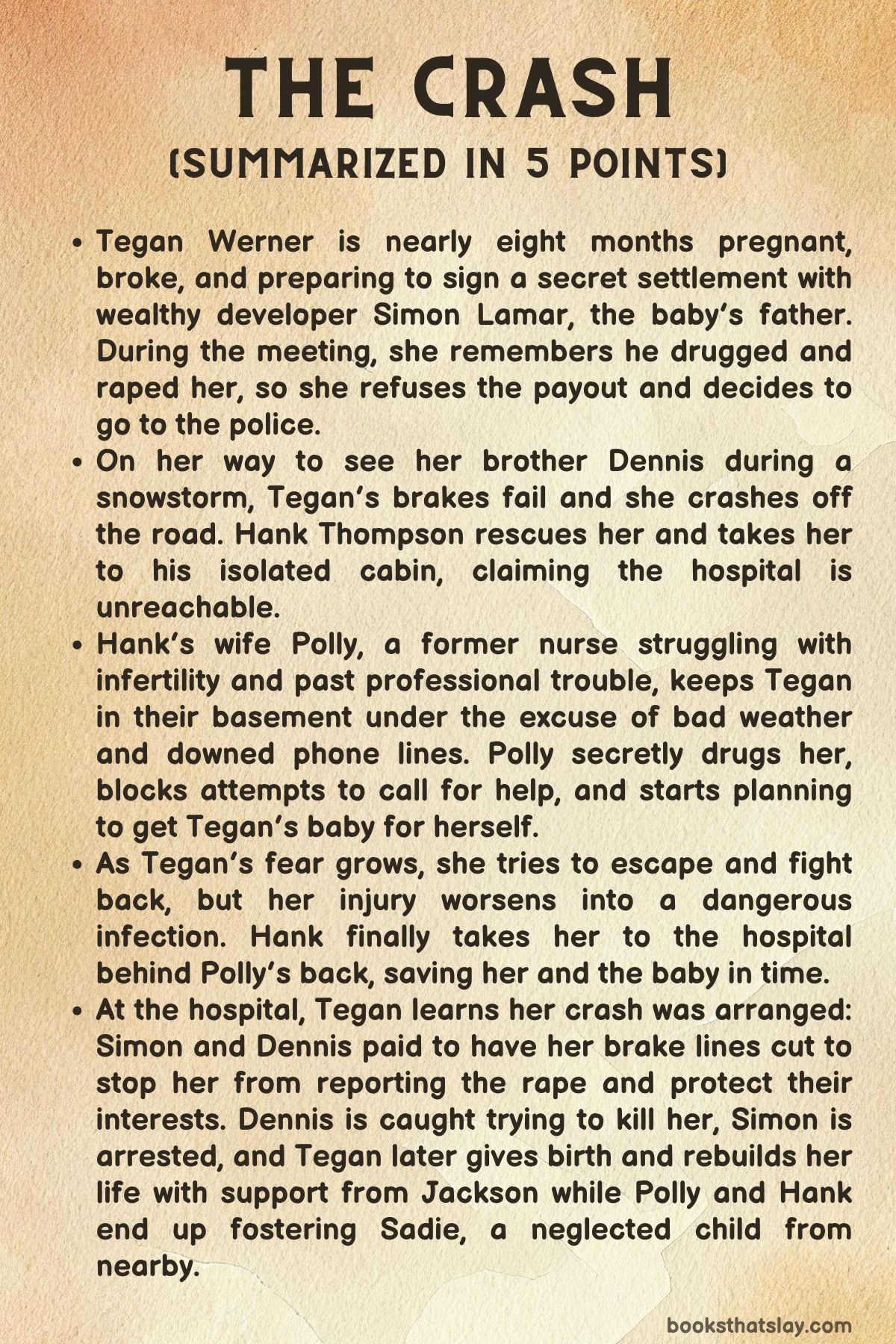
Characters
Tegan Werner
Tegan is the emotional center of The Crash, defined at first by vulnerability and scarcity but steadily revealed as stubborn, observant, and far tougher than her circumstances suggest. She starts the story exhausted by poverty, late pregnancy, chronic pain, and isolation, yet she still clings to a future plan—nursing school—as proof that her life can be more than survival.
What makes Tegan compelling is how quickly she shifts from endurance to resistance once she realizes she has been wronged: she refuses Simon’s payoff when she understands the truth of what happened to her, even though the money would solve nearly every practical problem she has. After the accident, her fear becomes sharper and more strategic; she reads small cues, tests boundaries, and tries to turn limited tools into chances to escape.
Her inner conflict is just as important as the external danger: she feels shame easily, doubts her own judgment, and still tries to be “good,” especially as a mother, even while being held captive. By the end, her choice to protect her peace by keeping parts of the truth private shows a survivor’s pragmatism rather than weakness—she learns that justice and safety don’t always arrive together, and she chooses stability for her child.
Polly Thompson
Polly is the novel’s most complicated character: outwardly competent and warm, inwardly volatile, rationalizing increasingly cruel decisions with a caretaker’s language. Her identity is shaped by loss—her mother’s death, infertility, failed adoption—and by the professional shame of “The Incident,” which turned her from a trusted nurse into someone watching life from the edges.
Polly’s deepest wound is envy mixed with longing; she doesn’t simply want a baby, she wants the role of mother as proof that her life has meaning and that she is not broken. That longing warps into entitlement once a pregnant stranger lands in her basement.
She tells herself she’s protecting an unborn child from an unfit mother, but the story makes it clear that this moral framing is a mask for possession and desperation. Polly’s intelligence is practical and dangerous: she knows how bodies respond to drugs, how institutions can be fooled, and how to perform calm while planning harm.
Yet she is not written as pure villainy; she has moments of fear, self-disgust, and fleeting clarity that reveal she understands—at least briefly—how far she has drifted. Her final actions place her in a disturbing gray area: she can stop one kind of harm while still being capable of another, and she remains someone who can convince herself that love justifies control.
Hank Thompson
Hank initially reads like a threat because of his size, silence, and blunt authority, but the novel steadily reframes him as a man trapped in a marriage ruled by Polly’s instability and leverage. He is physically powerful and capable of violence, yet he often functions as someone trying to keep the peace, choosing the simplest path that avoids catastrophe.
Hank’s moral compass is inconsistent in a way that feels realistic: he can be frightening in tone and presence, but he also shows restraint and an instinct to protect when Polly’s behavior crosses lines he cannot accept. His greatest weakness is his fear—fear of prison, fear of losing Polly, fear of the chaos her mental health can bring—and Polly uses that fear to control him.
The later reveal about Mitch shows Hank’s core trait: when he decides someone is harming a child, he becomes decisive and ruthless, willing to take consequences if necessary. That act complicates him into something unsettling but not empty; he is not a gentle hero, but a man who believes force is sometimes the only language that works.
His love for Polly is both his humanity and his flaw, because it keeps him tethered to someone who repeatedly tests the limits of what he will tolerate.
Jackson Bruckner
Jackson is written as the story’s most persuasive “safe” figure, which makes his moral ambiguity more impactful. He presents as patient, attentive, and respectful toward Tegan, and his kindness feels real enough that she begins to imagine a future connection with him.
Yet Jackson’s role as Simon’s lawyer ties him to power and control, and his first instinct is management: minimize the damage, contain the story, and push Tegan toward the option that makes the problem disappear. His response when she accuses Simon reveals how law can be used as emotional pressure—he frames the situation around proof and credibility rather than harm and truth.
As the plot develops, Jackson gains dimension by showing a conscience that finally overrides self-protection, suggesting he has seen patterns in Simon’s behavior and can no longer pretend it is a one-time mistake. He functions as a bridge between Tegan’s vulnerable world and the machinery that can actually punish Simon, but he is never portrayed as purely noble.
Even when he helps, his help is strategic—contracts, leverage, damage control—because that is the language he knows. In the end, Jackson embodies a complicated kind of ally: someone whose decency exists, but arrives through negotiation rather than purity.
Simon Lamar
Simon represents polished cruelty: he is wealthy, influential, and confident that his status will protect him from consequences. His most defining feature is entitlement—he treats people as problems to solve, not humans to respect.
When Tegan becomes inconvenient, his first move is not remorse but containment, offering money to buy silence and preserve his family image. His denial of the assault and his threats are not just intimidation; they reflect a worldview where reputation is more valuable than truth and where he assumes institutions will side with him.
Simon’s contempt toward Tegan reveals how he maintains control: by framing her as irresponsible, unreliable, or desperate, he attempts to erase her credibility before she can speak. The story also implies he is not an isolated predator but a repeat offender, which shifts him from a single antagonist into a symbol of how predation can hide behind success.
His downfall is not caused by empathy or confession but by evidence and pressure, reinforcing the book’s bleak realism: men like Simon rarely stop because they feel guilt—they stop when they are forced to.
Dennis Werner
Dennis begins as Tegan’s protective brother, a figure she trusts because he is her last stable family tie. That foundation makes his later betrayal feel especially chilling: he is not a stranger danger villain but someone who understands exactly how to guide her decisions.
Dennis’s psychology is built on resentment and self-justification. His ruined skiing career becomes a quiet grievance that he turns outward, and his willingness to trade his sister’s safety for personal gain shows how entitlement can exist inside family roles.
He frames his actions as necessary or practical—business, opportunity, survival—so he can avoid seeing himself as monstrous. The story also makes him a study in selective love: he can speak with care and still plan harm, which suggests that, for Dennis, affection is not the same as loyalty.
His attempt to kill Tegan in the hospital crystallizes his true nature: when his future is threatened, he will eliminate the threat, even if it is his own sister. Dennis is the novel’s sharp reminder that betrayal hurts most when it comes from someone who knows your soft spots.
Detective Maxwell
Detective Maxwell functions as the clarifying force who turns scattered fear into a coherent reality. Unlike many thriller investigators who feel distant, Maxwell is presented as methodical and direct, focusing on what can be proven and how different crimes connect.
The detective’s importance is not only in solving the case but in validating Tegan’s experience: the discovery of tampering and the unraveling of the plot confirm that Tegan’s danger was real and engineered. Maxwell also embodies the limits of justice; the investigation can put Simon and Dennis away, but it cannot undo what happened or guarantee that telling the full truth will feel safe for Tegan.
Through Maxwell, the story emphasizes how truth becomes official only when it can be supported by facts and procedures, which contrasts with the personal truth Tegan has carried from the beginning.
Sadie Hambly
Sadie is the story’s most visible symbol of innocence under threat, and her presence broadens the book’s focus beyond Tegan’s ordeal. She appears neglected, hungry, and bruised, and the adults around her become defined by how they respond to her suffering.
Sadie’s quietness and compliance reflect a child adapting to an unsafe home, learning rules that keep her alive—don’t invite people in, don’t tell too much, don’t provoke the person in control. She also becomes the moral mirror for Polly and Hank: Polly’s caretaker instincts are genuine when directed toward Sadie, even if those same instincts become warped into control with Tegan, and Hank’s most extreme act is tied to ending Sadie’s abuse.
By the end, Sadie’s acceptance of Hank as her father carries complicated weight: it shows a child reaching for safety and stability, while also highlighting how the adults’ “solutions” in this world often come through secrecy and irreversible acts.
Mitch Hambly
Mitch is portrayed as an embodiment of domestic menace—an adult whose power comes from intimidation, neglect, and the private isolation of a rural home. He is volatile, openly threatening, and unconcerned with consequences, which forces other characters into fear-driven choices.
Mitch’s role is important because he shows a different kind of control than Simon’s: where Simon uses money and reputation, Mitch uses proximity and brute force. His presence also intensifies Polly’s worldview; she sees herself as the only person who notices or cares about Sadie, which feeds Polly’s belief that she is justified in taking extreme measures “for the greater good.” Mitch’s death, and the circumstances around it, underline one of the story’s bleak themes: in this setting, official systems fail repeatedly, and people start making their own brutal versions of justice.
Mrs. Walden
Mrs. Walden serves as an early portrait of social judgment—the everyday cruelty that doesn’t draw police lights but still shapes how a vulnerable person experiences the world. Her condescension toward Tegan reflects a community tendency to moralize poverty and single motherhood, making Tegan feel watched and diminished even in her own home.
While Mrs. Walden is not central to the thriller mechanics, she matters because she helps explain why Tegan lies so easily about being married and why she expects people to assume the worst about her. Mrs. Walden represents a quieter antagonist: the kind that teaches a person to swallow truth for survival long before the bigger dangers arrive.
Angela
Angela appears briefly, but her role is emotionally sharp: she is a reminder of everything Polly feels she has been denied. Her pregnancy announcement triggers Polly’s bitterness and isolation, revealing how infertility has narrowed Polly’s capacity to celebrate others.
Polly’s decision to cut Angela off shows her self-protective instinct turning into cruelty—rather than endure pain, she chooses disappearance. Angela’s presence helps the reader understand that Polly’s later actions are not born overnight; they grow from years of private resentment that has never found a healthy outlet.
Dr. Salinsky
Dr. Salinsky is less a character with scenes and more a figure of accountability hanging over Polly’s life. Mentioned as Polly’s former therapist, he represents the boundary between Polly’s self-image and the reality of her mental health history.
Polly fears being seen as unstable again, and Hank fears what will happen if she is pushed back into crisis. Dr. Salinsky’s significance lies in what he symbolizes: intervention, diagnosis, and the possibility that Polly’s story could shift from secrets inside a house to consequences in the open.
Themes
Bodily Autonomy and the Fight to Be Believed
Tegan’s crisis begins long before the snowstorm, rooted in a violation that is made worse by how quickly powerful people attempt to rewrite it. When she remembers that Simon drugged and raped her, the story shows how bodily autonomy is not only about what happens to someone physically, but also about what happens afterward—who gets to define the event, whose version becomes “credible,” and what the cost of speaking is.
Simon’s immediate strategy is to treat the truth as a public-relations problem: he tries to buy silence through a nondisclosure agreement and then escalates to intimidation when Tegan refuses. That shift highlights how control can move from private harm to institutional pressure.
The threats are not vague; they are designed to trap her in a familiar pattern where the person with money, reputation, and legal resources can claim innocence simply by outlasting the person without those protections.
Jackson’s reaction deepens the theme because he represents the respectable pathway Tegan is told to trust. Even though he is kind, his instinct is to manage risk and preserve the deal, which mirrors the larger culture that often asks victims to choose “practical” outcomes over justice.
Tegan’s decision to go to the police becomes an act of reclaiming agency, but it comes with consequences engineered to make that choice feel impossible. The sabotage of her car literalizes the idea that systems of power can reach into the most ordinary parts of a person’s life—her commute, her safety, her ability to escape—when she refuses to comply.
The pregnancy adds another layer: her body is constantly treated as a bargaining chip by others, whether through Simon’s payoff, Polly’s fixation on the baby, or the medical risks that mount when Tegan is denied care. The Crash keeps returning to the fact that autonomy is fragile when people around you believe they have a claim to your body, your story, or your future.
Tegan’s struggle is not just to survive the immediate danger, but to keep ownership of her truth in a world that repeatedly tries to erase it.
Coercive Control Behind “Care” and Domestic Normalcy
The Thompsons’ cabin becomes a stage for how control can hide behind the language of help. At first, Hank and Polly present themselves as the only safe option: the storm is too dangerous, the hospital is too far, the phones are down.
Those explanations sound reasonable, which is exactly what makes the situation frightening. Control rarely arrives announcing itself; it often comes wrapped in practical justifications that delay a person’s ability to question what is happening.
Tegan’s confinement in the basement is framed as rest and recovery, but the details of the setting—darkness, isolation, the smell of a room tied to death—turn “care” into a tool of intimidation. The missing phone and pepper spray signal a critical shift: the rescue has become containment.
Polly’s role shows how caretaking skills can become a mechanism of dominance. Her medical knowledge gives her authority, and she uses that authority to decide what Tegan can swallow, when she can sleep, how much pain she should endure, and whether she “deserves” stronger medication.
Drugging Tegan with antihistamines is especially revealing because it mimics treatment while actually reducing Tegan’s capacity to resist. The acts look domestic and routine—food, pills, blankets—yet they function like restraints.
Even when Polly speaks softly or appears attentive, her choices repeatedly narrow Tegan’s options until the only “safe” path is obedience.
Hank complicates this theme because his physical presence reads as threatening to Tegan, but the true architect of the captivity is Polly. That reversal matters: it challenges the assumption that danger always wears the obvious face.
Hank’s reluctance, Polly’s leverage, and the couple’s shared history create a household where moral responsibility is blurred, and where one partner’s instability can pull the other into wrongdoing. The home becomes a closed system with its own rules, and Tegan, as an outsider, has no social standing inside it.
The Crash uses that setting to show how domestic spaces—often idealized as protective—can become private zones of power where control is easier to maintain because no one is watching and everything can be explained away as family business.
Desperation, Moral Injury, and the Ethics of “Necessary” Harm
From the opening murder to the final revelations, the story repeatedly asks what people convince themselves is acceptable when they believe they have no alternatives. The prologue’s unnamed killer frames the act as shameful yet unavoidable, setting a moral atmosphere where “I had to” becomes both a confession and a shield.
That logic echoes through multiple characters. Tegan is forced to weigh survival against risk again and again—whether to accept hush money, whether to report Simon, whether to trust strangers, whether to threaten Polly with a syringe.
Her choices are rarely clean because the situations she is placed in are designed to remove clean exits. The story’s tension comes not only from physical danger, but from watching people try to preserve some sense of decency while circumstances keep pushing them toward actions that leave scars.
Polly embodies moral injury in a different form. Her longing for motherhood and the humiliation of her past “incident” become a kind of internal pressure that distorts her judgment.
She justifies withholding help by turning Tegan into a symbol of everything she lacks and everything she thinks is unfair. The more she rationalizes, the easier it becomes for her to plan violence while still imagining herself as the victim.
What makes this theme unsettling is how ordinary the stepping stones are: envy becomes resentment, resentment becomes entitlement, entitlement becomes permission. Her intention to kill Tegan is not portrayed as a sudden transformation; it grows from months or years of unresolved grief and a life narrowed by disappointment and secrecy.
Hank’s confession about killing Mitch places the theme in stark relief. He frames the act as protection for Sadie, and the narrative supports that Mitch is abusive, but the method is direct and deliberate.
The book doesn’t let the reader rest in simple categories of hero and villain; it shows how a person can do something cruel while believing it prevents greater cruelty. In The Crash, “necessary” harm becomes a dangerous mental shortcut—one that can save a life in one moment and destroy it in another.
The story’s moral landscape suggests that when people start measuring human worth through convenience, fear, or desire, the line between protection and possession can disappear quickly.
Trust, Betrayal, and the Hidden Architecture of Manipulation
The plot is built on the constant recalibration of trust: who seems safe, who is safe, and how quickly those categories can reverse. Tegan enters the story already vulnerable—financially strained, physically exhausted, and socially isolated—and that vulnerability makes her dependent on others’ interpretations of reality.
Simon exploits this by treating her as disposable and by relying on the assumption that her word will be doubted. Dennis exploits it even more sharply because familial trust is supposed to be foundational.
His betrayal shows how manipulation is most effective when it comes from someone who has easy access to your decisions: a brother who suggests a visit, who knows your routines, who understands what you’re afraid to say out loud. The crash itself becomes a symbol of betrayal made mechanical—safety systems turned into weapons by someone who knew how to set the trap.
Jackson’s presence adds a subtler kind of manipulation: he is both support and gatekeeper. He appears compassionate and helpful, and he eventually uses his leverage against Simon to secure support for Tegan and her child.
Yet earlier, he urges Tegan to accept silence as the smart choice, showing how care can carry an agenda. That mixture creates emotional confusion that feels realistic: trust is not a switch that flips off when someone disappoints you, especially when they continue offering help.
The book uses that ambiguity to show how people can remain entangled with those who have failed them, because survival often requires accepting assistance even when it comes with discomfort.
Polly’s deception is the most sustained example of this theme. She performs kindness while hiding intent, offering food, conversation, and medical attention while quietly removing tools of self-defense and designing delays.
Her lies are not grand speeches; they are practical: roads aren’t clear, phones don’t work, the hospital is too far, tomorrow will be better. Those small statements form an architecture of manipulation that keeps Tegan suspended in hope just long enough to keep her compliant.
Even the moments where Polly genuinely helps—treating the infection, stopping Dennis—don’t erase the earlier choices; they complicate them. The Crash suggests that betrayal is not always absolute, and that people can commit harm and still do something protective later, which is part of what makes trust so hard to navigate.
The story leaves the reader with a clear sense of how easily a person’s perception can be shaped when the truth is controlled by those who hold the keys, the phones, and the doors.