The Ghostwriter by Julie Clark Summary, Characters and Themes
The Ghostwriter by Julie Clark is a suspense novel about family secrets, public shame, buried violence, and the stories people tell to survive guilt. The book follows Olivia Taylor Dumont, a successful ghostwriter whose career and personal life are already in crisis when her estranged father, Vincent Taylor, asks her to write his memoir.
Vincent was once a famous horror author, but he has long been suspected of killing his siblings decades earlier. As Olivia returns to the place she tried to erase from her life, she discovers that the old family tragedy is far more painful and complicated than she ever understood.
Summary
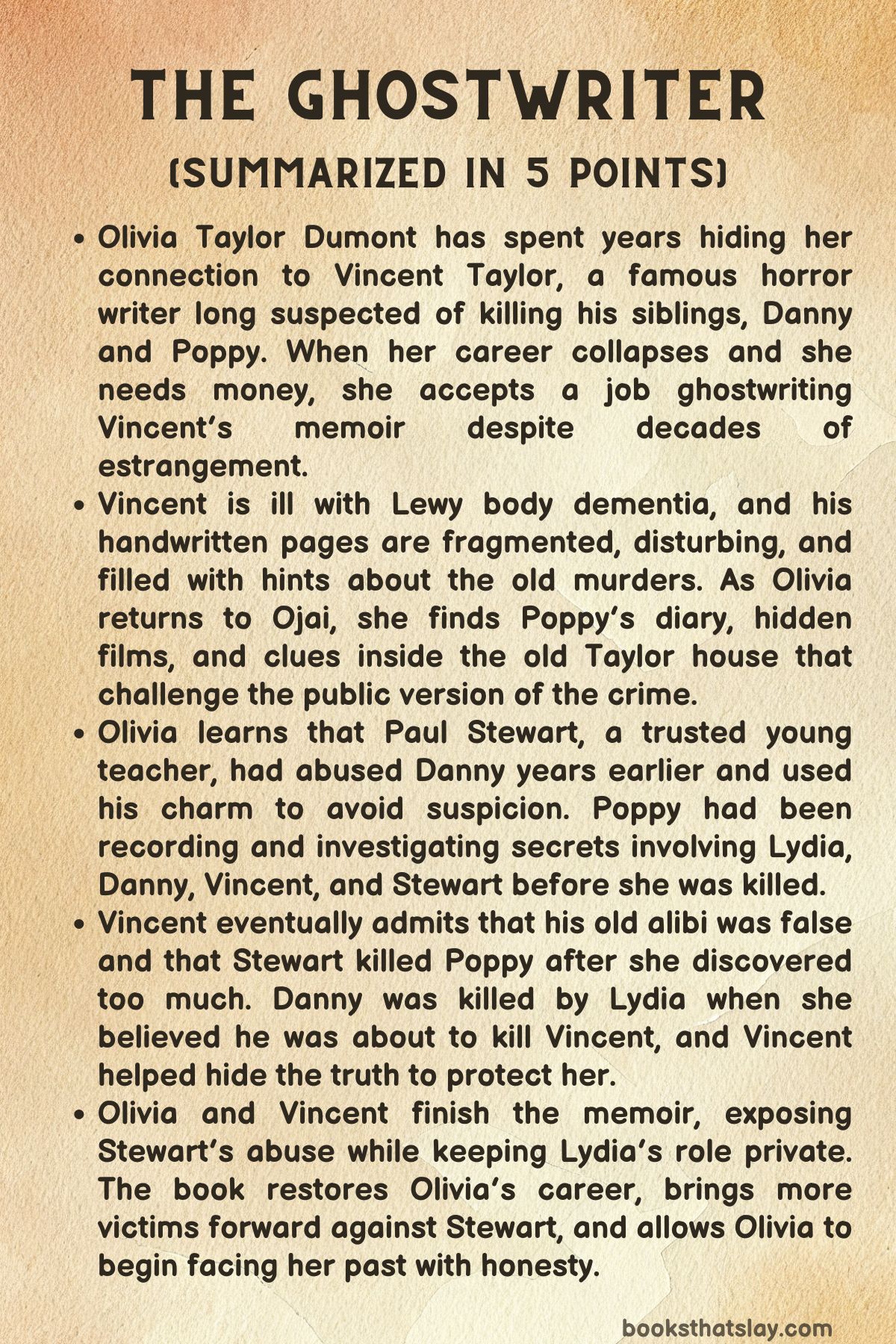
Olivia Taylor Dumont has spent most of her life trying to escape the Taylor name. When she was ten years old, another child told her that her father, Vincent Taylor, had murdered his brother Danny and sister Poppy in 1975.
Until that moment, Olivia had only known her father as a famous horror writer and a damaged, unreliable parent. The accusation changed the shape of her childhood.
The killings had taken place during the Ojai Carnival, when Poppy went home for a sweater and Danny was later found dead nearby. Vincent had always insisted he was innocent, claiming he had been with Lydia, Olivia’s mother, and Paul Stewart, a teacher, when the murders occurred.
After the tragedy, the Taylor family never recovered. Lydia eventually left, Vincent fell into drinking, drugs, and neglect, and Olivia was sent away to boarding school.
As an adult, she shed the Taylor name and built a career as a ghostwriter under the name Olivia Dumont. Her work allowed her to disappear into other people’s lives while keeping her own history hidden.
She even told her boyfriend, Tom, that both of her parents were dead, because the truth felt too dangerous to share.
By 2024, Olivia’s carefully managed life has begun to collapse. Her career is in ruins after a public confrontation with rival ghostwriter John Calder led to a lawsuit.
She owes Calder and her lawyers an enormous amount of money, and her house is at risk. When her agent, Nicole, calls with a high-paying opportunity, Olivia is desperate enough to listen.
The offer is from Vincent, who wants her to ghostwrite his next book. Olivia has not spoken to him in decades, but the money could save her, so she accepts.
Returning to Ojai forces Olivia back into the world she tried to bury. Vincent is no longer the powerful literary figure he once was.
He is broke, physically weakened, and dependent on a caregiver named Alma. Alma tells Olivia that Vincent has Lewy body dementia, which affects his memory, language, and perception.
Olivia soon realizes that Vincent’s proposed book is not a horror novel. It is a memoir about the months leading up to Danny and Poppy’s deaths.
Vincent has written pages by hand, but they are fragmented, confusing, and often alarming. His notes mention hidden objects, strange phrases, and the disturbing admission that he wanted to kill Danny.
Vincent tells Olivia not to interview anyone else, but his condition and the content of his pages make that impossible. At times, he seems lucid.
At other moments, he hallucinates or mistakes Olivia for Lydia. During one frightening episode, he tells Olivia that he hid “the knife” in Poppy’s window.
The remark suggests that Vincent knows more about the murders than he has ever admitted.
Olivia begins her own investigation while trying to keep the publishing project alive. She reconnects with Jack Randall, an old childhood friend whose father, Mark, had once been Danny’s best friend.
She also discovers that Vincent secretly owns the old Taylor murder house through an LLC named Lionel Foolhardy, a reference to one of his fictional characters. Inside the house, Olivia finds a threatening sentence in Vincent’s handwriting on Poppy’s closet wall.
Beneath loose floorboards, she discovers Poppy’s hidden Super 8 films and later finds Poppy’s diary. These materials show that Poppy had been suspicious of the adults and older teenagers around her, especially about Lydia’s pregnancy, an abortion, and the behavior of Vincent, Danny, and Paul Stewart.
The more Olivia learns, the less certain Vincent’s old story becomes. Vincent claims that Danny was dangerous and once buried Paul Stewart’s cat, Ricky Ricardo.
But one of Poppy’s films seems to show Vincent burying the cat. Vincent later explains that Danny had actually killed the animal and planted it with Vincent’s shirt, forcing Vincent to hide the evidence to protect himself.
Olivia cannot tell which parts of Vincent’s account are true, distorted by dementia, or shaped by old guilt.
She interviews people connected to the past. Margot, Poppy’s best friend, remembers Poppy as a determined young girl who was investigating Lydia’s abortion and suspected Paul Stewart of being involved.
Mark Randall tells Olivia that he saw Vincent arguing violently with Poppy at the carnival and always believed Vincent killed her, with Danny dying while trying to protect his sister. Olivia also learns more about Paul Stewart, the young teacher who lived nearby and seemed charming to his students.
He held parties, gave teenagers alcohol, and crossed boundaries that adults around him failed to confront.
While Olivia digs into the past, her present life falls apart. Tom overhears Alma refer to Vincent as Olivia’s father and realizes Olivia lied about her family.
Honesty is essential to him, and he ends their relationship. Olivia also faces sabotage from John Calder, who tries to expose the fact that she is working again.
Vincent helps her set a trap that gets Calder to admit he fabricated parts of a past celebrity memoir. Olivia then tells Nicole the truth about Vincent being her father.
Nicole immediately understands the publicity power of a daughter ghostwriting her infamous father’s memoir, but Olivia asks to keep the connection private until the book is finished and she can tell Tom properly.
Through Poppy’s diary and films, Olivia begins to reconstruct what happened before the murders. Poppy was young, observant, politically aware, and determined to use her camera to capture what others wanted hidden.
Olivia learns that Lydia had been raped by Danny at a bonfire, became pregnant, and had an abortion with Paul Stewart’s help. Vincent knew the baby was not his, but he wrongly believed Stewart was the father.
Poppy had been trying to understand the truth behind Lydia’s pregnancy and the secrets surrounding the people closest to her.
One of Poppy’s final sound films changes everything. Lydia had preserved it after Danny smashed Poppy’s camera.
In the film, Stewart confronts Danny in the woods. Their conversation reveals that Stewart had sexually abused Danny years earlier in the school equipment shed, and that Danny had burned the shed down in revenge.
Danny discovers Poppy filming and threatens to kill her if she tells anyone. The footage shows that Danny was both a victim and a dangerous presence, shaped by abuse and capable of violence.
Vincent eventually admits that his alibi was false. On the night of the murders, he was supposed to meet Poppy at the house after confronting Lydia about the abortion.
He first went with Lydia so she could explain what had happened, then arrived at the Taylor house too late. Poppy had been waiting for him when Paul Stewart entered, claiming he wanted to clear the air.
Poppy grabbed a kitchen knife and ran to her bedroom, but Stewart followed her. During the struggle, he twisted the knife back toward her, stabbed her, wiped the handle, and left.
Danny then found Poppy dying. He picked up the knife and broke down.
When Vincent arrived and saw Danny standing over Poppy with the weapon, he assumed Danny had killed her. Vincent attacked him, and Danny fought back viciously, injuring Vincent badly enough that he blacked out.
Lydia arrived next and saw Danny over Vincent. Believing Danny was about to kill him, she used the same knife to kill Danny and save Vincent.
When Vincent woke, he took the knife, ran to Lydia, and understood what she had done.
To protect Lydia, Vincent helped conceal the truth. He and Lydia asked Stewart to provide the false alibi, and Stewart agreed because he needed one as well.
Vincent burned his bloody shirt and hid the knife in Poppy’s window until Lydia later disposed of it. For decades, the lie protected Lydia while also allowing suspicion to remain on Vincent.
It also protected Stewart, whose abuse had damaged Danny and led directly to the chain of events that destroyed the Taylor family.
Olivia and Vincent complete the memoir, All Her Beautiful Days, but they do not publicly reveal that Lydia killed Danny. The book presents Stewart as the predator whose abuse caused lasting harm and helped set the tragedy in motion.
It also acknowledges that some parts of the truth can never fully belong to the living, because Danny, Poppy, and Stewart carried pieces of it that cannot be recovered in a simple, clean way.
After publication, more of Stewart’s victims come forward, and he is indicted. Vincent’s health continues to decline, and he moves into a care facility.
He apologizes to Olivia for sending her away and for failing her as a father. He dies in April 2025.
The memoir becomes a bestseller, allowing Olivia to pay her debts and restore her career. She sends the manuscript to Tom, and he slowly begins to contact her again.
In June 2025, Olivia gives a podcast interview and begins clearing out Vincent’s house. She reflects on the old murder house and the possibility of tearing it down, not as an act of denial but as a way of refusing to let the worst thing that happened there define everyone forever.
She asks Tom to come see where she came from, and the book closes with the possibility that honesty may allow her to rebuild what secrecy destroyed. The final memory returns to Poppy’s birthday in March 1975, when the family briefly seemed happy, whole, and safe before everything broke apart.
Characters
Olivia Taylor Dumont
Olivia Taylor Dumont is the emotional center of the book, a woman whose life has been shaped by the violence and silence surrounding her family. In The Ghostwriter, she is not only trying to uncover what happened to Danny and Poppy, but also trying to understand why she was abandoned, why she was lied to, and why she chose secrecy as a form of survival.
Her career as a ghostwriter is meaningful because it mirrors her personal life: she has spent years helping other people control their stories while refusing to tell her own. Olivia’s decision to change her name shows how deeply the Taylor legacy wounded her, but it also reveals how shame can become a prison.
She is intelligent, observant, and professionally skilled, but she is also defensive and afraid of intimacy. Her lie to Tom about her parents shows the cost of living in fear of being known.
As the novel progresses, Olivia becomes more willing to face uncomfortable truths, even when those truths damage her image of Vincent, Lydia, and herself. Her growth lies in her movement from concealment to honesty.
By the end, she understands that telling the truth does not mean exposing everything cruelly; it means refusing to let lies rule the future.
Vincent Taylor
Vincent Taylor is a tragic and morally complicated figure in the book. He is introduced through reputation before he is known as a person: a once-famous horror writer, an accused murderer, an absent father, and a broken old man.
His illness makes him vulnerable, but it does not erase the damage he caused. Vincent neglected Olivia, sent her away, and allowed her to grow up under the weight of suspicion and silence.
At the same time, the story gradually reveals that Vincent has carried a terrible burden for decades. He was not innocent in every moral sense, because he lied, concealed evidence, and protected a false alibi.
Yet he was not the killer the public believed him to be. His actions after the murders were driven by love for Lydia, shock, fear, and a need to protect someone who had already suffered.
Vincent’s dementia adds a painful layer to his character because he is trying to confess and create a record just as his mind is failing him. As a writer, he once turned fear into fiction, but near the end of his life he tries to use writing to face reality.
His relationship with Olivia is damaged but not empty; his apology matters because it comes after years of avoidance. He remains flawed, but his final act gives Olivia the truth she was denied.
Lydia
Lydia is one of the most important hidden forces in the story. For much of the book, she is absent, but her absence carries enormous weight.
Olivia remembers her as the mother who left, while Vincent’s memories and Poppy’s records gradually reveal a much more painful history. Lydia was assaulted by Danny, became pregnant, and endured an abortion in a world where shame, secrecy, and male control surrounded her.
Her silence is not simple weakness. It is the silence of someone trapped by trauma, fear, and the limited choices available to her.
On the night of the murders, Lydia kills Danny to save Vincent, which makes her both a victim and a killer. The book does not treat this act as simple justice or simple guilt.
Instead, it shows how one violent act can arise from another and how survival can leave permanent moral damage. Lydia’s decision to let Vincent carry public suspicion protects her, but it also harms Olivia and traps the family in decades of falsehood.
She represents the way women’s pain can be hidden beneath the stories men tell, but she also shows that suffering does not remove responsibility.
Poppy Taylor
Poppy Taylor is the moral witness of the book. Though she dies young, her diary and films allow her voice to shape the present.
She is curious, brave, politically aware, and unwilling to accept the polished version of events given to her by adults. Her camera is more than a hobby; it is a tool for truth.
Poppy notices what others ignore or excuse, especially the troubling behavior of Paul Stewart and the secrets surrounding Lydia’s pregnancy. Her youth makes her especially vulnerable because she understands enough to be dangerous to adults with something to hide, but not enough to fully protect herself from them.
Poppy’s death is devastating because she is killed while trying to reveal what had been concealed. She becomes a symbol of the cost of truth in a family and community built on denial.
Yet the book also resists turning her into only a victim. Through her films and diary, Poppy remains active, sharp, and alive in memory.
She is the one who leaves behind the evidence that eventually allows Olivia to rebuild the past.
Danny Taylor
Danny Taylor is one of the most difficult characters in the novel because he is both victim and threat. The early version of the family story casts him as either Vincent’s innocent victim or Poppy’s protector, but the truth is far more unsettling.
Danny was sexually abused by Paul Stewart, and that abuse left deep anger, shame, and damage. His burning of the equipment shed becomes an act of revenge against the place where he was harmed.
At the same time, Danny’s suffering does not erase his own violence. He rapes Lydia, threatens Poppy, and creates fear around him.
The book forces readers to hold these facts together rather than choosing an easy category for him. Danny’s life shows how abuse can distort a person’s sense of power, but it also makes clear that being harmed does not excuse harming others.
His final moments are especially tragic because Vincent misreads him standing over Poppy with the knife, setting off the fight that leads to Lydia killing him. Danny’s story is a study of how buried abuse can spread outward, damaging everyone near it.
Paul Stewart
Paul Stewart is the true predator at the center of the tragedy. He presents himself as a cool, approachable teacher, but that charm hides manipulation, entitlement, and abuse.
His parties for students, his alcohol, and his blurred boundaries all point to a man who uses access and trust to control young people. Stewart’s abuse of Danny is the hidden wound beneath much of the book’s violence.
When Danny burns the equipment shed, it is not random rebellion but retaliation against the site of his abuse. Stewart’s confrontation with Danny and his later killing of Poppy show how far he will go to protect himself.
He does not only harm through direct violence; he also benefits from the silence of others. His false alibi helps protect Lydia and Vincent, but it also keeps his own crimes hidden for decades.
Stewart represents institutional failure as much as individual evil. The adults and community around him allow him to appear respectable, and that respectability becomes part of his protection.
His indictment after the memoir’s publication is one of the book’s clearest forms of delayed justice.
Tom
Tom represents the life Olivia wants but does not yet know how to live honestly. He is important not because he is tied to the original murders, but because he exposes the cost of Olivia’s secrecy in the present.
His need for honesty is not portrayed as unreasonable. Olivia has built their relationship on a major lie, telling him that her parents are dead rather than admitting who she is and where she comes from.
Tom’s reaction shows that love cannot survive when one person controls the truth out of fear. At the same time, Tom is not cruel.
His withdrawal is painful, but it also gives Olivia a clear view of what her secrecy has done. When she later sends him the manuscript, she is not simply asking for forgiveness; she is finally allowing him to know her.
His slow return suggests that trust may be rebuilt, but only after truth has been offered without manipulation. Tom’s role gives the novel a present-day emotional stake beyond the murder mystery.
Jack Randall
Jack Randall acts as a bridge between Olivia’s childhood and the truth she is trying to uncover. As the son of Mark Randall, Danny’s best friend, Jack connects Olivia to people who remember the Taylor family before and after the murders.
His presence helps soften Olivia’s return to Ojai because he is someone from her past who does not approach her only as a scandal. Jack also gives the story a sense of local memory.
Through him, Olivia is reminded that the murders did not belong only to her family; they shaped an entire community’s understanding of Vincent, Danny, and Poppy. Jack’s value as a character lies in his steadiness.
He does not solve the central mystery for Olivia, but his connection to Mark helps open doors that would otherwise remain closed. He also reminds Olivia that returning to the past does not always mean being destroyed by it.
Sometimes it means finding witnesses who can help separate memory from rumor.
Mark Randall
Mark Randall carries one of the strongest early accusations against Vincent. As Danny’s best friend, he remembers the emotional atmosphere around the carnival and claims to have seen Vincent arguing violently with Poppy.
His belief that Vincent killed Poppy and that Danny died protecting her reflects how partial evidence can harden into certainty over time. Mark is not malicious; he is shaped by what he saw and what he thought it meant.
His perspective matters because it shows why the public version of the murders was so believable. Vincent had a temper, the family was unstable, and the scene appeared to confirm the worst assumptions about him.
Mark’s role in the book reveals the limits of eyewitness memory. He remembers something real, but his interpretation is incomplete.
Through him, the novel examines how communities build narratives around trauma, especially when the official truth is missing. Mark helps Olivia understand the power of perception, even when perception falls short of fact.
Margot
Margot is crucial because she remembers Poppy not as a symbol, but as a living girl with ideas, suspicions, and courage. As Poppy’s best friend, Margot provides Olivia with a view of Poppy’s private concerns, especially her interest in Lydia’s abortion and Paul Stewart’s possible involvement.
Margot’s memories help confirm that Poppy was actively investigating the people around her. She also brings emotional texture to Poppy’s character by showing that Poppy was not merely a victim waiting for tragedy, but a young person trying to make sense of adult corruption.
Margot’s role is quieter than Vincent’s or Olivia’s, but it is significant because women’s memories often hold the details that official stories leave out. She helps restore Poppy’s agency and reminds Olivia that friendship can preserve truth in ways that records and police files may not.
Margot also reinforces the book’s concern with listening to those who were overlooked when the original events occurred.
Alma
Alma is Vincent’s caregiver and one of the first people who forces Olivia to confront the reality of his condition. She is practical, protective, and honest about the toll of Lewy body dementia.
Through Alma, Olivia sees Vincent not as the monstrous figure of public rumor or the neglectful father of her childhood, but as a vulnerable man whose mind and body are failing. Alma’s role is important because she manages the daily reality that Olivia has been able to avoid for years.
She also inadvertently exposes Olivia’s lie to Tom when she refers to Vincent as Olivia’s father. This moment makes Alma a catalyst for one of the book’s major present-day ruptures.
She is not central to the old murder mystery, but she is central to the emotional conditions under which the truth finally emerges. Alma represents care, routine, and the unglamorous labor of tending to someone whose past is filled with damage.
Nicole
Nicole is Olivia’s agent, and her role shows the tension between truth, business, and public image. She brings Olivia the job with Vincent because she understands the financial and professional stakes.
Once she learns that Vincent is Olivia’s father, she immediately recognizes the explosive publishing potential of that fact. Nicole is not portrayed as heartless, but she is pragmatic.
She knows that scandal sells, especially when the ghostwriter is secretly the daughter of the accused man. Her presence reminds readers that stories do not enter the world in pure form; they are packaged, marketed, and shaped by public appetite.
Nicole also serves as a professional counterweight to Olivia’s emotional involvement. Where Olivia sees family pain, Nicole sees narrative power and career recovery.
Still, she respects Olivia’s request to keep the connection quiet until the right time. In that balance, Nicole becomes a realistic figure rather than a simple opportunist.
John Calder
John Calder is Olivia’s professional rival and a source of present-day pressure. His lawsuit has helped ruin her finances and reputation, forcing her into the desperate position that makes Vincent’s offer impossible to refuse.
Calder represents the competitive and ethically unstable side of the ghostwriting world. His attempt to sabotage Olivia by revealing that she is working again shows his vindictiveness, but the trap Vincent and Olivia set exposes his own dishonesty.
When he admits to fabricating parts of a celebrity memoir, the accusation he once used to damage Olivia turns back on him. Calder’s role is smaller than that of the family members, but he serves an important structural purpose.
He pushes Olivia toward Ojai, raises the financial stakes, and mirrors the book’s larger concern with authorship and truth. Like Vincent, Olivia, and Nicole, he works in a field built around shaping other people’s stories, but his willingness to falsify details makes him a warning about storytelling without responsibility.
Themes
Truth, Secrecy, and the Cost of Silence
Truth in The Ghostwriter is not treated as a clean object waiting to be found. It is broken across memories, films, diaries, lies, hallucinations, and half-confessions.
The Taylor family tragedy lasts for decades because too many people choose silence for reasons that are understandable, selfish, fearful, or protective. Vincent lies to protect Lydia.
Lydia remains hidden behind Vincent’s public suspicion. Stewart uses the false alibi to protect himself from exposure.
Olivia builds her adult life on a different kind of silence by hiding her parentage from Tom and the world. The book shows that secrecy may offer short-term safety, but it creates long-term harm.
Olivia grows up without a truthful account of her own family, and that absence shapes her identity, her relationships, and her career. The eventual memoir does not solve everything, because some truths remain morally complicated and some details die with the dead.
Still, the act of writing creates a record strong enough to challenge the old public story. Truth becomes less about perfect certainty and more about refusing to let the most convenient lie remain in control.
The Inheritance of Family Trauma
The Taylor family is shaped by trauma that moves from one person to another, changing form as it goes. Danny’s abuse by Paul Stewart becomes rage, shame, and violence.
Lydia’s assault becomes secrecy, fear, and a desperate act of protection. Vincent’s guilt becomes addiction, neglect, and emotional absence.
Olivia inherits all of it without being given the facts. This makes her life a study in how children can suffer from events they did not witness and choices they did not make.
She grows up carrying the public story of Vincent as a murderer, the private wound of abandonment, and the personal habit of concealment. The book is especially powerful in showing that family trauma is not only passed down through direct explanation.
It can be passed down through silence, distance, instability, and the refusal to answer questions. Olivia’s return to Ojai is therefore not only an investigation into old deaths; it is a confrontation with the emotional structure that shaped her.
By learning what happened, she does not erase the harm, but she gains the ability to stop living inside a history she never understood.
Storytelling, Authorship, and Moral Responsibility
Ghostwriting gives the novel a sharp way to examine who owns a story and what responsibility comes with telling it. Olivia has built her career by turning other people’s lives into polished narratives, yet her own life is defined by a story she has avoided telling.
Vincent, once a horror writer, now wants to produce a memoir that faces the real horror inside his family. The contrast between fiction, memoir, diary, film, and public rumor matters throughout the book.
Each form carries a different kind of authority, but none is complete on its own. Poppy’s films capture evidence, yet they still require interpretation.
Vincent’s handwritten pages contain truth, but they are damaged by illness and guilt. Olivia’s final work must decide what to reveal, what to protect, and how to honor the dead without exploiting them.
John Calder’s fabricated memoir provides a darker version of authorship, where marketable stories matter more than truth. The book argues that storytelling is never neutral.
To tell a story is to shape memory, reputation, justice, and sometimes the future of those still living.
Abuse, Power, and Delayed Justice
Paul Stewart’s role reveals how abuse survives when power is disguised as charm, mentorship, and social respectability. He gains access to young people because adults see him as appealing and harmless.
His parties, alcohol, and boundary-crossing behavior create conditions where exploitation can be hidden in plain sight. Danny’s abuse is especially important because it complicates the reader’s understanding of him without excusing his later actions.
The book shows that abuse can create lasting damage, but it refuses to make victimhood a simple moral shield. Danny is harmed, and Danny harms others.
Stewart’s crimes spread through the lives of Lydia, Poppy, Vincent, Olivia, and the broader community, even when his name remains publicly protected for decades. Justice arrives late, only after the memoir brings hidden patterns into the open and more victims come forward.
This delay is part of the theme’s force. The legal system and the community failed to stop Stewart when it mattered most, but testimony, memory, and documentation still retain power.
The book suggests that justice may be incomplete when it comes late, but naming the predator can still break a silence that protected him for too long.