The Missing Half Summary, Characters and Themes
The Missing Half by Ashley Flowers is a crime thriller centered on two missing sisters, two damaged families, and one secret that has been buried for years. The book follows Nicole “Nic” Monroe, a young woman whose life has stalled after her sister Kasey vanished under circumstances almost identical to another local disappearance.
When Jenna Connor, the sister of the other missing girl, forces her way into Nic’s life, the two women begin comparing the cases and uncover a chain of lies, affairs, threats, and hidden evidence. The story gradually shifts from a search for a predator to a darker account of guilt, protection, and moral collapse.
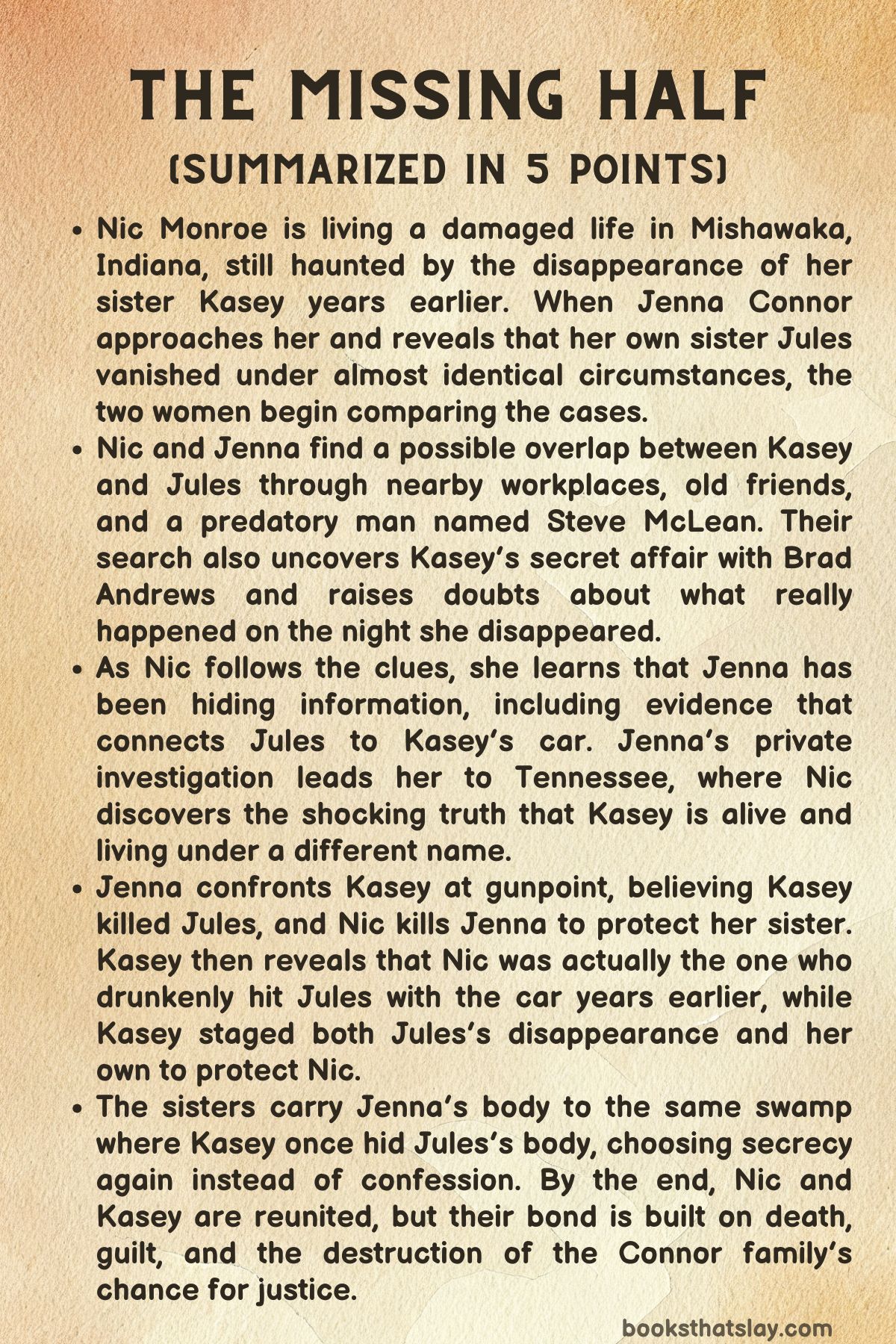
Summary
In The Missing Half, the story begins with a young woman running through a dark swamp. She is wounded, frightened, and desperate to stay quiet as she moves through mud, water, and underbrush.
Her mind briefly drifts to a happier memory of being at a lake with her sister, but the sound of a twig snapping behind her brings the terror back. She runs again, aware that someone is close.
The story then moves to 2019 in Mishawaka, Indiana, where Nicole “Nic” Monroe works at Funland, a children’s arcade and pizza restaurant. Her life is marked by exhaustion, shame, and unresolved grief.
Years earlier, her older sister Kasey disappeared, and Nic has never recovered from the loss. She is also dealing with the consequences of her own recent DWI: legal fines, mandatory AA meetings, community service at an animal shelter, and the loss of freedom that comes with a suspended license.
She tries to function by staying numb, but Kasey’s disappearance remains at the center of her life.
One evening at Funland, Nic notices a nervous woman watching her. After closing, the woman approaches and says she wants to talk about Kasey.
Nic immediately assumes she is another reporter, true-crime fan, or podcaster trying to use her family’s pain. She reacts with anger and tries to shut the conversation down.
But the woman stops her by saying that her own sister disappeared too. She introduces herself as Jenna Connor, the older sister of Jules Connor, the other girl who vanished around the same time as Kasey.
Jules disappeared two weeks before Kasey in 2012. The details of both cases were nearly identical.
Each woman’s car was found abandoned by the roadside with the door open and personal belongings still inside. Neither body was found, and neither case produced clear evidence of what happened.
Because of the similarities, the media called them the “Missing Mishawaka Girls,” linking Kasey and Jules together in public memory even though their families had never found real answers.
Jenna wants Nic to help her compare the two women’s lives and search for a missed connection. Nic resists at first.
She has spent years trying not to think about the case and does not trust Jenna’s motives. Jenna then lies and claims she has found Jules’s diary with new information inside.
This catches Nic’s attention and makes her willing to talk.
Nic tells Jenna what she remembers about the day Kasey disappeared. She woke up and found Kasey gone, then became annoyed because she believed Kasey had taken their shared car.
Nic worked her shift at Funland and later went to Rosie’s Records, where she believed Kasey’s friend Lauren said Kasey had not come in. Later, police told the Monroe family that Kasey’s car had been found abandoned off I-131 near Grand Rapids.
From that point on, Kasey was treated as missing, and her family was left without answers.
Nic and Jenna begin comparing Kasey’s and Jules’s lives. Jules had once worked at Famous Jake’s, a barbecue restaurant, before later moving to Osceola and working at Harry’s Place.
Kasey worked at Rosie’s Records. At first, there seems to be no meaningful overlap.
Then Nic realizes that Famous Jake’s later became Mesquite Barbecue and that Mesquite shares a wall with Rosie’s Records. This means the sisters may have moved through the same small area and possibly crossed paths with the same people.
This lead takes them to Lauren, now Lauren Tate, a churchgoing mother. Lauren reveals that she left Rosie’s Records and went to work at Mesquite.
She also tells them about a predatory manager named Steve McLean, nicknamed “Skeevy Steve.” Lauren says she gave his name to Detective Wyler years earlier, but Nic’s family was never told about him. This angers Nic, who feels the police kept important information from her.
Nic and Jenna confront Detective Wyler. He says McLean was investigated but dismissed as a suspect because he did not fit the profile and had an alibi.
Nic and Jenna are not satisfied. They go to Mesquite and discover that McLean still works there.
Later, they follow him to a pub and question him directly. McLean is crude, evasive, and unpleasant, but he also reveals something important.
He says Lauren used to complain constantly about Kasey and hints that Kasey was involved in something messy before she disappeared.
Nic and Jenna confront Lauren again. This time Lauren admits the truth she had kept hidden for years: Kasey had been sleeping with Brad Andrews, Nic’s boss and a close family friend, during the summer she vanished.
Lauren had seen Brad and Kasey together in Kasey’s car and argued with Kasey about it. Lauren also reveals that someone recently threatened her by using her four-year-old daughter.
A stranger told the child to pass along the message, “Stop talking about Kasey Monroe.” This warning suggests that someone still wants the past buried.
Suspicion turns toward Brad. Nic remembers that after Kasey disappeared, Brad behaved strangely and asked whether Kasey had ever told Nic anything about work or about anyone specific.
Nic begins searching for evidence in Kasey’s old car, which has been kept in storage. Inside, she finds receipts, old CDs, and a clue in the mileage.
More than five hundred miles were added between an oil change on August 2 and the night Kasey disappeared, far more than expected. Nic and Jenna suspect Kasey had been secretly driving somewhere.
Nic later finds a receipt with an address written on the back and traces it to Brad and Sandy’s lake house. She confronts Brad there, but Sandy interrupts and reveals what happened the night Kasey disappeared.
Kasey had come to Sandy and demanded ten thousand dollars to stay away from Brad. Sandy could not gather the full amount but gave Kasey nearly seven thousand dollars.
Brad appears ashamed of the affair but denies hurting either Kasey or Jules. This revelation explains some of Kasey’s secrecy but does not solve the disappearances.
As the investigation continues, Nic’s life becomes more unstable. She drives despite her suspended license and is arrested.
With no one else to call, she contacts Jenna for bail. Soon after, Jenna abruptly pulls away, claiming she has to focus on her dying mother.
Nic feels abandoned and betrayed, but she keeps searching.
Nic meets Detective Aimes, the detective currently handling Kasey’s case, and learns a hidden piece of evidence: one of Jules Connor’s hairs was found in the driver’s seat of Kasey’s car. Aimes believes the hair may have transferred from whoever abducted both women.
Nic is shocked, especially when she discovers that Jenna had already met Aimes and already knew about this evidence, even though she acted as if she was stepping back because of her mother.
Nic visits Jenna’s mother and learns Jenna lied. Mrs. Connor’s cancer is in remission; she is not dying.
Nic becomes convinced Jenna is hiding something. She breaks into Jenna’s house and checks her computer.
There, she finds messages between Jenna and Jules’s old friend Amy Miller. Amy told Jenna that Jules had once been raped by a man she worked with, known as Skeevy Steve.
Nic assumes Jenna may be planning revenge against McLean. When she finds an empty gun box in Jenna’s room, her fear grows.
When Jenna returns home, Nic hides in the bed of Jenna’s truck under a tarp. Jenna drives south for hours.
Nic believes Jenna is going to kill McLean, but the truck eventually stops at a garage apartment in Tennessee. Jenna knocks on the door, and the person who answers is not Steve McLean.
It is Kasey.
Kasey is alive. She has been living under her middle name, Marie, and working at a record store in Nashville.
Jenna accuses Kasey of killing Jules. She explains that years earlier she remembered seeing a dark car with the bumper sticker “We are not two, we are one” driving away near Jules’s abandoned car.
Later, while going through Kasey’s old car with Nic, she noticed the same lyric on a CD. Jenna traced the clue to auto shop records showing that the Monroe Honda had front-end damage repaired between Jules’s disappearance and Kasey’s.
Now she holds Kasey at gunpoint and demands a confession.
Nic watches from hiding and realizes Jenna is about to shoot her sister. In panic, she strikes Jenna in the back of the head with a hammer, killing her.
Kasey immediately takes charge. She checks Jenna’s body, cleans the blood, and tells Nic they need to move the corpse.
As they drive away with Jenna’s body, Kasey first claims she accidentally hit Jules and hid the body to protect herself. Nic pushes for the truth, and Kasey finally reveals the real story.
In 2012, Nic was drunk after leaving Harry’s Place. She called Kasey and said she had hit a tree.
Kasey biked to her and found the damaged car, but then discovered Jules’s body nearby. Jules’s own car had broken down, and she had likely been walking in the dark when Nic hit her.
Kasey almost called 911, but she believed Jules was already dead and feared Nic would go to prison. To protect her sister, Kasey placed Jules’s phone back in her car, wiped surfaces, loaded the body into the trunk, and staged the scene as an abduction.
Afterward, Kasey was overwhelmed by guilt. When she found a detective’s card in Nic’s room, she feared the police might connect Nic to Jules’s death.
To protect Nic again, Kasey staged her own disappearance to look like Jules’s case. She left her car and belongings behind so police would believe both women had been taken by the same person.
Nic realizes the recurring memory she had connected to her recent DWI was actually from the night she killed Jules.
Kasey drives Nic to the swamp where she dumped Jules’s body years earlier. Together, the sisters carry Jenna’s body into the water and let it sink.
By the end, both Connor sisters are hidden in the same dark place, while Nic and Kasey walk back to the truck together. They are reunited, but the reunion is built on death, lies, and a shared crime that leaves them morally ruined.
Characters
Nicole “Nic” Monroe
Nic Monroe is the central figure in the book, and her life is shaped by grief long before she understands the full truth behind it. She begins as a woman who seems broken by the disappearance of her sister Kasey, but the story slowly reveals that her pain is also tied to buried guilt and repressed memory.
Nic works at Funland, attends AA meetings, completes community service, and struggles with the consequences of a DWI, all of which show how unstable and self-destructive her life has become. Her grief has kept her suspended in place, but it has also protected her from facing memories she cannot bear to recognize.
Her anger toward reporters, podcasters, police, and strangers comes from exhaustion, but it also shows how tightly she guards the wound left by Kasey’s disappearance.
Nic’s investigation with Jenna gives her a temporary sense of purpose. She becomes determined, reckless, and increasingly willing to cross legal and moral boundaries to reach the truth.
She breaks into Jenna’s house, hides in Jenna’s truck, drives illegally, confronts suspects, and ignores personal consequences when the mystery seems close to breaking open. Yet her search for justice becomes deeply ironic because the truth leads back to her own actions.
The revelation that she killed Jules while drunk transforms Nic from a grieving sister into the hidden cause of another family’s devastation. Her final act of helping Kasey dispose of Jenna’s body shows that the reunion with her sister comes at the cost of her remaining moral clarity.
In The Missing Half, Nic is not simply a victim of loss; she is also someone whose buried mistake has shaped years of suffering for everyone around her.
Kasey Monroe
Kasey Monroe is first presented as the vanished sister at the center of Nic’s grief, but her role changes dramatically when she is revealed to be alive. Before her disappearance, Kasey appears to have been secretive, impulsive, and emotionally complicated.
Her affair with Brad Andrews shows poor judgment and a willingness to become involved in a relationship that could damage multiple lives. Her attempt to get money from Sandy suggests that she was capable of manipulation, especially when she felt cornered or saw a way to escape a messy situation.
Still, these flaws are only one side of her character.
Kasey’s defining action is her decision to protect Nic after the crash that killed Jules. In that moment, she chooses family loyalty over law, truth, and the Connor family’s right to know what happened.
She stages Jules’s disappearance, hides the body, and later stages her own disappearance to prevent the police from connecting Nic to Jules. Her love for Nic is fierce, but it becomes destructive because it is expressed through concealment and crime.
Kasey sacrifices her own identity and vanishes into a new life, yet she also leaves her family trapped in endless grief. When Nic finds her in Tennessee, Kasey quickly becomes controlled and practical, immediately managing Jenna’s death and planning how to hide another body.
This shows how deeply she has adapted to survival through secrecy. Kasey is both protector and corrupter, a sister whose love saves Nic from prison but destroys the lives of others.
Jenna Connor
Jenna Connor is driven by the disappearance of her sister Jules, and her grief has hardened into obsession. She enters Nic’s life under false pretenses, claiming to have Jules’s diary because she knows Nic may not help her otherwise.
This lie shows that Jenna is willing to manipulate others, but her actions come from desperation rather than casual cruelty. She has spent years living with the absence of Jules, and unlike Nic, she refuses to let the case remain cold.
Jenna studies details, follows leads, contacts people from Jules’s past, and pushes past official explanations that feel incomplete.
Her investigation reveals intelligence, persistence, and emotional damage in equal measure. Jenna lies about her mother’s cancer, withholds evidence from Nic, and secretly pursues her own theory about Kasey.
Her grief makes her both perceptive and dangerous. She notices clues that others miss, including the bumper sticker lyric and the repair records that connect Kasey’s car to Jules’s disappearance.
By the time she reaches Kasey in Tennessee, Jenna is no longer simply searching for truth; she is ready to force justice at gunpoint. Her death is tragic because she is right about Kasey’s involvement, but she does not know the full truth about Nic.
Jenna represents the destroyed family left behind by the Monroe sisters’ cover-up. In The Missing Half, her pursuit of answers makes her the closest thing to justice in the story, even though her methods become violent.
Jules Connor
Jules Connor is physically absent for most of the novel, but her death drives the entire plot. She is known publicly as one of the “Missing Mishawaka Girls,” a label that turns her into part of a shared mystery rather than a fully seen person.
Through Jenna’s investigation, small pieces of Jules’s life emerge. She worked at Famous Jake’s and later Harry’s Place, had connections to people who may have harmed or exploited her, and was once raped by someone known as Skeevy Steve.
These details suggest that Jules experienced danger even before the night she died, which makes the false abduction theory believable for years.
Jules’s actual death is horribly ordinary compared with the imagined crime surrounding it. She is not taken by a serial predator.
Her car breaks down, she walks in the dark, and Nic hits her while drunk. The simplicity of the accident makes the years of mystery even more painful.
Jules becomes a victim twice: first of the crash, then of the cover-up that denies her family the truth. Her body is hidden, her story is distorted, and her sister is left to chase answers that the Monroe family already buried.
Jules’s role in the book shows how a dead person can be erased when the living choose self-protection over accountability.
Lauren Tate
Lauren Tate begins as a guarded figure from Kasey’s past, someone who seems to have moved into a respectable and religious adult life while keeping old secrets buried. Her connection to Rosie’s Records and Mesquite makes her an important source of information because she stands at the overlap between Kasey and Jules’s worlds.
Lauren knows about Steve McLean, and she knows about Kasey’s affair with Brad Andrews, but she does not share everything at once. Her reluctance is partly fear and partly guilt.
She had complained about Kasey in the past, argued with her, and perhaps judged her choices harshly.
Lauren’s character shows how secondary witnesses can carry pieces of a truth without understanding the whole picture. She is not responsible for the disappearances, but her silence helps delay certain revelations.
The threat delivered through her young daughter also shows that she is still vulnerable to the old case. Even after building a new life, Lauren cannot completely escape what she knows.
Her eventual honesty helps Nic and Jenna understand Kasey’s hidden relationship with Brad, which shifts the investigation into a new direction. Lauren is flawed, frightened, and cautious, but she also becomes useful once she stops protecting the past.
Brad Andrews
Brad Andrews appears at first as Nic’s boss and a trusted family friend, but the revelation of his affair with Kasey exposes a deeply compromised side of him. His relationship with Kasey is troubling not only because he is married to Sandy, but also because he occupies a position of trust in Nic’s life.
After Kasey disappears, his strange behavior and questions make him look suspicious. He seems worried about what Kasey might have told Nic, which suggests that his primary concern is not only Kasey’s safety but also his own exposure.
Brad is not revealed to be the killer, but he remains morally weak. His affair contributes to the confusion surrounding Kasey’s last days and gives Kasey a motive to seek money from Sandy.
His shame does not undo the damage he causes. He represents the kind of adult whose selfish choices create shadows around vulnerable younger people.
While he does not physically harm Kasey or Jules, his dishonesty becomes part of the larger cloud of suspicion that keeps the truth hidden.
Sandy Andrews
Sandy Andrews is Brad’s wife, and her role becomes important when she reveals that Kasey came to her on the night she disappeared. Sandy’s decision to give Kasey nearly seven thousand dollars shows a mixture of desperation, humiliation, and self-preservation.
She wants Kasey to stay away from Brad, and she appears more focused on ending the affair quietly than exposing what has happened. Her reaction is understandable in emotional terms, but it also contributes to the secrecy surrounding Kasey’s final known movements.
Sandy is not portrayed as cruel, but she is someone who tries to manage damage privately rather than confront it openly. Her payment to Kasey becomes another hidden fact that misdirects the investigation years later.
Like many characters in the story, Sandy knows only one piece of the truth and tries to contain it for personal reasons. Her actions show how shame can lead people to silence, even when that silence later appears suspicious.
Steve McLean
Steve McLean, known as “Skeevy Steve,” functions as one of the story’s most disturbing suspects. He is vulgar, evasive, and predatory, and his past behavior toward women makes suspicion fall naturally on him.
The fact that Jules had once been raped by someone connected to her work, known by the same nickname, makes him appear especially dangerous. Even when police dismiss him because of his alibi and profile, his presence continues to haunt the investigation.
Steve’s role is important because he represents the believable monster everyone expects to find. He fits the shape of the crime as the public imagines it: a predatory man, vulnerable young women, and abandoned cars.
Yet the final truth does not rest on him. This does not make him innocent in a moral sense, because the story strongly connects him to abuse and intimidation.
Instead, it shows that a person can be guilty of serious harm without being guilty of the central crime. Steve’s presence also exposes how easily real patterns of predation can exist beside, but not fully explain, another hidden tragedy.
Detective Wyler
Detective Wyler represents the original police handling of the cases and the frustration felt by the families left behind. He tells Nic and Jenna that Steve McLean was investigated and dismissed because he did not fit the profile and had an alibi.
From his perspective, the police followed a process and made decisions based on available evidence. From Nic’s perspective, however, the failure to share McLean’s name with her family feels like another betrayal.
Wyler’s character is less emotionally central than others, but he plays an important role in showing the limits and blind spots of the investigation. The police looked for a predator, formed theories, dismissed suspects, and still missed the real truth because the scene had been staged so effectively.
Wyler is not necessarily corrupt or malicious, but he is part of an official system that leaves families feeling shut out. His presence adds to Nic’s belief that if she wants answers, she has to search for them herself.
Detective Aimes
Detective Aimes handles Kasey’s case years later and brings new information into Nic’s understanding of the disappearances. He reveals that one of Jules Connor’s hairs was found in the driver’s seat of Kasey’s car.
This evidence is crucial because it suggests a physical connection between the two cases. Aimes believes the hair may have transferred from whoever abducted both women, which shows that even the updated investigation is still trapped inside the false frame Kasey created.
Aimes is important because he provides the clue that makes Nic question Jenna’s honesty and the direction of the investigation. He is more current and open with Nic than Wyler, but he still does not have the full truth.
His character shows how evidence can be real but misleading when the original crime scene has been staged. The hair in Kasey’s car is not proof of a shared abductor; it is a leftover trace from the hidden handling of Jules’s body.
Mrs. Connor
Mrs. Connor is a quieter character, but her presence exposes one of Jenna’s major lies. Jenna claims she is stepping back from the investigation because her mother is dying, but Nic discovers that Mrs. Connor’s cancer is in remission.
This revelation changes Nic’s understanding of Jenna and makes her realize Jenna is hiding something important.
Mrs. Connor also represents the long-term suffering of a family that never received a body, a confession, or a clear explanation. Even though she is not active in the investigation, her life has been shaped by Jules’s disappearance.
Her illness and remission become part of Jenna’s deception, but they also remind the reader that Jules’s loss affected more than one person. Mrs. Connor stands for the quiet endurance of a parent left with uncertainty.
Themes
Sisterhood as Protection and Destruction
Sisterhood in this story is not treated as purely comforting or noble. Nic and Kasey love each other deeply, but that love becomes dangerous when protection replaces accountability.
Kasey’s choice to hide Jules’s body begins as an attempt to save Nic from prison, yet it creates years of suffering for the Connor family and forces Kasey into a life built on disappearance. Nic’s later decision to kill Jenna to protect Kasey repeats the same pattern.
Both sisters choose each other over truth, law, and the lives of others. This bond is powerful because it survives absence, guilt, and shock, but it is also corrupting because neither sister can stop protecting the other once violence enters their relationship.
Jenna’s love for Jules mirrors this in a different way. Her devotion pushes her to keep searching, but it also carries her toward armed revenge.
The book shows sisterhood as a force that can sustain people through unbearable loss, while also pushing them toward choices they can never morally repair.
The Damage Caused by Buried Truth
Secrets in the story do not stay still; they grow larger and more destructive with time. Jules’s death is first hidden to protect Nic, but that single cover-up requires more lies, more staging, and eventually Kasey’s own fake disappearance.
Every concealed fact creates new pain. The Connor family believes Jules may have been abducted.
The Monroe family believes Kasey is gone. Nic spends years grieving a sister who is alive while also carrying a buried memory of killing Jules.
Lauren hides what she knows about Kasey and Brad. Sandy hides the payment she gave Kasey.
Jenna hides her real theories from Nic. Each person’s silence may feel justified in the moment, but together these silences create a false reality.
The Missing Half uses the mystery structure to show that truth is not only about solving a case; it is also about restoring moral order. When truth is denied, people continue living, but they live inside damage that keeps spreading.
Addiction, Memory, and Self-Deception
Nic’s drinking is not just a background problem; it is central to the story’s final revelation. Her recent DWI appears at first to be a sign of a woman unraveling after years of grief, but it later connects to the older night she has blocked from full awareness.
The memory she associates with her recent crash actually belongs to the night Jules died. This connection shows how addiction and trauma can blur time, allowing Nic to avoid a truth she cannot face.
Her self-deception is not fully conscious, but it is still dangerous. She has built her life around the idea that Kasey was taken from her, while the deeper truth is that Kasey vanished because of what Nic did.
The story does not excuse Nic’s actions through addiction, but it does show how intoxication, shame, and denial can work together. Her drinking damages her present, but it also hides the past until the investigation forces memory back into place.
Justice, Revenge, and Moral Collapse
The search for justice becomes increasingly unstable as the story progresses. Jenna begins by wanting answers for Jules, and her need is understandable because her family has been denied the truth for years.
Yet the official investigation fails to satisfy her, and her pursuit turns into a private mission. By the time she confronts Kasey with a gun, justice has become inseparable from revenge.
Nic’s response is even more morally devastating. She kills Jenna to save Kasey, then helps hide the body, repeating the same crime of concealment that ruined both families in the first place.
The story refuses to offer clean justice. Jules does not receive public acknowledgment.
Jenna does not get a lawful resolution. Kasey and Nic survive, but survival comes through another act of violence.
The final image of Jenna’s body sinking into the same swamp as Jules’s body shows complete moral collapse. Instead of truth rising, the guilty choose burial again.