Fever Beach Summary, Characters and Themes
Fever Beach by Carl Hiaasen is a satirical crime novel set in the strange heat of Florida politics, wealth, racism, and environmental greed. The book follows a cast of corrupt politicians, rich donors, conspiracy theorists, hired killers, activists, and ordinary people caught in their mess.
At its center are Dale Figgo, a violent extremist with more ambition than intelligence; Viva Morales, a woman trying to rebuild her life; and Twilly Spree, an eccentric saboteur with a sharp eye for hypocrisy. The novel uses dark comedy to expose fraud, bigotry, political cowardice, and the damage caused when money and power protect absurd people.
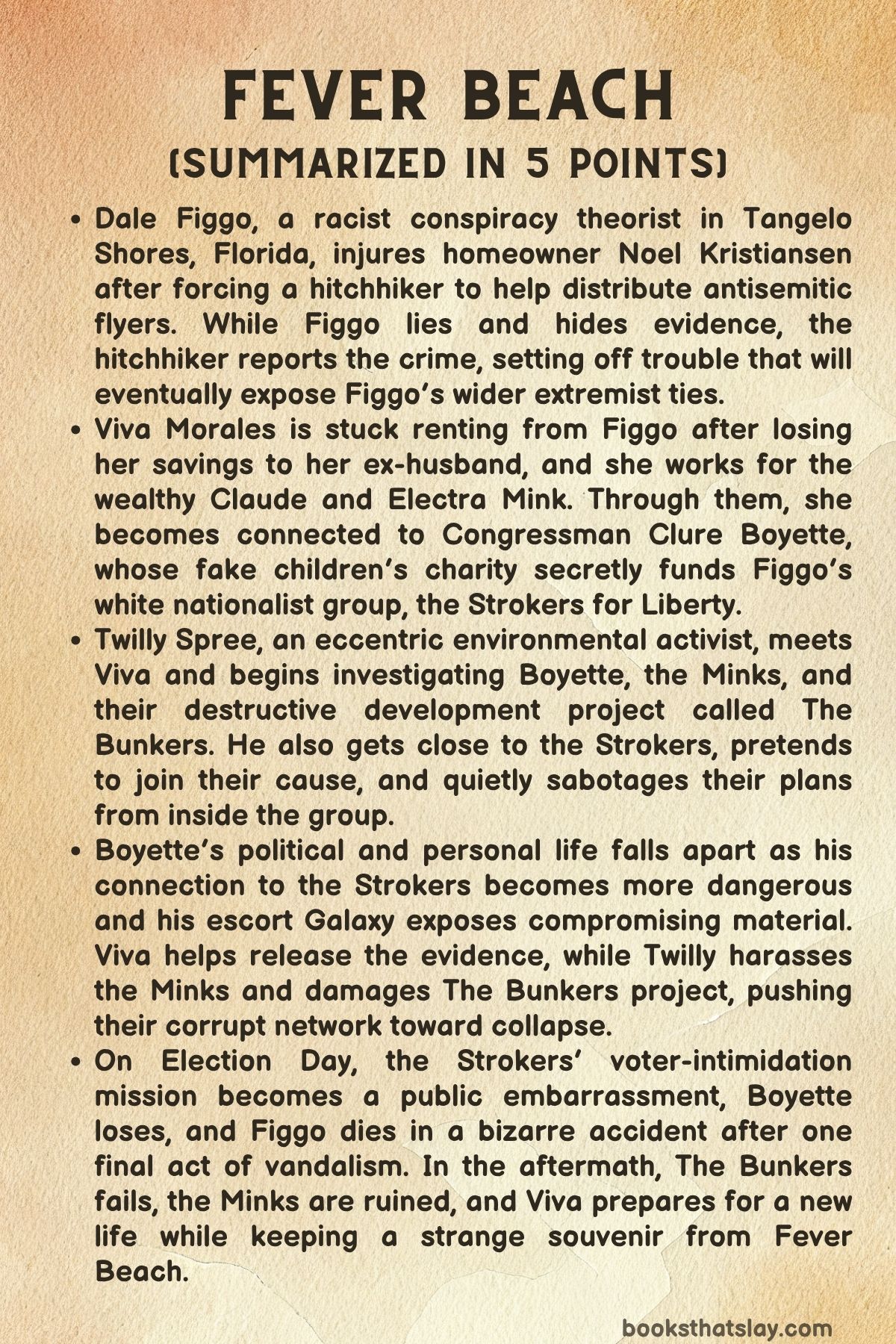
Summary
Fever Beach opens in Tangelo Shores, Florida, during a storm, with Dale Figgo driving through a wealthy neighborhood in his pickup truck. Figgo is a racist conspiracy theorist, landlord, and local agitator who has found purpose in an extremist group called the Strokers for Liberty.
While driving, he picks up a hitchhiker and forces him to help distribute antisemitic flyers. The flyers are weighted with sand so they can be thrown onto the driveways of rich residents.
What begins as a crude act of intimidation quickly turns violent when homeowner Noel Kristiansen confronts them. Figgo tries to threaten him with bear spray, but the can is empty.
Panicked and furious, Figgo runs Kristiansen down with his truck and flees.
The hitchhiker escapes and later reports the attack to the Florida Highway Patrol. Figgo tries to protect himself by hiding evidence and claiming his truck was stolen.
His response is not careful or clever, but it shows how easily he lies when cornered. This opening incident sets the tone for the rest of the novel: dangerous people with foolish plans keep trying to cover their tracks, and their lies become harder to control.
Figgo’s tenant, Viva Morales, is dealing with a different kind of trap. She is stuck in his townhouse because of a lease she cannot easily escape.
Her savings were taken by her ex-husband Malcolm, leaving her with limited choices and little security. Viva works for the Mink Foundation, run by Claude and Electra Mink, a wealthy couple whose public generosity hides vanity, greed, and moral emptiness.
Through her job, Viva comes into contact with Congressman Clure Boyette, a politician whose ambition is matched by his dishonesty.
Boyette presents the Minks with a fake charity called the Wee Hammers. He claims it helps children build houses, but the charity is only a front.
The Minks donate two million dollars, believing the project will enhance their reputation. Boyette secretly redirects the money to fund Figgo’s white nationalist group.
His goal is to use the Strokers for Liberty to intimidate voters in his vulnerable home precinct and protect his political seat. The donation links the novel’s different worlds: wealthy donors, political corruption, extremist anger, and the misuse of charitable language.
Viva’s life changes when she meets Twilly Spree on a flight to Florida. Twilly is an eccentric environmental troublemaker with a history of direct action against people who damage the land.
Viva initially mistakes him for a self-help author, and their conversation begins awkwardly. Twilly later finds her by using the address label from her magazine, apologizes, and begins seeing her.
Their relationship grows out of mutual curiosity, mistrust, attraction, and shared disgust at the people around them.
Twilly becomes interested in the Minks, Boyette, and a massive development project called The Bunkers. The project is planned for former citrus land and is being pushed as a huge community for profit, despite the environmental damage it will cause.
Twilly investigates the forces behind it and soon finds himself drawn into a larger web of corruption. He also infiltrates the Strokers for Liberty by befriending Figgo and pretending to accept the group’s ridiculous rituals.
While Figgo sees himself as a leader, Twilly sees a weak man who can be manipulated and exposed.
The Strokers hold meetings on Fever Beach, where Figgo announces that the group has new funding. Boyette secretly calls in and directs them toward Precinct 53 in Carpville, where he wants them to scare voters on Election Day.
Inside the group, Figgo’s authority is challenged by Jonas Onus, his unstable lieutenant. Onus wants control and resents Figgo’s hold over the money.
Their rivalry adds more chaos to a group that is already disorganized, angry, and foolish.
The Strokers attempt their first major public action by traveling to Key West to attack a drag club. The stunt is meant to show strength, but it becomes a complete embarrassment.
The performers and staff fight back, and the Strokers are badly beaten. The incident goes viral, humiliating Figgo and turning the group into a public joke.
Instead of appearing powerful, they look reckless and pathetic. The viral attention also creates problems for anyone quietly connected to them, especially Boyette.
At the same time, the Minks are trying to remove obstacles to The Bunkers. Claude Mink hires a killer named Moe to find Lewin Baltry, a county commissioner who is blocking the development.
Moe tracks Baltry, but he realizes the situation is more complicated than Claude has admitted and decides not to kill him. Moe is later sent after Galaxy, an escort who has damaging photos and videos of Boyette in bondage gear.
Galaxy proves far more capable than expected. She overpowers Moe, survives the attack, and shares the material that can destroy Boyette’s image.
Viva plays a key role in getting the evidence out. She anonymously releases the most damaging material, and Boyette’s sex scandal spreads online.
His campaign tries to dismiss the images as AI fakes, but the explanation fails to contain the damage. The scandal reveals Boyette’s hypocrisy and weakens his political operation.
His wife, Nicki Boyette, reacts by divorcing him after securing an expensive settlement. His powerful father, Clay Boyette, attempts to manage the crisis, but even he cannot fully control the fallout.
As the scandal grows, Viva continues helping Twilly expose the corruption around the Minks and Boyette. She is also trying to protect herself from Figgo, whose behavior remains threatening and unpredictable.
Twilly escalates his campaign against the Minks and The Bunkers. He sends obscene sex toys to Claude, frightens the couple, disrupts the development, and eventually brings Viva into one act of sabotage: blowing up an excavator at the project site.
For Viva, the act is risky but liberating. It gives her a chance to strike back at people who have treated others as disposable.
Other characters begin moving toward their own exits. Galaxy leaves for nursing school in Atlanta, escaping the chaos with a more stable future ahead.
Nicki Boyette separates herself from Clure. Clay Boyette loses influence over the situation.
The people who believed money and connections could protect them discover that scandal, evidence, and public ridicule have their own force.
On Election Day, the renamed Strokerz for Liberty travel to Carpville to intimidate voters at Precinct 53. Their plan collapses almost immediately.
Instead of creating fear, their presence becomes absurd and chaotic. Boyette loses the election, and the extremist group fails at the very task it was funded to perform.
Figgo, desperate for one final symbolic gesture, smears feces on a statue of Clay Boyette. Then, in a grotesque accident, he hangs himself from a flagpole.
His death is foolish, ugly, and fitting for a man whose life has been driven by hate, delusion, and self-importance.
Jonas Onus also misses the mission after being swept away and rescued by a ship headed for Mexico. His strange disappearance underlines the randomness and stupidity that follow the Strokers wherever they go.
Their movement ends not in glory, but in failure, ridicule, and scattered debris.
After the election, the corrupt structure surrounding The Bunkers falls apart. Claude Mink dies, Electra faces legal and financial ruin, and the development project collapses.
Viva quits her job and begins moving toward a new life in New York. Her connection with Twilly remains alive, though uncertain, shaped by their shared experience of exposing fraud and resisting the people behind it.
The novel closes back at Fever Beach, where Viva and Twilly clean up what the Strokers left behind. Among the debris, they find an old tiki torch from the group’s meetings.
Viva keeps it as a strange souvenir, not because it represents pride or victory, but because it marks the end of a grotesque chapter in her life. Fever Beach ends with corruption exposed, fools disgraced, and Viva standing closer to freedom than she was when the story began.
Characters
The characters in Fever Beach form a chaotic, satirical world where corruption, greed, racism, vanity, and environmental destruction collide with resistance, absurdity, and moral reckoning. Each character contributes to the book’s sharp criticism of political extremism, false patriotism, rich hypocrisy, and personal selfishness.
Dale Figgo
Dale Figgo is one of the central examples of ignorance, hatred, and pathetic self-importance in the book. He presents himself as a committed political warrior, but his actions reveal cowardice, stupidity, and moral emptiness.
His racism and antisemitism are not shown as powerful or impressive; instead, they are exposed as ridiculous, dangerous, and deeply insecure. The opening incident, where he forces a hitchhiker to help distribute hateful flyers and then runs down Noel Kristiansen, immediately shows that Figgo is capable of violence when challenged.
Yet he is also quick to lie, hide evidence, and protect himself, proving that his supposed bravery is fake.
Figgo’s leadership of the Strokers for Liberty is similarly hollow. He wants to appear important, but he depends on outside money, slogans, group rituals, and intimidation to feel powerful.
His obsession with symbolic gestures makes him more absurd than effective. He is easily manipulated by larger political forces, especially Clure Boyette, who uses him as a tool for voter intimidation.
Figgo’s downfall is fitting because it turns his own theatrical extremism into humiliation. His death while attempting one last crude political act reflects the book’s view of him: a hateful man destroyed not by greatness, but by his own stupidity and grotesque need for attention.
Viva Morales
Viva Morales is one of the most grounded and sympathetic characters in the story. She begins the book trapped in several ways: financially damaged by her ex-husband Malcolm, stuck in Dale Figgo’s townhouse because of her lease, and employed by the wealthy and morally empty Mink Foundation.
Her situation shows how ordinary people can become caught in systems controlled by selfish, powerful, or reckless individuals. Unlike many of the characters around her, Viva has a conscience, and her discomfort with corruption becomes stronger as she learns more about the people she works for.
Viva’s development is important because she moves from being trapped and uncertain to becoming active and brave. Her connection with Twilly Spree helps her see the larger corruption surrounding Boyette, the Minks, and The Bunkers project.
However, she is not merely Twilly’s helper. She makes her own choices, especially when she anonymously releases damaging evidence against Clure Boyette.
This act shows her intelligence, courage, and willingness to fight back. By the end, Viva’s decision to leave her old life behind and move toward a new future suggests personal renewal.
She survives the chaos without becoming cruel, and that makes her one of the book’s strongest moral centers.
Twilly Spree
Twilly Spree is an eccentric environmental rebel whose strange methods make him both comic and heroic. He is not a conventional reformer.
Instead of working through polite systems, he uses sabotage, pranks, infiltration, and psychological pressure to expose corruption and punish those who damage the natural world. His behavior is extreme, but it is guided by a clear moral outrage against greed and environmental destruction.
Through Twilly, the book presents the idea that traditional rules often fail when wealthy and powerful people are already breaking them.
Twilly’s relationship with Viva reveals a softer and more human side of him. He first enters her life through an awkward misunderstanding, but he later becomes a source of support and purpose.
His investigation into Boyette, the Minks, and The Bunkers shows his persistence and intelligence. His infiltration of the Strokers is especially important because he understands that the group is both dangerous and ridiculous.
He defeats them not through speeches, but by exposing their incompetence from within. Twilly is chaotic, but his chaos has direction.
He represents resistance against corruption, especially when legal or political systems seem too compromised to act.
Clure Boyette
Clure Boyette is a deeply corrupt politician who hides selfish ambition behind public image and fake charitable language. His creation of the Wee Hammers charity shows his talent for deception.
He uses the appearance of helping children and building homes to secretly move money toward a white nationalist group that can intimidate voters for his campaign. This makes him one of the clearest examples of political hypocrisy in the book.
He understands how to use respectable language to cover immoral actions.
Boyette’s personal life also exposes his weakness and arrogance. His involvement with Galaxy and the compromising photos and videos reveal that his carefully managed public identity is false.
When the scandal becomes public, his campaign’s attempt to dismiss the evidence as artificial intelligence only makes the situation more absurd. Boyette is not simply unlucky; he is destroyed by the same dishonesty that helped him rise.
His election loss shows that his power was more fragile than it appeared. He is a politician who depends on manipulation, family influence, money, and fear, but when those tools fail, there is very little substance beneath them.
Claude Mink
Claude Mink represents wealthy vanity, entitlement, and moral decay. As one of the leaders of the Mink Foundation, he has enough money to influence politics and development, but he lacks wisdom, compassion, and ethical responsibility.
His willingness to donate two million dollars to Boyette’s fake charity shows both his gullibility and his desire to appear generous. He wants the social rewards of philanthropy without truly understanding or caring where the money goes.
Claude’s involvement in The Bunkers project makes him even more corrupt. He is tied to a development scheme that destroys former citrus land, showing his disregard for the environment and the communities affected by reckless growth.
His decision to hire Moe to deal with Lewin Baltry reveals how far he is willing to go to protect his interests. Claude’s wealth gives him power, but it does not give him control.
Twilly’s obscene pranks and intimidation unsettle him because they attack his dignity and expose his vulnerability. His eventual death and the collapse of his project suggest that his world of money, influence, and arrogance was never as secure as he believed.
Electra Mink
Electra Mink is vain, wealthy, and deeply connected to the hollow social world represented by the Mink Foundation. Like Claude, she benefits from money and status while remaining detached from the consequences of the foundation’s actions.
Her role helps show how corruption is not always loud or openly violent. Sometimes it appears as privilege, carelessness, and a desire to maintain appearances.
Electra’s world is built around image, comfort, and self-importance.
Her downfall is significant because she is left facing legal and financial ruin after Claude’s death and the collapse of The Bunkers project. This outcome strips away the protection that wealth seemed to provide.
Electra is not portrayed as a mastermind, but she is still part of a corrupt structure that enables harm. Her character shows how people who benefit from immoral systems often avoid responsibility until the system begins to collapse around them.
Jonas Onus
Jonas Onus is Figgo’s unstable lieutenant and one of the clearest examples of insecurity inside extremist movements. He wants authority, recognition, and control, but he does not have the discipline or intelligence to lead effectively.
His resentment toward Figgo over the group’s money reveals that the Strokers are not united by noble principles. They are driven by ego, greed, jealousy, and personal frustration.
Onus’s instability makes him dangerous, but also ridiculous. He repeatedly tries to assert power, yet he never becomes the strong figure he imagines himself to be.
His absence from the final voter-intimidation mission after being swept away and rescued by a ship bound for Mexico turns his supposed militancy into farce. Like Figgo, he wants to be seen as a warrior, but the story reduces him to comic failure.
His character helps expose the weakness and absurdity behind the group’s violent fantasies.
Moe
Moe is a hired killer, but he is more complicated than a simple villain. Claude Mink hires him to find Lewin Baltry, and later he is sent after Galaxy.
His role introduces real danger into the story, because he represents the possibility that wealthy people can turn their money into violence. However, Moe is not mindless.
When he tracks Baltry, he realizes that the situation is more complicated than he was told and chooses not to kill him.
This moment gives Moe a strange moral ambiguity. He is still dangerous and involved in criminal work, but he shows more judgment than some of the supposedly respectable characters.
His failure against Galaxy also changes how the reader sees him. He is threatening, but he is not invincible.
Moe’s character demonstrates that violence can be bought, redirected, resisted, and sometimes interrupted by unexpected human judgment.
Galaxy
Galaxy is one of the most resourceful and self-protective characters in the book. As Boyette’s escort, she possesses compromising material that could destroy him politically.
This places her in danger, but it also gives her power. She understands the risks around powerful men and refuses to be an easy victim.
When Moe is sent after her, she overpowers him and survives, proving that she is far stronger and more prepared than others assume.
Galaxy’s decision to share the damaging material contributes directly to Boyette’s public collapse. She is not merely a scandalous figure in his life; she becomes part of the force that exposes his hypocrisy.
Her move to nursing school in Atlanta also gives her character a sense of forward motion. She is not defined only by her connection to Boyette.
Her future suggests ambition, independence, and the ability to leave behind a dangerous chapter of her life.
Lewin Baltry
Lewin Baltry is important because he stands in the way of The Bunkers development project. As a county commissioner blocking the scheme, he represents one of the few institutional obstacles to the greed of Claude Mink and his allies.
His presence shows that corruption does not always move forward without resistance. Even one official refusing to cooperate can become a serious problem for powerful people.
The fact that Claude sends Moe after Baltry reveals how threatening honest resistance can be to corrupt interests. Baltry does not dominate the story emotionally, but his role is crucial because he exposes the desperation behind The Bunkers project.
If the development were legitimate and harmless, its backers would not need intimidation or violence. Through Baltry, the book shows that local political decisions can carry enormous moral weight.
Noel Kristiansen
Noel Kristiansen plays a brief but important role in revealing Dale Figgo’s true nature. When he confronts Figgo over the antisemitic flyers, he represents ordinary moral resistance.
He sees something hateful happening in his neighborhood and challenges it directly. His confrontation exposes Figgo as violent and cowardly, because Figgo responds not with argument or accountability, but with an attempted attack and then vehicular violence.
Noel’s importance lies in how his injury sets the tone for the danger beneath the book’s comedy. The extremist behavior may often look absurd, but it still has real victims.
His character reminds the reader that hateful political theater can quickly become physical harm. Through Noel, the story makes clear that the Strokers are not only ridiculous; they are also capable of genuine brutality.
The Hitchhiker
The hitchhiker is a small but meaningful character because he becomes an unwilling witness to Figgo’s crime. At first, he is vulnerable because Figgo picks him up during a storm and forces him into helping distribute hateful flyers.
His situation shows how Figgo tries to dominate people who are temporarily dependent on him. The hitchhiker’s escape is important because it prevents Figgo from fully controlling the story of what happened.
By reporting the incident to the Florida Highway Patrol, the hitchhiker becomes a quiet agent of accountability. He does not have the power or prominence of other characters, but he does the right thing after witnessing violence.
His role shows that even minor characters can disrupt lies. In a story full of corruption and false narratives, his decision to tell the truth matters.
Nicki Boyette
Nicki Boyette is Clure Boyette’s wife, and her role becomes most important when his scandal breaks open. She is connected to the world of political image-making, where marriages can serve as part of a public performance.
However, when Clure’s hypocrisy becomes too damaging, Nicki acts in her own interest rather than protecting him.
Her divorce from Clure after securing an expensive settlement shows that she is practical, strategic, and unwilling to be destroyed by his disgrace. Nicki is not presented as a sentimental victim.
She understands the value of timing and leverage. Her character adds another layer to the political satire because even within Boyette’s family life, relationships are shaped by money, image, and negotiation.
Clay Boyette
Clay Boyette is Clure’s powerful father and represents old political influence trying to control a modern scandal. He attempts to manage the fallout from his son’s corruption and public humiliation, but he gradually loses control.
His presence shows that Clure’s power is not entirely his own. It is supported by family influence, connections, and inherited authority.
Clay’s failure is important because it shows the limits of political machinery. Even a powerful father cannot fully protect Clure once the scandal spreads and the campaign collapses.
The statue incident near the end also turns Clay into a symbol of public disgrace. Figgo’s crude final gesture toward the statue suggests the collapse of the entire Boyette power structure.
Clay represents authority, but by the end, that authority has become vulnerable, mocked, and ineffective.
Malcolm
Malcolm is Viva’s ex-husband, and although he is not as active in the main conflict, his impact on Viva’s life is significant. By causing her to lose her savings, he helps create the financial trap that leaves her stuck in Figgo’s townhouse and dependent on work connected to the Minks.
His selfishness shapes Viva’s starting position in the story.
Malcolm’s role is important because he represents a more personal form of damage. While Boyette, Figgo, and Claude operate through politics, extremism, and money, Malcolm’s harm is intimate and domestic.
He shows how betrayal in private life can limit a person’s freedom just as strongly as public corruption can. Viva’s eventual movement toward independence is more meaningful because she has to escape not only political chaos, but also the consequences of Malcolm’s betrayal.
Themes
Extremism and Public Cowardice
Extremism appears less as a display of strength than as a cover for fear, insecurity, and personal failure. Dale Figgo and the Strokers build their identity around hatred, but their actions repeatedly expose them as confused, reckless, and dependent on attention.
Their antisemitic flyers, voter-intimidation plan, and attack on a drag club are meant to look like political warfare, yet each act collapses into embarrassment. This makes the hatred more dangerous, not less, because it shows how foolish people can still cause real harm when they are armed with prejudice and encouraged by powerful figures.
Figgo’s violence against Noel Kristiansen proves that bigotry can move quickly from words to injury. At the same time, the group’s failures reveal the emptiness behind their bravado.
They want to seem feared, disciplined, and historic, but they are disorganized men chasing meaning through cruelty. Fever Beach uses ridicule to weaken their image while still showing the damage they can do.
Corruption Protected by Money and Status
Political and financial corruption spreads because wealthy people and public officials treat power as protection from consequences. Clure Boyette hides behind his position as a congressman while using a fake charity to move money toward voter intimidation.
Claude and Electra Mink present themselves as charitable and respectable, but their wealth is tied to vanity, greed, and environmental destruction. Their donation to the Wee Hammers shows how easily public generosity can become a mask for private schemes.
The planned development, The Bunkers, also reflects this corruption because land, influence, and political pressure are treated as tools for profit. Claude’s willingness to hire Moe shows that the desire to protect money can lead to violence.
The powerful characters assume that scandals can be denied, witnesses can be threatened, and public opinion can be managed. Their downfall comes when those hidden actions become visible.
The theme shows that corruption survives through secrecy, but it becomes fragile once exposed to public scrutiny.
Resistance Through Disruption
Resistance in the story is not polite, formal, or patient. Twilly Spree fights corruption through tricks, sabotage, humiliation, and direct interference.
His actions are extreme, but they are aimed at people who use legal and political systems to hide wrongdoing. He does not wait for institutions to correct themselves because the institutions are already being manipulated by Boyette, the Minks, and their allies.
Viva’s role in the resistance is equally important because she moves from being trapped by Figgo, Malcolm, and her job to actively helping reveal the truth. Her release of Boyette’s compromising material becomes a turning point because it attacks the public image that protects him.
Galaxy also resists by surviving Moe’s attack and sharing evidence instead of disappearing quietly. These acts show that resistance can come from people who are underestimated or dismissed.
The theme suggests that when power depends on silence, mockery, exposure, and refusal can become effective weapons against it.
Freedom from Control and False Promises
Several characters are trapped by people who offer security, opportunity, or belonging but actually create dependence. Viva’s lease with Figgo keeps her physically and financially stuck after Malcolm has already taken her savings.
Her work for the Mink Foundation places her near wealth, but that world offers no real protection or dignity. Boyette’s fake charity promises help for children while secretly serving his political survival.
The Strokers promise brotherhood and purpose to men like Figgo and Onus, but the group only feeds their anger and makes them more foolish. Even The Bunkers is built on a false promise: a planned community advertised as progress while destroying land and serving private profit.
Against these traps, freedom comes through recognition and action. Viva begins to see the systems around her clearly and chooses a different future.
Galaxy leaves for nursing school, Nicki Boyette extracts herself from Clure’s collapse, and the development fails. The theme shows freedom as the result of breaking illusions, not simply escaping a place.