Rain of Shadows and Endings Summary, Characters and Themes
Rain of Shadows and Endings by Melissa K. Roehrich is a dark fantasy romance set in a harsh Fae world ruled by power, bloodlines, and control. The story follows Tessa Ausra, a young Fae who expects to pass through the Selection Ceremony unnoticed, only to be claimed by Theon St. Orcas, the concealed heir of Arius.
What begins as a forced bond becomes a dangerous struggle over freedom, loyalty, desire, and hidden magic. The book builds a tense world where gods, kingdoms, and old powers move behind every choice, while Tessa begins to discover that she may be far more than anyone understands. It’s the 1st book of the Legacy series by the author.
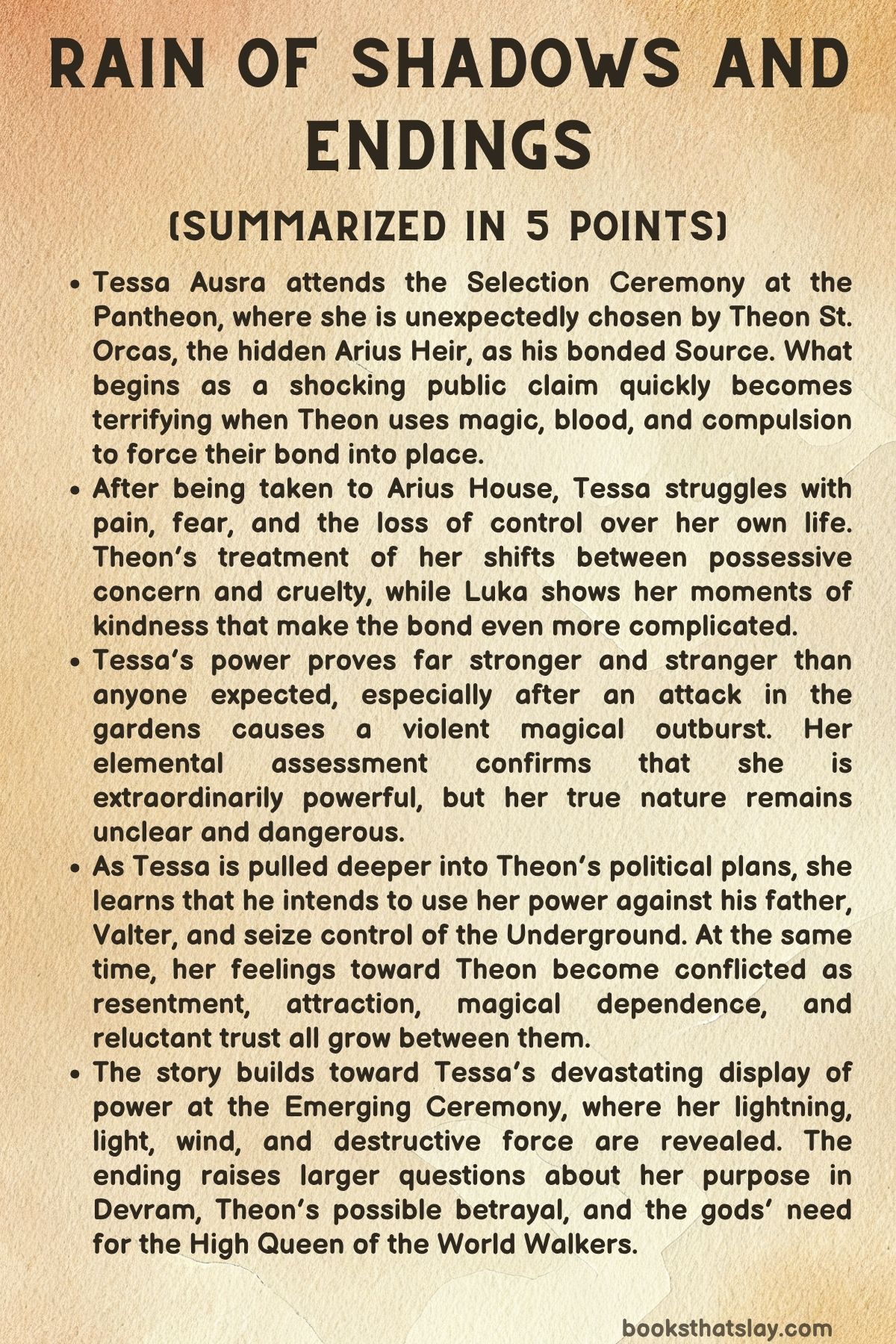
Summary
Tessa Ausra arrives at the historic Selection Ceremony at the Pantheon expecting the day to pass without much consequence for her. She is a Fae among many others, surrounded by friends and familiar faces, and she does not believe she will be chosen as a Source.
Before the ceremony begins, she sneaks away to eat stolen chocolate in private. Her small act of rebellion brings her face-to-face with a dark-haired Legacy who catches her and questions her.
He is sharp, controlled, and unsettling, and he wants to know whether she is expected to be Selected. Tessa tells him she is not, though the encounter leaves her uneasy.
She escapes back to her friends Dex, Oralia, Brecken, Katya, Lange, and Corbin, trying to put the strange meeting out of her mind.
During the ceremony, Tessa realizes that the man from the corridor is Theon St. Orcas, the hidden Arius Heir. His identity changes everything.
Against all expectations, Theon publicly chooses Tessa as his bonded Source. The decision shocks her and those around her.
Tessa has no desire to belong to him, but the laws and customs of the ceremony give her little choice. She is taken away from her friends and brought into Theon’s control.
Theon takes Tessa to a private suite, where he begins the process of claiming her. He injects her with a tonic that weakens her magical defenses, leaving her vulnerable to his power.
He then uses compulsion to force her obedience and make her acknowledge him as her Master. Tessa fights him as much as she can, but the bond is designed to strip away resistance.
When she learns that she is about to receive her first Source Mark, she tries to escape through a bathroom window. She contacts Dex, climbs along a ledge, and reaches a balcony, but Luka Mors finds her before she can get away and returns her to Theon.
The Marking is violent and agonizing. Theon cuts Tessa’s hand, mixes his blood with hers, and forces his magic into her body.
The bond takes physical form, leaving her marked with the symbol of Arius. Tessa’s body rejects the invasion.
She becomes horribly sick and vomits Theon’s magic for hours. After the Marking, she is taken through a portal into the Arius Kingdom, her old life now cut away from her by power, law, and blood.
The journey to Arius House is painful for Tessa. She suffers intense sensitivity, nausea, feverish discomfort, and emotional collapse.
Her body is struggling to adjust to Theon’s magic and the forced connection between them. Luka treats her with more care than Theon does, which creates tension.
Theon is possessive and protective in his own way, but he is also harsh, controlling, and determined to make Tessa obey. Luka’s quieter kindness offers Tessa a small measure of relief, though it also complicates the relationships among the three of them.
At Arius House, Tessa meets Theon’s parents, Valter and Cressida. The household is cold, disciplined, and full of danger.
Valter is a powerful and cruel figure who expects Theon to serve larger political goals. He pressures his son about alliances, arranged Matches, and the future of the Arius line.
Theon attempts to present Tessa as obedient and useful, but Tessa refuses to play the role easily. She talks back, resists orders, and keeps looking for chances to escape or regain control over herself.
Theon’s treatment of Tessa shifts between possessive care and severe domination. He wants her power, her obedience, and her loyalty, but he also seems increasingly affected by her pain and defiance.
Tessa, meanwhile, refuses to accept the bond as something natural or deserved. She hates the control Theon has over her, even as the magic between them creates physical pull, dependence, and confusion.
Their connection becomes more dangerous because it is not only political or magical; it is also emotional and physical in ways neither of them can fully control.
Tessa’s power begins to show itself in strange and alarming ways. After she is attacked by Legacy men in the gardens, something inside her breaks loose.
A violent force erupts around her, tearing open a crevice and releasing shadowy beings. Theon, Luka, and Axel realize that Tessa is not an ordinary Source.
Her magic is unusual, powerful, and difficult to define. What should have been a controlled bond now becomes something far more unpredictable.
Tessa is later taken for her elemental assessment, a process meant to identify the nature of her magic. Priestess Zefira subjects her to elixirs, pain, and visions.
The assessment is not a simple test; it becomes a form of torture. In one vision, Dagian, the Achaz Heir, uses Tessa’s fears about Dex and her friends against her.
He targets the people she loves because he knows they are the easiest way to wound her. Another powerful woman appears in the vision and challenges Dagian.
She calls Tessa “wild fury,” a phrase that suggests Tessa’s true nature is far beyond the categories others are trying to place her in.
The assessment confirms that Tessa is extraordinarily powerful, but it does not clearly reveal what she is. Her element, purpose, and source of magic remain uncertain.
Theon hides or alters parts of the results because he has his own plan. He does not simply want to help his father gain control over Devram.
His true goal is to kill Valter and take the Underground for himself. Tessa’s power is central to that plan, whether she agrees to it or not.
At the Acropolis, Tessa briefly reconnects with Dex through guarded communication. The contact reminds her of the life and people she was forced to leave behind.
Dex remains important to her, and his presence becomes a symbol of loyalty, memory, and the freedom she has lost. At the same time, Tessa is pulled deeper into Theon’s plans.
She learns more about the political forces around her and begins to understand that she is being watched, used, and tested by powers far greater than she first realized.
Tessa also meets Tristyn, who speaks to her in ways that suggest she may be either destruction or salvation. Tristyn pushes her toward chaos rather than submission, hinting that Tessa’s power cannot be understood through obedience or fear.
Luka also trains her and challenges her to stop merely surviving. He tells her to become the storm, urging her to claim strength instead of only reacting to the people controlling her.
As Tessa’s bond with Theon develops, it grows more complicated. She resents him for taking her freedom and forcing the bond on her.
She fears what he can do to her and what he may still demand from her. Yet there are moments when Theon’s care seems real, and moments when their magical and physical connection becomes difficult to ignore.
The bond creates closeness, but it does not erase the violence of how it began. Tessa is left caught between anger, attraction, distrust, and the need to survive.
The fragile balance around them breaks further when Valter arrives unexpectedly and kills Pen, a Fae servant Theon cares about. Pen’s death exposes the brutality of Valter’s rule and the limits of Theon’s control.
It also fractures the group emotionally, pushing Theon, Tessa, Luka, and the others closer to open conflict with the forces surrounding them. Tessa’s own buried power is nearing its limit, and the pressure placed on her becomes impossible to contain.
At the Emerging Ceremony, Tessa’s power finally erupts in full. Lightning, light, wind, and destructive force pour out of her with overwhelming intensity.
The display confirms that she is unlike any Source the others have known. Her power is vast, wild, and dangerous, and it terrifies those who want to control her.
Achaz Lord Rordan intervenes and suppresses her magic. He takes Tessa to his manor, where Dex is also present.
This reunion brings comfort, but it also raises deeper questions. Rordan tells Tessa that the real question is not merely what she is, but why she is in Devram at all.
The ending expands the story beyond Tessa’s immediate captivity and Theon’s plans. A vision-like scene shows Theon preparing to sacrifice Tessa, suggesting that his ambitions may place her life in direct danger despite their growing connection.
The final moments shift toward the gods, who discuss Auryon, Devram, and the need for the High Queen of the World Walkers. These revelations suggest that Tessa’s role is tied to ancient powers, worlds beyond the one she knows, and a destiny that neither Theon nor his enemies fully understand.
Rain of Shadows and Endings closes with Tessa trapped between many forms of control: Theon’s bond, Valter’s cruelty, Rordan’s interest, divine schemes, and the mystery of her own power. She begins the story as someone trying to avoid being chosen, but by the end, it is clear that she may be central to the fate of Devram and beyond.
Her struggle is no longer only about escaping one man or one kingdom. It is about discovering what she truly is, deciding who deserves her trust, and learning whether the force inside her will be used by others or claimed as her own.
Characters
In Rain of Shadows and Endings by Melissa K. Roehrich, the characters are shaped by power, survival, control, loyalty, fear, and destiny. The story places them in a world where bonds are not only emotional but magical and political, making every relationship complicated by hierarchy, violence, and hidden motives.
Tessa Ausra
Tessa Ausra is the emotional center of the book and one of its most powerful figures, even before she fully understands what she is. At first, she appears playful, rebellious, and almost ordinary in her desire to avoid ceremony, steal chocolate, and stay close to her friends, but that small act of defiance foreshadows the larger resistance that defines her.
Once Theon chooses her as his bonded Source, Tessa is forced into a brutal loss of freedom, and much of her character arc is built around her refusal to mentally surrender even when her body, magic, and circumstances are controlled. She is not passive in her suffering; she escapes, talks back, resists commands, and keeps reaching for Dex and her old life as symbols of the person she was before being claimed.
Tessa’s complexity comes from the tension between vulnerability and immense hidden strength. She is frightened, traumatized, physically weakened, and emotionally overwhelmed, yet the story repeatedly shows that beneath her pain is something vast and dangerous.
Her strange power does not behave like a simple elemental gift; it erupts through lightning, light, wind, shadows, destruction, and chaos. This makes her frightening not only to her enemies but also to the people who want to use her.
Tessa represents a force that cannot be neatly owned, named, or contained, even though many powerful figures try to do exactly that. Her journey is therefore not only about surviving Theon, Valter, and the politics of Devram, but about discovering whether she is a weapon, a savior, a catastrophe, or something beyond those categories.
Theon St. Orcas
Theon St. Orcas is one of the most morally conflicted characters in the novel. As the hidden Arius Heir, he carries immense political pressure, family expectation, and personal ambition.
His choice of Tessa appears shocking at the Selection Ceremony, but it quickly becomes clear that the decision is not romantic innocence or impulse alone. Theon sees value in Tessa before others understand her full significance, and his decision to bond her is tied to power, strategy, and rebellion against his father.
He wants to use her strength as part of a larger plan to kill Valter and take control of the Underground, which makes his connection to her deeply compromised from the beginning.
Theon is especially complex because he is capable of care, desire, protectiveness, and guilt, but he also commits acts of domination and cruelty. He injects Tessa with the tonic, uses compulsion, forces the bond, and repeatedly expects obedience from her.
At the same time, he is disturbed by threats to her, affected by her suffering, and increasingly drawn into a bond that becomes more emotionally complicated than he intended. His tragedy is that he wants to be different from Valter while still using many of Valter’s methods.
Theon’s relationship with Tessa is therefore built on contradiction: he wants her power and submission, but he is also fascinated by her defiance; he wants control, yet her very nature challenges control. This makes him a dangerous, damaged, and unpredictable figure in the story.
Luka Mors
Luka Mors functions as a contrast to Theon because he often shows Tessa a gentler form of attention within a violent and controlling world. He is still part of the same power structure, and he returns Tessa after her attempted escape, so he is not free from complicity.
However, his treatment of her is noticeably more humane. Luka sees her suffering more clearly than others do and responds with patience, concern, and practical guidance.
His kindness creates tension because it exposes how harsh Theon’s behavior can be and gives Tessa a different emotional point of reference inside Arius House.
Luka’s role as trainer also gives him symbolic importance. When he tells Tessa to stop merely surviving and become the storm, he recognizes something essential about her: endurance alone will not save her.
She must transform her pain into agency. Luka is important because he does not simply view Tessa as a political tool or magical resource.
He sees the person inside the power, and that makes his bond with her feel steadier and more compassionate. At the same time, his loyalty to Theon complicates him, because his kindness exists within boundaries he does not fully break.
Dex
Dex represents Tessa’s emotional anchor to her former life and to the version of herself that existed before she was taken into Theon’s world. His importance comes less from physical presence and more from what he means to Tessa.
When she contacts him during her attempted escape and later communicates with him under guarded conditions, Dex becomes a symbol of safety, familiarity, love, and resistance. He reminds Tessa that she has people beyond Arius House and that her identity is not limited to being Theon’s Source.
Dex also becomes a vulnerability that others can exploit. In the elemental assessment vision, Tessa’s fears about Dex and her friends are used against her, proving how deeply she cares and how easily love can become a weapon in this world.
His later presence at Rordan’s manor suggests that his role is not finished and that he may be connected to larger truths about why Tessa is in Devram at all. Dex is important because he grounds Tessa emotionally while also becoming part of the mystery surrounding her origin, destiny, and power.
Oralia
Oralia is part of Tessa’s original circle of friends, and although the provided events do not give her as much individual focus as Tessa, Theon, Luka, or Dex, her presence matters because she helps establish what Tessa loses after the Selection Ceremony. Oralia belongs to the world of companionship, youth, trust, and ordinary emotional connection that is violently interrupted when Tessa is chosen.
Through characters like Oralia, the story shows that Tessa is not isolated by nature; she had a community before she was claimed.
Oralia’s importance lies in her role as part of Tessa’s emotional history. She helps show that Tessa’s fear is not only about pain or power, but about separation.
Tessa’s friends represent a life where she had some measure of choice and belonging. When they are used in visions or kept beyond her reach, the cruelty of Tessa’s new circumstances becomes sharper.
Oralia therefore helps deepen the emotional cost of the bond by reminding the reader that Tessa is being pulled away from real relationships, not just from abstract freedom.
Brecken
Brecken, like the rest of Tessa’s friend group, helps establish the normal world that Tessa is torn away from. His presence at the beginning of the story contributes to the sense that Tessa once had peers who understood her outside the roles of Source, weapon, or political asset.
This matters because Arius House later treats her primarily according to usefulness, obedience, and danger. Brecken belongs to the part of the book where Tessa is still seen as a person among friends.
Brecken’s role also helps emphasize the emotional violence of Tessa’s selection. Theon’s choice does not merely change Tessa’s social status; it cuts her away from a network of people who know her in a more human way.
Even when Brecken is not directly involved in later events, his existence contributes to the pressure Tessa feels to remember who she is. He is part of the emotional contrast between friendship and possession, which is one of the central tensions of the story.
Katya
Katya is another member of Tessa’s original circle, and her role is important in showing the warmth and familiarity that surround Tessa before the ceremony changes everything. In a story filled with coercive bonds, political schemes, and magical domination, characters like Katya help establish the value of chosen companionship.
Tessa’s connection to her friends is not based on power or ownership, which makes it very different from the bond Theon forces upon her.
Katya also contributes to the reader’s understanding of Tessa’s emotional stakes. When Tessa is afraid for her friends or longs to return to them, the reader understands that she is grieving more than comfort; she is grieving a version of life where affection was not controlled by hierarchy.
Katya’s presence, even in the background, strengthens the sense that Tessa’s old world was imperfect but emotionally real. That makes Tessa’s isolation in Arius territory feel more severe.
Lange
Lange is part of the friend group that frames Tessa’s life before she becomes Theon’s Source. His importance lies in the collective role he shares with Oralia, Brecken, Katya, and Corbin: together, they show that Tessa had a social identity before others began defining her through magic and political usefulness.
Lange helps create the impression of a life interrupted, which is essential to understanding Tessa’s fear and anger after the Selection Ceremony.
Although Lange does not dominate the major power conflicts in the provided events, his presence still matters because the story repeatedly returns to the emotional danger surrounding Tessa’s friends. They become part of what can be threatened, manipulated, or taken from her.
Lange therefore functions as one of the humanizing ties that keep Tessa connected to ordinary affection and loyalty. In a world where almost everyone wants to claim, train, suppress, or use her, that connection is significant.
Corbin
Corbin’s role as part of Tessa’s friend group helps complete the picture of the life she is forced to leave behind. He belongs to the emotional foundation of the story, showing that Tessa begins as someone with bonds of friendship rather than bonds of ownership.
This contrast becomes increasingly important as the magical bond with Theon takes over her body and choices. Corbin’s presence helps show what natural connection looks like before forced connection becomes central to Tessa’s life.
Corbin also represents one of the emotional stakes behind Tessa’s resistance. Her defiance is not only pride; it is partly rooted in the knowledge that she had people, memories, and attachments before Theon’s claim.
Characters like Corbin make the reader understand that Tessa is fighting to preserve her personhood. Even when he remains outside the main political action, his role in Tessa’s original circle gives emotional weight to her longing for freedom.
Valter St. Orcas
Valter St. Orcas is one of the most threatening figures in the book because he represents institutional power at its coldest and most ruthless. As Theon’s father, he is not merely a private antagonist but a symbol of dynastic control, political ambition, and emotional brutality.
His pressure on Theon regarding alliances and arranged Matches shows that he sees relationships as instruments of power. This worldview shapes the environment of Arius House, where affection is secondary to obedience, usefulness, and strategy.
Valter’s killing of Pen is especially revealing because it demonstrates his cruelty in direct and personal terms. He does not simply command from a distance; he destroys people Theon cares about to assert dominance and remind others of his authority.
Valter’s presence also helps explain Theon’s own contradictions. Theon wants to oppose him, yet he has been formed by Valter’s world.
As a character, Valter is important because he embodies the system Tessa is trapped inside and the father Theon both fears and seeks to overthrow.
Cressida
Cressida, Theon’s mother, contributes to the cold and controlled atmosphere of Arius House. Her role may be quieter than Valter’s, but she is still part of the family structure that surrounds Theon and Tessa with expectation, judgment, and danger.
Through Cressida, the household feels less like a home and more like a political chamber where every action is observed and measured. Her presence reinforces the sense that Tessa has entered a world where warmth is rare and appearances matter deeply.
Cressida’s importance also lies in what she reveals about Theon’s upbringing. Theon does not come from emotional safety; he comes from a family shaped by power, control, and performance.
Cressida helps complete that portrait. Even without being the most openly violent figure, she belongs to the machinery of Arius authority.
Her presence makes Tessa’s situation feel more suffocating because the danger around her is not limited to one cruel man; it is embedded in the entire household.
Axel
Axel is important as one of the characters who begins to understand that Tessa’s power is far stranger than expected. Alongside Theon and Luka, he witnesses signs that she cannot be categorized easily.
His presence helps widen the circle of people aware that Tessa may be more than a Source. This matters because knowledge of her power is dangerous; anyone who understands her potential may want to protect, hide, exploit, or control her.
Axel’s role also contributes to the strategic side of the story. He is connected to the group that must interpret what Tessa’s eruptions mean and how they affect Theon’s plans.
In that sense, Axel functions as part of the bridge between personal drama and larger political conflict. He helps show that Tessa’s awakening is not merely emotional or private.
It has consequences for Arius, Devram, the Underground, and the balance of power among Legacies.
Priestess Zefira
Priestess Zefira is a disturbing figure because she represents spiritual or ritual authority used as violence. During Tessa’s elemental assessment, Zefira tortures her with elixirs and visions, turning what might have been a process of discovery into another act of control.
She is not simply testing Tessa; she is participating in a system that extracts truth through suffering. Her role shows how deeply cruelty is normalized in this world when power is at stake.
Zefira’s importance lies in the way she helps reveal Tessa’s extraordinary nature. The assessment confirms that Tessa is powerful, but it also fails to define her neatly.
This failure is significant because Zefira’s authority depends on classification and ritual knowledge. Tessa disrupts that certainty.
Through Zefira, the story shows that even established systems of magic and authority may be inadequate when faced with Tessa’s true identity.
Dagian
Dagian, the Achaz Heir, appears as a manipulative and psychologically threatening figure during Tessa’s vision. His power lies not only in direct danger but in his ability to weaponize fear.
By using Tessa’s worries about Dex and her friends against her, he exposes one of her deepest vulnerabilities. Dagian understands that emotional attachments can be just as useful as physical chains, and this makes him a sinister presence.
Dagian’s role also connects Tessa’s personal trauma to larger political forces. He is not an isolated threat; he belongs to Achaz power, which later becomes even more important through Rordan.
His encounter with Tessa suggests that multiple factions are interested in her, and each may approach her through different forms of control. Dagian’s manipulation emphasizes that Tessa’s love for others is both one of her greatest strengths and one of the easiest ways to hurt her.
Rordan
Rordan, the Achaz Lord, is a powerful and calculating figure whose actions shift the direction of the story near the end. When he suppresses Tessa’s overwhelming power at the Emerging Ceremony and takes her to his manor, he proves that he has both the strength and authority to interfere in events that Theon cannot fully control.
His presence changes the power balance because Tessa is moved from one dangerous sphere of influence into another.
Rordan is especially intriguing because he asks why Tessa is in Devram at all, suggesting that he may know or suspect truths that others do not. This question reframes Tessa’s entire existence.
Until then, much of the story focuses on what Tessa can do, who controls her, and how her power can be used. Rordan points toward a deeper mystery: why she is there in the first place.
His role is therefore both antagonistic and revelatory. He is dangerous, but he may also possess knowledge that could explain Tessa’s identity and destiny.
Tristyn
Tristyn is a mysterious and provocative character who pushes Tessa toward a larger understanding of herself. By suggesting that she may be destruction or salvation, Tristyn refuses to simplify her into something purely good or purely monstrous.
This makes Tristyn important because they recognize the dual nature of Tessa’s power. Tessa is not merely a victim, and she is not merely a weapon.
She may be a force capable of ending one order and beginning another.
Tristyn’s encouragement to embrace chaos is also significant. Many characters try to control Tessa, suppress her, train her, claim her, or interpret her.
Tristyn instead points her toward acceptance of the wildness inside her. This does not necessarily make Tristyn safe or trustworthy, but it does make them one of the few characters who speaks to Tessa’s power without immediately reducing it to usefulness.
Tristyn helps deepen the novel’s interest in destruction as something that may be terrifying but also necessary.
Pen
Pen is a Fae servant whose death has a major emotional impact despite her limited presence. She matters because Theon cares about her, and that care reveals a softer part of him that is often hidden beneath control and ambition.
Pen’s existence shows that Theon is capable of attachment beyond strategy. Her death therefore wounds him personally and exposes the cruelty of Valter in a way that political arguments alone could not.
Pen’s killing is also a turning point because it fractures the group and intensifies the emotional pressure around Theon and Tessa. Valter uses her death as an assertion of dominance, making Pen a victim of the larger power struggle inside Arius House.
As a character, Pen represents the vulnerability of those with little power in a world ruled by Legacies, heirs, and political schemes. Her death reminds the reader that the cost of this world’s ambition is often paid by those least able to defend themselves.
Auryon
Auryon is not developed in the same direct way as Tessa or Theon, but the mention of Auryon near the end expands the story from political fantasy into something more cosmic. Auryon appears connected to the gods’ discussion of Devram and the need for the High Queen of the World Walkers, which suggests that the conflicts surrounding Tessa are part of a much larger design.
This makes Auryon significant as a figure tied to mythology, divine knowledge, or ancient history.
Auryon’s importance lies in the way the name opens the world beyond Arius, Achaz, and the immediate struggle for control. The final movement of the book suggests that Tessa’s story may not be confined to the politics of Legacies and Sources.
Auryon appears to belong to that broader mystery. Even with limited information, the reference signals that the forces surrounding Tessa are older, larger, and more dangerous than most characters understand.
Themes
Power, Control, and Ownership
In Rain of Shadows and Endings, power is shown less as a gift and more as a system used to control bodies, choices, and futures. Tessa’s bond with Theon begins through force, making her magic and identity subject to another person’s command.
The language of Master and Source creates a world where authority is treated as natural, even when it is violent. Theon’s claim over Tessa is not only magical but political, because her power becomes something others want to possess, hide, measure, or use.
Valter, Rordan, Dagian, and even Theon view strength as a tool for rule, conquest, or survival. This makes Tessa’s resistance important because she challenges the belief that power automatically gives someone the right to dominate.
Her defiance, escape attempts, and refusal to become obedient show that control can be fought even when the body is trapped. The theme becomes more complex because Theon is also controlled by his father’s expectations and his own ambition, suggesting that oppressive systems damage both the oppressed and those raised to enforce them.
Survival, Resistance, and Inner Strength
Tessa’s journey is shaped by survival under extreme pressure, but the story does not present survival as passive endurance. She is physically weakened, magically invaded, politically isolated, and emotionally cornered, yet she continues to resist in whatever ways remain available to her.
Sometimes resistance appears as escape, sarcasm, anger, refusal, or silence; at other times, it appears through her unwillingness to let others define what she is. Her strength is not immediate mastery of power but the stubborn decision not to surrender her sense of self.
Luka’s advice that she should stop merely surviving and become the storm marks a shift in how her strength is understood. Survival alone keeps her alive, but resistance gives her direction.
Tessa’s buried magic reflects this same movement: what has been suppressed eventually breaks through. Her power is frightening because it answers years of control with force that cannot be easily named or contained.
The theme shows that true strength often begins in pain, but it grows when fear turns into action.
Trust, Desire, and Emotional Conflict
The relationship between Tessa and Theon is built on deep conflict because attraction exists beside fear, resentment, dependence, and betrayal. Their bond forces closeness before trust has been earned, which makes every moment between them unstable.
Tessa may feel physical desire or moments of reluctant understanding, but those feelings do not erase the violence of how the bond began. Theon sometimes protects or cares for her, yet he also manipulates her and treats her power as part of his larger plan.
This creates emotional confusion, especially because the magical bond intensifies sensation and need while Tessa’s mind continues to recognize the danger of his control. The theme asks whether intimacy can exist without freedom and whether care has meaning when it is tied to possession.
Luka’s gentler treatment of Tessa sharpens this question by showing how different protection can look when it is not rooted in domination. The emotional tension works because the story refuses to make desire simple.
It becomes a force that complicates judgment rather than resolving pain.
Identity, Destiny, and Hidden Power
Tessa’s identity is uncertain from the beginning because others keep trying to name her before she understands herself. She is chosen as a Source, assessed as a weapon, feared as a mystery, and described through prophecies or visions that suggest destruction, salvation, or chaos.
Each label reduces her into something useful or dangerous to others. Her unclear elemental nature is important because it resists the categories that the world depends on.
The more people try to measure her, the more obvious it becomes that she does not fit their systems. Her eruptions of lightning, light, wind, and destructive energy suggest a self that has been buried beneath fear, secrecy, and control.
The vision-like ending expands this theme by connecting Tessa’s personal struggle to a much larger question about gods, worlds, and queenship. Yet the central issue remains personal: Tessa must decide who she is beyond the roles forced on her.
Her hidden power is not only magical; it is the possibility of self-definition in a world determined to claim her.