All the Other Mothers Hate Me Summary, Characters and Themes
All the Other Mothers Hate Me by Sarah Harman is a comic mystery about Florence Grimes, a messy, sharp-tongued American single mother living in London. Once a member of a girl group, Florence now feels out of place among the polished, wealthy mothers at her son Dylan’s private school.
When Dylan’s classmate Alfie disappears during a school trip, Florence panics because Dylan had been bullied by Alfie and may know more than he says. The novel mixes dark humor, school-gate rivalry, crime, class tension, and maternal fear as Florence tries to protect her son while making one terrible choice after another.
Summary
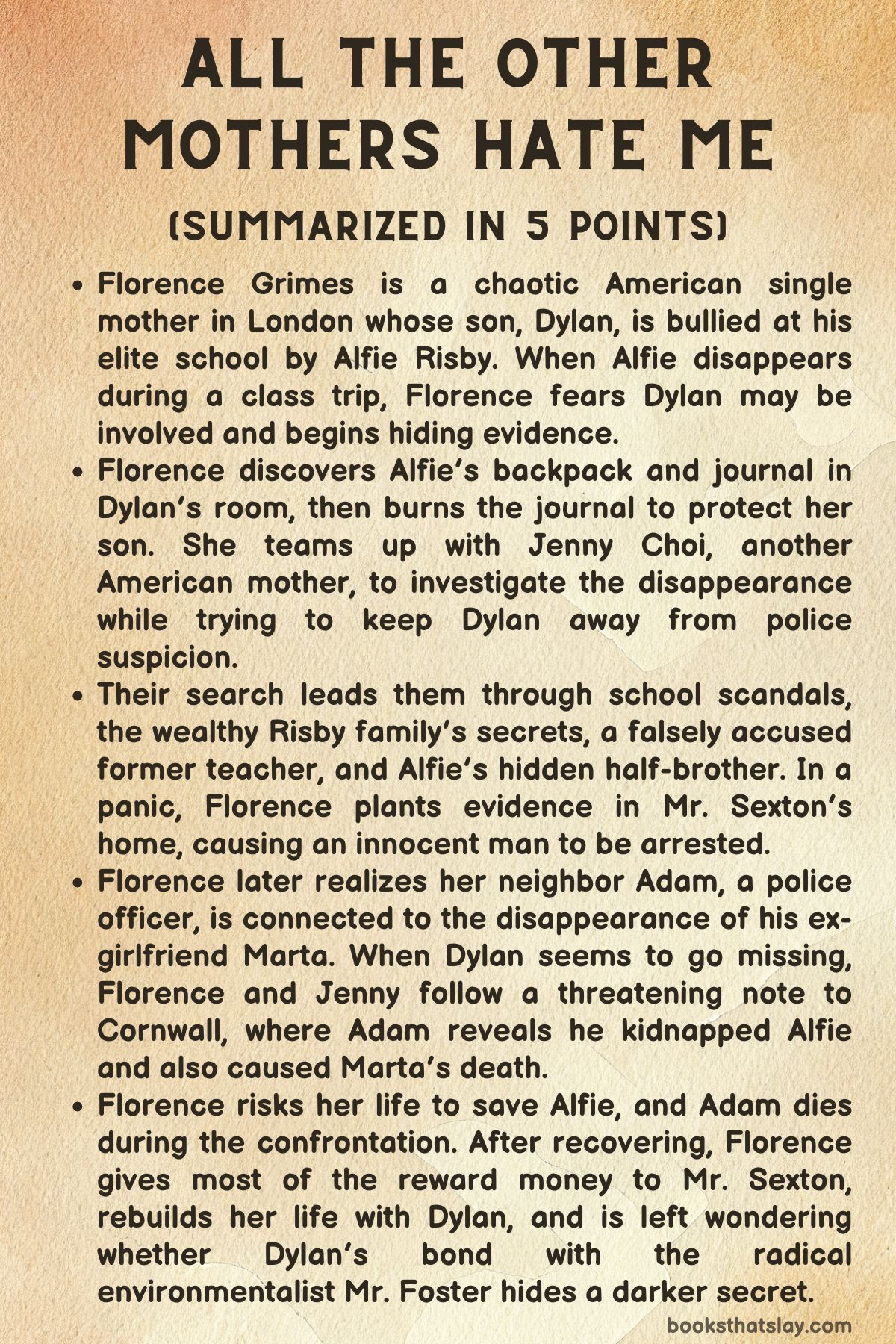
Florence Grimes is a 32-year-old American single mother living in Shepherd’s Bush, London, with her 10-year-old son, Dylan Palmer. Florence used to be part of a girl group called Girl’s Night, but her music career ended after she became pregnant and her ex-husband, Will, later left her for another member of the group.
Now she runs a custom balloon arch business, struggles with money, drinks too much, makes impulsive decisions, and feels hated by the other mothers at Dylan’s elite private school, St. Angeles.
Dylan is bright, odd, sensitive, and deeply interested in animals and environmental issues. He also has a temper, especially when he sees cruelty.
His classmate Alfie Risby, the son of a very rich and powerful family, bullies him. Florence knows Dylan is not easy, but she believes he is being judged unfairly by the school and the other parents.
When the school counselor raises concerns about Dylan’s behavior, including a previous incident in which he attacked Alfie with a cricket bat after Alfie tormented a turtle, Florence becomes defensive.
On the day of a school trip to the Wetland Centre, Alfie disappears. The school goes into crisis, the police arrive, and parents gather in panic.
Florence finds Dylan at school and immediately wonders whether he may have been involved. Instead of waiting for answers, she sneaks him out through a back entrance and takes him home.
Dylan says he was paired with Alfie for bird watching, left briefly to throw away litter, and returned to find Alfie gone. He also admits that when Alfie’s name was called during roll call on the bus, he answered for him.
No one noticed Alfie was missing until the bus returned to school.
Florence soon discovers that the backpack she carried home is not Dylan’s but Alfie’s. Inside she finds Alfie’s feelings journal, including an entry saying Dylan had threatened to kill him.
Terrified that Dylan will be blamed, Florence burns the journal. Her fear is sharpened by her belief that the Risby family, with their money and influence, could destroy her son’s life.
The police want to speak to Dylan, while Florence tries to act normal. She teams up with Jenny Choi, a new American mother at the school and a lawyer, to investigate Alfie’s disappearance themselves.
Jenny is organized, direct, and analytical; Florence relies more on charm, instinct, and bad ideas. Together they begin questioning people connected to the school.
They first look into Mr. Papasizi, the Romanian caretaker, partly because other parents are already casting suspicion on him. He tells Florence to ask about Mr. Sexton, a former teacher who was fired after accusations that he groped a student.
Florence and Jenny then speak with Vice Principal Helen Schulz, who reveals that Rollo Risby, Alfie’s father, has a secret adult son named Ian. This raises the possibility that Ian might benefit if Alfie were gone, since Alfie is the official heir to the Risby fortune.
Florence and Jenny track down Ian at a warehouse party where he is DJing. Ian denies involvement and says he was working when Alfie disappeared.
He also mentions Mr. Sexton and implies that Ms. Schulz told him about the old scandal. Jenny notices that Ms. Schulz has not been honest about how well she knows Ian.
Florence later learns that Ms. Schulz is Ian’s aunt and that her sister had Ian after becoming pregnant by Rollo as a teenager. Rollo refused to acknowledge the child, and the damage to the family was severe.
At the same time, Florence becomes increasingly worried about Dylan. A newspaper publishes a blurry CCTV image showing a boy pushing Alfie at the Wetland Centre, and Florence cannot tell whether it is Dylan.
The police ask her to bring Dylan in for a formal interview. In a panic, Florence decides to redirect suspicion away from her son.
She plants Alfie’s backpack and a USB stick containing photos of St. Angeles students in Mr. Sexton’s home, then anonymously reports that she found evidence there. Mr. Sexton is arrested, and Dylan is no longer required to attend the police interview.
Florence is relieved but also deeply guilty.
Her guilt worsens when Ms. Schulz tells her the truth about Mr. Sexton. He was not guilty of the old misconduct accusation.
The Risbys had helped ruin him after he gave Alfie a failing grade and refused to change it. Mr. Sexton lost his job and now works at a Christmas tree farm, which explains some of the items Florence and Jenny had found suspicious while following him.
Florence realizes she has framed an innocent man.
Meanwhile, another mystery begins to surface. Adam, Florence’s neighbor and a police officer, has always seemed dependable and fond of her.
Florence has treated him as a safety net, even though she has not fully committed to him. When she finds Jenny at Adam’s apartment and realizes they have been sleeping together, Florence feels betrayed.
Soon after, a woman named Zofia arrives looking for her missing sister Marta, Adam’s ex-girlfriend. Florence helps Zofia ask questions and learns that Marta supposedly moved back to Poland, but the explanation does not add up.
Marta had been having an affair with an older married man, and Florence discovers that man was Rollo Risby.
Florence later calls Marta’s phone and hears it ringing from Adam’s apartment. She concludes that Adam may be connected to Marta’s disappearance.
When she tries to report this, the police are unhelpful because Adam is one of their own. Florence returns home, gets drunk, goes out with a stranger, takes drugs, and blacks out.
The next morning, Dylan is missing. She finds a note with an address in Cornwall and a threat that says if she calls the police, “he dies.”
Florence calls Jenny, and they drive to the address, believing Adam has kidnapped Dylan. The cottage belongs to Adam’s family.
Florence goes inside while Jenny waits nearby. Just before reaching the door, Florence receives delayed messages from Dylan showing he has been trying to contact her.
Before she can answer, she is struck and loses consciousness.
When Florence wakes, Adam is there. He confesses that Marta is dead.
He found out she was having an affair with Rollo, confronted her, and pushed her during the argument. She hit her head and died.
Adam claims it was an accident, but he then dissolved her body in his bathtub using acid, damaging the plumbing and causing the strange sludge that had come through Florence’s shower. Florence tries to stay calm and asks where Dylan is.
Adam says he does not have Dylan. The note referred to Alfie.
Adam reveals that he kidnapped Alfie to punish Rollo and get ransom money. He knew from Dylan about the Wetland Centre trip and its limited security coverage.
He took Alfie during the trip while wearing a mask. Dylan saw him, and Adam frightened him into silence by making him believe he would be in trouble if he told anyone.
Florence is furious that Adam used and traumatized her son. Adam wants Florence to help demand ransom from the Risbys and threatens to expose her for framing Mr. Sexton if she refuses.
Florence pretends to cooperate while looking for a way to save Alfie. She manages to retrieve a syringe of horse tranquilizer that she and Jenny had obtained earlier.
She goes to Alfie and tells him to get ready to run. Adam catches her, and the situation turns violent.
Florence stabs him with the tranquilizer, and Alfie escapes. Adam attacks Florence brutally.
Jenny enters, takes the gun, and a shot is fired.
Florence wakes from a coma a week later. Dylan is safe, Alfie survived, and Adam is dead.
The public believes Florence is a hero. The Risbys cover her medical care and pay a reward.
Florence decides to give most of the money to Mr. Sexton as an apology for ruining his life, while keeping enough to buy Adam’s half of her building.
By Christmas, Florence is home with Dylan, Jenny, and Jenny’s children. Greta the turtle, whom Florence had feared dead, is alive and only hibernating.
Florence appears to have reached a more stable place, but the ending leaves a final unease. News reports say Florence’s elderly neighbor Mr. Foster is wanted in connection with an environmental bombing.
Florence remembers Dylan’s closeness to him and wonders whether her son may be involved in something dangerous. Her final instinct is the same one that drove the whole story: she will protect Dylan, whatever it costs.
Characters
Florence Grimes
Florence Grimes is the central character and narrator of All the Other Mothers Hate Me, and her voice defines the novel’s humor, disorder, and emotional pressure. She is a former girl-group singer whose career collapsed after pregnancy, betrayal, divorce, and public humiliation.
Now living in London as a single mother, she feels out of place among the rich, polished parents at Dylan’s school. Florence is funny, defensive, vain, impulsive, and often reckless, but her behavior is rooted in fear and shame.
She knows she is not the kind of mother the school community respects, so she performs confidence even when she is insecure. Her choices are often morally wrong: she burns Alfie’s journal, lies to the police, frames Mr. Sexton, neglects Dylan at dangerous moments, and makes decisions driven by panic rather than judgment.
Yet the novel does not reduce her to a bad mother. Florence’s love for Dylan is fierce, protective, and sometimes destructive.
She is most dangerous when she believes her son is under threat, because she is willing to bend truth and law to protect him. Her growth comes through painful recognition.
By the end, she is still flawed, but she has faced the damage caused by her fear and has taken real risks to save Alfie as well as Dylan.
Dylan Palmer
Dylan Palmer is Florence’s 10-year-old son, and much of the novel’s tension comes from the uncertainty around him. He is intelligent, sensitive, environmentally conscious, and deeply attached to animals, especially Greta the turtle.
At school, he is treated as strange and difficult, and his anger makes adults view him with suspicion. Dylan’s conflict with Alfie creates the possibility that he might be involved in Alfie’s disappearance, especially after Florence finds evidence suggesting he threatened Alfie.
However, Dylan is also a child under pressure. He has been bullied, misunderstood, and placed in an environment where wealth and social status shape how behavior is judged.
His silence after the kidnapping is not proof of guilt but the result of fear, manipulation, and trauma. Adam uses Dylan’s vulnerability against him, making him believe that telling the truth could ruin him.
Dylan’s connection with Mr. Foster adds another layer of unease. His environmental idealism seems innocent at first, but the ending raises the possibility that he may be drawn toward more extreme action.
Dylan remains partly unknowable to Florence, which is central to his role. She loves him completely, but she cannot fully read him, and that uncertainty drives many of her worst decisions.
Alfie Risby
Alfie Risby begins as an unpleasant figure seen through Florence’s angry perspective. He is rich, entitled, cruel to Dylan, and capable of casual nastiness, especially in the way he treats animals and other children.
Florence sees him as a bully whose family wealth protects him from consequences. His journal entry about Dylan threatening him makes him seem like a possible victim of Dylan’s anger, but it also deepens the complicated picture of school cruelty, fear, and adult negligence.
As the story progresses, Alfie becomes more than the “bad kid” Florence first describes. His kidnapping strips away his arrogance and reveals him as a frightened child who misses his mother.
This shift is important because it forces Florence to see him as human, not merely as the boy who tormented her son. Her decision to save him marks a turning point in her moral development.
Alfie represents the danger of reducing children to labels. He is a bully, but he is also a child trapped in the consequences of adult corruption, revenge, and resentment.
Jenny Choi
Jenny Choi is Florence’s unlikely partner in the investigation and one of the novel’s most important contrasts to her. Jenny is an American lawyer, organized, practical, and used to solving problems through logic and structure.
Where Florence is chaotic and emotionally reactive, Jenny is methodical and direct. Their friendship grows because both women feel socially isolated in London, though they cope with that isolation very differently.
Jenny’s investigative style can be aggressive, but she brings discipline and seriousness to Florence’s wild instincts. She also serves as a moral mirror.
When Florence lies, withholds evidence, or acts irresponsibly, Jenny is often the character who sees the consequences most clearly. Their friendship is strained by Florence’s jealousy over Adam and by Florence’s confession that she framed Mr. Sexton.
Still, Jenny does not abandon her completely. Her return in the final confrontation shows loyalty beneath the anger.
Jenny is not perfect, but she is one of the few characters who challenges Florence without simply judging her. She represents the possibility of adult friendship built not on social performance but on honesty, conflict, and eventual trust.
Adam
Adam is one of the most deceptive characters in the novel because he first appears to be safe. As Florence’s upstairs neighbor and a police officer, he seems dependable, kind, and quietly devoted to her.
Florence views him as a backup plan, someone stable who might always be available if her life becomes too difficult. This makes his eventual exposure especially disturbing.
Adam’s apparent goodness hides violence, entitlement, and desperation. His killing of Marta may begin as an accident, but his response reveals his true character: he disposes of her body, lies for months, keeps her phone, and continues living normally.
His kidnapping of Alfie shows an even colder level of planning. He exploits Dylan’s trust, uses his police knowledge, and weaponizes Florence’s fear for her son.
Adam’s motive is tied to humiliation and revenge against Rollo, but his actions show that he is willing to destroy children, women, and innocent people to protect himself. He also reflects the danger of institutional trust.
Because he is a police officer, Florence struggles to get authorities to take her suspicion seriously. Adam’s role exposes how charm, profession, and proximity can hide predatory behavior.
Will Palmer
Will Palmer is Florence’s ex-husband, Dylan’s father, and a major source of Florence’s emotional wounds. He was once connected to her music career as the manager of Girl’s Night, and his betrayal helped end the life Florence imagined for herself.
His affair with Rose and his decision to rebuild the group without Florence leave her feeling discarded both romantically and professionally. Will is not portrayed as a villain in the same way as Adam or Rollo, but he carries a quieter kind of damage.
He represents the people who move on from a shared past while leaving someone else trapped in the consequences. As a father, he is more stable than Florence in some ways, but his respectability also makes Florence feel judged.
Their arguments reveal unresolved bitterness, especially because Will’s life appears more settled and successful. Still, when Dylan becomes a possible suspect, Will shares Florence’s fear.
His presence reminds the reader that Florence’s current chaos is tied to older betrayals that shaped her sense of self-worth.
Brooke
Brooke, Florence’s younger sister, is disciplined, practical, and far more socially controlled than Florence. She often criticizes Florence’s immaturity, irresponsibility, and lack of stability, but her criticism is not simply cruelty.
Brooke has spent years watching Florence make reckless choices, and she is tired of managing the fallout. Her upcoming wedding highlights the contrast between the sisters: Brooke wants order, respectability, and a carefully planned life, while Florence resists being contained by those expectations.
Yet Brooke is not purely sensible or innocent. Her decision to have Julian throw a cricket ball through Florence’s window to scare her away from the investigation reveals that she, too, can be manipulative when she thinks she is protecting the family.
Brooke’s relationship with Florence is tense because it combines love, resentment, embarrassment, and loyalty. She wants Florence to grow up, but she also underestimates the depth of Florence’s fear for Dylan.
By the end, Brooke’s apology suggests that she understands Florence more than she had before, even if their relationship remains complicated.
Rollo Risby
Rollo Risby is wealthy, powerful, entitled, and morally rotten beneath his polished social position. He is Alfie’s father, Cleo’s husband, Ian’s biological father, and Marta’s lover.
His actions have harmed many people, though he often avoids direct consequences because of his money and status. His aggressive behavior toward Florence at the school gala shows his sense of sexual entitlement, while his treatment of Ian and Ian’s mother reveals a longer history of selfishness and cruelty.
He refuses responsibility when responsibility threatens his reputation. His family’s role in destroying Mr. Sexton’s career shows how power can be used to erase truth and protect privilege.
Rollo does not kidnap Alfie, but his past behavior creates the conditions for much of the novel’s conflict. Adam targets Alfie partly because Rollo ruined his life, and Ms. Schulz’s bitterness is tied to the damage Rollo caused her sister.
Rollo represents a class of people who are protected by money even when their actions leave lasting damage behind.
Cleo Risby
Cleo Risby initially appears as one of the polished, intimidating mothers Florence resents. As Alfie’s mother and Rollo’s wife, she belongs to the highest level of the St. Angeles social world.
Florence sees her through the lens of class envy, past humiliation, and fear. However, Alfie’s disappearance changes the way Cleo is presented.
Her grief at the vigil unsettles Florence because it cuts through Florence’s resentment and shows Cleo as a suffering mother rather than simply a rich rival. Later, when Cleo is drunk and desperate on the bus, begging Florence for help, she becomes one of the loneliest figures in the story.
The other mothers distance themselves from her because of legal concerns and social discomfort, leaving her isolated at the moment she most needs support. Cleo’s role exposes how quickly social circles built on status can abandon someone in crisis.
She is not deeply explored in terms of inner life, but her pain is crucial because it forces Florence to see that maternal fear is not limited by class.
Helen Schulz
Helen Schulz, the vice principal of St. Angeles, is a guarded and morally complex character. At first, she appears to be another school authority figure who knows more than she says.
Her connection to Ian, later revealed to be familial, explains her interest in the Risby family and her resentment toward Rollo. Her sister’s tragic history with Rollo gives Helen a personal stake in exposing or correcting the damage he caused.
Yet she is also compromised by secrecy. She withholds important information, misleads Florence and Jenny, and operates from private motives rather than full honesty.
Her account of Mr. Sexton’s firing is one of the novel’s clearest examples of institutional corruption: the school protects its reputation and financial interests while allowing an innocent teacher to be destroyed. Helen is sympathetic because of what happened to her family, but she is not entirely trustworthy.
She shows how grief and bitterness can push people into half-truths, especially when powerful people have gone unpunished for years.
Mr. Sexton
Mr. Sexton is one of the novel’s most wronged characters. Florence and Jenny first view him through suspicion because of the allegation that he behaved inappropriately toward a child.
The circumstances around him seem incriminating when they follow him, but those signs are misleading. The truth is that he was falsely accused after refusing to give Alfie special treatment.
His firing destroyed his career and reputation, and Florence’s decision to frame him for Alfie’s disappearance compounds that injustice. Mr. Sexton represents the damage caused when truth is less important than convenience, reputation, and power.
The school and the Risby family use him as a disposable person, and Florence does the same when she needs someone else to absorb suspicion. Her decision to give him most of the reward money is an attempt at repair, but it cannot undo what she has done.
His character is important because he prevents the story from treating Florence’s protective instincts as automatically noble. Her love for Dylan harms an innocent man.
Mr. Foster
Mr. Foster is Florence’s elderly neighbor and Dylan’s friend, and he appears at first as an eccentric environmentalist who shares Dylan’s concern for animals and the planet. His bond with Dylan seems wholesome, especially because Dylan struggles to make friends his own age.
Yet there is always something unsettling about him. He appears at odd moments, gives Dylan and Florence tins that do not always contain what they expect, and has an intensity that goes beyond ordinary environmental concern.
The final news report connecting him to an environmental bombing changes the meaning of his earlier behavior. Mr. Foster becomes a symbol of radicalization and the danger of adult influence over a lonely child.
His relationship with Dylan raises troubling questions about what Dylan may have learned from him and where Dylan went during the early morning when Florence could not account for him. Mr. Foster’s character leaves the ending unresolved and disturbing, suggesting that the danger Florence fears may not be over.
Ms. Dobbins
Ms. Dobbins is the school counselor who raises concerns about Dylan’s behavior. Her role is small but important because she represents the institutional gaze fixed on Dylan.
She sees patterns that worry her and suggests that Dylan may need evaluation. Florence reacts defensively because she hears this as judgment, not help.
The scene between them shows how difficult it is for Florence to accept criticism about Dylan, even when some of that criticism may be reasonable. Ms. Dobbins is not shown as cruel, but she is part of a school environment where Florence feels unwelcome and where Dylan’s differences are treated as problems.
Her character helps establish the pressure Florence feels before Alfie disappears. Florence’s later choices are partly driven by the fear that the school has already decided Dylan is dangerous.
Hope
Hope is the PTA president and one of the most visible representatives of the St. Angeles mothers. She is socially powerful, polished, and deeply conscious of appearances.
Florence sees her as judgmental and fake, especially after Hope fails to support her following the incident with Rollo. Hope’s behavior shows how social groups maintain control through exclusion, gossip, and moral performance.
Her request for money for flowers after Alfie’s disappearance, even while Florence is frightened and overwhelmed, shows how ritual and appearance can replace real compassion. Hope is not the main villain, but she helps create the hostile environment that makes Florence feel cornered.
Through Hope, the novel satirizes elite school-parent culture, where kindness is often filtered through status, etiquette, and group loyalty.
Ian Risby
Ian Risby, Rollo’s secret son, is introduced as a possible suspect because his existence threatens the Risby family image and because he might benefit if Alfie is gone. He is a DJ, carries signs of his connection to Rollo, and has a complicated relationship with his hidden place in the family.
Ian’s life has been shaped by Rollo’s refusal to acknowledge him and by the pain that refusal caused his mother. Despite this, he does not emerge as the villain.
He is defensive, wounded, and understandably angry when Florence implies he might want Alfie dead for inheritance reasons. Ian’s role expands the novel’s view of the Risby family beyond wealth and glamour.
He shows the human cost of Rollo’s selfishness and the way powerful men can create damage across generations. His presence also complicates the investigation because he seems suspicious for reasons that are emotionally convincing but ultimately misleading.
Marta
Marta is absent for most of the story, but her disappearance becomes one of the central hidden crimes. She was Adam’s ex-girlfriend and Rollo’s lover, and her fate reveals the violence beneath Adam’s ordinary exterior.
Because she is missing before the main action begins, Marta exists through traces: texts, memories, phone calls, and the concern of her sister Zofia. This absence is meaningful.
Adam tries to erase her physically and socially, creating fake explanations so people will stop looking for her. Her story also shows how easily a woman without strong institutional protection can vanish from other people’s lives.
Marta’s death connects the domestic, sexual, and class-based conflicts of the novel. She is caught between Adam’s possessiveness and Rollo’s selfishness, and both men treat her as someone whose life can be controlled or discarded.
Zofia
Zofia, Marta’s sister, brings moral clarity into the story because she refuses to accept the convenient explanation that Marta simply returned to Poland. Her arrival forces Florence to look more closely at Adam and to connect details she had ignored or misunderstood.
Zofia’s concern for her sister contrasts with the indifference of people who accepted Marta’s disappearance through text messages and assumptions. She is not a major character in terms of page presence, but she is vital to the plot because she opens the path to exposing Adam.
Zofia also reminds Florence what determined loyalty looks like when it is not mixed with vanity or self-protection. Her search is simple and urgent: she wants to know what happened to someone she loves.
Linh
Linh, Florence’s manicurist, acts as a comic and observational presence, but she also helps connect Florence’s personal world to wider events. She brings up local fears, such as the Shepherd’s Bush Strangler, and later mentions the militant environmental collective that becomes important to the ending.
Linh’s salon is one of the few places where Florence can speak freely without performing for the school mothers. Linh also has ambitions of her own, shown when she closes the shop to interview with a fashion house.
Her role is small, but she adds texture to Florence’s London life and gives the story moments of social commentary outside the school setting. She is practical, sharp, and more aware of the wider world than Florence sometimes realizes.
Themes
Motherhood, Protection, and Moral Compromise
Florence’s love for Dylan is intense, but the novel refuses to present maternal love as automatically pure or wise. Her instinct to protect him is understandable because Dylan is bullied, socially isolated, and quickly viewed as suspicious by adults who already see him as strange.
Yet that same instinct leads Florence into serious wrongdoing. She hides evidence, destroys Alfie’s journal, lies repeatedly, and frames an innocent man because she believes Dylan’s future is at risk.
The story examines the frightening side of parental devotion: the moment when love becomes possession, fear becomes logic, and protection becomes harm. Florence does not act because she is certain Dylan is innocent; she acts because she cannot survive the possibility that he may be guilty or punished.
Cleo’s grief later forces Florence to recognize that another mother’s child matters too. When Florence risks herself to save Alfie, she finally moves beyond protecting only her own son.
The theme is powerful because it shows motherhood as emotional, messy, and morally dangerous. Love may drive courage, but it can also excuse cruelty unless it is checked by responsibility.
Class, Social Judgment, and the School-Gate Hierarchy
The world of St. Angeles is built on money, status, and social performance. Florence is constantly aware that she does not belong among the other mothers.
She lacks their wealth, polish, accents, restraint, and confidence. Her clothes, past career, sex life, finances, and parenting style all make her feel exposed.
The school-gate world becomes a miniature class system where mothers compete through manners, gossip, charity gestures, and social exclusion. Florence’s resentment is funny, but it also reveals how isolating elite spaces can be for anyone who cannot match their rules.
The Risbys sit near the top of this order, and their influence affects how people speak, whom they suspect, and what truths are allowed to surface. Mr. Sexton’s ruined career shows the darkest side of this structure: when wealthy families and image-conscious institutions work together, ordinary people become disposable.
All the Other Mothers Hate Me uses school politics to show that class power is not only about money. It is also about who is believed, who is protected, who is mocked, and who is expected to disappear quietly when they become inconvenient.
Appearance, Reputation, and the Stories People Tell
Almost every major conflict in the novel is shaped by reputation. Florence is trapped by her public image as a failed pop star, unstable ex-wife, embarrassing mother, and outsider.
Mr. Sexton is destroyed by a false accusation because the school finds it easier to sacrifice him than challenge a powerful family. Adam survives as long as he does because his image as a kind neighbor and police officer protects him from suspicion.
The Risbys maintain respectability despite Rollo’s misconduct, hidden child, affairs, and abuses of power. The novel repeatedly shows that public stories often matter more than facts.
People believe what fits the image they already have: Dylan is strange, so he seems capable of hurting Alfie; Florence is chaotic, so her concerns seem unreliable; Adam is respectable, so the police hesitate to treat him as dangerous. Florence herself also manipulates stories, especially when she plants evidence against Mr. Sexton.
The theme asks how truth can survive in a world where social narratives are so easily controlled by wealth, gender, profession, and prejudice. The final irony is that Florence becomes publicly celebrated as a hero, even though the full truth of her actions is far more complicated.
Female Anger, Shame, and Self-Sabotage
Florence’s anger is one of the strongest forces in the novel. She is angry at Will for abandoning her, at Rose for replacing her, at the school mothers for judging her, at herself for failing, and at the world for turning her from a pop star into someone struggling to be taken seriously.
Her anger often appears as comedy, but beneath it is shame. She acts out sexually, drinks, steals, lies, and insults people before they can reject her.
She often turns pain into performance because vulnerability feels too dangerous. The novel is especially sharp in showing how female anger is judged.
Florence’s past public meltdown becomes a defining humiliation, while men such as Rollo and Adam cause greater harm and remain protected for much longer. Still, the story does not excuse Florence’s self-sabotage.
Her rage damages friendships, clouds her judgment, and places Dylan at risk. Her conflict with Jenny is important because Jenny refuses to romanticize her chaos.
By the end, Florence’s anger becomes more focused. Instead of using it only to defend herself or attack others, she uses it to fight Adam and save Alfie.
The theme presents anger as both destructive and necessary, depending on whether it is ruled by fear or directed toward justice.