First Lie Wins Summary, Characters and Themes
First Lie Wins by Ashley Elston is a suspense novel about identity, performance, and control. At its center is a woman living under a borrowed name, building a life that looks steady from the outside while hiding a long history of deception.
She is smart, adaptable, and always calculating the next move, but the life she has created begins to crack when her past starts showing up in unexpected ways. The story mixes romance, crime, and psychological tension, asking what happens when someone trained to lie begins to want something real. It is a fast, sharp novel about survival and the price of reinvention.
Summary
Evie Porter seems to be stepping into a perfect new life. She is about to move in with her boyfriend, Ryan, a wealthy and attractive man whose world appears stable, polished, and welcoming.
Yet almost everything about Evie is invented. Even the story of how they met is staged by her.
She created the flat tire that brought Ryan to her side, and she has carefully built the background she presents to his friends and community. She knows how to answer questions, how to dress, how to charm, and how to defend herself when someone pushes too hard.
Still, the closer she gets to Ryan’s life, the more dangerous her position becomes, because she has not entered his world for love alone.
Evie is working for a shadowy operator she knows as Mr. Smith, a man who has spent years using her talent for deception. Her assignment is to get close to Ryan and learn what he is doing during his regular Thursday trips to East Texas.
Mr. Smith suspects Ryan’s trucking business is involved in illegal activity connected to a long family history of moving stolen goods. Evie has done work like this before under many different names, sliding into other people’s lives to steal information, retrieve objects, or create leverage.
She is good at it, but she also knows she is disposable. One failed job has already left her in danger from powerful criminals, so this assignment matters not just professionally but personally.
If she fails again, her life may be worth very little.
As Evie settles into Ryan’s home and social circle, she faces scrutiny from the women around him, especially Rachel, a sharp attorney who quickly senses that something about Evie does not add up. Evie manages these encounters with practiced calm, using a tragic fake backstory and even fake online evidence to support it.
But the balance shifts at a Derby party when she meets a woman introduced as Lucca Marino. The name stops her cold, because Lucca Marino is her real name.
The stranger not only uses that name but also repeats details from Evie’s real past. For the first time in a long time, Evie feels exposed in a way she cannot easily control.
The appearance of this fake Lucca rattles her. She wonders whether someone from her past has found her, whether Mr. Smith is testing her, or whether she is being replaced.
Her fear grows when the woman starts moving easily through Ryan’s social world. Eventually Evie learns the truth: Mr. Smith planted the impersonator to test how quickly Evie would report a threat and to remind her that she can be erased and substituted at any time.
The message is cruel and clear. Mr. Smith owns the narrative, and if Evie forgets that, he can destroy her.
Determined not to remain passive, Evie begins investigating Ryan on her own. Disguised as a man, she sneaks onto the East Texas property connected to his trucking company and enters his office.
There she overhears Ryan and an associate interrogating an employee suspected of theft. The encounter reveals that Ryan’s business is indeed dangerous and violent, though the full structure of his operations is still unclear.
At the same time, Evie starts thinking more seriously about whether Ryan is only a target or something more complicated. Despite the lies between them, real feeling has begun to creep in.
The story also opens windows into Evie’s earlier life. As a teenager, she was Lucca Marino, caring for her dying mother and stealing jewelry from wealthy homes to cover medical bills.
After her mother’s death, she drifted into more organized scams. She was eventually spotted by people connected to Mr. Smith, who admired her nerve and skill and recruited her into his system.
Over the years she worked under many identities, entering homes, political circles, and wealthy social networks. She found blackmail, stole valuables, and manipulated events for powerful clients.
Along the way she learned that success did not bring safety. Mr. Smith rewarded talent, but he also watched for weakness and punished independence.
One important bond from that hidden life is Devon, a trusted ally who becomes central to Evie’s survival. Another is Amy Holder, a woman tied to an earlier mission that went badly wrong.
Mr. Smith believes Evie kept something from that job, something valuable enough to threaten him. As the pressure builds in the present, police suddenly connect Evie to Amy’s apparent death in a hotel fire.
Her aliases begin collapsing into one another. Records, photographs, and false trails are rearranged so that every version of her seems to point back to Evie Porter.
It becomes clear that Mr. Smith is not only watching her but actively rewriting her past.
Evie is arrested and questioned, but she manages to get help from Rachel, who agrees to represent her even after realizing how many names and identities are involved. Rachel’s research shows just how thoroughly Evie’s life has been manipulated.
Yet Evie still keeps the deepest truth to herself: she has been planning for years to turn the game around.
As the threat escalates, Evie tells Devon more of what is happening. Together they start moving pieces into place.
She feeds selected information to Mr. Smith while quietly altering other details. She revisits figures from her old jobs, including men who rose to positions of power and still owe her favors.
She wants Mr. Smith to believe she has been secretly collecting leverage on his clients and hiding it from him. The goal is to make him angry, suspicious, and reckless enough to step into the open.
During a tense trip with Ryan, Evie discovers something that feels like a personal betrayal. She overhears Ryan meeting with George, a man who has long acted as a courier and enforcer in Mr. Smith’s orbit.
Ryan has documents that Evie had sent to Mr. Smith, which suggests he has been connected to the operation more than she knew. This leads Evie to a disturbing possibility: perhaps Ryan is not simply involved with Mr. Smith but may actually be Mr. Smith, or the heir to that role.
The timing of Ryan’s life and the shifts in her contact with Mr. Smith begin to line up in a way she cannot ignore.
While trying to stay ahead of the police investigation into Amy Holder’s death, Evie makes one of her boldest moves. She returns to her hometown and uploads dental records designed to support a future identification switch.
Later, when detectives confront her with footage placing her at Amy’s hotel, she claims the woman they are seeing is Lucca Marino, not Evie Porter. Because Mr. Smith had already built a convincing public existence for the fake Lucca, Evie is able to push the authorities toward that version of events.
She also secures an alibi through a former football player whose life she once touched during another job. Every small part of her history becomes a tool.
The final confrontation takes place around a safety deposit box in Atlanta, the object Mr. Smith has been demanding. George escorts Evie to the bank, and there the truth becomes plain: George is Mr. Smith.
Inside the box is not the damaging cache he expects but only an origami swan. Evie then reveals how long she has been preparing for this moment.
Years earlier, after a job involving a stolen painting, she realized that Mr. Smith had his own operatives killed once they outlived their usefulness. The only survivor besides her was Amy Holder.
Rather than remain prey, the two women secretly joined forces. They faked Amy’s death, hid evidence, and began constructing a patient counterattack.
Evie explains that she now knows Mr. Smith’s true identity and has already passed it to Victor Connolly, the crime boss Mr. Smith betrayed. Connolly’s people are waiting outside.
Mr. Smith is finally trapped by the same methods of secrecy, manipulation, and fear that he used on others. He is taken away to face the consequences Evie has arranged.
Afterward, Evie goes to a safe house where Amy is revealed to be alive. The long plan has worked.
Devon confirms that Ryan was involved with Mr. Smith only briefly and that Mr. Smith intended to take over Ryan’s business rather than act for Ryan all along. This matters to Evie, because despite everything, her feelings for Ryan were genuine.
Months later, Evie returns to him and finally tells him the truth. Their reunion is cautious at first, shaped by damage and distrust, but they begin building something more honest than what they had before.
Yet the ending is not a clean break from the past. Ryan continues running his illegal business, and Evie, now armed with the knowledge of how Mr. Smith operated, steps into the power vacuum herself.
Taking control of the network once run by the man who shaped and hunted her, she adopts a new title.
She becomes Miss Smith.
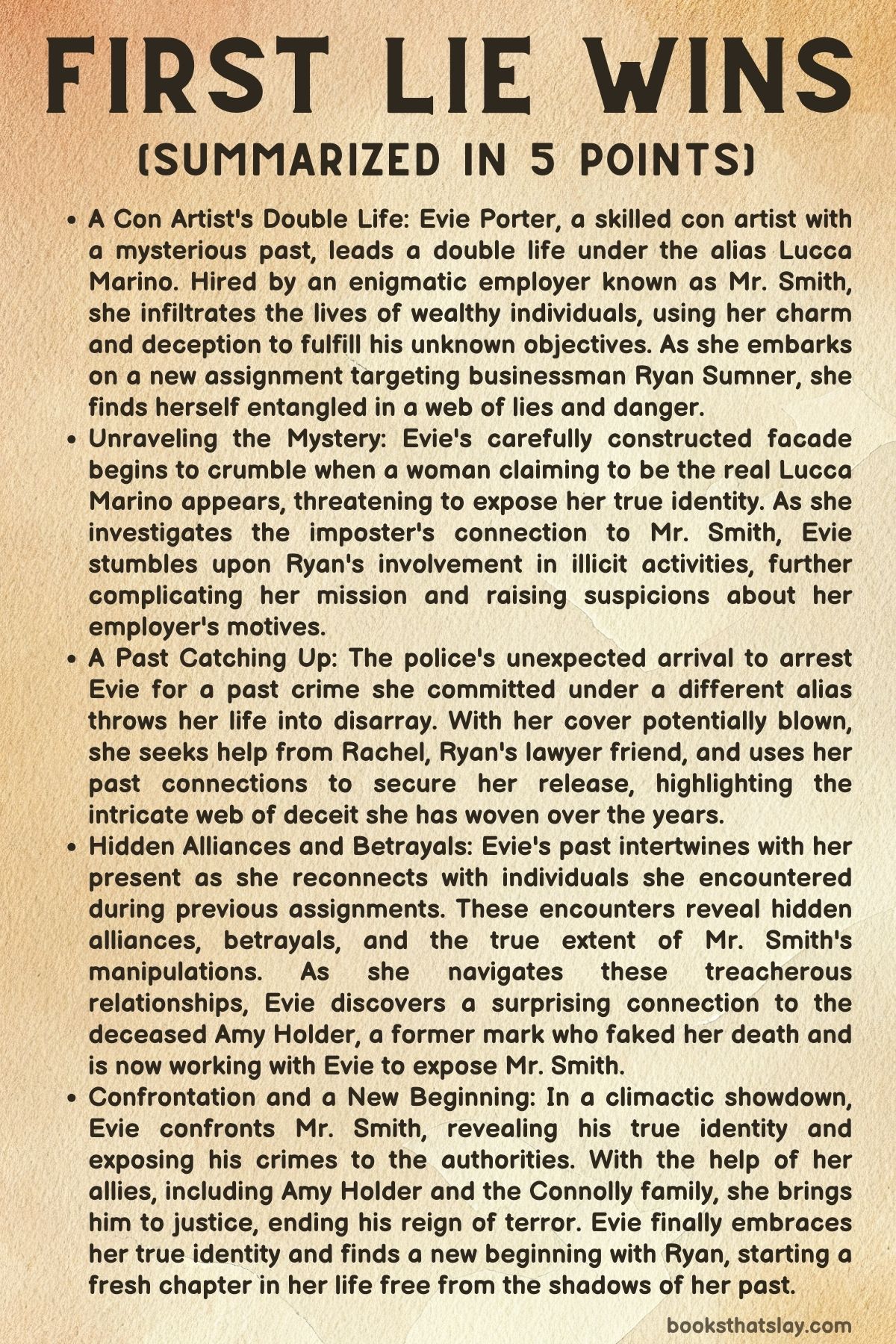
Characters
Evie Porter / Lucca Marino
Evie Porter is the center of the novel’s moral and emotional tension because she is both highly skilled at deception and deeply hungry for a life that does not require it. Underneath the polished alias is Lucca Marino, a woman shaped by early poverty, a dying mother, and the need to survive before she was old enough to have good options.
That beginning matters because it explains why she learned to treat identity as something flexible rather than sacred. She becomes someone who can study a room, read weakness, invent history, and perform trust with astonishing control.
Yet her intelligence is never presented as cold in a simple way. She carries guilt, fear, longing, and pride all at once, which gives her complexity beyond the role of a con artist.
One of her strongest traits is adaptability. She can shift class presentation, physical appearance, speech, and emotional tone depending on what a situation demands.
She is patient when patience serves her and quick when speed is required. This makes her effective in the criminal system that employs her, but it also leaves damage.
She is so used to constructing false versions of herself that even when she wants closeness, she cannot arrive honestly. Her relationship with Ryan exposes this conflict.
She begins the assignment with a plan, but real attachment unsettles her method. That tension between trained manipulation and sincere feeling drives much of her character arc.
She is also marked by a growing refusal to remain a tool in someone else’s design. Earlier in her life, she accepts risk as the price of survival.
Over time, however, she develops a sharper awareness of how power actually works around her. Mr. Smith does not merely give assignments; he erases, replaces, and disposes of people.
Evie’s rebellion becomes meaningful because it is not sudden. It grows from years of observation, fear, and buried anger.
She learns that the only way to survive him is not to flee but to think farther ahead than he does. By the end, she is no longer only reacting.
She is designing the board.
Her final transformation is unsettling in an intentional way. She does not emerge into innocence or normalcy.
She gains agency, but she also inherits the machinery of control that once trapped her. That ending keeps her from becoming a simple triumphant heroine.
She is capable, wounded, dangerous, and emotionally real. In First Lie Wins, she is written as someone who wants tenderness but understands power, and that combination is what makes her compelling.
Ryan Sumner
Ryan initially appears to be the dream target: handsome, wealthy, calm, generous, and socially established. He offers Evie access to a life of ease and legitimacy, which is exactly why he is useful to her assignment.
Yet he is never only a rich boyfriend figure. As the story develops, Ryan becomes more ambiguous.
He is kind in ways that seem genuine, but he is also secretive, connected to criminal business, and comfortable with forms of intimidation that reveal a hard edge beneath his polished exterior. This duality makes him effective as both romantic lead and source of unease.
A central part of Ryan’s character is the contrast between his emotional manner and his professional reality. In private life, he can be patient, attentive, and affectionate.
He apologizes for the behavior of his friends, tries to include Evie in his world, and often behaves as if he wants a real future with her. At the same time, his work in East Texas suggests that he has inherited not just a company but also a culture of violence and illegality.
He lives with compartmentalization much as Evie does, though in a different form. He does not invent identities, but he maintains separate selves depending on the setting.
Ryan also matters because he complicates Evie’s emotional defenses. If he were merely cruel, her assignment would remain straightforward.
Instead, he gives her evidence that some parts of him are genuine, even while other parts remain hidden. That uncertainty becomes more intense when Evie begins suspecting him of deeper involvement in Mr. Smith’s world.
The possibility that he may be using her as much as she is using him turns the relationship into a contest of concealed motives. Even when that suspicion is later adjusted, the damage has already exposed how fragile trust is between them.
As a character, Ryan represents the seductive surface of stability hiding corruption underneath. He is not the mastermind of the story, but he is not innocent either.
His importance lies in how he forces Evie to confront an uncomfortable truth: the life she wants may still be attached to criminality, secrecy, and compromise. He becomes the test of whether love can survive mutual dishonesty, and the answer the novel gives is cautious rather than sentimental.
Mr. Smith / George
Mr. Smith is the controlling intelligence that shapes the entire plot, even when he is off the page. He functions as employer, manipulator, judge, and executioner within the underground system where Evie has worked for years.
What makes him threatening is not loud cruelty but calm design. He studies people, identifies their usefulness, and treats them as assets whose value depends entirely on obedience and results.
The mechanical quality of his communication gives him an almost abstract menace at first, as though he were less a person than a mechanism of control.
As the story unfolds, his psychology becomes clearer. He depends on uncertainty.
He withholds information, changes the rules, tests loyalty through humiliation, and makes sure no one around him feels secure. The fake Lucca Marino is one example of this method.
It is not simply a practical move; it is emotional warfare. He wants Evie to understand that identity itself can be taken from her.
That instinct shows that his power is built not just on strategy but on domination. He prefers people who are talented yet frightened because fear keeps them productive.
The revelation that George is Mr. Smith sharpens the character in an important way. George has seemed peripheral, merely a messenger moving in and out of assignments, but that modest position is part of the disguise.
It allows him to stay close to operations without attracting the attention that a more visibly grand figure would draw. This choice fits his deeper nature.
He is powerful because he understands that invisibility can be stronger than spectacle. He lets others underestimate him until the structure he built is already around them.
He also stands for a particular kind of corruption: the use of intelligence without loyalty or moral limit. He recruits talent, profits from their work, and then eliminates the same people when they become inconvenient.
That pattern turns him into more than a personal villain. He embodies a whole system where information is currency and human beings are expendable.
His downfall is satisfying because it comes through the weapon he trusted most: hidden knowledge. He loses not in open combat but because someone finally understands his methods well enough to reverse them.
Devon
Devon is one of the most important stabilizing forces in Evie’s life because he belongs to her hidden world while still offering something that world rarely provides: loyalty without domination. He understands how operations work, how surveillance functions, and how to move quietly through dangerous situations, yet he is never written as a cold technician.
He is practical, skeptical, and protective, often serving as the person who sees the human cost of Evie’s choices even when she is trying to suppress it.
His role in the story is partly strategic and partly emotional. Strategically, he is essential because he provides information, helps set traps, tracks digital evidence, and becomes the operational partner who makes Evie’s longer plan possible.
Emotionally, he is one of the few people with whom she can speak in something close to her real voice. That matters because most of her relationships are shaped by performance.
With Devon, she does not need the same level of invention. Their connection carries trust built over years of risk, and that trust gives the novel an anchor.
Devon also functions as a moral mirror. He is not innocent, but he often sees more clearly than Evie when she is pushing herself too far.
He urges her to leave when the danger rises, not because he lacks nerve, but because he understands how thoroughly Mr. Smith consumes people. His concern highlights one of Evie’s defining traits: once she commits to a plan, she is willing to absorb immense risk rather than retreat.
Devon’s presence keeps that trait from reading as pure bravado. He shows the reader what a reasonable fear response would look like.
He is especially effective because he never steals the story’s center while still feeling indispensable. He supports, warns, and assists, but he also has his own judgment and methods.
In a novel full of manipulation, Devon stands out as one of the few relationships rooted in earned reliability. That makes him one of the clearest signs that Evie’s life contains something real beneath the aliases.
Rachel
Rachel begins as a social threat. She is the friend who asks sharp questions, notices inconsistencies, and refuses to accept charm at face value.
In many stories, a character like this would remain a rival or obstacle, but here she becomes more layered. Her skepticism is not petty suspicion for its own sake.
She is observant, intelligent, and unwilling to let sentiment override evidence. That makes her one of the first people in Ryan’s world to sense that Evie’s presented identity is unstable.
What makes Rachel valuable as a character is that she is not reduced to jealousy or hostility. She may be blunt, but she is also competent and principled.
When Evie later needs legal help, Rachel steps into a serious role and proves that her earlier suspicion came from discernment, not malice. She is able to see how many names and histories surround Evie without immediately collapsing into judgment.
This gives her an unusual position in the story: she is one of the few people from the respectable outer world who can confront the hidden one and still function effectively.
Rachel also sharpens Evie by forcing her to work harder. Around less perceptive people, Evie can rely on polish and confidence.
Around Rachel, she must think more carefully because Rachel responds to gaps, tone, and pressure points. That dynamic creates friction, but it also gives the story one of its stronger female interactions.
They do not become easy friends through sentimentality. Respect forms through conflict, usefulness, and evidence.
In thematic terms, Rachel represents lawful structure in a story crowded with criminal improvisation. She is not naive about how power works, but she still operates within institutions rather than outside them.
Her presence shows that intelligence is not limited to the underworld Evie inhabits. She offers a different kind of strength: disciplined, educated, and socially legitimate.
That contrast makes her a useful counterweight to Evie’s improvisational skill.
Amy Holder
Amy Holder is crucial because she shifts from apparent victim to hidden architect of the long game against Mr. Smith. For much of the story, she exists as a death, a case file, a danger, and a source of incriminating evidence.
This delayed visibility gives her presence unusual force. Even when she is absent, she shapes Evie’s fear because Amy is tied to the one mission that never settled cleanly.
When the truth comes out, Amy becomes one of the novel’s most important proof points that survival in this world depends on alliance as much as cleverness.
Amy’s significance lies in what she knows. She has evidence that Mr. Smith has betrayed his own clients, which means she understands the deeper structure of his corruption.
That knowledge turns her into a threat to him and a potential target for elimination. Instead of becoming a passive casualty, however, she collaborates with Evie to fake her death and disappear from his view.
This choice reveals her as someone capable of strategic patience, not merely someone running from danger.
She also deepens the story’s view of female survival. Like Evie, Amy exists in a system where men control money, violence, and information.
Her response is not open confrontation at first, because that would get her killed. She survives through concealment, timing, and shared purpose.
Her partnership with Evie matters because it counters the loneliness Mr. Smith relies on. He maintains power by isolating people and making them believe they must bargain alone.
Amy helps break that structure.
When she reappears alive, the effect is larger than a twist. It confirms that the plot against Mr. Smith has been built through endurance over years, not improvised in a few days.
Amy gives the ending historical depth. She is the reminder that long memory can defeat immediate power.
James
James is not the most psychologically deep figure in the novel, but he serves an important structural and thematic function. He is part of Ryan’s circle and embodies the instability that comes with money, gambling, and bad judgment.
His past debt to Ryan and later betrayal create the sense that the social world around Ryan is not as polished as it first appears. James helps expose the cracks beneath the privilege.
His presence becomes more significant once he appears with the fake Lucca Marino. In that role, he is attached to one of the story’s most destabilizing developments.
He does not seem fully aware of the deeper game being played around him, which makes him a useful example of a person caught near serious danger without understanding its scale. He drifts through situations fueled by impulse rather than insight.
James also serves as a contrast to Ryan. Both men belong to the same affluent world, but where Ryan is controlled and strategic, James appears loose, reckless, and compromised.
That difference helps define Ryan more clearly. James is the visible mess that makes Ryan’s self-control look stronger.
At the same time, James’s fate shows how disposable people can become when they are no longer useful in a world governed by hidden agendas.
The Fake Lucca Marino
The woman who appears using Evie’s real name has one of the most unsettling roles in the novel because she turns identity into a weapon. She is not merely an impersonator placed in the background.
She is a living challenge to Evie’s sense of self, walking around in a version of her own past. That effect is psychologically devastating because Evie has survived for years by controlling the gap between truth and performance.
The fake Lucca narrows that gap and makes it unstable.
As a character, she matters less for inner depth than for symbolic pressure. She is the clearest sign that Mr. Smith can manufacture not only cover stories but replacement selves.
Her presence asks a frightening question: if someone else can convincingly perform your history, what remains uniquely yours? For Evie, that is not abstract.
It threatens her safety, her work, and her ability to hold together the fragments of her past.
At the same time, the fake Lucca is not presented as all-powerful. When confronted directly, she is shaken.
That moment matters because it reminds the reader that she too is a worker inside the same cruel system. She is a threat, but she is also another disposable operative.
Her death soon afterward reinforces the structure of exploitation that governs everyone beneath Mr. Smith. She functions as both antagonist and warning.
Matt
Matt represents the more openly arrogant face of the network that employs Evie. Where Mr. Smith prefers distance and controlled ambiguity, Matt is easier to read as a man irritated by competence he cannot fully command.
His interactions with Evie in the past reveal professional resentment, especially when she improves on his plans or bypasses him. He is useful for showing the gendered hostility inside the criminal system, where a woman’s effectiveness can provoke contempt rather than respect.
He lacks the larger strategic patience of Mr. Smith, which is part of why he never feels like the ultimate threat. Still, he matters because he reveals the daily texture of the world Evie had to navigate.
Men like Matt enforce hierarchy through ego, anger, and dismissal. Evie’s ability to outthink him strengthens the reader’s sense of her intelligence, but it also comes with risk.
Outsmarting a superior in such a system is dangerous precisely because it embarrasses him.
Matt’s narrative function is to make visible the internal friction within the organization. The danger Evie faces does not come only from one mastermind.
It also comes from intermediaries who are insecure, punitive, and invested in reminding her of her place. He helps explain why her eventual refusal to stay under control feels earned.
George
Before the revelation of his full importance, George appears as a courier figure, someone who moves messages and instructions through the edges of the action. He is quiet, watchful, and easy to underestimate.
That understated presentation is exactly what makes him effective. He can appear in ordinary spaces without drawing the kind of attention a more dramatic figure would attract.
His apparent smallness is part of the disguise.
Once his deeper identity is exposed, earlier scenes involving him change in meaning. What seemed like routine logistical movement becomes evidence of a man who stayed close to every thread while appearing to be secondary.
This makes George a good example of how the novel handles power: not as visible authority, but as proximity, access, and silence. He does not need grand speeches or public status to control outcomes.
As a separate presence from the Mr. Smith name, George also shows how ordinary evil can look. He is not monstrous in a theatrical way.
He is effective because he is patient, forgettable, and embedded. That quality makes the final trap more satisfying, because the man who relied on invisibility is finally forced into recognition.
Andrew Marshall
Andrew Marshall serves as one of the clearest examples of Evie’s long memory and strategic foresight. In the earlier part of her life, she protects him from a planned scandal and gains influence over a room full of powerful men in the process.
Years later, when he has risen to become governor, she is able to call on that history. This gives him less of a personal arc than a positional one: he is evidence that Evie’s past operations created durable consequences.
His importance lies in what he reveals about her methods. Evie does not simply complete assignments and move on.
She notices debts, stores leverage, and understands that today’s rising figure may be tomorrow’s gatekeeper. Marshall’s willingness to help shows that she was not only surviving during those years; she was building a hidden map of obligation.
That makes her eventual campaign against Mr. Smith believable at a larger scale.
Marshall also represents public respectability touched by hidden compromise. He is a successful political figure, yet his path crosses a world of manipulation, sex, and covert bargaining.
The novel uses him to suggest that formal power and criminal leverage are not as separate as they appear. He is not portrayed as the worst man in the story, but he is part of a system where reputation often depends on who can manage scandal before it becomes visible.
Victor Connolly
Victor Connolly operates largely as an offstage force, but his presence matters because he gives the ending its weight. He is a crime boss with the power to do what law enforcement and private betrayal alone cannot.
Evie’s earlier failure on a case connected to his world leaves her vulnerable, which raises the stakes around every later move she makes. He is one of the reasons failure is not merely embarrassing for her but potentially fatal.
As a character, Connolly is defined more by reach than by intimacy. He does not need extensive page time because what matters is what his name means to others.
He represents consequence. When Evie finally turns Mr. Smith over by revealing his identity to the Connolly family, she is calling upon a force that exists beyond manipulation and paperwork.
She is placing Mr. Smith in the path of the kind of justice his own world understands best.
Connolly therefore functions as the endpoint of Mr. Smith’s arrogance. Mr. Smith believes he can betray clients, use operatives, and remain untouchable through secrecy.
Connolly’s existence proves that secrecy eventually fails when enough damage accumulates. He is less a rounded psychological portrait than a looming instrument of reckoning, and that is exactly how the story needs him.
Themes
Identity as Performance and Survival
Identity in First Lie Wins is not treated as a stable inner truth that simply waits to be discovered. It is shown as something built, revised, defended, and sometimes stolen.
Evie lives through aliases, invented histories, rehearsed emotional responses, and carefully planted evidence. She does not merely tell lies to escape consequences; she uses identity as a practical tool for movement through dangerous spaces.
That distinction matters because it gives the theme more weight than a simple contrast between honesty and dishonesty. For Evie, a false name can mean shelter, access, protection, or leverage.
The novel therefore asks the reader to consider whether identity is always something moral and fixed, or whether in some lives it becomes a craft shaped by necessity.
What makes this theme especially rich is that the story keeps pushing identity past the level of disguise into something more disturbing. Evie is not the only person capable of constructing a self.
Mr. Smith and his network manufacture backgrounds, digital footprints, official records, and public versions of reality. The arrival of the fake Lucca Marino becomes one of the sharpest expressions of this theme because it shows that identity can be duplicated and weaponized.
Evie is forced to confront the terrifying possibility that even her real past can be performed by someone else. Once that happens, the question is no longer just who she pretends to be.
The question becomes whether there is any meaningful difference between a life lived and a life convincingly documented.
The novel also links performance to emotional cost. Evie is skilled at becoming whatever a situation requires, but that skill damages her ability to exist without calculation.
Even in moments of tenderness, she is measuring what to say, what to hide, and how much truth can be safely released. This is why her relationship with Ryan carries so much tension.
She wants something real, yet she can only approach it through methods built for manipulation. The result is a character who is not simply deceptive, but fragmented by the habits that have kept her alive.
By the end, identity remains unresolved in an important way. Evie does not step into some pure and fully authentic self.
Instead, she claims greater control over who she will be and how that identity will function. The story suggests that in a world built on surveillance, coercion, and reinvention, identity is never fully private.
It is negotiated through power. Evie survives because she learns not only how to wear a role, but how to control the system that assigns roles in the first place.
Power, Control, and the Management of Fear
Power in this novel is rarely loud or theatrical. It works through access, secrecy, timing, and the ability to keep other people uncertain.
Mr. Smith stands at the center of this theme because he understands that fear is most effective when it is selective and unpredictable. He does not simply threaten people directly at every moment.
He withholds information, sets tests, changes expectations, and reminds his operatives that they are replaceable. That method creates a climate where obedience does not need constant force because anxiety has already entered the person’s thinking.
Evie’s life under his authority shows how control becomes strongest when it settles inside the mind.
The fake Lucca Marino is a perfect example of this method. The move is practical on one level, but it is also deeply psychological.
Mr. Smith is not only asking for results. He is showing Evie that even her name, face, and past can be taken from her and reassigned.
This is power expressed through humiliation and instability. He wants her to understand that she is not special, not secure, and never outside his reach.
That is why the novel’s treatment of control feels so sharp. It is not centered only on weapons, money, or criminal status.
It is centered on the ability to define the terms under which others must live.
Ryan’s world offers a related but different expression of power. His trucking business and family legacy suggest a system where control is tied to property, routine violence, and inherited influence.
He may not wield fear with the same abstract precision as Mr. Smith, but his business operates on intimidation and consequence. This broadens the theme by showing that control can wear different faces.
One man governs through hidden networks and emotional pressure. Another maintains authority through local command, reputation, and the threat of bodily harm.
Evie moves between these structures and must read both accurately to survive.
What gives the theme its full force is Evie’s eventual shift from being managed by fear to managing the fears of others. She starts to understand that power does not belong automatically to the most ruthless person in the room.
It belongs to the one who can best predict reactions, preserve information, and move people into positions they do not fully understand until it is too late. Her long strategy against Mr. Smith succeeds because she begins using his own principles against him.
She feeds suspicion, raises pressure, and designs a situation in which he is forced into visibility. The novel does not present this reversal as morally clean.
Instead, it shows that once a person learns the mechanics of control deeply enough, survival may depend on using some of those mechanics in return. Fear is not defeated by innocence here.
It is defeated by superior strategy.
The Cost of Reinvention
Reinvention in First Lie Wins is never presented as glamorous self-creation. It is shown as labor, strain, and a continuous act of maintenance.
Evie changes names, histories, accents, wardrobes, jobs, and emotional expressions, but each transformation leaves residue. She cannot simply step into a new life and begin again with a clear mind.
She must remember every invented detail, anticipate scrutiny, destroy traces, and remain alert to the ways past versions of herself might return. The novel is interested in reinvention not as fantasy, but as exhaustion.
To become someone new over and over again is to live without rest.
This theme grows more complex because reinvention begins in survival. As a young woman dealing with poverty and her mother’s illness, Lucca learns early that legitimacy does not protect everyone equally.
She uses her intelligence and skill to move through a world that offers little mercy. Later, under Mr. Smith’s control, reinvention becomes professionalized.
It is no longer a private response to hardship. It becomes a demanded service.
She must transform not when she chooses, but when instructed. That shift matters because it turns reinvention from freedom into obligation.
Her talent becomes another way for others to profit from her.
The emotional damage of this pattern appears in how difficult it is for Evie to imagine being known as a whole person. She can perform intimacy, but she struggles to trust it.
She can invent a background quickly, but she does not know how to live without the instinct to conceal. Even when she begins to care for Ryan, her attachment is burdened by the reality that he fell in love with a version of her designed for a task.
The novel does not let that contradiction disappear. Reinvention may help her survive physically, but it also disrupts her ability to experience continuity.
A person who has spent years becoming someone else may not know where performance ends.
The story also shows that reinvention has institutional consequences. Records can be altered, photographs can be reassigned, legal identities can be crafted, and digital histories can be built.
This means the self is vulnerable not just internally but administratively. Evie’s fear is not only that someone will discover who she really is.
It is also that systems of record will erase the difference between truth and fabrication. The past can be edited.
A false life can become official. That makes reinvention a political theme as well as a personal one.
The ending leaves this theme in an intentionally uneasy place. Evie gains more control, but she does not retire into transparency.
She continues working within structures of concealment and influence. Reinvention remains part of her life, but now it is less imposed from above and more directed by her own will.
Even so, the novel makes clear that repeated self-construction has a price. Survival may demand change, but too much change can make permanence feel almost unreal.
Trust, Intimacy, and the Problem of Real Connection
Trust in this novel is never simple because nearly every important relationship is shaped by concealment. Evie lies for a living, Ryan keeps major parts of his life hidden, Mr. Smith manipulates everyone around him, and even allies must often work through secrecy for their own safety.
In that setting, intimacy becomes both desired and dangerous. People want closeness, but closeness creates exposure, and exposure can be fatal.
The novel uses this tension to ask whether genuine connection is possible when truth itself has become risky.
Evie and Ryan are the clearest expression of this theme. Their relationship begins as a professional setup.
Evie engineers the meeting, studies him, and enters his life with a purpose unrelated to love. Yet the story refuses to leave the relationship at the level of pure fraud.
Real feeling begins to form, and that is precisely what makes the emotional stakes higher. If Evie felt nothing, then deception would remain only tactical.
Instead, attachment complicates every choice she makes. She wants Ryan’s affection, but she cannot receive it without also knowing it is directed toward a person she constructed.
This creates a painful split between emotional sincerity and factual dishonesty.
Ryan’s own secrecy prevents him from becoming a simple victim. He too is withholding truths, living in compartments, and operating within criminal structures.
That mutual concealment gives the relationship a strange balance. Neither person is fully known, yet neither person is fully false either.
The result is not romance built on innocence, but intimacy built in fragments. They respond to each other emotionally while remaining strategically guarded.
The novel captures how desire can coexist with suspicion, and how tenderness can survive even when trust is badly compromised.
Other relationships deepen the theme in a different way. Devon represents a rare form of earned trust.
His connection with Evie is grounded not in fantasy but in repeated proof. He knows the dangers of her world and still chooses loyalty.
Amy expands the theme further by showing that trust can become a method of resistance. She and Evie survive because they choose collaboration in a system designed to isolate them.
Their alliance is powerful precisely because it is difficult. In a world governed by betrayal, trust becomes an act of intelligence rather than innocence.
By the conclusion, the novel does not offer a sentimental solution. Truth does not erase the past, and confession does not restore simplicity.
Yet there is a meaningful shift. Evie tells Ryan more of who she is, and that act matters because it suggests that intimacy cannot exist forever under total performance.
At the same time, the story remains honest about the fact that these characters still inhabit morally compromised lives. Trust here is not purity.
It is the difficult decision to reveal enough of oneself to build something real, even when the past has made full certainty impossible.