The Women by Kristin Hannah Summary, Characters and Themes
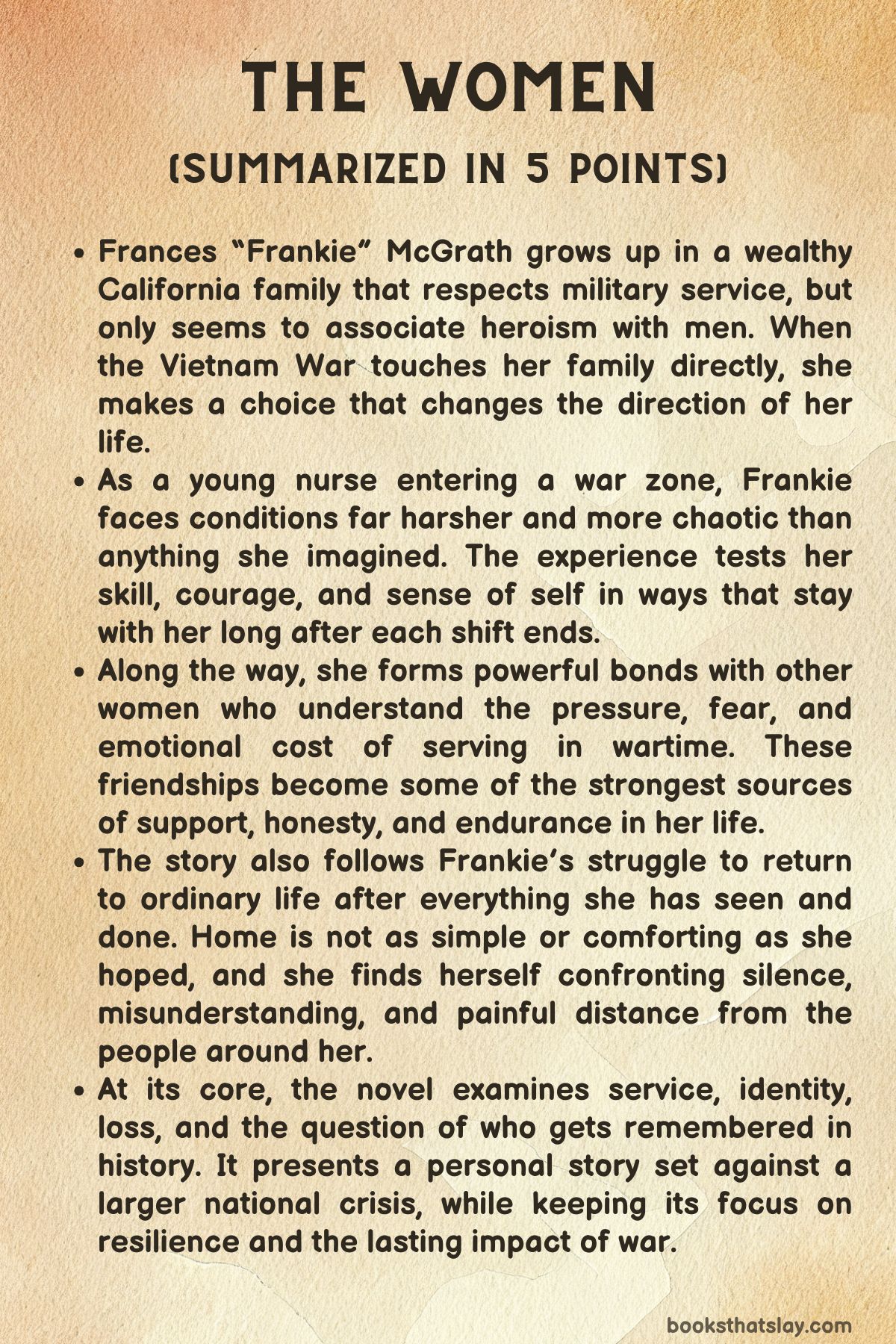
The Women by Kristin Hannah is a historical novel about courage, war, friendship, and the long shadow of trauma. Set during and after the Vietnam War, it follows Frances “Frankie” McGrath, a young woman from a privileged California family who joins the Army Nurse Corps after her brother goes to war.
What begins as a search for purpose becomes an experience that changes her life at every level. The novel looks closely at what women carried during the war and what many faced after returning home to a country that refused to see their service. It is both a war story and a story of survival.
Summary
Frances “Frankie” McGrath grows up in Southern California in a wealthy, conservative family that prizes military honor. Her family displays photographs of men who served in war, a silent record of who is allowed to be called heroic.
Frankie has been raised to follow a more traditional path, but a comment from her brother’s friend, Rye Walsh, stays with her: women can be heroes too. That idea takes root just as her brother Finley leaves for Vietnam.
Frankie trains as a nurse and begins to understand that service can offer a real sense of purpose. When she treats wounded soldiers at home, she sees the physical and emotional cost of war up close.
After Finley is killed in Vietnam, her decision hardens. Though her parents are horrified by her choice, especially because she is a woman, she joins the Army Nurse Corps and heads to Vietnam.
Nothing prepares her for what she finds there. The heat, fear, noise, exhaustion, and endless stream of wounded men hit her all at once.
At first she feels terrified and out of place, but other nurses, especially Ethel and Barb, help her adjust. They teach her the unofficial rules of survival, from what to wear to how to keep going after impossible shifts.
In the operating room and the wards, Frankie learns fast. She holds dying soldiers’ hands, assists in emergency surgeries, and discovers that war strips life down to urgency and endurance.
Vietnam changes her quickly. She becomes more skilled, more decisive, and more emotionally marked.
She sees soldiers with catastrophic injuries, civilians caught in bombings, children suffering from disease and neglect, and staff pushed beyond their limits. She visits villages and orphanages on medical missions and witnesses suffering far from the headlines.
The work is relentless, and yet it also gives her a fierce sense of meaning. For the first time in her life, she feels necessary.
Her closest anchors are Ethel and Barb, who become her chosen family. With them, she finds humor, blunt honesty, and loyalty.
She also forms complicated bonds with men around her. Jamie Callahan, a surgeon, is drawn to her, but his marriage and the conditions of war make any future impossible.
When he is gravely injured, Frankie is shaken by how quickly love and hope can be destroyed in Vietnam.
Later, Frankie reconnects with Rye Walsh, the man tied to memories of her brother and to her earliest idea that a woman might claim honor for herself. Their connection deepens in the middle of the war.
They steal brief moments together in a place built on uncertainty and death. Frankie falls in love with him and believes that once the war ends, they might build a future together.
Their relationship gives her emotional refuge, even as the war worsens around them.
During the Tet Offensive and its aftermath, Frankie sees chaos on an even larger scale. Casualties overwhelm the hospital, official reports fail to reflect the truth, and she grows angry at the gap between reality and public narrative.
Instead of leaving when her tour ends, she chooses to stay longer. Vietnam has become the place where she feels most fully herself, even though it is also breaking her.
When Frankie finally returns home, she expects relief, reunion, and recognition. Instead, she meets indifference, hostility, and erasure.
Anti-war protesters spit on her. Her parents have told people she was studying in Florence, as if her service must be hidden to preserve the family image.
Her father, who proudly honors male soldiers, cannot accept what she did. Frankie is left stranded between worlds: too damaged to slide back into her old life, and denied acknowledgment as a veteran.
The losses continue. She learns that Rye has supposedly been killed, and the grief nearly destroys her.
Her mental health worsens. She suffers nightmares, flashbacks, panic, rage, and numbness, though few around her understand what is happening.
Even doctors dismiss her distress, insisting that because she was a nurse and not a soldier in combat, she could not be truly traumatized. This refusal to recognize women’s experiences becomes one of the deepest wounds of her postwar life.
Ethel and Barb once again help save her. They pull her out of collapse and give her a place to land.
Frankie tries to rebuild through work, taking a hospital job, but civilian nursing feels narrow and dismissive compared with what she has done. She is treated as inexperienced because her Vietnam service does not count in the eyes of others.
Her frustration and instability rise, and she makes reckless choices that cost her the job.
She moves in with Ethel and Barb and begins to live among women who understand parts of what she cannot explain to anyone else. As the war continues and the country fractures over it, Frankie joins veterans’ activism.
Marching in Washington, she discovers that even other veterans try to exclude women, claiming there were no women in Vietnam. That denial confirms the pattern she has been facing since she came home: she served, suffered, and sacrificed, yet still must argue that she was there at all.
Back in California, Frankie returns when her mother suffers a stroke. Caring for her mother softens some of the distance within the family, and her father begins, slowly, to reckon with his failures.
Frankie also becomes involved in efforts to support prisoners of war and those listed as missing. During this period, she meets Henry Acevedo, a psychiatrist and widower who is patient, kind, and emotionally steady.
Their relationship offers the possibility of a gentler life. For a time, Frankie allows herself to imagine marriage, motherhood, and peace.
That hope is shattered when Rye turns out to be alive after all, one of the men previously reported dead but actually held as a prisoner of war. Frankie rushes to see him, only to discover he is married and has a child.
The truth is worse than loss: he lied to her. Even so, her feelings for him remain powerful, and the shock destabilizes the fragile life she has begun to build.
She becomes pregnant by Henry, accepts his marriage proposal, then loses the baby. At the same time, she cannot let go of Rye.
Eventually she breaks off her engagement to Henry, unable to enter a marriage while emotionally trapped in the past.
Frankie’s downward spiral accelerates. She misuses Valium, buries herself in work, and begins an affair with Rye after he reappears in her life with promises that prove false yet again.
When she learns he has continued deceiving her, the accumulated betrayal, grief, and trauma push her into full collapse. She drinks, drives recklessly, is arrested, and nearly kills herself.
At last, the pain she has been carrying can no longer be hidden or minimized.
Henry, now in a position to help her clinically rather than romantically, oversees her treatment. Frankie is diagnosed with PTSD, still a new and contested idea at the time.
In recovery, she begins the long process of naming what happened to her. Therapy, journaling, honesty, and the support of Barb help her understand that her suffering is not weakness.
It is the result of war, compounded by a society that refused to see women like her. She also recognizes how shame and silence kept her trapped.
As she heals, Frankie lets go of the myths that ruled her life: the myth of heroic masculinity as the only valid form of service, the myth that love can rescue her, and the myth that survival means returning to who she once was. She loses her nursing license for a time, but she begins to imagine a different future, one she chooses for herself.
Eventually she leaves California and creates a new life in Montana. There she buys a ranch, studies psychology, and builds a refuge for women veterans.
The place becomes both home and mission. Women who served can live there, work there, and receive support without having to prove they belong.
Together they create their own heroes’ wall, filling it with photographs of themselves. It is a direct answer to the exclusion that shaped Frankie’s early life.
Years later, Frankie attends a reunion connected to the Vietnam Veterans Memorial. She goes with Ethel and Barb, whose friendship has endured through every stage of her life.
At the memorial, Frankie finds her brother’s name and faces the grief she has carried for years. Her parents also come, finally ready to honor both of their children.
Her father apologizes and at last acknowledges her service. In another surprise, Frankie discovers that Jamie survived after all.
The reunion is not a fantasy of perfect closure, but it offers something more believable: recognition, memory, and the knowledge that survival itself can be a form of victory.
In the end, The Women is about the cost of war and the harder work of being seen after it. Frankie begins as a young woman searching for purpose in a world that has already defined her limits.
She becomes a nurse in war, a veteran denied her own history, a woman nearly destroyed by grief and trauma, and finally someone who makes space for others to be known. Her life is marked by loss, but also by endurance, friendship, and the insistence that women were there, and that their stories matter.
Characters
Frances “Frankie” McGrath
Frankie is the emotional and moral center of the novel, and her character arc carries the full weight of the story. She begins as a sheltered young woman shaped by privilege, expectation, and a family culture that honors male service while limiting female ambition.
At the start, she is still trying to understand who she is apart from the life planned for her. Her decision to join the Army Nurse Corps grows out of grief, idealism, and a deep need to matter.
She wants to live bravely, but she also wants her life to carry the kind of meaning her family has always attached to war and sacrifice. That desire makes her vulnerable, because she enters Vietnam with a romantic idea of duty that reality quickly strips away.
In Vietnam, Frankie changes with startling speed. She becomes capable under pressure, skilled in trauma care, and far more self-reliant than anyone at home ever imagined.
She is not naturally hardened; what makes her compelling is that she never fully loses her sensitivity. She keeps feeling everything, even when feeling becomes dangerous.
She can steady herself enough to work through horror, but she is deeply marked by every death, every ruined body, every child she cannot save, and every false narrative that hides the truth of the war. Her growth is not a simple movement from innocence to strength.
It is more painful than that. She becomes stronger because she is forced to function inside devastation, and yet that strength comes with psychic damage no one around her knows how to name.
What makes Frankie such a layered character is the conflict between competence and invisibility. She proves herself again and again in situations that demand courage, skill, and leadership, but when she comes home, the world refuses to recognize what she has done.
That erasure becomes one of the defining forces of her postwar identity. She is not only traumatized by what she witnessed; she is wounded by being told that her service does not count.
Her breakdown after returning home is not presented as personal weakness. It grows from accumulated grief, buried fear, shattered love, institutional dismissal, and a society unwilling to grant women the status of veterans.
Her dependence on medication, her reckless choices, and her psychological collapse all emerge from a life in which truth has been denied too long.
Frankie’s later transformation is what gives the novel its lasting force. Recovery does not restore her to the person she was before Vietnam.
Instead, it allows her to build a new identity rooted in honesty. She eventually learns that she does not need male approval, romantic rescue, or family permission to define her worth.
Her creation of a sanctuary for women veterans is the clearest expression of who she becomes: someone who turns pain into purpose and isolation into community. In that sense, she is not only the protagonist of The Women but also its strongest argument.
Through her, the novel insists that female service, female trauma, and female endurance deserve public memory.
Ethel Flint
Ethel is one of the strongest stabilizing presences in Frankie’s life. From the moment Frankie arrives in Vietnam, overwhelmed and uncertain, Ethel helps initiate her into the unwritten reality of war.
She is practical, sharp, experienced, and unsentimental in the best way. She does not offer comfort through softness alone; she helps by teaching survival.
There is authority in her voice and steadiness in her actions, and Frankie’s early development depends heavily on that example. Ethel understands that war does not reward innocence, so she guides Frankie toward adaptation without asking her to stop being human.
Beneath Ethel’s confidence is her own history of loss. The death of her boyfriend reveals that she is not simply tougher than everyone else; she has already paid a personal price and learned how to keep going.
That private grief gives her compassion, even when she appears brisk or blunt. She is a woman who has made room inside herself for both sorrow and function.
That duality makes her believable and important. She represents a form of female resilience that is not romanticized.
She is strong because she has had to become strong.
After the war, Ethel continues to play a crucial role in Frankie’s life, but her importance broadens. She is no longer just a guide through combat medicine; she becomes part of Frankie’s emotional rescue.
When Frankie is drowning in grief, addiction, and despair, Ethel helps pull her back toward life. She offers not only friendship but also an alternate model of living.
Her farm in Virginia becomes a place of refuge, and her later marriage suggests that survival does not mean emotional closure so much as the ability to keep building. Ethel embodies loyalty, competence, and hard-earned wisdom.
She is one of the clearest examples of how women in the novel save one another when institutions fail them.
Barbara “Barb” Johnson
Barb brings a different energy from Ethel, and together the two women create a balance that Frankie desperately needs. Barb is lively, outspoken, socially bold, and often more emotionally expressive than Ethel.
In Vietnam, she offers friendship through humor, irreverence, and directness. She helps Frankie navigate the emotional confusion of the war and the men around them, and she often says aloud what others hesitate to admit.
Her presence makes room for pleasure, gossip, anger, and release in a world otherwise dominated by blood and fear. She helps keep despair from swallowing everything.
At the same time, Barb is far more vulnerable than she first appears. Her letters after returning home reveal confusion, alienation, and a lack of direction.
Like Frankie, she discovers that civilian life has no language for what she has lived through. Her brother’s death deepens that pain and widens her anger at the country around her.
Barb’s activism grows out of that rage. She becomes the character who most openly rejects silence and pushes toward public confrontation.
Her involvement in anti-war protest and veterans’ activism shows how trauma can become political consciousness. She does not only want to survive; she wants the truth spoken in public.
Barb is also important because she exposes the false idea that only Frankie is struggling. Later in the story, when she admits that she too has nightmares, the moment widens the emotional frame of the novel.
Barb’s lively exterior never meant she was untouched. It meant she had her own way of enduring.
This makes her one of the richest supporting characters. She is funny, reckless, loyal, wounded, and brave.
More than once, she acts as Frankie’s lifeline, but she is never reduced to a helper role. She carries her own burden, and that gives her full emotional presence.
Rye Walsh
Rye begins as an idea before he fully becomes a person in Frankie’s life. In the opening, he is the one who asks why only men appear on the heroes’ wall, and that question alters Frankie’s sense of possibility.
He is linked from the beginning to awakening, permission, and desire. Later, in Vietnam and Hawaii, he becomes the embodiment of the future Frankie hopes might still be possible.
He is tied to her brother’s memory, to romance, and to the fantasy that someone truly sees who she is. Because of this, Rye is powerful in Frankie’s inner life long before he is fully tested by action.
As a romantic figure, Rye is charismatic, attentive, and emotionally resonant at key moments. He knows Frankie’s past, understands the war from within, and appears to love the parts of her that others overlook.
Their connection feels meaningful because it grows in the middle of danger and grief. Yet this same intensity also makes him dangerous to her.
He becomes less a stable partner than a screen onto which Frankie projects longing, safety, and continuity. The life she imagines with him is not only about love.
It is about making her suffering mean something and believing that someone from that lost world can accompany her into the future.
Rye’s deepest weakness is dishonesty. His lies do not simply complicate the romance; they expose a profound moral failure.
He allows Frankie to believe in a future built on trust while withholding basic truths about his life. Even after surviving and returning home, he continues to deceive her.
This matters because it transforms him from tragic love into part of her damage. He becomes another way in which she is denied clarity, respect, and emotional safety.
The pain he causes is especially sharp because Frankie’s attachment to him is so sincere.
As a character, Rye works less as a full moral center and more as a revealing force. Through him, the novel shows how vulnerable trauma can make a person to illusion.
Frankie keeps returning to him not because he is worthy of endless faith, but because he is tied to youth, war, first love, and all the unfinished grief she cannot resolve. He is memorable because he is both genuine in some moments and deeply selfish in others.
That contradiction is what makes him convincing.
Jamie Callahan
Jamie represents one of Frankie’s earliest adult emotional entanglements in Vietnam. He is flirtatious, warm, confident, and immediately appealing in a chaotic environment where attraction becomes intensified by danger.
As a surgeon, he is also part of the high-pressure world that Frankie is learning to survive. His confidence and professional authority make him seem like someone who can help define her new life.
He recognizes her talent early, encourages her growth, and helps pull her into the operating room, where she becomes more fully herself as a nurse.
At the same time, Jamie is morally compromised from the start because he is married. That fact prevents him from becoming a clean romantic possibility.
He may care for Frankie, but his emotional honesty is partial and imperfect. This gives his character a sadness that feels true to wartime relationships.
People reach for connection in the middle of fear, but the relationships formed under those conditions are often unstable, ethically messy, and shaped by need as much as love. Jamie is not presented as cruel, but he is not dependable either.
He is one more sign that in war, emotional boundaries are often broken by circumstance.
His injury is a major turning point because it forces Frankie to confront how quickly even strong, vivid people can be reduced to bodies in transit. Jamie shifts from surgeon to patient, from active force to fragile life.
For Frankie, this collapse of roles is devastating. It teaches her again that no one is safe and no connection is guaranteed time to ripen.
His later survival adds emotional complexity rather than simple relief. He becomes one of the living reminders of what war stole and what it failed to completely destroy.
Henry Acevedo
Henry enters the story at a time when Frankie’s life is unstable and fragmented, and he offers a very different kind of masculinity from the men who came before. He is thoughtful, observant, patient, and grounded in emotional reality.
As a psychiatrist, he sees signs in Frankie that others ignore or dismiss. Even before he fully reenters her life, he recognizes that she is carrying trauma.
This ability to perceive what is hidden makes him especially important in a novel built around denial and erasure.
As a romantic partner, Henry represents steadiness and decency. He is grieving his own loss, which makes him serious without being cold.
His relationship with Frankie is built less on wartime intensity and more on mutual loneliness, adult tenderness, and the possibility of repair. He is willing to love her without trying to dominate her.
He is also one of the few people who does not reduce her to a problem or a role. He sees her pain but does not turn away from it.
For a period, he stands for the life Frankie might have had if her past were not still pulling at her so violently.
What makes Henry especially moving is that he remains compassionate even after Frankie cannot go through with marrying him. He is hurt, but he does not become vindictive.
Later, when he helps oversee her treatment, his importance shifts from personal hope to clinical and moral recognition. He helps Frankie understand that PTSD is real and that her suffering has a name.
In doing so, he gives her something more valuable than romance: legitimacy. He is one of the novel’s most humane characters, and his role underscores how life-saving it can be to be believed.
Finley McGrath
Finley’s physical presence in the narrative is brief, but his symbolic importance is enormous. He is the golden son of the family, the visible heir to the McGrath tradition of military honor.
His place in the family is secure in a way Frankie’s never is. He is celebrated, toasted, and displayed as part of the masculine lineage that the household reveres.
His departure for Vietnam is one of the forces that pushes Frankie toward military service, and his death seals that path.
Finley functions partly as memory and partly as standard. Frankie measures herself against the family’s treatment of him, and the contrast becomes one of the novel’s sharpest critiques.
He is honored without question, while she must fight to have her service acknowledged at all. Yet he is not reduced to a symbol alone.
In Frankie’s memories and in her bond with Rye, Finley remains emotionally alive. He is a beloved brother whose absence keeps shaping the choices of the living.
By the end, his role expands again. He becomes part of the shared grief that Frankie and her parents must finally confront together.
His memory helps open the possibility of reconciliation because he belongs to them all. Through Finley, the novel shows how families enshrine some sacrifices while refusing to see others.
Frankie’s Father
Frankie’s father is one of the clearest embodiments of patriarchal authority in the story. He believes in honor, service, and military tradition, but his beliefs are narrow and deeply gendered.
He can celebrate male courage while refusing even to imagine female heroism. His pride in the family’s martial history does not prepare him to support his daughter when she claims her own place in that tradition.
This contradiction makes him more than a stern parent; he becomes the personification of the social order Frankie is trying to break through.
His failure is not just disapproval. It is erasure.
He allows the family to lie about Frankie’s service and protects his own image rather than her truth. Even after she returns broken by war, he is more concerned with propriety and silence than with what she has endured.
His rejection deepens her isolation and contributes directly to her collapse. In this sense, he is not merely unsympathetic; he is actively damaging.
Yet he is not frozen in one state. As the story progresses, grief, age, and Frankie’s suffering force him into self-reckoning.
His apology late in the novel matters because it is hard-won and overdue. He cannot undo the years of dismissal, but his eventual recognition has emotional power precisely because he has resisted it so long.
He is a flawed, late-learning man whose change does not erase the harm he caused, but it does suggest that even rigid systems of belief can crack under the pressure of truth.
Frankie’s Mother
Frankie’s mother initially appears more passive than her husband, but her role is more complex than simple submission. She moves within the same social code of appearances, class, and feminine expectation, and she often helps preserve the family’s denial.
She hides articles, maintains the lie about Florence, and urges Frankie toward versions of life that look respectable from the outside. In this way, she helps enforce the very system that wounds her daughter.
At the same time, she is not emotionally absent. Unlike Frankie’s father, she often moves toward care, even when that care is limited by fear or convention.
She comforts Frankie after devastating losses, worries over her, and later depends on her during illness. Her stroke becomes a turning point because it changes the family dynamic.
When Frankie cares for her, the relationship shifts from strained distance to a more intimate, if still imperfect, bond. The mother is revealed as a woman who has also lived within restrictions, managed disappointments, and accepted silences as survival.
Her advice is often shaped by her generation’s values, which means she sometimes misunderstands Frankie profoundly. Still, she is one of the story’s more human portraits of a woman trapped inside inherited expectations.
She is caring but limited, loving but complicit, and her relationship with Frankie reflects the painful gap between women shaped by different eras.
Coyote
Coyote serves an important secondary role as a reminder of the social world that persists even inside war. He is charming, flirtatious, energetic, and associated with movement, parties, and temporary escape.
He helps create moments in which the women can feel young rather than only exhausted. His invitations and presence bring a kind of surface brightness to the narrative, offering relief from the operating room and from grief.
At the same time, Coyote’s relative lightness also highlights what Frankie cannot fully return to. She can dance, travel to Saigon, and join in moments of celebration, but she is no longer simply a carefree young woman.
Her lack of interest in him, despite his attention, shows that she is already too emotionally altered for uncomplicated flirtation to be enough. He is not meant to rival the deeper emotional figures in her life.
Instead, he helps define the atmosphere around them and shows how even in war, people keep reaching for pleasure, music, sex, and distraction.
Margie
Margie is not one of the most dominant figures in the story, but she matters because she reflects Frankie’s own growth. When Margie appears as a new and inexperienced nurse during the chaos of a major attack, Frankie is no longer the frightened newcomer.
She has become the person who knows what to do, who takes charge when others freeze, and who can guide less experienced staff through crisis. Margie therefore functions as a mirror.
Through her presence, the reader sees how far Frankie has traveled from uncertainty to command.
Margie also helps underline one of the novel’s recurring truths: war keeps replacing the inexperienced with the experienced and then destroying both. She stands for the ongoing cycle of fear, initiation, and endurance.
Frankie’s goodbye note to her carries emotional weight because it suggests that even in conditions of constant loss, bonds form quickly and matter deeply.
Noah
Noah appears more briefly, but his importance lies in what he represents for Ethel. His marriage to Ethel suggests the possibility of life continuing after devastation.
In a story full of broken promises and emotional injury, even small signs of durable connection matter. Noah is less developed as an independent character than as a sign that not every future is closed.
His presence helps round out Ethel’s life beyond war and grief.
Themes
Women, War, and Erasure
From the moment Frankie chooses military service, the novel places her inside a contradiction that defines much of her life: she is needed by the war, but denied by the culture that surrounds it. This theme is not limited to the battlefield.
It continues after the fighting, in family conversations, public memory, political language, veterans’ spaces, and medical treatment. The story shows that women were present in Vietnam in ways that were essential, dangerous, and emotionally devastating, yet their presence is repeatedly minimized or denied.
Frankie serves in operating rooms, emergency wards, and evacuation units under extreme pressure, but when she returns home, she is treated as though she has no rightful claim to the identity of veteran. That refusal becomes one of the deepest injuries in the novel.
What gives this theme its force is the gap between reality and recognition. Frankie’s work is concrete, skilled, and physically exhausting.
She handles shattered bodies, makes life-and-death decisions, and absorbs scenes of horror that remain with her long after the war ends. Yet the world around her continues to define war experience through a narrow male lens.
Her father’s heroes’ wall becomes a powerful symbol of that exclusion. It is not only a family display.
It reflects an entire system of memory that reserves honor for men while assigning women to silence. Even later, when Frankie tries to join support spaces or speak publicly as someone who served, she is told that women were not really there.
The denial is so persistent that it begins to reshape how she sees herself.
This theme matters because the novel argues that erasure is not passive. It is an active form of harm.
When a person’s service is denied, their trauma is harder to name, their grief is harder to share, and their identity becomes fractured. Frankie does not only suffer from what she witnessed in war.
She suffers from returning to a country that refuses to hold her truth. The novel uses her experience to expose how official memory can be selective and unjust.
In doing so, it widens the meaning of war literature. It insists that women’s labor, women’s courage, and women’s suffering belong fully within the history of conflict, not at its edges.
That insistence gives the novel its moral clarity.
Trauma, Memory, and the Long Aftermath of War
War does not end for Frankie when she leaves Vietnam. The novel treats trauma not as a brief response to shock, but as a condition that follows her into ordinary life and alters her relationship to time, memory, and selfhood.
Home is supposed to represent safety, yet her return only makes clear how impossible it is to step back into the person she used to be. Nightmares, flashbacks, panic, numbness, grief, and rage begin to shape her days.
The war lives inside her body and mind, appearing without warning in country club conversations, in loud noises, in quiet moments, and in the simple effort of trying to sleep. This theme is handled with unusual seriousness because the story does not reduce trauma to emotional fragility.
It presents trauma as an ongoing struggle between memory and survival.
A major strength of this theme is that it links private suffering to public ignorance. Frankie’s symptoms are not understood by the people around her because they do not fit the accepted image of who gets traumatized by war.
Doctors dismiss her, family members try to silence her, and social circles pressure her to behave as if discipline and normalcy should be enough. This leaves her trapped between experience and language.
She knows something is deeply wrong, but the world has not yet made room for the truth of what she is carrying. That gap drives many of her worst choices.
Her substance misuse, emotional withdrawal, reckless behavior, and breakdown are not random acts. They grow out of unprocessed memory and the loneliness of not being believed.
The theme becomes even more powerful because recovery is not presented as quick or neat. Frankie does not have one moment of insight and become well.
Healing takes naming, treatment, community, honesty, and time. She must first accept that what happened to her has lasting consequences and that those consequences do not make her weak.
The diagnosis of PTSD becomes important not simply as a medical label, but as recognition. It gives shape to suffering that had been dismissed as instability or shame.
The novel is especially effective in showing that memory cannot be erased, only integrated. Frankie does not recover by forgetting Vietnam.
She recovers by learning to live with its truth in a way that no longer destroys her. This gives the novel a mature understanding of war’s aftermath.
The deepest battles are often fought long after the public has moved on.
Friendship as Survival and Repair
The emotional backbone of the novel rests not only on Frankie’s individual endurance, but on the friendships that help keep her alive. Ethel and Barb are far more than companions or secondary figures who add warmth to the narrative.
They form a structure of care that supports Frankie during war, collapse, and recovery. In a story filled with institutional failure, romantic disappointment, and family misunderstanding, female friendship becomes the most reliable form of shelter.
The novel treats these bonds with seriousness and weight, showing that friendship can carry knowledge, discipline, truth, and emotional rescue. This theme is especially important because it shifts the center of the story away from the usual assumption that fulfillment must arrive through romance or family approval.
In Vietnam, friendship begins as practical support. Ethel and Barb help Frankie learn how to move through the day, how to survive the base, how to interpret the emotional currents around her, and how to keep functioning in a place built on fear and exhaustion.
Their closeness is formed under pressure, which gives it unusual intensity. They understand one another without needing long explanations because they share the same environment of risk, labor, and loss.
Yet the value of these relationships becomes even clearer after the war, when Frankie’s world starts to fall apart. They do not retreat when she becomes difficult, unstable, grieving, or self-destructive.
They intervene. They pick her up, confront her reality, give her refuge, and continue to remind her that she is not alone.
What makes this theme so rich is that the friendships are not idealized into perfection. Ethel and Barb each carry their own wounds, and the novel allows them complexity.
Barb’s activism grows from pain and anger. Ethel’s steadiness comes with a history of grief.
Their support for Frankie does not erase their own struggles. That makes the bond among the three women feel earned rather than decorative.
They are not symbols of sisterhood in an abstract sense. They are women who have seen too much and who keep choosing loyalty anyway.
By the end, friendship becomes a foundation for rebuilding identity. Frankie’s later work creating a space for women veterans grows directly from the truth she learned through Ethel and Barb: healing becomes more possible when people do not have to prove their pain before receiving care.
The novel presents friendship as a force that counters shame and isolation. It is one of the few places in the story where memory is shared instead of denied.
That makes it not only comforting, but transformative.
The Struggle to Claim an Identity Beyond Expectation
Frankie’s life is shaped by competing ideas of who she is supposed to be, and much of the novel’s emotional movement comes from her attempt to define herself outside those expectations. At the beginning, she is a daughter of wealth and status, raised within a world that has already mapped out her future.
She is expected to be graceful, marriageable, and socially acceptable. Even the language of honor in her household is structured in a way that excludes her.
Men are celebrated for courage and sacrifice; women are expected to admire, support, and remain in the background. Her decision to join the Army Nurse Corps is therefore not only patriotic or impulsive.
It is an act of self-creation. She is trying to enter a version of adulthood that belongs to her, not one assigned to her.
What makes this theme compelling is that Frankie’s search for identity does not move in a straight line. Service gives her purpose, but war also wounds her.
Love offers hope, but it repeatedly confuses and destabilizes her. Her family gives her a name and a history, but also tries to force her back into a role she can no longer occupy.
Even after she returns, she keeps trying on possible futures: dutiful daughter, civilian nurse, lover, activist, wife, mother. None of these roles fully contain her, and some actively distort her.
The novel shows how difficult it can be for a woman to know herself when every surrounding structure insists on reducing her to a simpler form.
This theme deepens in the sections where Frankie loses control of her life. Her collapse is not only about trauma.
It is also about the breakdown of borrowed identities. She cannot be the obedient daughter her parents want.
She cannot be safely absorbed into romantic promises. She cannot pretend that ordinary domestic life answers what she has lived through.
Her later recovery matters because it is tied to a more honest form of self-definition. She begins to understand that she does not need to be redeemed by marriage, accepted by old social circles, or validated by the same family mythology that once excluded her.
The ending gives this theme its fullest expression. Frankie’s work with women veterans shows a version of identity built from experience, service, skill, and compassion rather than appearance or social approval.
She is no longer trying to fit herself into a role chosen by others. She creates a life that reflects who she actually is.
That movement from inherited expectation to self-made purpose is one of the novel’s most satisfying achievements. It suggests that freedom is not simply rebellion.
It is the difficult process of telling the truth about oneself and then building a life that can hold that truth.