Heartless Hunter Summary, Characters and Themes
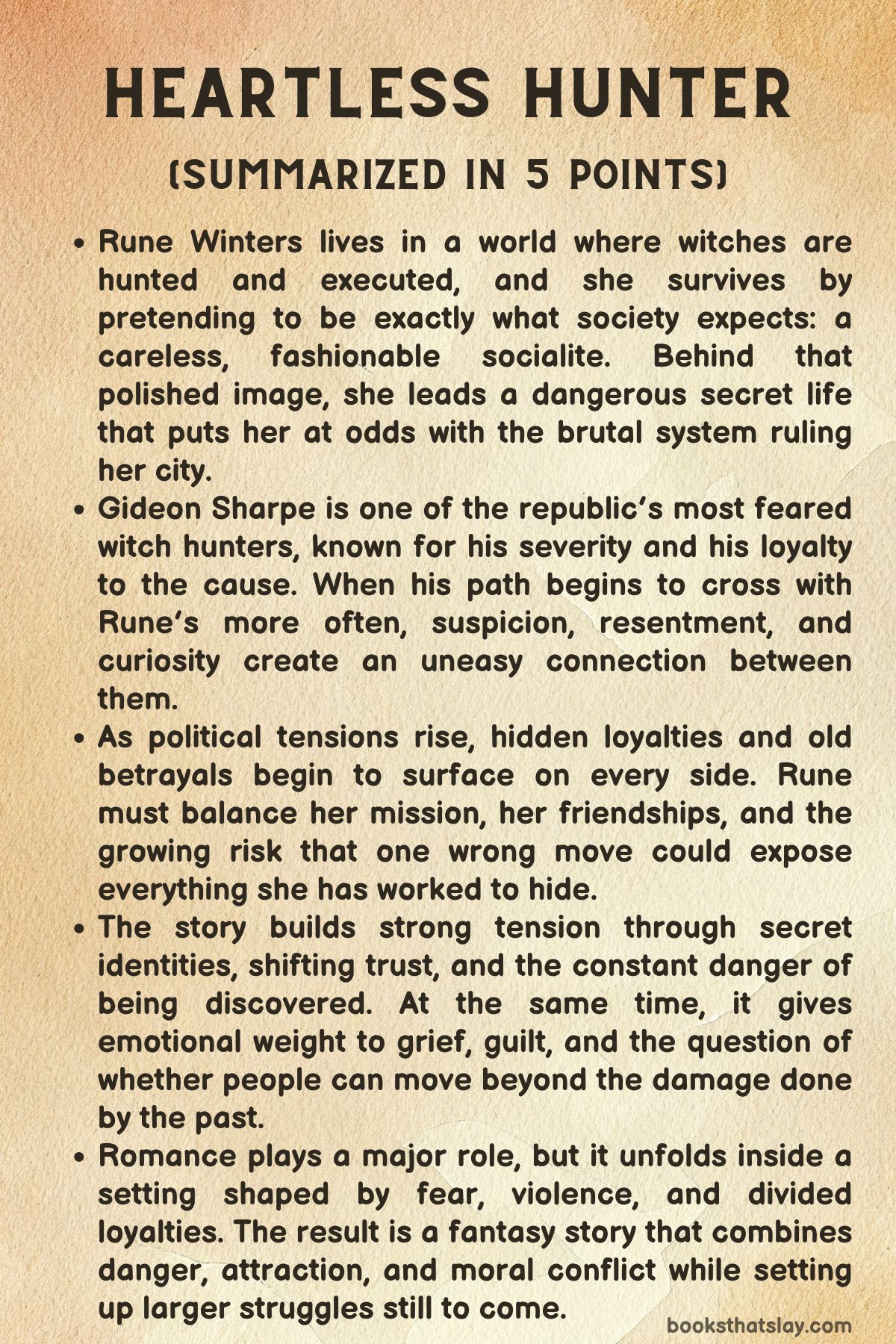
Heartless Hunter by Kristen Ciccarelli is a fantasy romance set in a brutal new order where witches are hunted, exposed, and executed in public. At its center is Rune Winters, a young woman living a double life.
By day, she plays the part of a frivolous heiress loyal to the regime. In secret, she risks everything to save witches from death. Opposite her is Gideon Sharpe, a feared hunter with his own scars from the old world. The novel builds its tension through deception, attraction, grief, and divided loyalties, asking what survives when love and hatred are shaped by violence, power, and fear. It’s the first book in The Crimson Moth series.
Summary
In Heartless Hunter, Rune Winters lives in a republic that rose from the fall of the witch queens. The Blood Guard now rules through fear, hunting witches and executing them in public as a warning to anyone who might protect them.
Rune carries a dangerous secret: she is a witch herself. Years earlier, when the new regime came to power, she betrayed her grandmother in order to survive.
That decision has defined her life ever since. To the public, she is the perfect symbol of loyalty, a wealthy young woman who turned in her own family member.
In private, guilt drives her to become the Crimson Moth, a masked rescuer who frees witches from prison and from the purge.
When Rune goes searching for Seraphine Oakes, an old friend of her grandmother and a powerful witch in hiding, she finds she is already too late. Seraphine has been captured by the Blood Guard.
The timing makes Rune suspect someone may be closing in on her secret life. She returns to the city and begins looking for answers in the only way she can: by performing the role everyone expects of her.
Among the elite, she acts shallow, flirtatious, and unserious, a disguise that helps hide the fact that she spends her nights breaking witches out of custody.
At the center of the hunt for the Crimson Moth is Gideon Sharpe, one of the most feared witch hunters in the republic. Rune despises him at first sight.
He helped bring down the witch queens and has sent countless witches to their deaths. Gideon, in turn, sees Rune as a spoiled socialite whose wealth shields her from the suffering of the city.
But Gideon is not only driven by duty. He has deep personal reasons for hating witches.
Years before, he was drawn into a relationship with Cressida Roseblood, the youngest of the Sister Queens. What began as desire became control, humiliation, and abuse.
Cressida destroyed his family piece by piece, leaving him marked by trauma and convinced that witches corrupt everything they touch.
Gideon receives a lead connecting Rune to a ship used in the escape of two witches, and he begins to suspect that she may be involved with the Crimson Moth. To investigate her, he decides to court her.
Rune quickly realizes his interest is probably strategic, but rather than avoid him, she decides to use him as well. If she can get close enough, she might uncover where Seraphine is being held and how to save her.
Their relationship starts as a contest of lies, testing, and manipulation. Rune tries to place spells on objects and drinks so she can draw information from Gideon.
Gideon studies her for the telltale scars witches bear from casting magic. Each believes the other is dangerous, yet each is pulled in despite better judgment.
Their meetings begin with sharp remarks and suspicion, then shift into something more uncertain. Gideon makes her a dress for an official dinner.
Rune sees flashes of kindness, vulnerability, and wounded pride beneath his cold exterior. Gideon starts to recognize that Rune’s public image is incomplete.
She is sharper, kinder, and far more complicated than he assumed.
As their connection deepens, both are forced to confront painful histories. Rune reveals the shame she carries over turning in her grandmother.
Gideon finally tells Rune the truth about Cressida: how she used forbidden blood magic, threatened his sister, caused his family’s destruction, and branded him to keep him in line. For Rune, this changes everything.
She had clung to the belief that the old queens were victims of a hateful revolution, but Gideon’s story reveals that at least some of that world was built on cruelty and violation. For Gideon, speaking the truth aloud opens a door he has kept sealed for years.
Even while they grow closer, danger closes in. Rune continues planning Seraphine’s rescue with the help of Alex Sharpe, Gideon’s younger brother and Rune’s closest friend, and Verity, Rune’s supposed ally in magic.
Alex has loved Rune quietly for years and has supported her secret work, even as it puts him at odds with his brother. He wants Rune to leave the city behind and build a safer life with him elsewhere, but Rune cannot let go of her mission.
She believes she owes the dead, especially her grandmother, more than escape.
Their plans become more urgent when Seraphine is brought out before a crowd and Rune is ordered to kill her herself as a public show of loyalty. Before Rune can act, chaos erupts.
Fire breaks through the ceremony, Seraphine vanishes, and evidence appears that points to an impossible truth: Cressida Roseblood is alive. That revelation shifts the entire conflict.
What seemed like a struggle between the republic and hidden witches becomes something larger and far more unstable.
As fear rises in the city, so does political pressure. The authorities push for raids, curfews, and harsher crackdowns.
Murders of Blood Guard officers increase. Gideon begins to suspect that the Crimson Moth may not be the greatest threat after all, but he is trapped between his role in the regime and his growing feelings for Rune.
Those feelings intensify when Rune, believing him dead after an explosion during a raid, breaks down in grief. When they reunite, they finally give in to the desire they have been resisting.
Their intimacy feels real to both of them. Rune falls in love with him.
Gideon starts to imagine a future that is not governed by duty and suspicion.
That hope is shattered the next morning. Gideon is forced to speak coldly about Rune in front of others to protect her and himself from suspicion, but Rune overhears only enough to believe he used her completely.
Hurt and humiliated, she runs back to Alex, who finally confesses his love and asks her to leave with him. Rune does not feel for Alex what she feels for Gideon, but she sees in him steadiness, history, and safety.
She agrees to marry him after they complete one final mission: rescuing Seraphine.
Then the truth begins to surface all at once. Rune discovers that Verity is not who she claimed to be.
The dorm room she used was an illusion, and her identity has been fabricated. Before Rune can fully understand what this means, Gideon confronts her with proof that she is the Crimson Moth.
He has seen enough to put the pieces together. Though devastated by her betrayal and by the sight of Alex’s engagement ring on her, Gideon still does what he believes the law demands.
He has Rune arrested. When Alex steps in to defend her and admits his role in helping witches escape, Gideon arrests his own brother as well.
At the public purge, Rune and Seraphine await death. In that final moment, Rune lets go of some of the self-hatred she has carried for years.
She forgives Gideon for what he has done because she understands that his choices were shaped by terror, grief, and the damage Cressida left behind. More importantly, she begins to forgive herself.
Then the square erupts into battle. Cressida appears openly at last, and Rune learns that Verity was Cressida in disguise all along.
She has been manipulating Rune from close range, hiding her identity through forbidden magic and preparing a return to power. Cressida leads a force of witches against the republic, takes the Good Commander hostage, and demands surrender.
Gideon refuses to yield. Cressida shoots at him, but Alex throws himself into the bullet’s path and dies saving his brother.
Alex’s death breaks both Rune and Gideon. In his final moments, Alex tells Rune to use his blood.
With the battle closing in and no other way out, Rune casts a powerful spell from her grandmother’s rare book, using blood magic to tear open the earth itself. A massive earthquake splits the square apart, separating the witches from the Blood Guard.
Across the chasm, Gideon and Rune see each other one last time, now fully divided by love, death, and war.
In the aftermath, Rune leaves the city with Cressida and the surviving witches aboard a ship bound for Caelis. She does not trust Cressida or share her vision of restoring witch rule, but she has nowhere else to go.
Gideon remains behind with grief, fury, and a promise: he will hunt Rune from now on. The novel closes with both of them transformed into enemies who still love each other, heading toward the next stage of a conflict neither can escape.
Characters
Rune Winters
Rune is the emotional and moral center of the story, and nearly every major conflict passes through her divided life. Publicly, she survives by performing the role of a shallow, fashionable heiress who appears loyal to the anti-witch republic.
Privately, she is a witch living under threat of death and the secret rescuer known as the Crimson Moth. What makes her compelling is not simply that she lives a double life, but that both versions of her are shaped by fear, guilt, and calculation.
She learned very early that survival depends on performance, so she weaponizes society’s low opinion of her. People underestimate beauty, wealth, and apparent foolishness, and Rune knows how to use that.
Her social mask is not just protection. It is also a form of control in a world where her body, blood, and future are all under political threat.
The deepest force driving Rune is guilt over turning in her grandmother. That act defines how she sees herself.
Even though she made the choice under pressure and with limited power, she has internalized it as proof of cowardice and betrayal. Her nightly work rescuing witches is not only resistance against the regime.
It is also an attempt to pay a debt she believes can never truly be repaid. This guilt explains why she refuses ease when it is offered.
Alex offers escape, safety, and a future away from danger, yet Rune keeps choosing risk because she does not feel she has earned peace. She is not motivated by abstract heroism alone.
She is driven by shame, grief, and the need to believe she can still become someone worthy of forgiveness.
Her relationship with magic reveals another key part of her character. Unlike many witches, Rune refuses to scar herself in the usual way because she knows visible marks would mean exposure and death.
This makes her spells weaker, more painful, and more dangerous to cast. It also symbolizes the compromise at the center of her life.
She is always working with limited means, always improvising, always paying more for power than others realize. When she finally crosses forbidden lines and uses blood without consent, the choice is morally significant because it shows how desperation can push even a character with strong internal limits into dangerous territory.
Rune is not written as morally pure. She is written as someone trying to remain human while being cornered by impossible systems.
Her romantic arc is equally important because it exposes how much she longs to be seen beyond performance. Gideon challenges her assumptions, angers her, attracts her, and gradually becomes one of the few people before whom she starts dropping pieces of her false persona.
Her love for him matters not because it softens her into a simpler heroine, but because it forces her to confront the possibility that the enemy may also be wounded, complex, and sincere. By the end, Rune changes in a profound way.
She moves from self-punishment toward self-recognition. Her decision to forgive Gideon and finally forgive herself marks a major internal turning point.
Even though she ends the book in exile and under the shadow of Cressida’s power, she is no longer only a girl trying to make up for one terrible choice. She is becoming someone who understands both her own strength and the cost of it.
Gideon Sharpe
Gideon is built as both an antagonist and a tragic romantic lead, and his strength as a character comes from the fact that he is never reducible to either role. He begins as the feared witch hunter, the man Rune associates with brutality, public executions, and the machinery of oppression.
Yet the story steadily reveals that his hatred of witches is not rooted in simple cruelty or ideology. It comes from intimate trauma.
Cressida’s abuse destroyed his family, twisted his sense of love, and left him with a body and mind marked by fear. Gideon does not merely oppose witches as a political class.
He reacts to them as someone who survived coercion, manipulation, and violence. That history makes him both more understandable and more dangerous, because his convictions are fused to old terror.
What is especially effective about Gideon is that he is not presented as secretly gentle from the start. He really is hard, suspicious, and capable of ruthless choices.
He has participated in a violent regime, and he has justified that violence to himself as necessary protection against greater horror. His tragedy lies in the fact that his trauma has been absorbed into the state.
The republic gives him structure, authority, and a moral framework that turns private pain into public purpose. Hunting witches allows him to believe that the chaos of his past can be controlled.
It gives his suffering a target. This is why his growing love for Rune is so destabilizing.
She is not only a woman he desires. She is a challenge to the entire system through which he has explained his life.
His relationship with class also shapes him deeply. Gideon comes from a poorer background than most of the elites he moves among, and he remains acutely aware of the gap between his world and Rune’s.
He is proud, defensive, and often prepared for humiliation before it even happens. This affects the way he reads her words and actions.
He frequently assumes condescension where there is none because he has spent too much of his life being reminded of what he lacks. That insecurity adds texture to his rigidity.
He is not simply a warrior hardened by violence. He is also a man who feels perpetually miscast in the worlds he enters, whether among the aristocracy or inside his own desires.
Gideon’s emotional arc is one of painful unraveling. He begins his courtship of Rune as a strategy, convinced that closeness will expose her secrets.
But the longer he remains near her, the more the certainties he lives by begin to crack. He sees her kindness toward the vulnerable, her grief over her grandmother, and her refusal to behave according to the shallow role he assigned her.
In turn, he becomes more open about his own history. His confession about Cressida is one of the most important moments in his characterization because it shows that beneath his discipline is someone still trying to name what was done to him.
When he imagines a future with Rune, it is not just romantic longing. It is a radical emotional possibility: a life not entirely ruled by fear and duty.
Even so, Gideon ultimately fails the test of trust. His decision to arrest Rune, and even more painfully, to arrest Alex, shows that when love and ideology collide, he still falls back on law, order, and fear.
That choice does not erase his humanity; it exposes the limit of his transformation. He is still a man shaped by systems he helped build.
By the end, after Alex’s death and Rune’s escape, Gideon is left with grief, rage, and the knowledge that his loyalty to the republic has cost him nearly everything. He closes the novel more broken than triumphant, and that makes him one of the most layered figures in Heartless Hunter.
Alex Sharpe
Alex is one of the most quietly tragic characters in the story because he spends so much of it standing at the crossroads between love, loyalty, and compromise. He is Rune’s closest friend, her protector, her co-conspirator, and eventually her suitor.
Unlike Gideon, who is defined by direct conflict and visible intensity, Alex operates through tenderness, patience, and emotional restraint. He has known Rune’s secret for years and has helped her carry it, not for glory or ideology, but because he loves her and cannot bear to betray her.
That steadfastness makes him seem, at first, like the safer and more stable counterpart to Gideon. Yet Alex is not emotionally simple.
Beneath his gentleness is a long history of fear, divided loyalty, and unresolved pain.
Alex’s relationship with Rune is defined by devotion, but also by delay. He waits too long to speak plainly, and that hesitation becomes central to his tragedy.
He wants Rune to choose life over mission, safety over sacrifice, and him over danger, but he struggles to assert those desires clearly until much of the emotional ground has already shifted. His love is real, yet it often expresses itself through support rather than claim.
He helps her escape capture, protects her secret, and offers practical futures rather than dramatic declarations. This makes him admirable, but it also leaves him vulnerable to being overlooked.
By the time he finally proposes, Rune is already emotionally entangled elsewhere, and Alex’s offer reads partly as hope and partly as desperation.
His role between Rune and Gideon gives him added depth. He loves them both in different ways and is repeatedly forced to choose between them.
That position tears at him throughout the story. He will not betray Rune to his brother, but he also cannot wholly betray his brother for Rune.
This tension gives Alex a moral complexity that is easy to miss if he is read only as the kind friend left behind by the central romance. He is carrying the weight of a broken family, the memory of the revolution, and the knowledge that he once chose mercy toward Cressida when his brother wanted destruction.
That choice reveals a lot about him. Alex is less certain than Gideon that killing enemies solves anything, and that instinct toward mercy remains one of his defining traits.
Alex also represents the path Rune might have taken if the story were only about healing and escape. With him lies music, distance, domestic hope, and a life not organized around constant danger.
He is the emotional embodiment of another future. The reason he matters so much is that he is not a weak alternative.
He is a genuine possibility. His house in Caelis, his proposal, and his desire to build something better are not presented as foolish dreams.
They are sincere and moving. But Alex’s future depends on stepping away from unfinished battles, and Rune is not ready to do that.
His death completes his tragic arc and redefines him in retrospect. By stepping in front of the bullet meant for Gideon, he becomes the one character who acts out of love without hesitation in the final crisis.
He dies saving the brother he has been estranged from and protecting the woman he has loved for years. His last message, asking Rune to tell Gideon that he loves him, makes clear that despite the betrayals, silences, and competing loyalties, Alex’s heart was never divided by bitterness.
He leaves the story as a figure of grace and loss, and his death becomes the emotional wound that seals the fracture between Rune and Gideon.
Verity
Verity is one of the most carefully constructed deceptive figures in the novel because she initially occupies a familiar role: the trusted female friend who offers practical help, emotional encouragement, and magical assistance. She is close to Rune, involved in rescue plans, and positioned as someone who understands the pressures Rune cannot share with the wider world.
Her advice often blends social strategy with witchcraft, which makes her feel useful, clever, and observant. She encourages Rune to think tactically about men, appearances, and opportunity, and that voice helps stabilize Rune when the demands of her double life begin to tighten around her.
For much of the story, Verity appears to be one of the few relationships Rune can depend on.
What makes the later reveal effective is that Verity’s earlier behavior already carries subtle signs of performance. She is knowledgeable, elusive, and strangely well-placed.
She has access, nerve, and answers that are often too convenient. Yet because she plays the role of ally so well, these signs register only faintly until the illusion breaks.
When Rune discovers that Verity’s identity, room, and even ordinary presence have been fabricated through magic, the betrayal lands with unusual force. It is not only that Rune has been lied to.
It is that one of the most intimate spaces of female trust in the story was built on manipulation.
As a constructed identity, Verity serves an important thematic purpose. She reflects Rune’s own reliance on masks, but with a much darker moral edge.
Rune performs to survive and protect others. Verity, who is actually Cressida in disguise, performs to infiltrate, control, and prepare the ground for a return to power.
This contrast sharpens the book’s broader interest in deception. Not all hidden identities are alike.
Some conceal vulnerability. Others conceal predation.
The fact that Rune cannot initially tell the difference reveals both her loneliness and her hunger for companionship.
Even before the reveal, Verity’s views on magic hint at a more radical relationship to power than Rune is comfortable with. She is more open to stronger spells, more practical about blood, and more dismissive of certain limits.
In hindsight, this matters because it shows how the character consistently pushes against Rune’s moral boundaries. Verity is not merely advising.
She is testing what Rune can be persuaded to normalize. Once exposed, her earlier friendship becomes part of a larger strategy to draw Rune closer, watch her closely, and perhaps prepare her for use in Cressida’s larger plans.
That makes “Verity” less a separate character than an instrument of invasion, one designed to occupy emotional space before revealing the violence underneath.
Cressida Roseblood
Cressida is the novel’s most frightening presence because she operates at the intersection of charisma, cruelty, and political ambition. Long before she reappears in full, she dominates the story through memory, trauma, and scent.
Gideon’s life has been shaped by what she did to him, and the possibility of her survival destabilizes everyone who believed the revolution had ended one kind of tyranny. She is not just a villain from the past returning for revenge.
She is the embodiment of a system of power that fed on intimacy, blood, and fear. Her menace comes from the fact that she knows how to make violence feel personal.
Through Gideon’s recollections, Cressida emerges as someone who excelled at seduction as domination. She drew him in with beauty, status, and attention, then used those same tools to isolate, threaten, and destroy.
Her abuse was not impulsive. It was deliberate and escalating.
She targeted what he loved, broke his family apart, branded his body, and taught him to associate desire with punishment. This history is essential because it prevents her from functioning as a distant fantasy villain.
She is concrete in the damage she causes. Her evil is made legible through aftermath: a dead sister, dead parents, a traumatized survivor, and a younger brother left to gather the remains.
Politically, Cressida represents the corruption of magical rule. She uses forbidden blood magic without hesitation, kills for power, and treats people as resources rather than lives.
When Rune learns more about her methods, the revelation complicates any simple sympathy for the witches as a persecuted class. The book does not suggest that all witches are like Cressida, but it does make clear that Cressida’s claim to leadership is bound up with domination rather than justice.
She does not want freedom from oppression so much as restoration of control. This distinction matters greatly by the end, when Rune finds herself forced into alliance with her.
Her disguise as Verity adds another layer to her characterization. It proves that Cressida is patient as well as ruthless.
She can wait, observe, flatter, and embed herself inside her enemies’ emotional worlds until the right moment arrives. The reveal also reframes her as a strategist who understands that conquest begins long before open battle.
By living close to Rune, she is able to study her, guide her, and prepare the final public rupture. This makes her far more than a returning queen.
She is an architect of psychological invasion.
Cressida’s final triumph is incomplete, which makes her even more dangerous moving forward. She regains visibility, power, and followers, but she does not fully control Rune.
Rune is repulsed by her methods and does not embrace her vision. That unresolved tension is crucial.
Cressida ends the story as both rescuer and captor, queen and predator. Her gaze on the departing ship captures exactly who she is: someone who never sees people without also measuring how they can be used.
Seraphine Oakes
Seraphine functions as both a person and a living link to the older world of witch history. At first, she appears mainly as an objective of rescue, someone Rune must save because of her connection to Rune’s grandmother and because her capture intensifies the threat closing around Rune.
Yet Seraphine gradually becomes more significant than a plot target. She represents memory, continuity, and the hard judgment of those who survived what Rune did not prevent.
When she first faces Rune publicly, she reacts with hatred, and that response matters. Seraphine refuses to treat Rune’s guilt as automatic redemption.
She stands in for the accusations Rune has been carrying inside herself for years.
Her preserved youth is another meaningful detail. It reminds both Rune and the reader that witches live differently, age differently, and remain tied to powers the republic seeks to stamp out.
Seraphine’s presence therefore unsettles official narratives. She is not just a prisoner.
She is evidence of a hidden continuity the regime cannot fully erase. Her existence suggests that the old order, for better or worse, still survives in living bodies and unfinished loyalties.
Emotionally, Seraphine matters because she becomes the person through whom Rune can finally speak the truth about her grandmother without disguise. On the purge platform, when Rune admits what happened, Seraphine’s shift from condemnation to understanding helps close one of the oldest wounds in the story.
She does not erase the past, but she recognizes Rune’s pain and moral struggle. That recognition is powerful because it comes not from a lover, not from a friend, but from someone tied directly to the woman Rune betrayed.
It carries the weight of witness.
Seraphine also helps expose the complexity of witch identity. She is not presented as innocent in a simplistic way, nor as monstrous like Cressida.
She stands somewhere between those poles, carrying knowledge, anger, and endurance. This makes her an important counterpoint in the book’s moral landscape.
Through her, the story suggests that witches are not a single political category but a broad and divided people, shaped by different histories and choices.
Laila Creed
Laila Creed is one of the clearest representatives of the Blood Guard’s hard logic. She is suspicious, disciplined, and firmly committed to the anti-witch cause.
Unlike Gideon, whose hatred is rooted in deeply personal trauma that the narrative opens up for examination, Laila often appears as the colder face of institutional violence. She is efficient, observant, and quick to suspect weakness or deception.
Her presence keeps pressure on Rune because Laila is one of the few people not easily fooled by social performance. She does not readily accept Rune’s frivolous mask, and that instinct makes her a persistent threat.
What makes Laila useful as a character is that she sharpens the contrast between private feeling and public duty. Gideon’s emotions repeatedly complicate his judgment.
Laila is far less compromised by sentiment. She moves through the story as someone who believes the mission is clear and that hesitation only increases danger.
This makes her formidable, but it also makes her less flexible. She belongs to the machinery of the regime in a purer way than Gideon does, and that rigidity allows the novel to show how oppressive systems are sustained not only by damaged men with tragic histories but also by competent believers who do not question the structure itself.
Her family position adds another layer. As part of the powerful Creed family, she is linked both to military authority and elite influence.
That connection reinforces how thoroughly violence and status work together in the republic. She is not an outsider clawing for legitimacy.
She is embedded in the order she protects. This gives her confidence and social power that make her especially dangerous to someone like Rune, who has to navigate both aristocratic performance and state surveillance at once.
Laila’s role may be secondary compared with Rune, Gideon, Alex, or Cressida, but she matters because she keeps the world’s threat concrete. She is one of the characters who reminds the reader that the regime is not only ideas or symbols.
It is people with weapons, suspicion, and authority, ready to act.
Harrow
Harrow operates as an informant, observer, and pressure point in Gideon’s storyline. She is valuable because she keeps feeding the investigation forward, linking Rune to suspicious events and repeatedly pushing Gideon to be more ruthless in how he tests her.
Harrow functions almost like the voice of relentless suspicion, the person who is least willing to let attraction, uncertainty, or partial evidence soften the hunt. Whenever Gideon begins to hesitate, Harrow appears with another lead, another inference, or another reason to keep distrust alive.
Her importance lies partly in how she exposes Gideon’s internal conflict. Because Harrow remains so focused on proof and threat, she becomes a measuring stick for how far Gideon is drifting from the pure logic of the hunt.
Her recommendations are often invasive and extreme, especially when she urges him to verify Rune’s innocence through physical intimacy. This does not simply make Harrow unpleasant.
It reveals the dehumanizing logic that the witch hunt has normalized. Privacy, dignity, and consent are all treated as secondary to state suspicion.
Harrow also contributes to the atmosphere of uncertainty around identity and infiltration. In a story where disguises, false appearances, and misdirection are central, her constant gathering of clues creates the sense that no secret remains secure for long.
At the same time, she is not infallible. Her certainty sometimes outruns what she actually knows, which fits the world she inhabits.
In systems built on paranoia, suspicion easily turns into method. Harrow embodies that process.
Nicholas Creed, the Good Commander
Nicholas Creed represents the republic as public authority rather than personal wound. He is a political face of post-revolution order, and his significance lies in how he frames oppression as necessity.
He is not written as impulsively sadistic. Instead, he is the kind of leader who justifies increasingly severe measures as unfortunate but required responses to crisis.
This makes him believable and dangerous. He gives ideological cover to surveillance, raids, curfews, and mass punishment, all while presenting himself as a guardian of public safety.
His role also reveals the gap between revolutionary promise and lived reality. The new order claimed to free people from the cruelty of the witches, yet under Nicholas, many forms of inequality and fear remain unchanged or are merely redirected.
Rune and Gideon both confront this in different ways. Rune sees how the regime continues public violence.
Gideon, despite serving it, recognizes that trampling rights may only deepen resentment and instability. Nicholas stands at the center of that contradiction.
He is the respectable language of control.
His capture by Cressida near the end also matters symbolically. He becomes a hostage in the struggle between the state and the returning queen, which shows how fragile his command really is when confronted by raw magical power.
Even so, his influence persists because he helped build the political conditions that made the final explosion possible.
Noah Creed and Other Supporting Figures
Noah Creed is less psychologically developed than the central cast, but he plays an important social role in the story’s architecture. As a possible suitor and a link to the prison system through family connections, he represents the kind of strategic marriage Rune considers as part of her larger mission.
He helps show how little freedom women like Rune truly have, even when they appear privileged. Marriage is not framed as romance alone.
It is access, information, and survival. Noah’s relative lack of force as a romantic figure is part of the point.
He belongs to a world of useful alliances rather than consuming feeling.
Charlotte Gong, Octavia Creed, Lizbeth, and other side characters deepen the social texture of the novel. Charlotte helps illuminate the elite world Rune must move through and manipulate.
Octavia’s household becomes part of the space where secrets are pursued under cover of glamour. Lizbeth, though more minor, is significant in showing that Rune’s secret life depends on small acts of trust and service that often go unnoticed.
These supporting figures may not command the narrative, but they make the setting feel active and interconnected.
The Penitent children, though not individualized in the same way, are also important to the moral structure of the story. Their marked bodies reveal how punishment extends across generations and how the republic turns inherited suspicion into visible stigma.
Rune’s willingness to let them cross her property quietly confirms the compassion that Gideon slowly comes to see in her. Their presence broadens the book’s concern beyond individual romance and revenge, pointing instead to a society built on branded categories of guilt.
Taken together, the characters in Heartless Hunter form a cast shaped by fear, secrecy, class, trauma, and competing ideas of loyalty. The strongest of them are not interesting because they are purely good or purely cruel.
They are interesting because each one has learned to survive power in a different way, and each pays for that survival in love, trust, or blood.
Themes
Performance, Secrecy, and the Making of Identity
Rune survives because she understands that identity in this world is not simply something a person possesses. It is something that can be staged, read, misread, protected, and weaponized.
Her life depends on performing a version of herself that others will dismiss. She appears frivolous, overdressed, flirtatious, and unserious because those qualities make people underestimate her.
The role is effective precisely because it fits what the elite expect from a wealthy young woman. They assume she is ornamental rather than dangerous, decorative rather than strategic.
That misreading becomes her shield. At the same time, the novel makes clear that a performance repeated long enough has consequences.
Rune is not untouched by the part she plays. Her public self becomes both a mask and a habit, which means that even when she wants to be seen clearly, she has to fight past the version of herself the world already believes.
This theme extends far beyond Rune. Gideon also performs a role, though his is harder and more disciplined.
He presents himself as the republic’s perfect weapon, a man of certainty, law, and controlled violence. Yet beneath that exterior is a person shaped by abuse, class insecurity, grief, and emotional confusion.
He performs strength because weakness once made him vulnerable to Cressida’s domination. His identity as a witch hunter is not false, but it is incomplete.
The same is true of Alex, whose gentle patience hides the extent of his divided loyalties, and of Verity, whose entire existence in the narrative depends on deception. By the time the truth about her emerges, the novel has shown that concealment can serve radically different ends.
Some characters hide to survive. Others hide to manipulate, infiltrate, and dominate.
The social order itself depends on performance as well. The republic stages loyalty through dinners, speeches, uniforms, public punishments, and ceremonies of civic virtue.
Power is always theatrical. Executions are not only acts of killing but acts of display.
Public life becomes a constant rehearsal of who belongs, who is suspect, and who deserves fear. In that sense, secrecy and performance are not only private coping strategies.
They are built into the structure of the state. The result is a world where almost nobody is fully legible, and where the question of who someone really is can never be separated from who they must pretend to be.
Heartless Hunter uses that tension to show how identity becomes unstable under regimes built on surveillance and punishment.
Love Under the Pressure of Fear, Violence, and Divided Loyalty
The central relationships in the story are shaped by attraction, but they are tested and defined by fear. Love does not arrive in a safe emotional space.
It develops inside a city organized by executions, political terror, and the memory of abuse. That setting changes what intimacy means.
To trust someone is not merely to risk heartbreak. It may mean exposure, arrest, or death.
This is why the bond between Rune and Gideon carries such force. Their attraction is never separate from danger.
Each is tied to the destruction of the other’s world. Rune is a witch hiding from the republic Gideon serves.
Gideon is a hunter formed by trauma that witches inflicted on his family. Their relationship matters because the novel refuses to treat love as something that rises above history.
Instead, it shows how desire gets tangled with memory, ideology, and survival.
Gideon’s past with Cressida gives this theme unusual weight. He has already experienced a version of intimacy corrupted by coercion and violence.
Because of that history, his growing closeness with Rune is not simply a movement toward romance. It is also a struggle over whether tenderness can exist without punishment.
His instinct is to distrust, to withhold, and to interpret feeling as vulnerability. Rune, meanwhile, has spent years believing she does not deserve happiness because of what happened to her grandmother.
She is drawn to Gideon not only because of physical attraction, but because he sees parts of her she has worked hard to hide. Yet she is also constantly measuring whether closeness to him will destroy everything she is trying to protect.
Love becomes a site of conflict between longing and self-preservation.
Alex complicates this theme by representing a different model of love. He offers patience, history, shared secrets, and a possible future built on care rather than collision.
His feelings are steady where Gideon’s are conflicted. Even so, his love is not uncomplicated.
He is caught between his loyalty to Rune and his loyalty to his brother, and that tension gives his devotion a tragic quality. He wants to save Rune by taking her away from danger, but he cannot make her choose peace when she still feels bound to guilt and unfinished responsibility.
His proposal is moving partly because it offers a believable alternative, not a hollow one. The novel understands that safety can be desirable and still fail to answer the deepest emotional needs of a character.
What emerges is a portrait of love as something neither pure nor redemptive by itself. Feeling deeply does not automatically make people brave, wise, or morally clear.
Gideon still arrests Rune. Rune still keeps devastating secrets.
Alex still waits too long to speak his heart. Yet the story does not reduce love to failure either.
It matters because it exposes the fault lines in each person’s identity. It reveals who they might have been in a less brutal world and what they cannot yet overcome in the world they inhabit.
Love, in this novel, is inseparable from fear because fear has shaped every available language of trust.
Trauma, Memory, and the Long Reach of Abuse
The political conflict of the story is powered not only by ideology but by remembered pain. Trauma is not treated as background information that explains a character once and then recedes.
It actively shapes decisions, relationships, and moral judgments in the present. Gideon is the clearest example.
His hatred of witches is inseparable from what Cressida did to him and his family. Her abuse reached into every part of his life, turning affection into control and intimacy into terror.
The result is that Gideon does not encounter witches as abstractions. He encounters them through memory.
His body remembers before his reason does. Fear, disgust, and suspicion rise from an old wound that has never truly closed.
This makes his violence understandable without making it innocent. The novel is careful on that point.
Trauma explains his rigidity, but it does not absolve the harm he helps perpetuate.
Rune is also governed by memory, though in a different register. Her defining trauma is not abuse at the hands of a lover but the guilt of betrayal and the spectacle of public execution.
She lives with the knowledge that she chose survival at the cost of someone she loved most. That memory shapes her entire moral life.
It drives her toward dangerous acts of rescue, makes her resistant to personal happiness, and fills her with a need to atone through action. She does not simply remember her grandmother.
She organizes her present around the need to answer the accusation she imagines in that memory. This gives the novel one of its most painful emotional currents: the way guilt can become a form of self-punishment disguised as duty.
The larger society is traumatized as well. The fall of the witch queens and the rise of the republic have not healed violence; they have redistributed it.
Public purges, scars, branded bodies, marked children, and whispered histories all show that the past remains visibly inscribed on the present. The Penitent children are especially important here because they reveal how punishment can outlive the original act and settle into social identity.
Trauma becomes hereditary, not in the sense of blood, but in the sense of stigma. A regime that claims to have restored order still relies on the public management of fear.
Cressida’s return sharpens this theme by proving that the past is not past at all. The person who damaged Gideon’s life is not a memory that can be slowly integrated or mourned.
She comes back as an active force, which means every unresolved wound is suddenly reactivated. That return also tests the meanings characters have built around their suffering.
Gideon’s certainty about witches, Rune’s ideas about the old queens, Alex’s mercy, even the republic’s claim to legitimacy all begin to shift under the pressure of old horrors reappearing in the present. The novel suggests that trauma does not remain contained in personal psychology.
It spills outward into institutions, loyalties, and public violence. Memory is therefore not only emotional residue.
It is one of the engines of history.
Power, Blood, and the Corruption of Moral Boundaries
Magic in this story is never presented as a neutral gift. It is tied to blood, and because of that, every act of power raises immediate ethical questions.
Who bleeds, who chooses, who is marked, who is used, and who pays the cost are never incidental details. The system of magic forces the novel to ask what power does to the body and what kinds of moral compromise become thinkable when survival is at stake.
Rune’s relationship to magic is especially revealing because she tries, at first, to remain within strict limits. She avoids scarring herself openly, uses weaker sources of blood, and accepts pain and reduced strength rather than expose herself or exploit others.
These choices make her sympathetic, but they also underline how fragile moral boundaries become under pressure. The more desperate her circumstances, the more those boundaries begin to strain.
What gives this theme depth is the distinction the novel draws between different uses of blood. Magic is not divided into simple categories of good and evil.
Instead, it exists along a spectrum shaped by consent, necessity, and hunger for control. Some forms require willing sacrifice.
Others depend on blood taken without permission and are understood to corrupt the witch who uses them. That framework turns every magical decision into a question of character.
When Rune uses Gideon’s blood without consent in order to escape, the act matters because it shows how quickly survival logic can push someone over a line they once believed firm. The story does not treat this as a trivial exception.
It marks it as a serious crossing, one that reveals the moral danger built into the very structure of magical power.
Cressida stands at the far end of this spectrum. She uses blood as domination, not exchange.
For her, other people’s bodies are reservoirs of force, and killing becomes not a tragic necessity but an available method. That is why she functions as more than a political enemy.
She embodies the endpoint of power detached from consent and restraint. Her methods expose how magic can become indistinguishable from predation when a person begins to see others primarily as fuel.
In contrast, Rune’s horror when faced with such practices shows that she still recognizes a line between using power and becoming ruled by it.
The republic’s violence mirrors this theme in nonmagical form. It too depends on bodies being controlled, marked, displayed, and sacrificed for a larger order.
In that sense, blood is not only the source of witchcraft. It is also the hidden currency of the state.
Public executions, purging platforms, prison systems, and militarized discipline all reveal a political structure that also runs on bodily cost. This parallel is one of the novel’s strongest ideas.
Both magical tyranny and state tyranny rely on the claim that some lives can be cut open for the stability of others. By placing these forms of power side by side, the narrative refuses easy innocence for either side.
It asks instead what kind of authority can exist without feeding on fear, wounds, and human expendability.