House of Flame and Shadow Summary, Characters and Themes
House of Flame and Shadow by Sarah J. Maas is a fantasy novel that blends epic war, political rebellion, ancient magic, and personal loyalty on a very large scale. It follows Bryce Quinlan as she fights to stop the Asteri, powerful rulers who have controlled Midgard through fear, lies, and exploitation for centuries.
The story expands the world of the series by linking forgotten history, hidden bloodlines, and multiple realms. At the center is Bryce’s determination to protect the people she loves and break a system built on cruelty. It is a story about freedom, sacrifice, power, and choosing a better future after long generations of control. It is the third book in the Crescent City series.
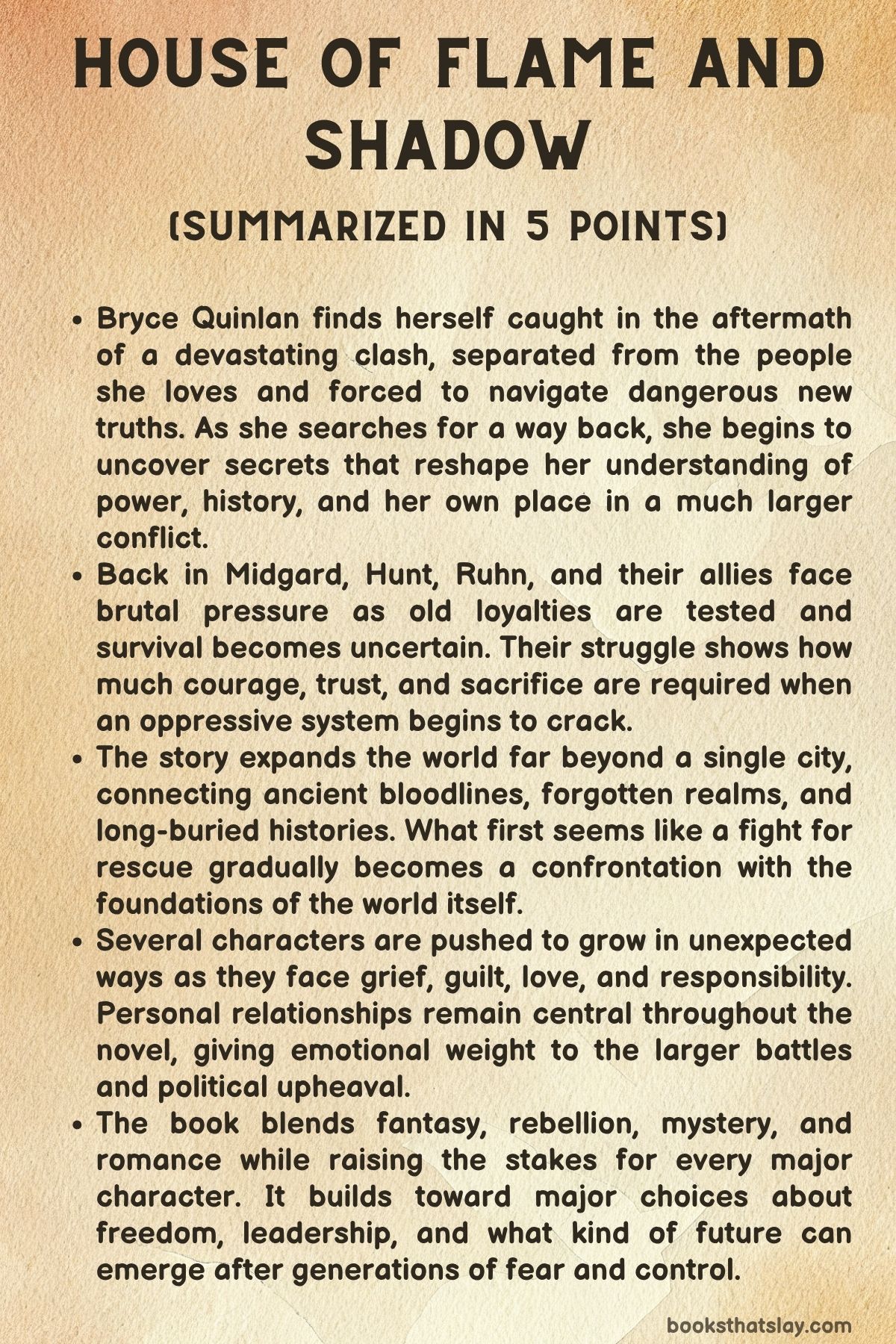
Summary
The novel opens in the aftermath of Bryce Quinlan’s disappearance. Her friends Hunt, Ruhn, and Baxian have been captured by the Asteri, while Bryce has landed in another world entirely: Prythian.
Back in Midgard, chaos spreads. The Asteri tighten their grip, use their mystics to search for Bryce, and prepare devastating weapons for war.
Lidia Cervos continues her dangerous life as a double agent, outwardly serving the Asteri while secretly helping the rebellion. She is forced to take part in the torment of Bryce’s imprisoned allies, all while trying to keep her cover intact.
In Prythian, Bryce is interrogated by powerful Fae, including Rhysand, Azriel, and Nesta. She explains what the Asteri are and how they conquer worlds by feeding on magic and draining civilizations.
Her presence shocks them further because she carries the Starsword, twin to Azriel’s dagger Truth-Teller. Bryce’s strange star-shaped power and the Horn tattooed into her back mark her as part of an ancient legacy connected to their world.
Although her captors distrust her, Nesta and Azriel eventually accompany her into underground ruins after her magic begins guiding her somewhere important.
As they travel through tunnels, ancient carvings reveal a lost history. Bryce learns that the Asteri were once known in Prythian as the Daglan, cruel rulers defeated long ago.
A hidden chamber shows her a recorded message from Silene, daughter of Theia, an ancient queen whose choices shaped both Prythian and Midgard. Through this revelation, Bryce discovers that the Asteri manipulated history across worlds.
Theia and her general Pelias betrayed allies, crossed realms, and brought powerful objects with them, including the Horn. Bryce also learns that the ritual known as the Drop is part of the Asteri’s system of control: a way to harvest power from the people of Midgard while keeping them dependent and weakened.
The deeper Bryce goes into this buried history, the more she understands that her own power is inherited from Theia’s bloodline. Silene had hidden part of Theia’s power in Prythian, intending it to be found one day by the right heir.
Bryce absorbs that stored power, becoming stronger and more dangerous. In the process, she also encounters an imprisoned Asteri named Vesperus.
With help from Nesta and Azriel, Bryce kills her, proving that the Asteri can be destroyed under the right conditions. Realizing that staying in Prythian could expose that world to invasion, Bryce returns to Midgard, taking the weapons she needs with her.
When Bryce arrives home, she lands in the study of her father, the Autumn King. He immediately traps her and questions her, but Bryce quickly realizes he has spent years researching the fading strength of the Fae and the true origins of their people.
Though selfish and cold, he has uncovered useful truths. Bryce learns that the Fae of Midgard have been weakened over generations because the Asteri have been feeding on their power.
She also learns more about the twin blades and their ability, when united, to open catastrophic portals. Bryce tricks her father, steals his research, and escapes to reunite with Hunt and the others.
Meanwhile, Lidia sets a rescue plan into motion. She kills one of the Asteri’s loyal enforcers, frees Hunt, Ruhn, and Baxian from prison, and helps them flee toward the Depth Charger, a ship that can evade enemy pursuit.
The escape is violent and desperate, and Lidia nearly dies buying them time. After she is saved and revived aboard the ship, more of her hidden life comes to light, including the existence of her twin sons.
Her relationship with Ruhn, strained by betrayal and secrecy, slowly begins to rebuild as he sees the cost of everything she has endured.
Bryce and her allies head to Avallen, believing that its ancient archives and sacred caves may hold the final answers they need. Avallen is ruled by King Morven, whose cruelty and arrogance mirror the old failures of Fae power.
Bryce bargains her way inside, while tensions rise around forced marriages, old customs, and the refusal of the Fae elite to change. In the archives and caves, Bryce and her companions uncover more evidence of the past, including the final hidden portion of Theia’s magic.
At the same time, Bryce and Hunt make contact with the Princes of Hel, who reveal that Hunt was not merely born powerful but was deliberately created as a weapon against the Asteri. His lightning is actually a force tied to Hel, and when joined with Bryce’s starlight, it becomes the key to using the twin blades at full strength.
The confrontation in Avallen turns deadly when Morven, the Autumn King, and the Murder Twins try to seize control. Bryce and her allies fight back.
Ruhn kills the Autumn King, ending the legacy of one of the most poisonous men in their family. Bryce kills Morven and claims leadership, but she refuses to rebuild the same rotten system.
She also unlocks the final third of Theia’s power, fully becoming the heir to an ancient force that has been scattered across worlds and ages.
At the same time, other battles unfold elsewhere. Ithan, working with Jesiba and Hypaxia, tries to undo the damage caused by Sigrid’s death and resurrection.
He learns more about the dead, secondlight, and the Under-King’s role in another cycle of exploitation. Hypaxia begins developing an antidote to the parasite-infected water of Midgard, using Hunt’s power as a stabilizing force.
When Ithan takes that antidote, his own suppressed strength expands dramatically, helping him challenge Sabine and claim his place as leader of the wolves. His story becomes one of stepping out of doubt and into responsibility.
As the Asteri launch open attacks on civilians and resistance bases, Bryce moves toward a final plan. She gathers allies from every corner: rebels, wolves, angels, mer, fire sprites, and the armies of Hel.
She reveals the truth about the Asteri to the public through recordings, hoping to ignite mass resistance. She also travels to the Northern Rift, where she again reaches Prythian briefly and asks Nesta for the Mask, a terrible object with the power to command the dead.
Bryce sends her parents to safety there before returning to the war.
The last act centers on a full-scale assault against the Asteri. Bryce uses the Mask to raise the Fallen and place their spirits into abandoned mech-suits, turning the enemy’s technology against them.
Hunt finally breaks free of the halo that has suppressed and controlled him. Ruhn and Lidia fight to save her sons from Pollux, and Lidia at last destroys him, reclaiming her strength in front of the children who finally recognize her as their mother.
Ithan receives from the dead a bullet filled with secondlight, designed to destroy the Asteri’s firstlight core, the source from which they draw immense power.
Bryce and Hunt fight their way to Rigelus and the core beneath the palace. There Bryce learns one last cruel truth: the core is also tied to Midgard itself, meaning its destruction could doom the world.
Even so, she chooses to act. She fires the charged bullet into the core, then uses her power to open a void that begins swallowing the Asteri.
Rigelus clings to her, and Bryce is pulled toward death with him. Hunt follows, empowered by the Mask and by the strange joining of his soul with Bryce’s.
With help from allies living and dead, Rigelus is finally destroyed.
Bryce dies in the process, but Jesiba sacrifices her own immortality to bring her back. In the aftermath, the old order collapses.
Hunt refuses political power. Bryce returns what she borrowed to Prythian, leaves the Starsword behind, and permanently closes the Northern Rift.
Then she does something even more radical than winning the war: she ends the monarchy, breaks the power of the old houses, and begins building a democratic future. She turns inherited wealth toward public good, opens a new gallery, and helps create a world where power no longer belongs only to bloodlines.
By the end, the fight is no longer just about defeating the Asteri. It is about giving Midgard the chance to become something better than it has ever been.
Characters
Bryce Quinlan
Bryce is the emotional and political center of the novel. At the start, she is no longer simply reacting to loss, betrayal, or catastrophe.
She has become someone who actively reshapes the world around her. What makes her compelling is that she does not fit the traditional mold of a royal savior or idealized warrior.
She is impatient, sharp-tongued, emotionally intense, and often willing to make dangerous choices without waiting for approval. That stubbornness can make her difficult, but it is also the reason she succeeds where more cautious people fail.
Bryce sees clearly that the old systems of power are rotten at the root, and she refuses to preserve them just because they are ancient or respectable.
Her growth in this story lies in the way she begins to understand the full scale of her inheritance. She is tied to old bloodlines, old weapons, and old prophecies, yet she never lets those things define her completely.
She does not want to become another version of the rulers who came before her. Even when she claims authority, she does so as a means to break inherited hierarchies rather than continue them.
That is one of the most important dimensions of her character: she is powerful, but she is deeply suspicious of power itself. She keeps asking what freedom should look like after victory, and that question makes her more than a chosen one figure.
Bryce is also written as someone whose compassion is selective in a very human way. She can be tender toward friends, family, and the vulnerable, but ruthless toward people she believes deserve no mercy.
The novel does not smooth out that contradiction. Instead, it presents her as someone whose love and fury spring from the same source.
She wants a world where ordinary people are not crushed by rulers, and she is willing to become terrifying in order to build that future. Her final decisions show that her deepest instinct is not conquest, but release: release from monarchy, inherited privilege, and the cycles of obedience that have shaped Midgard for generations.
Hunt Athalar
Hunt’s character arc is rooted in the question of what remains of a person after repeated enslavement. He begins the novel physically broken, captured again, and treated as a weapon rather than a man.
That situation brings his deepest fear back to the surface: the fear that no matter how much he loves, fights, or hopes, he will always be reduced to what others can use him for. His pain in this story is not only physical.
It is existential. He has spent so long being defined by violence that peace feels almost unreal to him.
What makes Hunt memorable is the contrast between his brutal reputation and his actual emotional core. He is capable of immense destruction, but what he wants most is a private, ordinary life with Bryce.
That desire does not make him weak. It makes him one of the most emotionally grounded characters in the novel.
He is not hungry for command, glory, or legacy. He wants safety, mutual loyalty, and the right to choose his own future.
That longing gives the character real weight, because it stands against the grand myths and destinies surrounding him.
His revelation that he was deliberately created as a weapon adds another layer to his struggle. He has always feared that the violence inside him might be his true nature, and now he learns that violence was designed into him.
The important thing, however, is that he refuses to let origin become destiny. Hunt’s most meaningful act is not simply fighting harder.
It is choosing what kind of man he will be despite what he was made for. By the end, he rejects the chance to become a ruler or military symbol.
That refusal completes his arc. He is no longer the Asteri’s killer, the rebellion’s tool, or anyone’s crafted instrument.
He becomes a person with agency, and that is his victory.
Ruhn Danaan
Ruhn begins in a state of humiliation, imprisonment, and emotional devastation, but his character is defined by endurance. He carries the burden of being royal, magical, and publicly important while also being one of the loneliest figures in the story.
His relationship with Bryce, his painful history with his father, and his growing bond with Lidia all place him in situations where loyalty is costly. He is deeply feeling, but he has learned to cover that with wit, composure, and anger.
One of Ruhn’s strongest qualities is that he is gentler than the world expects him to be. Though he is dangerous and powerful, his instincts are not cruel.
He is protective, deeply relational, and drawn toward emotional honesty even when it frightens him. His anger at Lidia after her betrayal is believable because it comes from real hurt, not pride alone.
He had trusted her in a way that made him vulnerable, and when that trust was shattered, the wound ran deep. The novel handles this well by not rushing him into forgiveness.
His eventual softening feels earned because he sees the depth of her sacrifices rather than being persuaded by words alone.
Ruhn’s biggest moment is not simply killing his father. It is what that act symbolizes.
He is ending a legacy of domination, coldness, and inherited entitlement that poisoned his family for years. He becomes, in effect, the opposite of the man who raised him.
He chooses solidarity over hierarchy, emotional truth over distance, and love over status. His story is partly about reclaiming himself from lineage.
Even though he is tied to ancient blood and prophecy, he is most powerful when he acts from chosen loyalty rather than birthright.
Lidia Cervos
Lidia is one of the most layered characters in the novel because nearly every part of her identity has been split in two. She is at once feared executioner and secret rebel, abused subordinate and strategic operator, distant symbol and vulnerable mother.
Her life has required performance at an almost unbearable level. She survives by letting the world believe in the mask of the Hind, all while maintaining a private moral life that few people understand.
That division gives her character a quiet tragedy.
Her strength is not loud heroism but sustained psychological endurance. Lidia cannot act openly for most of the novel.
She must manipulate, deceive, and absorb horror while waiting for the right moment to move. That makes her courage different from Bryce’s.
Bryce often acts in bursts of decisive force, while Lidia survives by discipline, concealment, and long-term risk. She is one of the clearest examples of what resistance looks like under constant surveillance.
Every action costs her, and there is no clean way for her to remain innocent.
Her role as a mother transforms the emotional register of her character. The revelation of her sons does not soften her into a simpler figure.
Instead, it explains the depth of what she has carried alone. Her love for them exists beside guilt, distance, and the consequences of choices forced on her by others.
When her sons finally call her mother, the moment matters because it completes an arc built on secrecy and separation. Lidia’s story is ultimately about reclaiming her own name from the persona imposed on her.
She ends as someone no longer trapped inside the legend of her cruelty, but recognized in her fullness.
Ithan Holstrom
Ithan’s journey is one of the clearest examples of reluctant maturation in the novel. He starts as someone overwhelmed by grief, self-doubt, and the feeling that he is always one step behind stronger personalities.
He wants to help, but he often seems unsure of where he belongs or whether he can carry real authority. That uncertainty makes him one of the more relatable characters because he is not marked at first by special destiny or elite confidence.
He has to grow into usefulness the hard way.
A major part of Ithan’s character lies in his relationship to guilt. He carries guilt over Connor, over Sigrid, over the wolves, and over his own hesitation.
He tends to judge himself harshly, which can make him impulsive in his efforts to fix things. Yet that same guilt also reveals his conscience.
He cares deeply about the cost of his choices, and unlike more arrogant leaders, he does not treat casualties as abstractions. Even his mistakes come from wanting to repair harm rather than gain advantage.
His eventual rise among the wolves is satisfying because it is not built on ambition. He does not seize control because he wants a throne.
He steps into leadership because the old order has become intolerable and because he has finally learned that decency without action is not enough. The antidote unlocking more of his power works symbolically as well as literally.
It reflects the release of a self he had not fully accessed. By the end, Ithan becomes a figure of renewal for the wolves, not because he is flawless, but because he is willing to serve rather than dominate.
Tharion Ketos
Tharion is one of the most restless characters in the novel. He is witty, impulsive, charming, and often trapped by the consequences of choices made in panic or pride.
He has a tendency to leap before thinking, which repeatedly lands him in compromised situations. Yet he is not shallow.
Beneath the sarcasm and recklessness is a man trying to find a form of honor after spending too much time entangled in systems of debt, manipulation, and desire.
His storyline examines what moral growth looks like for someone who has not always been reliable. Tharion is not introduced as an ideal hero.
He makes selfish decisions, avoids responsibility, and often gets caught between stronger powers because he has not committed fully to a clear path. What makes him interesting is that he does change.
He begins to act with more seriousness toward the suffering of others, especially when it comes to Sathia and the civilians at risk. His impulsive marriage to help free her shows both his rashness and his emerging integrity.
Tharion also represents a kind of displaced nobility. He has the instincts of someone who wants to do right, but he has spent a long time living as though he can escape consequences through charm.
This novel forces him to outgrow that illusion. His best moments come when he stops centering his own frustration and starts accepting sacrifice as part of loyalty.
He remains messy, but that messiness keeps him human. He is not the cleanest or strongest figure in the cast, but he becomes increasingly dependable in a way that matters.
Baxian Argos
Baxian often operates in the background compared with the louder personalities around him, but his quiet presence gives the story emotional steadiness. He is marked by grief, regret, and endurance, and he carries those things without self-dramatization.
His history has left him with a heavy moral burden, yet he does not seek pity or grand redemption speeches. Instead, he proves himself through action, persistence, and loyalty.
One of Baxian’s strongest traits is that he understands loss without turning bitter toward every living person around him. He has loved deeply, suffered deeply, and still chooses connection.
That gives him a subdued dignity. In many scenes, he serves as a stabilizing force, someone willing to do what is needed without making himself the center of attention.
The novel benefits from that because he offers a different model of masculinity than the more volatile men around him.
His role also highlights the theme that survival after grief does not look the same for everyone. Baxian is not trying to become a ruler, legend, or symbol.
He is trying to remain morally intact after having seen too much. His value in the group comes from being solid where others are fractured.
Though he is not the most transformative character in the plot, he is one of the most trustworthy, and that reliability is part of what makes him important.
Nesta Archeron
Nesta enters the story from another world, but she quickly becomes important because she functions as both mirror and challenge to Bryce. Like Bryce, she is marked by enormous power, trauma, pride, and a hard-edged protectiveness.
She is not easy, and the novel does not try to make her easy. Her sharpness is part of her integrity.
She distrusts quickly, judges harshly, and demands proof before offering faith.
Her interactions with Bryce work so well because the two women are similar enough to recognize each other’s strengths and flaws. Nesta sees Bryce’s recklessness and secrecy clearly, and Bryce sees Nesta’s guardedness and authority just as clearly.
Their alliance develops not through sentimentality but through necessity and earned respect. That creates a strong dynamic, since neither of them is inclined to offer trust cheaply.
Nesta’s significance in the story also lies in her relationship to ancient power. She understands the danger of Made objects, the cost of wielding them, and the consequences of being changed by forces beyond normal life.
Because of that, she acts as a bridge between buried history and present danger. She is not merely a guest character or symbolic crossover presence.
She provides moral and magical context, and her role underscores the larger idea that survival depends on women willing to confront terrifying power without being consumed by it.
Azriel
Azriel serves as a figure of caution, perception, and disciplined threat. He is less openly emotional than many characters, but his importance comes from the way he observes and evaluates everything around him.
He does not rush to trust Bryce, and that restraint is appropriate given the danger she represents to his world. He is a character built on control, precision, and hidden depth.
What stands out most in his role is the balance between suspicion and cooperation. He recognizes Bryce as a possible danger but does not reduce her to that danger alone.
He helps her when necessary, listens carefully, and contributes knowledge without surrendering his judgment. That makes him feel competent rather than reactive.
His presence adds tension because he is never fully off guard, and that tension strengthens the early sections of the novel.
Azriel also carries symbolic weight through Truth-Teller, the twin to Bryce’s blade. His connection to that weapon links him to an older history he did not know he was part of.
Even so, he remains grounded as a character because he does not respond with vanity or possessiveness. He is there to protect his people and understand the threat before him.
His understated nature contrasts well with Bryce’s emotional intensity, creating a productive friction between them.
The Autumn King, Einar Danaan
The Autumn King is one of the novel’s clearest portraits of corrupted intellect. He is brilliant, observant, and capable of genuine discovery, but those gifts are poisoned by ego, cruelty, and emotional emptiness.
He wants knowledge, yet he cannot imagine using it in the service of mutual good unless it also secures his own significance. That makes him more dangerous than a simple brute.
He sees patterns others miss, but he interprets them through entitlement.
What makes him effective as an antagonist within the family structure is that he embodies the rot of inherited patriarchy. He is obsessed with bloodlines, legacy, control, and superiority.
Even when he contributes useful information, he does so from a position of superiority rather than care. His relationship with Bryce and Ruhn is not nurturing in any sense.
It is possessive, dismissive, and abusive. He expects obedience but offers no love.
His death matters not only because he is cruel, but because he represents a worldview the novel wants decisively ended. He is the kind of ruler who mistakes intelligence for wisdom and authority for worth.
In killing him, Ruhn and Bryce do more than remove a father. They break with a model of power that has shaped their pain for years.
He leaves behind wealth and knowledge, but no moral legacy worth saving.
Jesiba Roga
Jesiba is one of the most enigmatic and quietly powerful figures in the novel. For much of the series, she has existed as a difficult employer, collector of dangerous things, and woman who always seemed to know more than she revealed.
Here, that mystery gains emotional and historical depth. She is tied to a world before the current order, and her knowledge stretches back across ages of conquest, survival, and compromise.
What makes Jesiba so striking is her detachment. She often appears cold, ironic, and uninterested in emotional display, yet beneath that surface is a fierce commitment to preservation.
She preserves objects, texts, histories, and possibilities that oppressive regimes would rather erase. In that sense, she is not just a collector of artifacts.
She is a guardian of memory. Her value in the narrative is intellectual, historical, and moral all at once.
Her final sacrifice reframes her entire character. She has spent centuries enduring under a curse, holding onto knowledge and power, only to give up immortality so Bryce can live.
That act reveals that beneath all her distance was a capacity for profound generosity. Jesiba’s ending is moving because it does not feel sentimental or out of character.
It feels like the final expression of a life spent waiting for the right moment to place her stored power in service of a future worth choosing.
Hypaxia Enador
Hypaxia’s role in the novel is shaped by intelligence, discipline, and moral seriousness. She is one of the clearest examples of leadership based not on spectacle but on competence.
While many characters fight on battlefields, Hypaxia fights through knowledge, ritual, and scientific persistence. She becomes essential because she can think structurally about problems others only confront in crisis.
Her storyline carries a strong sense of burden. She has already endured political overthrow and personal danger, and yet she continues to work toward repair.
She does not indulge in self-pity. Instead, she applies herself to the practical work of survival, whether through resurrection, antidotes, or confronting supernatural power.
That steadiness gives her a quiet authority. She does not need dramatic declarations to prove her value.
What is especially compelling about Hypaxia is how she unites old magic with new reasoning. She is neither only mystic nor only scientist.
She moves between those frameworks in a way that reflects the novel’s larger concern with hidden systems of exploitation. Her ascension after the death of the Under-King confirms her as more than a supporting expert.
She becomes one of the people capable of rebuilding a damaged world with intelligence and responsibility.
Connor Holstrom
Connor is dead before the main action of the novel, yet his presence continues to shape the emotional and moral landscape. He represents memory, unfinished love, and the enduring influence of the dead on the living.
For Ithan especially, Connor is not simply a lost brother. He is a measure of what courage, loyalty, and belief should look like.
His later appearance through the realm of the dead is powerful because he cannot say much, yet his pride in Ithan becomes unmistakable. That silence makes the exchange more affecting.
Connor’s role is not to return as a full character in action, but to confirm that the bonds of love and responsibility survive death in meaningful ways. He becomes part of the chain connecting the living struggle against the Asteri to the dead they have consumed and silenced.
Connor’s importance also lies in how he symbolizes the cost of the old order. He is one of many whose future was stolen.
By helping send the secondlight bullet that can destroy the enemy’s power source, he participates in justice even after death. That gives his memory purpose without reducing him to a plot device.
Sabine Fendyr
Sabine is a portrait of power emptied of any true moral legitimacy. She is ambitious, proud, violent, and entirely willing to weaponize fear in order to retain control.
Her maternal status and rank do not soften her. Instead, they deepen the sense that she sees family and pack structure mainly as tools for dominance.
She is less interested in leadership than in possession.
What makes Sabine effective as an antagonist is that she reflects the ugliness of traditional hierarchy on a smaller scale than the Asteri. She is not cosmic evil.
She is local tyranny. She bullies, manipulates, and treats those around her as disposable so long as her authority remains intact.
That makes her easy to hate, but she is also thematically important because she shows how oppressive systems repeat themselves at every level. Not every tyrant rules a world.
Some rule a household, a pack, or a city district with the same contempt.
Her end is fitting because it comes not through abstract justice but through the collapse of the legitimacy she has tried to claim. Once her lies are broken open and her authority is stripped, all that remains is violence.
She cannot transform, repent, or adapt. She can only destroy.
Her death clears space for the wolves to imagine a different future under someone less ruled by fear.
Sigrid Fendyr
Sigrid is one of the novel’s more tragic figures because she is never truly allowed to become the person she might have been. She enters the story burdened by expectation, lineage, captivity, and the projections of others.
People see in her a symbol, an heir, or a solution long before she is given the freedom to define herself. That makes her fate especially bleak.
Her resurrection as something altered and loyal to darker forces turns her into an image of what happens when systems of domination reach even into death. Sigrid’s body and legacy are both used by others.
She becomes less a fully realized leader and more a warning about what happens when potential is crushed by exploitation before it has the chance to mature. There is horror in that, but also sadness.
As a character, Sigrid works less as a psychological study and more as a thematic figure. She represents corrupted inheritance.
She might have been a future for the wolves, but instead she becomes evidence that the old world destroys what it cannot control. Her presence intensifies Ithan’s guilt and helps push him toward harder truths about leadership and responsibility.
The Asteri
The Asteri function as more than villains. They are the embodiment of parasitic empire.
Their defining trait is not simply cruelty, though they are cruel, but consumption. They feed on power, rewrite history, alter biology, create dependence, and construct systems where entire populations unknowingly sustain them.
That makes them a particularly effective enemy because they are both physical threat and political structure.
Their confidence comes from long success. They believe themselves eternal because they have shaped worlds to reinforce that illusion.
They are masters of propaganda and hierarchy as much as magic. The novel is strongest in its portrayal of them when it shows that their power depends on making people accept exploitation as natural.
The Drop, the water parasite, the social order of Midgard, and the fragmentation of different peoples all feed that structure.
Rigelus, especially, personifies manipulative superiority. He is not only strong but smug in the belief that everyone else exists to be harvested, studied, or used.
The eventual destruction of the Asteri matters because it is not merely the defeat of strong enemies. It is the exposure and collapse of a worldview that treated whole civilizations as livestock.
Apollion, Aidas, and Thanatos
The Princes of Hel are written with deliberate ambiguity. They are dangerous, ancient, and far from morally simple, yet they stand in opposition to the Asteri and become crucial allies.
What makes them interesting is that the novel does not turn them into harmless helpers. They remain unsettling.
Their support always carries the sense that they operate by laws older and stranger than human or Fae morality.
Apollion in particular is defined by force, secrecy, and long memory. He is involved in Hunt’s creation and in ancient struggles that shaped the present war.
Aidas, by contrast, often carries a more measured and knowing presence, and he feels tied to hidden history and patient intervention. Thanatos adds further weight to the sense that Hel is not a comforting realm but a formidable one.
Together, they represent a counterpower to the Asteri rather than a clean moral opposite.
Their importance lies in the way they complicate the novel’s treatment of good and evil. The enemy of a tyrant is not automatically gentle.
Hel’s rulers are willing to create weapons and act through darkness, but they are also committed to ending the Asteri’s dominion. They enlarge the moral landscape by showing that liberation may require alliances with forces that are frightening, ancient, and difficult to categorize.
Ember Quinlan and Randall Silago
Bryce’s parents provide one of the novel’s strongest reminders of what the larger war is actually for. They are not ancient beings, legendary rulers, or bearers of prophecy.
They are family. Their presence keeps Bryce emotionally grounded because they represent ordinary love, everyday protection, and the private life she is trying to defend.
Ember brings warmth, stubbornness, and moral clarity. Randall brings steadiness, practical courage, and the kind of fatherly devotion that does not depend on blood.
Together they offer a counterpoint to the coldness of biological lineage elsewhere in the novel. Bryce’s relationship with them reinforces an important idea: family is built by care, not merely inheritance.
That matters deeply in a story where bloodlines are so politically significant.
Their temporary passage into Prythian also creates a moving contrast between cosmic conflict and domestic attachment. Even in a world-ending struggle, Bryce is still a daughter trying to keep her parents safe.
That emotional thread prevents the story from becoming purely mythic. It reminds the reader that freedom means very little if it does not preserve the people one loves.
Fury Axtar and Juniper Andromeda
Fury and Juniper are not the most central players in the battle against the Asteri, but their presence is important because they represent continuity in Bryce’s personal world. They belong to the life she had before destiny, ancient history, and interdimensional war overtook everything.
Their loyalty shows that Bryce’s identity has always been built not only on power but on friendship.
Fury continues to project danger, efficiency, and mystery. She is the kind of ally who arrives prepared and competent, someone who understands violence without romanticizing it.
Juniper, in contrast, represents emotional stability and long-term care. Together they help preserve the sense that Bryce is part of a chosen community, not just a heroic pair with Hunt.
Their importance is partly structural. In a novel crowded with rulers, rebels, monsters, and prophetic legacies, these friendships protect the human scale of the story.
They remind us that Bryce’s world is not only worth saving in theory. It is populated by people whose affection, loyalty, humor, and shared history give that struggle meaning.
Isaiah Tiberian and Naomi
Isaiah and Naomi represent duty evolving into conscience. They are military figures who have lived within a corrupt structure, yet they are not wholly defined by obedience.
Their significance grows as the old order begins to crack, because they show that institutions can lose power when the people inside them choose principle over command.
Isaiah especially reflects a quieter kind of leadership. He is not drawn as a flamboyant hero.
Instead, he is measured, honorable, and ultimately willing to step forward when Hunt refuses the role. That transfer matters because it suggests a future built on steadier hands rather than charismatic violence.
Naomi complements that by acting with resolve and loyalty when the situation turns openly revolutionary.
Together they help bridge the gap between rebellion and what comes after. Defeating tyranny is one task; organizing a livable future is another.
Characters like Isaiah and Naomi suggest that such a future might actually be possible because they are capable of disciplined service without blind submission.
Celestina
Celestina is an example of moral failure complicated by remorse. She betrays Bryce and Hunt, and the consequences of that betrayal are severe.
Yet she is not written as a flat villain. She is weak where courage is required, susceptible to pressure, and too compromised by the system she serves.
Her failure is real, but so is her regret.
What makes her interesting is that she forces the question of what justice should look like after betrayal. Hunt wants revenge, and his anger is understandable.
Bryce’s decision to spare Celestina, however, shows a different moral instinct. The novel uses Celestina to draw a line between accountability and annihilation.
Not everyone who fails must be erased if they are capable of choosing differently afterward.
Her survival also reflects one of the story’s broader concerns: the new world cannot be built only by killing every compromised person within the old one. Some people must be allowed the chance to act better once the structure that shaped their cowardice begins to fall.
The Viper Queen
The Viper Queen is a secondary but memorable figure because she embodies predatory opportunism rather than ideological tyranny. She thrives in unstable systems, profiting from weakness, addiction, debt, and desperation.
She is not trying to rule the world. She is trying to extract pleasure and advantage from everyone caught inside it.
Her scenes are effective because they show another layer of corruption beneath official power. Even outside the Asteri’s highest circles, exploitation is normal, intimate, and transactional.
She knows how to use desire, dependency, and humiliation as tools. Characters like Tharion are especially vulnerable to her because they are unstable enough to be manipulated but not yet disciplined enough to resist.
The Viper Queen matters because she represents what survives in any broken society unless real structural change occurs. Removing kings and Asteri is not enough if smaller predators remain free to feed on the weak.
Her presence keeps the novel aware that injustice is not only grand and political. It is also local, personal, and profitable.
Morven
Morven stands for the decay of Fae aristocracy. He is rigid, arrogant, sexist, and convinced that sacred tradition exists to preserve his authority.
He does not have the cosmic reach of the Asteri, but he reflects the same logic at a smaller scale: power belongs to a chosen few, and everyone else exists beneath them.
His treatment of refugees, women, and outsiders makes clear that his idea of order is rooted in exclusion and coercion. He hides behind custom, but those customs are simply another language for control.
He is particularly effective as an obstacle because he shows that even when the larger enemy is obvious, older social cruelties still remain entrenched among supposed allies.
Bryce’s refusal to spare him matters because Morven is not merely inconvenient. He is part of the machinery that made Midgard vulnerable in the first place.
His death clears away one more inherited structure that could have survived the war and continued harming people under the name of nobility.
Pollux
Pollux represents sadism backed by political power. Unlike more polished antagonists, he does not disguise his cruelty behind ideals or history.
He enjoys domination, humiliation, and terror. That direct viciousness makes him especially loathsome, particularly in relation to Lidia and her children.
What makes Pollux effective is that he personalizes the violence of the regime. The Asteri are immense and abstract in some ways, but Pollux shows what their world feels like up close for the people trapped under it.
He is the abuser empowered by empire, protected because his brutality is useful to those above him.
His death at Lidia’s hands is one of the most satisfying acts of justice in the novel because it is both political and deeply personal. She is not only defeating an enemy soldier.
She is ending a long history of terror, violation, and fear. The moment restores to her a level of agency that he spent years trying to erase.
Jesiba’s Fire Sprites and Other Supporting Rebels
The smaller supporting figures, including the fire sprites, medwitches, rebel operatives, and ordinary civilians who answer Bryce’s call, are important because they fill out the collective dimension of the story. This is not a narrative in which one extraordinary heroine changes everything alone.
The victory only becomes possible because many overlooked people contribute in practical, dangerous ways.
The fire sprites in particular bring energy and loyalty that exceed their size or status. They act with devotion, anger, and courage, often punching above what the world expects from them.
Their presence adds heart to the rebellion because they are not motivated by titles or prophecy. They act because they care, because they remember, and because they refuse submission.
These characters matter thematically because they shift the story away from elite destiny and toward shared resistance. The end of the old order does not belong only to royals, generals, or magical heirs.
It belongs to everyone who chose to fight, shelter others, carry messages, heal wounds, or refuse lies. That broader human and Vanir effort is what gives the novel its final sense of transformation.
Themes
Power as Extraction, Control, and Consumption
Authority in House of Flame and Shadow is shown less as leadership and more as a mechanism of harvesting. The ruling order does not merely govern Midgard; it feeds on it.
The Asteri sustain themselves by building a civilization in which entire populations unknowingly surrender parts of their strength, their freedom, and even their understanding of history. This matters because the novel presents oppression not only as visible violence, but as a system that turns ordinary life into a source of fuel for those at the top.
The Drop, the poisoned water, the weakening of magical bloodlines, and the manipulation of class and species divisions all reveal a world where domination has been made ordinary. People are kept alive, but only in ways that make them useful.
This gives the story a sharp political edge. The central conflict is not simply about defeating cruel enemies in battle.
It is about exposing the hidden structure that has made exploitation seem natural for generations.
This theme also appears in smaller forms across the novel. Kings such as the Autumn King and Morven do not possess the reach of the Asteri, but they reflect the same logic.
They treat bloodline, marriage, inheritance, and tradition as tools through which others can be controlled. The Viper Queen operates in a different sphere, yet she too feeds on vulnerability, debt, and dependency.
The novel keeps showing that predatory power reproduces itself at every scale unless it is deliberately broken. That is why the ending matters so much.
Bryce’s victory is not complete when the Asteri fall. It only reaches its full meaning when she rejects monarchy and inherited hierarchy altogether.
The novel argues that it is not enough to replace one ruler with another if the underlying structure remains intact. A just future requires dismantling the habits, rituals, and institutions that allowed extraction to pass as order.
In that sense, power is not treated as neutral. It is judged by whether it nourishes shared life or feeds on it.
History, Memory, and the Politics of Erasure
The past in this novel is not distant background. It is active, buried pressure.
Ancient betrayals, hidden migrations, erased courts, lost libraries, and altered truths all continue shaping the present, even when most people have no idea that this history exists. This makes memory one of the book’s most important forms of resistance.
The Asteri do not rule by force alone. They rule by controlling what people believe about themselves, where they came from, and what kinds of futures are possible.
If a population can be cut off from its own history, then it becomes easier to keep that population divided, weakened, and compliant. The discoveries Bryce makes about Prythian, Theia, Silene, the Horn, and the original purpose of the Drop all show how much of Midgard’s social order rests on lies.
These are not minor corrections to the historical record. They are revelations that completely alter the moral and political meaning of the world.
The novel is especially interested in who preserves truth when official systems destroy it. Jesiba’s hidden knowledge, the lost books of Parthos, the carvings in underground chambers, and the testimony left behind by ancient figures all suggest that memory survives in fragments, often under the care of people dismissed as strange, dangerous, or irrelevant.
This gives the theme emotional depth as well as political force. To recover the truth is not simply to gain useful information for battle.
It is to restore continuity between the living and the dead, between the present and the generations whose struggles were buried. That connection matters because it transforms the fight against the Asteri from an isolated rebellion into a long historical correction.
The novel suggests that freedom cannot be built on ignorance. A people who do not know what was taken from them may settle for too little.
By contrast, when Bryce and her allies uncover the past, they begin to understand the scale of what has been stolen: not just power, but memory, dignity, and the right to define their own story. History here is not decorative lore.
It is contested ground, and reclaiming it becomes part of reclaiming the future.
Inheritance, Bloodline, and the Refusal of Predestined Identity
Lineage carries enormous weight throughout the novel, but the story refuses to treat bloodline as a simple source of legitimacy. Many characters are shaped by ancestry, prophecy, or inherited power, yet the narrative repeatedly questions whether any of those things should determine moral worth.
Bryce is descended from ancient rulers and linked to a vast magical legacy, but her character is defined by what she chooses to do with that inheritance rather than by the inheritance itself. She does not embrace old authority because it belongs to her.
She studies it, uses what is necessary, and then rejects the structure that gave it meaning. This is crucial to the book’s larger argument.
It does not deny that the past leaves material consequences in the present. It does insist, however, that ancestry is not destiny and that inherited systems should not be obeyed just because they are old.
This theme unfolds through several family lines and political structures. Ruhn must reckon with being his father’s son while refusing everything that father represents.
Lidia must carry the burden of roles imposed on her while trying to claim a self beyond them. Ithan confronts the expectations attached to wolf leadership and gradually becomes someone different from the people who previously held power.
Even Hunt’s storyline reflects a related problem, since he learns he was not merely born but designed for a purpose. In every case, the question is the same: what happens when a person is told that their body, blood, name, or origin already decides who they are?
The novel’s answer is not simplistic rebellion for its own sake. Instead, it shows how difficult and painful it is to break from inherited identity, especially when society keeps rewarding obedience to those old categories.
The importance of this theme becomes clearest in the ending. Bryce does not use her claim to authority in order to establish a stronger throne.
She uses it to abolish the entire monarchical framework. That decision gives the novel one of its strongest ideas.
True liberation is not achieved when the right bloodline finally takes charge. It is achieved when the system that gave bloodline too much power is dismantled.
The story therefore treats inheritance as something double-edged. It can preserve strength, memory, and connection across time, but it can also trap people inside scripts written long before they were born.
The moral task is not to pretend inheritance does not exist. It is to decide, with full awareness, what deserves to be carried forward and what must end.
Love, Loyalty, and the Building of Chosen Community
Affection in this novel is never presented as separate from politics. Love does not stand outside history and violence as a private escape.
Instead, it becomes one of the strongest forces pushing characters to resist dehumanization. Bryce and Hunt’s bond matters not simply because it is romantic, but because it preserves tenderness in a world that constantly tries to turn people into weapons, symbols, or tools.
Their connection is built on mutual recognition. Each sees the other as a person rather than a function.
In a novel full of rulers who consume and institutions that strip away individuality, that kind of love becomes quietly radical. The same is true of the bond between Ruhn and Lidia, which must survive secrecy, hurt, fear, and the long damage caused by surveillance and abuse.
These relationships are not idealized. They are shown as fragile, hard-won, and shaped by trauma.
That gives them weight. They matter because they are acts of trust in a world that trains people not to trust.
The theme expands far beyond romance. Bryce’s connection to Ember and Randall, Ithan’s devotion to Connor’s memory, Lidia’s love for her sons, and the loyalty among friends and rebels all show that chosen bonds are what allow people to remain morally alive.
The novel repeatedly contrasts these relationships with forms of false community built on rank, blood, coercion, or fear. Biological family can be cruel.
Political alliances can be predatory. Titles can conceal emptiness.
Against all of that, the story offers community built through care, sacrifice, and repeated action. People become family by sheltering one another, telling the truth, fighting side by side, and refusing abandonment.
This theme is essential because it explains why the battle against the Asteri can become more than revenge. If the novel were interested only in destruction, then victory would end with the fall of the enemy.
Instead, it keeps returning to questions of who will care for the displaced, who will raise the children, who will preserve knowledge, who will shelter refugees, and who will help build a life after catastrophe. That attention gives emotional seriousness to the idea of freedom.
Freedom is not merely the removal of tyrants. It is the creation of conditions in which loyalty no longer has to hide, love no longer has to survive under domination, and community can be built on choice rather than fear.