The Teacher Summary, Characters and Themes | Frieda McFadden
The Teacher by Freida McFadden is a fast-moving psychological thriller set inside a suburban high school, where authority, desire, jealousy, and deception turn ordinary school life into something dangerous. At first, it looks like a story about a troubled student and a strained marriage, but it gradually reveals a far darker pattern of manipulation.
The novel follows Eve, a math teacher; Nate, her charming English-teacher husband; and Addie, a lonely teenager already damaged by rumor and grief. As their lives tighten around one another, the story becomes a tense account of grooming, betrayal, and revenge, with secrets shifting the reader’s loyalties again and again.
Summary
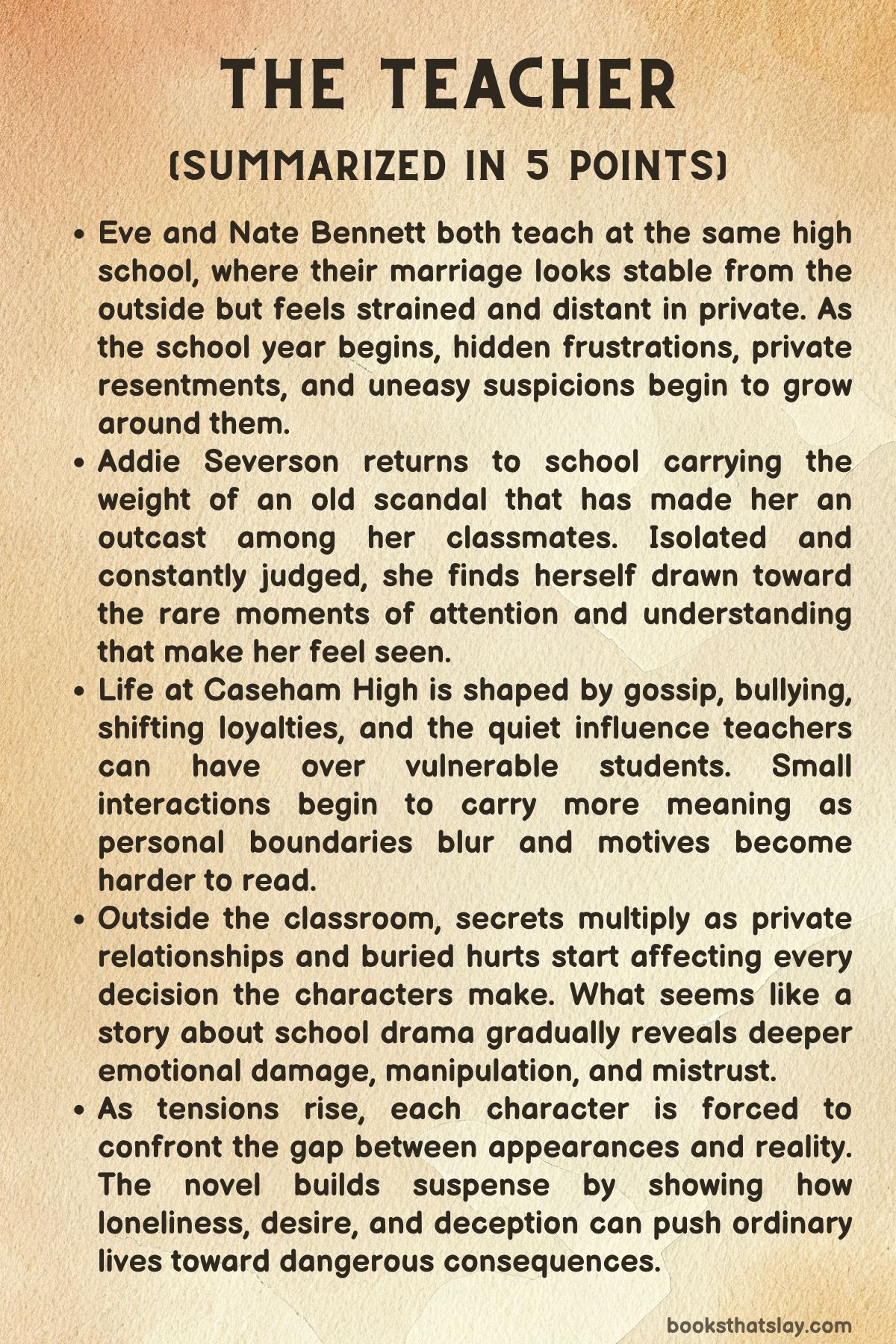
Eve Bennett and her husband Nate both teach at Caseham High School. From the outside, they seem like an enviable couple.
Nate is handsome, admired by students, and known around school as the kind of teacher everyone likes. Eve, who teaches math, appears settled into adult life with a husband, a home, and plans for a family.
But beneath that image, their marriage is cold and unsatisfying. Their life together has become mechanical, and Eve feels the absence of intimacy sharply.
She wants more from Nate and from her life, but she is also carrying her own secrets, including an affair with a shoe salesman named Jay.
At the same school, sixteen-year-old Addie Severson returns under a cloud of gossip. The previous year, her name became linked to a scandal involving a former teacher, Art Tuttle.
Although nothing was proven, the rumors destroyed his career and left Addie marked in the eyes of students and adults alike. She is isolated, bullied, and treated as if she is guilty of something shameful.
Kenzie, one of the most popular girls in school, leads much of the cruelty, while Hudson, once Addie’s closest friend, now keeps his distance. Addie feels trapped by the story everyone has told about her.
Eve becomes uneasy as soon as she realizes Addie is in her class and, even more troubling, in Nate’s English class. Art Tuttle later warns Eve to be careful around Addie, describing her as troubled.
That warning settles in Eve’s mind. At the same time, Addie begins to find comfort in Nate’s attention.
He praises her poetry, encourages her to join the school literary magazine, and treats her as if he truly sees her. For a girl who is lonely, mocked, and desperate for kindness, his approval matters deeply.
Addie’s home life adds to her pain. Her father was abusive, and his death still hangs over her life.
It is eventually revealed that during a fight, Addie pushed him after he became violent toward Hudson. He fell down the stairs and died.
Although it was not planned, the event shattered Addie’s friendship with Hudson and deepened her sense that disaster follows her. She is living with grief, guilt, and the feeling that no one understands her.
As the school year continues, Addie’s bullying gets worse. Kenzie and her friends humiliate her in the cafeteria, the locker room, and the halls.
Her clothes are stolen, her locker is vandalized, and she is cornered again and again. Nate responds with sympathy and private concern.
He gives her special assignments, praises her writing, and offers rides and emotional support. What first appears to be mentorship slowly becomes grooming.
He tells Addie she is special, gifted, and unlike anyone else. He shares personal details about his unhappy marriage and presents himself as misunderstood.
Addie starts to believe that he is the only person who truly values her.
Meanwhile, Eve’s own life continues to fracture. She shoplifts impulsively, struggles with her unhappiness, and continues seeing Jay in secret.
She senses something wrong in Nate’s behavior, especially his reactions whenever she brings up Addie. Still, she does not understand the full truth until she witnesses Nate and Addie together.
When she sees them kiss, everything snaps into focus. She immediately understands that Nate is having an affair with a student.
She also sees that Addie, though reckless and obsessive, is still a child being manipulated by an adult man who knows exactly what he is doing.
Eve does not go straight to the principal. Partly, she fears the public fallout and the damage it would bring to both of their careers.
Instead, she confronts Nate privately. He lies at first, then tries to shift blame onto Addie, claiming the girl pursued him.
Eve refuses to accept that version. She demands a divorce, the house, and his resignation from teaching.
Most importantly, she insists he end things with Addie. Nate agrees only under pressure, especially after Eve reveals that she has photographic proof.
Nate then contacts Addie and tells her that Eve knows about them and is forcing them apart. He suggests that if Eve were gone, everything could be different.
Addie does not initially set out to murder Eve, but she does begin thinking in dangerous ways. She has been convinced that she and Nate belong together and that Eve stands between them.
Addie goes to the Bennett home intending to talk, perhaps to plead her case, but the encounter goes wrong. Eve tries to make Addie understand that Nate has manipulated her.
Addie cannot accept it. In the middle of the confrontation, panic and rage take over, and she strikes Eve with a frying pan.
Believing Eve to be dead, she calls Nate.
Nate arrives and quickly takes control. Rather than call for help, he deletes the evidence from Eve’s phone and tells Addie they must hide the body.
He frames it as the only way to protect her from prison, tightening his hold over her even in crisis. What Addie does not realize is that Eve is not dead.
When Eve regains consciousness, she begs Nate to call 911 and get Addie help. Instead, Nate strangles her until she passes out again.
This moment reveals him fully: manipulative, predatory, and willing to kill to save himself.
He takes Addie into the woods with Eve’s body and instructs her to help dig a grave. He invents a cover story about Eve leaving town.
But when he sees a chance to save only himself, he abandons Addie at the burial site and starts building a case against her. He tells police that Eve disappeared, points suspicion toward Addie, and uses her past behavior to make her look unstable.
He even hands over a school writing assignment as if it were a threat. Nate assumes Addie will collapse under pressure and take the blame.
But the case begins to shift. Detective Sprague looks into Eve’s disappearance, and Addie starts to realize that Nate may have planned to sacrifice her all along.
Then Kenzie arrives with the missing piece of the story. She reveals that Nate previously groomed her too, feeding her the same lines about soulmates and special connection.
Even the poem he gave Addie was recycled. Kenzie shows Addie messages and explains that her bullying partly came from jealousy and anger over Nate’s manipulation.
Faced with the truth, Addie finally understands that she was never uniquely loved; she was selected, controlled, and used. She goes with Kenzie to the police and tells Detective Sprague everything.
While this is happening, Eve has survived. Buried under leaves and loose dirt, she manages to claw her way out of the grave.
Instead of immediately going to the police, she reaches out to Jay for help. He hides her and helps her recover.
Together, they decide not to expose Nate right away but to frighten him first. Eve begins leaving signs connected to “The Raven,” Nate’s favorite poem, using shoes, birds, and pumpkins to unsettle him and draw him back toward the grave.
Nate, already nervous and guilty, starts to believe he is being haunted or hunted.
At last, Nate returns to the burial site and finds the grave empty. Eve and Jay are waiting.
Jay knocks Nate out, and they throw him into the grave. When he wakes, he begs for mercy, but Eve has reached the end of hers.
She remembers that Nate once used the same romantic poem on her when she was only fifteen and his student, proving that his behavior stretches back years. He did not just betray her as a husband; he had preyed on her long before that.
With Jay helping, Eve buries Nate alive.
Six months later, life has shifted. Nate has vanished.
Eve has resurfaced, quit the school, and moved away. Addie and Kenzie, once enemies, have become friends through the shared knowledge of what Nate did to them.
Hudson has returned to Addie’s life as a source of comfort and steadier affection. The ending quietly reveals that Hudson’s nickname is Jay and that he works at Simon’s Shoes, tying together clues from earlier in the novel and suggesting just how carefully events were connected behind the scenes.
By the end, the story is not only about murder and survival but also about how a charming predator can damage many lives before the truth finally catches up with him.
Characters
Eve Bennett
Eve Bennett begins as someone who appears composed, respectable, and fully settled into adult life, yet much of her inner world is marked by dissatisfaction, insecurity, and suppressed anger. She is intelligent, observant, and capable of reading social dynamics quickly, but she also spends a great deal of time measuring herself against other women and against the life she once imagined she would have.
Her marriage has left her emotionally starved, and that emptiness shapes many of her choices. She wants intimacy, admiration, and a feeling of control, but she is living with routine, distance, and quiet humiliation.
This makes her both sympathetic and flawed. She is not presented as morally spotless; she lies, cheats, and acts impulsively.
Even so, her weaknesses make her feel human rather than shallow, because they come from loneliness and from years of trying to hold together a life that is already breaking apart.
One of the most interesting things about Eve is the contrast between how she is seen and who she actually is. To others, she is the math teacher with the handsome husband, the woman who should feel lucky, secure, and stable.
Internally, she feels overlooked and emotionally abandoned. That split gives her character depth.
She is often sharp, jealous, and suspicious, but those traits do not come from nowhere. They grow out of the fact that she is living beside a man who withholds warmth, manipulates perception, and makes her question her own instincts.
Her affair is not written as a romantic solution so much as evidence of her desperation to feel wanted again. She seeks validation in risky ways, including theft and secrecy, because she feels that the life she is living has become too small and too deadening.
As the story develops, Eve becomes the character who sees the truth most clearly once the mask finally drops. When she realizes what Nate is doing, her reaction is shaped not only by rage but also by a grim practicality.
She immediately understands the personal, professional, and moral consequences of exposing him. Importantly, she sees Addie not simply as a rival but as a manipulated girl, which shows that Eve’s anger does not erase her judgment.
Even when she is furious, she can still distinguish between a guilty adult and a damaged teenager. That ability gives her moral weight.
She is not kind in a soft or idealized way, but she is capable of clarity when it matters.
By the end, Eve changes from a passive, contained woman into someone willing to act with frightening finality. Her survival forces her into a different version of herself.
She is no longer trying to preserve appearances, save her marriage, or make the least damaging choice. She becomes someone who answers violence with violence.
That transformation is extreme, but it is prepared for by everything that comes before it: betrayal, manipulation, attempted murder, and the discovery that she herself had once been part of Nate’s long pattern of predation. Her final actions are morally dark, yet they feel like the culmination of buried fury finally given form.
In The Teacher, Eve stands as both victim and avenger, and that dual role is what makes her the most layered figure in the novel.
Nate Bennett
Nate Bennett is the central manipulator in the story, and his character is built around charm, performance, and predatory control. At first, he seems like the ideal teacher: attractive, literary, attentive, and well liked.
He knows how to present himself as sensitive and cultured, especially through poetry and emotional language. That image is essential to how he operates.
Nate does not rely on open force in the beginning; he relies on making other people feel special. He studies what they need, then becomes the person who appears to provide it.
This is what makes him dangerous. He is not impulsively cruel in a loud way.
He is deliberate, polished, and practiced.
His relationship with Addie reveals how he works. He identifies her vulnerability almost immediately: she is isolated, humiliated, emotionally neglected, and hungry to be seen as talented and worthy.
He offers praise, attention, secrecy, and language that makes her feel singular. He calls her his soulmate, encourages emotional dependence, and frames their connection as rare and misunderstood.
What is most revealing is how ordinary his method turns out to be. Later, it becomes clear that his words are recycled and his intimacy is formulaic.
The poem he offers as proof of love is not unique. The emotional script he uses has been used before.
This exposes the emptiness at the center of his character. Nate presents himself as passionate and artistic, but he is actually repetitive and opportunistic.
Nate is also deeply selfish. He does not love in any meaningful sense because he cannot place another person’s wellbeing above his own needs.
He wants admiration, control, and access without consequence. Even his complaints about Eve are self-serving.
He paints himself as trapped in a loveless marriage, but this narrative functions mainly as a tool to justify betrayal and gain sympathy. He positions himself as misunderstood so that others will step into the role of rescuer or chosen companion.
He is especially effective because he mixes self-pity with seduction. That combination lets him appear vulnerable while he is actually exerting power.
When pressure rises, Nate’s true nature becomes unmistakable. He lies easily, blames Addie, manipulates evidence, and tries to construct a case against a teenager to protect himself.
His cruelty sharpens when he senses that his life or reputation is under threat. Most importantly, he crosses fully into murder not in a burst of panic but in a sequence of self-protective decisions.
He strangles Eve, disposes of her body, abandons Addie, and feeds police a story that will direct suspicion away from him. All of this confirms that his earlier tenderness was never tenderness at all.
It was technique. He is a portrait of a man who hides predation beneath culture, romance, and professional authority.
Nate’s character also gains an added dimension through the revelation that Eve was once a student when he used the same language on her. That detail reframes much of the story.
He is not a man who made a terrible mistake in one vulnerable season of his life. He is a serial manipulator whose patterns stretch back years.
His appeal depends on the same qualities that make him monstrous: confidence, verbal fluency, and an instinct for weakness. He is the kind of person who survives by making others doubt themselves until it is too late.
Addie Severson
Addie Severson is one of the most emotionally exposed characters in the novel. She begins the story already damaged by rumor, loss, and social exile.
Her classmates see her through scandal before they see her as a person, and that shapes nearly every interaction she has. She is lonely, defensive, and often desperate for dignity.
Because she is so thoroughly isolated, she becomes highly susceptible to anyone who offers attention without contempt. This does not make her foolish; it makes her vulnerable in ways that feel believable.
Addie is still young enough to confuse intensity with love and secrecy with intimacy, especially when the adult guiding her knows exactly how to exploit that confusion.
She is also more complicated than a simple victim figure. Addie carries anger, resentment, and a desire for retaliation.
She steals keys, enters Kenzie’s house, imagines life being easier without obstacles in her path, and often nourishes private fantasies of reversal or revenge. These impulses matter because they show that she is not passive.
She is trying, in clumsy and sometimes troubling ways, to reclaim a sense of power. Her inner life contains shame and tenderness, but it also contains dark wishes and impulsive thinking.
That complexity makes her feel like an actual teenager under pressure rather than a symbol of innocence.
A major part of Addie’s character is her distorted understanding of love and loyalty. Her father’s abuse, her social isolation, and the rupture with Hudson have left her with a fragile sense of safety.
So when Nate tells her she is gifted, beautiful, and uniquely understood, she responds with total emotional investment. She does not yet have the experience or distance to see how manufactured his attention is.
She interprets his secrecy as sacrifice and his distance as necessity. Even when warning signs appear, she explains them away because the relationship gives shape to her hopes.
In that sense, her attachment to Nate is built as much from need as from desire.
At the same time, Addie has a conscience that never fully disappears. After she attacks Eve, her panic is immediate and genuine.
She is not relieved or triumphant. She is horrified.
Even after going along with Nate’s plan, she keeps questioning the marks on Eve’s neck, the logic of the cover-up, and Nate’s shifting explanations. Her denial lasts only as long as her need to believe in him.
Once other evidence appears, especially through Kenzie, Addie begins to confront the truth. That matters because her arc is not simply about victimization but about disillusionment.
She has to lose the fantasy before she can reclaim herself.
By the end, Addie becomes stronger not because she is suddenly fearless but because she finally tells the truth. Her decision to speak is a major turning point in her growth.
She moves from secrecy, shame, and emotional dependence toward a more grounded understanding of what happened to her. Her renewed connection with Kenzie and Hudson suggests that healing for her will come through honest relationships rather than hidden ones.
She remains marked by trauma, but she is no longer trapped inside Nate’s version of her life.
Kenzie Montgomery
Kenzie first appears as the classic high school tormentor: socially powerful, mocking, and cruel in a way that seems casual because it is backed by status. She humiliates Addie repeatedly and appears to enjoy making her feel small.
On the surface, she represents the social violence of adolescence at its meanest. She knows how to use a group, a laugh, or a minor act of sabotage to create maximum shame.
Because Addie is already isolated, Kenzie’s behavior lands with extra force. Early on, she looks like a simple antagonist whose role is to make school life unbearable.
What makes Kenzie more interesting is that her cruelty eventually turns out to be rooted in her own manipulation and hurt. She too was targeted by Nate, and once this is revealed, her earlier behavior changes meaning.
That does not excuse what she did to Addie, but it explains the emotional logic behind it. Kenzie believed she had a special connection with him and then saw that attention shift elsewhere.
Her jealousy, insecurity, and humiliation were redirected downward onto another girl. Instead of recognizing that Nate was the source of the harm, she attacked the person she saw as competition.
This is one of the more painful truths in the story: abuse can make victims act cruelly toward one another before they understand the structure trapping them.
Kenzie’s later honesty becomes one of the novel’s most important corrective forces. When she comes forward with screenshots and her own account, she breaks the illusion that Nate’s relationship with Addie was unique or consensual in any meaningful sense.
She provides the pattern. Her testimony matters not only legally but emotionally, because it allows Addie to reinterpret everything that happened.
In this role, Kenzie becomes a truth-teller, though not a perfect one. She has to confront her own complicity in the harm done to Addie, and the novel allows space for that discomfort.
Her eventual friendship with Addie is significant because it shows growth through shared recognition rather than sentimentality. They are not brought together by easy forgiveness but by the discovery that they were both used by the same adult man.
Kenzie becomes a more humane and substantial character once the story lets her step out from the role of school bully and into the role of wounded teenager trying to repair something. She is a reminder that cruelty and vulnerability can coexist in the same person, especially in adolescence.
Hudson Jankowski
Hudson functions as a quieter moral presence in the story, though he is not without flaws. He is tied to Addie’s past in a deeply painful way because he was there when her father died.
That shared trauma breaks their friendship, not because he stops caring about her, but because he does not know how to carry what happened. His distance hurts Addie, yet it is not framed as malice.
Instead, it reflects fear, confusion, and the kind of emotional paralysis that teenagers often feel when faced with an event too large for them to process. Hudson’s silence becomes one more form of abandonment in Addie’s life, but it is the silence of someone overwhelmed rather than someone cruel.
Throughout much of the story, Hudson appears on the edge of events rather than at the center. That position is meaningful.
He is a contrast to Nate’s intensity. Where Nate pushes, flatters, and invades, Hudson hesitates.
Where Nate uses language to control, Hudson struggles to say enough. This difference can make Hudson seem passive at first, especially when Addie wants him to defend her more openly.
But his restraint also marks him as safer. He is not trying to shape Addie into a story that serves him.
He is simply not strong enough, at first, to reconnect after what they have both lived through.
When Addie calls him from the woods, Hudson shows what remains constant in his character: despite everything, he comes. He does not yet know the full truth, but he responds to her need without demanding conditions.
Later, he apologizes for the way trauma drove him away and tells her that she is still his best friend. This moment gives him emotional substance.
He is not the bold rescuer type; he is a damaged, decent boy trying to return to honesty after fear.
His place in the ending also matters because it offers Addie a different model of attachment. With him, there is no secret language of soulmates, no false glamour, no hidden room.
There is ordinary presence, awkwardness, and care. That may seem less dramatic, but the story clearly presents it as healthier.
The closing suggestion that he is connected to the wider scheme through the shoe store adds a layer of cleverness around him, yet his emotional role remains clear: he represents the possibility of trust rebuilt slowly and without manipulation.
Jay
Jay initially seems to occupy a relatively simple role as Eve’s affair partner, but he grows into something more significant as the story unfolds. On the surface, he is the escape from Eve’s stale marriage: attentive, flattering, sexually available, and tied to her obsession with shoes and fantasy.
Their affair is built on secrecy and temporary relief, and because of that, he first appears to be another sign of Eve’s dissatisfaction rather than a fully formed character in his own right. Yet even in those early scenes, he is notable for how willing he is to step into the emotional space Nate has left empty.
Jay’s character becomes more compelling when the stakes rise. Once Eve survives the attempted murder, he does not disappear or shrink from what she tells him.
Instead, he becomes the person who believes her, shelters her, and helps her act. That loyalty complicates him.
He is not merely the convenient lover waiting on the sidelines. He is calm under pressure, practical, and willing to support Eve’s need for agency, even when her plans turn extreme.
His role in helping her torment Nate and lure him back to the grave shows that he is capable of crossing serious moral lines. He is supportive, but he is not innocent.
There is also an ambiguity to Jay that makes him interesting. He is caring toward Eve, but his willingness to help bury Nate suggests either deep devotion or a flexible conscience, perhaps both.
He becomes the instrument through which Eve can turn survival into vengeance. In that sense, Jay is less a stabilizing moral opposite to Nate than a partner in Eve’s transformation.
He helps her reclaim power, but he does so through violence and concealment rather than law or public truth.
His connection to the final reveal gives him a further twist, linking him more tightly to the broader network of characters than first expected. That added layer reinforces one of the novel’s pleasures: relationships that seem isolated at first are often part of a larger design.
Jay may not be as psychologically exposed as Eve, Addie, or Nate, but he matters because he becomes the bridge between Eve’s vulnerability and her retaliation.
Detective Sprague
Detective Sprague serves as the story’s main representative of rational inquiry. In a novel driven by deception, obsession, and emotional manipulation, she brings a steadier intelligence.
She does not solve everything instantly, nor is she romanticized as a genius investigator, but she consistently pushes against easy narratives. That is especially important because Nate tries hard to hand her a ready-made suspect in Addie.
Sprague listens, observes, and keeps asking questions that disturb his version of events.
Her value as a character lies in her refusal to accept appearances at face value. She notices inconsistencies, follows up on missing information, and pays attention to details that others might dismiss.
At the same time, she understands that Addie is frightened and withholding. She offers the girl chances to tell the truth without immediately crushing her under accusation.
This makes Sprague feel more human than procedural. She is skeptical, but she is not cold for the sake of being tough.
Sprague also plays an important thematic role. She represents the possibility that institutions can still function, even in a story where adults have repeatedly failed young people.
School administrators failed to protect students properly. Parents missed crucial truths.
Teachers abused trust. Against that background, Sprague’s persistence becomes significant.
She is not enough on her own to stop everything, but she creates the pressure that helps bring the hidden pattern to light. Her presence narrows the space in which Nate can continue controlling the story.
Shelby
Shelby is a secondary character, but she plays an important role in revealing Eve’s state of mind and the emotional environment around her. As Eve’s friend and colleague, Shelby provides a point of comparison.
She appears to have the family life and domestic contentment that Eve longs for, and that contrast often sharpens Eve’s feelings of inadequacy and frustration. Shelby’s conversations about children, marriage, and ordinary happiness are not cruel in themselves, but they intensify Eve’s sense of personal failure.
Through Shelby, the narrative shows how even benign social comparison can become painful when someone’s private life is collapsing.
Shelby also serves as an outside observer who occasionally sees more than Eve wants to admit. When she suggests that Addie may have been near the house because of Nate rather than Eve, she helps crack open Eve’s denial.
That moment matters because it pushes Eve closer to the truth she has been resisting. Shelby is not deeply developed in the same way as the central figures, but she functions effectively as a mirror, exposing the gaps between appearance and reality.
Art Tuttle
Art Tuttle is important less for his present actions than for what he represents within the story’s moral structure. He is the disgraced former teacher whose association with Addie has already primed the school community to see her as scandalous and dangerous.
Whether he crossed a line or was destroyed by suspicion, his role in the plot is to create an atmosphere in which Addie’s credibility is already weakened. By the time Nate begins manipulating her, the ground has already been prepared by gossip, assumption, and adult failure.
His warning to Eve that Addie is troubled is one of the novel’s more complicated moments because it mixes possible concern with self-interest and bitterness. Art has lost his career and reputation, and his view of Addie is shaped by that collapse.
He may be trying to warn Eve sincerely, but he is also someone who has every reason to cast Addie as the problem. This ambiguity matters because it reflects one of the story’s recurring tensions: damaged adults often tell partial truths.
Art is not given enough space to become fully knowable, but his presence lingers as part of the system of suspicion surrounding Addie.
Addie’s Mother
Addie’s mother is portrayed as caring, anxious, and often unable to grasp the full depth of what her daughter is experiencing. She clearly loves Addie and tries to remain involved, whether by driving her to school, questioning her about her day, or worrying about leaving her alone.
But her concern often takes the form of pressure rather than understanding. She wants reassurance, order, and normalcy, and this can make her miss how badly Addie is unraveling.
Her relationship with her late husband also reveals the complicated emotional patterns inside the family, especially since Addie cannot understand how her mother can continue to honor a man who was abusive.
What makes her affecting is that she is not negligent in any easy sense. She is working, trying, and worrying.
Yet she cannot protect Addie from the kinds of harm that are hardest to name. By the time she begins to suspect that something is terribly wrong, much has already happened.
She represents the painful limits of parental care when trauma, secrecy, and shame have already taken root inside a household.
Themes
Grooming, Manipulation, and the Abuse of Trust
Authority becomes dangerous in this story not because it is loud or openly violent at first, but because it hides inside praise, attention, and carefully chosen language. Nate does not control the girls around him through obvious threats in the beginning.
He studies what they are missing and then presents himself as the answer. Addie is lonely, shamed by rumor, and desperate to be seen as more than the girl everyone talks about.
Kenzie, for different reasons, is also vulnerable. Nate approaches both through admiration, emotional intimacy, and the promise that they are rare, gifted, and deeply understood.
That is what makes the theme of grooming so central. The harm does not begin with force.
It begins with recognition that has been designed to create dependence.
The school setting intensifies this because trust is already built into the role of a teacher. A teacher is supposed to guide, encourage, and protect.
Nate uses those expectations as cover. His comments on poetry, his offers of help, his private conversations, and his emotional confessions all look almost acceptable in isolation.
That is part of the point. Predatory behavior often grows in stages that can be explained away one moment at a time.
By the time the truth becomes undeniable, the victim is already emotionally trapped. Addie does not think she is being used because Nate has convinced her that secrecy is proof of the depth of their bond.
He turns professional authority into romantic authority, and then into psychological control.
This theme also gains power because the novel shows how grooming distorts the victim’s own understanding of events. Addie believes she is making choices freely, but those choices are shaped by lies, false promises, and emotional pressure.
She thinks she is protecting love when she is actually protecting the man who is harming her. Even Kenzie’s bullying is partly the result of the manipulation she endured.
Instead of immediately seeing Nate as the source of the harm, she turns her pain against another girl. That detail matters because it shows how abuse can spread outward and corrupt relationships between victims themselves.
By the end, the pattern becomes unmistakable. Nate recycles poems, repeats the same emotional script, and shifts blame whenever his actions are exposed.
The novel’s treatment of grooming is effective because it refuses to dress exploitation up as romance. It shows how praise can be a trap, how secrecy can become a weapon, and how a trusted adult can hollow out another person’s sense of judgment until they no longer know where love ends and control begins.
Female Anger, Retaliation, and the Refusal to Stay Passive
Anger drives much of the story, but it appears in different forms depending on who is carrying it. Eve’s anger begins in frustration and humiliation.
She feels neglected in her marriage, trapped in a routine life, and quietly diminished by a husband who withholds affection while maintaining the appearance of charm. Her anger is not immediately dramatic.
At first it shows up in resentment, suspicion, reckless choices, and the private need to feel wanted elsewhere. Addie’s anger is younger, less contained, and more impulsive.
She is bullied, isolated, and treated as if she is dirty or guilty. Her rage grows out of powerlessness, and because she has so few safe places to direct it, it hardens inside her.
Kenzie’s cruelty also comes from anger, but in her case it is redirected jealousy and hurt. Taken together, these strands create a story in which female anger is not dismissed as irrational noise.
It is a real force shaped by betrayal, shame, and the pressure of being controlled by others.
What makes this theme especially strong is that the novel does not present anger as clean or noble. It is messy, morally unstable, and at times destructive.
Addie attacks Eve in a moment of panic and delusion. Kenzie bullies another girl instead of confronting the adult who manipulated her.
Eve eventually chooses revenge rather than law. None of these responses are idealized.
Yet the story also makes clear that passivity has already failed these women and girls. Institutions did not protect them.
Social judgment distorted their experiences. Men with authority wrote the narrative for too long.
In that context, anger becomes not just emotion but resistance. It is the refusal to remain silent inside someone else’s story.
Eve’s final transformation gives this theme its darkest shape. She begins as someone trying to preserve appearances and limit damage.
By the end, survival changes her. After being betrayed, attacked, strangled, buried, and left for dead, she no longer believes in polite restraint.
Her revenge is extreme, but the novel builds toward it by showing how much has been demanded of her patience already. She becomes terrifying precisely because the rage she carries has been earned through repeated violation.
The same is true in a different way for Addie and Kenzie, who finally stop protecting Nate and speak the truth. Their anger turns outward in a more restorative direction, exposing him rather than one another.
This theme works because it does not flatten women into saints or victims alone. It allows them to be bitter, jealous, impulsive, protective, damaged, and dangerous.
Their anger is shown as the result of real injury, and although the forms it takes are not always admirable, the novel insists that suppressed rage has consequences. Once that rage finds expression, it changes the direction of the entire story.
Appearance, Performance, and the Lies People Learn to Live Inside
Almost every important relationship in the novel depends on performance. Characters are constantly managing what others see while hiding what is actually true.
Eve and Nate look like a successful married couple, two teachers with a new house and a respectable life. That image protects Nate in particular, because people are predisposed to read him as stable, attractive, and trustworthy.
Addie is trapped inside the opposite kind of performance, one she did not fully create for herself but is forced to live under anyway. At school, she is treated as the scandal girl, the one already associated with inappropriate rumors and bad judgment.
Once a public image settles over her, nearly everything she does is interpreted through it. The contrast between Nate’s polished appearance and Addie’s damaged reputation reveals how badly social perception can distort moral truth.
The school is an ideal setting for this theme because it is full of roles that look clear from the outside. Teachers are supposed to be mentors.
Popular students are assumed to hold social power because they are secure. Marriages are often judged by surface signs.
Even writing and poetry become part of performance. Nate uses literary sensitivity as part of his public identity, turning culture into camouflage.
He knows how to appear emotional without being emotionally honest. He can quote poems, praise talent, and speak in the language of intimacy while remaining fundamentally manipulative.
The gap between his words and his motives becomes one of the sharpest examples of performance in the novel.
Eve is also shaped by this theme. She spends much of the story aware of how others must see her, and that awareness affects her choices.
She feels judged as a wife, as a woman who has not gotten pregnant, and as someone who should be grateful for the life she has. Her affair, her stealing, and her obsession with shoes all carry a performative dimension because they are tied to self-image, desire, and the fantasy of being someone else for a moment.
Even her marriage lasts longer than it should partly because exposing the truth would shatter the life she has been visibly living.
The novel keeps returning to the idea that what looks convincing is often false, while what looks disreputable may contain the truth. Addie, whose reputation is stained from the beginning, is more sinned against than the adults around her admit.
Nate, who appears gentle and artistic, is the real danger. Kenzie, who first seems simply cruel, turns out to be another harmed girl.
By repeatedly overturning social assumptions, the story argues that appearances do not merely hide truth; they actively produce false judgments that can protect abusers and isolate victims. Public image becomes one of the most effective lies in the book.
Trauma, Memory, and the Search for a Life After Damage
Past injury shapes the present in almost every corner of the novel. Addie is living not only with current bullying but with the aftermath of her father’s abuse and death.
That history has altered how she sees herself, how others treat her, and how she responds to affection and fear. She has learned that home is not automatically safe, that adults can be violent or unreliable, and that one terrible moment can stain every moment that follows.
Because of that, she is especially vulnerable to anyone who offers a gentler script for her life. Nate steps into a space already prepared by trauma.
He offers tenderness where there was violence, but because the tenderness is false, it becomes another injury layered onto older ones.
Hudson is also marked by trauma, though his response is withdrawal rather than obsession. He cannot easily face Addie after witnessing her father’s death because the memory overwhelms him.
Their broken friendship shows that trauma does not only wound the person at the center of an event. It radiates outward, affecting relationships, trust, and the ability to return to ordinary closeness.
Addie experiences this as abandonment, while Hudson experiences it as paralysis. Their eventual reconnection matters because it suggests that healing is not about erasing the past but about finding a way to speak after silence has done its damage.
Eve’s trauma arrives later and more visibly, but it completely reshapes the story. Her marriage has already eroded her emotionally, yet the true rupture comes when she is attacked, strangled, buried, and left for dead.
After that, she is no longer a woman trying to repair an unsatisfying life. She becomes someone whose body and mind have crossed into survival mode.
Her choices after escaping the grave are guided not by normal social logic but by the raw force of what has happened to her. The novel is interested in how trauma changes perception.
Nate becomes haunted not only because Eve is literally alive, but because his guilt turns every sign into a threat. Meanwhile, Eve channels her damage into calculated retaliation.
Trauma does not soften her; it hardens her into action.
What keeps this theme from becoming purely bleak is the suggestion that truth-telling and shared recognition can create the first conditions for survival. Addie and Kenzie, once divided by jealousy and cruelty, become capable of understanding one another because they finally name what happened.
Addie and Hudson begin to rebuild a bond once the silence between them is broken. Eve disappears from school life, but that disappearance feels less like defeat than an attempt to live outside the structure that almost destroyed her.
The Teacher presents trauma as something that reshapes identity, memory, and relationships in lasting ways, yet it also allows the possibility that damaged people can still move toward something steadier once the lies around their suffering are stripped away.