All the Little Raindrops Summary, Characters and Themes
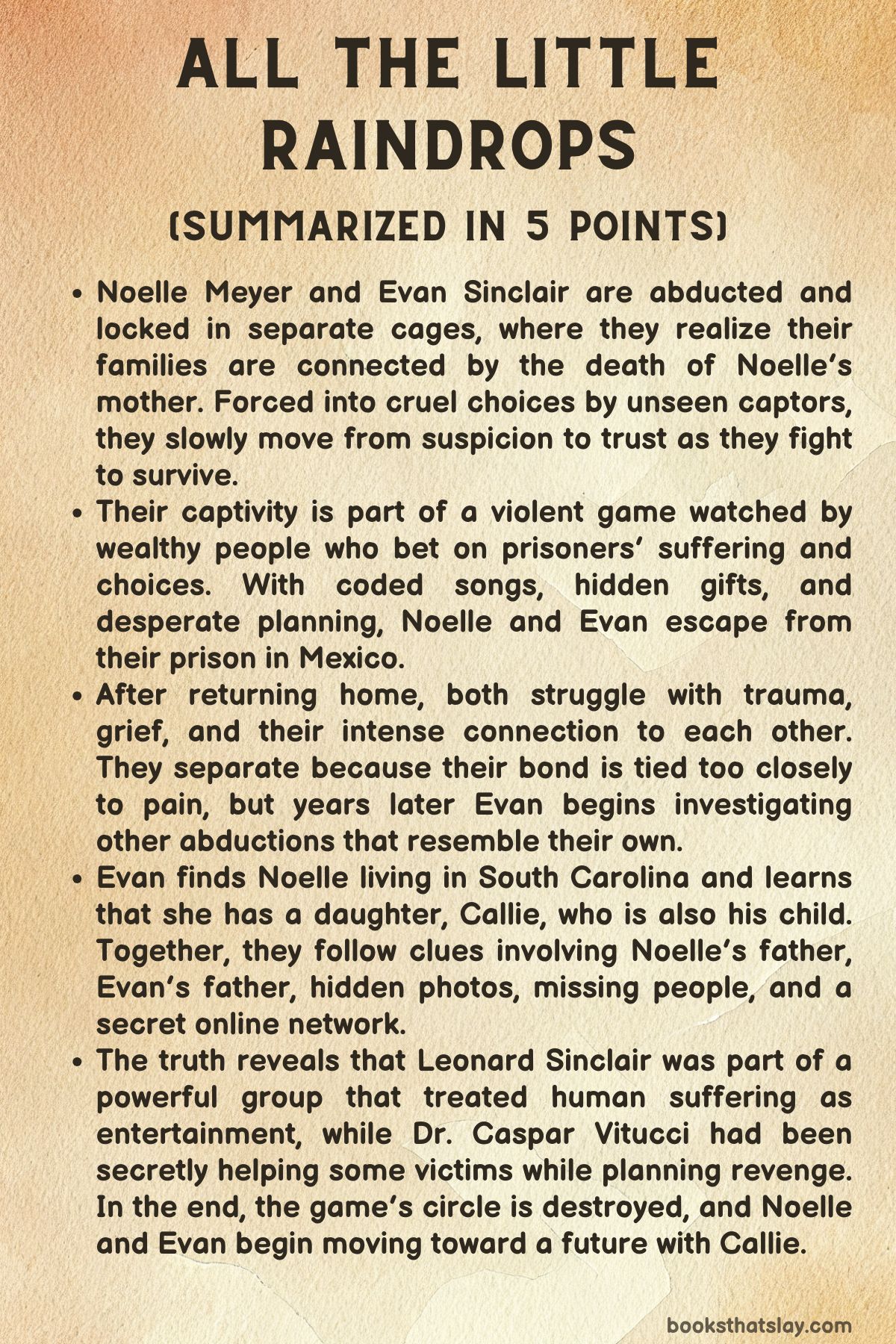
All the Little Raindrops by Mia Sheridan is a dark romantic suspense novel about trauma, survival, revenge, and the lasting cost of violence. The story follows Noelle Meyer and Evan Sinclair, two teenagers whose lives are already tied together by a painful family history before they are abducted and locked in cages.
Forced into a cruel game watched by powerful strangers, they must depend on each other to survive. Years later, their search for answers uncovers a larger network of abuse, corruption, and hidden crimes, while also forcing them to confront love, trust, parenthood, and healing.
Summary
Noelle Meyer wakes in a dark cage with no way to measure time. She remembers being on spring break during her senior year of high school, working as a waitress while her father worked nights, before someone abducted her.
Her cage is small, bare, and brutal, with only a toilet and occasional deliveries of bread and water. After some time, another person is thrown into a nearby cage.
He is Evan Sinclair, a wealthy boy taken after leaving his gym. At first, they are frightened and suspicious, but soon they realize they already know of each other.
Evan’s father, Leonard Sinclair, was accused by Noelle’s family of killing Noelle’s mother, Megan.
Noelle believes Leonard ruined her family. After Megan died on Sinclair property, Noelle’s father, Bennett Meyer, spent his savings trying to prove that Sinclair was responsible, but the legal case failed.
Evan has heard a different story: that Megan had stalked his father. Their captivity forces them to face old anger while dealing with immediate terror.
They argue, accuse each other’s families, and then slowly understand that neither of them is responsible for what happened before.
Their prison is part of a sadistic game watched by wealthy online participants. A man known as the Collector observes them through screens.
At first, he watches with clinical interest, studying their behavior and the odds placed on their choices. The captors force Noelle and Evan into horrific decisions: one must suffer to spare the other.
Noelle is taken away and raped by a masked man after being told Evan will be mutilated if she refuses. Evan is later beaten and abused rather than allow Noelle to be harmed.
Each returns broken, ashamed, and afraid, yet their bond deepens. They link fingers through the bars, share small gifts hidden in their food, and comfort each other with songs.
The Collector becomes more than a passive watcher. Unlike the other viewers, he begins sending them items that may help them escape.
He also visits Noelle in disguise, giving her coded clues by emphasizing certain words. He asks her to create something for him, and she steals part of a pencil.
Noelle and Evan realize they can communicate in code by altering the words of children’s songs. They use this method to plan.
They need the lock codes to their cages, and they use the captor’s reflective tie pin to watch him enter numbers. They also use the pencil graphite, a socket, rose petals, a mallet, cuticle scissors, and rope to build a desperate escape plan.
Evan injures his own hand badly enough to slip it through the bars and reach the keypad. Noelle starts a fire with the graphite and outlet.
As chaos spreads, Evan frees himself and then Noelle. They fight their guards with the tools they have, killing two men in the struggle, and flee the burning building.
Outside, they discover they are in Mexico. A kind family helps them reach a town, where Evan calls his father.
Noelle tries to reach her own father and learns later that he died while she was missing.
Back in the United States, Noelle and Evan are pulled apart by family pressure, grief, and trauma. Leonard Sinclair wants Evan to forget Noelle and the abduction.
Noelle is mourning her father and afraid of the world. Evan visits her, and their connection becomes physical, but both sense that their intimacy is bound to panic, survival, and need rather than peace.
A year later, they meet again in San Francisco. They still love each other, but they also recognize that being together keeps reopening their wounds.
Noelle lets Evan go, believing that separation may be healthier.
Seven years later, Evan is a private investigator. He has rejected the easy path his father wanted for him and is quietly researching abductions similar to his own.
With help from Aria Dixon, a police officer and former lover, he learns about Lars Knauer, an older man who claimed he was held in a cage with another captive named Hanh. Lars’s story matches Evan and Noelle’s experience: the cages, the forced choices, the gifts, and the eventual escape.
Evan begins to suspect a modern bloodsport in which rich people pay to watch vulnerable captives suffer and bet on their choices.
Evan decides he must speak to Noelle. He finds her in South Carolina, working at Sweetgrass Cottages for Chantilly Calhoun.
Their reunion changes everything when a little girl runs up and calls Noelle “Mommy.” The child, Callie, looks like Evan, and Noelle admits that Callie is his daughter. Evan is hurt and angry that he lost years with her, while Noelle explains that she learned she was pregnant after leaving him and believed she had to heal on her own before she could be a good mother.
Evan asks to know Callie, and Noelle agrees.
Evan tells Noelle about his investigation. They return to her father’s stored belongings and find planners that point to Dow Maginn, a computer expert who disappeared shortly before Noelle was taken.
Maginn was later found dead. Noelle and Evan also learn that Bennett sold Megan’s wedding ring before Noelle’s abduction, apparently to raise money.
In Maginn’s belongings, they find cash and an iPad containing photos of Evan’s gym and evidence of a website connected to the game. The clues suggest that Maginn helped arrange Evan’s kidnapping and that Bennett may have been involved, possibly to punish Leonard Sinclair.
This truth horrifies Noelle, but the mystery grows more complicated. Evan and Noelle interview another survivor, Tallulah Marsh, whose captivity also resembled theirs.
They realize the victims are often people whose stories can be dismissed: addicts, sex workers, migrants, and the poor. Their own case was different because they had a public connection to a wealthy family.
Noelle recalls the man who helped her in captivity and the story he told about a European man who collected women, draped them in jewels, and hosted a party that ended in massacre. Evan traces the story to Dedryck Van Daele in Brussels and a missing group of women.
The investigation leads to Leonard Sinclair’s secret past. Noelle finds photos hidden by her mother, showing Sinclair watching people in cages.
Megan had not been Sinclair’s unstable lover; she had worked for him and discovered his involvement in the game. He killed her and used his power to rewrite the story.
Bennett later found Megan’s proof and, consumed by grief and rage, tried to get revenge by arranging Evan’s abduction. When he saw Evan trapped with Noelle, he regretted it and tried to buy Evan’s freedom, but the game did not work that way.
Evan and Noelle break into Sinclair’s house and uncover more evidence, including a red diamond and the name Fontane Lejeune. They discover that Leonard Sinclair and Fontane Lejeune are the same man, one of the men connected to the Brussels massacre.
An antiques dealer reveals that another red diamond belongs to Dr. Caspar Vitucci, the therapist who treated both Evan and Noelle’s father.
Vitucci is the Collector. He explains that his mother worked for Van Daele, and his sister, Celesse, was one of the victims of the old massacre.
As a child, he survived and was raised under a new name. He later learned that the men responsible had moved to America and reinvented themselves.
Vitucci joined the game through Sinclair, claiming he did so to help captives survive by sending them useful gifts. He admits he killed Maginn and stole Bennett’s laptop and photos.
Evan and Noelle are disgusted by his choices, but Vitucci sees himself as someone working from inside a monstrous system.
On Vitucci’s screen, Evan and Noelle see a new pair of captives: Cedro, a young migrant boy, and Grim, a grieving man with addiction issues. They are being forced through the same kind of torment.
Vitucci leaves for a grand gathering connected to the game, taking the red diamond with him. At the event, he joins the same powerful men he has hunted for years.
With help from Gervais Baudelaire, his adopted brother, he poisons the guests’ champagne. As Cedro and Grim escape their prison, the screens switch from the captives to the dying partygoers.
Vitucci kills Sinclair and then Van Daele before drinking the poisoned champagne himself.
Noelle and Evan record what they can and contact Aria, though much remains uncertain. They watch the collapse of the game’s inner circle and the release of women held at the party.
Vitucci leaves behind a legacy that is both horrifying and difficult to judge: he helped some victims survive but also participated in the system that hurt them.
In the end, Evan goes to South Carolina to build a life near Noelle and Callie. He considers starting over there as a private investigator.
Noelle is still conflicted, but she is ready to move forward. Baudelaire returns Megan’s wedding ring, and Evan gives it to Noelle as a promise rather than a demand.
They link fingers, the gesture that once helped them survive captivity, and walk toward a future shaped by truth, love, and the choice to heal together.
Characters
Noelle Meyer
Noelle Meyer is the emotional center of the story and one of its clearest examples of survival under extreme pressure. At the beginning, she is a young woman whose life has already been shaped by loss: her mother’s death destroyed her family, and her father’s failed search for justice left both of them emotionally and financially damaged.
Her abduction forces her into a situation designed to strip away choice, dignity, and identity, yet Noelle repeatedly shows intelligence, courage, and moral clarity. She is terrified, violated, and traumatized, but she does not become passive.
Her ability to read hidden meaning, improvise, and communicate through altered songs becomes essential to the escape plan. In All the Little Raindrops, Noelle’s strength is not presented as fearlessness; it is shown through her decision to keep thinking, choosing, and protecting Evan even when she has every reason to collapse.
As an adult, Noelle’s character becomes more complex. She has built a life in South Carolina, raising Callie and creating a safe distance from her past.
Her choice not to tell Evan about their daughter is painful and morally complicated, but it comes from her need to heal and become stable enough to parent. Noelle’s growth lies in her gradual willingness to stop surviving alone.
She must confront the truth about her father, her mother, Sinclair, and Evan, while also accepting that love does not have to repeat old harm. By the end, Noelle is still scarred, but she is no longer defined only by what was done to her.
Evan Sinclair
Evan Sinclair begins the story as someone Noelle sees through the lens of his father’s crime and privilege. He is wealthy, protected by the Sinclair name, and initially assumes that his abduction may be about ransom.
Yet captivity exposes a very different Evan. He is not simply a rich boy; he is also the abused son of a violent, controlling father.
His instinct is to shield Noelle, even when doing so costs him physically and emotionally. Evan’s guilt, rage, and protectiveness shape many of his choices, especially when he sacrifices his own body to help them escape.
His bond with Noelle is built in terror, but it also reveals his capacity for loyalty, tenderness, and courage.
As an adult, Evan rejects his father’s world and becomes a private investigator, turning his trauma into a search for truth. This choice shows both strength and danger.
His investigation gives him purpose, but it also keeps him close to the horror he survived. His reunion with Noelle forces him to mature beyond trauma-driven attachment.
Learning about Callie wounds him deeply, yet he does not respond with cruelty. Instead, he chooses presence, patience, and accountability.
Evan’s greatest character movement is away from inherited violence. He carries the Sinclair name, but he refuses to become his father.
His love for Noelle and Callie becomes a deliberate act of repair.
Caspar Vitucci / The Collector
Caspar Vitucci is one of the most morally complicated figures in the novel. At first, he appears as the Collector, a watcher who studies Noelle and Evan through the game’s screens.
He is intelligent, observant, and emotionally controlled, but his fascination with the captives makes him unsettling. He claims to be different from the other viewers, and in some ways he is: he sends useful gifts, gives Noelle coded help, and wants certain prisoners to escape.
Still, he participates in the same system that brutalizes them. His belief that his motives make him ethically separate from the other players is one of his deepest self-deceptions.
Vitucci’s past explains his obsession without excusing it. As a child, he survived a massacre tied to Van Daele, Sinclair, and the powerful men behind the game.
His mother and sister were destroyed by the same culture of wealth, cruelty, and ownership that later traps Noelle and Evan. His intelligence becomes a weapon, and his patience becomes a long revenge plan.
Yet he also becomes contaminated by the system he wants to destroy. He helps some victims, but only after watching them suffer.
He seeks justice, but through murder, manipulation, and secrecy. In All the Little Raindrops, Vitucci represents the dangerous border between rescuer and predator, victim and avenger.
Leonard Sinclair / Fontane Lejeune
Leonard Sinclair is the embodiment of corrupted power. Publicly, he is a wealthy shipping tycoon and Evan’s father, a man protected by money, reputation, and legal influence.
Privately, he is connected to a brutal network that turns human suffering into entertainment. His past as Fontane Lejeune reveals that his cruelty is not accidental or recent; it is rooted in a long history of exploitation, sexual violence, and evasion of justice.
He survives by changing names, hiding evidence, and using wealth to control narratives.
His relationship with Evan shows how violence moves through families. Sinclair abuses his son under the excuse of making him strong, but what he really teaches is fear, dominance, and emotional isolation.
He also tries to separate Evan from Noelle, calling her poisonous because she threatens the false life he has built. Sinclair’s treatment of Megan Meyer is equally revealing.
He turns a woman he exploited and killed into the villain of his own story, relying on class power and misogyny to make others believe him. He is not merely a personal antagonist; he represents a system that protects rich men from consequence until the evidence becomes impossible to ignore.
Bennett Meyer
Bennett Meyer is a tragic figure whose grief turns into obsession and then moral collapse. After Megan’s death, he loses not only his wife but also his faith in justice.
He spends his savings trying to prove Sinclair’s guilt, and when the system fails him, he becomes hollowed out by anger. His love for Noelle remains real, but his inability to process grief in a healthy way leaves him vulnerable to desperation.
Years later, when he discovers evidence that Sinclair was guilty all along, he does not trust the police or courts to help him. Instead, he chooses revenge.
Bennett’s involvement in Evan’s abduction is one of the story’s harshest revelations because it forces Noelle to see her father as both a loving parent and a man capable of terrible harm. His plan is not clean justice; it is an attempt to make Sinclair suffer through his son.
Yet when he sees that Noelle is also caught in the game, and that Evan is not responsible for his father’s crimes, regret overtakes him. Bennett’s story shows how grief, when joined with powerlessness and rage, can corrupt even someone who once sought justice for the right reasons.
Megan Meyer
Megan Meyer is dead before the main action begins, but her presence shapes the entire story. For years, she is remembered through competing stories: Noelle sees her as a loving mother whose death destroyed their family, while Sinclair’s version paints her as an unstable woman obsessed with him.
The later truth restores her dignity. Megan was not Sinclair’s lover or stalker in the way he claimed.
She worked for him, discovered proof of his involvement in the game, and tried to document it. Her death was not a scandalous accident but a silencing.
Megan’s importance lies in how she continues to guide the living. Noelle remembers her mother’s ability to “read between the lines,” and that memory helps Noelle understand coded communication in captivity.
The hidden photos and documents Megan left behind eventually expose Sinclair. Although she could not save herself, she preserved the truth.
Her character stands for the women whose stories are twisted by powerful men, and for the evidence that survives even when justice is delayed.
Callie
Callie represents life after trauma, but she is not used as a simple symbol of healing. She is Noelle and Evan’s daughter, born from a relationship marked by survival, fear, need, and love.
Her existence forces both parents to think beyond their own pain. For Noelle, Callie becomes a reason to build stability and safety.
Noelle’s decision to raise her alone is controversial, but it is tied to her belief that she must become whole enough to protect her child. For Evan, Callie brings both joy and grief because he must accept that years of fatherhood were taken from him.
Callie changes the direction of Noelle and Evan’s relationship. They cannot return to the desperate bond they had as teenagers; they must create something healthier for their daughter’s sake.
She also gives Evan a chance to break from the Sinclair legacy. Through Callie, the story imagines a future that is not ruled by inherited violence.
Her presence asks whether people shaped by trauma can still create a loving family, and the answer is cautious but hopeful.
Grim
Grim is one of the later captives whose experience expands the scope of the game. He is a grieving man with addiction issues, and because of that, society is ready to dismiss him as disposable.
The captors choose people like Grim because they assume no one will believe them or fight hard to find them. His pain over his dead daughter, Penelope, becomes one of the emotional tools used against him.
The gifts he receives are designed to expose memory, weakness, and love.
Yet Grim is not reduced to his suffering. He protects Cedro and forms a bond with him under circumstances meant to make them betray each other.
His endurance during physical torture shows extraordinary will, but his deeper importance comes from his refusal to abandon the boy. Grim’s character challenges the idea that people marked by addiction, poverty, or grief are worth less.
His escape with Cedro proves that the game’s victims are not the powerless objects their captors imagine them to be.
Cedro Leon
Cedro Leon is a fourteen-year-old migrant boy whose captivity shows the cruelty of a world that preys on the unprotected. He is an orphan trying to reach his brother, and his skills as a pickpocket come from survival rather than malice.
The game targets him because he is young, undocumented, and easy to erase. His captors assume that his life will not matter to anyone powerful.
That assumption makes his courage even more important.
Cedro is frightened, but he is also observant and quick-thinking. He understands Grim’s suffering because he has seen addiction before, and he recognizes emotional pain in others despite his own fear.
His bond with Grim gives both of them a reason to keep fighting. When Cedro uses deception and skill to help them escape, he turns the very traits society might condemn into tools of survival.
His character brings attention to children who are endangered by borders, poverty, and indifference, while also showing that vulnerability and resourcefulness can exist together.
Tallulah Marsh
Tallulah Marsh is a survivor whose testimony helps Evan and Noelle understand that their abduction was part of a broader pattern. As a sex worker, she belongs to a group often dismissed by police and society, which is exactly why the game’s organizers target people like her.
Her experience with Iris confirms that the captors rely not only on cruelty but also on social prejudice. They choose victims whose claims can be ignored.
Tallulah’s character is important because she refuses to disappear into the role of victim. She remembers the gifts she received and connects them to how her grandfather saw her: capable, confident, and strong.
This detail matters because it shows that survival is tied not only to strategy but also to identity. Someone watching understood what would remind her of her own strength.
Tallulah also helps expose the class structure of the game. Noelle and Evan’s case became public because Evan was wealthy, but Tallulah’s suffering was easier for the world to overlook.
Lars Knauer
Lars Knauer is another survivor whose story gives Evan the first strong confirmation that his experience was not isolated. Lars is older, has a criminal record, and struggles with addiction, which allows the police to dismiss him.
His account of being locked in a cage with Hanh mirrors Evan and Noelle’s captivity so closely that it becomes impossible to treat the events as coincidence. Lars’s survival skills, shaped by his past in Vietnam, help him endure conditions designed to break him.
Lars’s role is partly investigative, but he is more than a clue. He shows how systems of credibility fail vulnerable people.
Because he does not fit the image of an ideal victim, his truth is ignored. His experience also reveals how the game studies people before harming them.
The gifts he and Hanh receive are not random; they are chosen based on personal history and survival potential. Lars helps Evan understand that the captives are being tested for entertainment, not merely imprisoned.
Aria Dixon
Aria Dixon serves as a practical and emotional contrast to Noelle in Evan’s adult life. She is a police officer who gives Evan useful information and helps him pursue similar abduction cases.
Her past relationship with Evan suggests that he has tried to form connections after Noelle, but it also shows that he has never fully separated love from trauma and unresolved longing. Aria notices this and feels used when she realizes his investigation is tied to reuniting with Noelle.
Aria’s frustration is understandable. She is not a villain for wanting honesty from Evan.
Her role helps reveal Evan’s emotional limitations before he fully confronts them. Professionally, she is important because she gives him access to information that official systems have neglected.
Personally, she forces him to admit that Noelle is still central to his life. Aria’s presence sharpens the story’s emotional stakes by showing that healing cannot happen through avoidance or substitute relationships.
Chantilly Calhoun
Chantilly Calhoun is a source of stability in Noelle’s adult life. Elegant, perceptive, and direct, she gives Noelle a safe place to work and live after years of pain.
Unlike many others, Chantilly does not treat Noelle as fragile or ruined. She knows Noelle’s history and respects her strength without turning it into a burden.
Her support allows Noelle to become more than a survivor; it gives her room to become a mother, employee, and woman with hopes beyond fear.
Chantilly also acts as a wise observer of Noelle’s emotional life. She recognizes the importance of Evan’s return and encourages Noelle to consider happiness without shame.
Her advice is not careless optimism. It comes from understanding that safety can become a hiding place if a person never risks anything again.
Chantilly’s role is quiet but meaningful because she represents chosen family and the healing power of steady, nonjudgmental care.
André Baudelaire and Gervais Baudelaire
André Baudelaire is tied to both the mystery and Vitucci’s past. As an antiques dealer, he becomes part of the investigation through Megan’s ring and the red diamonds.
He also raised Vitucci after the massacre, which places him close to the story’s hidden history. Baudelaire is not innocent in every sense, since he knows more than he first reveals, but he is also not aligned with Sinclair’s cruelty.
His knowledge helps Noelle and Evan connect the European crimes to the American identities built afterward.
Gervais Baudelaire, Vitucci’s adopted brother, plays a crucial role in the final revenge plan. By serving poisoned champagne and helping free the women, he becomes an active participant in destroying the game’s powerful circle.
The Baudelaire family represents a shadow network opposing Sinclair and Van Daele, though through morally dangerous means. Their actions raise the same question surrounding Vitucci: when legal justice has failed for decades, what does revenge solve, and what does it further damage?
Themes
Survival, Agency, and the Recovery of Choice
Captivity in the novel is designed to destroy agency. Noelle, Evan, Lars, Tallulah, Cedro, Grim, and others are placed in situations where every option is cruel, and the game’s viewers treat their choices as entertainment.
The captors believe that control belongs entirely to those with money, cameras, locks, and weapons. Yet the victims keep finding small ways to reclaim choice.
Noelle and Evan share food, link fingers, sing coded songs, and use hidden objects to plan their escape. These actions may seem small, but they matter because the game depends on reducing people to reactions.
Every moment of thought, care, and strategy resists that reduction.
Survival here is not only physical. Noelle’s later struggle to raise Callie, build a life, and decide whether to trust Evan again shows that escape from a cage is only the beginning.
Evan’s work as an investigator is also a survival response, though it risks pulling him back into the past. All the Little Raindrops treats agency as something damaged by violence but not erased.
The characters recover choice slowly, often imperfectly, by deciding whom to protect, whom to love, what truth to face, and what future to attempt.
Wealth, Power, and the Protection of Predators
The novel presents wealth not merely as comfort but as a shield that allows predators to avoid consequence. Leonard Sinclair’s money lets him hire lawyers, shape public opinion, hide evidence, and turn Megan Meyer from a victim into a supposed threat.
The game itself depends on rich participants who believe that other people’s suffering can be bought. They target those who are least likely to be believed: people with addiction issues, sex workers, migrants, the poor, and the socially isolated.
This is not random cruelty. It is organized around the knowledge that society often decides whose pain deserves attention.
Evan’s position complicates this theme because he is both a beneficiary of wealth and a victim of its corruption. His father’s name protects him in public but harms him in private.
His abduction becomes high-profile partly because of his class status, while survivors like Lars and Tallulah are dismissed. This contrast exposes how justice often depends on credibility, and credibility is shaped by money, race, class, gender, and reputation.
The novel argues that power becomes most dangerous when it controls not only events but also the stories told afterward. Sinclair’s greatest weapon is not just violence; it is his ability to make lies sound official.
Trauma, Love, and the Difficulty of Healing
Noelle and Evan’s relationship is born in terror, and the novel treats that bond with seriousness rather than simple romantic certainty. Their connection saves them in captivity.
They comfort each other, protect each other, and become the only people who fully understand what happened. Yet after escape, that same closeness becomes complicated.
Their physical relationship is filled with need and consent, but it is also tied to panic, memory, and the desperate desire to feel alive. The story does not deny their love, but it questions whether love formed inside trauma can survive without becoming another kind of prison.
Years later, both have changed. Noelle has created distance and stability, while Evan has turned his pain into investigation.
Their reunion forces them to ask whether they are drawn to each other only because of shared suffering or because they can build something healthier. Callie raises the stakes because healing is no longer only personal; it affects a child’s future.
The novel’s treatment of trauma is careful in showing that recovery is uneven. People can make painful choices for understandable reasons.
They can love someone and still need distance. Healing requires truth, but also time, boundaries, and the courage to imagine a life not ruled by fear.
Revenge, Justice, and Moral Corruption
Revenge drives many of the story’s most important choices, but the novel repeatedly shows how revenge can become morally unstable. Bennett Meyer seeks justice after Megan’s death, but when the legal system fails him, grief turns into retaliation.
By arranging Evan’s abduction, he tries to punish Sinclair through his son, repeating the same logic of using an innocent person as a tool. His regret comes too late to undo the damage.
Vitucci’s revenge is broader and more calculated. He wants to destroy the men who murdered his family and built a culture of abuse, but he does so by entering their world, watching their victims, and deciding who may receive help.
The novel does not present legal justice as fully reliable. Police, courts, and social systems fail Megan, Bennett, Lars, Tallulah, and others.
This failure makes revenge understandable, but not clean. Vitucci’s final act destroys many predators and frees victims, yet it also comes after years of participation in the game.
He is both rescuer and accomplice, victim and killer. The theme asks whether justice achieved through corruption can ever be pure.
The answer is deliberately uneasy. Some evil is stopped, but the cost leaves behind grief, doubt, and the knowledge that revenge can punish the guilty while still damaging the innocent.