All The Light We Cannot See Summary and Key Themes
All the Light We Cannot See by Anthony Doerr is a historical novel set during World War II, moving between occupied France and Nazi Germany. It follows Marie-Laure LeBlanc, a blind French girl who flees Paris with her father, and Werner Pfennig, a gifted German orphan whose talent with radios draws him into the Nazi war machine.
The novel is about survival, moral choice, fear, courage, and the invisible connections between people. Through radio signals, hidden rooms, lost family, and a legendary diamond,the book asks how goodness can survive in a world shaped by violence and obedience.
Summary
The book begins in August 1944, as American planes drop warning leaflets over Saint-Malo, a walled French city still held by German forces. The city is about to be bombed.
Inside a tall house on rue Vauborel, 16-year-old Marie-Laure LeBlanc, who is blind, waits alone. She has stored water and relies on the model city her father built for her years earlier.
Elsewhere in the city, a young German soldier named Werner Pfennig takes shelter in the basement of the Hotel of Bees with two other soldiers. As bombs fall, both are trapped in different kinds of darkness.
Years earlier, Marie-Laure lives in Paris with her father, Daniel LeBlanc, the locksmith at the Natural History Museum. After losing her sight as a child, she learns to read Braille and to understand the world through touch, smell, sound, memory, and patient practice.
Her father builds detailed wooden models of their neighborhood so she can learn to move through Paris by herself. At the museum, she grows fascinated by shells, sea creatures, and stories.
One story centers on the Sea of Flames, a legendary diamond said to grant long life to its keeper while bringing disaster to everyone around them unless it is returned to the sea.
At the same time, Werner grows up in an orphanage in a coal-mining town in Germany with his younger sister, Jutta. He is small, clever, and unusually skilled with machines.
When he repairs an old radio, he and Jutta begin listening to broadcasts from across Europe, including science lessons by a French speaker whose voice opens Werner’s imagination. He dreams of becoming an engineer instead of being sent into the mines, where his father died.
But as Nazi influence expands, radio becomes a tool of propaganda, youth groups become mandatory, and Werner’s future narrows.
When Germany invades France, Marie-Laure and her father flee Paris. Daniel has been entrusted with one of four stones removed from the museum: three are copies, and one may be the real Sea of Flames.
He does not know which he carries. After a failed attempt to reach a safe house, he takes Marie-Laure to Saint-Malo, where they stay with his uncle Etienne, a traumatized veteran who has not left his house for decades, and Madame Manec, the elderly housekeeper.
Daniel builds Marie-Laure a model of Saint-Malo, just as he once built Paris for her. Before long, he is summoned back toward Paris, arrested, and sent to a prison work camp.
Marie-Laure waits for him, but he never returns.
Werner’s skill earns him a place at a brutal Nazi training school. He wants the school because it saves him from the mines, but he soon sees the cost of belonging.
The boys are trained to obey, to crush weakness, and to accept cruelty as strength. Werner befriends Frederick, a gentle boy who loves birds and refuses to take part in the school’s violence.
Frederick is beaten until he suffers lasting brain damage. Werner, frightened and ambitious, does not protect him.
His silence becomes one of the central burdens of his life.
In Saint-Malo, Madame Manec begins small acts of resistance against the occupiers. She gathers other women, passes messages, and helps those in need.
After her death, Etienne, moved by her courage and by Marie-Laure’s trust, takes up the work. Hidden behind a wardrobe, he uses a secret radio in the attic to transmit coded information to the Allies.
Marie-Laure helps by collecting loaves of bread from the bakery, where messages are hidden. Their work is dangerous, but it gives them purpose.
Meanwhile, a German officer named Reinhold von Rumpel searches Europe for the Sea of Flames. He is a gem expert serving the Reich, and as he grows sick with cancer, he becomes convinced the diamond can save him.
He finds the fake stones one by one and eventually realizes that Daniel LeBlanc, the museum locksmith, may have carried the real one. His search leads him to Saint-Malo.
Marie-Laure discovers that her father hid the stone inside the small wooden model of Etienne’s house. Unsure whether it is real or cursed, she keeps it hidden.
Werner is sent to the front to locate illegal radio broadcasts. His mathematical ability helps German units find resistance transmitters, and the discoveries often lead to deaths.
In Russia and elsewhere, he sees civilians killed and buildings burned because of signals he has traced. He becomes increasingly haunted by his part in the war.
In 1944, his unit is sent to Saint-Malo to find a broadcaster. When Werner locates Etienne’s transmission, he recognizes the voice and music from the childhood broadcasts he and Jutta loved.
Realizing that the source is an old man and a girl, he chooses not to report it.
The timelines meet during the bombing of Saint-Malo. Etienne has been arrested after leaving the house on a resistance mission, and Marie-Laure is alone.
Von Rumpel enters the house, searching for the diamond. Marie-Laure hides in the attic behind the wardrobe with food, water, her cane, a knife, and the little house containing the stone.
As von Rumpel searches below, she turns on the transmitter and begins reading aloud from Twenty Thousand Leagues Under the Sea. Trapped under the ruined Hotel of Bees, Werner repairs a radio receiver and hears her voice.
He understands that she is in danger.
Werner and Volkheimer eventually escape the basement by using a grenade to blast a way out. Werner goes to Marie-Laure’s house.
There, he confronts von Rumpel and kills him. He finds Marie-Laure and helps her out of hiding.
For a brief night, the two talk, share her last can of food, and recognize the strange link between them: her grandfather and Etienne made the broadcasts that shaped Werner’s childhood. Werner helps her leave the city during a cease-fire.
Before they part, Marie-Laure takes him to the grotto by the sea and leaves the model house in the water, returning the Sea of Flames to the place where it belongs. She gives Werner the key to the grotto.
Marie-Laure survives and is reunited with Etienne. They return to Paris, but Daniel never comes home.
She eventually studies at the Natural History Museum and becomes a scientist, building a life from loss. Werner does not survive long after saving her.
Captured by the French resistance and weakened by illness, he wanders from a prison camp and dies after stepping on a German land mine.
The later sections show the long aftermath of war. Jutta, Werner’s sister, receives his belongings decades later from Volkheimer, including the model house.
She travels to Saint-Malo with her son and eventually meets Marie-Laure in Paris. Marie-Laure learns that Werner died and remembers the ways he saved her: by concealing Etienne’s transmitter, by killing von Rumpel, and by guiding her through the city.
When she opens the wooden house, she finds only the grotto key. The diamond remains in the sea.
In the final pages, Marie-Laure is an old woman walking with her grandson. She reflects on memory, technology, and the dead who remain present in unseen ways.
All the Light We Cannot See ends with the idea that lives continue to send signals across time, even after people are gone.
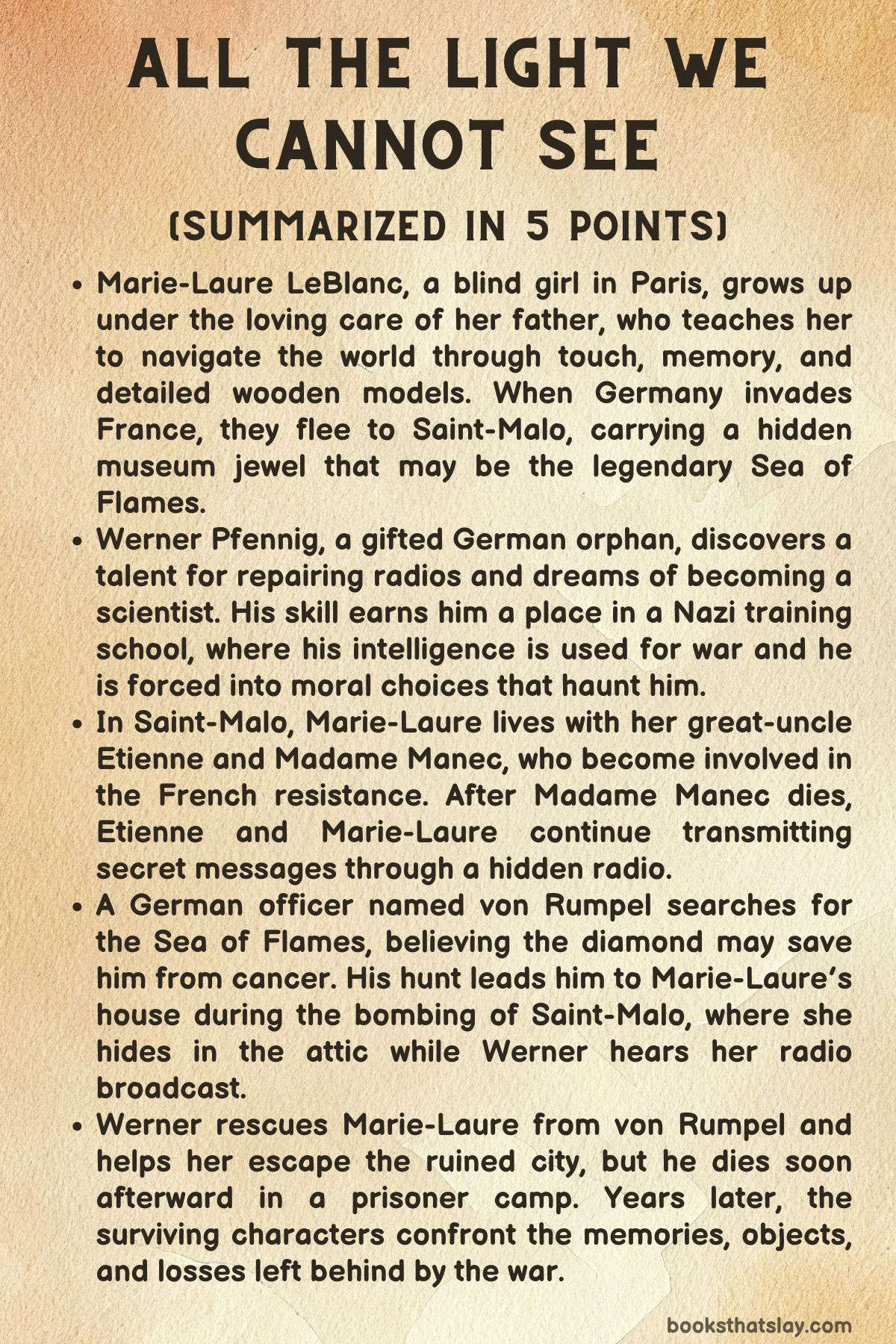
Characters
Marie-Laure LeBlanc
Marie-Laure is the emotional and moral center of All the Light We Cannot See. Her blindness is not treated as a simple symbol of weakness; instead, it becomes one part of the way she learns to read and survive the world.
As a child in Paris, she depends deeply on her father, but she is also trained by him to trust memory, touch, sound, and reason. The model neighborhoods he builds for her are not just tools of navigation; they represent his belief that she can belong fully in the world.
Marie-Laure grows from a frightened child into a young woman capable of courage under extreme pressure. Her love of the sea, shells, books, and scientific knowledge gives her an inner life that war cannot fully destroy.
In Saint-Malo, after her father is arrested, she faces abandonment, occupation, hunger, fear, and danger, yet she continues to act with intelligence and restraint. Her decision to help Etienne with resistance messages shows that she is not passive.
She understands danger but refuses to let fear become her only guide. In the final crisis, when von Rumpel searches the house, she survives through patience, discipline, and the skills her father gave her.
Marie-Laure’s strength is quiet but firm: she endures loss without becoming cruel, and she protects the memory of love even when almost everyone she loves is gone.
Werner Pfennig
Werner is one of the most tragic figures in the novel because his intelligence is both his gift and his trap. As an orphan in Zollverein, he is curious, inventive, and tender, especially with his sister Jutta.
His early fascination with radios shows his hunger for a larger world beyond coal mines and poverty. The French broadcasts he hears as a child awaken in him a belief that knowledge can free a person.
Yet that same talent draws the attention of the Nazi system, which turns his skill into a military weapon. Werner wants to escape the mines, and his desire is understandable, but every step away from that fate pulls him closer to moral compromise.
At the training school, he learns to stay silent when others are harmed, especially Frederick. His failure to defend Frederick becomes a lasting wound because it proves that intelligence alone is not courage.
Later, in the army, Werner locates enemy transmissions, knowing that his calculations lead to deaths. His guilt grows as he sees civilians killed and homes destroyed.
His turning point comes in Saint-Malo, when he recognizes Etienne’s broadcast and chooses not to report it. By saving Marie-Laure, he finally acts against the machine that has shaped him.
Werner’s death soon afterward does not erase his guilt, but it gives his life a final act of moral clarity.
Daniel LeBlanc
Daniel LeBlanc is defined by devotion, patience, and practical love. As Marie-Laure’s father, he refuses to treat her blindness as a reason to shrink her life.
Instead, he teaches her independence by building models, setting challenges, and trusting her to learn. His love is active rather than sentimental.
He makes puzzle boxes, walks routes with her, places objects in her hands, and gives her the tools to understand space. His work as a locksmith at the Natural History Museum also reflects his character.
He is careful, methodical, loyal, and protective of valuable things, whether those things are museum treasures or his daughter’s confidence. When he carries one of the stones out of Paris, he becomes trapped between public duty and private responsibility.
He does not know whether he carries the real Sea of Flames, but the secret places him in danger and indirectly places Marie-Laure in danger too. His arrest is one of the story’s deepest losses because his absence leaves Marie-Laure emotionally unmoored.
Even when he is imprisoned, his letters try to comfort her, hiding the truth of his suffering. Daniel represents the kind of goodness that works through daily care.
He cannot protect Marie-Laure forever, but the habits, courage, and knowledge he gives her continue to protect her after he is gone.
Jutta Pfennig
Jutta is Werner’s conscience and one of the clearest moral voices in the novel. As a child, she shares Werner’s love of radio, imagination, and learning, but she responds differently to the world they hear through the airwaves.
While Werner is drawn to possibility and escape, Jutta listens for truth. She hears reports of German violence and refuses to excuse them.
Her warning to Werner before he leaves for the Nazi school is one of the strongest moral statements in the story: doing what everyone else does does not make it right. Jutta cannot stop Werner, but she sees the danger in his desire to belong.
Her anger comes from love as much as judgment. She understands that the system will not simply educate him; it will change him.
After the war, Jutta carries trauma, grief, and shame. She does not romanticize memory or believe easily in healing.
Her journey to Saint-Malo years later is not a simple search for closure. It is an attempt to face the remains of Werner’s life and understand what he became before he died.
Through Jutta, the novel examines what it means to survive a guilty nation’s history. She is not responsible for Werner’s choices, yet she inherits the pain of them.
Etienne LeBlanc
Etienne is a wounded man whose fear has shaped his life for decades. After surviving the First World War, he retreats into his house and avoids the outside world, haunted by trauma and panic.
At first, he seems fragile and removed from the conflict around him, but his sensitivity is not weakness. His room of radios, records, books, and scientific memories shows a mind that remains alive even while his body stays hidden.
His relationship with Marie-Laure gives him a reason to rejoin life. He reads to her, shares his memories, and gives her access to the hidden world of broadcasts and ideas.
Madame Manec’s death and example push him further. When he takes over the resistance broadcasts, he transforms from a man ruled by fear into a man willing to risk himself for others.
His courage is not sudden or easy; it is painful because every trip beyond the house forces him to confront old terror. That is what makes his bravery meaningful.
Etienne does not become fearless. He acts despite fear.
His love for Marie-Laure and his loyalty to Madame Manec’s values help him recover a sense of purpose. He represents the possibility that a damaged person can still choose action, service, and renewal.
Madame Manec
Madame Manec is one of the novel’s strongest examples of ordinary resistance. She is elderly, practical, generous, and sharp-willed.
In Saint-Malo, she feeds people, cares for the vulnerable, welcomes Marie-Laure and Daniel, and keeps the household alive under occupation. Her courage is rooted in daily life.
She does not begin as a soldier or political leader; she begins as someone who refuses to accept humiliation and cruelty as normal. Her resistance starts with small acts, but those acts matter because they rebuild dignity among people who feel powerless.
She organizes women, passes information, helps neighbors, and challenges Etienne’s passivity. Her argument that doing nothing can become a form of cooperation with evil is central to her character.
Madame Manec also gives Marie-Laure a model of fearless public action, balancing Daniel’s private protection with a wider sense of duty. Her death is a turning point because it forces Etienne and Marie-Laure to decide whether her work will end with her.
In that sense, she continues to influence the plot after she is gone. Madame Manec shows that resistance is not only dramatic sacrifice; it is also food, friendship, stubbornness, shared risk, and the refusal to let fear decide everything.
Frank Volkheimer
Volkheimer is physically powerful, disciplined, and difficult to read. At the Nazi school, he functions as Werner’s protector, but also as a reminder of the violent system Werner has entered.
He is not sentimental, yet he is not empty either. His size and strength make him useful to the school and later to the army, but his relationship with Werner suggests a quiet capacity for care.
He recognizes Werner’s value and shields him in practical ways. On the battlefield, Volkheimer becomes part of the machinery of killing, helping carry out missions based on Werner’s radio calculations.
Yet he is also shown as a man who has been shaped, used, and damaged by war. In the basement of the Hotel of Bees, trapped under rubble, he becomes a figure of endurance.
His decision to blast open the stairwell after hearing the music is important because it allows Werner to reach Marie-Laure. Decades later, Volkheimer lives alone, marked by the past.
His effort to return Werner’s belongings to Jutta suggests that he has not forgotten and perhaps cannot forgive himself easily. He represents the survivors who continue physically after war but remain emotionally caught inside it.
Reinhold von Rumpel
Von Rumpel is the novel’s clearest human antagonist, though he is more than a simple treasure hunter. As a Nazi gem expert, he serves a regime that steals art, jewels, and wealth from occupied people and murdered victims.
His work shows how violence can be made bureaucratic and professional. He does not always need to shout or strike; he uses rank, threat, knowledge, and patience.
His search for the Sea of Flames becomes increasingly desperate after his cancer diagnosis. The legend of the diamond gives his greed a personal urgency.
He wants not only possession but survival, and this makes him more dangerous. His sickness strips away the polished surface of authority and reveals obsession beneath it.
He follows clues from Paris to Saint-Malo, invading private spaces and interpreting every object as a possible hiding place. His pursuit of the stone contrasts with Marie-Laure’s eventual decision to return it to the sea.
Von Rumpel sees the world as something to be seized and used, while Marie-Laure learns to release what brings harm. His death at Werner’s hands closes the immediate threat, but his character also exposes the larger theft at the heart of occupation: the attempt to possess people, places, memory, and culture.
Frederick
Frederick is gentle, observant, and morally brave in a setting designed to destroy those qualities. At Schulpforta, he does not fit the model of the ideal Nazi youth.
He loves birds, beauty, books, and private thought. His poor eyesight and sensitive nature make him vulnerable, but his true difference lies in his refusal to surrender his conscience.
When ordered to participate in cruelty, he refuses. This act is simple but enormous because everyone around him has been trained to obey.
Frederick’s punishment exposes the school’s real purpose. It is not merely educating boys; it is breaking compassion out of them.
His suffering also reveals Werner’s weakness. Werner knows Frederick is better than the system that abuses him, yet he does not defend him.
Frederick’s later brain injury is one of the novel’s harshest reminders that innocence and moral courage do not guarantee protection. In 1974, his damaged life continues quietly, and the bird prints Werner sent him arrive far too late to restore what was taken.
Still, his brief attention to the owl suggests that something of his old self remains. Frederick represents the beauty that authoritarian violence cannot understand and therefore tries to crush.
Frau Elena
Frau Elena is a protective mother figure in Werner and Jutta’s early lives. As the head of the orphanage, she raises children with limited resources but real care.
She gives them structure, food, language, songs, and affection in a world where they have little security. Her Alsatian background and French speech place her in a vulnerable position as nationalism hardens around her.
When the older boys become absorbed into Nazi youth culture, she becomes more cautious, even afraid of her own accent. This change shows how authoritarian systems invade ordinary homes and make people police their speech, memories, and identities.
Frau Elena cannot save Werner from the state’s plans for him, just as she cannot fully shield the children from war. Yet her kindness matters because it forms part of Werner’s early moral world.
He has known care before he knows brutality. In the later horrors of Berlin, Frau Elena’s presence with the girls from the orphanage carries both comfort and helplessness.
She represents the adults who try to protect children while history becomes too violent for private goodness alone to hold back.
Sergeant Major Bastian
Bastian embodies institutional cruelty. As the field commandant at Werner’s school, he teaches boys to identify weakness, attack it, and call that violence discipline.
His methods are designed to turn children against one another so that obedience becomes instinctive and pity becomes shameful. He does not simply punish; he stages cruelty as a lesson.
By forcing boys to name the weakest among them, he makes them participants in the system’s values. This is especially important in Werner’s development because Bastian’s world rewards silence and punishes compassion.
Under his authority, boys learn that survival may depend on betraying someone more vulnerable. Bastian is not given the emotional depth of some other characters because his role is structural.
He represents the training ground of fascism, where children are reshaped into instruments of the state. His cruelty toward Frederick is not random; it is the logical outcome of a worldview that worships strength and despises tenderness.
Through him, the novel shows that violence in war begins before the battlefield. It begins in classrooms, drills, tests, slogans, and the repeated demand that young people stop seeing one another as human.
Dr. Hauptmann
Dr. Hauptmann recognizes Werner’s brilliance and gives him the intellectual attention he craves. To Werner, this attention feels like rescue because it separates him from the mines and from the ordinary brutality of school life.
Yet Hauptmann’s mentorship is morally dangerous. He does not nurture Werner’s talent for Werner’s sake; he develops it for military use.
The mathematics, circuits, and radio technology that once filled Werner with wonder become tools for locating people who will be killed. Hauptmann represents the corruption of knowledge when it is severed from conscience.
He is not as openly brutal as Bastian, but his influence may be more damaging because it appeals to Werner’s dreams. He offers Werner a version of the future he wants while hiding the cost.
When Werner asks to go home, Hauptmann’s refusal reveals the truth: Werner is not a free student but a resource owned by the state. Hauptmann’s character shows how science and education can be absorbed into systems of violence when ambition, obedience, and national service replace ethical responsibility.
Madame Ruelle
Madame Ruelle, the baker’s wife, plays a quiet but essential role in the resistance network of Saint-Malo. Her bakery becomes a place where ordinary routine hides dangerous work.
Bread, one of the simplest symbols of daily survival, becomes a carrier of secret messages. Madame Ruelle’s courage lies in her ability to appear normal while taking serious risks.
She is not as forceful as Madame Manec, but she continues the work even as danger grows. Her help in finding Marie-Laure after the grotto incident shows her loyalty not just to the cause but to the people within it.
After the bombing, she also helps reconnect Marie-Laure with safety and with Etienne. Madame Ruelle represents the many people whose resistance depends on secrecy, trust, and repetition.
She shows that heroism is often hidden inside ordinary labor. The war effort against occupation is not carried only by fighters with weapons; it is also carried by bakers, housekeepers, old women, and neighbors willing to risk punishment for small acts that save lives.
Hubert Bazin
Hubert Bazin is a damaged veteran and outsider whose presence connects Saint-Malo’s past with its wartime present. His scarred face and unstable social position make others see him as strange, but he becomes important to Marie-Laure.
He tells her stories of the city, gives her access to the grotto, and expands her sense of Saint-Malo as a place filled with history beneath its streets and walls. Like Etienne, Bazin carries the wounds of an earlier war, reminding the reader that violence does not end when battles stop.
His disappearance suggests the danger faced by those who help the resistance, especially people already living on the margins. Bazin’s gift of the grotto key later becomes crucial because the grotto is where Marie-Laure returns the Sea of Flames to the sea.
His role may seem small, but it is symbolically strong. He gives Marie-Laure a hidden passage into the city’s deeper life, and that hidden place becomes the answer to the curse, the chase, and the burden left by her father.
Big Claude
Big Claude is a collaborator shaped by greed and self-preservation. As a perfumer who profits during occupation, he adjusts himself to power rather than resisting it.
He notices Daniel’s suspicious activity and understands that information has value under German rule. His willingness to inform makes him dangerous because he is local; he knows the people, the streets, and the habits of Saint-Malo.
Unlike von Rumpel, he does not need an ideology or a grand obsession. His betrayal is smaller, more ordinary, and therefore disturbing in a different way.
He shows how occupation corrupts communities by rewarding suspicion and selfishness. Big Claude’s actions help lead von Rumpel toward the LeBlancs, placing Marie-Laure in danger.
He represents the moral collapse that happens when people treat survival and profit as excuses for betrayal. In a novel filled with people who risk themselves for others, Big Claude stands as a contrast: a person who uses the suffering of his neighbors as an opportunity.
Themes
The Moral Cost of Obedience
Obedience is shown as one of the most dangerous forces in the novel because it often appears reasonable before it becomes monstrous. Werner does not join the Nazi school because he begins as cruel or hateful.
He joins because he wants a future beyond the mines, because adults praise him, because the state offers him a path that seems rare for a poor orphan. Yet once inside that system, obedience demands more from him at every stage.
He must accept the humiliation of weaker boys, ignore Frederick’s suffering, use his intelligence for military violence, and remain silent when he knows the difference between right and wrong. The tragedy is that each compromise feels survivable in the moment, but together they change his life.
The novel shows that systems of violence depend not only on fanatics but also on frightened, gifted, ordinary people who convince themselves that they have no choice. Jutta’s role makes this theme sharper because she sees early what Werner tries not to see.
Her moral clarity exposes the excuses Werner uses to survive. By the time Werner acts against orders in Saint-Malo, the cost of his obedience has already become immense.
His final act matters, but it cannot undo the harm that silence allowed.
The Power and Danger of Invisible Signals
Radio signals, voices, memory, propaganda, and unseen emotional bonds shape the lives of the characters as strongly as physical events. Werner’s childhood is transformed by radio because it carries knowledge into a poor orphanage and gives him a sense of wonder beyond the coal town.
The French science broadcasts connect him to Marie-Laure’s family long before he knows her name. Yet radio is also used by the Nazi state to spread propaganda, control thought, and organize violence.
The same technology that teaches children about light can lead soldiers to hidden transmitters and cause deaths. This double nature is central to All the Light We Cannot See.
Invisible signals are neither pure nor corrupt by themselves; their moral meaning depends on how people use them. Etienne’s secret broadcasts become acts of resistance, while Werner’s tracking equipment becomes an instrument of war.
Later, Marie-Laure’s voice reaches Werner from the attic and gives him a reason to live and act. The novel treats communication as fragile but powerful.
A voice can cross borders, survive darkness, and reach someone at the exact moment when a choice must be made. What cannot be seen may still guide, damage, save, or haunt.
War’s Damage to Children and Innocence
The novel repeatedly shows children being forced into adult terror before they can understand or resist it. Marie-Laure loses her home, her father, and her safety, yet must learn to survive in an occupied city.
Werner and Jutta grow up inside a Germany where poverty, propaganda, and state power narrow childhood into training. Frederick is perhaps the clearest example of innocence punished by violence.
His love of birds, drawing, and beauty has no place in a school that values hardness, obedience, and aggression. Because he refuses cruelty, he is destroyed by it.
The damage is not limited to physical injury. Werner’s imagination, once filled with invention and scientific wonder, is redirected toward locating people for death.
Jutta’s childhood moral awareness becomes adult trauma. Even after the war, the survivors carry wounds that cannot be neatly healed.
The later scenes with Jutta, Frederick, Volkheimer, and Marie-Laure show that war continues long after the fighting ends. Childhood objects such as notebooks, model houses, radio lessons, puzzle boxes, and books return decades later carrying both tenderness and pain.
The novel refuses to treat children as symbols of simple hope. Instead, it shows how war uses, breaks, scatters, and sometimes fails to fully erase them.
Possession, Loss, and Letting Go
Objects in the novel carry enormous emotional weight: keys, radios, books, shells, models, letters, bread, stones, and notebooks. People hold onto them because they preserve memory, identity, duty, or hope.
Daniel’s models help Marie-Laure possess a map of the world through touch. Werner’s notebook preserves the boy he was before the war claimed his talent.
Etienne’s radios preserve the voice of his dead brother and later become tools of resistance. The Sea of Flames is the most extreme example of possession because it inspires secrecy, pursuit, and obsession.
Von Rumpel believes that owning the diamond may save him from death, so he turns the object into a substitute for life itself. Daniel hides it because he is loyal to the museum and to France, but the hiding places also create danger for his daughter.
Marie-Laure’s final decision to leave the stone in the grotto is therefore a rejection of ownership as salvation. She chooses release over control.
This theme also appears in grief. Characters cannot recover the dead by clinging to objects, yet objects can help them face what happened.
Jutta’s meeting with Marie-Laure does not restore Werner, but it allows his memory to move from secrecy into shared truth. Letting go does not erase loss; it changes the way the living carry it.