All Your Perfects Summary, Characters and Themes
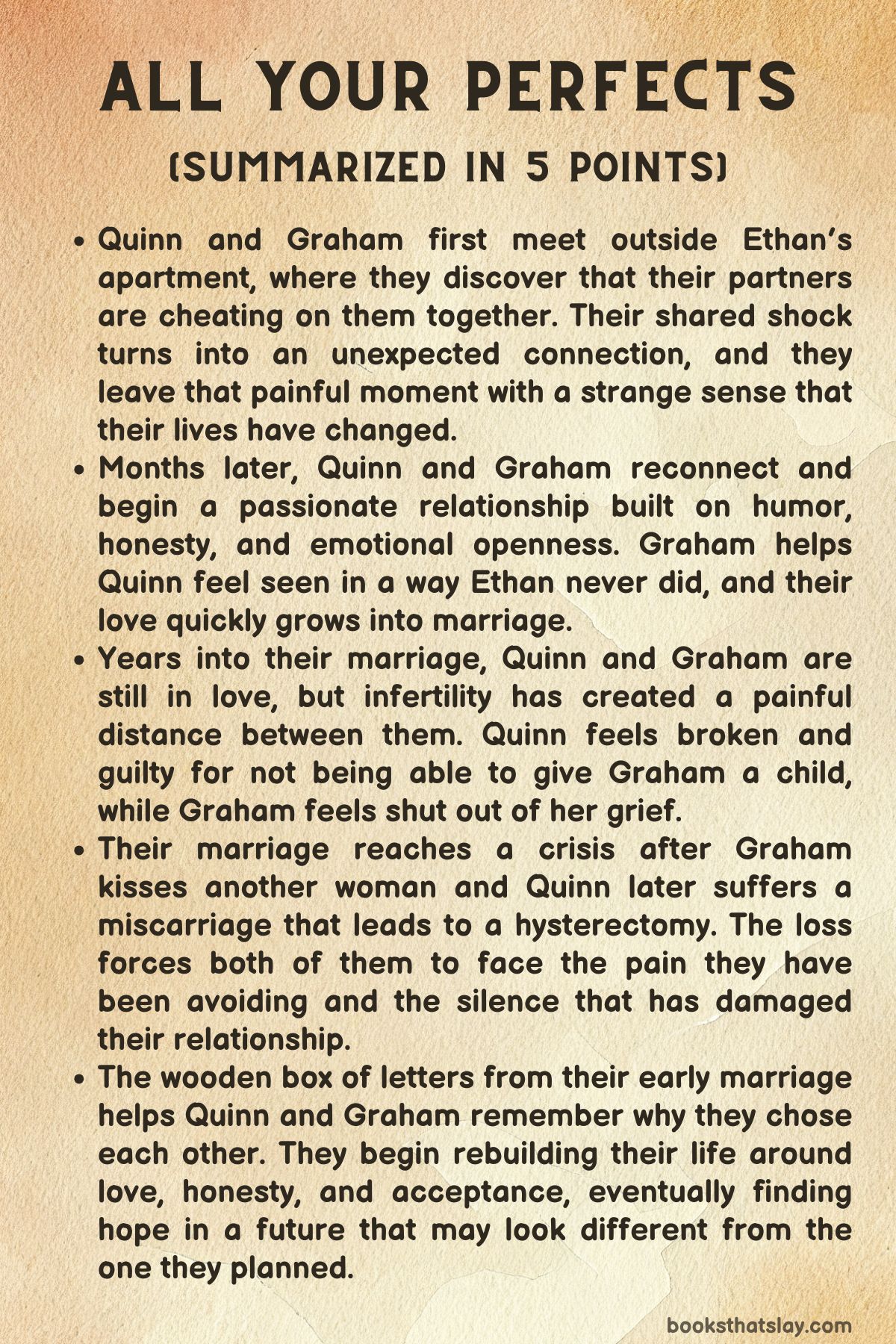
All Your Perfects by Colleen Hoover is a contemporary romance about love after disappointment, and about what happens when the dream a couple built their future on begins to collapse. The novel follows Quinn and Graham across two timelines: the bright beginning of their relationship and the painful present of their marriage.
Their story is shaped by betrayal, infertility, silence, guilt, and the fear of not being enough. At its center, All Your Perfects asks whether love can survive when two people stop recognizing themselves, and whether a marriage can be rebuilt when hope has changed form.
Summary
Quinn’s life changes on the day she goes to surprise her fiancé, Ethan, after returning early from a business trip. She arrives at his apartment expecting a romantic reunion, but instead finds a stranger waiting outside the door.
The stranger is Graham, who tells her that his girlfriend, Sasha, is inside with Ethan. Quinn refuses to believe him at first.
Ethan is her fiancé, their wedding is approaching, and her life has been planned around him. But as sounds from inside the apartment make the truth impossible to deny, Quinn and Graham are forced to sit together in the hallway while the people they trusted betray them.
Their first meeting is strange, painful, and unexpectedly honest. Quinn worries about the humiliation of canceling the wedding and about her mother Avril’s likely reaction.
Graham, though hurt, remains calm and steady. When Chinese food arrives at the apartment, Quinn is especially upset because ordering Chinese food after sex was something she associated with herself and Ethan.
Instead of letting Ethan and Sasha have it, Quinn and Graham take the food and eat it together. Their fortune cookies become meaningful: one tells Quinn that focusing only on flaws will dim everything perfect.
That line becomes a key idea in the novel.
When Ethan and Sasha finally emerge, Quinn and Graham leave together without giving them the satisfaction of a breakdown. Outside, Graham offers to help Quinn, but she drives away.
Still, something about him stays with her. He impresses her in one hour more than Ethan had in years.
The novel then moves between the early days of Quinn and Graham’s love and the later years of their failing marriage. In the present, Quinn and Graham still love each other, but their marriage feels almost over.
Their home is full of silence, avoided conversations, and physical distance. A wooden box sits between them as a symbol of the relationship they once had and the emergency they are now afraid to face.
The central wound in their marriage is infertility. Quinn has endometriosis, and after years of failed attempts, failed IVF treatments, rejection from adoption agencies, and financial strain, she begins to see herself as broken.
Her grief changes how she feels about her body, sex, and her future. Intimacy with Graham, once joyful, becomes tied to ovulation, pregnancy tests, and disappointment.
Each period feels like another loss. Quinn hides her pain in long showers, online support groups, and emotional withdrawal.
She believes she is keeping Graham from the life he wants: fatherhood.
Graham, meanwhile, is also suffering. He wants children, but more than that, he wants Quinn.
He tries to comfort her, give her space, and keep loving her even as she pulls away. But Quinn’s silence leaves him lonely.
They stop talking honestly because each is trying not to hurt the other. The more Quinn thinks she is protecting Graham from her grief, the more isolated he becomes.
Their past shows why their present feels so tragic. After meeting outside Ethan’s apartment, Quinn and Graham reconnect months later by chance at a restaurant while both are on dates with other people.
Their attraction is immediate and powerful. Graham shows up at Quinn’s apartment, and instead of beginning with sex, they talk, joke, and begin to build a bond.
Graham is confident that they are meant to be together. Quinn is cautious but drawn to his openness.
Their relationship grows quickly. Graham introduces Quinn to his family, who are warm and welcoming, unlike Quinn’s mother.
Quinn’s mother, Avril, is critical, image-conscious, and never truly maternal. She preferred wealth, status, and appearances, and she never fully accepted Graham as good enough for Quinn.
Graham, however, sees Quinn clearly. When Quinn feels ashamed of her family and hurt by her mother’s coldness, Graham tells her that the person she became despite that upbringing is remarkable.
This is the moment Quinn knows she loves him.
Graham also has his own painful past. When he was younger, he drove after drinking because he was the least drunk among his friends.
A truck ran a stop sign and hit the car, killing his best friend Tanner and injuring Tanner’s brother. Although the accident was not entirely his fault, Graham carries deep guilt.
Quinn accepts this part of him without judgment. Their honesty creates a strong foundation, and they begin to imagine a life together.
At a beach house, they talk about children, marriage, faith, the universe, and the future. Graham proposes with a simple gold band, describing it as endless, like the love he believes they will share.
Quinn accepts. Later, overwhelmed by wedding planning and her mother’s interference, the couple elopes at the beach house.
As a wedding gift, Graham gives Quinn a wooden box. Inside, they place love letters they wrote to each other.
They agree to open the box on their twenty-fifth anniversary, or sooner only in a true relationship emergency, such as divorce. It becomes their promise that if they ever reach a breaking point, they will first return to the love that began their marriage.
In the present, Quinn and Graham are very near that breaking point. Their relationship is strained further when Quinn’s sister Ava becomes pregnant.
Quinn loves Ava and is happy for her, but the news deepens her own pain. Around the same time, Quinn overhears Graham holding his newborn nephew and admitting that he is devastated he has not become a father.
This confirms Quinn’s worst fear: that Graham is suffering because of her. Instead of talking to him, she lies about not having made it to the visit and retreats further.
Graham’s loneliness grows. One night, Quinn suspects he has been unfaithful.
When she confronts him, he admits the woman’s name is Andrea. He later explains that he did not sleep with Andrea, but he did kiss her.
Andrea reminded him of Quinn, and in his pain and anger, he reached for someone else because he missed his wife. Quinn is furious, not only because of the betrayal, but because her first relationship ended the same way.
Graham’s mistake cuts into one of her deepest wounds.
Quinn leaves for her mother’s house but cannot stay. She has a rare honest moment with Avril, asking why someone who never wanted children was given them when Quinn wants them so desperately.
Avril admits that motherhood did not fit the life she had imagined, but says she tried in her own way and is grateful for Quinn and Ava. The exchange does not fix everything, but it gives Quinn a clearer view of her mother.
Back home, Quinn and Graham argue in the car. Graham tells her that he kissed Andrea not because he wanted someone else, but because he felt abandoned in their marriage.
Quinn accuses him of trying to justify his affair. Graham insists he loves her and always has, no matter how much she seems to wish he did not.
Soon after, Quinn suffers severe pain and bleeding. Graham rushes her to the hospital, where they learn she had a rare cervical ectopic pregnancy that ended in miscarriage.
Because of the danger and bleeding, doctors perform a hysterectomy. Quinn loses the ability to carry a child.
The tragedy briefly gives her proof that she had been pregnant, but it also ends the possibility of pregnancy forever.
While recovering, Quinn goes to Europe to stay with Ava. She does not speak to Graham for weeks.
Eventually, Graham arrives and tells her she must choose: come home or leave him. He cannot continue living in uncertainty.
He brings the wooden box. Quinn does not stop him from opening it, and inside she finds not only their original letters, but several more letters Graham wrote over the years.
The letters reveal what Graham could not say aloud. He describes his helplessness as he watched Quinn suffer, his willingness to continue fertility treatments mainly because he knew how much motherhood meant to her, and his fear that he no longer brought her happiness.
He admits that after realizing Quinn saw him with his nephew, he felt as though his presence only caused her pain. He wonders if kissing Andrea was a terrible way of giving Quinn a reason to leave him and seek happiness without guilt.
But his letters also make clear that he loves her deeply and will accept whatever choice she makes.
Reading the letters breaks through the silence between them. Quinn tells Graham she loves him.
She forgives him, and she also apologizes for shutting him out. They begin to understand that infertility did not destroy them by itself; avoiding each other did.
Quinn remembers an earlier anniversary when they imagined two possible futures: one with children and one without. At the time, she had said both would be perfect because they would still have each other.
She realizes she lost sight of that truth.
Quinn and Graham decide to rebuild their marriage around what remains, not what they lost. They talk about dreams that do not center only on children.
They consider moving closer to Ava and Reid. The fortune-cookie message returns to Quinn: by focusing only on what was missing, she had stopped seeing the good things still present in her life.
Graham, their love, and the life they can still make together are enough to begin again.
Two years later, Quinn and Graham are stronger. They still face awkward questions about children, but they handle them with humor, sometimes inventing fake answers as a private game.
Quinn has not fully abandoned the idea of adoption, but motherhood is no longer the only measure of a complete life. Their marriage has been rebuilt on honesty, acceptance, and the understanding that love must be cared for even when life does not go as planned.
When they find a puppy in a pet store, they adopt him and name him August, honoring the date that brought them back together and the number eight that has followed their love story from the beginning.
Characters
Quinn
Quinn is the emotional center of the novel, and her character is shaped by a painful contrast between who she was at the beginning of her relationship and who she becomes inside her marriage. In the early timeline, she is guarded but still open to surprise.
Her betrayal by Ethan wounds her deeply, yet her meeting with Graham reveals that she can still respond to humor, tenderness, and emotional honesty. She is thoughtful, self-aware, and often quietly observant, noticing small shifts in people’s behavior before she is ready to admit what they mean.
In the present timeline, Quinn has become consumed by infertility, not because motherhood is a casual wish for her, but because it has become tied to her sense of identity, worth, and future. She does not simply mourn the absence of a child; she begins to mourn the woman she thought she would become.
This grief makes her withdraw from Graham, even though she still loves him. Her silence is not cruelty but self-protection, yet it damages the marriage because she mistakes emotional distance for strength.
Quinn’s journey in All Your Perfects is about learning that loss does not have to erase love, and that a life can still be meaningful even when it does not match the version she once imagined.
Graham
Graham is presented as loving, patient, charming, and emotionally expressive, but he is not idealized as perfect. His early relationship with Quinn shows him as bold and unusually certain about love.
He pursues Quinn with confidence, but not carelessness; he is attentive, funny, and deeply interested in who she is beyond her heartbreak. He becomes the kind of partner who sees Quinn’s best qualities when she cannot see them herself.
In marriage, however, Graham’s devotion is tested by years of infertility and by Quinn’s increasing emotional absence. His pain is complicated because he wants to support Quinn without making her feel guilty, but he also wants to be seen in his own grief.
His kiss with Andrea is a serious betrayal, and the novel does not excuse it, but it does place it inside a wider pattern of loneliness, avoidance, and despair. Graham’s letters reveal a man who has been trying to hold the marriage together while also feeling helpless inside it.
He carries guilt from his past accident, guilt from wanting fatherhood, guilt from hurting Quinn, and guilt from not knowing how to reach her. His strongest trait is his willingness to keep choosing Quinn, even after he makes a damaging mistake.
Ethan
Ethan functions less as a deeply developed character and more as the first example of betrayal in Quinn’s adult life. He represents the kind of stability Quinn thought she had before discovering that her future with him was built on dishonesty.
His affair with Sasha destroys Quinn’s engagement and humiliates her, but it also frees her from a relationship that may have looked secure without being emotionally meaningful. Ethan’s reaction when Quinn catches him is important because he does not seem as devastated or remorseful as he should be.
His behavior suggests emotional shallowness and selfishness. He had a polished life, an approved place in Quinn’s mother’s social world, and the appearance of being a suitable husband, but those surface qualities hide a lack of loyalty.
Through Ethan, the story shows how appearances can deceive. He may have been the man Quinn was supposed to marry, but he was not the person capable of loving her in the way she needed.
Sasha
Sasha, like Ethan, is introduced through betrayal, but her role has a slightly different emotional weight because she is Graham’s girlfriend. Her affair with Ethan creates the situation that brings Quinn and Graham together, making her part of the painful accident that leads to the central relationship.
Sasha’s actions are selfish and hurtful, yet Graham later describes her as someone who is not entirely bad, only someone capable of making terrible choices. That detail matters because it reflects Graham’s generous way of understanding people.
Sasha’s presence also creates insecurity in Quinn. Quinn wonders why Sasha would give up Graham, and she compares herself to Sasha in the aftermath of the affair.
Sasha therefore becomes part of Quinn’s early anxiety about desirability and worth. She is not explored in great depth, but she serves as a reminder that betrayal is rarely just about the act itself; it also leaves the betrayed person questioning their own value.
Avril
Avril is Quinn and Ava’s mother, and she is one of the strongest influences on Quinn’s emotional life. She is status-conscious, controlling, and often insensitive, especially when she discusses Quinn’s infertility in public or judges Graham against Ethan.
Avril’s parenting style is cold and self-serving. She shows care through money, appearances, and control rather than through emotional warmth.
Her quick remarriage after Quinn’s father’s death and her tendency to reshape her daughters’ lives according to her preferences show how uncomfortable she is with genuine vulnerability. Yet Avril is not written as a simple villain.
Her honesty later in the story reveals that motherhood never came naturally to her and that children did not fit the life she had imagined for herself. This does not erase the harm she causes, but it gives context to her failures.
Avril helps explain why Quinn struggles to ask for help, why she fears judgment, and why she has learned to carry pain privately. In a painful way, Avril also reflects one of the novel’s deepest questions: why some people who long for children cannot have them, while others who never desired motherhood are given that role.
Ava
Ava is Quinn’s sister and emotional support system. She understands Quinn in a way few other characters do, partly because they share the same difficult mother and partly because their bond is built on honesty, humor, and loyalty.
Ava is careful with Quinn’s pain, sometimes too careful, as seen when she worries about how to tell Quinn she is pregnant. Her hesitation hurts Quinn because it makes Quinn feel like her grief has turned her into someone others must handle gently.
Still, Ava’s intentions are loving. She does not try to compete with Quinn or minimize her pain.
Instead, she gives Quinn space to feel conflicting emotions: happiness for Ava and sorrow for herself. Ava’s move to Europe creates another loss for Quinn at a time when she already feels isolated, but it also becomes a place of refuge after Quinn’s surgery and marital crisis.
Ava represents family as chosen emotional safety rather than obligation. Unlike Avril, she is nurturing without being controlling, and her presence helps Quinn survive the hardest parts of the story.
Reid
Reid, Ava’s husband, has a smaller role, but he contributes warmth and stability to the family circle. He is kind to Quinn during her stay in Europe and does not treat her as a burden.
His reassurance that her presence helps Ava shows his sensitivity and generosity. Reid also connects well with Graham in the earlier timeline, helping Graham become part of Quinn’s extended family in a way that feels natural and easy.
While he is not central to the main conflict, Reid represents a healthy kind of partnership. His relationship with Ava offers a quieter contrast to Quinn and Graham’s troubled marriage.
He is supportive without demanding attention, and his role is important because he helps create the safe environment Quinn needs when she is recovering physically and emotionally.
Caroline
Caroline, Graham’s sister, represents the family life Graham and Quinn are both close to and painfully separated from. Quinn cares about Caroline’s children and is involved in their lives, but being around pregnancy and babies also intensifies her grief.
Caroline does not intend to hurt Quinn when she comments that Graham would be a good father, yet Quinn overhears the remark at the worst possible moment. That scene is important because Caroline gives voice to something Quinn already fears: that Graham’s natural tenderness with children means he is being denied something essential by staying with her.
Caroline is not cruel; she is part of a loving family that welcomes Quinn. But her motherhood becomes emotionally difficult for Quinn to witness.
Through Caroline, the novel shows how ordinary happiness in one person’s life can become a source of pain for someone else, even when no harm is intended.
Andrea
Andrea is the woman Graham kisses during the lowest point of his marriage. She is not developed as a full romantic rival, and that is significant.
Her purpose is not to replace Quinn but to expose how broken Graham and Quinn’s connection has become. Graham is drawn to Andrea partly because her gestures remind him of Quinn, which makes the betrayal more painful and more tragic.
Andrea becomes a symbol of Graham’s loneliness and his desperate desire to feel close to the version of Quinn he misses. Still, Graham’s explanation does not remove his responsibility.
Andrea’s presence forces the marriage into crisis and pushes Quinn and Graham toward the wooden box they had avoided. In that sense, Andrea is less important as an individual than as a sign of emotional collapse.
She represents the danger that grows when pain is left unspoken for too long.
Tanner
Tanner is Graham’s best friend who died in the accident that changed Graham’s life. Although Tanner is not present in the main action, his death shapes Graham’s guilt, caution, and emotional depth.
Graham’s past with Tanner explains why he carries responsibility so heavily and why he is haunted by the idea that one mistake can permanently damage lives. His guilt over Tanner’s death also affects his relationship with alcohol and his view of himself.
He knows what it means to live after a terrible event, and that history makes him both compassionate and burdened. Tanner’s role helps readers understand Graham’s fear of causing pain and his tendency to blame himself even for things outside his control, including Quinn’s miscarriage before the doctor explains what happened.
Alec
Alec, Tanner’s younger brother, is another part of Graham’s traumatic past. He survives the accident but is injured, which adds another layer to Graham’s guilt.
Tanner’s death alone would have been devastating, but Alec’s suffering means Graham must live with the knowledge that the accident harmed more than one person. Alec’s role is brief, yet he matters because he shows that Graham’s past is not abstract.
It involves real people, real consequences, and a wound that never fully disappears. Graham’s confession about the accident allows Quinn to see the broken places in him, just as he later sees hers.
In this way, Alec is connected to the novel’s larger interest in how people carry old pain into new love.
Themes
Infertility, Identity, and Self-Worth
Infertility in All Your Perfects is not treated as only a medical problem; it becomes an emotional force that changes how Quinn sees herself, her marriage, her body, and her future. Quinn’s inability to conceive makes her feel defective, even though she has no moral or personal failure to answer for.
Her grief grows because motherhood is not just something she wants; it is something she has imagined as part of her identity for years. Failed treatments, rejected adoption attempts, financial strain, and the constant arrival of other people’s pregnancy news make her feel trapped in a cycle of hope and disappointment.
The tragedy is that Quinn begins to measure her value through the one thing her body cannot give her. She stops seeing the parts of herself that Graham loves because she is focused on the absence she cannot fix.
The theme becomes especially powerful because infertility also changes intimacy. Sex, once joyful and connecting, turns into a scheduled act tied to ovulation and possible failure.
The novel shows how grief can distort love, not because the love is weak, but because the pain becomes so loud that everything else grows quiet.
Silence and Emotional Avoidance
Quinn and Graham’s marriage does not collapse because they stop loving each other; it weakens because they stop speaking honestly. Silence becomes their most dangerous habit.
Quinn avoids telling Graham how deeply she is hurting because she believes her grief is already a burden to him. Graham avoids pressing too hard because he does not want to make her feel worse.
Both think they are protecting the other, but their restraint creates distance. Quinn hides in showers, work, and private sorrow.
Graham hides his despair behind patience until it turns into loneliness and resentment. Their home becomes full of things unsaid.
The wooden box is a clear symbol of this avoidance: it contains the words that might help them, but they delay opening it because opening it would mean admitting how serious the emergency has become. This theme is powerful because it shows that love cannot survive on feeling alone.
Even sincere love needs communication, especially when pain is shared unevenly. The novel suggests that silence may feel safer in the moment, but over time it becomes its own form of harm.
Marriage Beyond the Life Once Imagined
Quinn and Graham build their marriage around love, desire, and a shared dream of having children. When that dream becomes impossible, they are forced to ask whether the marriage itself is still enough.
This question is painful because neither of them can simply erase the future they wanted. Graham did want to be a father, and Quinn did want to be a mother.
Pretending otherwise would make their healing feel false. The novel instead asks whether a couple can grieve an imagined life while still choosing the real one in front of them.
Quinn’s turning point comes when she remembers that she once believed even a childless future with Graham could be perfect because they would still have each other. Her pain made her forget that earlier truth.
Their marriage can only recover when they stop treating children as the only proof of a complete life. This does not mean giving up hope entirely, since adoption remains a possibility, but it does mean refusing to let one missing piece define the whole relationship.
Their love matures when it becomes less dependent on a planned outcome and more rooted in daily choice.
Betrayal, Forgiveness, and Accountability
Betrayal appears twice in Quinn’s romantic life, first through Ethan’s affair and later through Graham’s kiss with Andrea. These betrayals are not equal in emotional meaning, even though both wound her.
Ethan’s betrayal exposes a relationship that was already weaker than Quinn realized. Graham’s betrayal is more devastating because it damages a love that was genuine and deeply important.
The novel does not present forgiveness as quick or simple. Quinn is furious, and she has every reason to be.
Graham’s pain may explain his actions, but it does not excuse them. What makes the later forgiveness possible is not his charm or his apology alone, but his willingness to take responsibility, quit the environment connected to his mistake, and reveal the truth of his emotional state through the letters.
Forgiveness here is not about forgetting. It is about deciding whether the broken relationship still contains enough honesty and love to rebuild.
Quinn also has to face her own role in the emotional distance between them, though that does not make her responsible for Graham’s betrayal. The theme works because it separates accountability from blame.
Healing begins only when both characters tell the truth about what they did, what they felt, and what they still want.