The Alchemist Summary, Characters and Themes
The Alchemist by Paulo Coelho is a philosophical adventure novel about Santiago, a young Andalusian shepherd who leaves behind the comfort of his familiar life to search for a treasure near the Egyptian pyramids. What begins as a simple quest for wealth becomes a journey of courage, faith, love, and self-knowledge.
The book follows Santiago as he learns to read omens, trust his heart, and understand that desire can be a form of guidance. Its lasting appeal comes from its clear style and its belief that a person’s deepest dreams are worth following.
Summary
Santiago is a young shepherd from Andalusia who has chosen freedom over the life expected of him. His family once wanted him to become a priest, but Santiago wanted to know the world more than he wanted a fixed place in it.
His father, though saddened, gave him a few old coins to buy sheep and allowed him to leave. Since then, Santiago has spent his days walking with his flock across the Spanish countryside, reading books, observing the land, and speaking to his sheep as if they understand him.
He is content, yet there is a restless part of him that senses something beyond the fields and towns he already knows.
One night, while sleeping in an abandoned church with a sycamore tree growing inside it, Santiago has a recurring dream. In the dream, a child appears among his sheep, takes him to the Egyptian pyramids, and tells him that he will find treasure there.
Santiago wakes before learning the exact location. Troubled by the dream’s return, he visits an old woman in Tarifa who interprets dreams.
She tells him that he must go to Egypt, because dreams are the language of God. Santiago is disappointed by the simplicity of her answer, but she asks for a tenth of the treasure if he ever finds it.
Soon after, Santiago meets a mysterious old man named Melchizedek, who says he is the King of Salem. The old man speaks to Santiago about the world’s greatest lie: that people eventually lose control of their lives and become ruled by fate.
He tells Santiago that everyone has a Personal Legend, something they are meant to accomplish, and that when a person truly wants something, the desire comes from the soul of the universe. Melchizedek says that Santiago is close to giving up on his Personal Legend before he has even begun.
He offers to tell him how to reach the treasure in exchange for a portion of his sheep.
Santiago struggles with the decision. He thinks about the merchant’s daughter he is supposed to visit, his sheep, and the life he already understands.
Yet the old man’s words awaken something in him. Santiago sells most of his flock and gives some sheep to Melchizedek, who tells him that the treasure is near the pyramids and that he must follow the omens.
He gives Santiago two stones, Urim and Thummim, to help him when he cannot read the signs clearly. With hope and uncertainty, Santiago crosses from Spain into Africa.
In Tangier, Santiago immediately faces hardship. He does not speak Arabic and does not understand the customs of the place.
A young man who speaks Spanish offers to help him reach Egypt, but instead steals all his money. Santiago is left alone in a foreign city with almost nothing except his jacket, his book, and the stones.
At first he feels crushed and foolish, but then he chooses to see himself not as a victim but as an adventurer searching for treasure. This change in perspective gives him strength.
While walking through Tangier, Santiago finds a crystal shop on a hill. The shop has lost many customers over the years, and its owner has become discouraged.
Santiago offers to clean the dirty crystal in exchange for food. While he is cleaning, customers enter and buy crystal, which the merchant takes as a good sign.
He offers Santiago work. Santiago first accepts because he wants to earn enough money to return to Spain and buy sheep, but over time he becomes deeply involved in improving the business.
Santiago suggests placing a display case outside the shop to attract passersby. Later, he proposes selling tea in crystal glasses to people climbing the hill.
The merchant is hesitant because success would change his quiet routine, but he agrees. The ideas work, and the shop begins to prosper.
Santiago learns Arabic, earns a large amount of money, and gains confidence in his ability to shape his circumstances. Yet he also sees that the crystal merchant is a man who dreams of going to Mecca but fears that fulfilling the dream would leave him with nothing to live for.
Santiago recognizes that he could return to Spain richer than before, but he would be giving up the treasure and the call that led him onward.
After nearly a year, Santiago decides to continue toward Egypt. He joins a caravan crossing the desert and meets an Englishman who studies alchemy.
The Englishman is searching for an alchemist who lives at the Al-Fayoum oasis. He believes that wisdom lies in books and formulas, while Santiago learns by watching the desert, the camels, the caravan, and the behavior of people under pressure.
They are different, but both believe in omens and the existence of a universal language.
The caravan travels across the desert while tribal war grows around them. Santiago befriends a camel driver who once lost his land to disaster and learned to live without fearing the unknown.
The desert teaches Santiago patience, silence, and attention. The travelers eventually reach the oasis, where they must remain until the war ends.
At the oasis, Santiago helps the Englishman search for the alchemist. During this search, Santiago meets Fatima, a young woman at the well, and instantly feels that she is the woman he loves.
Santiago begins meeting Fatima every day. He tells her about his journey, his dream, the old king, and the treasure.
He wants to stay with her, believing that love may be the treasure he has been seeking. Fatima, however, understands the desert and the lives of men who must travel.
She tells Santiago that if she is truly part of his dream, he will return to her. Her love does not ask him to abandon his Personal Legend; it asks him to complete it.
One day, while watching hawks in the sky, Santiago has a vision of an attack on the oasis. He takes the warning seriously and tells the camel driver, who urges him to inform the tribal chiefs.
The chiefs are cautious, but they decide to arm the oasis. If Santiago’s vision proves true, he will be rewarded; if it proves false, he may die.
The next day, the oasis is attacked, but because of Santiago’s warning, the attackers are defeated. Santiago receives gold and is offered a position as counselor.
That night, Santiago meets the alchemist, a powerful and mysterious man who has been watching him. The alchemist tests his courage and then tells him that he must continue to the pyramids.
Santiago hesitates because he now has wealth, honor, and Fatima. The alchemist warns him that if he stays, he may be happy for a while, but his unfulfilled dream will trouble him until he loses the chance to follow it.
Santiago accepts that he must leave. He says goodbye to Fatima, promising to return.
Santiago and the alchemist cross the desert together. The alchemist teaches him to listen to his heart, even when it is afraid.
Santiago discovers that the heart cannot be silenced, but it can be understood. It speaks of fear, longing, memory, and the desire to avoid suffering.
By listening instead of running from it, Santiago becomes calmer and stronger. The alchemist explains that the closer a person comes to fulfilling a dream, the harder the tests become.
Their journey becomes dangerous when armed tribesmen capture them and accuse them of being spies. The alchemist gives Santiago’s gold to the tribal chief and claims that Santiago is an alchemist who can turn himself into the wind.
Santiago is terrified because he has no idea how to do this, but the alchemist tells him that he must learn because his life depends on it. For three days, Santiago listens to the desert, his heart, and the world around him.
On the final day, Santiago stands before the tribesmen and speaks with the desert, the wind, and the sun. He asks for their help, explaining that love is the force that moves all things toward becoming better.
When the sun cannot give him the answer, Santiago turns in prayer to the hand that created everything. In that moment, he understands that the Soul of the World is connected to the Soul of God, and that his own soul is part of it.
A violent windstorm rises, and when it ends, Santiago has moved across the camp. The tribesmen are amazed and afraid, and the chief allows him and the alchemist to leave.
The alchemist takes Santiago near the pyramids, stopping at a monastery along the way. There he demonstrates the transformation of lead into gold and divides the gold into portions, giving some to Santiago and leaving extra with a monk in case Santiago needs help later.
Then he sends Santiago forward alone. Santiago reaches the pyramids under the moonlight.
Overwhelmed by the sight, he falls to his knees and weeps. Believing the treasure must be where his tears fall, he begins to dig.
While Santiago digs, a group of refugees from the war finds him. They beat him and take his gold.
When Santiago tells them he is searching for treasure because of a dream, one of the men mocks him. The man says he once had a dream of treasure hidden in Spain, inside a ruined church where shepherds slept with their sheep, buried under a sycamore tree.
He says he was not foolish enough to cross the desert for such a dream.
Santiago realizes the truth with joy. The treasure was at the place where his journey began, but he had to travel across the world to understand how to find it.
He returns to the abandoned church in Andalusia, digs beneath the tree, and discovers a chest filled with gold and jewels. He places Urim and Thummim inside the chest, remembers his promise to give the old woman her share, and feels the wind from Africa on his face.
His journey has brought him treasure, wisdom, and love, and he prepares to return to Fatima.
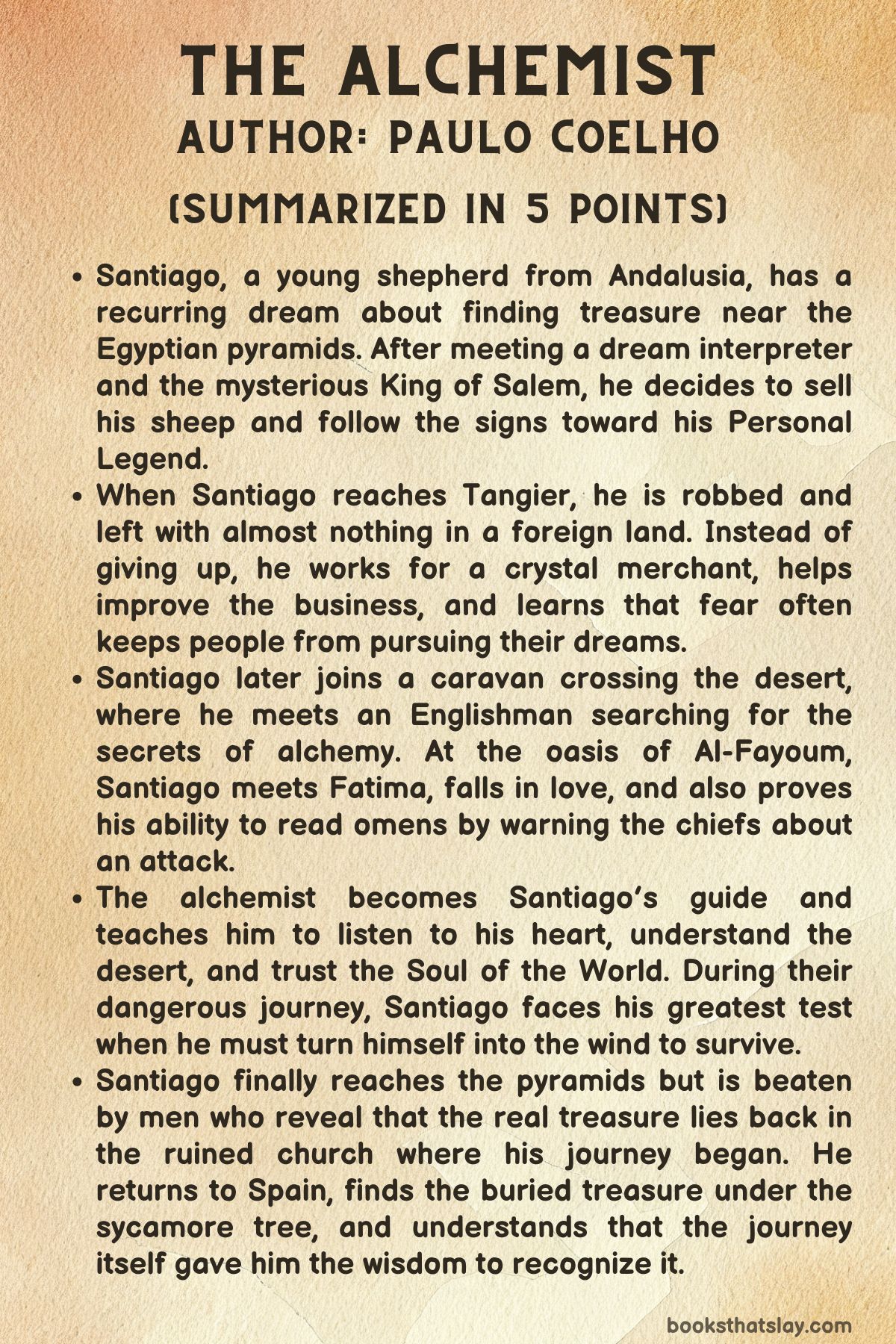
Characters
Santiago
Santiago is the central figure of The Alchemist, and his growth gives the book its emotional and philosophical shape. At the beginning, he is already different from many people around him because he has chosen movement over security.
He leaves the path of priesthood because he wants to see the world, and this decision shows his early hunger for experience. Yet he is not fearless.
He worries about losing his sheep, missing the merchant’s daughter, being cheated, and making the wrong choice. His courage is not the absence of fear but the decision to keep moving while fear remains present.
Santiago learns from every stage of his journey: the sheep teach him attention, the crystal shop teaches him initiative, the desert teaches him patience, Fatima teaches him mature love, and the alchemist teaches him to listen to his heart. His greatest change is internal.
At first, he thinks treasure is a distant object to be found; by the end, he understands that the journey has trained him to recognize the treasure that was waiting at home. Santiago represents the person who is willing to lose comfort in order to gain a fuller life.
Melchizedek
Melchizedek, the King of Salem, serves as the first major guide in the book. He appears at the exact moment when Santiago is tempted to dismiss his dream and return to ordinary concerns.
His role is not to carry Santiago to the treasure but to awaken his sense of purpose. He introduces the idea of the Personal Legend and explains that desire can be a sign of one’s deeper calling.
Melchizedek is mysterious, wise, and slightly playful. He knows private details about Santiago’s life, possesses a jeweled breastplate, and gives him Urim and Thummim, which connect the boy’s journey to ancient forms of guidance.
Yet his wisdom is practical rather than distant. He tells Santiago to follow omens, but he also asks for payment in sheep, forcing Santiago to make a real sacrifice.
Melchizedek’s importance lies in his ability to make Santiago responsible for his own dream. He opens the door, but Santiago must choose to walk through it.
The Crystal Merchant
The crystal merchant is one of the most quietly important characters in the novel because he shows what happens when a dream is preserved but never pursued. He wants to go to Mecca, but he is afraid that once he fulfills this dream, his life will lose meaning.
As a result, he keeps the dream at a safe distance, using it as comfort rather than direction. His shop reflects his inner life: it is full of beauty but has become stagnant.
Santiago’s arrival brings energy, risk, and change. The merchant is cautious, but he is not foolish; he recognizes Santiago’s good ideas and allows the business to grow.
Through him, the book presents a painful truth about fear. The merchant is not unhappy because he lacks a dream; he is unhappy because he has made peace with not living it.
His kindness toward Santiago makes him sympathetic, but his resignation also serves as a warning. He helps Santiago earn money, yet his deeper role is to show the cost of choosing safety over fulfillment.
The Englishman
The Englishman is a seeker of knowledge, but his way of seeking contrasts strongly with Santiago’s. He has spent years studying alchemy through books, symbols, and theories.
He is serious, educated, and devoted, but he often misses the living world around him because he expects truth to appear mainly through written instruction. His journey to the oasis is motivated by a genuine desire to meet the alchemist and understand the secrets of transformation.
However, he is impatient with the slower, less formal lessons of the desert. Santiago learns by watching animals, people, movement, silence, and omens, while the Englishman trusts study and intellectual discipline.
The book does not mock him; instead, it shows that knowledge needs experience to become wisdom. His attempt to perform the Master Work at the oasis is a necessary stage in his own development.
He reminds readers that learning is valuable, but it becomes limited when it does not include humility before life itself.
Fatima
Fatima is the love interest in The Alchemist, but she is not written as a simple reward for Santiago’s journey. She represents a form of love that supports rather than confines.
When Santiago meets her at the well, he feels an immediate certainty that she matters deeply to him. Yet Fatima’s strength appears most clearly when she refuses to become the reason he abandons his Personal Legend.
She understands waiting, distance, and longing because she belongs to the desert, where men often leave and women learn to live with hope. Her love is generous, not possessive.
She tells Santiago to continue his search and trusts that if their bond is true, he will return. This makes her one of the book’s clearest voices of faith.
Fatima also changes Santiago’s understanding of love. He initially thinks staying with her may be the end of his search, but she helps him see that real love does not ask a person to become smaller.
Instead, it gives them the courage to become complete.
The Alchemist
The alchemist is the strongest mentor figure in The Alchemist, appearing when Santiago has already learned many lessons but still needs to complete the hardest part of his journey. He is severe, calm, and deeply aware of the laws that govern both matter and spirit.
Unlike the Englishman, he does not treat alchemy as a set of formulas alone. He understands it as transformation rooted in harmony with the Soul of the World.
His teaching style is demanding because he refuses to let Santiago hide behind comfort, wealth, or love. He knows that Santiago’s greatest danger is not failure but stopping too soon.
The alchemist tests his courage, leads him through danger, and forces him to listen to his heart until fear loses its power over him. His decision to tell the tribesmen that Santiago can become the wind seems cruel at first, but it becomes the final test that reveals Santiago’s spiritual growth.
He is a teacher who does not remove danger; he teaches Santiago how to pass through it.
The Gypsy Woman
The Gypsy woman in Tarifa is one of the first people to confirm that Santiago’s dream should be taken seriously. Santiago approaches her with suspicion, partly because he fears being deceived and partly because he expects dream interpretation to be mysterious or complex.
Her answer is direct: he must go to the pyramids and find the treasure. Her simplicity disappoints him, but the clarity of her interpretation matters.
She asks for a tenth of the treasure rather than immediate payment, which places her advice in the future and links her to Santiago’s eventual success. She also helps establish one of the book’s central ideas: truth is not always hidden behind complicated language.
Sometimes the answer is simple, but the difficulty lies in believing it and acting on it. Though her appearance in the story is brief, she helps push Santiago from passive dreaming toward action.
The Camel Driver
The camel driver is a practical philosopher shaped by loss. Before becoming a camel driver, he had a settled and prosperous life, but disaster destroyed what he owned.
Rather than becoming bitter, he learned to live in the present and accept uncertainty. His wisdom is grounded in experience, not in books or magic.
He tells Santiago that people do not need to fear the unknown when they are capable of pursuing what they need and want. This attitude makes him one of the calmest characters in the desert journey.
He is also the person Santiago trusts after seeing the vision of the oasis being attacked. The camel driver’s respect for omens and seers helps Santiago take his vision seriously and report it to the chiefs.
His role is modest, but he gives Santiago an important model of resilience: a person can lose almost everything and still continue with dignity.
The Crystal Thief in Tangier
The young thief in Tangier appears briefly but changes Santiago’s journey completely. He speaks Spanish, dresses in a familiar style, and seems like exactly the person Santiago needs in a strange country.
Because Santiago is inexperienced and eager, he trusts him too quickly. The theft leaves Santiago alone, ashamed, and nearly hopeless.
Yet this loss becomes one of the most important turning points in the story. Without it, Santiago might have moved too easily toward the pyramids without learning patience, work, language, and self-reliance.
The thief represents deception, but he also becomes an unwilling agent of growth. His betrayal forces Santiago to decide what kind of person he will become after being hurt.
Santiago can become suspicious and defeated, or he can continue as an adventurer. By choosing the second path, he begins to mature.
The Merchant’s Daughter
The merchant’s daughter represents Santiago’s early idea of love and settled happiness. Before he leaves Spain, he thinks about seeing her again and wonders whether she might be impressed by his travels and stories.
She is associated with the life Santiago already knows: sheep, villages, trade, and the possibility of a familiar future. His attraction to her is sincere, but it is also limited because it exists mostly in imagination.
Santiago does not know her deeply, and she does not truly shape his destiny. Her role is important because she shows what Santiago must leave behind in order to discover a larger life.
She is not rejected cruelly; rather, Santiago outgrows the dream she represents. Through her, the story shows that not every desire is a Personal Legend.
Some desires belong to an earlier version of the self.
The Tribal Chiefs
The tribal chiefs at the oasis represent authority, tradition, and judgment. When Santiago warns them of an attack, they must decide whether to trust a foreign boy’s vision.
Their response is cautious but not closed-minded. The elder chief connects Santiago’s situation to the story of Joseph, another stranger who interpreted dreams in a foreign land.
This comparison gives Santiago’s warning moral and spiritual weight. The chiefs also create real stakes: if Santiago is correct, he will be rewarded; if he is wrong, he may be killed.
Their role shows that wisdom requires both openness and responsibility. They are willing to listen to omens, but they also demand accountability from the person who claims to read them.
In doing so, they help Santiago move from private belief to public action.
Themes
The Courage to Follow a Personal Calling
Santiago’s journey is built around the idea that every person has a calling that asks to be lived rather than merely imagined. His dream of treasure could easily remain a strange memory, something he laughs about before returning to his sheep.
Instead, he is pushed to treat it as a serious summons. The difficulty is that following a calling always requires loss.
Santiago must sell his sheep, leave Spain, risk loneliness, and accept the possibility of failure. The book presents fear as the main force that keeps people from their Personal Legends.
The crystal merchant wants to go to Mecca but cannot bring himself to act. Santiago sees in him the danger of delaying one’s dream until it becomes only a private comfort.
The theme gains force because Santiago’s path is not smooth. He is robbed, tested, and repeatedly tempted to settle for a lesser version of happiness.
His courage grows through action. By the end, the treasure matters not only because it is real, but because Santiago has become the kind of person capable of finding it.
Omens, Attention, and the Language of the World
The story treats the world as meaningful, but it does not suggest that meaning appears automatically to everyone. Santiago must learn to pay attention.
At first, omens seem like magical signs given from outside, such as Urim and Thummim or the recurring dream. Gradually, however, Santiago learns that omens can also appear through ordinary events: customers entering a crystal shop, the movement of hawks, the behavior of a horse, the silence of the desert, or the uneasiness of his own heart.
This theme asks the reader to think of wisdom as a form of listening. The Englishman searches for the universal language through books, while Santiago discovers it through contact with life.
Both forms of learning matter, but the story gives special value to awareness. People miss signs not because the world is empty, but because they are distracted by fear, habit, or fixed expectations.
In The Alchemist, attention becomes a spiritual discipline. Santiago’s success depends less on controlling events than on understanding what events are trying to teach him.
Love as Freedom Rather Than Possession
Santiago’s relationship with Fatima changes his understanding of love. When he first falls in love, he is tempted to believe that finding Fatima means he has found enough.
The oasis offers him wealth, status, safety, and companionship, all of which could persuade him to stop. Fatima’s response is central to the theme: she does not ask him to remain.
She understands that love should not interrupt a person’s calling. Her willingness to wait is not weakness; it is a sign of trust.
The book presents possessive love as a form of fear, while true love gives courage. Santiago must learn that loving Fatima and pursuing his treasure are not opposing paths.
If his love is real, it will survive the journey; if he abandons his dream in her name, that love may eventually become a source of regret. This theme gives the romance a larger purpose.
Fatima is not a distraction from Santiago’s Personal Legend. She helps him understand that a complete life requires both devotion to another person and honesty toward one’s own soul.
Transformation Through Loss and Testing
Santiago becomes stronger because he is repeatedly stripped of what makes him feel secure. He loses his sheep, then his money, then nearly loses his confidence, then gives up his gold again in the desert.
Each loss feels like a setback, but each one forces a new stage of growth. When he is robbed in Tangier, he must decide whether to see the world as hostile or continue believing in his journey.
When he works in the crystal shop, he learns that effort can turn misfortune into preparation. When he is captured by tribesmen, he must move beyond ordinary courage and trust the spiritual knowledge he has gained.
Testing is not presented as punishment. It is the process by which Santiago proves that he has truly learned.
The nearer he comes to the treasure, the more demanding the tests become, because the goal requires a transformed self. The final irony is that the treasure was buried where he began, but the earlier Santiago could not have understood its meaning.
Only the tested Santiago can return home and find it.