We Are All Guilty Here Summary, Characters and Themes
We Are All Guilty Here by Karin Slaughter is a crime novel centered on two investigations separated by twelve years and the buried failures connecting them.
What begins with the disappearance and murder of two teenage girls becomes a larger examination of predatory men, institutional trust, family secrecy, guilt, and the danger of deciding too quickly that a case has been solved. Deputy Emmy Clifton carries the consequences of the original murders into adulthood, while the disappearance of another girl forces her to reconsider nearly everything she believed about the crime, her father, her community, and her own family. It’s the first book in Karin Slaughter’s North Falls series.
Summary
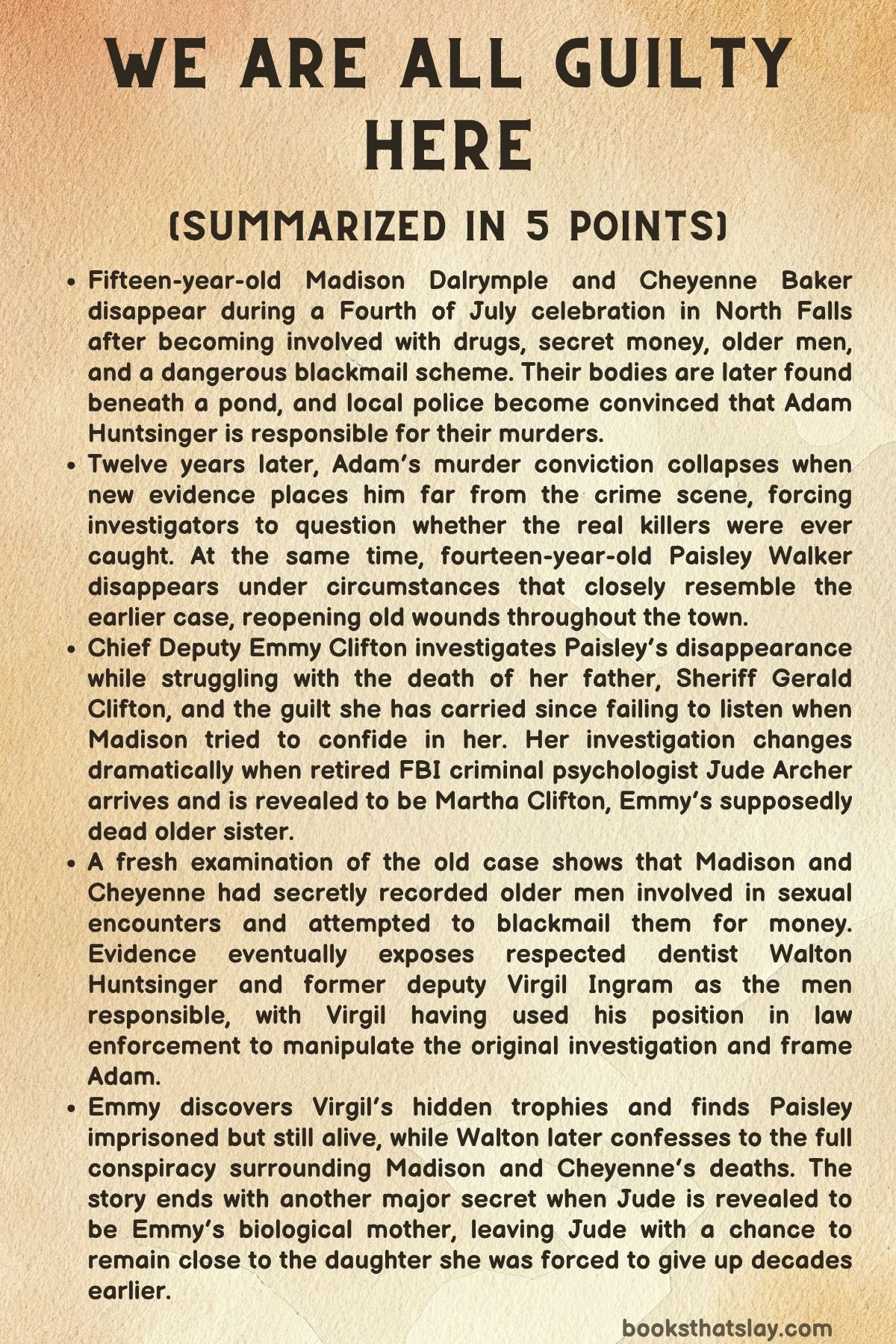
Fifteen-year-old Madison Dalrymple spends the Fourth of July waiting for her best friend, Cheyenne Baker, in the small Georgia town of North Falls. The two girls have secretly planned to leave for Atlanta, and both have been collecting money while hiding activities that their families know nothing about.
Madison is already angry with her father Paul, uncomfortable with her stepmother Hannah, and still affected by her mother’s death. When Deputy Emmy Clifton-Lang, Hannah’s closest friend, notices Madison at the celebration, she tries to warn the girl about the choices she is making, but later fails to listen when Madison appears ready to confide something serious.
During the fireworks, Madison sees a sedan crossing the soccer field with Cheyenne’s bicycle sticking from the trunk. She approaches and discovers Cheyenne bound, gagged, injured, and trapped inside, but before she can rescue her friend, Madison turns and sees the man responsible.
After the fireworks, Emmy and her father, Sheriff Gerald Clifton, notice evidence that something terrible has happened. They follow vehicle tracks, find Cheyenne’s damaged bicycle and Madison’s shattered phone, and discover a large pool of blood that makes it clear the girls have been abducted rather than simply running away.
The search immediately expands across the county. At Cheyenne’s home, investigators learn that her parents believed she was safe with Madison, while her younger sister Pamela seems to know more than she initially admits.
A search of Cheyenne’s room reveals thousands of dollars, marijuana, cocaine, birth-control pills, photographs, and evidence of a secret phone. Pamela eventually reveals that Cheyenne has been seeing sixteen-year-old Jack Whitlock, but Jack tells investigators that Cheyenne’s private life included far more dangerous behavior.
According to Jack, Cheyenne had been selling drugs and receiving money for sexual acts. She and Madison also had contact with an older man they called the Perv, while other evidence suggests that a wealthy adult man had been paying Cheyenne enough money to help finance the girls’ plan to escape North Falls.
The investigation exposes failures among the adults surrounding the girls. Emmy confesses to Hannah that Madison tried to talk to her before disappearing, causing Hannah to condemn Emmy for remaining consumed by her troubled marriage to Jonah when Madison needed her attention.
Evidence found at school makes the case even darker. Cheyenne’s locker contains drugs and sexual photographs, while chorus teacher Dale Loudermilk is discovered with a hidden computer containing a large collection of child-abuse images.
Dale appears to be an obvious suspect because he had access to both girls, no convincing alibi, a recently cleaned vehicle, and a missing firearm. Yet the details do not fully fit: he is financially unstable, his illegal material focuses on younger children, and the weapon involved in Cheyenne’s injuries appears to have been a .22 rather than Dale’s missing Glock.
A new lead comes from Emmy’s Aunt Millie, who remembers seeing Madison with a man working near her pond. That man is Adam Huntsinger, the older drug supplier known to the girls as the Perv.
Police search Adam’s property and find Cheyenne’s missing necklace nearby, strengthening the case against him. Emmy then realizes Millie’s pond may be important and travels there alone, where she finds Madison’s clothing floating on the water.
Beneath the surface, Emmy discovers both girls weighted underwater. Madison is dead after severe violence, while Cheyenne has also been killed after being shot and beaten, leaving Emmy permanently marked by the sight of the two bodies she personally brings to shore.
Adam is convicted and sentenced to death for the murders, and for twelve years Emmy believes justice has been done. That certainty collapses when an old rape kit produces Adam’s DNA and places him around a hundred miles away at the time Madison and Cheyenne were killed, leading to the destruction of the murder conviction.
Soon after Adam’s release, fourteen-year-old Paisley Walker disappears while riding her bicycle to school. Her damaged bicycle and blood are found along the same backroads associated with the earlier murders, immediately raising the possibility that the original killer was never caught.
The crisis becomes personal when Paul Dalrymple confronts Emmy near Adam’s house with a gun. Hannah attempts to intervene, but a shot strikes Gerald, who dies in Emmy’s arms after urging her to continue doing her job.
At the same time, fifty-nine-year-old FBI criminal psychologist Jude Archer is reaching mandatory retirement after decades investigating abducted and murdered children. When she sees the report about Paisley and Emmy, she abandons retirement plans and travels to North Falls, a town tied to a past she has hidden for more than forty years.
At Gerald’s funeral home, Emmy meets Jude for the first time. The encounter becomes shocking when Emmy’s uncle Tommy recognizes Jude as Martha Clifton, the older sister Emmy had always been told died long ago.
Jude begins assisting with Paisley’s case and refuses to assume that the similarities automatically prove the same person committed both crimes. Her behavioral analysis points toward an organized, disciplined, trusted white man with access to children and a respected social position, a profile that fits Adam poorly.
As Jude and Emmy work together, old family history becomes inseparable from the investigation. Emmy learns that Jude disappeared after years of addiction, anger, and instability following the drowning death of her brother Henry, while Gerald used family influence to tell the town that Martha had died.
The Walker investigation uncovers a separate network of sexual secrecy. Paisley’s controlling father Elijah has hidden affairs, and explicit photographs eventually connect Jack Whitlock to him, although Jack is in Los Angeles when Paisley disappears and therefore cannot be her abductor.
Jude eventually confronts Adam and reveals that he raped her when she was fifteen. Adam remains predatory and abusive, and he admits having sexual contact with Cheyenne in exchange for drugs, yet his behavior still does not resemble the controlled person responsible for Madison’s systematic torture.
Emmy, meanwhile, begins repairing her relationship with Hannah. Their conversation acknowledges the damaged marriages and decisions that shaped both their lives, but it also allows them to share grief over Madison instead of allowing guilt and anger to keep them permanently separated.
A new review of the original evidence exposes how weak the case against Adam actually was. The investigators focus on two missing objects the real killer may have kept as trophies: Cheyenne’s secret phone and the claw hammer used to break Madison’s hands and feet.
The team realizes Cheyenne owned a Nokia phone capable of recording video and storing files on a removable memory card. They conclude that she had probably recorded sexual encounters with older men and attempted to use the material for blackmail.
The likely sequence becomes clearer. Cheyenne was struck from her bicycle and tortured for information about the phone and memory card, but the attackers were forced to target Madison when Cheyenne did not have everything they needed.
The investigators also discover unexplained mileage on an Audi belonging to Dale’s wife. Before they can follow the lead, Adam reports that someone has placed a bloody claw hammer in his truck, suggesting that the same people who framed him years earlier may still be actively protecting themselves.
At Adam’s home, Emmy notices an old wallet that once belonged to Adam’s father, Walton Huntsinger, but now contains Adam’s identification. She realizes Walton could have traveled using Adam’s identity, creating an apparently impossible alibi while another vehicle was being used elsewhere.
Emmy then visits retired deputy Virgil Ingram and discovers altered phone documents linking him to Walton. A deeper search uncovers trophies from numerous victims, including Cheyenne’s missing Nokia and memory card.
Virgil arrives armed and admits his involvement, revealing that one of Gerald’s most trusted deputies was actually part of the crimes he helped investigate. When Virgil tries to kill Emmy, she shoots him and searches his property.
Inside a concealed soundproofed space, Emmy finds Paisley alive but terribly injured. The discovery proves that the threat never disappeared and gives Emmy the chance she never had with Madison and Cheyenne: to reach a victim before it is too late.
Jude interrogates Walton until he finally confesses. Cheyenne had secretly recorded a sexual encounter involving herself, Madison, Walton, and Virgil, then demanded $50,000 so that she and Madison could leave town.
Virgil decided the girls had to die, and Walton helped create the false alibi. Dale’s wife’s Audi was used during the scheme, Cheyenne was deliberately struck from her bicycle and abducted, Walton shot her during an attempted escape, and Virgil later captured Madison.
Madison was taken to Virgil’s property, abused and tortured, and both girls were ultimately weighted beneath Millie’s pond. Virgil then exploited his law-enforcement position to manipulate the investigation and help frame Adam, while later evidence suggests that he and Walton had harmed many other victims.
Hannah is eventually cleared in connection with Gerald’s shooting, while Paul can take responsibility. Emmy sees video showing that Hannah’s intervention actually redirected the bullet away from Emmy and toward Gerald, leaving Emmy with a painful example of how an attempt to save one person can produce an unintended tragedy.
The final revelation concerns Jude and Emmy themselves. As a troubled teenager, Jude became pregnant and secretly gave birth, but Gerald and Myrna forced her to leave the baby behind if she wanted to escape North Falls.
That baby was Emmy. Gerald stopped drinking and Myrna publicly claimed Emmy as her own daughter, while Jude stayed away because she believed entering Emmy’s life would destroy the family identity that had been created for her.
Emmy remains unaware that Jude is her biological mother. She only knows that Gerald left an unfinished letter addressed to “Dear Daughter,” and Jude realizes his dying apology to Emmy’s “mother” was actually intended for her.
When Emmy later invites Jude to join the family potluck, Jude accepts. The moment gives her a quiet opportunity to remain close to the daughter she surrendered decades earlier, even though the deepest truth between them remains unspoken.
Characters
Emmy Clifton
Emmy is the emotional and investigative center of We Are All Guilty Here, defined by a combination of duty, guilt, anger, and an almost compulsive need to correct what she believes she failed to prevent. Her decision not to listen when Madison tries to confide in her becomes one of the defining moments of her life, and finding Madison and Cheyenne beneath Millie’s pond ensures that the case is never merely professional for her.
Twelve years later, Emmy has become chief deputy, but she still measures herself against Gerald and continues carrying responsibility for decisions that were not entirely hers. Paisley’s disappearance forces her to confront the possibility that her certainty about Adam contributed to a wrongful murder conviction and allowed the real offenders to remain hidden.
Her greatest weakness is that emotion can narrow her judgment. Jude repeatedly challenges Emmy when grief, loyalty, or anger pushes her toward convenient conclusions, and Emmy’s eventual growth comes from learning that good police work requires questioning even the beliefs connected to people she loves.
Emmy also changes personally through reconciliation. Repairing her relationship with Hannah and accepting Jude into the family circle show that she is becoming capable of living with uncertainty and forgiving imperfect people rather than dividing the world into innocent and guilty categories.
Jude Archer / Martha Clifton
Jude is one of the novel’s most complicated characters because the woman known nationally as an accomplished FBI criminal psychologist began life as Martha Clifton, a troubled teenager who fled North Falls. Her career investigating abducted and murdered children is connected to personal experiences of loss, guilt, addiction, sexual violence, and separation.
Her investigative strength comes from refusing easy conclusions. Where Emmy initially sees Adam as the obvious answer, Jude distinguishes between being a dangerous sexual predator and being the specific organized offender responsible for Madison and Cheyenne’s deaths.
Jude is also a character built around controlled secrecy. She has spent decades maintaining sobriety, creating a professional identity, and avoiding the family that once erased her existence, only to return when Paisley disappears.
The final revelation transforms her relationship with Emmy: Jude is not simply an estranged sister but Emmy’s biological mother. Her decision not to reveal this truth immediately reflects both love and fear, because she wants a place in Emmy’s life without destroying the identity Emmy has carried since childhood.
Gerald Clifton
Gerald initially appears to be the respected sheriff whose instincts and experience guide the first investigation. He loves Emmy, recognizes the seriousness of the girls’ disappearance quickly, and later becomes the moral and professional standard against which Emmy measures herself.
Yet Gerald’s past complicates that idealized image. He had once been a cruel alcoholic father whose treatment of Martha contributed to her disappearance, and he participated in the family decision to erase her identity publicly.
His importance lies partly in his capacity to change. He stopped drinking, became a better father, and built a respected career, showing that terrible past behavior does not necessarily prevent later growth.
At the same time, the original murder investigation demonstrates that even a decent and experienced sheriff can be deceived by someone inside his own department. Gerald’s trust in Virgil becomes one of the weaknesses that allows the real killers to remain protected.
His death deepens Emmy’s grief, but his final instruction that she continue doing her job becomes a lasting influence. The unfinished apology discovered later suggests that Gerald knew some family wounds remained unresolved when he died.
Madison Dalrymple
In We Are All Guilty Here, Madison is remembered as rebellious, angry, and desperate to leave North Falls, but those qualities exist alongside grief and vulnerability. She resents her father and stepmother, mourns her dead mother, and imagines Atlanta as a place where she and Cheyenne can finally control their own lives.
Her tragedy is intensified by the fact that she appears to recognize the danger surrounding her shortly before she disappears. She tries to speak to Emmy but loses the opportunity because Emmy is distracted, creating a moment that haunts nearly every important relationship afterward.
Madison’s death also becomes evidence of the killer’s psychological nature. The systematic injuries inflicted on her indicate patience, control, and deliberate cruelty rather than a sudden uncontrolled attack.
She remains important long after her death because Emmy, Hannah, Paul, and the wider community continue defining parts of their lives around what happened to her. Madison therefore represents both a murdered child and the permanent consequences created when adults fail to recognize the danger surrounding vulnerable teenagers.
Cheyenne Baker
Cheyenne is clever, secretive, ambitious, and willing to take enormous risks to gain financial independence in We Are All Guilty Here. Her parents believe Madison has changed her, but the evidence eventually shows that Cheyenne has constructed an extensive hidden life involving drugs, secret phones, sexual encounters, money, and blackmail.
Her actions are dangerous, but the story never makes those choices equivalent to responsibility for what happens to her. Older men exploit her age, need for money, and desire to escape, while adults repeatedly misunderstand secrecy as proof that the girls themselves are the central problem.
Cheyenne also proves more resourceful than the killers expect. Her secret recording creates evidence capable of exposing Walton and Virgil, which is why recovering her phone and memory card becomes crucial twelve years later.
Her attempt to blackmail the men is reckless, yet it also reveals her belief that she can use their wrongdoing to purchase freedom. That calculation fails because she underestimates the violence powerful adults will use to protect themselves.
Hannah
In We Are All Guilty Here, Hannah begins as Madison’s stepmother and Emmy’s lifelong best friend, making Madison’s disappearance a crisis that destroys both her family and her closest friendship. When Emmy admits that Madison tried to speak with her, Hannah directs years of frustration at Emmy and accuses her of sacrificing important relationships to an unhealthy marriage.
Her anger is severe, but it comes from grief rather than simple cruelty. Madison’s death leaves Hannah with the permanent knowledge that the girl she loved died while surrounded by adults who missed opportunities to understand what was happening.
Twelve years later, Hannah’s attempt to stop Paul from shooting Emmy results in Gerald being struck instead. The event places her in legal danger even though later video proves that her intervention saved Emmy’s life.
Her reconciliation with Emmy becomes one of the novel’s clearest examples of damaged relationships being repaired without pretending that the past can be erased.
Virgil Ingram
Virgil is the most devastating betrayer in We Are All Guilty Here because his public identity as Gerald’s trusted deputy gives him the perfect position from which to hide his crimes. He does not merely evade investigation; he participates in the investigative system itself and helps shape the evidence surrounding Madison and Cheyenne.
His hidden trophies reveal that the murders were not isolated acts. They expose a long history of predatory behavior and demonstrate how successfully he used respectability, police access, and community trust as protection.
Virgil’s cruelty is especially evident in Madison’s torture and in Paisley’s injuries. The methodical damage done to their hands and feet reveals a pattern of controlled domination rather than spontaneous violence.
His exposure also forces Emmy to accept that professional loyalty can become dangerous when it prevents scrutiny. The trusted older deputy she once regarded as part of her father’s law-enforcement world turns out to be the man most capable of corrupting that world from within.
Walton Huntsinger
In We Are All Guilty Here, Walton is outwardly respectable, professionally established, and socially protected. As a dentist and father, he occupies precisely the kind of ordinary community position that makes Jude’s offender profile so important.
His crimes reveal the contrast between respectable appearance and private exploitation. Walton participates sexually with underage girls, assists Virgil, helps construct false alibis, and shoots Cheyenne when the girls attempt to escape.
His use of Adam’s identification is particularly revealing. Rather than acting impulsively, Walton carefully manipulates travel records so that his movements appear impossible to reconcile with the murders.
His confession finally provides the structure investigators lacked twelve years earlier. Through Walton, the novel shows how social status can allow predatory men to appear safer than people whose misconduct is more visible.
Adam Huntsinger
Adam is deliberately constructed as a morally repellent man who is nevertheless innocent of the specific murders for which he was sentenced to death. In We Are All Guilty Here, He supplies drugs to teenagers, has sexual contact with Cheyenne, and raped Jude when she was fifteen.
These facts make it psychologically easy for investigators and the public to believe that he killed Madison and Cheyenne. The case against him becomes a warning about confusing evidence of one form of guilt with proof of another crime.
Adam never becomes sympathetic in a simple sense. His release does not erase the harm he caused, and Jude’s confrontation confirms that he continues minimizing sexual violence.
His character therefore challenges the assumption that proving a wrongful conviction requires turning the wrongly convicted person into an admirable victim. Adam can be dangerous, predatory, dishonest, and still not be the murderer.
Dale Loudermilk
Dale appears to be a natural suspect after Emmy discovers his hidden collection of child-abuse material. His access to the girls, missing gun, suspicious vehicle cleaning, and lack of a strong alibi make the evidence against him initially seem overwhelming.
Closer examination, however, shows that some aspects do not fit the murders. His financial problems contradict Cheyenne’s description of a wealthy older man, and the weapon evidence points elsewhere.
Dale nevertheless remains guilty of serious crimes and becomes connected to the wider conspiracy through the use of his wife’s Audi. His character demonstrates why investigators must distinguish between discovering criminality and proving responsibility for the particular crime under investigation.
Paul Dalrymple
In We Are All Guilty Here, Paul is a grieving father whose relationship with Madison had been damaged before her death. Her resentment toward him becomes one of the unresolved emotional facts surrounding the case because death removes any possibility that they can repair their relationship.
Twelve years later, grief and alcohol have made him dangerously unstable. His confrontation outside Adam’s home ends with Gerald being shot, transforming his private pain into another family tragedy.
Paul represents the destructive form grief can take when blame becomes the only available response. Unlike characters who eventually reconsider their failures, Paul remains trapped by rage until it produces consequences that cannot be reversed.
Paisley Walker
In We Are All Guilty Here, Paisley initially functions as the missing girl whose disappearance reopens the past, but she gradually becomes more than a repetition of Madison and Cheyenne. Her family life is marked by Elijah’s excessive control over her clothes, appearance, friendships, and sexuality.
Her kidnapping confirms that the original threat remained active after Adam’s conviction. Virgil’s assault on her repeats elements of the earlier violence, especially the deliberate injuries to her hands and feet.
The major difference is survival. Emmy finds Paisley alive, giving the investigation an outcome that the earlier case could never provide and giving Emmy the opportunity to save a girl instead of recovering another body.
Cole
In We Are All Guilty Here, Cole grows from the child Emmy struggled to raise during her difficult marriage into an adult deputy working beside her. His presence shows that Emmy’s personal and professional lives have never been fully separate.
His past relationship with Jack introduces an unexpected emotional complication when investigators identify Jack in one of Elijah’s explicit photographs. Cole’s admission forces the investigation to confront secrets that affect him personally while still maintaining focus on Paisley.
Cole also represents a younger generation living with consequences created by adults before him. He inherits family history without yet understanding its deepest secret: Jude is his biological grandmother rather than simply the aunt his family erased.
Jack Whitlock
Jack first appears as Cheyenne’s teenage boyfriend and becomes a significant source of information about the hidden life she and Madison were living. His testimony helps expose drug dealing, sexual transactions, and the presence of older men around the girls.
As an adult, Jack creates the Misguided Angel podcast, which helps challenge Adam’s murder conviction. His role therefore changes from teenage witness to public advocate questioning the official story.
His secret relationships with Cole and Elijah complicate his position further. Jack is neither directly responsible for Paisley’s disappearance nor morally uncomplicated, and his private choices show how many people surrounding the investigation have built separate public and private identities.
Dylan Alvarez
Dylan is both a law-enforcement figure and an important emotional connection for Emmy. Their history gives him insight into her personality, while his role as Hannah’s attorney places him between two women whose friendship was destroyed by Madison’s death.
He provides legal clarity when Gerald’s shooting creates uncertainty about whether Paul or Hannah controlled the weapon. Later, his home becomes one of the few places where Emmy can stop performing authority and allow exhaustion to overcome her.
Dylan therefore represents emotional steadiness rather than investigative revelation. He offers Emmy support without demanding that she resolve every personal problem while a child remains missing.
Jonah
Jonah is Emmy’s former husband and one of the central examples of a relationship she maintained long after recognizing its failures. At the beginning, Emmy is frustrated that he avoids responsibility for their son and expects her to carry the larger burden of family life.
Her argument with him indirectly contributes to one of her greatest regrets because she is distracted by their problems when Madison tries to speak to her. Hannah later identifies Emmy’s loyalty to Jonah as evidence that she protected an unreliable husband while neglecting relationships that deserved her attention.
Their eventual divorce reflects Emmy’s slow willingness to stop maintaining situations simply because she has invested years in them.
Myrna Clifton
Myrna appears in the present as an elderly woman with advanced Alzheimer’s disease, but her importance lies in the family secret she helped maintain. She knew Martha was alive even after the family publicly claimed she had died.
More significantly, Myrna participated in taking Jude’s newborn daughter and presenting Emmy publicly as her own child. She therefore helps create the identity structure that defines Emmy’s entire life.
Her Alzheimer’s has an ironic effect because the illness weakens the silence surrounding the truth. Her repeated insistence that Martha was alive eventually contributed to Gerald admitting the deception to Tommy.
Elijah Walker
Elijah is Paisley’s controlling father, and his first response to her disappearance exposes troubling ideas about responsibility and sexuality. He tends to interpret his daughter’s appearance as something capable of attracting male attention, effectively placing responsibility on Paisley rather than on adults who might exploit her.
His secret sexual relationships further undermine his moral authority. While policing his daughter’s clothing, relationships, and sexuality, he hides encounters with Belinda and pays Jack for sex.
Elijah therefore embodies hypocrisy within parental control. His fear of Paisley becoming sexually active does not produce genuine communication or protection; instead, it produces surveillance while his own life remains built on secrecy.
Carl Whitlock
Dr. Carl Whitlock initially enters the story as Jack’s father and a trusted pediatrician. His professional position gives him access to intimate information about teenagers, including Madison’s birth control and later Paisley’s sexual status.
Although he is not identified as one of the killers, his presence raises questions about adult boundaries. Parents use his medical authority as part of their attempts to monitor girls rather than establishing relationships in which those girls might safely disclose what is happening to them.
Aunt Millie
Millie appears eccentric and peripheral at first, yet she becomes crucial to both the original investigation and the discovery of the girls. Her memory of seeing Madison with Adam near the pond redirects Emmy toward the location where Madison and Cheyenne have been hidden.
Her property becomes one of the most emotionally important locations in the story. The pond hides the bodies for only a short period, but the image of the girls recovered from the water remains central to how the crime is remembered.
Pamela Baker
Pamela is Cheyenne’s younger sister and one of the earliest characters who understands that Cheyenne has a life hidden from adults. Her reluctance to speak reflects the loyalty and fear common among children who possess information without fully understanding its importance.
She eventually leads Emmy toward hidden money, drugs, and information about Jack.
Pamela’s role shows the limits of adult assumptions. While investigators initially question parents and obvious suspects, a ten-year-old child holds some of the most useful information about Cheyenne’s secret world.
Themes
Guilt, Responsibility, and the Consequences of Inaction
Guilt in We Are All Guilty Here rarely belongs only to the people who commit crimes. Emmy’s defining guilt comes from failing to listen when Madison tries to speak, even though she could not have known exactly what the girl intended to reveal.
That moment demonstrates the difference between legal responsibility and emotional responsibility. Emmy did not abduct or kill Madison, yet she spends twelve years treating one distracted decision as evidence of a personal failure that she must somehow repair.
Similar patterns appear throughout the story. Hannah believes adults failed Madison, Gerald carries regrets connected to Martha, Jude carries guilt over leaving Emmy, and the Clifton family lives under the consequences of decisions made decades earlier.
The theme becomes more complex because guilt can either destroy people or force them to change. Gerald transforms from an alcoholic and cruel father into a respected sheriff, while Emmy eventually learns to question old assumptions and repair her relationship with Hannah.
The novel therefore refuses the simple idea that mistakes can always be corrected. Madison and Cheyenne cannot be restored, Gerald cannot survive the redirected bullet, and Jude cannot recover the years she lost with Emmy.
What remains possible is accountability. Characters can recognize what they did, choose differently afterward, and refuse to let one failure become the justification for another.
The Danger of Respectability and Misplaced Trust
The central murders survive unresolved for twelve years because the most dangerous men do not look like obvious monsters. Virgil is a trusted deputy, Walton is a dentist, and both benefit from the assumption that respectable men with established community roles are less suspicious than someone like Adam.
Adam’s visible criminality makes him an easy target. He deals drugs, exploits teenagers, and has committed rape, so investigators find it psychologically comfortable to believe he is capable of every terrible act associated with him.
Virgil and Walton benefit from the opposite effect. Their positions allow them to move through the community without attracting equivalent suspicion, and Virgil’s law-enforcement access gives him the extraordinary advantage of participating in the investigation of his own crimes.
Dale creates another version of the same problem. His hidden criminal material proves he is dangerous, yet assuming that one discovered crime automatically proves another would repeat the mistake made with Adam.
The broader warning is about treating social appearance as evidence. Professional success, family status, age, familiarity, and institutional authority can all create false feelings of safety.
Jude’s behavioral approach becomes important because she examines actions rather than reputations. Once investigators stop asking who looks guilty and begin asking what kind of person could have planned and concealed these crimes, the case changes completely.
Secrecy, Family Identity, and Buried Truth
Nearly every major family in the story survives by hiding something. Madison and Cheyenne conceal drugs, money, sexual encounters, phones, and plans to escape, while the adults around them hide affairs, addictions, old crimes, damaged marriages, and painful family history.
The Clifton family carries the largest secret. Martha is publicly declared dead after leaving North Falls, even though Gerald and Myrna know she is alive, and Emmy grows up believing a false account of her own family.
The final revelation makes that deception even greater. Jude is Emmy’s biological mother, but Gerald and Myrna raised Emmy as their own daughter after pressuring Jude to leave without her baby.
Secrecy is not presented as automatically evil. Cheyenne hides information because she is trying to gain independence, Jude stays away because she believes returning would disrupt Emmy’s happiness, and some characters conceal painful truths because they think silence protects others.
Yet the story repeatedly demonstrates that hidden truths acquire power. The longer they remain buried, the more relationships and decisions are built around incomplete information.
By the end, solving the murder case requires recovering things that were deliberately hidden: a phone, a memory card, trophies, altered records, false identities, and forgotten family history. Truth becomes less a sudden revelation than the gradual dismantling of stories people have depended on for years.
Control, Exploitation, and the Vulnerability of Girls
Madison, Cheyenne, and Paisley live under different forms of adult control, yet none of that control succeeds in making them safe. Cheyenne’s parents respond to her changing behavior with restrictions, Elijah monitors Paisley’s clothing and sexuality, and adults repeatedly focus on whether the girls are behaving properly instead of asking why older men have access to them.
The distinction matters because control can disguise itself as protection. Elijah believes supervision gives him authority over Paisley’s safety while simultaneously maintaining secret sexual relationships of his own.
Cheyenne responds to restriction by becoming more secretive. She builds a hidden economy involving drugs, sexual transactions, recordings, and money because she believes financial independence is the only practical route out of North Falls.
Her blackmail scheme is dangerous, but the greater moral responsibility lies with the adults exploiting children and then using violence to protect themselves. Virgil and Walton possess money, age, professional standing, mobility, and social credibility that the girls do not.
Paisley’s survival gives this theme a different ending. She suffers terrible violence, but Emmy reaches her in time, allowing the story to move from the recovery of dead girls toward the rescue of a living one.
The repeated lesson is that young people cannot be protected merely through surveillance or punishment. Safety depends on adults creating conditions in which children can speak, be believed, and receive help before secrecy becomes the only form of control they possess.