The Dead Husband Cookbook Summary, Characters and Themes
The Dead Husband Cookbook by Danielle Valentine is a domestic thriller about marriage, motherhood, ambition, food and the dangerous stories families create to protect themselves.
At its centre is Thea Woods, a disgraced editor who receives a career-saving opportunity to work with legendary chef Maria Capello on a memoir concerning her husband’s unexplained disappearance. What begins as an exclusive publishing assignment soon becomes an investigation into stolen recipes, hidden relatives, manipulated evidence and generations of women who respond to abandonment in disturbing ways. The novel combines publishing-world tension with family drama and culinary horror, gradually transforming familiar ideas about nourishment, loyalty and sacrifice into something far more threatening.
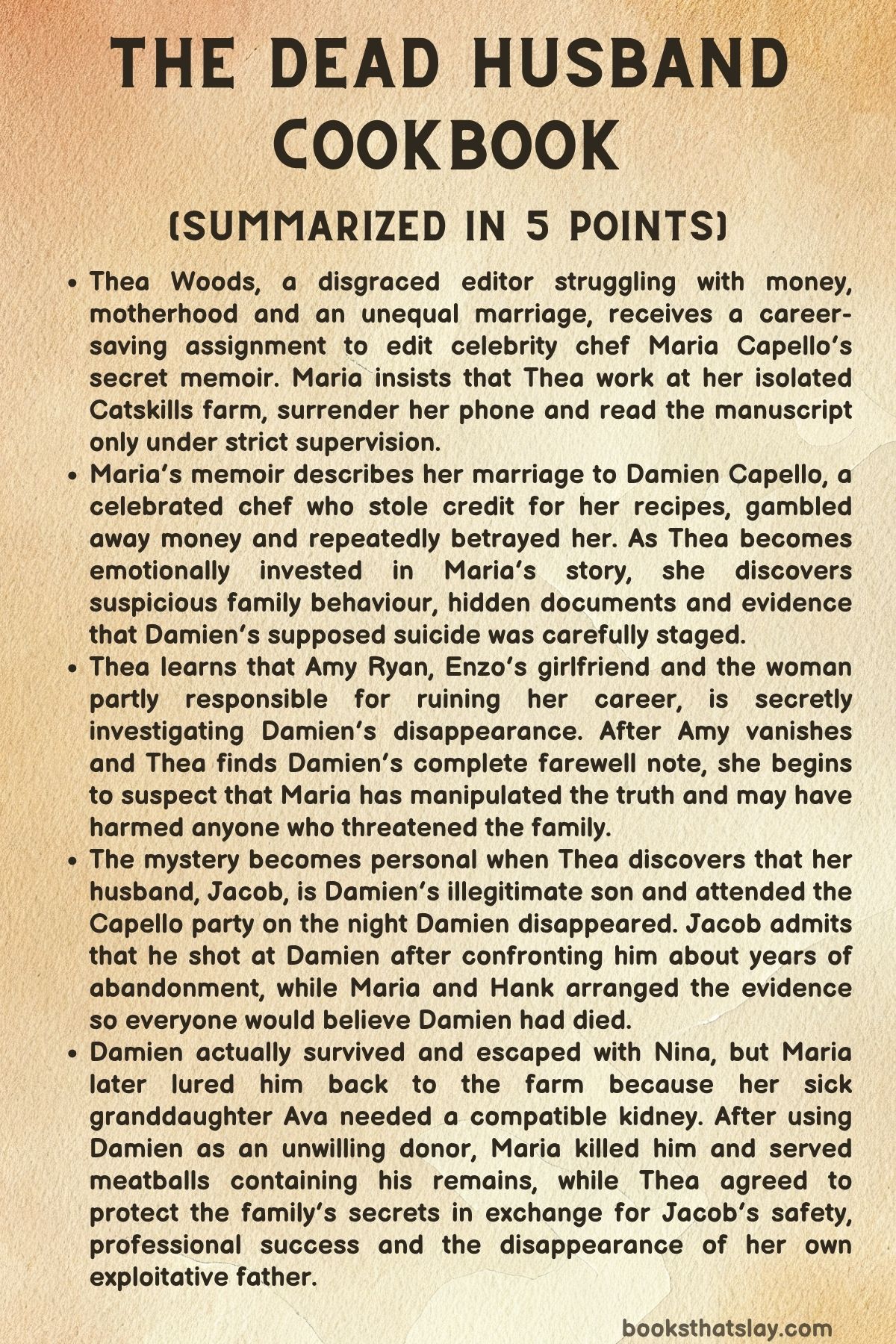
Summary
Thea Woods returns to her Brooklyn apartment carrying groceries, work files and her screaming toddler, Ruthie, up four flights of stairs. Her husband, Jacob, is exercising with headphones on and has ignored her request for help, leaving Thea to manage their daughter, the household and the unpaid day-care bill by herself.
Her marriage has become defined by small disappointments that neither spouse properly addresses. Jacob remains absorbed in his journalism and personal interests, while Thea feels that every practical responsibility has quietly become hers.
Thea’s professional life is equally unstable. Once a respected senior editor at Hanes House Press, she is now associated with the disastrous memoir of politician Kincaid Hughes, whose sexual harassment of an intern named Riley became public after Thea discussed the allegations while intoxicated.
The resulting scandal hurt Riley, destroyed the book’s commercial prospects and exposed the publishing company to legal trouble. Thea believes her mentor and boss, Cassandra Hanes, has summoned her to the office to end her career.
Instead, Cassandra presents her with an extraordinary opportunity. Celebrity chef Maria Capello has written a memoir and has personally demanded that Thea serve as her editor, even though the two women have never met.
Maria became famous through her restaurant, television appearances and cookbooks, but public fascination has always centred on the 1996 disappearance of her husband, Damien Capello. His clothes were found beside a creek after a family party, yet his body was never recovered.
Cassandra believes the memoir could become the year’s largest publishing event if it finally explains what happened to Damien. Thea uses Maria’s request as leverage, demanding a promotion and higher salary, but Cassandra warns that one complaint from the author will permanently end her career.
When Thea meets Maria, she is overwhelmed because the chef’s television programme and cookbooks had provided comfort during her lonely childhood. Maria appears affectionate, but beneath her familiar public warmth she is observant, controlled and unusually interested in Thea’s personal history.
Maria imposes strict rules on the editing process. Only one printed manuscript exists, it cannot be copied or photographed, and Thea may read it only while staying at the Capello farm in the Catskills.
The arrangement requires Thea to leave Jacob and Ruthie, surrender her phone and work under Maria’s supervision. Although the conditions trouble her, Thea accepts because the memoir could repair her finances and reputation.
Before leaving, Thea hides another crisis from Jacob. Her unreliable father has returned to her mother’s life and emptied the retirement account Thea spent years rebuilding, forcing Thea to drain nearly all the money in her joint account to rescue her mother.
Thea recognizes that she has repeated the very behaviour she resents. Her mother repeatedly sacrificed financial security for an irresponsible husband, while Thea has now endangered her own family to protect her mother from that same man.
The Capello property is not the inviting farmhouse shown on television. It is an isolated modern mansion surrounded by barns, livestock and an old slaughterhouse, while the confiscated phone, unreliable internet and locked doors immediately make Thea dependent on the family.
She meets Maria’s daughter Issie, who appears physically and emotionally exhausted, and Issie’s young daughter, Ava. Issie continues pumping breast milk for four-year-old Ava because she believes a mother’s body provides nourishment that cannot be replaced.
Thea also meets Maria’s son, Enzo, and his girlfriend, Amy Ryan. She instantly recognizes Amy as the person who secretly recorded her comments during the Hughes scandal and obtained private messages that helped ruin both Riley and Thea.
Maria gives Thea the memoir in small sections rather than allowing her to read the entire work. In the opening pages, Maria describes meeting Damien when he received the restaurant position she had wanted, their immediate attraction and the intense romance that followed.
Maria and Damien eventually open Polpette della Nonna, named after his grandmother and her meatball recipe. Maria performs much of the labour, but Damien controls the finances and becomes the public face of their success.
Damien’s cousin Hank supplies the restaurant’s meat. Maria soon notices Damien’s attraction to Hank’s wife, Nina, and later discovers them having sex in the butcher shop on the same day she arrives to announce her pregnancy.
The betrayal begins a long period of emotional neglect. Maria gives birth to Issie and later Enzo, while Damien resumes his affair, gambles away money and accepts praise for culinary work that Maria has largely created.
As Thea reads, she identifies strongly with Maria’s fear of abandonment and exhaustion. Maria’s account echoes Thea’s childhood memories of watching her father repeatedly leave, return, demand money and disappear again.
Thea nevertheless suspects that Maria is deliberately shaping her emotions. The memoir offers detailed justification for Maria’s resentment but continues to postpone the promised explanation of Damien’s fate.
Outside the manuscript, the Capello household becomes increasingly disturbing. Thea hears animals being slaughtered, sees strange herbal preparations and discovers that Ava speaks casually about blood, skull soup and dead animals.
Amy secretly investigates the family and admits that she runs the celebrity-gossip account HushHush. She has entered Enzo’s life under false pretences because she is writing her own book about Damien’s disappearance.
Amy believes the Capellos have a history of removing inconvenient people. She lists a former editor, a competing butcher and one of Enzo’s schoolmates among those whose lives changed after conflicts with Maria.
Thea refuses to share the memoir but begins conducting her own research. She visits Hank’s butcher shop, discovers that Nina disappeared around the same time as Damien and learns that the shallow creek could not easily have concealed a body.
Her suspicions deepen when she enters the mansion’s padlocked basement. Inside, she finds herbs, blood products, breast milk, butchered meat and dead piglets stored in an industrial freezer.
She also discovers the complete version of Damien’s supposed suicide note. The publicly known version omits a middle page in which Damien announces that he is leaving Maria to search for happiness elsewhere.
The missing page transforms the document from a suicide note into a farewell letter. Damien also asks Maria to protect his secrets in exchange for his silence about hers, proving that the public story was deliberately manufactured.
Thea initially wonders whether Maria helped Damien escape rather than killing him. Maria’s next manuscript pages support this theory by describing how she removed the middle page and allowed the remaining sections to suggest suicide.
Maria portrays the act as a final sacrifice for her children. She claims she protected them from learning that their father had deliberately abandoned them.
Meanwhile, someone drives a nail into Thea’s rental-car tyre, leaving her unable to depart independently. Her phone remains confiscated, the landline is monitored and every trip away from the farm requires help from the Capellos.
Thea also discovers that Jacob lied about Maria’s hospital alibi. He had claimed that his mother, Gloria, personally saw Maria at the hospital on the night Damien disappeared, but Gloria reveals that she was not working there.
Amy then vanishes from the farm. The Capellos claim she left voluntarily, yet her burner phone and investigative notebook remain behind, suggesting she may have been prevented from leaving.
While carrying Amy’s phone through the slaughterhouse, Thea sees an elderly man digging where Maria claimed she had buried money. His eyes and features strongly resemble Damien’s, leading Thea to believe that Damien survived and has returned for the hidden fortune.
A message on Amy’s burner phone directs Thea to an abandoned barn. She expects to meet Damien but instead encounters Nina, now an elderly woman who has spent decades in hiding.
Nina claims Maria killed Damien. She says she heard Maria and Damien arguing near the creek, followed by a gunshot, and later watched Hank arrange Damien’s clothing beside the water to create the appearance of suicide.
Nina also reveals that Damien had an illegitimate son who attended the family party when he was sixteen. Amy’s research indicates that this son despised Damien and believed he deserved whatever happened that night.
Maria’s private perspective reveals the scale of her manipulation. She had Thea investigated before offering her the memoir and learned about her marriage, finances, daughter, parents and professional scandal.
Maria understood that threats or money would not easily control Thea. Instead, she designed the memoir to make Thea love her, presenting herself as the nurturing maternal figure Thea had always wanted and as another woman damaged by an unreliable man.
Maria’s account of her childhood explains her moral outlook. Her father abandoned the family and stole their money, after which Maria’s mother tracked him down, killed him and made his body disappear.
Rather than mourning him, Maria learned that men who exploited and deserted their families could be removed through patience and planning. She later inherited her mother’s belief that protecting the women and children of the family justified almost any act.
The memoir’s claims are also exposed as selective inventions. The savings bonds Maria said Damien stole from her had actually belonged to him, and Maria hid them because he planned to use the money to escape.
Thea prepares to leave the farm after realizing that Maria may have killed Damien and harmed Amy. Her car disappears, Enzo’s keys are locked away and the kitchen telephone cord is removed.
In the kitchen, Hank blocks the exit while wearing a bloodstained apron and holding a cleaver beside a skinned carcass and industrial grinder. Maria enters and calmly explains that they are preparing dinner.
Maria then admits that Damien’s celebrated recipes were actually hers. His grandmother’s original meatballs were ordinary, while Maria improved the ingredients, preparation and seasoning until they became the foundation of Damien’s fame.
Every major dish associated with Damien was created through Maria’s labour. He accepted public admiration while reducing her to the role of wife and mother, stealing both her professional identity and financial security.
Maria’s immediate plan concerns Ava, who is suffering from severe kidney failure. A previous transplant from Issie has failed, and none of the available Capello relatives is medically compatible.
Thea learns that Damien’s illegitimate son is Jacob. The photograph proving the boy’s identity shows the same eyes, hair and facial structure that Thea recognizes in her husband and daughter.
Jacob arrives after Maria contacts him using Thea’s phone. He admits that Damien was his biological father and that he concealed the truth because he wanted no connection to the man who abandoned him and Gloria.
Jacob explains what happened at the 1996 party. He publicly confronted Damien for withdrawing financial support, accidentally struck Enzo during the argument and caused the injury that sent Gloria, Enzo and Issie to the hospital.
Because Gloria resembled Maria and knew the hospital employees, she signed Maria’s name and appeared in the security footage. Maria therefore gained an alibi without ever leaving the farm.
Jacob followed Damien to the creek with his stepfather’s gun. When Damien attempted to escape again, Jacob fired and fled believing he had killed him.
Maria and Hank arranged Damien’s clothes beside the water and allowed Jacob to live with the belief that he was responsible. Maria offers to publish a false but convincing version of the disappearance that will protect Jacob, save Thea’s career and preserve Ruthie’s family.
Thea accepts the arrangement. Seven months later, Maria’s memoir becomes a major success, Cassandra promotes Thea to editorial director and the publishing industry praises her for obtaining the story everyone wanted.
Thea and Jacob remain together after finally admitting their secrets. Jacob reduces his professional workload to care for Ruthie, creating a more balanced marriage even though the truth about Damien remains hidden.
Ava is now healthy, and Thea reconstructs what truly happened. Jacob’s bullet wounded Damien but did not kill him, allowing Nina to help him escape while Maria staged the suicide.
Decades later, Maria deliberately allowed Amy to discover information about the hidden bonds. She knew Amy would contact Nina, who would then tell Damien that the money remained on the farm.
Damien returned and was captured by Hank. He was imprisoned in the industrial freezer and transported to Mexico, where one of his kidneys was removed and transplanted into Ava.
Maria bribed and threatened Nina into disappearing again. After the operation, Damien was killed, and his body was processed according to a family tradition involving blood, bone, slow cooking and ground meat.
At the memoir’s launch party, the guests praise Maria’s famous meatballs without knowing that Damien’s remains have been incorporated into the meal. The secret ingredient preserving his memory is not a seasoning but the dead husband himself.
Characters
Thea Woods
Thea is the central viewpoint character and the person through whom the reader enters the Capello family’s carefully controlled world. At the beginning of The Dead Husband Cookbook, she is exhausted, financially desperate and professionally humiliated, making her vulnerable to an offer that promises recognition and stability.
Her strongest quality is her determination to protect vulnerable people, but this instinct repeatedly causes harm. Her attempt to warn others about Kincaid Hughes damages Riley, while her decision to rescue her mother leaves her own household without enough money for Ruthie’s day care.
Thea is perceptive enough to recognize the warning signs at the farm, yet her emotional identification with Maria weakens her judgement. Because Maria’s experiences resemble those of Thea’s mother, Thea begins treating the memoir as confirmation of what she already believes about selfish men and sacrificial women.
Her development is not a simple movement from deception to truth. She discovers the truth and then makes a conscious decision to suppress it, accepting professional success, family security and protection for Jacob in exchange for her silence.
By the conclusion, Thea has become more honest within her marriage but less morally certain in the wider world. She understands Maria’s manipulation, yet she also recognizes that she has benefited from it and is now connected to the same system of secrecy she once intended to expose.
Maria Capello
Maria is the author of the memoir, the controlling force behind the editing assignment and the principal architect of the novel’s mysteries. In The Dead Husband Cookbook, she moves between the roles of celebrity chef, neglected wife, protective mother, manipulative storyteller and murderer.
Her public personality depends on warmth, nourishment and domestic reassurance. Privately, she studies people with precision, identifies their emotional needs and constructs situations in which they will mistake dependency for affection.
Maria’s resentment toward Damien is rooted in genuine exploitation. He steals her recipes, accepts praise for her labour, gambles away money, conducts affairs and prepares to abandon the family after Maria has sacrificed her ambitions to sustain his career.
However, the wrongs committed against Maria do not make her methods morally innocent. She alters facts, imprisons Damien, exploits Jacob’s guilt, uses Thea as bait and treats murder as an acceptable form of family management.
Her devotion to Ava further complicates her character. Maria’s determination to obtain a compatible kidney reflects immense familial loyalty, but she protects one life by taking control of another person’s body and eventually destroying it.
Maria is also an author who understands that control over a narrative can be as powerful as control over evidence. She does not merely conceal the truth; she creates a version of events that encourages others to defend her before they know what she has done.
Damien Capello
Damien is absent from most of the present-day action, yet his choices shape nearly every relationship in the story. He is remembered publicly as a brilliant chef and tragic missing husband, although that reputation was built on Maria’s uncredited creativity.
His behaviour follows a repeated pattern of consumption. He takes Maria’s recipes, labour, inheritance, loyalty and public support while offering little responsibility in return.
Damien is charming enough to inspire intense devotion, particularly from Maria and Nina, but he treats commitment as temporary. He wants the admiration associated with marriage, fatherhood and culinary success without accepting the obligations attached to them.
His abandonment of Jacob is especially damaging. By withdrawing financial support and refusing to acknowledge his son, Damien creates the anger that brings Jacob to the Capello party with a gun.
Even after surviving the shooting, Damien remains driven by self-interest. His eventual return to the farm is motivated by hidden money rather than concern for his children or grandchildren, allowing Maria to predict and exploit his behaviour.
Damien is certainly a victim of murder, imprisonment and bodily violation. Nevertheless, the novel refuses to separate his fate from the years in which he treated other people’s lives, talents and affection as resources available for his own use.
Jacob Woods
Jacob initially appears to be an inattentive husband who leaves Thea carrying most of their domestic responsibilities. His failure to pay Ruthie’s tuition or respond when Thea asks for help contributes to her resentment and sense of isolation.
His secrecy is far greater than Thea first understands. Jacob has hidden his biological connection to Damien throughout their marriage and has even invented details about Maria’s hospital alibi to discourage questions about the Capellos.
As a teenager, Jacob sought recognition and financial responsibility from a father who had abandoned him. His confrontation with Damien comes from years of humiliation, poverty and anger rather than a sudden desire for violence.
Jacob’s belief that he killed Damien shapes his adult life. He distances himself from the Capellos, becomes invested in controlling the public story and avoids discussing the night that defined him.
His marriage improves only after his secrets are exposed. By stepping back from his career to care for Ruthie, he finally recognizes that Thea’s exhaustion has not resulted from personal weakness but from an unfair division of labour.
Jacob remains protected by deception at the end of the novel. Although he did not actually kill Damien, he accepts the benefits of Maria’s false memoir and becomes another member of a family sustained by managed truths.
Amy Ryan
Amy is both Thea’s professional enemy and an investigative counterpart. Her secret recording helped trigger the scandal that damaged Thea’s career, making every later interaction between them tense and uncertain.
She enters Enzo’s life under false pretences while researching Damien’s disappearance. Her gossip account and proposed book reveal a person willing to manipulate relationships and private information in pursuit of a major story.
Amy is often correct about the danger surrounding the Capellos, but her methods make it difficult for others to trust her. She blackmails Nina, misrepresents herself to Enzo and uses the private suffering of several people as material for publication.
Her disappearance intensifies the atmosphere of danger because Thea cannot determine whether Maria harmed her or merely forced her away. Maria’s explanations eventually suggest that Amy was not murdered, yet the destruction of her research shows that the family successfully neutralized her investigation.
Amy functions as a warning about Thea’s possible future. Both women want professional recognition through the Capello mystery, but Amy pursues exposure while Thea ultimately chooses cooperation with the family.
Enzo Capello
Enzo is Maria and Damien’s son, and his physical resemblance to Damien makes him a constant reminder of the missing man. He appears protective of his family but is less informed than Maria about the full scale of her plans.
As a child, Enzo rushes to defend Damien during Jacob’s confrontation and is accidentally struck. His broken nose creates the hospital visit that provides Maria with her false alibi.
As an adult, Enzo participates in the family’s secrecy by destroying Amy’s notebook after discovering her investigation. His action suggests that loyalty to the Capellos overrides his concern for Amy or for the truth.
Enzo is also part of the pattern of children inheriting the consequences of their parents’ behaviour. Damien’s betrayal produces the confrontation that injures him, while Maria’s secrecy teaches him that protection may require intimidation and destruction of evidence.
Issie Capello
Issie is Maria’s daughter and Ava’s mother. Her physical exhaustion reflects the demands of long-term caregiving and the emotional strain of watching her child suffer from kidney failure.
Her continued pumping of breast milk for four-year-old Ava initially appears strange, but it expresses her belief that a mother’s body must provide whatever a child needs. This attitude closely resembles Maria’s understanding of motherhood as total physical sacrifice.
Issie has already donated a kidney to Ava, but the transplant failed. Her inability to save her daughter despite surrendering part of her body intensifies the desperation that allows Maria’s plan to proceed.
She is not shown arranging Damien’s capture, yet she benefits from the result and prepares to travel with Ava after the transplant. Her position remains morally uncertain because maternal fear may have limited how much she was willing to question.
Ava
Ava is Maria’s granddaughter and the child whose illness motivates the present-day conspiracy. Her unusual behaviour around blood, animals and the slaughterhouse unsettles Thea long before her medical condition is revealed.
Her statements about skull soup and her comfort beside dying animals reflect the environment in which she has been raised. Concepts that horrify outsiders have been normalized within the Capello family’s traditions.
Ava is innocent of the decisions made on her behalf. She needs a kidney, but she has no meaningful control over the imprisonment, exploitation and murder that make her recovery possible.
Her restored health at the end gives Maria’s plan a visible success. That success creates the novel’s most difficult moral pressure because the reader must confront a healthy child whose survival is directly connected to terrible violence.
Nina Casey
Nina is Hank’s wife, Damien’s lover and one of the few surviving witnesses to the night he disappeared. Her resemblance to Maria emphasizes Damien’s tendency to pursue women who offer familiar qualities without requiring the same obligations.
She genuinely loves Damien and plans to escape with him, although she knows he has lied to multiple women. Her willingness to wait for him despite learning about another relationship shows that she is also trapped by his charm.
Nina helps Damien survive after Jacob shoots him and then spends decades hiding from Maria and Hank. Her fear is justified, yet her long silence allows Jacob to believe he is a killer and leaves the public mystery intact.
Amy later forces Nina back into the investigation through blackmail. When Damien returns to the farm, Maria uses money and threats to make Nina disappear again, proving that Nina remains vulnerable to the same forces that shaped her earlier life.
Nina tells important truths, but her account is incomplete. She assumes Maria killed Damien in 1996 without knowing that he survived, showing how each witness possesses only one part of the larger reality.
Hank Casey
Hank is Damien’s cousin, the butcher who supplies meat to the restaurant and Maria’s long-term accomplice. His loyalty to Maria grows from Damien’s affair with Nina and from a wider family tradition of punishing unfaithful men.
He helps stage Damien’s suicide by arranging the clothing beside the creek. Decades later, he captures Damien in the slaughterhouse and confines him until the kidney operation can occur.
Hank’s professional knowledge makes him essential to the family’s darkest practices. The cleavers, grinders, carcasses and meat-processing equipment associated with him blur the boundary between ordinary butchery and the disposal of human bodies.
He appears threatening because he rarely explains himself and is frequently covered in blood. Although some suspicions about him are exaggerated, his actual role is more disturbing than the rumours Thea initially fears.
Cassandra Hanes
Cassandra is Thea’s employer, former mentor and surrogate maternal figure. She once supported Thea’s career, but the Hughes scandal transforms their relationship into one based on mistrust and commercial pressure.
Her decision to give Thea the Capello memoir is partly an opportunity and partly an act of exploitation. Cassandra knows Thea’s damaged reputation makes her less able to refuse unreasonable conditions.
Cassandra values the memoir according to its market potential. She repeatedly demands scandalous revelations and treats the truth as useful only when it increases sales without creating legal danger.
Her eventual promotion of Thea reflects the publishing industry’s preference for commercial success over ethical clarity. Because the memoir becomes a bestseller, Cassandra accepts its manufactured story without seriously questioning what may have been concealed.
Ruthie Woods
Ruthie is Thea and Jacob’s young daughter. Her needs expose the unequal structure of her parents’ marriage because Thea manages her illness, day care, meals and daily care while Jacob remains comparatively detached.
She also represents what Thea believes she is protecting when she agrees to Maria’s deception. Exposing Jacob’s connection to Damien could destroy Ruthie’s relationship with her father and destabilize the family.
Ruthie links Thea to the other mothers in the novel. Her presence helps Maria predict that Thea will eventually place her child’s security above abstract commitments to truth.
Gloria
Gloria is Jacob’s mother and the woman who raised him after Damien refused to act as a responsible father. Her experience resembles Maria’s because both women are left to manage the consequences of Damien’s selfishness.
She accompanies sixteen-year-old Jacob to the Capello party and waits in the car. After Enzo is injured, she takes him and Issie to the hospital and signs Maria’s name.
Her resemblance to Maria creates the false security footage that protects Maria’s alibi. Gloria therefore participates in the deception, although her immediate purpose is to help injured children rather than to conceal murder.
Gloria later confirms that Jacob lied to Thea about her presence at the hospital. Her willingness to answer Thea’s questions helps break open a secret she has protected for decades.
Thea’s Mother
Thea’s mother is defined by her inability to resist her husband’s repeated returns. She welcomes him despite his financial exploitation and emotional abandonment, forcing Thea to become the responsible adult in their relationship.
Her choices shape Thea’s attitudes toward marriage and protection. Thea grows up believing that unreliable men will always return to take more and that women must absorb the damage they leave behind.
Although she appears vulnerable, her dependence also harms Thea’s family. By allowing Thea’s father access to her savings, she indirectly contributes to Ruthie’s unpaid tuition and the crisis that makes the Capello assignment impossible to refuse.
Thea’s Father
Thea’s father is a recurring source of financial and emotional instability. He abandons the family, returns when he needs money and relies on Thea’s mother to forgive him.
His pattern closely resembles Damien’s behaviour. Both men assume they can leave women with the consequences of their choices and then return whenever they require money, comfort or support.
Thea’s anger toward him becomes increasingly violent while she is at the farm. Her threat to have him killed shows how Maria’s moral reasoning is beginning to influence her.
By the conclusion, he disappears after Maria promises to handle him. Thea does not investigate, suggesting that her silence extends beyond Damien and now includes violence committed for her own benefit.
Maria’s Mother
Maria’s mother establishes the family tradition that later shapes Maria’s treatment of Damien. After her husband abandons the family and steals from them, she follows him, kills him and disposes of his body through cooking.
She teaches Maria that domestic knowledge can become a form of power. Food preparation, patience and familiarity with routine allow her to erase a man while keeping the household functioning.
Her influence explains why Maria does not experience murder as a complete moral rupture. Maria understands it as an inherited response to men who consume family resources and then attempt to escape responsibility.
Maria’s Father
Maria’s father is absent from much of her childhood but remains important as the first example of male abandonment in her life. He leaves with another woman, takes the family’s money and even removes useful household possessions.
His disappearance at the hands of Maria’s mother gives Maria satisfaction rather than grief. The event teaches her that an abusive absence can be transformed into permanent removal.
He serves as the model through which Maria later interprets Damien. Once Damien prepares to leave with money and another woman, Maria sees him as a repetition of her father rather than as an individual whose life must be preserved.
Riley
Riley is the young intern sexually harassed by Kincaid Hughes. Although Thea tries to prevent further harm, her careless warning leads to the exposure of Riley’s private messages and makes Riley a public target.
Riley’s experience demonstrates the danger of taking control of another person’s story without consent. Thea’s failure to protect her becomes an important reason she is desperate to rebuild her ethical and professional identity.
The irony is that Thea later repeats a related mistake. She helps publish Maria’s controlled version of events while suppressing the experiences of Nina, Jacob, Damien and others who might challenge it.
Kincaid Hughes
Kincaid Hughes is the politician whose memoir causes Thea’s professional collapse. His harassment of Riley reveals the conflict between publishing powerful men and protecting the people they have harmed.
Although he does not participate in the central Capello mystery, his behaviour establishes the professional culture surrounding Thea. Institutions are willing to manage wrongdoing when reputation and revenue are at stake.
His scandal also makes Thea vulnerable to Maria. Without the damage caused by the failed memoir, Thea might have rejected the isolated editing arrangement or questioned Maria’s demands much earlier.
Henry Perse
Henry Perse is Maria’s literary agent and one of the professionals responsible for managing the memoir’s publication. He participates in the accelerated schedule and accepts Maria’s unusual restrictions without openly challenging her.
His presence gives the project a sense of formal legitimacy. Because an experienced agent supports the arrangement, Thea initially treats Maria’s control as celebrity eccentricity rather than a possible threat.
Henry also represents the network of professionals who profit from Maria’s public image. Their focus on access, secrecy and sales helps her maintain control over the narrative.
Celia
Celia is Nina’s friend and part of the small support system surrounding her after decades of hiding. She becomes involved when Amy pressures Nina to cooperate with the investigation.
Her role is limited, but she demonstrates that Nina has not survived entirely alone. She also helps establish that Amy’s disappearance occurs during a meeting rather than through an immediate attack by Maria at the farm.
Themes
The Theft of Women’s Work
Recipes, memoirs and domestic labour become forms of authorship that men and institutions repeatedly claim without acknowledging their creators. Damien’s reputation as a brilliant chef depends on Maria’s recipes, management, inheritance and years of invisible work, yet he presents her publicly as a supportive wife rather than the source of his success.
The same pattern appears in Thea’s marriage. Her editing career is treated as flexible, while Jacob assumes that child care, tuition payments, meals and household organization will somehow remain her responsibility.
The Dead Husband Cookbook connects creative ownership to personal identity. When Damien takes credit for Maria’s food, he does not merely steal a recipe; he removes her from the story of her own achievement.
Maria’s memoir becomes an attempt to reclaim that authorship, but her recovery of power is morally corrupted by her willingness to rewrite facts. She responds to being erased by erasing other people, controlling which memories remain visible and which witnesses disappear.
The publishing world reinforces this conflict. Cassandra values Thea when she can deliver a profitable narrative, while Maria selects Thea because her damaged status makes her useful.
The novel therefore presents authorship as both liberation and control. Telling one’s own story can restore a stolen identity, but control over the page can also become another method of silencing anyone whose account threatens the chosen version.
Motherhood, Sacrifice and Bodily Ownership
Motherhood is repeatedly represented through exhausted bodies, financial surrender and the expectation that women must provide without limit. Thea carries Ruthie, manages her illness and sacrifices money for her own mother while Jacob remains unaware of the full burden.
Issie expresses this expectation even more literally. She pumps breast milk for Ava beyond infancy, donates a kidney and continues believing that anything produced by a mother’s body should be available to her child.
Maria treats this principle as an absolute moral law. Once Ava needs a compatible kidney, Damien’s right to control his body becomes less important to her than her granddaughter’s survival.
The pig Dumpling, bleeding while her piglets feed, becomes a disturbing image of this belief. Nourishment is inseparable from injury, and the mother’s suffering is treated as natural so long as the young continue living.
The novel does not dismiss maternal devotion, since Ava’s recovery is emotionally powerful and Thea’s concern for Ruthie is understandable. Instead, it questions what happens when sacrifice becomes compulsory and when mothers begin demanding sacrifices from other people.
Maria transforms caregiving into a justification for violence. Her family survives because she is willing to use bodies as resources, repeating the same consuming behaviour she condemns in Damien.
Secrets, Storytelling and Manufactured Truth
Every major character protects a private version of the past. Jacob hides his parentage, Gloria conceals the hospital deception, Nina withholds Damien’s survival and Maria constructs a memoir that mixes emotional truth with deliberate invention.
The power of Maria’s manuscript comes from its accurate understanding of pain. Damien did exploit her, steal her work and prepare to abandon the family, even though many surrounding details are altered to make Maria appear less responsible.
Because the emotions are convincing, Thea becomes willing to accept unsupported claims. Maria proves that a story does not need to be factually complete if it makes its audience feel that the conclusion is morally deserved.
Editing becomes an especially important form of control. Thea believes her role is to clarify Maria’s account, but Maria is actually editing Thea by deciding what she reads, when she reads it and which personal memories each section should awaken.
The final published memoir protects Jacob and advances Thea’s career while giving the public a satisfying explanation. Its commercial success demonstrates that readers and institutions often prefer a polished narrative to an unresolved truth.
The novel ultimately treats secrecy as a family inheritance. Each generation survives by deciding which facts must be hidden, but every concealment creates new guilt, dependency and vulnerability.
Food, Consumption and Retribution
Food carries comfort, professional ambition, memory and horror at the same time. Maria’s recipes nurture families and create a successful restaurant, yet the kitchen also becomes the place where theft, resentment and violence are transformed into acceptable forms.
Damien consumes other people symbolically long before Maria consumes him physically. He takes her creativity, Hank’s trust, Nina’s devotion, Jacob’s security and the labour of everyone who sustains his public image.
Maria’s final treatment of Damien turns that pattern against him. The man who built a career by taking credit for her food becomes an ingredient in the recipe that made him famous.
This revenge is presented with dark precision rather than moral simplicity. Damien’s selfishness explains Maria’s hatred, but it cannot provide ethical permission for imprisonment, organ removal, murder or cannibalism.
The family tradition of corpse medicine gives consumption another meaning. Blood, bone and flesh are treated as substances that can preserve health, allowing Maria to describe bodily violation as nourishment.
The launch-party meatballs complete the transformation of private violence into public celebration. Guests praise the food, the memoir and the myth of Damien without recognizing that they are participating in the destruction hidden beneath all three.
Food therefore becomes the story’s clearest expression of power. Whoever prepares, names and serves the meal controls what others consume, what they believe and which hidden ingredients become part of them.