The Ever King by L.J. Andrews Summary, Characters and Themes
The Ever King by L. J. Andrews is a dark fantasy romance centred on two heirs raised on opposite sides of a war. Livia Ferus, princess of the earth fae, accidentally reopens a magical sea barrier and allows Erik Bloodsinger, the feared ruler of the Ever Kingdom, to return.
He abducts her as leverage against her father, but their shared childhood, matching magical marks, and growing attraction complicate his plans. Set across enchanted seas, pirate ships, royal courts, and corrupted islands, the novel examines inherited hatred, political duty, trauma, obsession, and the difficult choice to love someone taught to see you as an enemy. It’s the 1st book of the Ever Seas series.
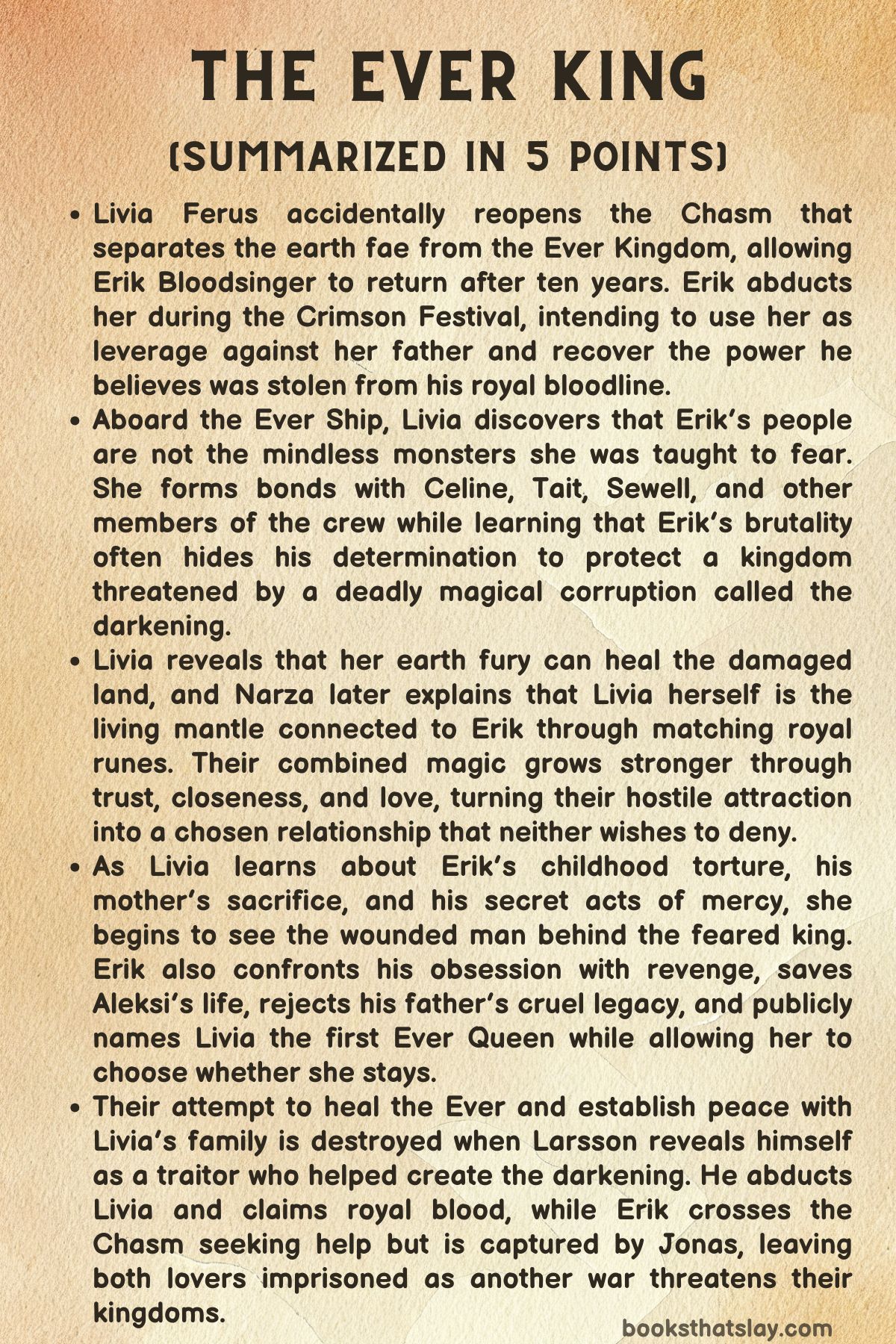
Summary
Years before the main events of The Ever King, a young Livia secretly visits Erik Bloodsinger, a captive sea-fae boy imprisoned after a war between their peoples. She reads him her altered version of a story in which a serpent and a songbird become friends instead of destroying each other, gives him a silver swallow necklace, and promises to guard a golden talisman that belonged to his father.
While escaping the prison tower, Livia drops the talisman and breaks it into three pieces. A mysterious royal rune appears on her arm, creating a magical connection she does not understand, while Erik remembers her kindness and preserves the necklace through years of suffering.
A decade later, twenty-year-old Livia is the heir to the Night Folk and lives with her parents, King Valen and Queen Elise, near the Chasm separating the earth fae from the Ever Kingdom. As the Crimson Festival approaches, she experiences nightmares involving serpents, birds, blood, and the sea, sensing that the barrier is no longer secure.
During a private celebration with Aleksi, Jonas, Sander, and Mira, Livia swims toward the Chasm. A song draws her closer, the rune on her arm burns, and her touch opens a path through the magical wall, allowing Erik to cross into her world for the first time in ten years.
Erik has become the ruthless ruler of a kingdom threatened by the darkening, a magical corruption that destroys soil, water, crops, and entire islands. He believes Valen took the royal mantle after killing Erik’s father, Thorvald, and he is convinced that recovering it will restore his power and save his people.
Erik enters the earth-fae fortress during the Crimson Festival and sees Livia as an adult. At the masquerade, he disguises himself behind a black mask, dances with her, listens to her speak about painting and family, and awakens an attraction that neither of them can easily dismiss.
Livia takes the stranger to her chamber, believing she has found a man who sees her rather than her title. Erik then reveals the silver swallow, removes his mask, and demands the mantle before abducting her and carrying her through the burning fortress.
Despite Livia’s resistance, Erik takes her aboard the Ever Ship and crosses the Chasm. She expects cruelty from the feared sea-fae pirates, but Erik gives her his cabin, protects her from the crew, and insists that no one may harm the woman he has claimed as his personal prisoner.
Life aboard the ship gradually challenges Livia’s beliefs about the Ever folk. She befriends the gentle cook Sewell, gains the guarded respect of Celine, observes Tait’s loyalty, and learns that the crew members possess magical voices connected to blood, bones, tides, emotions, and the sea.
During a battle against the pirate Lucien Skurk, Livia disobeys Erik to save the wounded Sewell. She later witnesses Erik execute Lucien for attacking innocent villagers, but she also sees him provide shelter and protection to the survivors, revealing that his violence often serves his responsibilities as king.
On the corrupted island of Skondell, Livia touches the darkened soil and senses that the blight was deliberately created. Using her earth fury, she heals part of the land and produces a golden flower, giving Erik the first real hope that his dying kingdom can be restored.
Narza, the powerful leader of the House of Mists and Erik’s grandmother, examines the matching runes. She reveals that the mantle is not the broken golden talisman but an ancient heart bond intended to unite an Ever ruler with a chosen partner whose love strengthens the crown.
Livia confesses that she broke Thorvald’s talisman as a child and has hidden the pieces ever since. Instead of punishing her, Erik understands that the royal power transferred into her, making Livia the living mantle and connecting her heart to both him and the Ever Kingdom.
Their hostility begins giving way to trust and desire. Erik protects Livia from an enchanted sea singer and refuses to exploit her while she is under the influence of magic, while Livia agrees to help heal the Ever if Erik promises to spare Valen during their eventual confrontation.
At the royal city, Livia faces hatred from citizens who blame her family for Thorvald’s death and the sealing of the Chasm. Erik removes her from a humiliating cage, places her under his direct protection, and announces before the royal houses that harming her will be considered an attack against the crown.
As Livia learns more about him, she discovers that Erik’s monstrous reputation hides years of secret mercy. He saved Celine from mutilation and death, protected Gavyn, helped Sewell escape abuse, healed enemies when no one was watching, and repeatedly acted against Thorvald and Harald’s cruelty.
Erik eventually reveals that Thorvald once poisoned both Erik and his mother and forced the four-year-old child to choose whom his healing voice would save. His mother ensured that he healed Thorvald and died in his place, leaving Erik convinced that he had caused her death.
Livia refuses to treat him as guilty for surviving. She accepts his scars, damaged leg, violent instincts, hidden tenderness, and fear of abandonment, while Erik admits that she possesses his heart and has become more important than revenge, legitimacy, or the crown.
Together, their combined magic heals a large section of the Glass Isles. Livia’s earth fury restores the land while Erik’s royal power strengthens her, proving that the mantle works through trust, emotional openness, and mutual devotion rather than domination.
Their growing closeness makes Livia a target. Assassins attack her inside the palace, hoping to drain her blood and steal her power, but she awakens the darker side of her magic and uses roots and vines to kill one of them.
Erik takes a blade meant for Livia and nearly dies. With Tait’s assistance, Livia combines medicinal plants, her own blood, and Erik’s healing song to save him, proving both the strength of their bond and her willingness to fight for his life.
Soon afterward, Gavyn returns through the Chasm with a gravely wounded Aleksi. Erik briefly considers allowing him to die so that Livia’s family cannot take her away, but he rejects that selfish impulse and exhausts his power healing the man Livia loves as a cousin and brother.
Aleksi reveals that the history Erik accepted was incomplete. Stieg protected Erik during his imprisonment, earth-fae warriors rescued him, Valen defended him against Thorvald’s rejection, and Erik once healed Aleksi’s father despite the war between their peoples.
Livia confronts Erik about hiding these truths. He admits that vengeance became the foundation of his identity because he believed abandoning it would make him unworthy of his father, his people, and the crown, even though Thorvald had rarely shown him love.
Livia chooses Erik with full knowledge of his past. Their relationship becomes physically and emotionally complete, no longer sustained only by magic, captivity, or political necessity but by a conscious acceptance of each other’s tenderness and darkness.
Before the royal court, Erik rejects Thorvald’s legacy and places Livia on the forbidden Ever throne. He names her the first Ever Queen but gives her the freedom to leave, and she chooses to remain beside him regardless of the crown.
Erik begins reforming the kingdom, exposes corrupt house lords, frees imprisoned sirens, and proposes peace talks with Livia’s family. He and Livia prepare to unite the sea and earth fae while continuing their efforts to heal the darkening.
Their plans collapse when Larsson betrays them. He lures Livia away with a false message, stabs Tait, abducts her, and reveals that he helped create the darkening because he believes he is Thorvald’s illegitimate son and the rightful ruler of the Ever.
Erik loses contact with Livia through their bond but refuses to believe she is dead. Following Aleksi’s advice, he crosses the Chasm to seek Valen’s help, only to be captured by Jonas, who believes Erik has murdered Livia and intends to deliver him to her father for execution.
The story ends with Livia chained aboard Larsson’s vessel, Erik imprisoned in the earth-fae realm, and both kingdoms approaching another war. Their separation leaves the identity of Larsson’s mysterious ally, the fate of the throne, and the possibility of peace unresolved.
Characters
Livia Ferus
Livia is the emotional and magical centre of The Ever King. She begins as a protected princess frustrated by royal expectations, political courtship, and the feeling that her life is being shaped by everyone except herself.
Her abduction forces her to confront danger, desire, violence, and an enemy culture she has known only through inherited stories. Instead of remaining a passive prisoner, she gathers knowledge, forms alliances, treats the wounded, studies the darkening, and learns how to turn her earth fury into both healing and lethal protection.
Livia’s greatest strength is her willingness to revise her beliefs when confronted with new evidence. She does not excuse Erik’s cruelty, but she recognizes the difference between mindless brutality and violence shaped by survival, duty, and trauma.
Her choice to become Ever Queen completes her movement from sheltered heir to independent ruler. She does not simply accept Erik’s claim over her; she demands mutual belonging, political recognition, emotional honesty, and an equal place beside him.
Erik Bloodsinger
Erik is the feared ruler, wounded survivor, romantic lead, and central contradiction of The Ever King. He presents himself as a cruel pirate monarch because fear protects his authority and because Thorvald and Harald taught him that compassion would make him vulnerable.
His violence is real, yet it exists beside a powerful instinct to protect. He kills enemies without hesitation, but he also saves villagers, shelters refugees, defends women targeted by powerful men, protects damaged members of his household, and repeatedly risks himself for those he claims not to love.
Erik’s deepest conflict comes from his need to earn the approval of his dead father. He has built his identity around revenge because surrendering it would force him to admit that Thorvald abused, rejected, and manipulated him.
Livia’s love threatens this identity by offering him worth independent of bloodline or conquest. By naming her queen, challenging old laws, and seeking peace with Valen, Erik begins becoming a ruler guided by his own values rather than the expectations of crueler men.
King Valen Ferus
Valen is Livia’s father, the king of the Night Folk, and the man Erik has blamed for Thorvald’s death. Although he is absent for much of the central journey, his love, reputation, and past decisions strongly influence both protagonists.
To Livia, Valen represents fierce parental devotion and the example of a passionate marriage she hopes to find for herself. His refusal to force her into a political match shows that he respects her autonomy even while remaining intensely protective.
Erik initially treats Valen as a murderer who stole the mantle and destroyed the Ever Kingdom. Later revelations show that Valen defended Erik from Thorvald’s rejection and even offered the wounded boy a home, complicating the belief that he was ever a simple enemy.
Valen’s grief after Livia’s abduction threatens future peace. His capacity for love may motivate reconciliation, but the same love could cause him to attack Erik before hearing the truth.
Aleksi
Aleksi is Livia’s beloved cousin, trusted confidant, and one of the strongest bridges between the earth fae and the Ever Kingdom. His military training makes him disciplined and capable, but his loyalty to Livia is more personal than political.
He listens when Livia confesses her childhood connection to Erik and initially reassures her that the Chasm can never open. After her abduction, he repeatedly risks his life trying to reach her, eventually following Gavyn through the barrier and suffering nearly fatal injuries.
Erik’s decision to heal Aleksi alters their relationship. Aleksi learns that Erik once saved his father, while Erik recognizes that Aleksi’s devotion to Livia is not romantic competition but a form of familial loyalty.
His willingness to serve Erik temporarily demonstrates maturity and adaptability. Rather than clinging to inherited hatred, he judges the Ever King by his present actions and becomes a possible mediator in the coming conflict.
Celine
Celine is Erik’s Tidecaller, trusted crew member, and one of Livia’s earliest allies in the Ever. Her blunt manner and loyalty initially make her appear intimidating, but she gradually becomes a source of practical assistance, protection, and friendship.
Her history reveals the cruelty of the former rulers. Born with siren blood, she was targeted after her mother’s execution, and Harald had her magical song cut from her throat.
Erik saved her by hiding her among servants and helping her create a new magical identity as a Tidecaller. Her loyalty therefore comes not from blind obedience but from firsthand knowledge that Erik protected her when doing so placed him in danger.
Celine also helps Livia understand Ever customs and the threats posed by the royal houses. Their friendship gives Livia a connection beyond Erik and supports the possibility that women can gain authority within a society that has traditionally reduced them to mates and heirs.
Tait
Tait is Erik’s cousin, first commander, and one of the most disciplined figures in the Ever. As a Heartwalker, he can sense emotions and intentions, making him especially suspicious of anyone who approaches the king.
His initial treatment of Livia is harsh because he sees her as both an enemy princess and a potential weakness. He insists that she work aboard the ship and remains prepared to challenge her whenever Erik’s attachment appears to endanger the kingdom.
Tait’s loyalty is severe but not mindless. When Erik is wounded, he reads Livia’s intentions and allows her to assist with the healing because he recognizes that her love is genuine.
His near-fatal encounter with Larsson exposes the limits of his vigilance. Despite his emotional gift, he does not anticipate betrayal from a long-serving crew member, showing how familiar loyalty can become a dangerous blind spot.
Larsson
Larsson appears for most of the story as a reliable member of Erik’s crew. He scouts enemy territory, assists with disguises, carries messages, and seems to support the king’s effort to reclaim the mantle.
His betrayal transforms him into the novel’s principal internal antagonist. He helps create the darkening, arranges assassination attempts, manipulates the palace, attacks Tait, and abducts Livia.
Larsson’s claim that he is Erik’s brother suggests that his resentment is rooted in royal blood and denied legitimacy. He does not merely want power; he wants to replace Erik and prove that the throne belongs to a stronger heir.
His actions also contrast sharply with Erik’s development. While Erik learns that kingship requires sacrifice, trust, and partnership, Larsson treats people, magic, and suffering as instruments for obtaining the crown.
Sewell
Sewell is the Ever Ship’s cook and one of the gentlest characters in the story. An old injury has left his speech fragmented, causing others to underestimate his intelligence and awareness.
He treats Livia with kindness when she first enters the galley, allows her to keep a stolen knife, and quietly protects the rune on her arm from discovery. His warning that she has broken the natural order reveals that he understands the royal magic long before most of the court does.
Sewell’s presence helps Livia see the humanity within the feared pirate crew. Her decision to risk herself during battle to save him marks one of the earliest moments when she acts out of genuine care for someone in the Ever.
The revelation that he is Celine and Gavyn’s father adds greater emotional importance to Erik’s secret acts of mercy. By protecting Sewell, Erik preserved a family that Thorvald and Harald attempted to destroy.
Gavyn
Gavyn is the leader of the House of Bones, Celine’s brother, and one of Erik’s most useful secret allies. His forbidden ability to change his appearance makes him an effective spy, infiltrator, and political weapon.
He serves Erik through intelligence rather than open military force. By crossing the Chasm, observing the earth fae, gathering information on corrupt lords, and interfering with attempted invasions, he helps prevent conflict while protecting Erik’s larger plans.
Gavyn also understands the emotional significance of Livia’s bond with Erik before Erik fully accepts it. He recognizes that the sea singer’s spell exposed Livia’s existing desire rather than creating it.
His family history demonstrates why he trusts Erik. Erik protected Gavyn, Celine, and Sewell when the royal establishment wanted them silenced, giving Gavyn a personal reason to support a king who publicly appears merciless.
Narza
Narza is the powerful leader of the House of Mists, a sea witch, and Erik’s maternal grandmother. She possesses essential knowledge about the mantle, royal runes, bloodlines, and the ancient purpose of the Ever crown.
Her relationship with Erik is marked by resentment and emotional distance. He blames her for failing to protect him after his mother’s death, while Narza fears that he may repeat Thorvald’s destructive pattern of domination.
Narza functions as both guide and challenger. She explains that Livia is the living mantle, but she also warns that the bond can survive only through love, respect, and genuine emotional openness.
Her support for Livia’s queenship is politically significant because she represents one of the realm’s strongest houses. Even so, her failure to intervene during Erik’s childhood leaves her morally complicated rather than purely wise or benevolent.
Thorvald
Thorvald is Erik’s father, the former Ever King, and the most influential absent figure in the story. His death does not free Erik from his control because Erik continues measuring himself against his father’s expectations.
Thorvald values power, bloodline, and the crown more than affection. By poisoning Erik and Erik’s mother, forcing the child to choose whom to heal, and later rejecting his injured son as ruined, he creates wounds that shape Erik’s entire adulthood.
His attack on the earth fae may appear to be an act of paternal vengeance, but it does not erase his earlier abuse. Erik confuses Thorvald’s rage with love because he desperately wants proof that his father once valued him.
The novel gradually separates Erik’s kingship from Thorvald’s legacy. Rejecting his father’s model becomes necessary before Erik can rule through responsibility rather than fear.
Harald
Harald is Erik’s uncle and the chief architect of the harsh identity Erik adopts as an adult. Where Thorvald created the original wounds, Harald repeatedly reopened them through humiliation, violence, and manipulation.
He displayed Erik’s scars during blood feasts, treated his damaged body as entertainment, punished vulnerability, and taught him that tenderness invited exploitation. His abuse convinced Erik that cruelty was not merely useful but necessary for survival.
Harald also harmed those Erik secretly protected, including Celine and Sewell. Erik’s efforts to save them became quiet acts of resistance against the man who controlled his public life.
The revelation that Erik eventually killed Harald indicates that he was never entirely submissive. Even before meeting Livia again, part of him was already rejecting the brutal world Harald wanted him to preserve.
Jonas Eriksson
Jonas is one of Livia’s closest childhood friends and a source of humour, affection, and emotional support. His bold jokes and exaggerated romantic stories often distract Livia from fear and royal pressure.
Beneath his playful behaviour, Jonas is fiercely protective. He comforts Livia during her nightmares and promises that Erik will never be allowed to harm her.
His grief after Livia’s abduction turns that loyalty into rage. When Erik crosses the Chasm seeking Valen’s help, Jonas captures him and assumes that Livia has been murdered.
Jonas’s actions are understandable but dangerous. His refusal to consider that Livia may have chosen Erik shows how love can become controlling when grief prevents a person from listening.
Sander Eriksson
Sander is Jonas’s quieter twin and part of Livia’s trusted circle. He receives less direct attention than Jonas, but his steady presence balances his brother’s louder personality.
He participates in the private celebrations near the Chasm and represents the familiar world Livia leaves behind. His attempts to reach her during the abduction demonstrate the loyalty shared by the entire group.
Sander’s emotional importance lies in what he represents to Livia: safety, childhood, friendship, and a life untouched by the harsher demands of queenship. Her concern for his suffering shows that choosing the Ever does not erase her love for those she left behind.
His eventual response to Livia’s new position remains important to the unresolved conflict. Like Jonas, he will need to decide whether loyalty means retrieving her by force or respecting the choice she has made.
Mira
Mira is a princess, Livia’s close friend, and one of the people who encourages her to act beyond the limitations of royal expectation. She supports Livia’s desire to experience passion and independence during the masquerade.
Her warning to the masked Erik that she will punish him if Livia is harmed shows that her encouragement is accompanied by genuine protectiveness. She does not judge Livia for pursuing desire, but she insists that Livia’s safety matters.
Mira’s friendship offers Livia a form of female solidarity before Celine assumes a similar role in the Ever. Both women respect Livia’s choices while remaining prepared to defend her.
Her grief after the abduction reminds Livia that freedom can have painful consequences for those who love her. Reconciliation will require Livia to explain that her eventual bond with Erik developed through choice rather than continued coercion.
Rorik
Rorik is Livia’s younger brother and one of the clearest symbols of her attachment to home. Despite being only nine, he confronts Erik with an oversized axe and demands that the sea king release his sister.
His courage reflects the fierce loyalty of the Ferus family, though his youth also highlights the danger created by the adults’ unresolved war. He is prepared to die because inherited stories have taught him that Erik is a monster threatening everything he loves.
Erik’s decision to leave Rorik alive matters because it contradicts his threats against Valen’s family. Even during the violent abduction, he responds to Livia’s plea and refuses to punish a child for his father’s actions.
Rorik’s eventual understanding of Livia’s queenship could carry symbolic weight. Acceptance from her younger brother would represent hope that the next generation can escape the hatred inherited from the previous one.
Fione
Fione is an ambitious woman from the House of Mists who once expected to become Erik’s mate. She embodies the traditional political structure in which relationships exist to produce heirs, strengthen houses, and maintain male authority.
Her hostility toward Livia comes partly from jealousy and partly from fear that an earth-fae queen will overturn the established hierarchy. She treats Livia as temporary and suggests that Erik requires a stronger, more suitable partner.
Fione’s contempt also exposes Erik’s emotional growth. He makes clear that his previous arrangements never involved love and publicly ends any assumption that Fione possesses a claim on him.
When Livia defends Erik against Fione’s accusation of weakness, the confrontation becomes larger than romantic rivalry. It represents a conflict between a queen chosen through mutual devotion and a system that measures women primarily by political usefulness and fertility.
Stieg
Stieg is one of Valen’s trusted warriors and a fellow prisoner during Erik’s childhood captivity. Erik initially remembers his presence without understanding whether he was protector, participant, or enemy.
The later truth establishes that Stieg tried to shield Erik from the torturers. His actions offer evidence that individuals from opposing sides did not always follow the hatred promoted by their rulers.
Erik’s decision to heal Aleksi’s father, Tor, is partly an attempt to repay Stieg’s kindness. This connection shows how a single compassionate act can survive for years and influence choices made during war.
Stieg’s role also weakens the simple division between innocent sea fae and guilty earth fae. His courage supports the wider argument that moral identity comes from personal choices rather than nationality, bloodline, or inherited allegiance.
Erik’s Mother
Erik’s mother is central to his emotional development despite dying when he was very young. Her heart bond with Thorvald failed because he did not offer her the love, equality, or respect required by the mantle.
When Thorvald poisons them both, she prevents Erik from using his healing voice on her. Her choice ensures that the child saves the king and survives the consequences of Thorvald’s rage.
Erik interprets her death as proof that he killed her, but Livia recognizes it as a final act of maternal protection. This reinterpretation allows him to begin separating guilt from grief.
Her fate serves as a warning for Livia. The difference is that Livia refuses to become a silent source of power for an Ever King and insists that her bond with Erik must be mutual, chosen, and equal.
Themes
Love as Choice Rather Than Destiny
The magical bond between Livia and Erik could easily reduce their romance to fate, but The Ever King repeatedly insists that magic alone is insufficient. Their matching runes create attraction, strengthen their powers, and connect Livia’s heart to the Ever, yet both remain uncertain whether their feelings are authentic until they repeatedly choose each other without magical compulsion.
Erik demonstrates this distinction when he refuses to exploit Livia under the sea singer’s spell. Although the enchantment exposes her desire, he waits until she can act with clear judgment, establishing consent as the boundary between forced attraction and genuine intimacy.
Livia makes the same distinction after learning that she is the mantle. She does not accept Erik because ancient magic selected her; she studies his actions, confronts his lies, challenges his cruelty, and decides that the complete man is worthy of her loyalty.
Their public union follows the same pattern. Erik offers Livia the freedom to leave when he names her queen, and she remains because she has chosen him independently of captivity, political obligation, or supernatural destiny.
Love therefore becomes meaningful only when supported by knowledge and freedom. The bond may bring them together, but their decisions give that bond emotional and moral value.
Breaking Inherited Cycles of Power
Erik inherits a kingdom built on domination, fear, patriarchal authority, and the belief that vulnerability weakens rulers. Thorvald and Harald teach him that kingship requires cruelty, emotional isolation, unquestioned control, and the public destruction of anyone who might challenge the crown.
For much of his life, Erik performs the identity they created for him. He threatens, kills, humiliates enemies, and hides compassion because he believes mercy will undermine his legitimacy.
His relationship with Livia forces him to question whether repeating his father’s behaviour honours the past or merely continues its damage. He begins distinguishing strength from abuse and authority from ownership.
Placing Livia on the throne becomes his clearest rejection of inherited power. Ever tradition insists that only the king may rule, but Erik recognizes that the kingdom’s survival depends on partnership rather than the isolation that destroyed earlier royal bonds.
Livia also challenges existing structures. She accepts the title of queen but refuses to become a passive mate, source of heirs, magical object, or symbol controlled by powerful men.
Their proposed reforms suggest that institutions change when individuals refuse to treat tradition as morally absolute. The novel presents leadership as the courage to protect, listen, share power, and abandon customs that preserve suffering.
Trauma, Shame, and the Need to Be Seen
Erik’s public cruelty is closely connected to private shame. His scars, damaged leg, childhood torture, mother’s death, and paternal rejection have convinced him that he is ruined, unworthy of tenderness, and valuable only when he is feared.
He hides his body, emotions, and acts of mercy because exposure once led to humiliation. Harald displayed his injuries as entertainment, while Thorvald treated his suffering as evidence of weakness rather than survival.
Livia does not heal Erik by pretending his darkness is absent. She sees his violence, jealousy, possessiveness, grief, compassion, and fear, then refuses to reduce him to any single part of himself.
Her acceptance of his scars matters because it replaces pity with desire and shame with recognition. She does not ask him to become harmless before he can be loved.
Livia undergoes a related transformation. Her panic, uncertainty, desire, and capacity for violence initially make her question whether she is strong enough to rule.
Erik accepts her healing gift and her lethal fury, calling her his beautiful monster after she kills to save him. Their bond allows both characters to understand that moral worth does not require purity, perfection, or freedom from damage.
Being fully seen becomes the beginning of recovery, even when the wounds themselves remain.
Reconciliation, Truth, and Inherited Hatred
The conflict between the earth fae and sea fae survives because each side preserves a selective version of history. Livia is taught that the Ever folk are monsters, while Erik is raised to believe that Valen murdered Thorvald, stole the mantle, and condemned the sea kingdom without mercy.
Personal experience gradually breaks these narratives apart. Livia discovers that the Ever contains families, workers, rulers, victims, and ordinary citizens rather than a single hostile population.
Erik learns that Stieg protected him, earth-fae warriors rescued him, and Valen offered him safety when Thorvald rejected him. These facts do not erase the violence committed during the war, but they prevent either people from claiming complete innocence.
Aleksi becomes especially important because he enters the Ever as an enemy and survives through Erik’s mercy. His presence creates the possibility that truthful testimony can reach people who would otherwise refuse to listen.
Larsson represents the opposing force. He benefits from resentment, hidden bloodlines, political division, and the belief that suffering grants an automatic right to rule.
Reconciliation therefore requires more than discovering the truth. Characters must surrender identities built around revenge, accept the pain caused by their own side, and risk trusting former enemies.
The unresolved ending shows how difficult that process remains when grief, fear, and manipulation continue to speak louder than evidence.