All This Could Be Yours Summary, Characters and Themes
All This Could Be Yours by Hank Phillippi Ryan follows Tessa Calloway, a woman who transforms overnight from an exhausted corporate employee into a bestselling author and motivational figure. What begins as a triumphant story about empowerment and reinvention soon unravels into a suspenseful psychological mystery.
Beneath the glossy surface of her fame and success, Tessa hides painful secrets from her past — secrets that begin to resurface as her book tour unfolds. Ryan’s novel examines ambition, identity, and the price of reinvention, exploring how the stories people tell the world often conceal the ones they can’t bear to face.
Summary
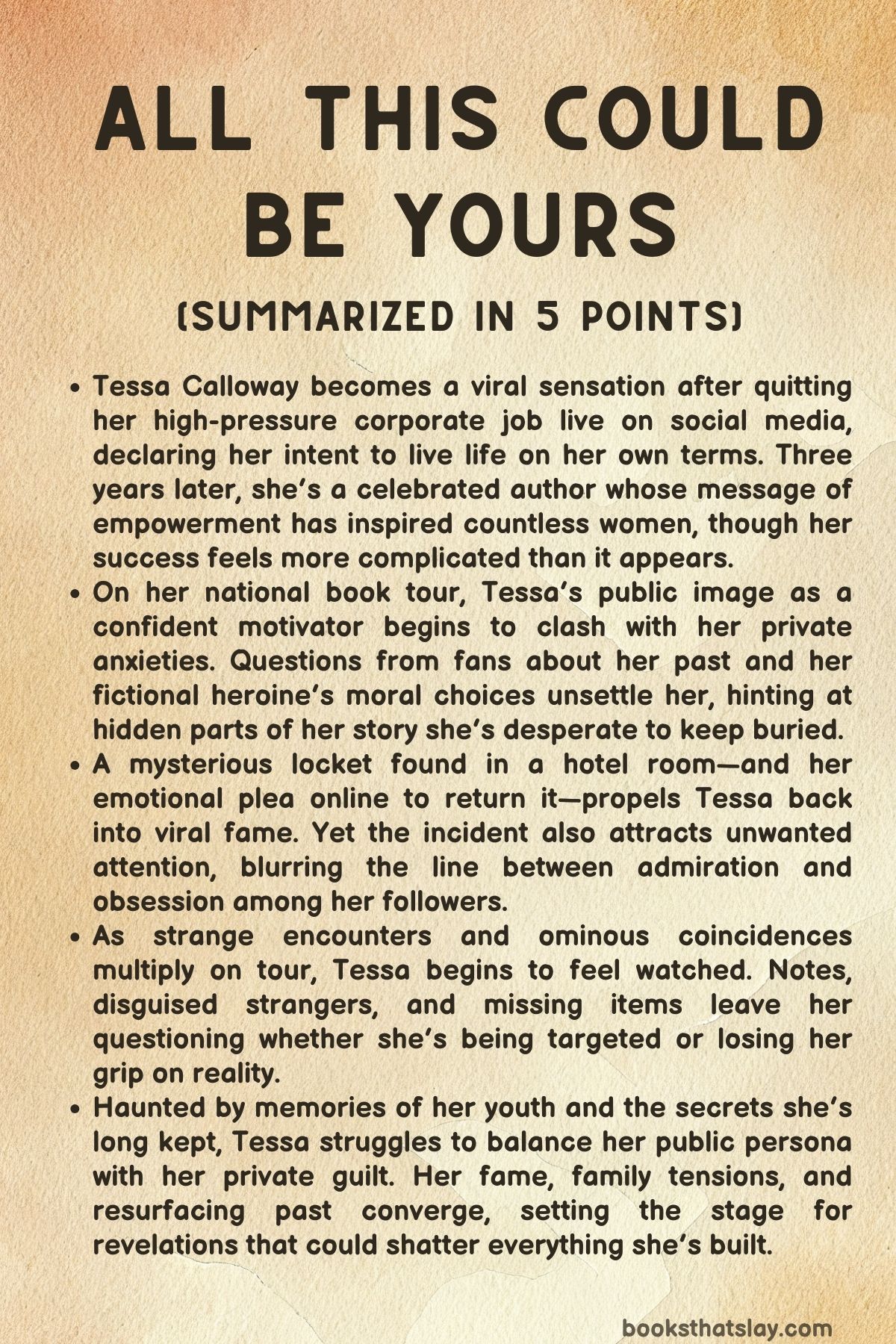
Tessa Calloway’s journey begins with a viral moment. Burned out from years of corporate work at Swain and Woodworth, she goes live on social media to announce she’s quitting her job.
In front of thousands of viewers, she declares that she’s reclaiming her life and will pursue her dream of writing. Her video, shared widely among the “#MomsWithDreams” online community, turns her into a symbol of empowerment for women seeking fulfillment beyond their routines.
Three years later, that impulsive decision has made her a star. Tessa’s debut novel, All This Could Be Yours, has become a bestseller, and she’s touring the country, adored by readers who chant her motto: “One life!
” Her book’s heroine, Annabelle Brown, embodies confidence and courage—the woman Tessa’s followers believe she has become. At her events, fans treat her like a visionary, but the line between author and character begins to blur.
Tessa admits she sometimes “hears” Annabelle’s voice guiding her, suggesting her fictional creation has become a powerful, intrusive force in her own life.
During one event, a reader asks personal questions about Tessa’s childhood. Her agent, Sadie, has always warned her to avoid the subject.
A “moral turpitude” clause in her contract means any scandal could ruin her career. Flustered, Tessa insists her book isn’t autobiographical and redirects the crowd.
Later, in her hotel, she enjoys the trappings of fame—flowers from fans, recognition at the desk—but her family’s distance weighs heavily. Her husband Henry calls with vague worries about strange noises at home, and her children, especially her daughter Linny, resent her absences.
In her room, Tessa discovers a rose-gold heart-shaped locket in the nightstand. Inside is a small photograph of a smiling family beside a lake.
Believing it to be a lost keepsake, she tries contacting the hotel’s lost-and-found but gets no help. Instead, she turns again to social media, posting a live video asking her followers to help find “Locket Mom.
” Her emotional plea goes viral, spreading her image as a caring, relatable celebrity.
The next morning, her driver mentions the video’s success, suggesting she keep the locket rather than turn it in. At the airport, Tessa’s phone fills with comments—praise, criticism, and speculation.
Some mention Maine, a place tied to Tessa’s hidden past. Unsettled, she boards her plane, only to discover her seatmate, Sam, is reading her book.
Their friendly conversation takes an eerie turn when he reveals his daughter’s name—Savannah—Tessa’s own secret middle name. Sam says he’ll attend her next event in Phoenix, and she brushes off her discomfort.
That night in Phoenix, Tessa’s event begins like any other, but tension builds when fans press her about her viral “Locket Mom” post. She avoids answering directly.
Then, during the signing, Sam reappears, implying he knows more about her family than he should. The store owner, Heather, quickly intervenes, warning Tessa about “parasocial fans”—followers who believe they have personal relationships with celebrities.
Rattled, Tessa returns to her hotel, where she finds a strange note slipped under her door reading: “Package for you at front desk. ” When she checks, the staff insists no package exists.
She realizes someone may have lured her out to access her room.
Terrified, she FaceTimes Henry as she reenters her darkened suite. Everything seems untouched, but her nerves are frayed.
Later, she discovers the locket missing. Only that item is gone, confirming her fear.
The following morning, however, the front desk clerk gives her a bag labeled with her name and room number—inside are the same plastic wrappings and the returned locket. Someone took it and placed it back exactly as it was.
She now knows someone is watching her.
Determined to stay professional, Tessa continues her tour. Her next Uber driver introduces herself as Annabelle—the same name as her fictional heroine.
The coincidence unnerves Tessa, especially when the driver gushes about loving her book and asks her to sign it “to the real Annabelle. ” Tessa begins to sense that her life and her fiction are merging in strange ways.
At her next event, a bookstore manager named Rosalie tells her that someone texted the store claiming to recognize the family in the locket photo. As Tessa prepares to meet this person, she learns a gray-wigged woman with large glasses has arrived asking to speak with her.
However, the woman vanishes before Tessa’s talk begins. After the event, employees find a gray wig hanging outside the store—a chilling signal that the stranger had been there, observing her all along.
The next morning, Tessa FaceTimes Henry. Their call spirals into tension when she sees that Linny, their daughter, has cut her long hair into a short pixie style at a neighbor’s salon.
Henry and their neighbor Nellie Delaney had allowed it without telling her. Suppressing her anger, Tessa praises Linny but resents being excluded.
Henry mentions a woman named Barbara who has been asking personal questions about Tessa’s parents. He also shows her a postcard from Sam, the man from the plane, implying jealousy.
The argument intensifies until Henry abruptly says they’re getting a puppy. Overwhelmed, Tessa ends the call.
While waiting for her next flight, Tessa drifts into memories of her youth. She recalls confiding in her best friend Emily about being kidnapped as a child near the Maumee River, lured with a Popsicle and five dollars.
Later, as teenagers, she and Emily were involved in a late-night accident in Maine, when Emily, driving Tessa’s mother’s rental car, struck something—or someone. Emily’s father, the sheriff, covered it up, insisting they’d hit a deer.
Tessa’s mother, furious and afraid, forced her to move away and sever all contact with Emily forever.
Now in Seattle, Tessa searches online for any trace of her childhood or the accident, but finds nothing. When Henry calls again, he mentions that their neighbor Nellie invited their son Zack to her family’s lake house in Maine—in Blytheton, the same town where the long-buried tragedy occurred.
Terrified, Tessa pretends indifference and hangs up.
That night at her Seattle event, her host Ethan warns her about anonymous questions asking where she spent her childhood summers. She lies that her family vacationed in Cape Cod.
During the signing, a blond-haired woman with an oddly wig-like style approaches her, accusing her of avoiding questions. Her tone is calm but accusatory.
When Ethan steps in, the woman leaves abruptly, and Tessa wonders if she could be Emily.
Back at the hotel, Tessa receives a sealed envelope from a clerk, delivered by a mysterious woman who insisted on using a blank envelope. The note inside remains unread, but its presence deepens her dread.
As she video calls home, Zack tries to tell her about a “secret” but hesitates, asking if revealing it will let him go to Maine. Before he can finish, Linny interrupts, and Henry storms in angrily, catching them mid-conversation.
His expression and the chaos behind him make Tessa realize something is very wrong at home.
As the story closes, Tessa’s carefully crafted life begins to unravel. The world sees her as a beacon of reinvention, but her fame, secrets, and guilt collide.
The mysterious watchers, the resurfacing memories, and her family’s distance force her to confront the truth she has long buried—the identity she created for her followers and the real woman she’s been running from. All This Could Be Yours becomes not just the title of her book but an echo of everything Tessa risks losing—her family, her past, and perhaps even her sanity.
Characters
Tessa Calloway
In All This Could Be Yours, Tessa is both the architect and prisoner of a story she’s spent years selling to the world. She begins as a burned-out corporate employee whose viral “one life” broadcast transforms her into a bestselling author and a beacon for the “#MomsWithDreams” movement.
Fame amplifies her voice but also narrows her private world; the more she performs empowerment for others, the less room she has to process her own past. Her relationship with social media is a double-edged sword—she’s deft at mobilizing her audience to find the locket’s owner, yet that same visibility invites intrusion, surveillance, and parasocial fixation.
Morally, she is complex: she hides formative secrets (a childhood kidnapping memory, a teenage accident, a possibly changed name) while insisting her fiction isn’t autobiographical, then lets her heroine’s “voice” justify choices she won’t fully own. As a mother, she is loving and present at a distance—guilt-ridden when she misses milestones, fiercely protective when she senses danger—but often dismissed by those closest to her.
The locket saga functions as a mirror for Tessa: what she casts as a public good deed becomes a private reckoning with control, truth, and the costs of being seen.
Annabelle Brown
Annabelle is the avatar through which Tessa externalizes intuition, courage, and rationalization. On the page, Annabelle is the confident heroine readers chant for; in Tessa’s mind, she’s an audible presence that comments, nudges, and sometimes excuses.
This porous boundary lets Tessa claim agency while also displacing it—“Annabelle acts on her own” becomes a way to harness boldness without admitting risk. Annabelle’s name echoing through the real world (the adoring Uber driver, fans who chant “One life!
”) makes the character feel physically manifest, blurring author and creation. As the tour grows perilous, Annabelle’s voice oscillates between support and complicity, dramatizing the danger of letting a brand stand in for a self.
Annabelle Browning
The discovery and online search for “Annabelle Browning” expose a shadow self tied to Tessa’s early kidnapping and the unresolved summer in Maine. The near-match between Annabelle Browning and Annabelle Brown suggests more than coincidence; it hints that Tessa’s celebrated heroine may be a reclaimed or reframed version of a silenced past.
The absence of search results underscores how powerfully adults can erase or rename trauma, either to survive it or to conceal culpability. Annabelle Browning becomes the locked drawer in Tessa’s psyche—the name that can unlock motive, fear, and the impulse to curate facts before they can incriminate.
Henry Calloway
Henry is partner, foil, and stress test for Tessa’s reinvention. His surface steadiness—managing the house, joking about time zones, proposing a puppy—frequently curdles into dismissiveness, jealousy, and secrecy.
He minimizes Tessa’s safety fears about the locket, bristles at Sam’s postcard, and allows boundary-crossing from neighbors that Tessa reads as intimate encroachment. With the children, he can be caring yet careless, gone at crucial moments and using reassurance as a way to end uncomfortable conversations.
Henry’s arc raises the question of whether he is oblivious, overwhelmed, or willfully evasive; whichever is true, his behavior forces Tessa to confront how much of her marriage depends on her managing perceptions rather than confronting facts.
Linny Calloway
Linny is the novel’s gauge of maternal cost. Her unexpected haircut, arranged without Tessa, marks a rite of passage that happens offstage for the parent who built a career helping other mothers claim their lives.
Linny’s earlier banana-sickness memory coincides with the first moment Tessa “hears” Annabelle, binding Linny’s small vulnerability to the birth of Tessa’s authorial persona. On video calls Linny is affectionate and mercurial, a child who wants proximity while the adults around her triangulate control; she embodies the tension between a public figure’s touring life and a private mother’s daily presence.
Zack Calloway
Zack is the family’s reluctant truth-teller, carrying adult secrets in a child’s hands. He’s practical under pressure (shutting off the flooding dishwasher) and hungry for moral clarity, asking whether some secrets must be kept even from his mother.
His possible trip to Maine—ground zero for Tessa’s teenage trauma—turns him into a narrative fuse, and his loyalty is courted by competing adults. Zack’s scenes expose how secrecy reproduces itself across generations and how quickly a well-meaning child can be recruited into the maintenance of an adult’s image.
Sadie Bailey
Sadie represents the ruthless logic of reputation economics. By warning Tessa about “moral turpitude” and scripting interviews away from biography, she codifies an unspoken contract: success requires a spotless narrative, even if the truth is messier.
Sadie’s counsel keeps Tessa safe in the marketplace and precarious in her conscience, making every personal question feel like a legal trap rather than an invitation to trust.
Olivette
Olivette and the team embody the exhilaration and extraction of literary fame. They celebrate list placement and viral reach while cautioning Tessa about obsessive followers, implicitly acknowledging that the marketing machine both feeds and endangers her.
Their remote toasts and video calls are affectionate but transactional; they need the persona as much as the prose. In their world, the returned locket is content before it is a threat.
Sam
Sam personifies the charm-to-menace gradient of parasocial intimacy. He starts as a flattering stranger with a book for his daughter, then reappears with unsettling knowledge and a postcard that inflames Henry’s suspicion.
His pattern—friendly request, odd coincidence, boundary nudge—maps the subtle escalations that public figures must decode in real time. Whether he is a harbinger, a red herring, or an emissary from Tessa’s past, Sam teaches Tessa how fragile the membrane is between reader devotion and personal intrusion.
Nellie Delaney
Nellie is the neighbor whose kindness blurs into trespass. She shepherds Linny to a drastic haircut, helps choose the family’s paint, and invites Zack to Maine, stitching herself into the Calloway home while Henry looks on.
Whether she is simply helpful or opportunistic, Nellie heightens Tessa’s fear that her domestic life is being rearranged in her absence and by people she did not appoint.
Barbara
Barbara’s nosy questions about Tessa’s parents are less about gossip than about pressure applied at a fault line. By probing family origin—the deaths of mother and father, the absence of old photos—she threatens to surface the biography Tessa has worked to deflect.
Barbara’s curiosity functions as the neighborhood’s collective eye, reminding Tessa that secrecy has a way of drawing attention to itself.
Emily and Sheriff Owen
Emily is the friend through whom the past refuses to stay buried; Sheriff Owen is the adult who weaponizes authority to manufacture a clean story. The late-night drive, the impact on a dark road, and the command to “call it a deer” establish a template for silence that Tessa replicates later in life: protect the narrative at all costs, leave town if necessary, sever ties that could talk.
Whether Emily is the blonde woman in Seattle or a phantom of memory, her presence reframes Tessa’s success as built atop a carefully paved cover-up.
Heather, Rosalie McDermott, Dorrit, and Ethan Cornish
These booksellers are the gatekeepers of Tessa’s public encounters. Heather spots danger and intervenes decisively with Sam, Rosalie bathes Tessa in professional warmth, Dorrit delivers news that is equal parts adoration and alarm, and Ethan quietly triages risk by filtering hostile questions.
Together, they reveal how author events double as community rituals and security theaters, stages where admiration, confession, and threat share the same microphone.
Themes
Identity and Reinvention
Tessa Calloway’s journey in All This Could Be Yours centers on her attempt to reconstruct her identity in the aftermath of personal and professional dissatisfaction. The viral video in which she quits her corporate job represents more than rebellion—it symbolizes a desperate act of self-definition in a world that constantly commodifies identity, especially for women.
Her evolution from an invisible employee to a bestselling author admired for her authenticity is laced with irony. Tessa’s new self—the confident, inspirational “#MomsWithDreams” figure—is, in many ways, another performance carefully curated for her followers.
Beneath the glossy exterior lies a woman still fractured by unacknowledged trauma and guilt. The constant pressure to maintain her public persona forces her to navigate a blurred line between who she truly is and who the world expects her to be.
The locket, an object that literally holds an image of another family, mirrors this tension: it becomes a vessel for lost and borrowed identities. Through Tessa, the novel exposes the instability of selfhood when identity becomes a public spectacle, asking whether one can ever truly reinvent oneself without confronting the past that shaped them.
Her new life appears successful on the surface, yet it is built on avoidance—of childhood pain, moral compromise, and secrets she has long buried. The pursuit of reinvention thus becomes both her liberation and her undoing.
The Illusion of Empowerment
The narrative of empowerment that defines Tessa’s public image conceals deeper contradictions about control and authenticity. Her brand promises freedom—encouraging women to “take their lives back”—but her own freedom is precarious, constantly managed by contracts, agents, and moral clauses that dictate her behavior.
The “one life” mantra that made her famous becomes a marketing slogan, echoing the commercialization of empowerment culture. Even her fans’ devotion, though well-meaning, turns parasocial, exposing how easily genuine connection morphs into obsession.
The novel challenges the reader to see empowerment as something more complex than success stories or social media affirmations. For Tessa, empowerment is entangled with surveillance, performance, and fear.
Her viral fame amplifies her voice but simultaneously erodes her autonomy—every decision she makes is scrutinized by strangers. The supposed control she gains by quitting her job transforms into a different kind of captivity, one shaped by audience expectation and digital exposure.
The story reveals how contemporary notions of empowerment can mask dependence on external validation, suggesting that true empowerment requires not public approval but private reconciliation with one’s past and self.
Secrets, Guilt, and the Haunting Power of the Past
The buried memories of Tessa’s youth form the dark pulse beneath her success. Her life, built on reinvention, is haunted by the unspoken guilt surrounding the accident from her teenage years and the mysterious disappearance of her friend Emily from her life.
These secrets manifest as paranoia and fear, following her from one city to the next during her book tour. The reappearance of figures who might know her past—whether real or imagined—forces her to confront the cost of suppressing memory.
The recurring motif of the locket reinforces this theme: a small object containing someone else’s past becomes the trigger that unravels Tessa’s carefully controlled present. The return of the stolen locket and the eerie reemergence of people who may be connected to her earlier life symbolize how the past refuses to remain buried.
The novel explores how guilt corrodes relationships and distorts perception—her marriage frays, her connection with her children weakens, and even her sense of reality becomes unstable. Through Tessa’s unraveling, the book exposes how the act of hiding the past can transform memory into menace, and how redemption demands confrontation rather than denial.
Motherhood and the Conflict Between Care and Ambition
Tessa’s dual role as mother and professional success story underscores the emotional cost of ambition for women. Her daughter Linny’s haircut and her family’s subtle detachment represent the growing distance between the public figure Tessa has become and the private life she has neglected.
The guilt she feels for missing milestones, for not being present during crises, and for using motherhood as part of her inspirational persona reveals a deep moral tension. The novel does not romanticize maternal sacrifice; instead, it presents motherhood as a space of competing loyalties and constant negotiation.
Henry’s indifference and the intrusion of outsiders like Nellie highlight the vulnerability that arises when maternal presence is replaced by symbolic influence. Even Tessa’s online “mom community,” built on shared dreams, becomes an ironic mirror—an audience that praises her for balance she no longer truly possesses.
Through Tessa’s story, the book questions whether women can ever fully reconcile ambition with the expectations of motherhood, or whether every attempt at success must come with emotional debt. The portrayal of her fractured family life gives the theme a piercing realism, capturing the loneliness that hides behind public triumph.
The Nature of Reality and Perception
Throughout All This Could Be Yours, the boundaries between truth and imagination blur as Tessa’s inner and outer worlds collide. Her conversations with Annabelle, the fictional heroine who seems to speak in her mind, raise questions about sanity and authorship.
The narrative suggests that storytelling, once her escape, becomes the medium through which her fears materialize. Each event—the mysterious notes, the disguised women, the reappearing locket—could be evidence of real danger or psychological projection.
The instability of perception mirrors the instability of her constructed identity. By filtering her experiences through the lens of her imagination, Tessa loses the ability to distinguish fiction from memory, admiration from threat.
The novel’s psychological tension builds around this uncertainty, portraying the mind as both refuge and trap. In this way, the story becomes a meditation on the cost of narrative control: when life becomes a story told to others, the storyteller risks losing her grip on what is real.