All the Way to the River Summary and Analysis
All the Way to the River: Love, Loss, and Liberation is Elizabeth Gilbert’s memoir about love, addiction, grief, and recovery, centered on her relationship with her late partner, Rayya Elias. The book looks at the difference between devotion and self-erasure, between care and control, and between romance and addiction.
Gilbert writes about Rayya’s illness and death, but also about her own patterns of codependency, love addiction, overgiving, secrecy, and spiritual hunger. It is a candid account of a relationship that was full of love but also damage, and of the long recovery that helped Gilbert reclaim her life.
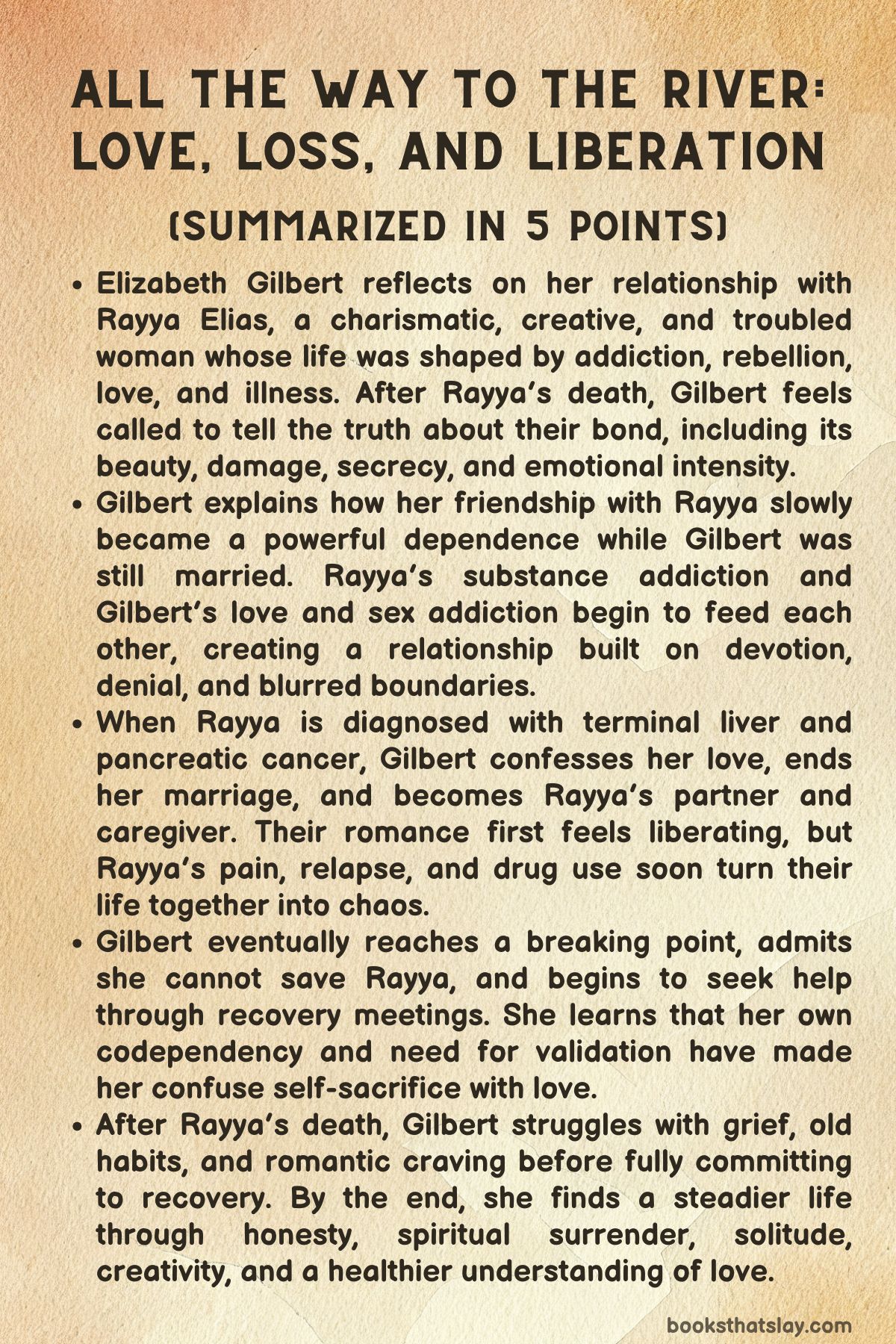
Summary
The book begins with Elizabeth Gilbert looking back on Rayya Elias after Rayya’s death. Gilbert feels that Rayya’s presence, once vivid in her life, has become harder to reach with time.
Then, on Gilbert’s fifty-fourth birthday, she senses Rayya’s energy in her New York apartment and imagines Rayya speaking to her. In this spiritual encounter, Rayya acknowledges both the love and the disorder of their relationship, encourages Gilbert to stay committed to recovery, and gives her permission to tell the truth.
That moment becomes the doorway into the memoir.
Gilbert introduces Rayya as a Syrian immigrant raised in Detroit, a bold, queer, and rebellious woman who never fit easily into family or social expectations. Rayya was creative, funny, direct, and deeply compassionate, but she also lived for years with serious addiction.
She used drugs from a young age, later built a life as a musician, filmmaker, writer, and hairdresser, and spent years in sobriety before relapse entered her life again. Gilbert remembers her as magnetic and brave, but not as flawless.
From the start, the book insists on holding both realities together: Rayya was loving and alive with spirit, and she could also be difficult, needy, and destructive.
Gilbert first meets Rayya when she goes to her for a haircut during Gilbert’s first marriage. At the time, Gilbert is a writer under pressure, trying to fulfill roles that do not feel like her own.
Rayya’s confidence, honesty, and refusal to please everyone fascinate her. Gilbert is drawn to Rayya’s directness because she herself has spent much of her life avoiding conflict and trying to earn safety through being agreeable.
Over time, their friendship deepens. Rayya becomes a trusted confidante, a person who tells the truth without fear and helps Gilbert feel braver around other people.
After the success of Gilbert’s earlier memoir, her life changes dramatically. She becomes wealthy and famous, but her inner life remains anxious and uncertain.
Her habit of overgiving grows stronger. She gives money, help, housing, and emotional support with the hope, often hidden even from herself, that love and approval will come back to her.
When Rayya faces financial and emotional hardship, Gilbert offers her a converted church in New Jersey as a temporary place to stay. Rayya remains there for years.
Gilbert later recognizes that this offer, though generous, was also tied to codependency. She wanted to help Rayya, but she also wanted to keep Rayya close.
As Gilbert explains her own patterns, the memoir widens into an examination of addiction. Rayya’s addiction is tied to substances, while Gilbert identifies her own as love and sex addiction, a process addiction marked by obsession, secrecy, fantasy, and emotional dependence.
Gilbert describes her need for love, attention, validation, and approval as something that once felt necessary for survival. She begins to see that her attachment to Rayya was not only friendship or affection.
It became a form of dependence. Rayya made her feel safe, powerful, and seen, and Gilbert increasingly relied on her as her emotional anchor.
Their friendship becomes more intense while Gilbert is still married to her second husband. Gilbert does not physically betray him, but she knows she is slowly replacing him emotionally with Rayya.
Rayya becomes her companion at public events, her advisor, and her private refuge. Gilbert hides the depth of this attachment from her husband, Rayya, and herself.
At the same time, Rayya has her own secret: she has begun drinking again. She tells Gilbert that alcohol is not her real addiction and presents her drinking as harmless.
Gilbert wants to believe her because she has placed Rayya on a pedestal. Their addictions begin to feed each other: Rayya hides her relapse, and Gilbert protects the image of Rayya she needs in order to feel safe.
In 2016, Rayya receives devastating news. A scan shows tumors on her liver and pancreas, and she understands that she is likely dying.
The diagnosis forces Gilbert to face the truth she has avoided. She can no longer pretend that Rayya is only her friend.
She tells her husband that she is in love with Rayya, and the marriage ends. When Gilbert confesses her feelings to Rayya, Rayya admits she feels the same.
The two become romantic partners, and at first the relationship feels like a release from years of secrecy. They are swept up in passion, urgency, and the strange freedom created by Rayya’s limited time.
Rayya responds to her diagnosis with a fierce desire to live as fully as possible. Gilbert throws herself into making Rayya’s remaining life exciting and meaningful.
She helps Rayya record music, attend events, speak publicly, and pursue whatever brings her pleasure. But Gilbert later sees that her own addiction was fully active during this period.
She spends recklessly, neglects her health and career, and treats Rayya’s happiness as her only purpose. What looks like devotion becomes self-erasure.
Gilbert is living as if she, too, is dying.
When Rayya begins chemotherapy, the mood changes. Treatment shrinks the tumors but leaves her in pain, exhausted, and emotionally unstable.
Gilbert becomes her constant caregiver, proud of her devotion and convinced she can endure anything for love. But Rayya’s suffering increases, and so does the pressure on Gilbert.
Rayya returns to cocaine, first as an attempt to manage pain and then as part of a larger collapse. She becomes paranoid, cruel, sleepless, and abusive.
Gilbert, trapped in the role of lover and caregiver, gives Rayya money for drugs and feels unable to stop. The relationship turns frightening and unbearable.
At her lowest point, Gilbert begins to think about killing Rayya to end the chaos. She takes pills from Rayya’s supply and considers how she might cause an overdose.
Then she realizes she cannot kill Rayya, but she might kill herself. In that crisis, she hears an inner call telling her she has no power left and needs help.
She reaches out to friends and finally tells the truth about what has been happening. One friend suggests that Gilbert may need help for love and sex addiction.
This becomes a turning point.
Gilbert tries to confront Rayya through an intervention, but it fails. Rayya denies the problem, attacks Gilbert, and says she wishes they had never become a couple.
Gilbert leaves in agony. She begins attending recovery meetings for people affected by addiction and for people with love and sex addiction.
At first she resists the lessons she hears there. The idea that she should focus on her own life rather than controlling Rayya feels almost impossible.
But slowly she begins to understand that saving Rayya is not her job, and that her obsession with rescue is part of her own illness.
Eventually Gilbert returns to Rayya and speaks honestly. She apologizes for her dishonesty, blurred boundaries, and codependence, but she also tells Rayya that she cannot keep sharing a life with her.
Rayya accepts this with sadness. She later goes to Detroit, where her former partner Stacey takes care of her with firm, practical love.
Gilbert is jealous and ashamed that Stacey can do what she could not, but she also recognizes Stacey as a saving presence for both of them.
When Rayya stabilizes, Gilbert visits her in Detroit. Rayya is near death but calmer and clearer.
They talk openly about the damage between them. Gilbert even admits that she had planned to murder her, and Rayya understands why.
They ask each other for forgiveness, and they receive it. This conversation gives them a measure of peace before the end.
As Rayya’s death approaches, loved ones gather around her. Her final days are painful and chaotic rather than serene, and Gilbert refuses to soften that truth.
Rayya resists death fiercely, but her last breath seems peaceful.
After Rayya dies, Gilbert collapses into grief. She works too much, tries to appear fine, manages Rayya’s estate, and returns to old habits of seeking romantic and sexual validation.
Eventually, another emotional breakdown sends her back to recovery. This time she commits fully.
She shares in meetings, accepts help from a sponsor, ends romantic entanglements, deletes triggers, stops using alcohol and drugs, and begins to face the childhood wounds beneath her hunger for approval. She also becomes financially sober, learning not to use money as a way to rescue others or buy love.
Over the years, Gilbert grows steadier. She draws, writes poems, cooks, walks in nature, practices yoga, gardens, and learns to live without constant romantic intensity.
She understands that wellness is not a single revelation but a daily practice. She also reconnects with her younger self, the frightened child within her whom she had long resented.
Instead of seeking someone else to protect that child, she begins to care for her herself.
By the end of the book, Gilbert can love Rayya without worshiping her, remember her without needing her to be perfect, and honor their bond without being consumed by it. The memoir closes with forgiveness, spiritual humility, and a hard-won sense of freedom.
Gilbert has lost Rayya, but she has not lost her creativity, faith, friendships, or capacity for hope.
Key People
Elizabeth Gilbert
Elizabeth Gilbert is the narrator, central figure, and emotional lens of All the Way to the River. Her character is built around intense self-examination.
She does not present herself as a simple victim of Rayya’s illness or addiction; instead, she studies her own behavior with unusual severity. Gilbert is generous, creative, spiritually curious, and capable of deep devotion, but she also recognizes that her generosity often becomes a form of control.
Her desire to help others is tied to her fear of abandonment and her need for love, approval, and emotional safety. This makes her relationship with Rayya both beautiful and dangerous.
Gilbert wants to be loyal, brave, and selfless, but she gradually sees that she has been using caretaking as a way to avoid her own wounds. Her arc is one of painful honesty.
She moves from secrecy, obsession, and self-erasure toward recovery, solitude, humility, and responsibility for her own life.
Rayya Elias
Rayya Elias is presented as brilliant, wild, funny, truthful, and deeply damaged. She has a forceful personality that draws people toward her.
Her honesty gives others permission to stop pretending, and Gilbert admires her courage because Rayya says what Gilbert is often too afraid to say. Rayya’s background as a queer Syrian immigrant growing up in Detroit shapes her outsider identity and rebellious spirit.
She is creative and charismatic, but she is also marked by addiction, instability, and defiance. Her substance use is not treated as a side detail; it is central to the tragedy of her life and to the breakdown of her relationship with Gilbert.
Rayya can be compassionate and protective, but when her illness, pain, and addiction intensify, she becomes cruel, paranoid, and emotionally dangerous. Gilbert’s portrait of Rayya is loving but not idealized.
Rayya is not reduced to her addiction, yet the book refuses to hide the harm her addiction causes.
Stacey
Stacey, Rayya’s former partner, becomes one of the most grounded figures in the narrative. She enters most powerfully when Gilbert can no longer safely care for Rayya.
Unlike Gilbert, Stacey is able to help Rayya without being consumed by the fantasy of being her savior. Her care is practical, firm, and disciplined.
She accepts Rayya into her home, manages her withdrawal and health needs, and gives her structure at a time when Gilbert has collapsed from exhaustion and emotional chaos. Stacey’s presence exposes one of Gilbert’s painful realizations: love alone is not always enough, especially when love is mixed with codependency.
Gilbert envies Stacey’s ability to stay steady, but she also comes to recognize her as a kind of rescuer, not in a romantic or dramatic sense, but in the plain and difficult work of keeping Rayya safe. Stacey represents mature care, boundaries, and competence.
Gigi
Gigi, Rayya’s ex-wife, appears as part of the circle of people who continue to love Rayya through illness and death. Her role is quieter than Gilbert’s or Stacey’s, but she is significant because she shows that Rayya’s life did not belong to Gilbert alone.
Gigi’s presence reminds the reader that Rayya had a long history of relationships, loyalties, and emotional debts before Gilbert became her partner. She is present during Rayya’s final decline and shares in the vigil around her death.
She also gives language to Gilbert’s overwhelming waves of grief by calling them “bow-down” moments. Through Gigi, the memoir shows grief as a shared but uneven experience.
Each person around Rayya has a different claim, a different memory, and a different wound. Gigi helps widen the emotional field of the story beyond Gilbert’s private suffering.
Georgette
Georgette, Rayya’s mother, appears mostly through memory, spiritual visitation, and Rayya’s approach to death. Though she is not physically alive in the main timeline, her presence matters deeply.
Gilbert describes moments when she feels Georgette’s spirit near Rayya, especially during emotionally charged scenes involving comfort, illness, and the fear of dying. Georgette represents maternal love, ancestry, and the possibility that death may not be total erasure.
For Rayya, who resists death fiercely, the image of her mother becomes a source of invitation and comfort. The idea that Rayya finally takes her mother’s hand at the end offers one of the memoir’s gentler spiritual resolutions.
Georgette’s role also reflects Gilbert’s belief that love can continue in mysterious forms after death, even if those forms cannot be proven.
Tina
Tina appears briefly but meaningfully as a person whose pain is brought into the open by Rayya’s fearless honesty. Gilbert initially wants to comfort Tina in a careful, socially acceptable way, but Rayya immediately senses that something serious is wrong.
By naming what she sees, Rayya allows Tina to admit her self-harm, addiction, and suicidal thoughts. This moment reveals Rayya’s gift for cutting through politeness without cruelty.
Tina’s role is important because she helps show why Gilbert admires Rayya so intensely. Rayya’s honesty is not just bluntness; at its best, it is an act of care.
Tina’s breakdown and confession demonstrate that truth can be protective when spoken with courage and compassion. The scene also contrasts Gilbert’s people-pleasing with Rayya’s direct engagement with suffering.
Gilbert’s First Husband
Gilbert’s first husband is less developed as an individual and more important as part of Gilbert’s early pattern of living a life shaped by other people’s expectations. During this marriage, Gilbert feels trapped by domestic roles, full-time work, and the pressure to have children.
Her life appears stable from the outside, but internally she feels that she is becoming someone she does not want to be. His character represents the social script Gilbert is trying and failing to inhabit.
He is not portrayed as a villain; rather, the marriage becomes a setting in which Gilbert’s discomfort with conventional expectations becomes impossible to ignore. Her meeting with Rayya during this period matters because Rayya seems to embody the freedom, self-possession, and rebellion that Gilbert lacks.
Gilbert’s Second Husband
Gilbert’s second husband occupies a morally important place in the story because Gilbert’s emotional dependence on Rayya develops while she is still married to him. He represents the private cost of Gilbert’s secrecy.
Gilbert acknowledges that although she does not physically betray him at first, she does gradually replace him emotionally with Rayya. His role forces the memoir to confront the harm caused by hidden attachment, even when that attachment is framed as friendship.
He is part of Gilbert’s reckoning with love addiction because her inability to be honest with him reveals how deeply she is protecting her need for Rayya. The end of the marriage is not treated as a simple romantic awakening; it is also part of a larger pattern of avoidance, secrecy, and emotional displacement.
Gilbert’s Sponsor
Gilbert’s sponsor becomes a guide into recovery and a counterforce to Gilbert’s habits of obsession, drama, and rescue. The sponsor helps Gilbert understand that recovery requires concrete action, not just insight.
Through this figure, Gilbert learns to end romantic entanglements, avoid triggers, stop using other people for emotional regulation, and examine her relationship with money. The sponsor’s importance lies in her plain wisdom.
She does not encourage Gilbert’s grand stories about love and suffering; she brings Gilbert back to discipline, boundaries, and daily practice. The sponsor helps Gilbert see that overgiving money is part of the same addictive structure as chasing romance.
In this way, she becomes one of the people who helps Gilbert rebuild her life from the ground up.
The Recovery Community
The recovery community functions almost like a collective character in All the Way to the River. At first, Gilbert resists the people she meets in recovery rooms.
She judges them, fears being seen by them, and struggles to accept that their stories resemble her own. Over time, however, their honesty becomes essential to her healing.
These people offer a form of truth that Gilbert cannot access alone. They are flawed, wounded, and sometimes messy, but their willingness to speak openly helps Gilbert understand the nature of addiction.
The recovery community also challenges her belief that she is exceptional. In those rooms, she becomes one person among many who must surrender, listen, and practice humility.
Their collective presence helps her move from isolation into accountability.
God
God appears not as a conventional religious figure but as a spiritual presence associated with tenderness, surrender, and liberation. Gilbert’s God is not a punishing authority.
This presence speaks through poems, recovery rooms, intuition, other people, and moments of crisis. God often appears when Gilbert has reached the limits of control.
In the memoir, God asks Gilbert to stop managing everyone else’s life and return to her own. This spiritual figure is central to Gilbert’s recovery because it gives her a way to understand surrender without despair.
God becomes the force that tells her she belongs, that she can stop fighting reality, and that she does not need to earn love through suffering. As a character-like presence, God represents mercy, humility, and the possibility of inner restoration.
Themes
Addiction as a Distortion of Love, Need, and Worship
Addiction in All the Way to the River is shown as more than substance use. Rayya’s addiction is visible through drugs and alcohol, but Gilbert’s addiction works through romance, sex, validation, and emotional dependence.
This contrast expands the idea of addiction beyond the obvious forms and shows how any craving can become destructive when it takes over a person’s judgment. Gilbert’s need for love becomes so urgent that she mistakes obsession for devotion and rescue for care.
Rayya’s substance addiction and Gilbert’s love addiction feed each other because each woman protects the other’s illness in order to preserve what she needs. The theme is powerful because it refuses easy categories of good and bad.
Addiction does not erase love, but it changes the way love behaves. It turns tenderness into control, loyalty into enablement, and longing into worship of the wrong thing.
Recovery begins only when Gilbert admits that her problem is not simply Rayya’s addiction, but her own dependence on being needed, chosen, and adored.
Codependency and the Danger of Overgiving
Gilbert’s overgiving appears generous on the surface, but the memoir steadily reveals how destructive it can become. She gives money, housing, time, emotional labor, and caretaking, often at great cost to herself.
Her actions may look loving, but they are also tied to fear. She gives in order to feel safe, useful, and loved.
This makes codependency one of the book’s most important emotional patterns. Gilbert does not simply want to help Rayya; she wants to organize Rayya’s life, protect her from consequences, and make herself indispensable.
The tragedy is that this kind of care weakens both people. Rayya becomes more dependent, while Gilbert loses her own boundaries, health, finances, and sense of self.
The memoir shows that overgiving is not the same as love. True care requires respect for another person’s agency, even when that person is making painful choices.
Gilbert’s recovery depends on learning that she cannot save another adult by sacrificing herself. She must stop confusing self-abandonment with devotion.
Truth, Secrecy, and the Cost of Avoidance
Secrecy drives much of the suffering in the memoir. Gilbert hides the depth of her attachment to Rayya from her husband, from Rayya, and from herself.
Rayya hides her drinking and later the severity of her relapse. Both women maintain versions of reality that allow their addictions to continue.
Gilbert’s fear of confrontation makes the damage worse because she would rather preserve emotional comfort than risk an honest conversation. This avoidance creates a private world where dependence, fantasy, and denial can grow unchecked.
The memoir repeatedly shows that truth is painful, but secrecy is more damaging. When Gilbert finally tells the truth about her love for Rayya, her marriage changes forever.
When she tells the truth about Rayya’s abuse and drug use, she begins to find help. When she tells Rayya the truth about her own codependence, she finally steps out of the role that is destroying her.
Truth does not fix everything, and it does not save Rayya from death, but it gives Gilbert a way back to sanity.
Grief, Surrender, and Spiritual Recovery
Grief in the memoir is not peaceful or clean. Rayya’s illness and death are physically painful, emotionally chaotic, and spiritually confusing.
Gilbert grieves not only Rayya’s death but also the fantasy of their love story, the damage they caused each other, and the version of herself who believed suffering could prove devotion. This grief eventually becomes part of her recovery because it forces her to surrender control.
Gilbert cannot control Rayya’s addiction, illness, family, death, or afterlife. She cannot control the past or rewrite the relationship into something simpler.
What she can do is tell the truth, seek help, and build a life that does not depend on romantic intensity. Spiritual recovery comes through humility rather than certainty.
Gilbert’s idea of God gives her a language for surrender, but the work remains practical: attending meetings, staying sober from destructive patterns, caring for her body, managing money responsibly, and learning solitude. Grief does not disappear, but it becomes something she can live with instead of something she must escape.