All the Sinners Bleed Summary, Characters and Themes
All the Sinners Bleed by S. A. Cosby is a Southern crime novel about violence, race, faith, guilt, and the cost of justice in a town built on buried history. Set in Charon County, Virginia, the story follows Titus Crown, a former FBI agent who has returned home and become the county’s first Black sheriff.
What begins as a school shooting investigation soon uncovers a far darker crime: the torture and murder of Black children by men hiding behind religion, power, and small-town respectability. The novel is both a serial-killer mystery and a hard look at inherited hatred.
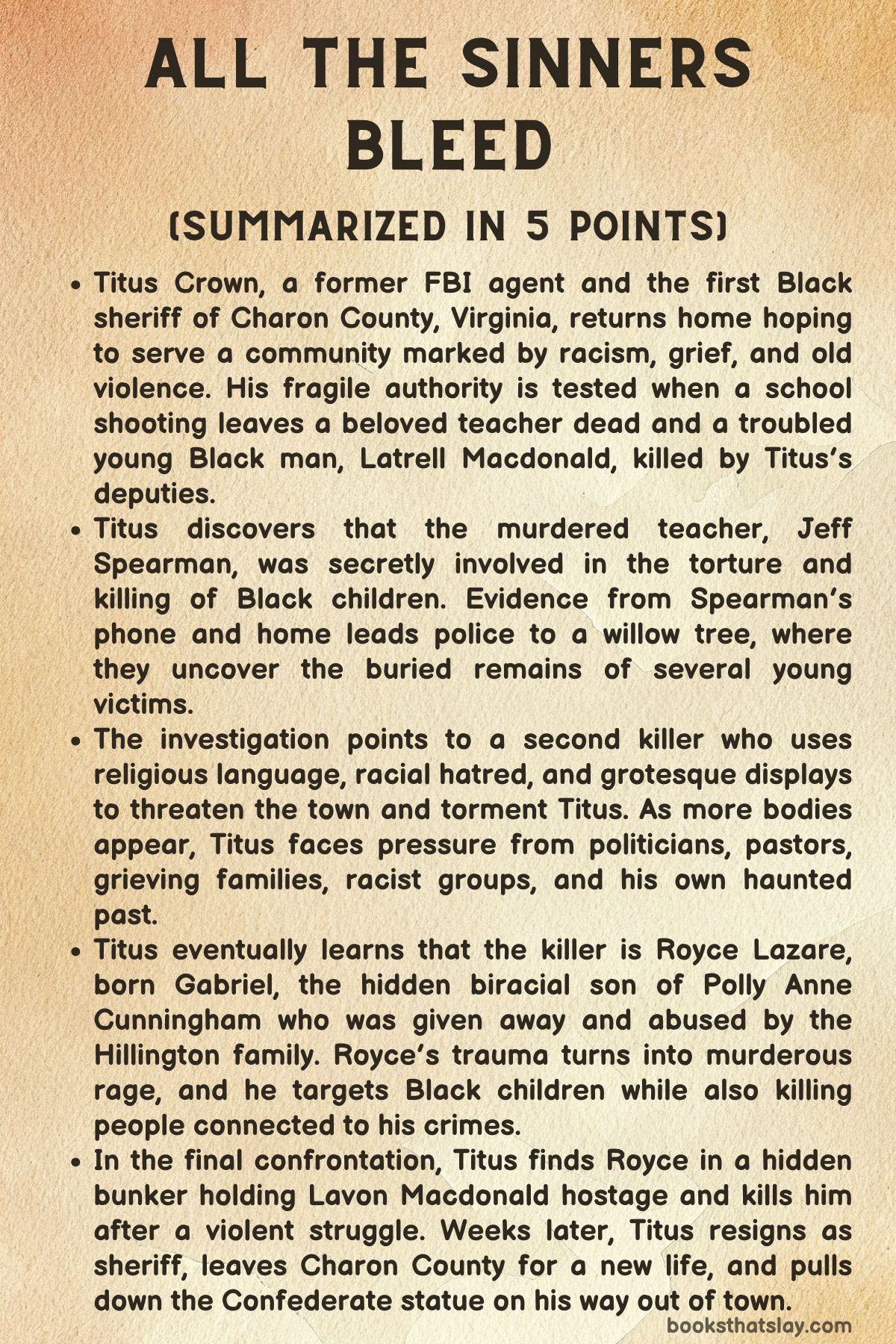
Summary
Charon County, Virginia, is a place where the past has never really passed. Its name seems accidental, but it fits the county’s long association with death, violence, and buried wrongs.
The land carries the memory of Indigenous destruction, slavery, racism, and generations of bloodshed. In the present, Charon appears quiet, but Sheriff Titus Crown knows that violence still lives there, often beneath polite smiles and church signs.
Titus has returned to his hometown after leaving the FBI under circumstances he keeps hidden. He now lives with his father, Albert, whose health has declined.
Titus’s mother died when he was young, and that loss shaped his anger toward religion and his distrust of easy comfort. As the first Black sheriff in Charon County, Titus hopes to improve a flawed system from the inside, but he is surrounded by old prejudice, political pressure, and public disappointment.
Local neo-Confederates, led by Ricky Sours, are planning a parade around a Confederate statue, and Titus is expected to protect them even though he despises what they represent.
The main crisis begins when Titus is called to Jefferson Davis High School during an active-shooter situation. A beloved teacher, Mr. Spearman, has been shot.
Outside the school, Titus sees Latrell Macdonald, the troubled son of his old friend Calvin, holding a gun and mask. Titus tries to talk him down, but Latrell behaves strangely, speaks of fallen angels and death, and charges toward the officers.
Two deputies shoot him dead. The shooting shocks the community and puts Titus in a painful position: he must investigate the death of a young Black man killed by his own department.
At first, Spearman appears to be an innocent victim. That changes when Titus uses the dead teacher’s fingerprint to unlock his phone.
He finds horrific images showing Spearman and another masked man torturing, abusing, and murdering Black children. Latrell appears in some of the images, not as the leader but as someone drawn into the crime.
Titus and his deputies search Spearman’s house and find more videos, drives, and a painting of a willow tree. Titus realizes the tree may mark a burial site.
On hunting land owned by a man named Tank, the police dig and uncover the remains of seven children.
The case transforms from a school shooting into a hunt for a serial killer. Titus believes Spearman and the unknown man used Latrell as bait to lure Black boys into their trap.
The killer seems obsessed with religion, punishment, race, and false Biblical language. Bodies bear carved phrases connected to distorted theology, including references to the Curse of Ham.
Titus begins to suspect that the killer may be connected to one of Charon County’s many churches, especially after a strange phrase appears on several church signs.
The investigation grows more disturbing when Cole Marshall, a white man connected to local racist circles and the fish house where Latrell worked, is found murdered and mutilated. His body is staged in a grotesque angelic pose.
A package later arrives at the police station containing Cole’s face and a threatening message. Titus realizes the killer is not only covering old crimes but also punishing people connected to them.
The murderer, whom Titus thinks of as the Last Wolf, begins taunting him directly.
As Titus searches for answers, he faces problems from every side. Scott Cunningham, a powerful local businessman and politician, pressures him to protect tourism and county business interests.
Jamal Addison, a Black pastor who once supported Titus, criticizes him for not standing more forcefully against racism and the neo-Confederates. Titus’s own officers are strained by the case, and one of them, Tom, is revealed to be corrupt, taking money from Jasper, a local bar owner involved in drugs.
Titus fires Tom, though he knows Tom’s corruption may have shaped his quick decision to shoot Latrell.
Titus also carries personal burdens. His relationship with Darlene suffers because he withholds too much of himself.
His ex-girlfriend Kellie arrives in town with a true-crime podcast, stirring old feelings and adding danger. His brother Marquis, who has kept his distance, reveals that he once had ties to Jasper’s drug operation.
Titus finally tells Marquis the truth about why he left the FBI: while pursuing a white supremacist cult leader named Red DeCrain, Titus shot him instead of arresting him after DeCrain’s family died in an explosive suicide plot. Titus has been living with guilt ever since.
A key clue comes from the history of Holy Rock of the Redeemer, a strange church on Piney Island led by Elias Hillington. Titus learns from Griselda Barry that Elias and his wife once raised an adopted boy named Gabriel, who was partly Black and partly white.
The boy was abused, hidden, and treated as shameful. Elias’s brother Henry also abused him, and Henry later died after being locked in an outhouse with snakes.
Titus starts to believe that this abused child grew up to become the killer.
The trail leads to the Cunningham family. DNA evidence shows that the killer is related to Scott Cunningham through Scott’s mother, Polly Anne.
Titus visits her at Blue Hills Plantation, a place marked by its own history of slavery and cruelty. Polly Anne admits that after her husband’s death, she had a child with a Black man.
The Cunningham family forced her to give up the baby, and he was adopted by the Hillingtons. That child was Gabriel.
The revelation connects the county’s old racism, religious hypocrisy, and family shame to the murders now terrifying Charon.
The killer keeps escalating. A dead lamb is nailed to Titus’s front door.
Elias Hillington is found tortured and murdered. Dayane Carter, who had been involved with Cole, disappears.
Kellie and her podcast partner Hector are attacked at an inn; Hector is killed, but Kellie survives after Titus arrives and drives the masked man away. The killer’s threats about Titus’s “flock” suggest he is targeting people close to Titus and the case.
During Fall Fest, the conflict over the Confederate parade erupts. Jamal and others hold a counter-protest.
A fight breaks out after a racist slur is shouted, and then Denver Carlyle drives a truck into the crowd, killing Reverend Wilkes and injuring another person before Titus and Carla shoot him. The festival collapses into panic.
Soon after, Lavon Macdonald, Latrell’s younger brother, goes missing.
Titus is close to handing the case over to the state police when Dr. Kim, the medical examiner, sends him a photo of a T-shaped object found in one victim’s body. Titus recognizes it as a truck lock from the Cunningham flag factory.
Factory records show that Royce Lazare, a school bus driver and associate of the neo-Confederates, drove the truck on the relevant date. Titus realizes Royce Lazare is Gabriel.
His name also echoes Azrael, the angel of death.
Titus goes to Royce’s house with Tom, who wants to help despite being fired. Inside, they find Dayane still alive but horribly injured.
Royce appears and shoots Tom in the head. Titus fights him and wounds him, but Royce escapes into a hidden underground bunker.
Titus, badly injured and losing blood, finds the entrance and follows him down.
The bunker is filled with religious images, angel decorations, strange lights, and signs of the killer’s twisted mind. Royce holds Lavon hostage and rants about God, suffering, and abandonment.
He blames God for not saving him from abuse and claims he killed more children than the seven already found. Titus tells him that his hatred is also hatred of the Black part of himself.
Lavon manages to stab Royce with a small knife, giving Titus the chance to attack. Titus kills Royce by stabbing him in the throat.
Lavon calls for help, and Titus survives.
Weeks later, Titus leaves Charon County. He resigns as sheriff, and Carla becomes interim sheriff.
The Cunninghams leave town, closing their businesses. Darlene has already moved away.
Marquis burns down Jasper’s bar, and Titus knows but does not expose him. Titus accepts a new job as a criminology professor in Baton Rouge.
On his way out of Charon, Titus passes the Confederate statue that has caused so much tension. No longer bound by the badge, he stops, attaches a tow strap to it, and pulls it down.
The act gives him joy. After failing to save everyone and carrying the wounds of Charon’s violence, Titus leaves the town behind and drives toward a new life.
Characters
Titus Crown
Titus Crown is the moral and emotional center of All the Sinners Bleed, a man caught between law, memory, rage, and responsibility. As the first Black sheriff of Charon County, he occupies a position that is both historic and deeply isolating.
He wants to reform the justice system from within, but the town constantly reminds him that a badge does not erase racism, political pressure, or community mistrust. Titus is disciplined, intelligent, and observant, shaped by his FBI training and by the violence he has already seen.
Yet beneath his control is a man burdened by guilt. His killing of Red DeCrain still haunts him, and his return to Charon is partly an attempt to atone for that act by becoming a better guardian of his hometown.
He is not sentimental about faith, authority, or small-town nostalgia; he sees too clearly how often those things have been used to excuse cruelty. His emotional distance damages his relationship with Darlene and complicates his lingering feelings for Kellie.
Still, Titus is not cold. His grief for the murdered children, his concern for Latrell’s family, and his refusal to let power protect evil reveal a man whose sense of justice is painful because it is sincere.
By the end, his decision to leave Charon shows that survival sometimes requires stepping away from the place one tried to save.
Albert Crown
Albert Crown represents endurance, faith, and the older generation’s way of surviving pain. As Titus’s father, he is a grounding presence in the novel, though he and Titus often see the world differently.
Albert responds to grief through religion, community, and patience, while Titus responds through skepticism, anger, and action. His faith gives him comfort after the death of his wife, Helen, and later as he faces illness, loss, and the violence surrounding his son’s work.
Albert’s belief that suffering can be folded into God’s plan frustrates Titus, especially when innocent children have been tortured and killed. Yet Albert is not presented as weak or naïve.
His faith is a survival language, a way to keep living after personal devastation. His work in the church garden also shows his practical compassion.
He does not merely talk about goodness; he grows food and helps people. Through Albert, the novel contrasts spiritual hope with moral outrage, showing that both can come from love.
His relationship with Titus is tender but strained, marked by unspoken grief over Helen and by their different ways of processing loss.
Latrell Macdonald
Latrell Macdonald is one of the story’s most tragic figures because he is both victim and participant. When he appears at the school with a gun, he seems to be the obvious criminal, but the investigation reveals that his role is far more complicated.
Latrell has struggled with mental illness, substance use, and instability, making him vulnerable to manipulation by older, predatory men. Spearman and the masked killer appear to have used him as bait to reach other Black youths, turning his pain and weakness into a tool for their crimes.
His death at the hands of police also exposes the racial and institutional tensions Titus must navigate. Even though Latrell is armed, his killing reopens the community’s fear that Black lives are treated as disposable.
Latrell’s final words, filled with confused religious imagery, show how deeply he has been damaged by the horrors he witnessed and helped conceal. He is not excused, but he is understood as someone crushed by forces larger than himself: neglect, addiction, racism, abuse, and predation.
Jeff Spearman
Jeff Spearman embodies the terror of respectable evil. To many in Charon County, he is a beloved teacher, a familiar white authority figure, and a man whose public identity seems harmless.
His murder initially appears to be a senseless school shooting carried out by a troubled young man. Once Titus uncovers the images on Spearman’s phone, that public image collapses.
Spearman is revealed as a predator who used his position, trust, and racial privilege to harm Black children. His character shows how communities can protect monsters by assuming that social status equals virtue.
Darnell’s memory of Spearman attempting to molest him years earlier reveals that the warning signs existed, but the power imbalance between a popular white teacher and a Black student made disclosure feel impossible. Spearman’s importance lies not in psychological complexity but in what he exposes: evil can thrive when a community values reputation over truth, and when certain victims are already treated as less believable, less visible, and less worthy of protection.
Royce Lazare
Royce Lazare, born Gabriel, is the novel’s most disturbing figure because he is both a product of violence and an agent of it. His childhood under Elias and Mare-Beth Hillington is marked by secrecy, racial shame, religious extremism, and abuse.
As Polly Anne Cunningham’s hidden biracial son, he becomes the living evidence of a history the Cunningham family wants buried. Given to the Hillingtons and raised in cruelty, he grows into a man whose identity is poisoned by rejection and self-hatred.
His murders are not random. They are shaped by a warped theology, racial hatred, and a desire to turn suffering into a sacred performance.
Royce targets Black children, suggesting that he has internalized the hatred directed at his own Blackness and redirected it outward. He also punishes those tied to his past crimes, killing and mutilating people in ways that reflect his obsession with angels, damnation, and divine abandonment.
Yet the novel does not allow his suffering to excuse him. He was harmed, but he chooses to become a murderer.
His character shows how trauma, when joined with hatred and moral emptiness, can become catastrophic.
Darlene
Darlene is Titus’s girlfriend and one of the clearest measures of his emotional unavailability. She cares for him, worries about his safety, and wants a real future with him, but Titus keeps parts of himself sealed away.
Darlene is not simply a romantic figure; she represents the possibility of ordinary life, intimacy, and staying rooted in Charon. Her flower shop and her concern for family contrast with Titus’s world of bodies, secrets, and violence.
As the town becomes more dangerous, Darlene’s fear grows, and her decision to move away is reasonable rather than cowardly. She understands that Titus may care for her, but she also senses that he cannot fully love her in the way she needs.
Her departure is important because it forces Titus to confront what his emotional withholding costs. She is a reminder that survival is not only about catching killers; it is also about knowing when a place has become too unsafe to call home.
Kellie
Kellie, Titus’s former girlfriend, brings his past into the present. She arrives as a true-crime podcaster, which creates tension because the murders are not entertainment to Titus; they are wounds in an already damaged community.
Yet Kellie is not treated as a shallow outsider. Her history with Titus gives her emotional weight, and her presence reveals how much of Titus’s inner life remains unresolved.
He still has feelings for her, but those feelings are tangled with memory, regret, and timing. Kellie also becomes a target because Royce recognizes her importance to Titus, whether through gossip or observation.
Her attack at the inn shows how the killer uses personal connections to torment Titus. As a character, Kellie exposes Titus’s conflict between the life he left and the life he tried to build after returning home.
She is associated with another possible path, but not necessarily a future he can reclaim.
Marquis Crown
Marquis Crown, Titus’s brother, is distant, sharp, and more emotionally perceptive than he first appears. He often refuses Titus’s invitations and seems detached from family life, yet his actions show that he cares deeply.
His fight at the Watering Hole begins because men insult Titus with a racial slur, proving that his loyalty is fierce even when he keeps his distance. Marquis also understands that Titus carries too much responsibility and wrongly believes he must fix everything.
His confession about past involvement with Jasper’s drug operation complicates him, making him neither innocent nor villainous. Like many characters in Charon, he has made compromises to survive.
His burning of the Watering Hole near the end is morally questionable, but it reflects his desire to destroy a source of corruption that harmed the town. Marquis serves as a mirror to Titus: both brothers are angry, both have crossed lines, and both are shaped by grief, but they express those burdens in different ways.
Carla
Carla is one of Titus’s most capable and reliable deputies. She is practical, steady, and committed to the work, even when the investigation becomes emotionally overwhelming.
Her ability to keep functioning in the face of horror makes her essential to Titus’s team. Unlike some other officers, she does not seek attention or power; she focuses on doing the job.
Her involvement in interviews, crime scenes, and major confrontations shows that Titus trusts her judgment. By the end, when Titus resigns and Carla becomes interim sheriff, her promotion feels earned.
She represents the possibility that Charon’s law enforcement can continue without Titus, perhaps with less personal baggage and more local continuity. Carla’s character also matters because she is not defined by spectacle.
She is competent, grounded, and present when the work is hardest.
Davy
Davy is another member of Titus’s department who helps carry the investigation forward. He is affected by the brutality of the evidence, especially the videos found in Spearman’s possession, which shows that he has not become numb to suffering.
His recognition of Cole Marshall’s tattoo helps identify one of the victims, and his presence during key investigative moments gives the sheriff’s office a sense of teamwork. Davy is not as central as Titus or Carla, but he contributes to the novel’s portrait of a small department facing crimes far beyond its usual scale.
Through him, the reader sees how ordinary officers are forced to confront extraordinary evil. His reactions help emphasize that the case is not merely procedural; it is psychologically damaging to everyone who must look directly at what happened.
Tom
Tom is one of the more morally compromised figures within Titus’s department. At first, his shooting of Latrell may appear legally defensible, but later revelations make his motives more troubling.
His connection to Jasper shows that he has been taking bribes and leaking police information to protect drug activity. This corruption makes his quickness to shoot Latrell more suspect, since Latrell may have known about his arrangement with Jasper.
Tom’s excuse that he needed money exposes a selfish willingness to endanger the community for personal comfort. Yet the novel gives him a final turn when he tries to help Titus catch Royce.
His attempt at redemption ends with his death, but it does not erase the harm he caused. Tom is a study in compromised authority: a man who wears the badge but weakens its meaning, then tries too late to recover some part of his honor.
Trey
Trey is important as the department’s first Black investigator and as the person tasked with reviewing the shooting of Latrell. His role carries symbolic weight because he must examine an event charged with racial pain while also remaining bound to evidence and procedure.
His conclusion that the shooting was legally justified does not make the situation less tragic, but it reflects the difficult space Black law enforcement officers occupy in the novel. Trey also uncovers Tom’s suspicious bank records, helping expose corruption inside the department.
He is careful, professional, and useful to Titus’s investigation. His character reinforces one of the novel’s central concerns: justice is not a simple matter of identity or intention.
It requires hard facts, institutional accountability, and a willingness to confront uncomfortable truths, even when those truths do not satisfy anyone emotionally.
Pip
Pip brings a quieter kind of steadiness to Titus’s team. His background in the Peace Corps suggests a broader experience of people and conflict, and he is described as calmer than many others around him.
In a case marked by panic, racial anger, political pressure, and gruesome violence, Pip’s composure matters. He may not dominate the investigation, but he helps create the sense that Titus’s department is made up of individuals with different temperaments and strengths.
Pip’s calmness contrasts with the emotional strain that overtakes others. He also helps with the practical work of the case, including moments when suspects and witnesses are brought in.
As a supporting character, he gives the sheriff’s office texture and balance.
Calvin Macdonald
Calvin Macdonald is a grieving father whose pain gives the investigation its human cost. He is Titus’s childhood friend, which makes Latrell’s death even harder for Titus to face.
Calvin’s desperate phone call after hearing rumors that his son is dead captures the cruelty of public tragedy in a small town, where news travels faster than official confirmation. His grief later deepens when Lavon goes missing.
Calvin represents the families left to suffer after institutions fail, after predators exploit vulnerable children, and after violence becomes public spectacle. His relationship with Titus is marked by trust, history, and anguish.
Titus wants to help him, but he cannot undo Latrell’s death or promise Lavon’s safe return. Calvin’s role keeps the story grounded in parental loss rather than letting the case become only a mystery.
Dorothy Macdonald
Dorothy Macdonald, Latrell and Lavon’s mother, carries the pain of a parent who tried to believe her son was improving. She thought Latrell’s new job at the fish house might help him stabilize, which makes the truth even more devastating.
Her grief is not abstract; it is rooted in the everyday hope that a struggling child might finally be turning a corner. When Lavon later disappears, Dorothy faces the possibility of losing both sons to the same chain of violence.
Her character highlights how families of vulnerable young people are often left with too little support. Latrell’s mental health struggles and substance use are not treated as isolated personal failures but as part of a wider social neglect.
Dorothy’s suffering reminds the reader that every victim and damaged participant belongs to someone who loved them.
Lavon Macdonald
Lavon Macdonald is a child forced into fear by the violence around him. After Latrell’s death and the revelation of Spearman’s crimes, Lavon becomes a potential target because Spearman had threatened him.
He carries a knife because he is frightened, and that detail shows how quickly childhood can be replaced by survival instinct. His abduction by Royce brings the central horror of the novel into its final confrontation, but Lavon is not merely helpless.
His decision to stab Royce gives Titus the opening he needs to save them both. Lavon’s courage is small in scale but enormous in meaning.
He survives where other Black children were not protected, and his survival offers a fragile answer to the novel’s many losses. He represents both vulnerability and resistance.
Jamal Addison
Jamal Addison is a pastor and community voice who challenges Titus from the side of public conscience. He helped support Titus’s election, but he becomes disappointed by what he sees as Titus’s caution toward the neo-Confederates and the racist structures of Charon.
Jamal wants direct resistance, especially when Fall Fest and the Confederate parade become symbols of the town’s refusal to confront its past. His criticism wounds Titus because it touches on Titus’s fear that he has not done enough.
Jamal can be confrontational, and his invocation of Titus’s mother crosses a line, but his anger comes from a real place. He sees the danger of allowing racist displays to hide behind procedure and public order.
After the violence at Fall Fest, Jamal is shaken by the consequences of protest meeting hatred. His character shows the tension between moral urgency and the unpredictable results of public confrontation.
Scott Cunningham
Scott Cunningham represents inherited power, entitlement, and the business-minded face of Charon’s old order. As chairman of the board of supervisors and part of a family that controls major local businesses, he expects influence over Titus and the investigation.
His concern often centers on tourism, profits, public image, and control rather than justice for the murdered children. Scott’s family history is tied to segregation, exploitation, and violence, even when he tries to present himself as a practical civic leader.
His anger when Titus questions his mother reveals how power protects family secrets. Scott is not the killer, but his world helped create the conditions that produced Royce.
His character shows that evil is not only committed by the person holding the knife. It is also sustained by families, institutions, and reputations that bury shame instead of facing it.
Polly Anne Cunningham
Polly Anne Cunningham is one of the novel’s most complex figures because she is both a victim of family pressure and a participant in abandonment. Her confession reveals that she gave birth to Gabriel after a relationship with a Black man and was forced by the Cunningham family to give him up.
She regrets what happened, but regret cannot undo the life Gabriel endured with the Hillingtons. Polly Anne’s story exposes the hypocrisy of a powerful white family obsessed with racial purity and public appearance while privately depending on secrecy and coercion.
She is more sympathetic than some of her relatives because she shows remorse and rejects certain racist attitudes, but the consequences of her decision are devastating. Her character demonstrates how private weakness, when combined with social prejudice and family control, can destroy lives far beyond the original act.
Elias Hillington
Elias Hillington is a religious extremist whose household becomes one of the roots of Royce’s violence. As pastor of Holy Rock of the Redeemer, he presents himself as a man of faith, but his treatment of Gabriel reveals cruelty, hypocrisy, and spiritual corruption.
His snake-handling church already appears isolated and severe, but the deeper horror lies in the abuse and racial shame within his family. Elias helps turn Gabriel into an outcast, denying him love and dignity while hiding the truth of his origins.
His later murder by Royce is staged as punishment, but the novel does not frame it as justice in any clean sense. Elias’s character is essential because he shows how religion, when stripped of compassion and joined with control, can become a language of abuse.
Mare-Beth Hillington
Mare-Beth Hillington is part of the abusive household that raises Gabriel while denying his true status and identity. She participates in the lie that Gabriel is not adopted and helps maintain the family’s cruel treatment of him.
Her role is quieter than Elias’s, but silence and participation are not innocence. She helps create the emotional prison in which Gabriel grows up.
Through Mare-Beth, the novel shows that domestic abuse is often sustained not only by the most aggressive figure but also by those who accept, enable, or normalize cruelty. She represents the everyday complicity that allows a child’s suffering to continue behind closed doors.
Griselda Barry
Griselda Barry serves as a witness to a truth that Charon ignored. Her memories of Gabriel’s treatment at the Hillington church give Titus crucial insight into the killer’s origins.
She saw that something was wrong: the child’s unexplained arrival, the denial of adoption, the racial secrecy, and the abuse. Her regret matters because she admits that no one did enough to save him.
Griselda is not a villain, but her character shows the limits of private sympathy without effective action. She recognized cruelty but could not or did not stop it.
In a novel filled with buried secrets, she represents the half-spoken truth, the local memory that survives even when official records and powerful families conceal the facts.
Darnell Posey
Darnell Posey is another example of how Spearman’s respectability protected him. As a student, Darnell was targeted by Spearman, who offered him rides and then tried to molest him.
Darnell did not report the abuse because he believed no one would take the word of a Black boy over a beloved white teacher. His fear is one of the clearest indictments of Charon’s racial and social order.
Later, Darnell is used by Royce to deliver the box containing Cole’s face, showing that the killer continues manipulating vulnerable people from the margins of the case. Darnell’s testimony helps Titus understand that Spearman’s predation did not begin with the murders.
His character gives voice to the victims who escaped but were still marked by what happened.
Dayane Carter
Dayane Carter is drawn into the case through her relationship with Cole Marshall and her fear of the killer. She lies during questioning because she is frightened, and her brief reference to Titus’s “flock” reveals that she knows more than she is willing to say.
Her later disappearance and discovery in Royce’s house show the danger of being connected to the killer’s secrets. Dayane is flawed, evasive, and scared, but she is also a victim of a man who uses fear as a weapon.
Her suffering reinforces how Royce cleans up loose ends by turning people into messages. She also helps expose the killer’s pattern of using others to lure victims, deliver threats, or conceal his identity.
Cole Marshall
Cole Marshall is connected to the network of racism, violence, and local corruption surrounding the case. He works at the fish house, associates with men tied to neo-Confederate circles, and becomes one of Royce’s victims.
His murder is staged in a religiously grotesque manner, suggesting that Royce sees him as both witness and offering. Cole is not presented as innocent in a moral sense, but his killing still reveals the killer’s brutality and his desire to punish those linked to the old crimes.
Cole’s death also expands the investigation beyond the buried children and proves that the murderer is actively eliminating people. His character functions as a bridge between the fish house, the racist social circles of Charon, and Royce’s hidden past.
Jasper
Jasper is the owner of the Watering Hole and a source of everyday corruption in Charon County. His bar appears to make more money than it should, and everyone knows he is connected to methamphetamine dealing.
He survives because people with influence protect him, and because corruption inside law enforcement gives him advance warning. Jasper represents the non-spectacular evil that weakens a community over time: drugs, bribery, silence, and mutual benefit among people who should be stopped.
He is not the serial killer, but his world damages the same vulnerable people whom predators exploit. Marquis’s past connection to him and Tom’s bribe-taking show how far Jasper’s influence reaches.
The destruction of the Watering Hole near the end feels like an unofficial judgment on a place the law failed to clean up.
Ricky Sours
Ricky Sours is the public face of Charon’s neo-Confederate movement. He wants to celebrate the Confederate statue and preserve symbols that many others experience as racist threats.
Although he sometimes tries to prevent his followers from bringing weapons or letting things get out of hand, his movement is built on provocation and resentment. Ricky’s character shows how extremist nostalgia often hides behind claims of tradition and local pride.
He may not be the most violent person in the novel, but he helps create the atmosphere in which violence becomes more likely. His parade forces Titus into the painful role of protecting speech and assembly that he personally finds hateful.
Ricky represents the persistence of Lost Cause mythology in public space.
Royce Lazare’s Victims
The murdered children are not developed as individual characters in the same way as Titus or Royce, but their presence defines the moral stakes of All the Sinners Bleed. The discovery of their bodies under the willow tree exposes how Black children can disappear without receiving equal urgency from media, police, or society.
Tavaris Michaels, identified through Dr. Kim’s work, becomes especially important because Titus must face his mother and confirm what she already fears. The children’s deaths are the novel’s deepest wound.
They are not symbols only; they are lives that were ignored, hunted, and hidden. Their treatment by Spearman and Royce reveals the combined horror of racism, predation, and institutional neglect.
The investigation becomes an act of delayed recognition, an attempt to give names, truth, and justice to children who were denied protection in life.
Themes
Racism, Historical Violence, and the Burden of Place
Charon County is not simply a setting; it is a landscape shaped by racial violence that continues to influence the present. The county’s history includes the destruction of Indigenous communities, slavery, Confederate memory, segregation, and the quieter forms of racism that survive through business, religion, policing, and local politics.
Titus’s role as the first Black sheriff does not free him from this history. Instead, it places him directly inside its contradictions.
He must protect a neo-Confederate parade he despises, answer to powerful white officials who treat him as subordinate, and investigate the murders of Black children whose disappearances were ignored because society did not value them enough. The Confederate statue becomes a physical symbol of this burden.
It stands in public as if the past deserves honor rather than judgment. The Cunningham family also carries this theme, since their wealth and influence are tied to generations of racial control and secrecy.
Royce’s existence is another result of this history: a biracial child hidden away because a powerful white family feared shame. In All the Sinners Bleed, racism is not limited to open hatred.
It is also found in silence, selective concern, inherited privilege, and the habit of treating some lives as less urgent than others.
Faith, Hypocrisy, and Moral Responsibility
Religion fills Charon County, but the novel repeatedly questions whether faith leads people toward compassion or gives them language to excuse harm. Albert’s faith is sincere and sustaining.
It helps him endure the death of his wife, his illness, and the fear surrounding Titus’s work. His garden ministry reflects a practical, generous spirituality rooted in feeding people rather than judging them.
Titus, however, sees faith as dangerous when it asks people to accept suffering too easily. His anger toward God comes from grief, especially the loss of his mother and the murder of innocent children.
The novel presents both positions with seriousness. Faith can comfort, but it can also become a shield against hard moral questions.
Elias Hillington’s church shows the darkest misuse of religion. His household uses spiritual authority and secrecy to abuse Gabriel, while Royce later twists religious language into justification for murder.
False Biblical phrases carved into bodies reveal a mind that has turned theology into cruelty. Reverend Jackson’s greed adds another form of hypocrisy, showing how religious office can mask selfishness.
The theme asks whether belief has any value if it does not protect the vulnerable. The novel’s answer seems to lie not in words, signs, or sermons, but in action.
Justice, Guilt, and the Limits of the Badge
Titus believes in justice, but he also knows the badge cannot purify the person who wears it. His career is shaped by contradiction.
He becomes sheriff to make the system better, yet he carries guilt from his FBI past, when he executed Red DeCrain instead of arresting him. That act gives Titus a personal understanding of how easily justice can become vengeance.
Throughout the investigation, he must make decisions under pressure while knowing that law and morality do not always align neatly. Latrell’s shooting is legally judged acceptable, but it remains emotionally and racially painful.
Tom’s corruption shows how the badge can become a tool of self-interest. Scott Cunningham’s pressure shows how law enforcement can be pushed to serve power instead of truth.
Titus’s struggle is not whether he cares about justice; he clearly does. The struggle is whether justice can survive inside institutions shaped by racism, politics, fear, and human weakness.
His final decision to resign suggests that the office has limits. He solves the case, saves Lavon, and exposes the truth, but he cannot heal Charon through policing alone.
Pulling down the Confederate statue after leaving office becomes a private act of moral release, free from the restrictions of his official role.
Secrets, Silence, and the Cost of Looking Away
Charon County survives by hiding what it does not want to face. Families hide shame, churches hide abuse, officials hide corruption, and the town hides behind the pleasant surface of small-town life.
The serial murders are possible because too many people either fail to see or choose not to act. Spearman’s reputation protects him when he targets Black boys.
Darnell stays silent because he knows the town will likely believe a white teacher over him. Griselda sees Gabriel’s abuse but cannot stop it.
Polly Anne gives up her child under pressure and lives with the consequences. Tom hides his connection to Jasper.
Dayane hides what she knows because fear overpowers trust. These silences differ in motive, but together they create a culture where harm grows in darkness.
The novel is especially interested in the difference between not knowing and refusing to know. Many people in Charon prefer comforting stories: the good teacher, the respectable family, the holy pastor, the harmless tradition, the safe town.
Titus’s investigation destroys those stories one by one. Truth arrives violently because it has been postponed for too long.
The cost of silence is measured in bodies, grief, ruined families, and a community forced to confront what it allowed to remain hidden.