Her First Lie Summary, Characters and Themes
Her First Lie by Lucinda Berry is a dark psychological thriller about trauma, survival, motherhood, and the terrible secrets people carry to protect themselves and those they love. The novel serves as a prequel to The Perfect Child and follows Beatrice “Becky” Watson, a young woman shaped by extreme childhood abuse, who suddenly finds herself responsible for a baby she never knew she was carrying.
As Becky struggles to hide the child and keep her life from falling apart, a present-day police investigation uncovers buried remains connected to her past. The story examines how violence can echo across generations, and how love, fear, guilt, and desperation can blur the line between victim and perpetrator.
Summary
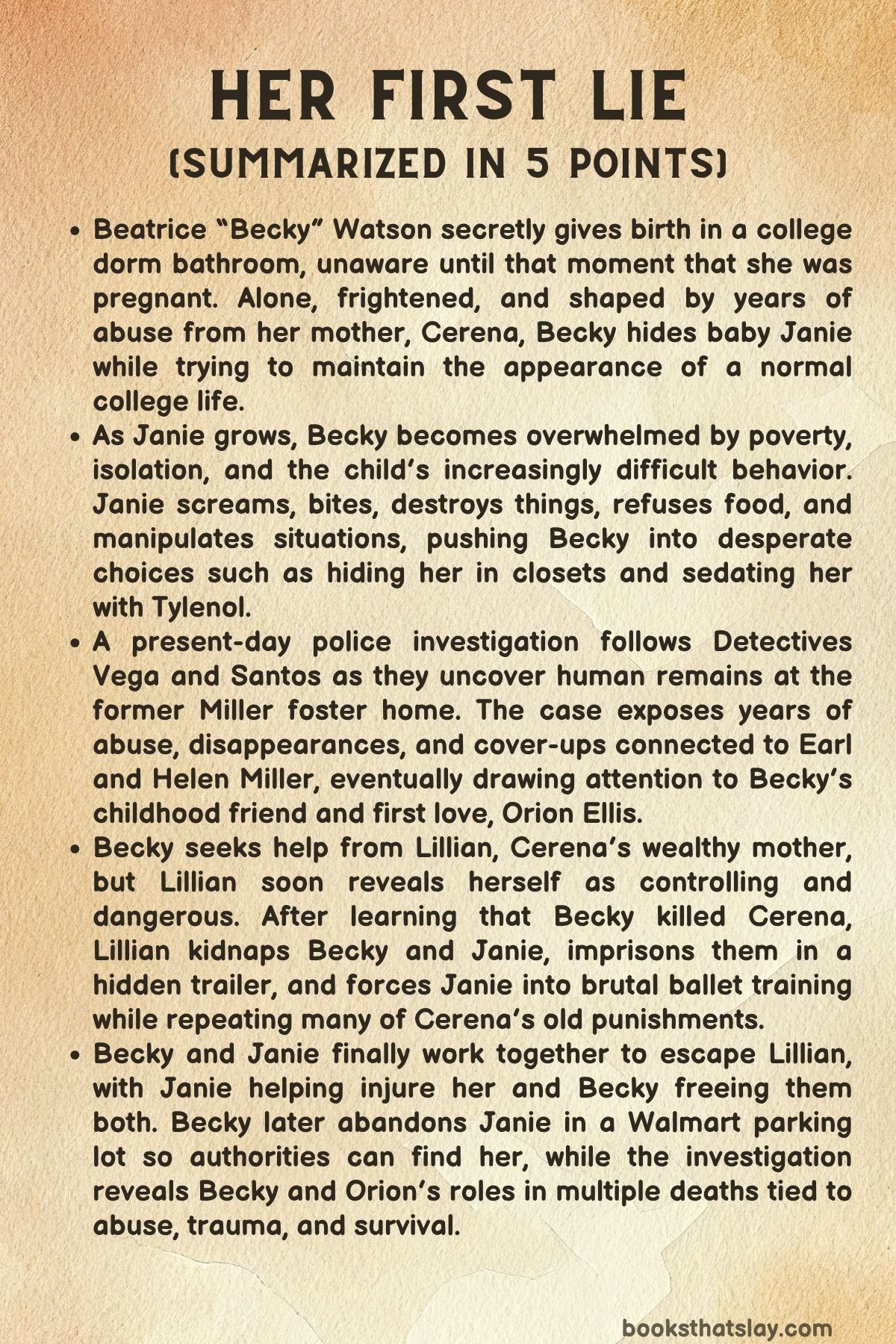
Beatrice “Becky” Watson is a college student trying to build a life far away from the cruelty of her childhood when her world changes in one terrifying moment. Alone in a dorm bathroom, she gives birth without ever realizing she had been pregnant.
Shocked, frightened, and unable to understand what has happened to her body, Becky hides the newborn instead of seeking help. She is already living on the edge, juggling school, work, internships, and poverty with almost no support system.
The baby’s arrival threatens to expose everything she has tried to keep hidden, including the emotional damage left by her mother, Cerena.
At first, Becky does not even name the baby. She tries to pretend life can continue as before, but the secret grows heavier each day.
Eventually, she calls the child Janie. Becky keeps Janie hidden in her dorm room, doing whatever she can to keep her quiet while she attends classes and tries to appear normal.
She is exhausted, scared, and deeply alone. Her own memories of being neglected and abused by Cerena make motherhood even more confusing.
Becky has no model of care to follow. She only knows what harm looks like, and she is desperate not to become like her mother.
Becky begins seeing Maura, a student therapist, but she cannot bring herself to tell the truth about Janie. Instead, she talks about Cerena and the childhood she survived.
Cerena had starved Becky, beaten her, locked her away, humiliated her, and controlled her through fear. Becky’s memories reveal a home ruled by punishment and instability.
Even after escaping, Becky remains trapped by those experiences. Her body is free, but her mind still lives in rooms where food, affection, and safety could be taken away at any moment.
As Janie grows, Becky’s ability to manage her secret begins to collapse. She misses classes, fails exams, and falls behind in every part of her life.
She hides Janie in closets, gives her medicine to make her sleep, and lies constantly to keep anyone from discovering the child. Eventually, Becky leaves the dorm and moves into a dirty studio apartment, but the move does not solve anything.
It only isolates her further. She is now a young mother with no money, no help, and a child she both loves and fears.
Running alongside Becky’s story is a present-day investigation led by Detectives Vega and Santos. Human remains have been found at the site of the former Miller foster home, a place once run by Earl and Helen Miller.
The home had taken in many troubled teenagers over the years, and several of them had vanished or reported abuse that child protective services failed to address properly. As more remains are uncovered, including Earl Miller’s, the detectives begin to see that the property holds years of buried violence.
Former foster children describe Earl as a predator who sexually abused children in his care. Helen either protected him, ignored what he did, or helped keep the truth hidden.
Vega and Santos begin tracing the missing and dead, trying to understand who was buried there and why. Their search leads them toward Orion Ellis, Becky’s childhood friend and first love, who had once lived at the Miller home.
Orion becomes an important connection between the remains, the foster home, and Becky’s hidden past.
Meanwhile, Becky becomes increasingly alarmed by Janie’s behavior. Janie is not an easy child.
She refuses food, destroys things, bites, screams, manipulates situations, and seems able to perform innocence around others while acting very differently when alone with Becky. Becky begins to wonder whether something is wrong with Janie or whether she herself is failing as a mother.
Her fear is made worse by the shadow of Cerena. Every time Becky loses patience, she worries that she is repeating the violence she endured.
In desperation, Becky contacts Orion. Their relationship goes back to childhood, when both of them understood what it meant to live with fear.
Orion moves in to help with Janie, and for a time, his presence gives Becky comfort. Their old bond returns, and they begin to feel like a small family.
But love cannot erase their problems. They are poor, Orion cannot find steady work, and Janie’s behavior becomes more dangerous.
The apartment remains tense and unstable, with both adults trying to survive while caring for a child who tests every limit.
One day, Janie becomes dangerously ill after being locked in a closet for too long as punishment. Becky is forced to take her to the hospital, where her secret life risks exposure.
At the hospital, Becky reaches out to Lillian, Cerena’s wealthy mother. Becky hopes that family support might finally give Janie a chance at safety and stability.
Lillian arrives and immediately takes control. She pays for help, presents herself as loving and capable, and seems especially charmed by Janie.
At first, Lillian appears to be the answer Becky needs. She has money, confidence, and authority.
She gives Janie attention and resources Becky could never provide. But Lillian’s interest soon becomes disturbing.
She fixates on Janie, especially on shaping her into a dancer, as Cerena once had been. Lillian’s affection is conditional and possessive.
She begins to push Becky aside while claiming Janie for herself. The comfort Becky had hoped for turns into a new kind of danger.
Lillian also knows more than she first admits. She reveals that she knows Becky killed Cerena.
The truth of Becky’s past comes forward: after years of abuse, Becky had fled her mother, but later returned as an adult. Unable to live under Cerena’s shadow any longer, she smothered her mother with a pillow.
Orion then helped her set the apartment on fire, concealing what they had done. This secret has bound Becky and Orion together for years, and it gives Lillian power over Becky.
Lillian’s control becomes open violence when she kidnaps Becky and Janie at gunpoint. She takes them to a hidden trailer and holds them captive.
There, she repeats many of the same punishments Cerena once used against Becky. She chains Becky and Janie, drugs them, beats them, humiliates them, and feeds Janie dog food.
She forces Janie into ballet training, treating the child less like a person than an object she can shape into her own fantasy. Becky is forced to watch her daughter suffer the same cycle of cruelty she had tried to escape.
Captivity changes Becky and Janie’s relationship. Until then, Becky has often been frightened of Janie, unsure how to love her and terrified of what Janie might become.
But under Lillian’s abuse, mother and daughter finally learn to rely on each other. Becky teaches Janie how to observe, wait, and help them survive.
Janie, who has always been strong-willed and unpredictable, becomes Becky’s partner in escape.
Their chance comes when Janie uses a shard of glass to slash Lillian’s neck as Lillian comes to unlock her. Becky seizes the moment and finishes the escape, freeing both herself and her daughter.
They survive Lillian, but freedom does not bring an easy future. Becky knows the police investigation is moving closer to the truth about her and Orion.
She also realizes that she cannot safely raise Janie. Love alone is not enough to undo the damage, poverty, danger, and legal consequences surrounding them.
In one of her most painful choices, Becky takes Janie to a Walmart parking lot, calls 911 anonymously, and leaves her where authorities will find her. Janie is placed with the Bauer family, a surgeon and a nurse who can offer the stability Becky cannot.
Becky watches from a distance, grieving the loss but believing she has given Janie her best chance. Then she decides to return to Orion, the one person who knows the full truth of who she is and what she has done.
The investigation continues to close in. Detective Vega uncovers Becky’s connection to Orion and begins to suspect that Becky is central to the deaths tied to the Miller property.
The final revelations explain how deeply Becky and Orion are connected to the bodies found there. Becky had killed Earl Miller to protect Orion from abuse, and Helen Miller had helped cover it up.
Becky had also killed Brock Tapp in another act connected to protection and trauma. Orion, too, carries blood on his hands.
He killed Kyle Wallace during a trauma-triggered attack, buried him at the Miller property, and later moved the body when construction threatened to expose the graves.
By the end, Her First Lie leaves Becky and Orion together, trying to believe they can begin again. They imagine a future where the past stays buried and where love can make them whole.
But the ending is uneasy. Orion privately insists that he is not a killer, even though the truth says otherwise.
Becky and Orion see themselves as survivors, protectors, and damaged people who did what they had to do. Yet the story refuses to let that belief feel simple.
Their lives have been shaped by abuse, but their choices have also caused death and pain. The novel closes on that troubling tension: the desire for a normal life beside the weight of secrets that may never truly stay hidden.
Characters
Her First Lie presents its characters through trauma, secrecy, survival, and moral compromise. The people in the story are not simply divided into innocent and guilty figures; most of them are shaped by fear, abuse, neglect, or desperate love.
Each character helps reveal how violence can repeat across generations, how institutions can fail vulnerable people, and how even protective actions can become destructive.
Beatrice “Becky” Watson
Beatrice “Becky” Watson is the central character in the book, and her life is defined by secrecy, fear, and the long shadow of childhood abuse. Her sudden discovery that she has given birth without knowing she was pregnant places her in an impossible situation, but her response is shaped by far more than panic.
Becky has grown up believing that danger comes from the people who are supposed to care for her, especially because of the cruelty she suffered from her mother, Cerena. This background explains why she hides Janie instead of seeking help.
She has no stable model of motherhood, no reliable family support, and no confidence that authorities will protect her rather than punish her.
Becky is deeply sympathetic because she is poor, isolated, and psychologically wounded, yet she is also morally complicated. Her treatment of Janie becomes neglectful and dangerous, especially when she hides the child, gives her medicine to keep her quiet, and locks her away.
These actions are horrifying, but the book presents them as the behavior of someone who is collapsing under fear rather than someone who is naturally cruel. Becky wants to survive, wants to stay in school, wants to become someone different from her mother, but she does not know how to care for a child while carrying so much unresolved trauma.
Her relationship with Janie develops from terror and avoidance into a painful form of love. At first, Janie feels like a threat to Becky’s future and safety, but during their captivity under Lillian, Becky begins to see her daughter as a partner in survival.
Their bond becomes strongest when they are both trapped, abused, and forced to rely on each other. Becky’s decision to abandon Janie in a public place where authorities will find her is one of her most heartbreaking choices.
It shows that she loves Janie enough to recognize her own inability to raise her safely.
Becky’s darker side is revealed through the deaths connected to her past. She kills Cerena, Earl Miller, and Brock Tapp, but these acts are tied to abuse, protection, and trauma rather than simple malice.
She repeatedly crosses moral lines because she believes there is no other way to stop people who harm others. Becky is therefore one of the most tragic and morally complex figures in the story.
She is both victim and perpetrator, both protective and dangerous, both damaged child and desperate mother.
Janie
Janie is one of the most unsettling and emotionally important characters in the book. She begins life hidden, unnamed, and unwanted, not because Becky lacks all feeling for her, but because Becky is too frightened and traumatized to accept motherhood.
Janie’s earliest world is one of secrecy, hunger, confinement, and instability. This makes her behavior as a toddler especially significant.
Her screaming, biting, destruction, refusal to eat, and manipulation are frightening, but they also reflect the damaged conditions in which she is raised.
Janie often appears almost impossible for Becky to control, and the story uses her behavior to create fear and uncertainty. Becky worries that something is wrong with Janie, but the deeper question is whether Janie is inherently disturbed or whether she has been shaped by neglect and trauma from the very beginning.
Her ability to behave differently around others makes her seem calculating, yet it also suggests that she has learned survival instincts at an extremely young age. She understands power, attention, and fear before she understands safety.
During Lillian’s captivity, Janie becomes more than a difficult child. She becomes a survivor.
The same qualities that once terrified Becky, such as stubbornness, aggression, and watchfulness, become useful when she and Becky need to escape. Janie’s attack on Lillian is violent, but it is also an act of self-preservation and loyalty to her mother.
Through Janie, the book shows how traits labeled as disturbing can also be responses to danger.
Janie’s placement with the Bauer family gives her the possibility of a different future. This does not erase what happened to her, but it separates her from the cycle of abuse that shaped Becky, Cerena, and Lillian.
Janie represents both the danger of inherited trauma and the hope that a child might still escape it if given safety, care, and stability.
Cerena
Cerena is Becky’s mother and one of the most destructive figures in the story. She represents the original source of much of Becky’s fear, shame, and emotional damage.
Her abuse is not limited to physical punishment; she starves Becky, locks her up, beats her, and emotionally tortures her. Cerena’s cruelty teaches Becky that love and violence can exist in the same household, and this lesson poisons Becky’s understanding of family.
Cerena’s character is important because she shows how abuse can become a pattern passed from one generation to the next. Although she is not present for much of the main action, her influence dominates Becky’s choices.
Becky’s fear of being discovered, her inability to ask for help, and her harsh treatment of Janie all connect back to what Cerena did to her. Cerena makes Becky believe that weakness will be punished and that survival requires secrecy.
At the same time, Cerena is not only an abusive mother; she is also connected to Lillian’s controlling expectations. Lillian’s obsession with dance and perfection appears to have shaped Cerena as well.
This does not excuse Cerena’s cruelty, but it places her within a larger family history of control, humiliation, and damaged love. Cerena becomes both a villain and a product of another person’s obsession.
Becky’s killing of Cerena is one of the story’s clearest examples of trauma turning into violence. Becky does not merely escape her mother; she destroys her.
Cerena’s death shows the terrible result of a relationship built entirely on fear. Even after she dies, Cerena remains powerful because Becky carries her voice, punishments, and emotional scars into her own motherhood.
Orion Ellis
Orion Ellis is Becky’s childhood friend, first love, and emotional anchor. He is one of the few people who understands parts of Becky’s past, especially because he also has connections to the Miller foster home and its abuse.
His bond with Becky is built on shared trauma, secrecy, and loyalty. When Becky calls him for help with Janie, he returns not as a perfect rescuer, but as someone who wants to protect Becky while still carrying his own wounds.
Orion’s presence gives Becky comfort, but it also complicates her life. He helps her care for Janie and revives the emotional bond they once had, yet he cannot fully stabilize the household.
His inability to find steady work, combined with poverty and Janie’s difficult behavior, adds pressure to an already fragile situation. Orion’s love for Becky is real, but love alone is not enough to repair the damage both of them have suffered.
Like Becky, Orion is morally complicated. He is connected to the concealment of Cerena’s death, and later revelations show that he killed Kyle Wallace after a trauma-triggered attack.
He also moves Kyle’s body when construction threatens to expose the graves. These actions show that Orion is not simply a gentle victim of abuse.
He is someone whose trauma has made him capable of dangerous choices, especially when he feels threatened or cornered.
The ending makes Orion especially unsettling because he insists privately that he is not a killer while imagining a normal future with Becky. This denial reveals how deeply he separates his self-image from his actions.
Orion wants peace, love, and a future, but the past remains buried beneath that dream. His character shows how trauma can distort a person’s sense of guilt and responsibility.
Lillian
Lillian is Becky’s grandmother and one of the most chilling characters in the book. She first appears as a possible source of rescue.
She has money, confidence, and the ability to provide medical help, housing support, and order when Becky’s life is falling apart. For a brief time, she seems like the family support Becky desperately needs.
However, this appearance of stability quickly becomes another form of danger.
Lillian’s love is possessive, controlling, and deeply conditional. She becomes obsessed with Janie, especially with shaping her into a dancer like Cerena.
Her treatment of Becky is cold and rejecting, while her attention to Janie becomes increasingly invasive. Lillian does not love Janie as a full person; she sees her as a second chance to control the past.
This makes her affection frightening rather than comforting.
Her kidnapping of Becky and Janie reveals the full extent of her cruelty. In the hidden trailer, Lillian recreates many of the same abusive patterns associated with Cerena.
She chains them, drugs them, beats them, humiliates them, feeds Janie dog food, and forces ballet training on the child. Lillian’s violence proves that the family’s abuse did not begin with Cerena.
She is part of the root system of cruelty that has shaped both mother and daughter.
Lillian is terrifying because she believes control is love. She presents herself as refined, wealthy, and superior, yet her behavior is brutal and dehumanizing.
Her death at the hands of Janie and Becky becomes a symbolic break in the family cycle. By escaping Lillian, Becky and Janie fight not only one captor but generations of abuse disguised as discipline, ambition, and family duty.
Maura
Maura is the student therapist Becky sees while trying to manage her collapsing life. Her role is quieter than that of the major family members, but she is still important because she represents the possibility of help that Becky cannot fully accept.
Becky talks to Maura about Cerena and her childhood, but she hides the existence of Janie. This makes their sessions incomplete from the beginning.
Maura’s character highlights Becky’s deep mistrust of authority and care. Therapy should be a place where Becky can reveal the truth, yet she is too frightened of consequences to be honest.
Her silence is not simply deception; it is a survival habit. Becky has learned that telling the truth can lead to punishment, exposure, or loss of control.
Because of this, Maura can only reach the parts of Becky that Becky allows her to see.
Maura also shows the limits of professional help when a person is trapped in secrecy. She may provide emotional space for Becky to discuss her past, but she cannot help with the hidden baby, the neglect, or the immediate danger because Becky conceals those realities.
In this way, Maura’s presence adds tension to the story. Help is near, but Becky’s trauma keeps her from using it.
As a character, Maura is less defined by personal conflict and more by what she represents. She stands for the path Becky might have taken if she had been able to trust someone sooner.
Her role reminds the reader that trauma isolates people not only from loved ones, but also from the very systems that might save them.
Detective Vega
Detective Vega is one of the main figures in the present-day investigation. She is determined, observant, and increasingly convinced that the remains found at the former Miller foster home point to a deeper history of abuse and hidden violence.
Her investigation gives structure to the mystery and gradually connects the past to Becky, Orion, and the missing children.
Vega’s strength as a character lies in her persistence. She listens to former foster children, follows connections that others might dismiss, and recognizes that the Miller home was not simply a troubled household but a place where serious harm occurred.
Through Vega, the book exposes the failures of systems that ignored vulnerable children when they most needed protection.
She also functions as a moral counterweight to Becky and Orion. While they hide bodies, conceal crimes, and justify violence through survival, Vega works to uncover the truth through law and investigation.
She does not have access to all the emotional context at first, but she steadily moves toward it. Her role creates tension because the reader can understand why Becky and Orion acted while also recognizing that Vega is right to pursue the deaths.
Vega is important because she refuses to let the buried past remain buried. Her investigation suggests that trauma may be hidden for years, but it leaves evidence behind.
She represents accountability, even when accountability is complicated by sympathy for the people involved.
Detective Santos
Detective Santos works alongside Vega in the investigation and helps ground the police storyline. While Vega often appears as the driving force, Santos contributes to the steady uncovering of the Miller home’s secrets.
His presence gives the investigation a sense of partnership and procedure, showing that the truth is assembled through persistence rather than sudden revelation.
Santos is important because he helps balance the emotional intensity of the past with the methodical work of the present. The discoveries at the Miller property are disturbing, but the detectives must treat them as evidence.
Santos’s role supports this movement from horror to clarity. He helps trace disappearances, examine connections, and follow the pattern of abuse surrounding Earl and Helen Miller.
Although he is not as psychologically central as Becky, Janie, or Orion, Santos still matters to the story’s structure. He is part of the force that brings hidden crimes into public view.
His character reinforces the idea that buried violence cannot remain private forever once someone begins asking the right questions.
Santos also helps show that the investigation is not only about solving deaths, but about listening to people who were ignored in the past. The former foster children’s stories matter because detectives like Santos and Vega finally give those accounts weight.
In that sense, Santos represents delayed institutional attention after years of institutional failure.
Earl Miller
Earl Miller is one of the clearest predators in the story. As a foster parent, he holds power over vulnerable children who depend on him for shelter and care.
Instead of protecting them, he sexually abuses them. His role in the book reveals the horror of abuse within systems that are supposed to provide safety.
Earl’s cruelty is especially disturbing because it is hidden behind the respectability of foster care. The children in his home are already troubled, displaced, or lacking support, which makes it easier for adults to dismiss their claims.
Earl benefits from this disbelief. His power depends not only on his own actions, but also on the silence and negligence of the people around him.
His death becomes one of the major moral complications in Becky’s past. Becky kills Earl to protect Orion from abuse, which makes the act both criminal and emotionally understandable.
Earl’s death forces the reader to confront a difficult question: what happens when official systems fail so completely that a traumatized child or young person believes violence is the only available protection?
Earl is not a complex character in the same sympathetic sense as Becky or Orion, but he is central to the book’s exploration of institutional betrayal. His abuse creates consequences that stretch far beyond his life.
Even after his death, the damage he caused continues shaping Orion, Becky, the investigation, and the buried secrets at the Miller property.
Helen Miller
Helen Miller is Earl’s wife and a deeply troubling character because her guilt comes through complicity, silence, and cover-up. She may not be presented as the same kind of direct predator as Earl, but she protects or enables him by looking away from the abuse.
Her failure to act makes her part of the harm done to the children in her care.
Helen represents the kind of adult who preserves appearances at the expense of vulnerable people. As a foster mother, she has a duty to protect the children in her home.
Instead, she helps maintain the environment in which Earl can continue abusing them. This makes her morally significant because the story does not treat silence as innocence.
Her inaction becomes a form of participation.
Her role in covering up Earl’s death adds another layer to her character. Helen is willing to hide the truth when it serves her interests or protects the household’s secrets.
This does not redeem her, even if Earl’s death stops his abuse. Instead, it shows that Helen’s main instinct is concealment rather than justice.
Helen’s character strengthens one of the book’s central ideas: abuse survives when people who know the truth choose comfort, reputation, or self-protection over action. She is a reminder that evil is not only carried out by violent people, but also by those who allow violence to continue.
Brock Tapp
Brock Tapp is another figure connected to Becky’s pattern of killing in response to abuse or threat. Although he is not as central as Earl, his death matters because it shows that Becky’s violence is not limited to one desperate act.
The revelation that she killed Brock under similar circumstances expands the reader’s understanding of her moral world.
Brock’s character functions partly as evidence of repetition. Becky has learned to respond to certain kinds of danger with finality.
If someone is abusive or threatening enough, she does not trust systems, warnings, or escape routes. She eliminates the threat.
This makes Brock important less as an individual personality and more as part of the pattern that defines Becky’s hidden past.
His presence also complicates any simple reading of Becky as only a victim. The more deaths connected to her are revealed, the harder it becomes to view her actions as isolated survival choices.
Brock’s death suggests that Becky’s trauma has created a dangerous moral logic. She sees herself as protecting others, but protection and murder become disturbingly close in her life.
Through Brock, the book deepens its examination of justified violence, revenge, and survival. His character adds weight to the idea that Becky’s past is not merely tragic, but also dangerous.
She has been shaped by abuse, yet she has also become someone capable of deciding who must die.
Kyle Wallace
Kyle Wallace is important because of his connection to Orion’s violence and denial. Orion kills Kyle after a trauma-triggered attack, and this death becomes one of the buried crimes tied to the Miller property.
Kyle’s role helps reveal that Orion, like Becky, is not only a survivor but also someone capable of lethal action.
Kyle functions as a trigger for Orion’s unresolved trauma. The attack suggests that Orion’s past abuse has left him with deep psychological wounds that can erupt under pressure.
His killing of Kyle may not be coldly planned, but it is still a killing, and Orion’s later decision to bury and move the body shows conscious concealment. This makes the event both tragic and criminal.
Kyle’s character also affects how the reader sees Orion at the end. Orion privately insists that he is not a killer, but Kyle’s death contradicts that belief.
The gap between Orion’s self-image and his actions becomes one of the most unsettling parts of the conclusion. Kyle exists in the story as the proof that Orion’s dream of normalcy rests on denial.
Although Kyle is not developed as deeply as the main characters, his role is crucial to the book’s moral structure. He shows that buried trauma can create new victims, and that refusing to face the truth does not erase responsibility.
The Bauer Family
The Bauer family represents the possibility of safety for Janie. As a surgeon and a nurse, they suggest stability, care, and competence, standing in sharp contrast to the chaos of Becky’s life and the cruelty of Lillian’s captivity.
Their home offers Janie a chance to be raised outside the family pattern that has damaged the women before her.
The Bauers are important because they show what Becky cannot provide, even though she loves Janie. Becky’s decision to leave Janie where authorities will find her is painful, but the placement with the Bauers confirms that Janie may have a better chance away from her birth mother.
This does not make Becky heartless. Instead, it shows her clearest moment of self-awareness as a parent.
The Bauer family also represents the story’s limited form of hope. They cannot undo Janie’s early trauma, and the book does not pretend that love from a new family will magically erase everything.
However, they offer structure, medical knowledge, emotional care, and a life not built around secrecy and fear. For Janie, that difference may be life-changing.
As characters, the Bauers are less individually developed, but their symbolic role is strong. They stand for intervention that comes late but still matters.
In a story filled with failed parents, abusive guardians, and negligent systems, they offer one of the few images of possible healing.
Themes
Trauma and the Repetition of Abuse
In Her First Lie, trauma does not remain fixed in the past; it shapes behavior, fear, parenting, and survival. Becky’s childhood under Cerena leaves her with no safe model of care, so when Janie is born, Becky reacts from panic rather than understanding.
Her secrecy, emotional shutdown, and harmful choices are not presented as simple cruelty but as the actions of someone who has learned life through punishment, neglect, and fear. The most disturbing part of this theme is how abuse repeats across generations.
Cerena’s violence damages Becky, and later Lillian recreates similar punishments through control, humiliation, starvation, and confinement. Becky becomes both victim and flawed mother, showing how trauma can distort love when it is never healed.
The story suggests that abuse survives because it teaches its victims the wrong lessons about power, safety, and obedience. Yet Becky’s eventual effort to protect Janie also shows that cycles of abuse can be challenged, even if breaking them comes at a painful cost.
Motherhood, Fear, and Moral Failure
Motherhood is shown as frightening, unstable, and morally complicated rather than naturally comforting. Becky becomes a mother without preparation, support, money, or emotional safety, and her fear quickly turns motherhood into a secret she must manage rather than a bond she can celebrate.
Janie’s existence threatens Becky’s education, freedom, and fragile sense of control, so Becky treats the child at times like a problem to hide. Her choices, including drugging Janie, locking her away, and failing to seek help sooner, are deeply harmful.
Still, the narrative refuses to make Becky a simple villain. Her failures come from terror, poverty, untreated trauma, and isolation, but those explanations do not erase the damage done to Janie.
This creates a difficult portrait of motherhood where love and harm exist together. Becky wants to protect Janie, yet she also endangers her.
The theme becomes powerful because it asks whether a damaged person can love a child deeply while still being unable to raise her safely.
Poverty, Isolation, and Institutional Neglect
Becky’s collapse is tied closely to the absence of support around her. She is poor, alone, and trying to survive school, work, and motherhood while hiding a crisis that grows beyond her control.
Her situation shows how poverty narrows choices until every decision feels desperate. A person with stable housing, family support, medical care, or safe childcare might have had options; Becky has secrecy, exhaustion, and fear.
This theme also appears through the investigation into the foster home, where vulnerable children were failed by adults and systems meant to protect them. Reports of abuse were ignored, disappearances were not properly confronted, and dangerous people remained in positions of power.
The story connects Becky’s private desperation with a larger pattern of neglect: children and damaged young people are repeatedly left unseen until tragedy forces attention. Institutions appear reactive rather than protective.
By the time authorities investigate, the harm has already shaped lives, deaths, and identities.
Guilt, Survival, and the Blurred Line Between Justice and Crime
The story repeatedly places characters in situations where survival leads to criminal acts, making guilt difficult to judge in simple terms. Becky kills to protect herself and others from abusers, yet her actions still involve deception, concealment, and death.
Orion also carries violence connected to trauma, fear, and protection, but he tries to separate himself from the identity of a killer. This tension creates a moral world where the law and emotional justice do not always match.
Earl, Cerena, and others cause severe harm, so their deaths may feel like punishment, but the cover-ups create new damage and keep the characters trapped in secrecy. Becky’s decision to abandon Janie is similarly painful: it is both an act of loss and an act of protection.
The theme shows that survival can demand choices that leave permanent guilt behind. No one escapes cleanly.
The characters may seek a new future, but the past remains active because what they did to survive cannot be fully forgotten or undone.