Harmless Women Summary, Characters and Themes
Harmless Women by Rebecca Sharpe is a dark, tense story about two women who begin as enemies and become unlikely allies while running from violence, police, and the lives that trapped them. Avalon Dale arrives in England with a ruthless plan to steal from Primrose Meath, a wealthy woman whose orderly world is already collapsing.
But the crime quickly grows beyond money, and both women are forced into a dangerous journey across the country. The novel explores identity, fear, survival, guilt, and the ways women are judged when they fight back against harm.
Summary
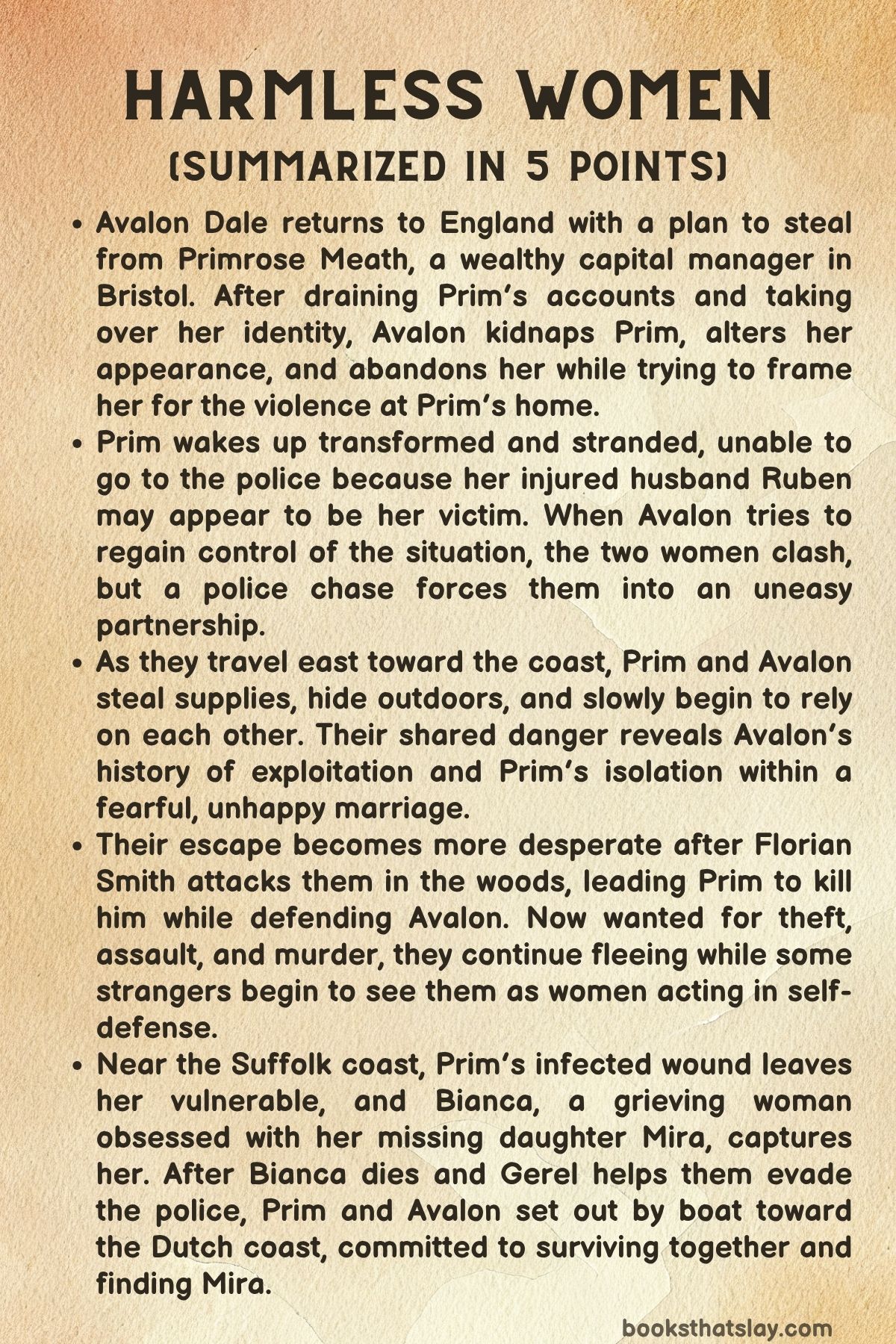
Avalon Dale returns to England with a clear purpose: she intends to destroy Primrose Meath’s comfortable life and take her money. Prim, a wealthy Bristol capital manager, appears to have everything Avalon lacks: status, property, financial security, and the kind of respectability that allows people to move through the world unquestioned.
Avalon rents a cottage, studies Prim’s routines, and carries out a careful theft. She drains Prim’s accounts, moves money around, and even pays for the care home where Prim’s father lives.
The act is not random. Avalon has planned it with patience and bitterness, and she waits for the moment when Prim will be most vulnerable.
Prim’s life is already beginning to fracture before Avalon reaches her. She has discovered that her husband, Ruben, has been cheating on her.
Their marriage, which has long been shaped by loneliness, resentment, and fear, erupts into violence. During a confrontation at home, Ruben is badly injured.
Prim leaves him behind and drives away, shaken and desperate. She thinks she is heading toward a yoga sanctuary, a place where she might find safety or at least time to think.
Instead, she is intercepted by Avalon.
Avalon drugs Prim, shaves her head, changes her face with fillers, and steals her identity, phone, car, and documents. When Prim wakes, she is alone in the rented cottage with cash and instructions that suggest she should simply go home.
But going home is no longer simple. Her appearance has been altered so drastically that she barely recognizes herself.
She has no easy way to prove who she is. Worse, she knows Ruben may be dead or seriously hurt, and any attempt to explain herself to the police could make her look guilty.
Avalon returns to Prim’s house to clean up evidence and strengthen the trap she has built. There she finds Ruben lying bloodied on the bedroom floor and assumes he is dead.
A cleaner sees Avalon leaving and screams that she killed him. Avalon, who had meant to place suspicion on Prim, suddenly becomes entangled in the very danger she designed for someone else.
Prim, meanwhile, escapes the cottage on foot. When Avalon realizes Prim is gone, she tracks her down and catches her in a field.
Avalon tries to convince Prim to surrender, but Prim understands that Avalon is not interested in justice. Avalon only wants to save herself.
Their conflict shifts when the police close in. Avalon tries to flee by car, but Prim blocks her path.
Avalon hits her, yet instead of abandoning her, she helps Prim into the car and takes her along. This choice changes the course of both their lives.
They abandon the vehicle, disguise themselves, and begin moving east on foot, hoping to reach the coast and escape by sea. Their first bond is not friendship but necessity.
Prim wants her stolen money back. Avalon refuses to return it.
Both women know the other is dangerous, but each also understands that surviving alone may be impossible.
As they travel, they steal food, hide in woods, sleep outdoors, and learn how to endure discomfort and fear together. Their partnership is uneasy, full of suspicion, arguments, and half-truths, yet it gradually becomes something more solid.
Avalon’s past begins to explain the hard, guarded person she has become. She once ran away from a care home and was exploited by criminals who taught her to live by theft, deception, and self-protection.
She has built herself around mistrust because trust has rarely kept her safe. Prim’s history is different but also marked by confinement.
Her wealth has not saved her from isolation, an unhappy marriage, or the pain of watching her father decline. Ruben later survives and speaks publicly, presenting himself as Prim’s victim and shaping the story in a way that turns public opinion against her.
The women’s flight becomes even more dangerous when they are attacked in woodland by Florian Smith, the son of a Member of Parliament. Florian assaults them, injures Prim, and attempts to rape Avalon.
In the struggle, Avalon bites him in order to escape, and Prim kills him with a rock. The killing is an act of desperate defense, but it makes their situation worse.
They are now linked not only to Avalon’s theft and Ruben’s attack but also to the death of a powerful man’s son. The world outside begins to turn their story into a spectacle.
News reports, online arguments, and public assumptions reduce them to symbols before anyone knows the truth.
Yet not everyone sees them as monsters. When cyclists recognize Prim and Avalon, they choose to help rather than turn them in.
They have seen online support suggesting that Florian’s death may have been self-defense. They give the women supplies and better cycling gear, allowing them to continue.
This moment shows how the public story around the women is divided. Some people fear them or condemn them.
Others recognize the pattern of women being punished for surviving male violence.
A second strand of the story follows Bianca, a grieving woman in Suffolk whose daughter, Mira, disappeared two years earlier. Bianca has been living in the shadow of that loss, unable to accept uncertainty.
A private investigator recently found a body abroad that might have been Mira’s, but it was not. Instead of bringing peace, the discovery deepens Bianca’s confusion and grief.
After returning home, she begins to experience disturbing visions: flies, a cracked window, and the presence of the Churel, a legendary vengeful female spirit. Her friend Gerel tries to support her and gently suggests that Mira may have fled a controlling home rather than suffered some outside horror.
Bianca resists this idea because it would force her to face her own part in Mira’s disappearance.
As Bianca reads reports about Prim and Avalon, her grief attaches itself to their story. She becomes convinced that Prim must be rescued from Avalon.
In her mind, saving Prim becomes a way to restore order, replace what she has lost, and prove that women can be returned to the roles assigned to them. Her thinking grows more unstable as Prim and Avalon move closer to the Suffolk coast.
By this time, Prim is seriously ill. A wound from the attack in the woods has become infected, and she is weakening.
Avalon, though still hard and defensive, cannot abandon her. She stops a truck driven by Gerel, who recognizes them but chooses to help.
Gerel gives them antibiotics and takes them to Bianca’s nearby boathouse, where they can hide and prepare to leave by boat. This gives them a possible route out: across the North Sea toward the Dutch coast.
Bianca finds them before they can escape. Now deeply delusional, she tranquilizes Avalon and takes Prim into Mira’s old bedroom.
She treats Prim not as a fugitive or a stranger but as a replacement daughter. Prim, already sick and exhausted, is trapped inside Bianca’s fantasy.
Avalon manages to free herself and tries to rescue Prim. Bianca demands that Avalon leave alone and allow Prim to stay with her, but Prim warns Avalon that Bianca’s gun is only a toy.
Bianca locks them in and plans to call the police, believing she is doing the right thing. Before she can complete that plan, she collapses and dies, apparently from a heart attack while overcome by hallucinations and fear.
Gerel arrives before the police and acts quickly. She hides Avalon and Prim in a wardrobe and misleads the authorities by claiming that she was the shaved-headed woman seen in the window.
Her lie gives the women one more chance. After the house is clear, Prim collects a passport that Gerel has left for her.
She and Avalon return to the boathouse and prepare the small boat with fuel, food, water, and medicine.
At the end of Harmless Women, Prim and Avalon set out across the North Sea toward the Dutch coast. Their survival is uncertain.
They are injured, hunted, and heading into dangerous waters with no guarantee that they will reach land. Still, the journey marks a powerful change.
Avalon began by stealing Prim’s identity, money, and freedom. Prim began as Avalon’s target, angry and terrified.
By the final scene, they are no longer simply criminal and victim. They are two women who have seen the worst in each other and still chosen to continue together.
Before leaving, Prim promises Gerel that they will look for Mira. Avalon goes further and says they will find her.
This promise gives their escape a new purpose. They are not only running from the crimes, accusations, and men who harmed them.
They are moving toward another missing woman, another truth, and another chance to decide who they will become. The novel ends with uncertainty, but not emptiness.
Prim and Avalon may not be safe, innocent, or forgiven, yet they are no longer alone. Their future depends on the sea ahead, the choices they make, and the fragile trust they have built from violence, fear, and survival.
Characters
Avalon Dale
Avalon Dale is one of the most complicated and forceful figures in Harmless Women. She enters the story as a thief with a carefully designed plan, but the book gradually reveals that her criminality is not simple greed or cruelty.
Her actions are extreme: she steals Primrose Meath’s money, identity, car, phone, and documents, physically alters her appearance, and tries to use her as a shield against suspicion. At first, Avalon appears cold, calculating, and almost frighteningly practical.
She plans, watches, sedates, disguises, and escapes with the focus of someone who has learned to survive by controlling every possible detail. Yet beneath that control is a woman shaped by abandonment, exploitation, and fear.
Her past as a care-home runaway exploited by criminals explains why she distrusts systems of protection and why she believes survival depends on sharpness rather than innocence.
Avalon’s character becomes richer once she is forced into partnership with Prim. She begins as Prim’s attacker, but the danger surrounding them turns her into Prim’s protector as well.
This shift does not happen neatly or sentimentally. Avalon remains defensive, secretive, and unwilling to give up the stolen money, but she also repeatedly chooses to keep Prim alive when it would be easier to abandon her.
Her decision to take Prim along after hitting her with the car shows the beginning of a moral conflict inside her. She is still self-preserving, but she is no longer able to treat Prim as merely a problem to be disposed of.
As their journey continues, Avalon becomes someone who can steal food, lie, flee, and fight, but also someone who can share a tarp, tend to wounds, and imagine a future that includes another person.
Avalon’s violence is also connected to trauma and survival. When Florian Smith attacks the women, Avalon’s reaction is brutal, instinctive, and desperate.
She does not act from heroic confidence but from the raw will to survive another assault. That moment exposes the deep history of threat carried in her body.
She has learned that the world is dangerous for women who are alone, poor, unwanted, or disbelieved. Her toughness is therefore not a simple personality trait; it is armor built from repeated harm.
By the end of the story, Avalon has not become innocent, but she has become more emotionally open. Her promise that she and Prim will find Mira suggests that she is no longer fleeing only for herself.
Avalon’s development lies in her movement from isolation to attachment, from pure self-defense to chosen loyalty.
Primrose Meath
Primrose Meath, known as Prim, begins the book as a wealthy Bristol capital manager whose life appears controlled, comfortable, and socially secure. However, that surface stability quickly collapses.
Her discovery of Ruben’s affair, the violent confrontation at home, and Avalon’s attack strip her of the identity she has relied on. Prim loses her money, her appearance, her documents, her car, and even her public credibility.
This makes her one of the most dramatically transformed characters in the story. She begins as someone defined by status, marriage, property, and fear of scandal, but she is forced into a life where none of those protections matter.
The shaved head and altered face become outward signs of a deeper crisis: Prim no longer knows how to prove who she is, what she has done, or what she deserves.
Prim is morally complex because she is both victim and participant. She is victimized by Ruben’s betrayal, Avalon’s crime, Florian’s assault, and Bianca’s delusion, but she is not passive.
She injures Ruben during a violent confrontation, resists Avalon, insists on reclaiming her money, kills Florian to save Avalon, and ultimately chooses to continue the journey rather than surrender. Her transformation is not a simple fall from privilege into suffering.
It is also an awakening. Removed from the world of wealth and appearance, Prim discovers a harsher but more honest version of herself.
She is frightened, angry, physically weakened, and often dependent on Avalon, yet she also shows courage, intelligence, and an increasing willingness to act decisively.
Prim’s relationship with Avalon is central to her development. At first, Avalon is the person who destroys her life, and Prim’s anger toward her is justified.
Yet as the two women flee together, Prim begins to recognize Avalon not only as a criminal but as another wounded woman trying to survive. Their bond is tense because it is built on betrayal before trust, but that makes it more powerful.
Prim does not simply forgive Avalon; instead, she learns to live with contradiction. She can want her money back and still rely on Avalon.
She can fear Avalon and still save her. She can resent her and still choose to cross the sea with her.
By the end, Prim has changed from a woman trapped in a lonely marriage and a carefully managed identity into someone who accepts danger, uncertainty, and companionship. Her final journey suggests not escape from guilt, but movement toward a freer and more truthful life.
Bianca
Bianca is one of the most tragic characters in the book because her actions grow out of grief that has become distorted into obsession. She is a Suffolk woman haunted by the disappearance of her daughter Mira, and her inability to accept uncertainty slowly breaks down her sense of reality.
Her recent trip abroad after a private investigator finds a body that might have been Mira’s gives her a brief hope of closure, but when the body is not Mira’s, Bianca returns to a life even more unstable than before. She is surrounded by signs of psychological collapse: visions, flies, a cracked window, and the legend of the Churel.
These elements show how grief, guilt, folklore, and fear merge inside her mind.
Bianca’s tragedy lies in the fact that her love for Mira has become controlling rather than healing. She wants to restore order, but her idea of order depends on forcing people back into roles she understands.
When she reads about Prim and Avalon, she convinces herself that Prim must be rescued from Avalon. In reality, Bianca is not seeing Prim clearly.
She is projecting Mira onto her, turning Prim into a replacement daughter and Avalon into a threat that must be removed. This makes Bianca dangerous because she believes she is acting protectively.
Her delusion is not random; it is shaped by maternal loss, denial, and the possibility that Mira may have fled an oppressive home rather than been taken by an outside evil.
Bianca’s treatment of Prim in Mira’s old bedroom shows the full collapse of her boundaries between past and present. She no longer responds to Prim as a separate adult woman with her own crisis.
Instead, she tries to place her inside the emotional vacancy left by Mira. Her use of tranquilizers and confinement reveals the frightening side of grief when it becomes possession.
At the same time, Bianca remains pitiable because she is not simply a villain. She is a mother destroyed by not knowing what happened to her child.
Her death, apparently from a heart attack amid hallucinations, feels like the final failure of a body and mind that have carried unbearable sorrow for too long. Bianca represents the danger of unresolved grief when it hardens into fantasy, control, and fear of female freedom.
Gerel
Gerel is one of the most quietly important characters in the story. She functions as a figure of compassion, practical intelligence, and moral courage.
As Bianca’s friend, she understands the depth of Bianca’s grief but also sees what Bianca refuses to face: Mira may not have been simply lost or stolen, but may have chosen to escape an oppressive home. Gerel’s role is difficult because she must care for Bianca without fully accepting Bianca’s version of events.
This places her in a position of emotional honesty. She does not comfort Bianca by feeding her delusions, but she also does not abandon her.
Gerel’s encounter with Prim and Avalon reveals her courage most clearly. She recognizes them, understands the danger of helping them, and still chooses to offer assistance.
Her decision to provide antibiotics and lead them to the boathouse is not naive. She knows they are wanted women, but she also understands that the public story about them may not contain the whole truth.
Gerel has the rare ability to judge people through immediate human need rather than through official labels. Prim is wounded, Avalon is desperate, and both are in danger.
Gerel responds to that reality first.
Gerel also becomes essential to the ending. When she hides Avalon and Prim in the wardrobe and misdirects the police by claiming she was the shaved-headed woman seen in the window, she actively risks herself to protect them.
Her action is not just kindness; it is a rebellion against a system that may punish the women without understanding what they have endured. By leaving a passport and helping them reach the boat, Gerel becomes a bridge between Bianca’s world and the possibility of Mira’s rescue.
She carries both grief and hope. Her faith that Prim and Avalon might look for Mira gives the ending a larger purpose beyond survival.
Gerel represents trust, female solidarity, and the possibility of doing the right thing even when the law and morality do not perfectly align.
Ruben
Ruben is a damaging presence in Prim’s life and in the public version of events that follows her disappearance. He is introduced through betrayal, as Prim discovers that he is cheating on her.
This betrayal is not merely romantic; it exposes the emptiness and humiliation within their marriage. Ruben’s relationship with Prim seems to have contributed to her loneliness and fear, making her life appear more stable from the outside than it feels from within.
The violent confrontation between them becomes the first major break in Prim’s old life, setting off the chain of events that leads her into Avalon’s path.
Ruben’s importance increases after he survives and begins giving interviews portraying himself as Prim’s victim. This public performance is central to his character.
Rather than existing only as an injured husband, he becomes someone who shapes the story told about Prim. He benefits from the simplicity of that version: he is the wounded man, and she is the dangerous wife.
The fact that he was unfaithful and that their marriage was already emotionally damaged becomes secondary in the public eye. Through Ruben, the story shows how easily a woman’s complexity can be erased when a man controls the narrative of harm.
Ruben is not developed as deeply as Avalon or Prim, but his function is powerful. He represents domestic betrayal, male self-pity, and the social willingness to believe a polished victimhood when it is performed by the right person.
His survival prevents Prim from being guilty of murder in that moment, but it also creates another trap for her because he can speak while she is missing, disguised, and unable to defend herself. Ruben’s character reminds the reader that violence is not always only physical.
Reputation, interviews, and public sympathy can also become weapons.
Mira
Mira is absent for the entire present action, yet she shapes one of the story’s most important emotional threads. As Bianca’s missing daughter, she exists through memory, fear, speculation, and projection.
Her disappearance has created a wound in Bianca’s life that refuses to close. Because Mira is not present to explain herself, other characters imagine her according to their own needs.
Bianca imagines her as a lost daughter who must be restored. Gerel is more willing to consider that Mira may have fled from an oppressive home.
Prim and Avalon eventually become connected to the possibility of finding her, turning Mira from a missing figure into a future mission.
Mira’s character is important because her absence raises questions about freedom, control, and the stories families tell about missing women. If Mira ran away, then Bianca’s grief contains an uncomfortable truth: the home Bianca remembers may not have been the safe place she wants it to be.
This possibility threatens Bianca so deeply that she resists it. Mira therefore becomes more than a missing daughter.
She becomes a symbol of the female desire to escape spaces that call themselves protective while actually suffocating the person inside them.
By the end, Mira represents hope as well as loss. Prim promises Gerel that they will look for her, and Avalon goes further by saying they will find her.
This promise gives the final journey emotional purpose. Avalon and Prim are not only escaping punishment; they are moving toward another woman whose story has been left unresolved.
Mira’s absence connects the different parts of the novel, linking Bianca’s grief with Avalon and Prim’s flight. She is a reminder that some characters shape a story most powerfully not through what they do on the page, but through the longing, guilt, and determination they leave behind.
Florian Smith
Florian Smith is one of the clearest embodiments of predatory male violence in the book. As the son of an MP, he carries social privilege, and that privilege makes his attack on Prim and Avalon even more disturbing.
He appears in the woodland as a direct physical threat, assaulting them, injuring Prim, and attempting to rape Avalon. His violence interrupts the uneasy survival journey the two women have formed and forces them into an even more dangerous position.
Until this point, they are wanted for theft, disguise, and the incident involving Ruben; after Florian’s death, they are also linked to murder.
Florian’s role is brief but decisive. He reveals how vulnerable Prim and Avalon are while fleeing outside ordinary protection.
They are already afraid of the police, the media, and exposure, which means they cannot easily seek help when attacked. Florian exploits that vulnerability.
His assault also changes the moral shape of their flight. Prim kills him with a rock, but the killing occurs in defense of Avalon during a sexual attack.
This makes the public label of murder feel inadequate, because the situation is rooted in survival and self-defense. The later online support for the women reflects this tension between legal accusation and moral understanding.
Florian is not presented as emotionally complex in the same way as Avalon, Prim, or Bianca. His function is sharper and more symbolic.
He represents entitlement, sexual violence, and the danger posed by powerful men who expect women to be available, weak, or silent. His death binds Prim and Avalon more closely because each woman saves the other in that scene.
Avalon fights to survive the assault, and Prim crosses a line she cannot undo in order to protect her. Florian therefore becomes the catalyst for a deeper partnership between them, even as his death increases the danger surrounding their escape.
Prim’s Father
Prim’s father is a largely indirect character, but he is important because he helps explain Prim’s emotional and financial choices. He is in a care home, and Avalon sends money to cover his care after stealing from Prim.
This detail complicates Avalon’s theft, because she does not simply empty Prim’s accounts without awareness of the consequences. It also reveals something important about Prim: her life is shaped not only by wealth and marriage but by responsibility, fear, and the decline of someone she loves.
Her father’s condition adds quiet pressure to her already lonely existence.
Prim’s father represents dependence and deterioration. His need for care ties Prim to systems of money, duty, and adult responsibility.
The fact that Avalon makes sure the care home is paid suggests that even while committing a cruel crime, she recognizes a boundary around vulnerable people. For Prim, her father’s decline may also deepen her fear of losing control.
She is surrounded by forms of breakdown: her marriage is failing, her father is declining, and then her own identity is violently stripped away. Though he does not act directly in the main events, Prim’s father helps create the emotional background that makes Prim’s collapse more understandable.
Themes
Reinvention and the Loss of Identity
Avalon’s theft is not only financial; it is an attack on Prim’s very selfhood. By changing Prim’s appearance, taking her documents, stealing her car, and controlling the story that surrounds her, Avalon forces Prim into a terrifying state where she no longer has the protections that wealth, status, and respectability once gave her.
Prim’s shaved head and altered face become outward signs of a deeper crisis: she must learn who she is when her name, money, marriage, and public image are stripped away. At the same time, Avalon has spent much of her life surviving through disguise, movement, and secrecy, so identity for her is something flexible and defensive rather than stable.
In Harmless Women, both women are pushed into versions of themselves they did not choose, yet this loss also creates freedom. Away from their old lives, they begin to act with greater honesty, courage, and loyalty.
Identity becomes less about official proof and more about what they decide to protect.
Female Rage Against Male Power
The violence surrounding Prim and Avalon grows out of a world where men assume they can control, use, or rewrite women. Ruben’s betrayal and later public self-presentation show how easily a man can make himself look like the victim while hiding the harm he caused.
Florian’s attack in the woods makes this imbalance even more brutal, as he treats the women’s fear and vulnerability as permission to dominate them. Prim’s killing of him is not presented as simple aggression but as a desperate act of survival in a situation where polite resistance would mean death or violation.
Avalon’s response to danger is equally shaped by past exploitation, showing how women who are labelled criminal or unstable may actually be reacting to years of being trapped. The theme is powerful because the women’s rage is not random.
It rises from being cornered, disbelieved, hunted, and handled as disposable. Their violence becomes a dark answer to a society that often notices women only after they fight back.
Survival Through Unlikely Solidarity
Prim and Avalon begin as enemies, with one woman stealing the other’s life and the other desperate to recover what was taken. Yet the road east changes the meaning of their relationship.
Hunger, injury, exposure, fear, and pursuit force them to depend on each other in ways neither expects. Their bond does not become sentimental or easy; distrust remains, especially around the stolen money and Avalon’s original plan.
However, survival slowly turns into recognition. Prim sees that Avalon is not merely a thief, and Avalon sees that Prim is not merely a rich victim.
Help also comes from unexpected women and strangers, including the cyclists and Gerel, suggesting that solidarity can form outside law, family, and respectability. These acts of aid matter because the official systems around them are mostly threatening or useless.
The women survive not because they are innocent in a simple sense, but because they begin choosing each other. Trust becomes practical first, emotional later, and finally essential.
Motherhood, Grief, and Possession
Bianca’s story presents grief as something that can become dangerous when love turns into control. Her missing daughter leaves behind an absence that Bianca cannot accept, so she fills that absence with visions, fear, legends, and eventually Prim herself.
Instead of facing the possibility that Mira left because home felt oppressive, Bianca clings to the idea that she must rescue, restore, and possess. This makes her a tragic mirror to the other women: like them, she has suffered, but unlike them, she cannot move forward.
Her treatment of Prim as a replacement daughter shows how grief can erase the real person standing in front of her. The Churel imagery deepens this theme by connecting female pain with haunting and revenge, but Bianca’s haunting is turned inward until it destroys her judgment.
Gerel offers a healthier form of care because she helps without owning. Through Bianca, the story shows that love without freedom can become another kind of captivity, even when it begins in loss.