Honey by Imani Thompson Summary, Characters and Themes
Honey by Imani Thompson is a dark literary thriller about Yrsa, a Cambridge doctoral student whose academic interest in violence gradually becomes inseparable from her private appetite for control.
Intelligent, confrontational, sexually adventurous, and emotionally guarded, she begins killing men whom she believes have abused women or benefited from racist and patriarchal systems. Her actions initially appear to offer revenge against injustice, but each death reveals deeper contradictions in her motives. Through Yrsa’s relationships, family history, research, and increasingly unstable reasoning, the novel examines whether violence can restore power or merely reproduce the cruelty it claims to oppose.
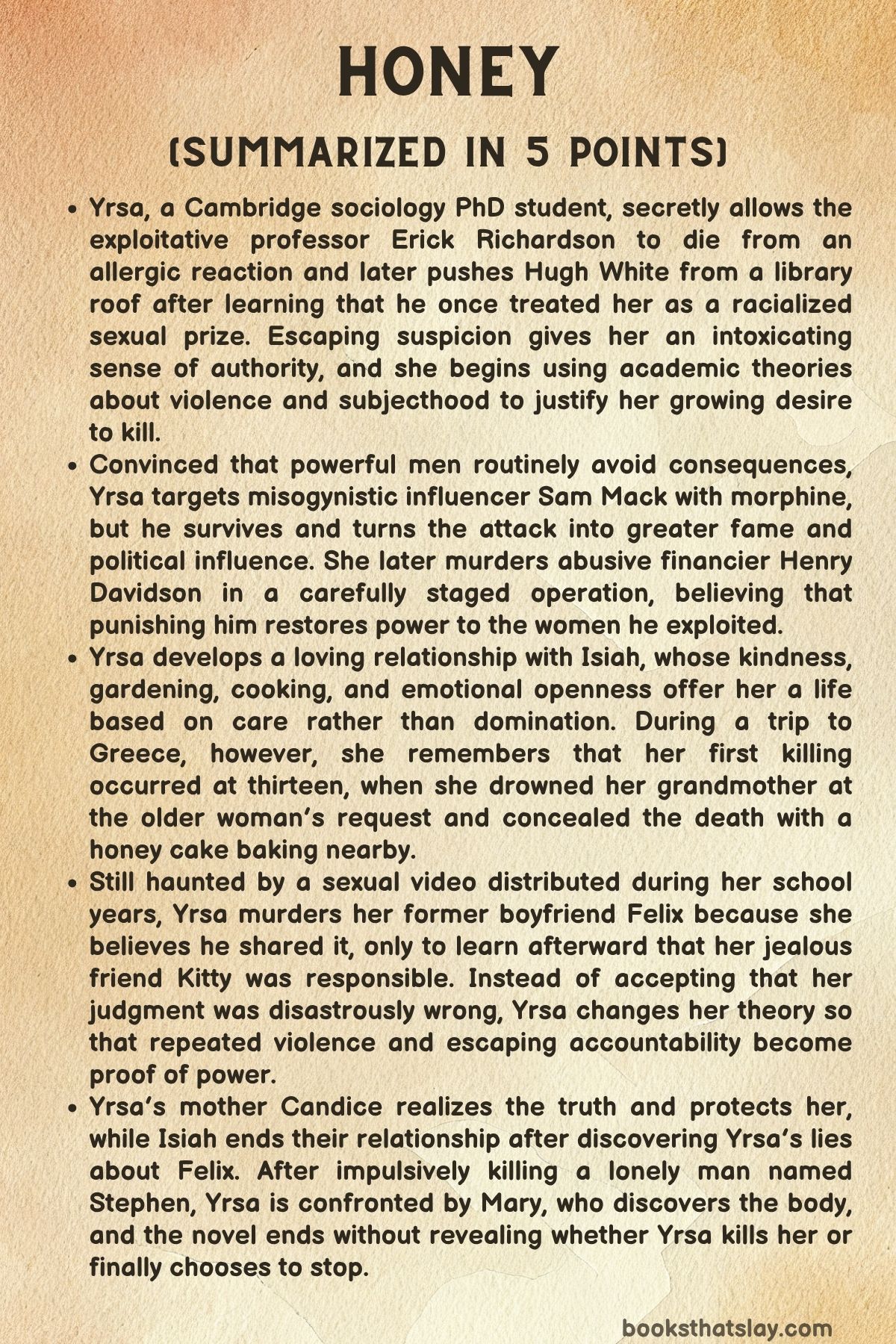
Summary
Yrsa is a sociology PhD student at Cambridge who studies race, violence, and the treatment of Black bodies. She is intelligent and commanding, but her teaching style can be humiliating, as demonstrated when she publicly dismisses Damien for questioning whether intersectional theory has gone too far.
Her personal relationships are equally confrontational. Ethan, the unreliable man she is dating, cancels a dinner she has carefully prepared, while her friend Nina confesses that her married supervisor, Erick Richardson, has used her research, promised to leave his wife, and then abandoned her while attempting to remove her contribution from his book.
When Yrsa later encounters Richardson, she knocks a bee into his lemonade despite knowing that he has a severe allergy. She watches him struggle to breathe without calling for help, then performs distress and gives ineffective CPR after his death.
Instead of experiencing guilt, Yrsa feels powerful and excited. She discovers that she can cause a death, control the account of what happened, and appear to be an innocent witness.
Yrsa cooks goat curry using her grandmother’s traditions, believing that food can comfort the spirits of people who die prematurely. The ritual allows her to portray herself as someone honoring Richardson while privately enjoying her responsibility for his absence.
Ethan later returns with flowers and an invitation to Paris, but his charm disappears when he refuses to use a condom and pressures Yrsa to accept unprotected sex. She throws him out, demonstrating that she can defend her boundaries even while remaining emotionally detached from the harm she has caused elsewhere.
Yrsa’s ideas about sex and power began in adolescence. Growing up in a religious household where sexuality was associated with shame, she contacted adult men online and learned that desirability could give her temporary authority over people who otherwise possessed greater age and social power.
Her doctoral research also begins changing after Richardson’s death. While discussing Afropessimism with her supervisor, Syed, she wonders whether society’s appetite for violent spectacle could be redirected toward different bodies, although she has not yet admitted that this question is becoming personal.
At Richardson’s memorial, his wife Anna thanks Yrsa for supposedly trying to save him. Anna also describes her husband’s selfishness, which encourages Yrsa to believe that his death may have relieved others rather than simply causing grief.
Yrsa soon reconnects with Hugh White, a privileged former classmate with whom she once slept. Their attraction appears capable of becoming affectionate until Hugh admits that their encounter was part of a rugby initiation game in which Yrsa was assigned points under a racialized category.
The admission transforms their shared past into evidence that Hugh treated her as a competitive object. While they are sitting on the roof of the Wren Library, Yrsa pushes him to his death, removes evidence from his phone, and invents an alibi.
Hugh’s death is treated as either an accident or suicide. Yrsa initially isolates herself, but fear gradually becomes exhilaration when she realizes that she has again escaped suspicion.
Unlike Richardson’s death, Hugh’s killing was a deliberate physical act. It convinces Yrsa that murder can reverse the relationship between observer and object by giving her control over another person’s body and the story that will be told afterward.
Returning to her family home, Yrsa is unsettled by her mother Candice’s careful questions about Hugh. Her father Martin, by contrast, remains kind and trusting, telling her that therapy has helped him and suggesting that she might benefit from it.
Yrsa begins using the story of Celia, an enslaved woman executed after killing the man who repeatedly raped her, to construct an intellectual defense of her actions. She asks whether violence can restore a person’s subjecthood after humiliation has reduced that person to an object.
She starts listing possible victims and becomes interested in Sam Mack, a misogynistic online celebrity accused of exploiting young women. After an encounter with Kyle, who chokes and degrades her without first asking permission, Yrsa becomes more convinced that men repeatedly avoid consequences for violating women’s boundaries.
She steals slow-release morphine from Blake, her elderly neighbor and friend, and follows Mack to a party on a luxury boat. Pretending to be an admirer, she gives him a drugged shot and watches him collapse.
Her plan fails when Mack’s friend calls an ambulance. Mack survives, and his claim that powerful enemies attempted to assassinate him increases his popularity, strengthens his security, and eventually supports his political ambitions.
Yrsa is disturbed not because she nearly killed him, but because someone prevented her from completing the act. The failure intensifies her desire and shows that murder has become more than punishment; it has become a source of anticipation and personal release.
At Cambridge, Yrsa receives a student complaint accusing her of humiliating students rather than helping them improve. Syed acknowledges that white male academics may be allowed greater aggression, but he advises her to soften her manner to protect her employment and funding.
Yrsa interprets this as another example of institutions protecting some people while regulating the anger of others. Her resentment increases when Dr. Barnett resists Skye’s proposal for a discussion group specifically for women of color and portrays Yrsa and Skye as excessively angry.
Using an online warning system created by sex workers, Yrsa selects Henry Davidson, a wealthy financier accused of racist abuse, violence, secretly filming women, and refusing to respect sexual boundaries. She disguises herself as an escort and manipulates him into taking her to an Airbnb.
Henry fetishizes her race, forces sexual acts upon her, and confirms many of the allegations. Yrsa drugs him, handcuffs him to the bed, injects him with heroin, and watches him die from respiratory failure.
This murder is carefully planned rather than spontaneous. Yrsa cleans the room, stages the death as an accidental overdose, takes part of Henry’s money, and dedicates a flower to the exploited Black female body.
Her excitement is interrupted by an anonymous email stating that the sender knows what she has done. Yrsa cannot determine whether the writer is a witness, a police informant, a blackmailer, or someone connected to one of the dead men.
During this period, she meets Blake’s grandson Isiah. His kindness, humor, love of cooking, and commitment to teaching children how to grow food offer Yrsa an experience of desire that does not depend on humiliation or control.
They break into a college ball, dance, eat sweets, ride a Ferris wheel, and kiss. Yrsa is frightened by how much she enjoys his company because affection requires an openness she has avoided in both her sexual and academic life.
Isiah later shows her the community garden where he works. His acceptance of natural cycles contrasts with Yrsa’s determination to direct life, death, memory, and meaning according to her own wishes.
Their relationship deepens, and Yrsa ends her arrangement with Kyle. She begins imagining a future with Isiah, although she remains unwilling to explain her past or reveal the secrets surrounding the sexual video that destroyed her school reputation.
Therapy with Layla provides another possible route toward honesty. Yrsa admits that she imagines harming people but disguises her experiences as dreams, testing whether Layla will condemn her while withholding the information that would make real treatment possible.
She also avoids discussing the death of her grandmother, who had Alzheimer’s and died while Yrsa was alone with her. Her family’s spiritual traditions, secrecy, punishments, and belief in the unstable boundary between life and death continue influencing the way Yrsa understands her actions.
When Felix, her former school boyfriend, returns, Yrsa becomes obsessed with him. She believes he circulated their sexual video, causing widespread humiliation and making her a target of judgment from classmates and school authorities.
While travelling through Greece with Isiah, Yrsa finally remembers the truth about her grandmother’s death. Her grandmother had repeatedly begged thirteen-year-old Yrsa to help her die, and Yrsa eventually held her underwater in the bath while a honey cake baked in the oven.
The authorities believed the death was an accident caused by Yrsa becoming distracted by the cake. Yrsa then ate the entire cake while surrounded by her parents, police officers, and paramedics, experiencing the overwhelming sweetness that she would later associate with taking a life.
This memory proves that Richardson was not her first victim. It also shows that her attraction to killing existed long before her academic arguments about resistance, race, and restored subjecthood.
Despite her growing love for Isiah, Yrsa secretly meets Felix. She tells herself that kissing him is not betrayal because she intends to murder him rather than begin a relationship.
At Felix’s flat, he apologizes for the school scandal and insists that he loved her but never distributed the video. Yrsa refuses to believe him, drugs his drink, and attempts to incapacitate him.
The plan becomes chaotic when Felix fights back. Yrsa grabs a baseball bat and beats him repeatedly, continuing long after he is unable to resist.
She stages the killing as a gang initiation, constructs an alibi, and cleans the flat. Unlike Henry’s death, Felix’s murder is driven by uncontrolled rage and produces relief rather than a sense of carefully reasoned justice.
Yrsa visits Felix’s grieving family and speaks at his funeral while pretending to mourn. His sister Gemma and Detective Morley remain suspicious, but the police continue considering the possibility of a random attack.
At the funeral reception, Kitty confesses that she stole the sexual video from Felix’s phone and distributed it because she was jealous. Yrsa realizes that Felix was innocent of the betrayal she used to justify killing him.
She also acknowledges that she suggested filming the encounter and initially imagined that the video might make her famous, although Kitty’s decision to distribute it still violated her consent. Felix loved her and suffered for an act he did not commit.
Rather than abandoning murder, Yrsa changes her theory. She decides that violence gains power through repetition and impunity, and therefore concludes that she must continue killing and continue escaping consequences.
Candice eventually makes it clear that she knows Yrsa killed Felix. She strengthens her daughter’s alibi, warns her to control her increasingly manic behavior, and reveals that she has discovered the hidden list of possible victims.
Trying to follow her mother’s advice, Yrsa tells Isiah that she loves him, gives up drugs and casual sex, destroys her victim list, and revises her thesis. Her new academic position examines the structures that make violence appear necessary instead of celebrating violent reversal.
The relationship collapses when Isiah discovers that Felix was Yrsa’s former boyfriend and that she concealed their meetings and messages. Yrsa responds with deflection and emotional manipulation, and Isiah leaves after recognizing that she will not speak honestly.
Yrsa returns to dating apps and false identities while Sam Mack announces that he has founded a political party. Her failed attempt to destroy him has helped transform him into a more influential figure.
She meets Stephen, a lonely logistics worker who is awkward but generous, humorous, and devoted to his daughter. Although Yrsa initially enjoys his company, she decides he deserves to die after discovering that he supports some of Mack’s policies despite knowing about the accusations against him.
Yrsa drugs Stephen and causes a fatal heart attack, but the unplanned killing leaves her without proper supplies or a disposal strategy. Mary, Kyle’s girlfriend, then confronts Yrsa and reveals that she sent the threatening emails because she believed Yrsa knowingly slept with Kyle.
Mary discovers Stephen’s body and becomes trapped in the car with Yrsa. As Yrsa drives toward the remote Fens, Mary begs for her life while Yrsa reveals fragments of the truth about Felix, her grandmother, her mother, and her fascination with controlling living things.
The story ends with Yrsa touching the remaining needle and then placing her hand on Mary’s shoulder. Whether she kills Mary remains unresolved, leaving her caught between continuing the pattern and accepting that no intellectual argument can transform murder into liberation.
Characters
Yrsa
At the center of Honey, Yrsa is an exceptionally intelligent but deeply unreliable protagonist whose academic study of violence gradually becomes a language for explaining desires that existed long before her research. She presents herself as a critic of systems that objectify Black women, yet she repeatedly treats other people as objects whose lives can be judged, managed, and ended according to her needs.
Her first remembered killing occurs when she is thirteen and helps her grandmother die. Although the act is connected to her grandmother’s repeated requests, Yrsa’s response to the death reveals an unsettling attraction to control, secrecy, and the sensation of crossing an irreversible boundary.
Her later murders are initially directed at men who have harmed women or benefited from racism and misogyny. Richardson exploits Nina, Hugh racializes Yrsa, Henry abuses sex workers, and Felix appears responsible for circulating an intimate video, allowing Yrsa to imagine herself as an agent of punishment.
However, her justifications steadily collapse. Felix is innocent of the act for which she kills him, Stephen is murdered largely because of a political opinion, and Mary becomes a possible victim simply because she has discovered too much.
Yrsa’s relationships reveal her conflict between domination and vulnerability. She easily controls Ethan, Kyle, Henry, and Felix, but Isiah’s kindness frightens her because genuine intimacy cannot be maintained through performance, secrecy, or intellectual superiority.
Her tragedy lies not in an inability to recognize contradictions but in her ability to recognize them and continue. Even when she admits that her thesis has forced conclusions, she repeatedly changes her theory instead of changing her behavior.
Candice
Honey presents Candice as a controlled, observant mother whose emotional distance hides a complicated history of secrecy, sexual desire, resentment, and protective loyalty. Her criticism of Yrsa often appears cruel, but her questions reveal that she has been watching her daughter far more carefully than Yrsa realizes.
Candice resents the burden her own mother placed upon the family, particularly during the decline caused by Alzheimer’s. Her refusal to discuss why Yrsa was repeatedly left alone with an unstable and demanding grandmother suggests that guilt lies beneath her composure.
Her hidden photograph and later confession show that she also pursued secret sexual experiences and struggled to stop after marrying Martin. This creates an uncomfortable similarity between mother and daughter, both of whom conceal powerful appetites beneath respectable public lives.
Candice eventually understands that Yrsa killed Felix and deliberately strengthens her alibi. Her protection is not simple approval; it is combined with warnings that Yrsa must become sensible before her compulsions destroy the family.
Her behavior raises difficult moral questions because she recognizes the danger but chooses secrecy over accountability. She hopes that a stable relationship with Isiah will restrain Yrsa, yet this solution places an innocent man in danger and avoids confronting the seriousness of her daughter’s actions.
Martin
Martin is Yrsa’s affectionate and trusting father. His warmth offers a contrast to Candice’s sharpness, and Yrsa values his uncomplicated love even while hiding nearly every important part of herself from him.
His decision to begin therapy shows that he is capable of self-reflection and personal change. He encourages Yrsa to seek similar help, unknowingly offering her a genuine opportunity to confront her behavior.
Martin’s innocence also makes him vulnerable. At Yrsa’s birthday party, he accidentally reveals Felix’s former relationship with her, causing Isiah to understand how extensively Yrsa has lied.
Yrsa’s Grandmother
Yrsa’s grandmother is a formative presence whose religion, spiritual beliefs, medicines, punishments, and stories shape Yrsa’s understanding of life and death. She teaches Yrsa that invisible forces remain close to ordinary existence and that certain actions can release consequences that cannot easily be contained.
Her Alzheimer’s creates fear, confusion, and dependence within the family. She repeatedly asks the thirteen-year-old Yrsa to help her die, placing an unbearable responsibility upon a child who has already learned to associate love with obedience and secrecy.
Yrsa eventually holds her beneath the bathwater and stages the death as an accident. Whether the act is mercy, coercion, trauma, or the beginning of a compulsion remains deliberately uncertain.
The honey cake baked during the death becomes one of the story’s central images. Its sweetness links care, appetite, concealment, death, and pleasure in a memory Yrsa suppresses until adulthood.
Isiah
Isiah represents the possibility of intimacy without conquest. He is gentle, playful, attentive, and emotionally open, offering Yrsa a relationship built on shared meals, conversation, humor, travel, and mutual attraction.
His work teaching children to grow and cook food reflects a constructive relationship with the world. While Yrsa seeks power by ending lives, Isiah finds meaning in cultivation, patience, and accepting natural cycles.
He does not function as a perfect moral opposite, since he occasionally misunderstands the extent of Yrsa’s experience with racism and institutional exclusion. Nevertheless, he is willing to question, listen, and remain vulnerable in ways Yrsa finds difficult.
Isiah leaves because the relationship is built upon concealment. His decision demonstrates that love cannot survive when one person continually alters reality, withholds essential information, and uses another person’s past pain to avoid accountability.
Felix
Felix is Yrsa’s former boyfriend and the person she wrongly holds responsible for distributing their sexual video. His return reactivates her humiliation, anger, and longing for the social life she lost after the scandal.
He apologizes for failing to protect her but insists that he never shared the recording. His affection appears genuine, and his willingness to reconnect suggests that he has carried regret for years.
Yrsa kills him before learning that Kitty was responsible. His death therefore becomes the clearest proof that Yrsa’s private system of judgment is unreliable and that her certainty can destroy innocent people.
Felix’s family, former girlfriend, and friends reveal a fuller person than the symbolic villain Yrsa created. Their grief exposes the human cost she repeatedly excludes from her theories.
Kitty
Kitty is Yrsa’s former best friend and the actual person responsible for distributing the sexual video. Her action is motivated by jealousy, insecurity, and the unstable competitiveness that shaped their friendship.
Her betrayal has severe consequences for Yrsa’s reputation, relationships, and understanding of herself. Nevertheless, Kitty is not presented as a simple enemy because Yrsa also remembers humiliating and excluding her.
Kitty’s confession comes too late to save Felix, but it forces Yrsa to confront the weakness of her certainty. Yrsa’s decision not to kill her is one of the few occasions when she resists immediate violent desire, although she soon creates a broader theory that permits future murders.
Nina
Nina is Yrsa’s friend and one of the first people whose suffering appears to justify Yrsa’s violence. She is exploited by Richardson, who conducts an affair with her, uses her research, and then attempts to erase her contribution.
Her emotional attachment prevents her from reporting him, demonstrating how professional dependence and romantic manipulation can silence victims. Yrsa believes that killing Richardson has avenged Nina, but Nina never requests or approves such an act.
Nina later distances herself because she suspects Yrsa of exposing the affair publicly. Their damaged friendship shows that violence performed in another person’s name does not necessarily restore that person’s trust, dignity, or agency.
Erick Richardson
Richardson is a married academic who exploits Nina emotionally and professionally. His position allows him to use her research, promise her a future, and then protect his own reputation by attempting to remove her contribution.
His death becomes Yrsa’s first adult experiment with punishment. By refusing to help during his allergic reaction, she discovers that passivity can be used as a form of killing while still allowing her to appear innocent.
Anna’s description of him as selfish complicates his public image without justifying his murder. Richardson remains an example of a guilty man whose death is decided by someone who has appointed herself investigator, judge, and executioner.
Hugh White
Hugh is a privileged former classmate whose attraction to Yrsa initially appears sincere. Their reunion reveals that he has remembered her for years and once studied colonialism partly to impress her.
His admission about the rugby points game transforms their sexual history. By accepting a racialized category that reduced Yrsa to “Black-girl magic,” he participated in a system that turned women into trophies.
Hugh’s wrongdoing is real, but Yrsa’s decision to push him from the roof is immediate and irreversible. His later memories and affectionate message reveal that he cannot be reduced entirely to the worst thing he did.
Sam Mack
Sam Mack is a misogynistic influencer who converts accusations, controversy, and public anger into money and political influence. He represents a modern system in which visibility can protect harmful men rather than expose them.
Yrsa chooses him because he appears to embody impunity. Her failed assassination, however, becomes part of his public mythology, allowing him to claim persecution and attract an even larger following.
His rise demonstrates that violence can strengthen the forces it intends to destroy. By attempting to make Mack disappear, Yrsa helps him become more powerful.
Henry Davidson
Henry is a wealthy financier accused by sex workers of racist, abusive, and sexually violent conduct. His behavior toward Yrsa confirms his fetishization of Black women and his assumption that money permits him to ignore their boundaries.
Yrsa’s murder of Henry is her most methodical killing. She studies his habits, creates a false identity, drugs him, restrains him, and stages the death as an overdose.
His actions make him one of Yrsa’s most clearly culpable victims, yet his death still fails to alter the systems that enabled him. The killing gives Yrsa personal satisfaction but offers no protection or repair to the women he previously harmed.
Blake
Blake is Yrsa’s elderly neighbor, a former war journalist, and one of the few people with whom Yrsa forms a genuine friendship. Their relationship begins as Yrsa’s attempt to perform goodness but becomes an important source of companionship.
Blake’s aging body places mortality close to Yrsa without requiring violence. Her eventual move into care also confronts Yrsa with a form of loss that cannot be controlled through dramatic action.
Blake unintentionally assists Yrsa when Yrsa steals morphine from her belongings. Her casual advice to do something foolish is interpreted by Yrsa as permission because Yrsa often turns ordinary remarks into support for decisions she has already made.
Syed
Syed is Yrsa’s academic supervisor and an important intellectual challenge to her reasoning. He respects her intelligence but repeatedly questions conclusions that appear unsupported or ethically dangerous.
He recognizes that Yrsa faces racialized expectations within Cambridge and advises her to manage the system strategically. Yrsa hears this as a request to become more acceptable to people who are uncomfortable with her authority.
Syed’s strongest role comes when he criticizes her thesis for forcing Black experience back into the violence she claims to oppose. His criticism exposes the scholarly contradiction that Yrsa has used to protect her private desires.
Ida
Ida is Yrsa’s close friend and housemate. Her emotional openness provides a contrast to Yrsa’s guardedness, particularly when she describes love as wanting another person inside her blood.
Her breakup and renewed involvement with Serena reveal that secrecy and contradiction are not exclusive to Yrsa. However, Ida’s private mistakes do not involve the deliberate destruction of other lives.
Ida accepts Yrsa’s explanations after Hugh’s death and later helps organize her birthday celebration. Her loyalty gives Yrsa the appearance of an ordinary social life even as her private actions become increasingly dangerous.
Skye
Skye is a friend who challenges both institutional racism and Yrsa’s behavior. Her proposal for a discussion and knitting group for women of color reflects a desire to create community rather than rely solely on confrontation.
She criticizes Yrsa when her sarcasm causes Dr. Barnett to become defensive. Skye’s response shows that people facing the same institutional pressures can disagree about strategy without denying that the underlying inequality exists.
Skye is later revealed as the writer who exposed Richardson’s affair and theft of Nina’s research. Unlike Yrsa, she uses public information and collective discussion rather than private violence to challenge abuse.
Yasmin
Yasmin is part of Yrsa’s Cambridge friendship group and briefly expresses interest in Hugh. Yrsa discourages her by exaggerating Hugh’s conservative beliefs, revealing Yrsa’s possessiveness before she fully admits her renewed attraction to him.
Yasmin also keeps Yrsa informed about Eliot’s investigation into Hugh’s death. Her conversations contribute to Yrsa’s awareness that the official account may not satisfy everyone.
Kyle
Kyle is an American rower with whom Yrsa begins a casual sexual relationship. He assumes that her physical pleasure gives him permission to choke, degrade, and dominate her without prior agreement.
His comments about pornography, gender roles, and Yrsa being unexpectedly easy reveal entitlement beneath his attraction. Yrsa continues seeing him because the relationship requires little emotional vulnerability.
After Isiah leaves, Yrsa returns to Kyle for rough sex. His unexpected gentleness afterward complicates her attempt to treat him as nothing more than another selfish man.
Mary
Mary is Kyle’s girlfriend and the sender of the threatening emails. She believes Yrsa knowingly slept with Kyle and attempts to frighten her through anonymous accusations.
Her messages have no connection to the murders, but Yrsa interprets them through her own guilt. Mary therefore becomes an accidental reflection of how fear can cause Yrsa to construct elaborate explanations around incomplete evidence.
When Mary discovers Stephen’s body, she becomes a direct threat to Yrsa’s freedom. Her final plea creates the unresolved moral decision at the end of the story.
Stephen
Stephen is a lonely, socially awkward logistics worker whom Yrsa meets through a false dating profile. He is older and attracted to her race, but he is also generous, funny, and devoted to his daughter.
Yrsa genuinely enjoys dancing and laughing with him, creating a moment in which she could choose connection over judgment. She condemns him only after discovering that he supports some of Sam Mack’s political ideas.
His death reveals how far Yrsa’s standards have expanded. She no longer kills only direct abusers but anyone whose beliefs she considers evidence of moral failure.
Layla
Layla is Yrsa’s therapist and one of the few people capable of helping her examine her motives. She responds calmly to Yrsa’s disguised confessions and refuses to define a person entirely through one violent act.
Yrsa treats therapy as another performance, inventing dreams, changing names, and testing Layla’s reactions. By secretly reading the therapist’s notes, she repeats her habit of controlling narratives rather than participating honestly.
Layla’s distinction between understanding and excusing harm challenges Yrsa’s habit of treating explanation as justification. The therapy cannot succeed because Yrsa withholds the truth needed for meaningful accountability.
Ethan
Ethan is an unreliable romantic partner who alternates between neglect and charm. His refusal to use a condom and his attempt to pressure Yrsa into unprotected sex reveal that his attentiveness does not extend to respecting her boundaries.
Yrsa’s decision to remove him from her home demonstrates her capacity for clear self-protection. It also shows that her awareness of consent is genuine, even when she later denies other people control over their bodies.
Damien
Damien is the student Yrsa humiliates after he questions whether intersectionality has gone too far. He becomes her suspected author of the teaching complaint, although his role is never definitively confirmed.
His presence exposes Yrsa’s difficulty separating intellectual authority from personal domination. Even when her criticism may be theoretically justified, her method leaves students feeling attacked rather than educated.
Anna
Anna is Richardson’s wife and one of the people most directly affected by his death. She thanks Yrsa for attempting to save him, unknowingly expressing gratitude to the person who allowed him to die.
Her bitterness about Richardson’s selfishness complicates the image of a perfectly grieving widow. However, Yrsa uses Anna’s dissatisfaction to reassure herself rather than recognizing Anna’s right to understand and respond to the truth.
Eliot
Eliot is Hugh’s friend and secretly appears to have been in love with him. He refuses to accept the assumption that Hugh died by suicide and constructs diagrams examining the circumstances of the fall.
His suspicions make him one of the few people who notices weaknesses in Yrsa’s narrative. However, his grief causes others to treat his investigation as obsession, allowing institutional convenience to overpower unanswered questions.
Gemma
Gemma is Felix’s sister and one of the most openly suspicious members of his family. She asks precise questions about Yrsa’s departure and notices details that Felix’s grieving parents are too overwhelmed to examine.
Her skepticism supports Detective Morley’s belief that the gang-initiation explanation may be incomplete. She represents the persistent family voice that refuses to let an easy narrative replace the truth.
Detective Morley
Detective Morley investigates Felix’s murder and remains dissatisfied with Yrsa’s account. Her repeated questioning indicates that she senses inconsistencies even when she lacks sufficient evidence to make an accusation.
She embodies the pressure of external accountability that Yrsa usually manages to avoid. Her continuing interest also shows that Yrsa’s control over public narratives is not absolute.
Martin and Candice’s Marriage
Although Martin and Candice function individually, their marriage also shapes Yrsa’s understanding of intimacy. Martin appears devoted and trusting, while Candice hides sexual secrets and silently manages dangerous knowledge about their daughter.
Their household teaches Yrsa that relationships can remain stable while important truths are never spoken. This becomes the model she unsuccessfully tries to reproduce with Isiah.
Malcom
Malcom is the twenty-eight-year-old man Yrsa meets online when she is fifteen. His willingness to have sex with a teenage girl demonstrates the adult exploitation hidden beneath Yrsa’s belief that she was controlling the encounter.
He marks the beginning of Yrsa’s attempt to transform sexual risk into personal authority. Her memories reveal that feeling powerful does not necessarily mean that the surrounding relationship is equal or safe.
Serena
Serena is Ida’s former partner and later secret sexual companion. Her unstable relationship with Ida reflects the confusion between separation, desire, and emotional attachment that appears throughout the novel.
Unlike Yrsa, Ida and Serena’s secrecy remains within the imperfect boundaries of a relationship. Their situation offers a smaller, nonviolent version of the difficulty of letting go.
Victoria
Victoria is Henry’s fiancée, who turns his disappearance and death into public social-media content. Her posts allow Yrsa to monitor the investigation and confirm that the authorities consider the death an overdose.
Victoria’s growing audience demonstrates how grief can be transformed into performance and consumption. Yrsa criticizes this behavior while also using Victoria’s posts for her own protection.
Sarah
Sarah is Felix’s American former girlfriend, whom Yrsa meets at the funeral. Her genuine grief reveals how deeply Felix was loved after Yrsa had reduced him to the role of betrayer.
Yrsa comforts Sarah with calculated kindness rather than remorse. The encounter shows her ability to perform empathy while remaining emotionally separated from the pain she caused.
Dr. Barnett
Dr. Barnett resists Skye’s proposal for a group specifically for women of color because she believes her existing women’s organization should be sufficient. Her reaction demonstrates how universal claims of inclusion can ignore differences in race and experience.
When Yrsa uses sarcasm, Barnett focuses on the women’s anger rather than the limitations of her own position. She represents the institutional habit of treating discomfort with criticism as evidence that the critic is unreasonable.
Themes
Violence, Subjecthood, and the Illusion of Liberation
Violence repeatedly promises Yrsa a way to reverse objectification. In Honey, she argues that people reduced to objects by racism, misogyny, sexual exploitation, or institutional neglect might restore their subjecthood by directing violence toward those who harmed them.
Her earliest killings appear to support this belief. Richardson exploits Nina, Hugh turns Yrsa into a racialized prize, and Henry treats Black women as purchasable bodies, so their deaths give Yrsa a temporary sensation of control.
That sensation is personal rather than transformative. Nina remains wounded, the women Henry abused receive no repair, Hugh’s death creates grief, and Mack becomes more powerful after surviving Yrsa’s attack.
Felix’s murder destroys the logic completely because he did not distribute the video. Once Yrsa learns the truth, she does not reject violence but changes her theory so that repeated killing itself becomes a form of resistance.
This intellectual flexibility exposes the central deception. Yrsa’s theories do not produce her desire to kill; they provide respectable language for a desire rooted in childhood, secrecy, appetite, and control.
The final encounter with Mary removes nearly every political justification. Mary has not exploited Yrsa or committed institutional violence, but she has seen too much, making her survival inconvenient.
The unresolved ending therefore asks whether Yrsa can finally separate liberation from domination. Unless she accepts limits, guilt, and accountability, her pursuit of subjecthood will continue turning everyone else into an object.
Race, Gender, and Institutional Power
Yrsa lives within institutions that claim fairness while distributing authority unevenly. Cambridge values her intelligence, yet her anger is treated as threatening in ways that similar conduct from a privileged white male academic might be dismissed as confidence or brilliance.
The complaint about her teaching is not entirely baseless because she humiliates students. However, Syed’s warning that she must become more palatable shows that legitimate criticism can exist alongside racialized expectations about how a Black woman should speak, teach, and exercise authority.
Nina’s exploitation by Richardson demonstrates another form of institutional protection. His seniority allows him to combine professional theft with sexual manipulation while assuming that Nina’s dependence and shame will keep her silent.
Sex workers’ warnings about Henry reveal how wealth allows violent men to move between private misconduct and public respectability. Their collective knowledge is extensive, yet the formal system has failed to translate that knowledge into protection.
Sam Mack represents the ability to convert misogyny into influence. Accusations strengthen his brand because his followers interpret criticism as proof that he threatens established power.
The novel does not suggest that Yrsa imagines these inequalities. Her error lies in believing that individual killing can replace political organization, public testimony, community, or structural reform.
Skye’s article and proposed women-of-color group offer alternative responses. They rely on exposure, collective speech, and shared space, methods that are slower and less satisfying to Yrsa because they do not provide the immediate authority of deciding who lives.
Desire, Intimacy, and Control
Yrsa often experiences desire as a contest over who controls the encounter. Her adolescent relationships with older men allow her to imagine that sexual availability has transformed her from a vulnerable girl into the person directing the situation.
This sense of authority is unstable because the adults still possess greater experience and social protection. Yrsa responds by separating sex from trust, treating partners as sources of sensation rather than people capable of entering her emotional life.
Ethan and Kyle reinforce her distrust. Both assume that attraction or pleasure gives them permission to ignore boundaries, confirming Yrsa’s belief that intimacy creates opportunities for exploitation.
Isiah challenges this pattern by offering attention without domination. Cooking, gardening, travel, laughter, and mutually chosen sex show Yrsa that desire can be connected to patience and care rather than humiliation.
She becomes frightened because Isiah’s love requires truth. Murder allows Yrsa to control another person’s final experience, but love requires her to accept that another person can question, judge, leave, or misunderstand her.
Her concealment of Felix therefore destroys the relationship. She wants Isiah’s devotion without allowing him the information needed to decide freely whether he wishes to remain with her.
After he leaves, Yrsa imagines killing him, revealing how quickly love becomes hostility when she loses control. Her deepest emotional problem is not an inability to desire others but an inability to let them remain separate, autonomous people.
Inheritance, Memory, and Moral Responsibility
Yrsa’s violence develops within a family culture shaped by migration, religion, secrecy, discipline, sexual concealment, and uncertain boundaries between the living and the dead. Her grandmother’s stories and spiritual practices teach her that actions can release forces that remain long after the original event.
The grandmother’s death becomes the hidden center of Yrsa’s adult life. By suppressing the memory, Yrsa convinces herself that Richardson began her transformation, allowing academic theory and social injustice to appear responsible for desires already present in childhood.
The honey cake reveals the connection between memory and appetite. Yrsa experiences sweetness while surrounded by death, authority, and deception, creating an emotional pattern that later returns through elaborate meals, flowers, sex, and the physical excitement of killing.
Candice carries a related inheritance of secrecy. Her hidden photographs and affairs show that she also maintained a private life of appetite and deception beneath the role of wife and mother.
Mother and daughter recognize their similarities without fully naming them. Candice protects Yrsa after Felix’s death, continuing the family habit of preserving stability by hiding unbearable truths.
Yet inheritance cannot remove responsibility. Yrsa may have been shaped by childhood exploitation, racial humiliation, institutional inequality, and maternal silence, but she repeatedly makes decisions after recognizing their consequences.
Understanding the origins of her violence explains how she became capable of murder. It does not transform her victims into symbols, erase their grief, or excuse her refusal to stop.