The Hypnotist Summary, Characters and Themes
The Hypnotist by Lars Kepler is a Swedish crime thriller about murder, memory, trauma, and revenge. The story begins with the brutal killing of a family, leaving one wounded survivor whose testimony may save another missing family member.
Detective Joona Linna turns to trauma specialist Erik Maria Bark, a doctor who once used hypnosis but abandoned it after a scandal. When Erik breaks his promise and hypnotizes the boy, the case takes a shocking turn and pulls Erik’s own family into danger. The Hypnotist blends police investigation with psychological suspense, showing how buried guilt and old wounds can return with deadly force.
Summary
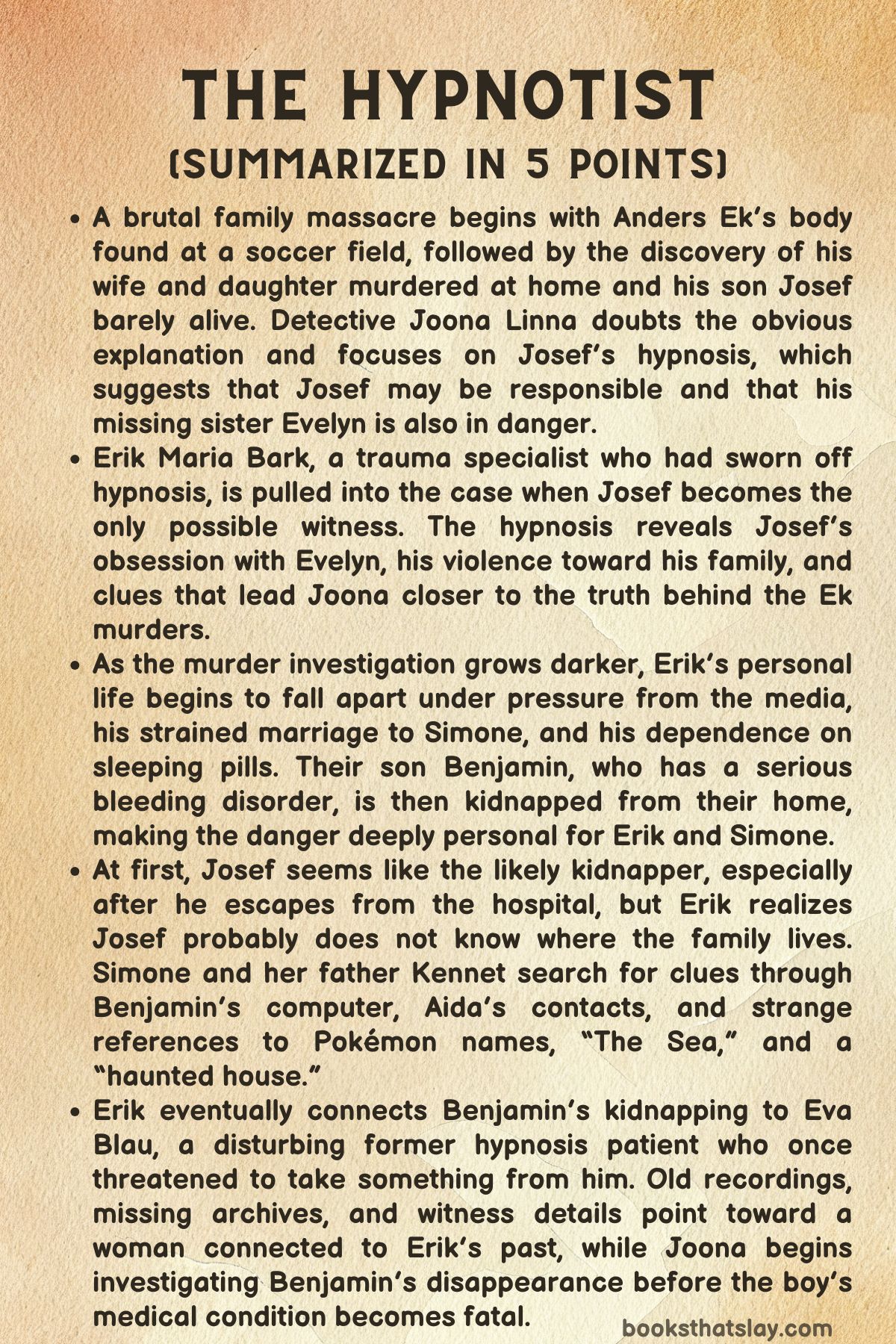
A terrible murder begins the story of The Hypnotist.
A man named Anders Ek is found dead in the bathroom of a locker room at a soccer field in Tumba. His body has been violently mutilated, and at first the police consider whether his death might be connected to gambling debts. When officer Erland Björkander goes to Anders’s home to inform the family, he finds an even worse scene. Anders’s wife, Katja, and their young daughter, Lisa, have also been murdered.
Their teenage son, Josef, is badly injured but still alive. The only family member missing is the older daughter, Evelyn.
Detective Joona Linna becomes involved in the case and quickly doubts the idea that Anders was killed for money. He believes the killer first murdered Anders at the soccer field and then went to the family home to attack the others. Since Evelyn is missing, Joona fears that she may still be alive but in immediate danger. If the murderer is trying to wipe out the entire family, Evelyn could be the next target. The problem is that Josef, the only survivor, is in shock and too badly injured to answer questions.
Josef is taken to Karolinska Hospital, where trauma specialist Erik Maria Bark works. Erik once practiced hypnosis on trauma patients, but he stopped ten years earlier after a serious scandal and promised never to hypnotize anyone again. Joona pressures him to make an exception because Josef may know where Evelyn is. Dr. Daniella Richards also supports the idea. Erik refuses at first, but the possibility of saving Evelyn’s life finally makes him agree.
Under hypnosis, Josef begins describing the murders in broken and disturbing fragments. At first, he seems like a victim trying to remember what happened. But as he speaks, Erik and Joona realize that his words point in another direction.
Josef was not simply watching the violence. He appears to have taken part in it. He mentions his father, his mother, his sister, and Evelyn, and he refers to Aunt Sonja’s cottage. The more he says, the clearer it becomes that Josef may be the killer himself.
Joona follows the clues to Sonja’s cottage, where Evelyn is found nearby with a shotgun. She is terrified when she learns that her family is dead. At first, she is reluctant to explain what happened, but Joona notices that her story does not fit all the evidence.
Josef had described details inside the cottage, which proves he had been there recently. Evelyn finally admits the truth. Josef had developed a sexual obsession with her and had pressured her for sexual favors. She had tried to escape him by going to the cottage.
When she rejected him, Josef threatened to punish her by killing their family. His violence was driven by obsession, resentment, and a twisted desire to control Evelyn.
The case becomes even more complicated when Josef’s confession under hypnosis becomes public. Erik is attacked by the media for hypnotizing a minor and for helping produce a confession that cannot be used as legal evidence. Josef becomes furious at Erik for exposing him.
Soon after, he escapes from the hospital, killing a nurse during his escape. Joona chases him and even shoots him, but Josef manages to disappear.
While the murder case continues, Erik’s family life is under strain. His wife, Simone, still carries pain from Erik’s affair ten years earlier, and she suspects he may again be too close to Daniella.
Erik is also dependent on sleeping pills, which adds to the tension between them. Their teenage son, Benjamin, has a serious blood disorder that requires regular medication. Even a small injury can become life-threatening because his blood does not clot properly. Benjamin is dating Aida, an older tattooed girl whose family life is troubled, which makes Simone uneasy.
One morning, Simone notices signs that someone may have entered their home. Erik dismisses her concerns. Later, after an argument, Erik sleeps separately. During the night, Simone wakes with pain in her arm and realizes she has been drugged.
She sees a shadowy figure dragging Benjamin out of the apartment, but she collapses before she can identify the kidnapper. Because Josef has escaped and has threatened revenge, everyone first assumes he abducted Benjamin.
The kidnapping is not treated with the urgency Simone expects, so she turns to her father, Kennet, a former police inspector. Erik does not want Kennet involved because the two men dislike each other, but Simone is desperate.
She and Kennet investigate Josef’s old home and find signs that Josef had been hiding in a secret room in the basement. However, Benjamin is not there. This makes it less likely that Josef is the kidnapper.
Benjamin manages to call Erik from the trunk of a moving car. He is frightened and says something about being taken to a place called the haunted house.
The call is brief, but it gives Erik a clue. Erik begs Joona to take over the case, explaining that Benjamin’s condition makes every hour dangerous. Joona asks Erik to think about anyone from his past who might want revenge.
Erik’s memories return to events from ten years earlier, when he was doing research with group hypnosis for trauma patients. One patient, Eva Blau, had behaved in a deeply unsettling way and had once broken into his home. Another patient, Lydia, had described abusing a child in a cage during a hypnosis session.
Erik reported this to child services, believing a child was in danger. When authorities went to Lydia’s home, they found no child, and Lydia attempted suicide. The scandal destroyed Erik’s professional reputation, ended his research, and led him to swear off hypnosis.
As Joona and Erik investigate Benjamin’s kidnapping, old clues begin to matter again. Erik finds an old hypnosis tape marked with references to the haunted house.
The tape shows Eva Blau reacting strangely during a group session. Some of the recording has been erased, but it suggests a link between Erik’s past patients and Benjamin’s disappearance. Joona also reconstructs the kidnapping and discovers that a homeless cleaner named Anabella saw the kidnapper reflected in a mirror through a peephole.
She describes a woman in a wool hat with a strangely happy-looking mouth.
At first, Eva Blau seems like the main suspect, especially because she had once accused Erik of taking something from her and had threatened to take something from him.
But the investigation reveals that Eva is dead. Suspicion then turns toward Lydia. Kennet questions Benjamin’s girlfriend Aida and learns that a woman had claimed to be Benjamin’s real mother and had called him Kasper, the name Lydia had used for her child during the hypnosis sessions. At Lydia’s residence, police find the body of a young child buried there.
Erik’s old fear had been correct: Lydia really did have a child. She had kept him locked in a cage for years and killed him after realizing Erik had contacted child services.
Benjamin has been kidnapped by Lydia, who believes he is connected to the child she lost. She is helped by former members of Erik’s hypnosis group. Joona, Erik, and Simone eventually track Benjamin to a remote cottage near a frozen lake.
Lydia plans to punish him by cutting him, an injury that could kill him because of his blood disorder. Benjamin escapes from the cottage and hides in a bus, wrapped in a blanket against the cold.
A violent confrontation follows. Lydia and the others struggle with Joona, Erik, Simone, and Benjamin. Benjamin uses the bus to interrupt the fight, but Lydia overpowers him and tries to flee across the frozen lake. The ice breaks beneath the bus, and it begins to sink.
Erik manages to rescue Benjamin, but he and Lydia are trapped as the bus goes under. Erik is finally pulled to safety with the help of a rope and life preserver, while Lydia is lost.
The novel ends on Christmas Eve with Erik, Simone, and Benjamin eating at McDonald’s. They are alive and together, but they know the trauma will not vanish easily.
Their family has survived murder, kidnapping, old secrets, and revenge, yet the damage remains. The Hypnotist closes with a sense of relief, but also with the understanding that healing will take time.
Characters
Joona Linna
Joona Linna is the central investigative force in The Hypnotist, and his character is defined by calm intelligence, stubborn intuition, and an almost physical refusal to accept easy answers. While others initially see the Ek family murders as a possible result of Anders Ek’s gambling debts, Joona reads the crime scenes differently and understands that the sequence of violence points toward something more personal and psychologically disturbed.
His strength as a detective lies in his ability to notice what others overlook: the order of the killings, Josef’s dirty feet, the significance of the cottage, and later the reflection in the Rosenlunds’ mirror. Joona is not reckless, but he is willing to push boundaries when a life is at stake, which is why he pressures Erik to hypnotize Josef and later persuades Carlos Eliasson to let him investigate Benjamin’s kidnapping.
His moral complexity comes from the tension between procedure and urgency. He operates inside the police system, yet he repeatedly bends around its limitations because he sees the human cost of delay.
Joona is portrayed as perceptive, controlled, and unusually persistent, but also as someone whose confidence can place pressure on others. He does not merely solve crimes; he enters the emotional wreckage left behind by them and forces hidden truths into the open.
Erik Maria Bark
Erik Maria Bark is one of the most psychologically burdened characters in the book. He is a trauma specialist whose professional skill is tied to an old moral wound: his former use of clinical hypnosis and the damage connected to that part of his past.
His decision to hypnotize Josef is not casual; it violates a personal vow and reopens a history he has tried to bury. Erik’s character is built around guilt, exhaustion, dependency, and fear.
His dependence on sleeping pills suggests a man who cannot rest naturally because his mind is crowded with unresolved trauma. His home life is equally unstable, especially because Simone mistrusts him after his old affair and because Daniella’s presence creates fresh suspicion.
When Benjamin is kidnapped, Erik’s professional composure collapses into parental desperation. His intelligence remains active, but it becomes frantic: he studies strange photographs, revisits memories, searches old tapes, and follows the clue of the “haunted house.” Erik is not heroic in a simple way.
He is damaged, evasive, and at times responsible for the consequences of past choices, yet his fear for Benjamin reveals deep love. His arc shows how the past does not disappear merely because someone stops speaking about it; it waits until a crisis forces it back into the present.
Simone Bark
Simone Bark is a deeply anxious, emotionally wounded, and fiercely determined character. Her relationship with Erik is shaped by mistrust, betrayal, and the pressure of parenting a medically vulnerable son.
She is not simply a suspicious wife; her suspicion comes from a history of being hurt and from the instability she senses around Erik. When Benjamin is kidnapped, Simone becomes one of the most desperate figures in the story.
The moment she sees her son being dragged away while she is drugged and unable to move becomes a defining image of helplessness. Yet Simone does not remain passive.
She investigates Josef’s former home, searches Benjamin’s computer, follows leads involving Aida, Nicke, and “Wailord,” and continues moving even when exhausted. Her brief attempt to seek escape with Shulman shows the depth of her emotional collapse, but it also reveals that she cannot truly detach from her role as Benjamin’s mother.
Simone is vulnerable, angry, frightened, and sometimes impulsive, but her love for Benjamin gives her a relentless energy. She represents the emotional cost of crime on the family, not only as grief but as panic, guilt, suspicion, and survival instinct.
Benjamin Bark
Benjamin Bark is physically fragile but emotionally central to the story. His dangerous bleeding disorder makes his kidnapping especially terrifying because time itself becomes a threat; without medication, his body may fail him even if his captor does not directly harm him.
Benjamin’s vulnerability is not only medical. He is also caught in risky social relationships, particularly through Aida and the threatening world connected to Nicke and “Wailord.” His involvement with an older, troubled girl suggests a teenager drawn toward danger, secrecy, and emotional intensity.
Yet Benjamin is not portrayed as foolish so much as exposed. He lives under the shadow of his illness, his parents’ strained marriage, and forces he does not fully understand.
His phone call from the moving car is one of the most important moments connected to him because it shows both terror and survival. Even frightened, he tries to communicate clues.
Benjamin functions as the emotional center of Erik and Simone’s crisis. The threat to him forces hidden histories, old enemies, and family fractures into the open.
Josef Ek
Josef Ek is one of the darkest and most disturbing characters in the novel. At first, he appears to be the surviving victim of a family massacre, gravely wounded and perhaps the only witness to an unspeakable crime.
The hypnosis scene gradually changes that understanding, revealing that Josef may not be a helpless survivor but the killer himself. This reversal makes him deeply unsettling because his victimhood and violence are entangled.
His obsession with Evelyn, his threats, and his hatred connected to his own birth by C-section create a portrait of a mind warped by resentment, sexual fixation, and symbolic violence. The mutilation of Katja’s old scar suggests that Josef’s rage is not random but ritualized, aimed at the body and history of his own mother.
He is terrifying because his violence appears intimate and meaningful to him, even when it is monstrous to everyone else. His escape from the hospital, despite severe injuries, reinforces his almost inhuman persistence.
Josef’s character embodies the horror of violence emerging from within the family, where love, dependency, shame, and hatred have become fatally twisted.
Evelyn Ek
Evelyn Ek is a traumatized and complicated character whose role is surrounded by fear, secrecy, and guilt. As the missing older daughter, she is first treated as a possible victim in immediate danger, but her connection to Josef gradually becomes more disturbing.
Her terror at Sonja’s cottage seems genuine, especially when she learns that her family is dead. However, her early denials and inconsistent account show that she has been hiding parts of the truth.
Evelyn’s relationship with Josef is central to understanding the murders: his sexual obsession with her and his threats against their father place her in a horrifying position. She is not responsible for Josef’s violence, but she is trapped inside its emotional logic.
Her silence may come from shame, fear, self-protection, or the shock of being connected to something so monstrous. Evelyn’s character brings out the theme of hidden family damage.
She survives, but survival does not make her free; she is left carrying knowledge of how close desire, fear, and violence came to destroying everyone around her.
Anders Ek
Anders Ek is important both as a victim and as a figure whose life initially misleads the investigation. His gambling debts create an early explanation for the murders, but Joona’s rejection of that theory reveals that Anders’s death is part of a much more intimate pattern of violence.
Anders is killed first, which makes him the opening target in Josef’s plan rather than an accidental casualty. His role as father becomes significant because Josef’s threat to Evelyn involved killing him first.
This turns Anders into a symbol of paternal authority and family structure, something Josef seeks to destroy. Although Anders is not developed through his own actions, his death shapes the entire investigation.
He represents the first broken link in the family, and the misunderstanding around his gambling debts shows how outward facts can hide deeper emotional motives.
Katja Ek
Katja Ek is one of the most tragic victims in the story because the violence against her continues even after death. The cutting open of her old C-section scar gives her murder a symbolic cruelty that connects directly to Josef’s hatred and disturbed feelings about his birth.
Katja is therefore not only a murdered mother but also a body onto which Josef projects rage, origin, blame, and identity. Her character is seen mostly through the horror done to her, yet that horror reveals how deeply Josef’s violence is rooted in family history.
The attack on her scar transforms motherhood itself into something Josef wants to punish. Katja’s death is devastating because it shows that the killer’s motive is not merely to eliminate witnesses but to attack the emotional and biological bonds that define the family.
Lisa Ek
Lisa Ek is the youngest and most innocent victim of the Ek family murders. Her death emphasizes the extremity of Josef’s violence because she has no apparent role in the conflicts involving Evelyn, Anders, or Katja.
As a young daughter, Lisa represents the ordinary family life that has been brutally erased. Josef’s apparent admission under hypnosis that he attacked Lisa makes his character even more horrifying, because it shows his rage extending beyond specific grievances into total destruction.
Lisa’s presence in the story is brief but emotionally powerful. She gives the murders their full moral weight, reminding the reader that the crime is not only mysterious or psychologically complex but also an act of cruelty against a child.
Erland Björkander
Erland Björkander is the police officer who first moves from the discovery of Anders’s body to the horrifying scene at the Ek family home. His role is procedural, but it is also emotionally important because he becomes the person who crosses from one crime scene into the revelation of a larger massacre.
He represents the ordinary machinery of police work suddenly confronted with extraordinary brutality. Unlike Joona, who interprets patterns and challenges assumptions, Erland functions as an initial responder whose discovery expands the scope of the case.
His presence helps establish the shock and escalation of the opening crimes.
Daniella Richards
Daniella Richards is a doctor whose role places her at the intersection of medical urgency and ethical pressure. She helps push Erik toward hypnotizing Josef, which makes her part of the decision that exposes the truth but also triggers public backlash against Erik.
Daniella’s character also affects Erik’s personal life because Simone associates her with Erik’s past betrayal and mistrust. Her answering of a call believed to be from Erik becomes emotionally charged, even if the professional context may be more complicated than Simone assumes.
Daniella is not simply a romantic complication; she represents the blurred boundary between Erik’s professional world and his damaged private life. Her presence intensifies the sense that Erik cannot keep his past, his work, and his family separate.
Aida
Aida is a troubled and risky presence in Benjamin’s life. She is older, tattooed, and connected to a threatening social world that Simone immediately fears.
Aida’s importance grows when she sends Benjamin the strange photograph and when Benjamin’s computer reveals messages involving her brother Nicke and “Wailord.” She seems to belong to a world of coded threats, manipulation, and adolescent danger. Her character functions as a bridge between Benjamin’s ordinary teenage vulnerability and the darker external forces surrounding his kidnapping.
Aida may not be fully understood, but she clearly complicates Benjamin’s life and gives Simone another reason to believe her son has been pulled into something unsafe.
Kennet
Kennet, Simone’s father, is practical, loyal, and brave in a way that feels grounded rather than dramatic. He helps Simone investigate when official answers are not enough, questions Nicke, and follows the clue connected to “The Sea.” His role shows the wider family’s response to Benjamin’s kidnapping: he does not merely comfort Simone, he acts.
Kennet’s sudden realization outside the 7-Eleven and the attack at the pedestrian crossing make him a victim of the same hidden danger he is trying to uncover. The fact that he sees only a young girl before being hit by the truck adds mystery and menace to his fate.
Kennet’s character is marked by devotion and tragic interruption. He is close to finding something important, and that is precisely what seems to make him dangerous to someone else.
Nicke
Nicke is Aida’s brother and a character connected to intimidation, money, and hidden clues. Through Benjamin’s computer and Kennet’s questioning, Nicke becomes part of the web surrounding Benjamin’s disappearance.
His link to boys pretending to be Pokémon characters suggests a strange mixture of childish imagery and criminal manipulation. Nicke seems to occupy a lower level of the threat network: not necessarily the mastermind, but close enough to know something useful.
His character adds a street-level layer to the story, showing how teenage relationships, online identities, and extortion-like schemes may connect to a much larger danger.
“Wailord”
“Wailord” is less a conventional character than a threatening identity or alias within Benjamin’s digital world. The name’s connection to Pokémon gives it an eerie childishness, especially when paired with fear, money, and possible manipulation.
This contrast makes the alias unsettling: something playful has been turned into a mask for coercion. “Wailord” represents the hidden dangers of online communication, where identities are unstable and people can control others from behind names that seem harmless.
In the investigation, the alias matters because it points toward a concealed network rather than a single obvious kidnapper.
Eva Blau
Eva Blau is one of the most important figures connected to Erik’s past, and her character carries the force of revenge, performance, and psychological disturbance. She first appears in Erik’s memory as a former patient who behaved erratically, sexually provoked him, disrupted his office, and made disturbing claims.
Her later actions, including breaking into Erik and Simone’s home and stealing a photograph of Benjamin, show that her obsession with Erik crossed from therapy into personal invasion. Her accusation that Erik had taken something from her and her threat to take something from him become chillingly relevant after Benjamin’s kidnapping.
Eva is especially complex because Erik remembers realizing that she had been faking hypnosis. This makes her not only damaged but also manipulative, someone who understands performance and uses it to distort the therapeutic space.
The “haunted house” tape suggests that beneath her theatrical behavior lies a buried trauma involving childhood, violation, and possibly the loss of someone vulnerable. Eva is frightening because she may be both victim and predator, someone shaped by harm who may have turned that harm outward.
Liselott Blau
Liselott Blau appears as a person connected to Eva and therefore to the hidden past Erik must confront. Although the book does not give much direct action from her, her importance lies in the possibility that she can help clarify Eva’s identity, background, or current whereabouts.
She represents the investigative path from Erik’s memories into Eva’s real history. In a story where names, records, and identities may be unstable, Liselott’s connection to the Blau family becomes potentially significant.
Her character functions as a link to truths that Erik cannot recover from memory alone.
Lasse Ohlson
Lasse Ohlson is the person who brings Eva Blau into Erik’s professional life, and his nervousness immediately suggests that Eva is not an ordinary patient. By pushing her toward Erik, he becomes indirectly responsible for connecting Erik to a destructive force from the past.
Lasse’s role may be small, but it matters because he acts as a gateway figure. His unease frames Eva as someone difficult, unstable, or dangerous even before her behavior confirms it.
He also reflects one of the book’s recurring concerns: professionals pass troubled people through systems, but the consequences of those encounters can outlast the original clinical setting.
Carlos Eliasson
Carlos Eliasson represents authority within the police structure. His decision to allow Joona one week to investigate Benjamin’s disappearance gives Joona limited official space to act.
Carlos is not portrayed as emotionally central, but his role matters because he controls institutional permission. Through him, the story shows how urgent cases still depend on hierarchy, procedure, and negotiation.
His willingness to give Joona time suggests trust, but the limit of one week also emphasizes pressure. Carlos stands for the system Joona must work within, even when that system cannot move as quickly as fear demands.
Anja
Anja is a capable investigative support figure whose work gives Joona important information. She traces Benjamin’s phone call to a base station in Gävle and searches for records of Eva Blau.
Her character represents the technical and research side of the investigation, where progress comes through databases, phone records, and administrative traces. The fact that she finds no record of Eva under that name adds to the mystery and suggests that Eva’s identity may be false, hidden, or altered.
Anja’s role is quiet but essential because she turns scattered clues into usable investigative direction.
Fredrik Stensund
Fredrik Stensund is frustrating to Erik because he offers vague assurances rather than the urgency Erik desperately needs. His character represents the emotional gap between official procedure and parental terror.
From Erik’s perspective, Fredrik’s responses feel inadequate because Benjamin’s illness makes every delay dangerous. Fredrik may not be malicious, but his vagueness makes him seem distant and ineffective at a moment when Erik needs certainty.
He helps show why Erik turns to Joona and begins acting on his own memories: the official response does not feel immediate enough to save Benjamin.
Kurt
Kurt works in the hospital archive and becomes important when Erik searches for old hypnosis recordings. His inability to provide the missing digitized files deepens the sense that Erik’s past is fragmented and unreliable.
Kurt’s role is not dramatic, but it is meaningful because the missing materials create a barrier between Erik and the truth. Through Kurt, the story shows how institutional memory can fail: files vanish, old materials are discarded, and crucial evidence disappears through neglect rather than conspiracy.
His character adds realism to Erik’s search, where answers are not neatly preserved for the moment they are needed.
Anabella
Anabella is a homeless cleaner who has been secretly staying in the Rosenlunds’ apartment, and her hidden presence becomes crucial to the kidnapping investigation. Because she is socially invisible, she sees what others miss.
Joona’s discovery that she could have observed the kidnapper through the peephole reflection turns her from a marginal figure into an essential witness. Her description of the kidnapper as a woman with a wool hat and a happy-looking mouth is strange and memorable, giving the investigation a new direction.
Anabella’s character shows how people overlooked by society can hold vital knowledge. She also adds a note of vulnerability, because her secret use of the apartment suggests poverty, instability, and fear of being discovered.
The Rosenlunds
The Rosenlunds are mostly absent, but their apartment becomes an important investigative space. The supposedly empty home, the cared-for cat, the peephole, and the angled mirror all turn their apartment into an accidental witness to Benjamin’s kidnapping.
Their absence matters because it creates the conditions for Anabella to stay there and for Joona to reconstruct what happened. As characters, they function less through personality and more through the environment they leave behind.
Their home becomes a puzzle box, proving that even an empty apartment can contain evidence.
Aunt Sonja
Aunt Sonja is significant because her cottage becomes a key location in uncovering the truth about Evelyn and Josef. Even if she does not appear directly, her property connects the investigation to Evelyn’s hiding place and to Josef’s recent movements.
The cottage becomes a space of fear, secrecy, and revelation. Through Aunt Sonja’s absent presence, the story expands the Ek family world beyond the murder scenes and shows that the truth has been displaced into hidden family spaces.
Shulman
Shulman appears in connection with Simone’s exhaustion and emotional desperation. Her brief attempt to seek escape with him shows how overwhelmed she has become while Benjamin is missing.
Shulman’s role is not primarily investigative; he functions as a sign of Simone’s need for relief from unbearable pressure. Yet the fact that she cannot stop thinking about Benjamin even with him shows that her identity as a mother overpowers any temporary escape.
Shulman therefore reveals Simone’s emotional state more than his own character. He is part of the atmosphere of strain surrounding her.
Themes
Violence as a Symptom of Hidden Trauma
In The Hypnotist, violence does not appear as a sudden, isolated act; it grows out of buried damage, obsession, and psychological distortion. Josef’s brutality toward his own family becomes more disturbing because it is tied to emotions he cannot process in a normal way.
His fixation on Evelyn, his hatred toward his mother, and the strange connection he makes between birth, punishment, and the body show how violence can become a language for a damaged mind. The murders are not only physical crimes but also expressions of resentment, humiliation, and possessive desire.
This makes the investigation more complex, because the police are not simply chasing a killer with an obvious motive. They are forced to interpret fractured memories, disturbing symbols, and emotional wounds that have been hidden inside the family.
The theme suggests that violence often has roots beneath the visible surface, and that those roots can be far more frightening than the act itself.
The Unreliability of Memory and Testimony
Memory becomes both necessary and dangerous throughout the story. Josef is the only living witness to the massacre, yet his account is damaged by trauma, injury, and his own possible guilt.
Erik’s use of hypnosis creates a serious moral problem because the truth it reveals is not clean or stable. Josef’s words under hypnosis seem useful, but they are also confused, symbolic, and open to interpretation.
This creates tension between the need for answers and the risk of trusting unstable memories. The same uncertainty returns through Erik’s past, especially in the old hypnosis recordings and his memories of Eva Blau.
What people remember, what they hide, and what they invent all shape the investigation. The story presents memory not as a perfect record but as something vulnerable to fear, guilt, suggestion, and self-protection.
Because of this, truth must be built carefully from fragments, contradictions, and small details rather than accepted from a single voice.
Professional Duty Versus Personal Consequences
Erik’s decision to hypnotize Josef shows how professional responsibility can create personal disaster. He breaks a promise he made to himself because a child may be in danger and the police need immediate answers.
On one level, his action seems justified: Evelyn might still be alive, and Josef may know where she is. However, the decision exposes Erik to public attack, damages his already fragile marriage, and brings old enemies back into his life.
His professional skill, once meant to heal, becomes connected with harm, scandal, and revenge. Joona faces a similar conflict when he pushes beyond ordinary procedure because he believes the official explanation is wrong.
Both men act from a sense of duty, yet their choices carry heavy costs. The theme shows that doing the right thing is not always safe, clean, or socially approved.
In a crisis, moral action may demand risk, but that risk can spread beyond the case into family, reputation, and personal survival.
Family as Protection and Vulnerability
Family is shown as both the strongest bond and the easiest target. The Ek family is destroyed from within, not by a stranger alone but by someone tied to them by blood, memory, and resentment.
This makes the murders especially horrifying because the home, usually a place of safety, becomes the scene of betrayal. Erik’s family also becomes vulnerable when Benjamin is kidnapped, and the fear surrounding his illness makes the threat more urgent.
Simone’s desperation, Kennet’s investigation, and Erik’s panic all show how family love can drive people into danger when official systems feel too slow or distant. At the same time, mistrust within Erik and Simone’s marriage weakens them when they most need unity.
The story repeatedly shows that family relationships carry deep emotional power: they can protect, comfort, and motivate, but they can also become sites of jealousy, revenge, secrecy, and control. This makes family one of the most fragile spaces in the narrative.