Mother Mary Comes to Me Summary, Characters and Themes
Mother Mary Comes to Me by Arundhati Roy is a reflective, intimate work in which the author looks back on her mother Mary Roy’s extraordinary, turbulent life and on her own unusual upbringing in Kerala. Through memories of conflict, tenderness, distance, and reconciliation, Roy explores the impact of a woman who shaped generations through education, activism, and an unyielding sense of self.
The book is also a portrait of a daughter learning to understand the parent who shaped her strengths, her fears, her writing, and her independence.
Summary
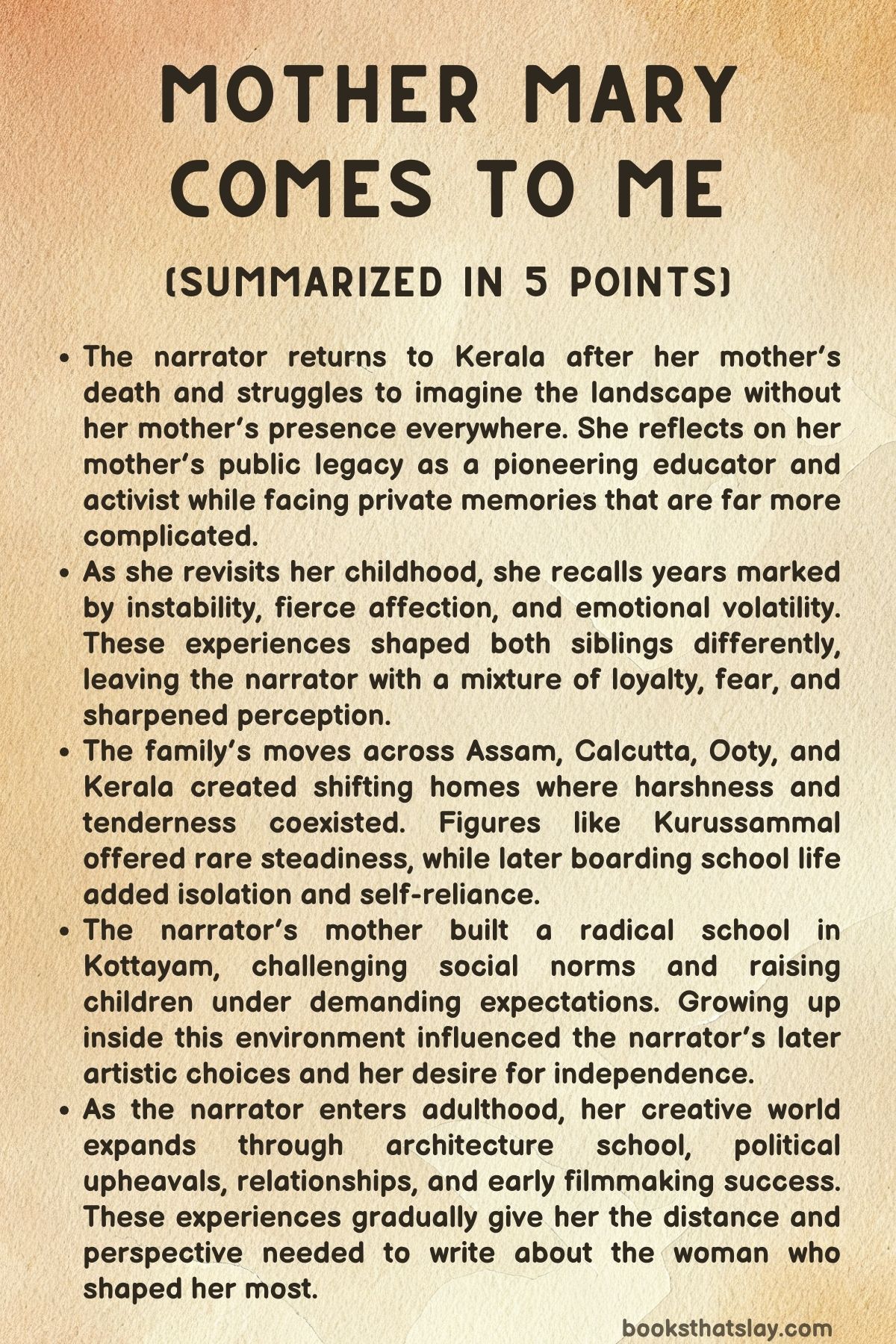
The story begins with the narrator returning to Kerala after her mother’s death, grappling with the idea of a landscape inseparable from her mother’s presence. Her grief is heightened by memories of a woman who lived with striking intensity: a school founder, an educator who shaped countless children, and a rebel who changed Christian women’s inheritance rights through a landmark legal fight.
When she died, neither the church nor the mother herself wanted a church funeral, leaving the family to design their own farewell. The narrator reflects on her mother’s long pattern of surviving dangers, revising wills, and surprising everyone, which had created the illusion that she might endure forever.
Her brother insists that their mother treated the narrator the worst, but she refuses to measure pain that way. She sees her own childhood struggles as small compared to the suffering she has seen in the world.
Even so, she recognizes that writing about her mother risks exposing wounds she once worked hard to hide. She left home at eighteen after years of rising tension.
She had already run away once at sixteen to attend architecture school in Delhi, frightened but determined, carrying a knife and not knowing a word of Hindi. She did not flee due to a lack of love, she explains, but because close proximity made affection impossible.
Her mother never asked where she had been for those seven years, and although they reconciled later, the relationship remained uneasy. The adult narrator visited her mother with a mix of admiration, caution, and curiosity.
Mary Roy had always been exceptional. She was brilliant, unpredictable, generous to some and unyielding to others, and wildly unconventional in a conservative community.
Growing up with her forced the narrator to sharpen her emotional instincts and later provided material for her novels. The mother recognized herself in the narrator’s fiction, even identifying with Ammu in The God of Small Things.
Once, she confronted her daughter about a scene the narrator thought she had invented, showing how memory and imagination merged in their shared past.
The narrator recounts her mother’s early years as a young teacher married to an alcoholic in Assam. When the 1962 India–China war caused evacuations, Mary seized the chance to escape and fled with her two children to Calcutta, then to Ooty, where they lived in half of a holiday cottage belonging to the narrator’s estranged grandfather.
They shared the property with an unstable Englishwoman named Mrs. Patmore and survived on Mary’s meager salary.
When relatives tried to evict them by citing inheritance customs that excluded daughters, a lawyer helped them claim squatters’ rights, an ordeal Mary stored as private fuel for her future legal case.
Life in Ooty was fragile. The cold worsened Mary’s asthma, and the children often had to care for themselves.
Her temper flared often, especially toward the narrator’s brother, who remembered their father and the life they had left behind. A turning point came when Kurussammal, a local woman, joined the household.
She provided the children with steady affection, bathing them, cooking for them, and becoming the first dependable caregiver they had known. Eventually, when money ran out and the children became malnourished, Mary brought them back to Kerala.
They moved into the Ayemenem home of Miss Kurien, Mary’s unmarried aunt, where hostility, fights, and tension filled the household. But Ayemenem also became the narrator’s first real sense of belonging.
She learned Malayalam, roamed the riverbanks, made friends among villagers, and formed a bond with a young man who later inspired the character Velutha.
Yet her mother’s rages continued. The narrator recalls moments when Mary mocked her speech or reacted unpredictably to small incidents.
Shame, fear, and loyalty shaped the girl’s inner world.
Mary and a missionary colleague eventually founded a small school in Kottayam that grew steadily. The family moved into a hostel attached to the school, Kurussammal returned, and life gained stability.
Mary became Mrs. Roy to hundreds of students, training girls to be fearless and boys to be gentle.
She challenged social norms, confronted gender prejudice directly, and clashed with missionary expectations. Her strictness was harshest on her son, whom she sent away to boarding school at nine, and later sent the narrator as well.
The narrator describes boarding school as harsh and lonely, marked by dirt, militaristic discipline, and isolation. She learned to hide her emotions and endured long, solitary journeys home, missing her mother despite everything.
She also recalls episodes of intense discipline at home: her mother beating her brother for an average report card or calling the narrator a cruel name in front of others for a small mistake. These moments shaped how she interpreted success, guilt, and fear.
Meanwhile, political tensions filtered into the school, such as the fear of Naxalite violence and the children’s rehearsed responses to threatening phone calls. These impressions later resurfaced in her writing.
Over time, the siblings bonded through their shared turbulence. When Mary died, the narrator mourned deeply while her brother refused to perform conventional grief, saying bluntly that he would not pretend.
The narrator believes they absorbed their mother’s inner storms to allow her to shine in public.
As the school expanded, Mary bought a piece of wild land called “the bald hill” and hired Laurie Baker, a radical architect. His principles of low-cost, climate-aware design matched Mary’s unconventional vision.
The campus took shape slowly, with open classrooms, a sunken stage, and buildings raised only when money appeared. Watching Baker inspired the narrator to study architecture, and on the day she decided this, she also met his young apprentice, whose presence awakened new feelings in her.
Tensions with her mother escalated during her teenage years, including an incident when Mary angrily ordered her out of a van on a highway. Still, the narrator pursued her studies, eventually reaching Delhi, where she embraced independence, friendships, first love, and political awareness.
She transformed her identity, dropping her first name and building a life shaped by freedom rather than fear.
In Delhi, she took part in creative projects with Pradip, including the ambitious but doomed play Bargad. After its collapse, they turned to low-budget filmmaking, leading her to write In Which Annie Gives It Those Ones in three weeks.
To their surprise, it was accepted, funded, and eventually broadcast nationwide, winning National Awards and marking her emergence as a writer in her own right.
Her mother, meanwhile, fought local authorities in Kerala over a planned staging of Jesus Christ Superstar at her school. A district collector, angered by personal grievances, banned the play as blasphemous, sparking petitions, raids, and political theater.
Mary resisted, hid evidence, won court battles, and eventually staged the play, foreshadowing the rise of grievance-based politics in India.
Roy and Pradip then created Electric Moon for Channel 4. The project was complicated by bureaucracy, censorship, logistics, and clashes between crews.
The experience left Roy unsettled, prompting her to write a long private essay about the chaotic shoot. When an editor discovered it and published it uncut, it became her first significant prose publication and marked another turning point in her writing life.
Through these memories, the narrator traces the long path from a difficult childhood to creative independence, recognizing how her mother’s force of personality shaped her, challenged her, and ultimately empowered her.
Characters
Mary Roy (the Mother)
Mary Roy emerges as the gravitational force around which Mother Mary Comes to Me revolves. Her presence dominates the narrator’s inner and outer worlds, shaping the emotional, social, and political landscapes of the story.
She is portrayed as brilliant, volatile, charismatic, and fiercely independent — a woman who carved out space for herself in a deeply conservative Syrian Christian society that expected women to be obedient and invisible. Her contradictions define her: she is nurturing and ruthless, progressive yet authoritarian, a visionary educator who fought for gender equality yet inflicted deep emotional wounds on her own children.
Her violent temper, cutting remarks, and unpredictable moods coexist with her extraordinary courage and her creative, entrepreneurial spirit. Her founding of the school, her historic legal battle for Christian women’s property rights, and her unconventional pedagogy illustrate her public heroism.
Yet the same fire that fueled her triumphs also scorched her family; her children lived in the long shadow of her rage, her disappointments, and her relentless expectations. Through the narrator’s memories, Mary becomes both mythic and painfully human — a woman who demanded total devotion, who could not tolerate weakness, and who raised her children to be self-reliant partly because she gave them no other choice.
Her life is marked by near-death experiences, reinvention, and a kind of theatrical unpredictability, making her death feel almost unreal. She is the book’s central enigma: both the source of trauma and the source of the narrator’s creative and emotional formation.
The Narrator (Arundhati Roy)
The narrator stands at the intersection of grief, memory, and self-discovery. Returning to Kerala after her mother’s death, she relives the fragmentary, often painful contours of her upbringing.
Her voice blends clarity with vulnerability, exposing the complex ways she internalized shame, fear, and love. As a child, she grows up acutely observant, learning to read her mother’s expressions the way others might read weather patterns.
This early hypervigilance later becomes the foundation of her novelist’s craft; she learns to see hidden emotions, to detect the unsaid, to turn lived experience into storytelling. She leaves home at sixteen and again at eighteen not out of rebellion but for survival — distance becomes the only way she can continue loving her mother.
The narrator’s adulthood is marked by an oscillation between tenderness and analysis: she loves her mother, fears becoming like her, recoils from her cruelty, and yet is always drawn back to her. Writing about Mary becomes the narrator’s way of reclaiming her past, confronting its fractures, and understanding the roots of her creative identity.
Her reflections span childhood poverty, boarding school loneliness, sexual awakening, architectural studies, her early artistic failures and successes, and the political landscapes she encounters. Through it all, she carries the weight of her mother’s contradictions, learning finally to transform inherited darkness into a generative artistic force.
The Brother
The narrator’s brother functions both as a mirror and a contrast to her childhood experience. Whereas the narrator absorbs their mother’s rage in quieter, more ambiguous ways, the brother receives the blunt force of her anger — physical violence, verbal abuse, and explicit contempt.
Beaten for an “average” report card, taunted in ways that erode his sense of self-worth, and once told he should kill himself, he grows up under the harshest edge of Mary’s expectations. Yet as he matures, he forms a uniquely resilient personality, sometimes jovial, sometimes detached, and often unwilling to perform emotional displays, even at their mother’s funeral.
His relationship with the narrator evolves across their lives: from childhood rivalry to adolescent mutual protection, anchored by a shared understanding of their mother’s volatility. He remembers their father and their early life more clearly than the narrator, which intensifies his sense of loss and resentment during the years in Ooty.
Over time, he becomes the keeper of certain family memories, shaping how the narrator revisits their past. His presence underscores the book’s central tension: siblings raised under the same roof can inherit entirely different emotional legacies.
Kurussammal
Kurussammal is a quiet, stabilizing presence in the children’s otherwise chaotic early life. When the family struggles in Ooty — living in poverty, lacking food, surrounded by hostility — she steps in with warmth, consistency, and everyday care.
She cooks, cleans, bathes the children, and creates a domestic rhythm they had never known. For the narrator and her brother, she becomes the first adult who offers unconditional affection without fear or punishment.
Her simple acts of care become foundational memories: the feel of being bathed, the comfort of regular meals, the security of an adult who does not fly into unpredictable rages. She is also one of the few people the mother trusts enough to allow into her household repeatedly, even later when the family moves to the school’s hostel.
Her presence softens the narrative’s harsh edges and illuminates how love from unexpected sources can shape resilience and tenderness in children growing up in emotionally difficult environments.
Miss Kurien
Miss Kurien, the mother’s educated unmarried aunt, represents the rigid conservatism of the family lineage the narrator’s mother tried so hard to escape. When the mother returns to Kerala with two young children and nowhere to go, Miss Kurien reluctantly offers a place in Ayemenem but surrounds them with disapproval and judgment.
She embodies the social norms of Syrian Christian respectability: propriety, hierarchy, resentment toward broken marriages, and discomfort with women who defy tradition. Her hospitality is conditional and tinged with hostility, shaping the narrator’s early experiences of being simultaneously sheltered and unwanted.
Yet Ayemenem — despite Miss Kurien’s disapproval — becomes a place where the narrator develops friendships, discovers the landscape that will later inspire her fiction, and experiences a fleeting sense of belonging. Miss Kurien, in her rigidity, becomes an emblem of the cultural forces Mary Roy fought against for her entire life.
G. Isaac
G. Isaac, the eccentric, nearly blind Rhodes scholar uncle, adds intellectual disorder and creative chaos to the Ayemenem household.
His presence is marked by contradictions: highly educated yet scattered, brilliant yet impractical, kind yet often detached from the children’s emotional needs. He brings an air of baffling adulthood into the narrator’s childhood world — someone who is impressive to outsiders but difficult to live with.
He later runs a small factory and continues to be part of the family’s fractious dynamics. His presence highlights the peculiar mix of talent, dysfunction, and emotional unavailability that characterizes many adults in the narrator’s life.
The Father
The narrator’s father is seen mostly through memory and absence. An alcoholic tea-estate employee in Assam, he represents the life Mary Roy fled in fear and desperation.
His addiction, unreliability, and the wartime evacuation become catalysts for the mother’s escape. For the narrator, he is less a character than a shadow: someone she has almost no memory of.
For her brother, he is a more vivid figure — which becomes a source of pain during their early years in Ooty. The father’s absence shapes the family’s instability, their poverty, and the mother’s need to become both protector and oppressor.
He symbolizes the part of the narrator’s origins that remains unresolved and distant.
Mrs. Patmore
Mrs. Patmore, the mentally disturbed English tenant who shares the Ooty cottage, embodies the unpredictability and danger that cling to the family’s fugitive life.
Her erratic behavior, her emotional instability, and her foreignness create an atmosphere of unease around the children. She represents both the colonial hangover of hill-station life and the precariousness of the family’s existence.
Though not malicious, she becomes one more adult whose instability the narrator must navigate, adding to her early training in reading emotional terrain for survival.
Laurie Baker
Laurie Baker, the radical architect who designs the mother’s school, becomes one of the narrator’s most formative adult influences. His unconventional methods, environmental sensitivity, frugal creativity, and gentle rebellion against standard architectural practices captivate her during adolescence.
Watching him work — improvising, respecting the terrain, designing buildings that breathe — opens the narrator to architecture as a calling. His kindness and quiet brilliance stand in contrast to the emotional turbulence of her home life.
He represents a world where creativity emerges from patience, humility, and thoughtful engagement with the environment. Meeting him marks a turning point in her self-understanding: the moment she discovers a possible future beyond the emotional confines of her family.
Pradip Krishen
Pradip Krishen — filmmaker, collaborator, lover, and creative partner — becomes central to the narrator’s artistic evolution. Their shared projects, from experimental theater to the creation of In Which Annie Gives It Those Ones and Electric Moon, form the backdrop of the narrator’s entry into storytelling.
Pradip provides both companionship and creative friction: their collaborations are warm, chaotic, and often fraught, mirroring the intensity of their personal bond. Through him, the narrator enters the world of filmmaking, learns the complexities of creative labor, and begins to articulate her voice as a writer.
He is also the person with whom she builds a makeshift home during their most productive years, a counterweight to the instability of her childhood. Though their artistic visions sometimes clash, Pradip remains a defining figure in her transition from student to writer.
Golak
Golak, the narrator’s college friend from Odisha, adds humor, tenderness, and tragedy to her Delhi years. His artistic sensibility, emotional devotion, and chaotic energy contribute to the making of Annie — and his accidental haircutting blunder becomes one of the film’s most memorable mishaps.
Golak’s love affair, his moments of distraction, and his personal struggles make him a vivid figure in the narrator’s early creative life. He represents friendship born from shared poverty, ambition, and artistic dreams, and he remains an emblem of the community that nurtured the narrator long before literary fame found her.
Themes
Grief, Memory, and the Unstable Terrain of Remembrance
Grief in Mother Mary Comes to Me appears not as a single emotional event but as an active force reorganizing the narrator’s interior world. Returning to Kerala after her mother’s death confronts her with landscapes saturated by the presence of someone who is now absent, and the tension between memory and physical space becomes a central emotional struggle.
The narrator recognizes that her mother lived a life filled with contradictions, reinventions, dramatic choices, and near-misses with death, and this history shapes the way she processes loss. Memory does not function as a faithful archive; it behaves like a shifting organism, influenced by time, distance, affection, and even imagination.
When the narrator realizes that the fight scene she believed she invented in her novel was actually drawn from a forgotten incident, the book underscores how porous the border is between factual recollection and creative reconstruction. Grief amplifies this uncertainty, as the narrator tries to honor a woman who resisted being fully known, even by her children.
In mourning, she is compelled to examine the fragments she has carried—some tender, some violent—and acknowledge that love and hurt sit side by side, inseparable. Her struggle is not only with the finality of death but with the impossibility of assembling a singular, definitive version of her mother.
Grief becomes an attempt to reconcile these competing images: the public icon, the volatile parent, the deeply principled fighter, and the woman whose presence shaped the narrator’s emotional survival strategies. The instability of memory ensures that loss is never resolved, only revisited from different angles as the narrator continues to write and rewrite what her mother meant.
The Mother–Daughter Relationship and the Complexity of Intimacy
The relationship between the narrator and her mother forms one of the book’s most emotionally layered threads. The mother’s charisma, unpredictability, and fierce intellect dominate the narrator’s childhood, shaping her fears, talents, and eventual independence.
Their bond resists neat characterization: love exists alongside cruelty, admiration alongside resentment, and a longing for connection alongside the urgent need for escape. The mother’s sharp temper, public humiliations, and emotional volatility leave the narrator navigating childhood with heightened awareness and self-protection.
Yet she is never able to dismiss her mother as simply abusive or tyrannical; the woman’s bravery, resilience, and unconventionality hold equal weight. This creates a bond marked by contradiction, where the narrator feels both wounded and profoundly shaped by the force of her mother’s personality.
Their eventual reconciliation is hesitant and fragile, lacking the catharsis one might expect, but their connection remains unbroken even after years of distance. When the narrator visits as an adult, she observes her mother with detachment and love, learning to negotiate the space between them without dissolving into childhood vulnerabilities.
The relationship’s complexity lies in the simultaneous presence of affection and damage, and the narrator’s attempt to understand her mother without flattening her into archetypes—martyr, monster, victim, or hero. By writing about her, the narrator risks betraying her younger self, who bore the brunt of her mother’s anger, but she also seeks to honor the truth of a relationship that cannot be simplified.
Their intimacy evolves into a lifelong force—creative, painful, formative, and impossible to escape.
Female Agency, Resistance, and Defiance of Social Norms
The mother embodies a relentless pursuit of autonomy, continually challenging the conservative expectations of Syrian Christian society. Her refusal to remain in an abusive marriage, her insistence on raising and educating her children independently, and her groundbreaking fight for women’s inheritance rights establish her as a figure of resistance whose actions reshape legal and cultural norms.
Her decision to build a school outside of ecclesiastical control further illustrates her refusal to accept patriarchal or institutional authority. The book presents these achievements not through idealization but by showing the cost of such radical independence: social ostracism, family cruelty, and the practical difficulties of raising children while carrying the burden of societal judgment.
Her personal agency becomes a model for the narrator, even as it complicates their relationship. The narrator inherits not just her mother’s rebelliousness but also the emotional scars created by that same temperament.
Female agency in the narrative is not portrayed as serene or morally unambiguous; it is messy, demanding, and often isolating. The mother’s uncompromising will makes her a transformative public figure but a difficult private presence.
Through her, the book examines what it means for a woman to step outside prescribed roles—how society punishes her, how her children absorb the consequences, and how her actions still create pathways previously unimagined. Her legacy becomes a study in the connection between resistance and survival, showing how defiance can be both liberating and destabilizing, both empowering and harsh, depending on where one stands in its path.
Childhood Trauma, Emotional Survival, and the Formation of the Self
The narrator’s childhood is marked by volatility, economic precarity, displacement, and intense emotional pressure, and these experiences deeply influence her adult identity. Her mother’s unpredictable temperament and the instability of their living situations force her to develop acute observational skills that later become essential to her writing.
Trauma does not appear solely as overt violence; it is embedded in moments such as witnessing her brother’s severe punishment, absorbing public shaming, or navigating silence and fear during boarding school years. Her sense of worth becomes entangled with guilt, especially when she realizes that her successes often coincided with her brother’s suffering.
The emotional landscape of her youth is one of constant vigilance, where affection must be earned and safety cannot be assumed. Yet the book is not solely about pain; it also explores resilience through figures like Kurussammal, who offers unconditional care, grounding the children during periods of instability.
The narrator learns to interpret adult moods, social dynamics, and hidden tensions, skills that later equip her to create complex characters and layered narratives. Trauma becomes a source of both vulnerability and artistic power, shaping her moral compass and her ability to empathize with marginalized lives.
The book shows how emotional scars are carried into adulthood not as static wounds but as elements of personality, influencing relationships, creative work, and the narrator’s understanding of the world. In examining her past, she recognizes how survival strategies became artistic sensibilities, turning childhood pain into a foundation for her future voice.
Social Hierarchies, Class, and Structural Inequality
Social inequality forms a constant backdrop, influencing every stage of the narrator’s life. Her mother’s battles against discriminatory inheritance laws reveal how deeply patriarchal structures are woven into legal and religious systems.
The family’s homelessness, their struggle for squatters’ rights, and the judgment they face from wealthier relatives illustrate how class determines dignity as much as material comfort. In Ooty and later in Ayemenem, the narrator becomes aware of caste and class divisions not only through household conflict but through friendships and observations of the village.
These experiences eventually shape the social consciousness present in her later writing. The book also explores how political movements like Naxalism, though feared by privileged groups, arise from the desperation of those crushed by systemic inequality.
Even the conflicts surrounding Jesus Christ Superstar reveal how power operates—religious sentiment becomes a convenient tool for bureaucratic control, masking personal vendettas behind claims of collective outrage. Professional gatekeeping in the arts, where bureaucrats scrutinize film scripts for “proper” portrayals of India, reflects another layer of structural control.
The narrator’s journey is repeatedly influenced by institutions—church, state, school, family hierarchies—that attempt to confine women, artists, and the poor within restricted roles. Her perspective reveals how inequality is not abstract but lived, shaping opportunities, relationships, and the stories people are allowed to tell.
Through her experiences, the book critiques how systems justify themselves through morality, tradition, or nationalism, even while perpetuating harm and silencing dissent.
Creativity, Artistic Calling, and the Claiming of a Personal Voice
The narrator’s evolution into a writer is intertwined with her experiences of constraint, rebellion, and observation. Art becomes a way to reclaim autonomy after years of emotional turbulence and societal expectations.
Architecture school offers her intellectual freedom and companionship, allowing her to shed earlier identities and experiment with selfhood. Her first encounters with film and theater thrust her into collaborative chaos, risk, and exhilaration, teaching her that creative work is both a refuge and a battleground.
Projects like In Which Annie Gives It Those Ones reveal how creativity can emerge from scarcity, improvisation, and shared idealism. The unexpected success of the film confirms that her voice has resonance, even when the establishment dismisses or misinterprets her work.
When Electric Moon becomes mired in conflict, she turns to prose as a private space to process frustration, not yet realizing that writing will become her central path. Throughout the book, artistic expression is linked to survival: it gives structure to pain, transforms memory into narrative, and allows her to articulate truths that institutions and family life tried to suppress.
Claiming her creative identity is not a smooth ascent but a series of experiments, failures, joys, and confrontations with authority. Her mother’s larger-than-life presence, the political turmoil around her, and the contradictions of her upbringing become material that she shapes into literature.
Creativity becomes both a sanctuary and a form of resistance, enabling her to speak in ways she could not as a daughter, student, or member of a rigid society.