People Watching Summary, Characters and Themes
People Watching by Hannah Bonam-Young is a contemporary romance about two people whose lives have been shaped by loss, responsibility, and the weight of family history. Set in small-town Muskoka, the story follows Milo, a wanderer who never stays in one place for long, and Prue, a young woman who has spent years caring for her mother as early-onset Alzheimer’s rewrites their world.
When their paths cross by chance, their connection challenges everything they believe about love, loyalty, and what it means to build a life that is truly their own.
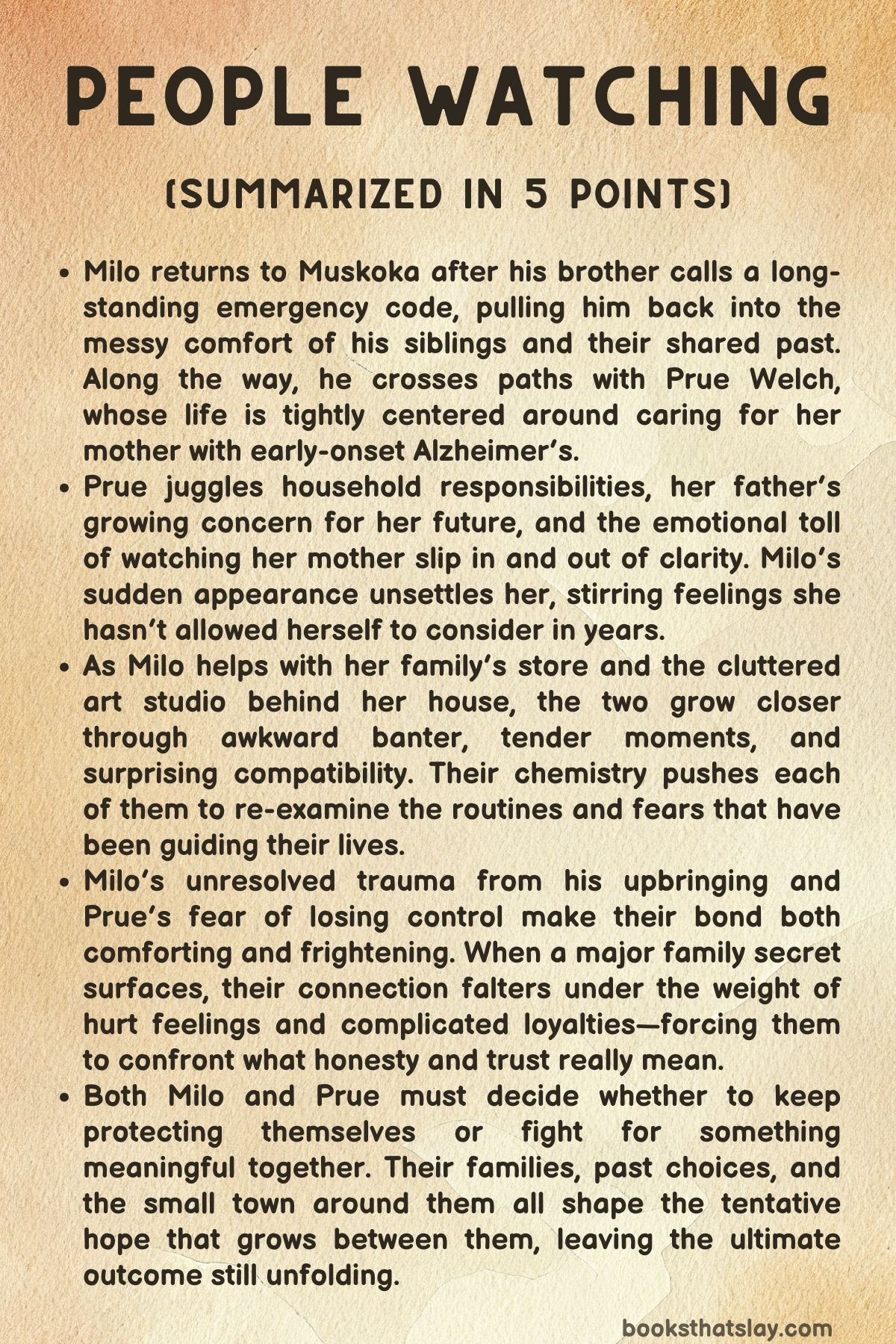
Summary
Milo returns to Muskoka after receiving a family emergency signal from his older brother, Nik. He arrives in his beat-up van to pick up his younger sister, Nadia, who has abandoned her life in Toronto after Nik’s urgent call.
The siblings fall back into familiar rhythms during the drive, sharing memories of their difficult upbringing, the instability of their parents, and the unspoken dependence they have always had on one another. Milo has spent years drifting from job to job, avoiding both confrontation and the parts of his past that still cling to him, while Nadia seems tired of trying to keep her life together.
Neither knows exactly what Nik needs from them, only that he asked, and that has always been enough.
Meanwhile, in the same town, Prue Welch manages her family’s home life with quiet precision. She lives in an A-frame studio behind her parents’ house, holding everything together while caring for her mother, Julia, whose Alzheimer’s has slowly reshaped their days.
Prue wakes each morning to the demands of a household that depends almost entirely on her. When Julia suddenly insists it’s her wedding day, Prue and her father, Tom, rearrange their plans and play along to keep her calm.
It’s a life Prue feels committed to, even as it isolates her from opportunities and the version of herself she once imagined.
Milo and Nadia stop at the Welch family store on their way into town, where Milo meets Prue for the first time. He is struck by her immediately, drawn to her bluntness and the exhaustion she doesn’t bother to hide.
The moment is awkward from the start, especially when Julia mistakes Milo for someone she once knew, but he leaves thinking of the girl in the blue dress long after they drive away. When Milo and Nadia arrive at Nik’s house, chaos greets them: children everywhere, Nik’s pregnant wife bustling around, and Aleks—Nik’s friend and Nadia’s unresolved past—hovering in the background.
Nik finally tells Milo the truth: he needs help running the new family brewery before the baby arrives. Milo agrees, but his attention drifts often to the idea of seeing Prue again.
Late that night, Tom tells Prue he has arranged for her mother to move to a memory-care facility in a few months. He insists he can no longer watch Prue sacrifice her life, and she breaks under the news, begging for more time.
She promises she can get her mother to a more stable place and prove she is building a life of her own. After she retreats to her studio, she finds her thoughts returning to Milo, irritated at herself for feeling something so sudden and confusing.
The next day, Milo returns to the Welch store to buy groceries for Nik. He meets Tom, who is immediately fond of him, and Prue walks in to find them getting along effortlessly.
Tom encourages Milo to help her clean the studio, and Prue reluctantly agrees. As they sort through old supplies and pieces of Julia’s artwork, the tension between them grows.
Milo flirts without shame, while Prue tries to maintain distance even as she feels herself drawn in. When he almost kisses her, she panics and shuts him down, embarrassed by her inexperience and terrified he will see too much of her.
Later, Milo joins Nik and Aleks at the brewery, but his slip-up about the brewery’s name leaves him feeling foolish. He eventually wanders back to the Welch store to help Tom fix a dangerous sign, and Tom sends him to the A-frame for a drill.
There he finds Prue overwhelmed and lying facedown on the floor. Instead of teasing her, he turns on loud music and coaxes her into dancing until she forgets, for a moment, how heavy everything feels.
When she confesses her fear of failing her father’s ultimatum, Milo offers to spend time with her mother so Prue can focus on living. She agrees on one condition: one hour with her mother and one hour with him each day, strictly as friends.
Milo plays along but privately hopes for more.
Their friendship shifts quickly. One night at the studio, quiet companionship becomes something charged.
Prue reveals a list of intimate experiences she wants to try, admitting she has no real frame of reference. Milo responds with patience and reassurance.
Their intimacy deepens as they learn each other’s boundaries, and Prue experiences comfort and desire in ways that surprise her. They discover unexpected connections from years earlier—her teenage poem tattooed on his hip, his old painting kept by her mother—and laugh over how oddly their histories have brushed against one another.
The next morning, Prue slips away to handle a nighttime incident with her mother. Milo wakes alone but quickly understands.
Later at the brewery, Milo and Nadia have a rare conversation about their past, which stirs unresolved pain for him. Overwhelmed, he escapes to Prue’s dock, where Tom finds him drunk.
There, Tom reveals privately that he has Hodgkin’s lymphoma and begs Milo not to tell Prue. He wants her to choose her future freely, not out of obligation.
Milo is shaken, torn between loyalty to Tom and his growing feelings for Prue.
When Prue later discovers her father’s medical files, everything crashes down at once. She calls Milo, desperate for answers, and realizes he knew all along.
She feels betrayed by both her father and Milo, convinced she has been manipulated into planning a future that was never hers to choose freely. Their argument ends with her asking him to leave, and Milo, devastated, walks away into the night.
The next morning, Prue confronts her father calmly. She demands the truth, makes him cancel her mother’s placement, and insists they make decisions together from now on.
Afterward, she finds a box Milo left in her studio. Inside are dozens of sketches of her—moments he noticed, moments she didn’t know anyone had seen, moments that reveal how deeply she had mattered to him from the start.
The box includes a note asking her to meet him on the dock if she can forgive him.
That night, Milo waits for hours, ready to return again and again even if she never comes. When Prue finally approaches with a lantern, Milo breaks with relief.
She listens as he apologizes and admits he should have never kept her father’s secret. She chooses to forgive him, acknowledging her own part in the misunderstanding, and they reaffirm their trust.
Milo tells her he loves her, and she says it back.
They reunite at her studio, share a night of tenderness and honesty, and agree to be together. Six months later, Milo has become part of the Welch family’s daily rhythm, helping prepare for Julia and Tom’s symbolic “second wedding.” The small town rallies around them, and Milo reflects on how far he has come: from a wanderer with no true home to a man rooted in a family, a community, and a relationship that gives him a future he wants to keep building. With Prue by his side, he finally sees a life worth staying for.
Characters
Milo
Milo is the emotional core of People Watching, a man whose chaotic, drifting lifestyle masks a deep fear of failing the people he loves. He begins the story as someone who literally and figuratively lives on the move, driving an unreliable van named Bertha and cobbling together temporary jobs as if permanence might swallow him whole.
His childhood was fractured by volatile, often frightening parents, leaving him with the instinct to run when things get hard and the belief that stability is for other people. Yet Milo is also exceptionally loyal.
The moment his siblings call the family code, he drops everything and returns home, suggesting that beneath his reluctance toward roots lies a hunger for belonging. Meeting Prue awakens a part of him he didn’t know he was capable of accessing: tenderness without fear, commitment without dread, and vulnerability without shame.
His journey is one from avoidance to accountability, especially when confronted with Tom’s diagnosis and the truth about Prue’s emotional world. Milo’s arc is defined by learning that love requires both honesty and presence.
By the end of the novel, he becomes grounded, purposeful, and emotionally brave, transforming from a wanderer into a man who chooses to stay.
Prudence (Prue) Welch
Prue is a young woman whose life has been overshadowed by responsibility far beyond her years. Caring for her mother with early-onset Alzheimer’s has shaped her identity, routines, and sense of self so thoroughly that she no longer knows where caretaking ends and living begins.
She is self-sacrificing, capable, and fiercely devoted, but also lonely, stagnant, and haunted by the fear of wanting more than her circumstances allow. Her A-frame studio is a symbolic extension of her internal world: cluttered with memories, half-finished projects, and things she has not yet been able to let go of.
Milo’s arrival disrupts her predictable, self-contained existence. He pushes her to experience joy, connection, and desire, and helps her confront the truth that she deserves a life outside the confines of duty.
Yet Prue is not passive; she has agency, clarity, and moral conviction. When betrayed by Milo’s silence about Tom’s illness, she draws boundaries and demands honesty from the people she loves.
Her growth lies in learning to trust herself enough to claim a future, even when it feels selfish. Ultimately, Prue becomes someone who can hold both love and responsibility without losing herself in either.
Nadia
Nadia is sharp-tongued, witty, and emotionally guarded, presenting herself as the sibling most in control while secretly battling insecurities shaped by the same difficult childhood as Milo and Nik. She takes on the role of the truth-teller in the family, unafraid to call out hypocrisy or discomfort, but her humor often masks pain.
Leaving her life in Toronto for the emergency call reveals her fierce loyalty, even when she pretends otherwise. Nadia’s struggle with being “nice enough” speaks to the deep wounds inflicted by their upbringing, where emotional expression was often unsafe.
Her romantic entanglement with Aleks exposes her vulnerability, showing that beneath her tough exterior lies someone who fears abandonment and inadequacy. Nadia is the sibling who knows everyone’s emotional temperature better than they do and acts as an anchor in moments of crisis.
She loves fiercely and imperfectly, and though her arc is subtler than Milo’s or Prue’s, she emerges as someone quietly learning to forgive herself for the parts of her past she couldn’t control.
Nik
Nik embodies both the burden and pride of being the eldest sibling. He carries their family history on his shoulders, determined to create a life of stability and safety after growing up amid chaos.
His home is messy, noisy, full of children, and overflowing with love, yet he often feels overwhelmed and stretched thin. Nik’s decision to call his siblings home reflects his desperation rather than weakness; he is trying to open a brewery, care for his pregnant wife, raise five kids, and keep the family afloat.
His strength lies in his capacity to love through action, but he also struggles with emotional expression, especially regarding their abusive father. When he attempts to talk about the past and Milo flees, it becomes clear that Nik is trying to heal generational wounds, even if he doesn’t have the language for it.
He is both a protector and a man who occasionally cracks under the weight of all he carries. Nik’s steadiness serves as a contrast to Milo’s drifting and Prue’s isolation, grounding the narrative in the realities of adulthood, responsibility, and resilience.
Sef
Sef is the quiet powerhouse of Nik’s household, holding together a life that would overwhelm nearly anyone else. Pregnant with her sixth child, managing a chaotic home, and supporting Nik’s dream of opening a brewery, she represents endurance shaped by love rather than obligation.
Sef understands the siblings’ history and treats Milo and Nadia with a mix of affection and practicality, knowing they each carry scars that surface at unpredictable moments. Her influence is subtle but essential; she is the emotional nucleus that keeps Nik’s family functioning.
Sef’s presence softens the home environment and provides a sense of stability that the siblings did not experience in childhood. Through her, the story shows that family healing often comes from the quiet, consistent acts of love performed without fanfare.
Tom Welch
Tom is one of the most emotionally resonant figures in the novel, a man defined by compassion, grief, and unwavering devotion. He has spent years caring for his wife, Julia, as her illness progresses, all while trying to protect Prue from losing herself in caretaking.
His decision to move Julia into a memory-care facility is not a betrayal but the act of someone who refuses to let his daughter sacrifice her entire life. Tom’s illness introduces an additional layer of heartbreak: even while battling cancer, he prioritizes Prue’s future over his own wellbeing.
His choice to confide in Milo is desperate but deeply human, born from the fear that Prue will imprison herself in responsibility unless someone guides her outward. Tom is gentle, perceptive, and quietly courageous, embodying a love that is both selfless and fiercely protective.
His arc revolves around learning that vulnerability with his daughter is not a burden, but an essential path toward healing for both of them.
Julia Welch
Julia is the heart of the Welch family, even as her presence slips away piece by piece. Her early-onset Alzheimer’s shapes the emotional landscape of the story, infusing it with both grief and unexpected beauty.
Through flashbacks and memories, it becomes clear that she was once vibrant, artistic, nurturing, and full of joy. Even in her confusion, moments of clarity reveal her enduring love for her family.
Julia’s illness becomes a symbol of the fragility of time, the pain of watching someone fade, and the tenderness required to care for them. She is not reduced to her diagnosis; instead, the story honors her humanity by showing how her spirit echoes in Prue’s creativity, Tom’s gentleness, and even Milo’s memories from childhood.
Julia represents the ache of loss intertwined with the persistence of love.
Aleks
Aleks is Nik’s best friend and the wildcard who drifts at the edges of the siblings’ dynamic. His history with Nadia creates tension and unresolved feelings, revealing that he is more emotionally complex than his easygoing persona suggests.
Aleks provides comic relief at times, but he also acts as a stabilizing presence in the brewery and in Nik’s life. With Nadia, he is awkward, hesitant, and clearly carrying his own emotional baggage.
Though not the central focus of the story, Aleks enriches the narrative by deepening the bonds within the community and hinting at future growth, particularly in his connection to Nadia. His role highlights the theme that even secondary figures in a small town are intricately woven into the lives and futures of those around them.
Themes
Family as Burden and Family as Anchor
Family operates as both the greatest strain and the deepest source of grounding in People Watching, shaping every major decision the characters make. Milo, Nadia, and Nik carry the residue of a childhood marked by instability and volatility, and this history influences their adult behavior in ways they don’t always notice.
Milo’s tendency to drift, his fear of permanence, and his instinct to flee moments of emotional confrontation are direct echoes of a home where love was inconsistent and safety was easily overturned. Yet the same family that wounded him also becomes the force that pulls him home.
The siblings’ code “one-one-nine” symbolizes this duality; it emerges from trauma yet becomes a binding thread of loyalty that none of them can ignore. Nadia’s exhaustion, Nik’s desperate attempts to build stability for his children, and Milo’s guilt toward his younger sister all reflect how family obligation can feel heavy, even suffocating, but also vital.
Prue’s family experience mirrors this dynamic but expresses it differently. Her mother’s illness demands constant vigilance, reshaping her identity so thoroughly that she begins to lose sight of her own life.
Her father’s devotion to both his wife and daughter sits at the center of their household, yet his hidden illness shows how protecting a loved one can become its own silent burden. When Prue discovers his secret, her devastation stems not only from fear but from the feeling that the foundation she relied upon has been shifted without her knowledge.
Both Prue and Milo learn that family can trap people in cycles of sacrifice or avoidance, but it can also offer the deepest form of love—one that pushes them toward honesty, mutual reliance, and ultimately, the possibility of choosing each other without abandoning their roots.
The Weight of Caregiving and the Cost of Self-Sacrifice
Prue’s storyline exposes the emotional and psychological cost of being a caretaker long before adulthood truly begins. Her life contracts around her mother’s needs, her father’s unspoken fears, and the unrelenting responsibility of managing a home haunted by gradual loss.
The routines she develops—playing along with her mother’s confusion, closing the store for imaginary weddings, navigating unpredictable mornings—become a form of survival rather than choice. Her compassion is tender, but the weight she carries isolates her from experiences that might allow her to grow.
She internalizes the belief that stepping away, even briefly, means failing the people she loves. This quiet erosion of her own identity becomes one of the novel’s most poignant threads.
Her father’s decision to arrange memory care for Julia forces Prue to confront the reality she has been avoiding: sacrifice without boundaries eventually consumes the person offering it. His refusal to let her disappear into obligation challenges her belief that love is measured only in how much one gives up.
Discovering his illness adds another layer of complexity, turning her pain into anger, fear, and a sense of betrayal. The crisis propels her toward redefining what caregiving should mean—not martyrdom, but shared responsibility, honesty, and an acknowledgment that one person cannot repair everything alone.
Through Prue’s evolution, the story examines how caregiving shapes identity and how easily devotion can transform into self-erasure. It also shows the necessity of allowing oneself to step back, ask for help, and accept that caring for a loved one doesn’t require abandoning oneself.
Healing from Trauma and the Fear of Being Unlovable
Milo’s character arc is built upon the lingering consequences of childhood trauma—shame, avoidance, fear of permanence, and a deep belief that he is inherently unreliable or unworthy. His nomadic existence isn’t simply wanderlust; it is a way to outrun memories and responsibilities that feel too heavy to face.
When he returns home and begins forming a connection with Prue, he is confronted with the unsettling idea that someone could see value in him even when he doesn’t see it himself. His instinct to flee whenever emotions intensify reflects a learned pattern: the safest path is distance.
Prue carries her own fears of inadequacy, though shaped by different circumstances. Years of caring for her mother have left her with limited social experience, especially romantically.
She worries about embarrassment, misunderstanding expectations, and being too much or not enough. Her “No-Longer-a-Prude To-Do List” captures both her desire for autonomy and her fear of emotional complexity.
Intimacy, for her, is risky because it requires vulnerability she has had little space to develop.
Their relationship becomes a quiet, mutual healing process. Milo learns that honesty doesn’t have to lead to rejection, and Prue learns that desire doesn’t have to be tied to humiliation or fear.
When they fight over Tom’s secret, their emotional wounds collide—his fear of failing someone he loves and her fear of being manipulated or left behind. Their reconciliation shows that healing is not linear; it requires accountability, forgiveness, and the willingness to be seen fully.
This theme underscores how trauma shapes people long after the events have passed, but also how healthy relationships can become spaces of repair rather than repetition.
Love as a Choice, Not an Accident
Romantic love develops in People Watching not through destiny but through repeated choices—small, deliberate decisions to stay, support, apologize, communicate, and grow. Milo and Prue’s connection begins with attraction but evolves through moments of honesty, shared vulnerability, and mutual effort.
Their intimacy works because it is built on communication rather than assumption, especially in scenes where Milo supports Prue as she navigates unfamiliar experiences without judgment. Their relationship is defined not by perfection but by how they respond when things break.
The turning point comes when trust fractures under the weight of the secret about Tom’s illness. Prue’s sense of betrayal and Milo’s guilt create a rupture that could have ended everything.
Instead, it becomes the moment where love must either become intentional or fade. Milo chooses accountability by offering not excuses but acknowledgment of harm.
Prue chooses forgiveness not by erasing her anger but by recognizing the sincerity of his remorse and the reality of her own feelings.
Love in the novel isn’t portrayed as effortless. It requires confronting personal baggage, setting boundaries, asking for help, and letting someone see the most fragile parts of oneself.
Their final commitment—expressed in shared plans, open communication, and the desire to build a life together—reflects a love grounded in action rather than fantasy.
Community as a Source of Strength and Belonging
The small town of Baysville, with its interconnected lives and overlapping histories, functions as a supporting structure for the characters. For Milo, who has spent years drifting, the town becomes the first place where he feels rooted.
The business-owner group chat, casual alliances among friends, neighbors stepping in during crises, and the spontaneous community-led wedding reveal how belonging forms not through grand gestures but through simple dependability.
Prue has always lived in this community, yet she often experiences it from the margins, weighed down by family responsibilities. As she steps into a more balanced life, she begins to feel supported rather than scrutinized.
Community becomes a safety net rather than a source of pressure.
By the epilogue, the town’s involvement in Tom and Julia’s ceremony illustrates the fullness of chosen and inherited community. It becomes clear that family extends beyond blood ties—into friendships, mentorships, and shared histories.
The final image of Milo reflecting on how he arrived here shows that community can transform the trajectory of a life, offering stability to someone who once believed he had none.