The Primal of Blood and Bone Summary, Characters and Themes
The Primal of Blood and Bone by Jennifer Armentrout expands the mythic scale of the Blood and Ash universe, exploring the origins of divine power, the rise of mortals, and the fragile balance between Life and Death. This installment follows Poppy and Casteel as they face forces older and more dangerous than any kingdom or crown, with threats that reach into the very fabric of creation.
The story blends vast lore with intense emotion as the characters struggle with identity, memory, loyalty, and the rising shadow of a Primal determined to reshape existence for himself. It’s the 6th book in the Blood and Ash series by the author.
Summary
The story opens with a nameless narrator suspended in absolute darkness, stripped of identity and memory except for echoes of agony and the faint belief that she once acted to stop it. In this void, she is pulled into a colossal vision of creation itself.
Light erupts across the emptiness to form stars whose fallen remnants give rise to new worlds. From the roots of titanic trees born of starlight, the first beings emerge—Ancients, Elementals, Fates, and Great Creators.
She watches as they battle the winged beasts that dominated the early world and later face conflict within their own ranks.
Ten Ancients begin dreaming the future and, fearing the danger of their growing strength, sacrifice parts of themselves to bring forth the Primals, guardians meant to keep balance. From these Primals come gods capable of ascension.
Their visions warn of disaster linked to the birth of a god born of two Primals, a child who becomes the true Primal of Life. His compassion leads him to grant choice to the winged beasts, creating the first spark of free will.
This spark passes to draken and then, painstakingly, to the first mortal he forms from soil and shared blood.
The Ancients predict that the spread of emotion and choice will lead to ruin. As mortals flourished and Primals grew attached to them, resentment twisted the Ancients’ judgment.
Their attempt to reclaim creation ends in catastrophe, shattering lands and sky and burying them in the earth, where they later rise as destructive forces. The vision ends with glimpses of a distant bloodline—a king descended from the first mortal, a Chosen who is the true Primal of Life, and a destined union that will shape both an end and a beginning.
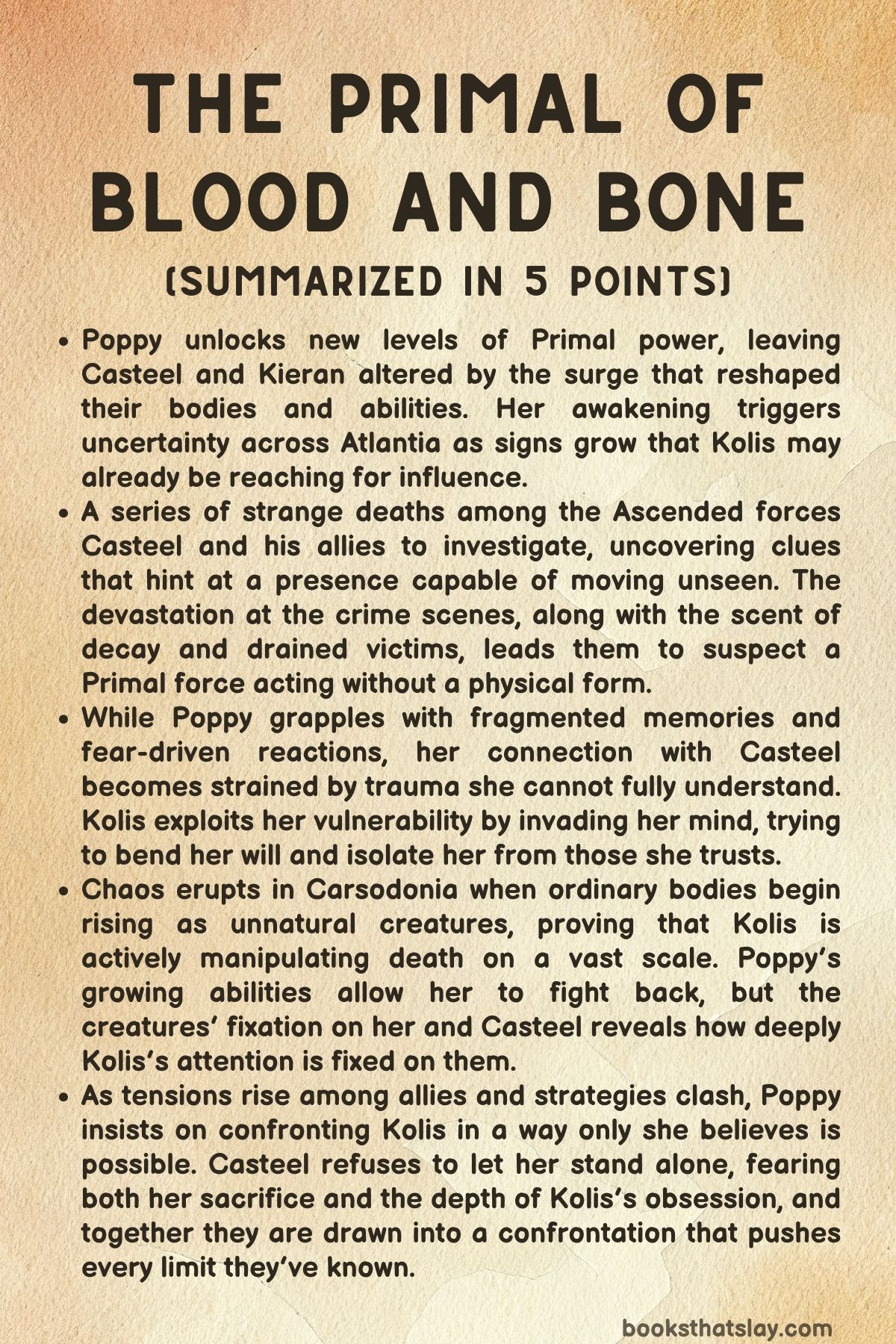
The narration shifts to Casteel, who stands beside his unconscious wife Poppy after killing a Revenant. The creature’s last words suggest that Kolis, the true Primal of Death, has long awaited her.
Before Casteel can make sense of it, the ground splits open with silver light. Ancient symbols flare, and Poppy’s body erupts with eather.
Her skin glows, shadows stir beneath it, and when she opens her eyes, they shine molten silver without pupils.
Power explodes from her, suspending Casteel and Kieran as Primal essence tears through them, reforging bone and filling veins with blinding energy. They lose consciousness and wake two days later transformed, their bodies now touched by Life and Death because their Joining fused with Poppy’s primal awakening.
Duty forces Casteel away when news arrives of mysterious deaths among Ascended in the Luxe district. Reluctantly, he leaves Poppy in Kieran’s care.
In the Luxe neighborhood, an unnatural stillness hangs in the air. Lights have burst, plants have decayed to gray dust, and a sickly scent of sweetness masks the homes.
In underground chambers they find several dead Ascended. There are no signs of a fight.
Each bears clean puncture marks at the throat as if drained by fangs, yet they were alive that same morning.
More bodies in other homes show the same signs. Dead birds lie in one home, and the same strange scent clings to everything.
The decay around each residence mirrors the destructive influence of a Primal spirit. Casteel suspects Kolis, whose partial state after being pierced by an Ancient’s bone might allow him to slip through the world in a form that can kill but not fully stand.
Reaver later confirms this possibility and explains that Kolis could reclaim a body by taking a vessel at the moment a soul leaves it. Casteel realizes Malec was likely meant to be that vessel.
Meanwhile, Poppy drifts in a fragmented world of visions and waking dreams. She hears a voice that claims it has always been with her.
She finds herself in a golden cage, unable to remember who she is apart from the knowledge that she is Primal. Mist crawls into the cage, tightening around her throat as Kolis appears.
He attempts to manipulate her through confusion and pain, trying to make her open herself to him. She resists, and after he inflicts devastating torment, she awakens in Wayfair with shattered memory and overwhelming fear.
Casteel approaches her gently, but her mind flips between seeing him and seeing the Duke of Masadonia. She attacks repeatedly, driven by instinct and terror.
He refuses to hurt her and only restrains her until hunger overwhelms her and she accepts his vein, drinking until her mind clears enough to stop fighting.
As she recovers, new dangers rise. Bodies from one of the earlier crime scenes begin to move.
A dead child attacks Malik, revealing that they have become gruls—creatures created not through hunger or infection but through divine corruption. Panic spreads across the district as more gruls spill from homes, attacking citizens and soldiers.
Poppy and Casteel fight side by side, killing creature after creature. One grul bites Poppy but flees rather than eat her, and all the gruls begin responding to a screech from the same elder creature.
During the battle, Poppy uses her essence to turn two gruls to ash. In one of them, she sees the unmistakable presence of Kolis.
The elder grul speaks with his voice, calling her “so’lis,” a term of endearment meaning “my soul,” before Casteel destroys it.
The next days are filled with unrest as Poppy and Casteel rally allies, explain the truth about Kolis, and argue bitterly about how to confront him. Poppy proposes going alone, believing he cannot use his will on her without risking killing her, but Casteel refuses.
Tawny’s arrival brings a fleeting moment of comfort overshadowed by Poppy’s fear about what she once did to save her.
The final sequence takes place in Seacliffe Manor. Poppy is struck by Kolis’s essence and hurled across the hall, flesh burning and bones shattered.
Attes lies dying nearby. Kolis approaches, taunting and threatening her, revealing his intention to kill those she loves and claim both her essence and soul.
He touches her with cruel familiarity, escalating her fear while recounting what he once planned to do to her.
Strength returns slowly, and she waits for the moment Kolis grows careless. When he pulls her against him and bares her throat, she strikes.
She drives her knee into him, kicks him away, and unleashes a surge of essence that sends him reeling. She summons Attes’s bone dagger and attacks with ferocity, stabbing him again and again.
But he recovers quickly, slamming her across the room.
Kolis transforms into a monstrous figure with crimson bone and drakenlike wings. He drives the dagger into her chest, then grabs her by the braid and sinks his fangs into her throat.
She feels her blood and essence pulled away, her limbs going cold. Memories of Casteel flood her mind.
She refuses to reach through their bond, not wanting him to feel her death, and repeats her love for him in her thoughts as darkness closes in.
Just before everything fades, she senses a blast of powerful cold, smells lilacs and citrus, and glimpses a towering figure in a black stone helm with a massive wolf of moonlight fur stepping toward her. Then the world goes silent.
Characters
Poppy
Poppy undergoes the most dramatic and painful evolution in The Primal of Blood and Bone, becoming a being caught between Life and Death, memory and trauma, divinity and vulnerability. Her awakening into Primal power splits her essence, reshaping her body, memory, and perception in ways she struggles to understand.
After Kolis’s psychic manipulation and the disorientation of her Ascension, she becomes trapped in a haze of fragmented memories that make even Casteel feel like her tormentor, creating a heartbreaking internal conflict where instinct and reality continuously contradict each other. Her struggle underscores her fundamental resilience: even without memory, she rejects manipulation, fights through fear, and clings to the faint threads of connection she cannot fully name.
Her growing command of eather, her ability to heal, destroy, and sense intentions, and her fierce emotional core reveal a Primal who is not defined by inherent power but by deliberate choice. Throughout the story, she becomes a living embodiment of balance: compassion paired with righteous fury, sovereignty paired with self-doubt, and divinity paired with deeply human emotion.
Her survival of Kolis’s brutal attack and near death reflects both her strength and the gravity of the prophecy surrounding her.
Casteel
Casteel is the emotional anchor of the narrative and the character most visibly transformed by his devotion to Poppy. He is reshaped physically by the Joining and Primal essence, but the more compelling shift is in his internal world.
His desperation to protect Poppy battles constantly with his duty as King, revealing a man continually torn between love and responsibility. The fear of losing Poppy, especially when she awakens disoriented and views him as a threat, almost breaks him, yet he remains steadfast, refusing to use violence even when attacked.
His fury toward Kolis reveals a depth of primal possessiveness and protective love that he has never exhibited before, manifesting in physical reactions like frost spreading across their bed. Casteel’s emotional vulnerability is as striking as his power: he continuously fears that Poppy will be taken from him, yet he respects her choices, argues fiercely with her when he must, and stands beside her in every moment of crisis.
His bond with Kieran evolves as well, complicated by the Joining and the changes wrought in their bodies and souls, but strengthened through shared purpose and shared fear.
Kieran
Kieran represents loyalty in its highest form, serving as confidant, protector, and emotional ground for both Poppy and Casteel. The Joining blends him more intimately with the couple, creating a connection that is physical, spiritual, and emotional.
He balances Casteel’s volatility with steady rationality and anchors Poppy when her fragmented memories drive her into panic or self-doubt. Kieran remains the voice of reason, reminding Casteel of duty when grief threatens to consume him and helping interpret signs, prophecies, and the changing behaviors of wolven and mortals alike.
His protective instincts extend beyond the political sphere; he watches Poppy with a mixture of brotherly affection and Primal awareness, sensing threats even when she cannot. In the battles against gruls, his courage reinforces his role as a defender not just of the kingdom but of the delicate bonds that hold their triad together.
Kolis
Kolis is the embodiment of corruption, obsession, and ancient malice, a Primal of Death who has twisted his power into a tool of domination and cruelty. His partial essence form, his ability to slip unseen into homes, kill Ascended, and puppeteer corpses underscores his inhuman nature.
Yet it is his fixation on Poppy that becomes the most chilling part of his character. His manipulation in her dream-state, his violent attempts to break her mind and spirit, and his grotesque mixture of intimacy and brutality reveal a being who equates possession with affection.
He sees Poppy not as a person but as a vessel, a soul to claim, a power to drain, and a future he believes is owed to him. His violence against her in Seacliffe Manor, culminating in the assault that nearly kills her, illustrates the true extent of his depravity.
Kolis is not simply a villain but a cosmic imbalance—a deity who cannot comprehend that love without choice is not love at all.
Malik
Malik is portrayed as a man trying to rebuild himself from layers of guilt, trauma, and fractured loyalty. His tentative attempts to reconnect with Casteel reveal the weight of his past betrayals and the complicated love between the brothers.
Through Poppy, he begins to confront his own remorse and recognize his lingering desire to belong somewhere again. The bite he endures from the grul child becomes symbolic: he is repeatedly placed at the crossroads between past sins and an uncertain future.
His protectiveness during the chaos of the district attack shows a man working desperately to be better, even when he doubts he deserves forgiveness. Malik’s arc is one of quiet redemption—unfinished, uncertain, but deeply human.
Reaver
Reaver serves as the voice of divine logic, offering crucial insights into the nature of Kolis’s essence and the possible vessel he seeks. His bluntness often borders on cruelty, yet his knowledge reveals the severity of the threat they face.
Reaver’s presence reinforces the growing tension between draken obligations and personal loyalties. His explanations about vessels, soul timing, and Primal essence shift the narrative from mere political conflict into existential danger.
Though emotionally distant, he becomes an indispensable force of information, illuminating the stakes of Poppy’s power and Kolis’s intentions.
Emil
Emil provides grounding amidst the escalating horror, balancing sharp observational skills with loyalty and compassion. His reactions to the transformed Casteel and the strange deaths in Luxe highlight the perspective of an Atlantian who is both soldier and friend.
During the grul outbreak, his quick action and fearless participation demonstrate unwavering dedication. Emil often serves as the lens through which the reader can interpret the shock and confusion of the kingdom’s citizens, making his presence essential in portraying the broader impact of divine conflict on everyday lives.
Naill
Naill functions as an attentive and courageous secondary leader, one whose instincts and quick reporting repeatedly prevent catastrophe. He is both soldier and witness, encountering the earliest signs of unnatural decay, the first rising of gruls, and the escalating evidence of Kolis’s influence.
His reactions to Poppy and Casteel’s Primal changes reveal both awe and anxiety, showing how overwhelming their transformations appear to Atlantian eyes. His willingness to kill the grul child, despite the horror of the act, underscores his ability to make devastating decisions in moments of crisis, marking him as a crucial warrior in a rapidly darkening world.
Hisa
Hisa represents duty, structure, and unwavering discipline. She remains vigilant as chaos spreads across the city, investigating Ascended homes, directing patrols, and responding sharply to Casteel’s commands.
Her role emphasizes the severe political and military pressure surrounding the kingdom as divine threats bleed into mortal spaces. Hisa’s reliability offers a stabilizing counterpoint to the emotional turbulence of the main cast, acting as one of the few who retain calm judgment even when ancient forces begin unraveling natural laws.
Attes
Attes, the Primal of War and one of the remaining Ancients with knowledge of the world before its corruption, stands as both ally and enigma. His willingness to place himself between Poppy and Kolis, even knowing it could kill him, portrays a loyalty rooted in prophecy, divine responsibility, or perhaps personal affection.
His suffering, especially the near-fatal wound dealt by Kolis, becomes a visual reminder of how fragile even ancient beings can be against the true Primal of Death. In many ways, Attes symbolizes the last thread of the old balance struggling to survive.
Themes
Creation, Power, and the Burden of Origin
Creation is shown as both a triumph and a long-shadowed responsibility throughout The Primal of Blood and Bone. The cosmos is shaped by radiant power, yet every act of making carries the potential for unintended consequences.
The narrator’s vision of the world’s beginning exposes how the first divine beings acted with certainty but very little understanding of what they were unleashing. Their choices—birthing the Primals, forming gods that could ascend, shaping mortals from soil and blood—seed a future they cannot control.
This theme expands far beyond myth; it influences every current crisis. Mortals inherit emotions, choice, and unpredictability not because they were designed carefully but because curiosity and compassion guided the first Primal of Life.
His desire to offer choices rather than force change inadvertently introduces volatility into existence itself. Power becomes something that cannot be contained by intent alone.
In the present, Poppy carries the weight of this legacy. Her abilities are not gifts she requested but consequences of ancient decisions made long before her birth.
Casteel and Kieran, too, become caught in that lineage when the Joining binds them with Primal essence. Their transformations highlight how creation keeps echoing forward, reshaping lives without permission.
The theme suggests that the act of creating anything—worlds, gods, mortals, relationships—requires a reckoning with the outcomes that follow. No origin is clean, and every beginning demands a cost.
Through this, the narrative argues that power is never simply held; it reverberates across eras, binding its inheritors to choices they never made but must answer for.
Free Will and the Consequences of Choice
Choice becomes the hinge upon which the entire narrative turns. The first Primal of Life’s decision to offer the winged beasts a path instead of forcing it creates free will itself, a force that becomes more influential than any divine power.
This theme plays out in every layer of the story. Mortals carry the spark of volition, the ability to love, hate, destroy, or build, leading the Ancients to fear them and resent their creators.
That resentment fuels their downfall and eventual rebirth as forces of destruction. The present world inherits the chaos of a choice made with compassion but without foresight.
Poppy’s journey reflects the same complexity. When she awakens changed, confused, and terrified, her reactions are shaped by fragmented memories and instinct, yet her decisions still define her path back to herself.
She refuses Kolis’s manipulation not because she is fully aware of who she is but because her internal compass rejects his control. Casteel’s choices mirror this theme as well.
He chooses to stay at Poppy’s side despite threats, guilt, and responsibility, then chooses to step away when his duty demands it. Even the gruls reflect twisted echoes of free will—they move with purpose but are puppeted by a greater will that steals their autonomy.
The theme insists that choice is both empowering and dangerous. It grants individuals the ability to resist fate but also generates consequences no one can predict or contain.
In this world, free will is not merely a philosophical idea; it is a supernatural force that shapes nations, relationships, and the very structure of existence.
Love, Devotion, and the Transformative Nature of Bonding
Love in The Primal of Blood and Bone is not a gentle or passive emotion but a force that alters destinies, reshapes bodies, and drives divine beings to irrational acts. The bond between Poppy and Casteel is presented as something that endures confusion, violence, and attempts at manipulation.
When Poppy awakens without stable memory and attacks him, Casteel responds not with retaliation but with unwavering devotion, grounding her even as she perceives him as a threat. Their connection becomes a stabilizing influence in a world where ancient powers are unraveling the boundaries of life and death.
Kieran’s bond with them deepens this theme. The Joining does more than merge their essence; it binds their fates, emotions, and transformations.
Devotion becomes a form of strength, but it also exposes vulnerabilities, because love creates stakes that enemies like Kolis exploit. Kolis himself twists this theme into something violent and possessive.
His fixation on Poppy represents love stripped of empathy and warped into obsession. Through him, the story explores how devotion can turn monstrous when driven by entitlement instead of connection.
Poppy’s memories of Casteel anchor her even when her body is failing and her soul is torn from her. This demonstrates how love functions as a life-force, not romantic ornamentation.
The theme underscores that bonds—romantic, familial, or spiritual—have transformative power, capable of rebuilding or destroying depending on how they are honored. Love becomes a counterweight to ancient rage and divine cruelty, offering hope even as catastrophe unfolds.
Corruption, Ruin, and the Cycles of Destruction
The narrative repeatedly shows that immense power carries the risk of decay, both physical and moral. The Ancients, once creators and protectors, become corrupted by resentment and fear, eventually rising as destructive entities who shatter the land.
This historical cycle mirrors the current threat posed by Kolis. He embodies corruption on multiple levels—his body fractured between essence and form, his mind twisted by centuries of confinement, his desires transformed into cruelty.
His actions throughout the story revolve around destruction: draining Ascended without struggle, turning families into gruls, breaking natural laws, and destabilizing the balance of the world. The rising of the gruls demonstrates corruption in its most grotesque physical expression.
Innocent people are transformed into violent, decaying creatures not through their own choices but through Kolis’s influence. The infection spreads silently and swiftly, reflecting how rot moves through systems once stability falters.
Poppy’s injuries under Kolis’s attacks also embody this theme. Her body burns, breaks, and heals under impossible strain, showing how power makes her both resilient and vulnerable.
Destruction becomes a catalyst for revelation—every ruined city, broken body, and corrupted being exposes deeper truths about the fragility of balance. The theme argues that ruin is not random; it grows from fear, possessiveness, and the refusal to relinquish power.
Yet destruction also clears the ground for renewal, suggesting that endings, however violent, create space for new beginnings. This cyclical structure underscores that decay is inevitable when power stagnates or is abused, but regeneration remains possible through courage and resistance.
Identity, Memory, and the Fragmented Self
Poppy’s loss of memory becomes one of the most emotionally charged explorations of identity in the narrative. Her awakening is marked by confusion, terror, hunger, and warped visions that replace familiar faces with threatening ones.
Identity is presented not as a static truth but as something fluid, shaped by experience, memory, and emotional connection. When those foundations crumble, the self becomes unstable.
Her struggle to understand who she is—a Primal, a queen, a wife, a fighter—reflects the story’s broader tension between inherited roles and chosen purpose. Memory becomes both weapon and lifeline.
Kolis uses past trauma to break her, forcing images of abuse into her mind to destabilize her sense of reality. This manipulation reveals how fragile identity becomes when memory can be rewritten or erased.
Yet her return to herself is not triggered by divine power but by instinctual recognition of emotions tied to Casteel, Kieran, and her own strength. Malik’s warnings about tensions within her inner circle deepen this theme by reminding her that who she is influences the bonds around her.
The confrontation in Seacliffe Manor advances the theme further. As she lies dying, she clings to fragments of memory—not grand revelations but tactile, intimate moments that remind her of who she chooses to be.
Identity becomes an active force of survival. Her refusal to yield to Kolis’s assault is rooted in a sense of self built through relationships and choices, not bloodline or prophecy.
Through Poppy, the narrative suggests that identity must be reclaimed continually, especially when external forces seek to fracture or claim it.
Fate, Prophecy, and the Tension Between Destiny and Choice
The story is steeped in prophecy—visions of creation, warnings of catastrophe, foretellings of a union that will reshape the world. Yet destiny is not portrayed as an absolute path.
Instead, it operates as a framework that individuals can confirm or challenge through their decisions. The narrator’s early vision of future bloodlines sets the stage for expectations about kings, daughters, and conspirators, but nothing ensures these outcomes beyond the actions of those involved.
The rising sun in the west, a sign of prophecy manifesting in impossible ways, reinforces the looming weight of destiny, yet it also demonstrates how unstable the world has become under Kolis’s influence. Poppy’s role is central to this theme.
She is repeatedly told she is needed—by the Ancients, by prophecy, by Kolis—but she continually asserts agency, refusing to be a vessel or pawn. Casteel reinforces this idea by refusing to let her face Kolis alone, asserting that partnership, not prophecy, will decide their path.
Even Kolis misinterprets prophecy through his obsession, believing fate entitles him to Poppy’s soul and power. The narrative shows how destiny becomes dangerous when treated as justification rather than guidance.
The theme argues that fate may outline possibilities, but the individuals living within those predictions choose how those possibilities become reality. Prophecy provides pressure and context, but it is choice—often reckless, painful, or courageous—that shapes the final outcome.