The Austen Affair Summary, Characters and Themes
The Austen Affair by Madeline Bell is a romantic time-slip novel about grief, second chances, and finding your way back to yourself. Tess Bright, an actress raised by a Jane Austen–obsessed single mother, loses her mom and her career momentum almost at once.
When she’s cast in a big-screen Northanger Abbey adaptation, she hopes the role will restore her standing and keep her mother close in spirit. Instead, a clash with her prickly co-star Hugh Balfour ends in a freak accident that drops them into 1815 England. Stranded in Austen’s world, they must survive strict social rules, untangle a fake engagement, and decide what love and “home” really mean.
Summary
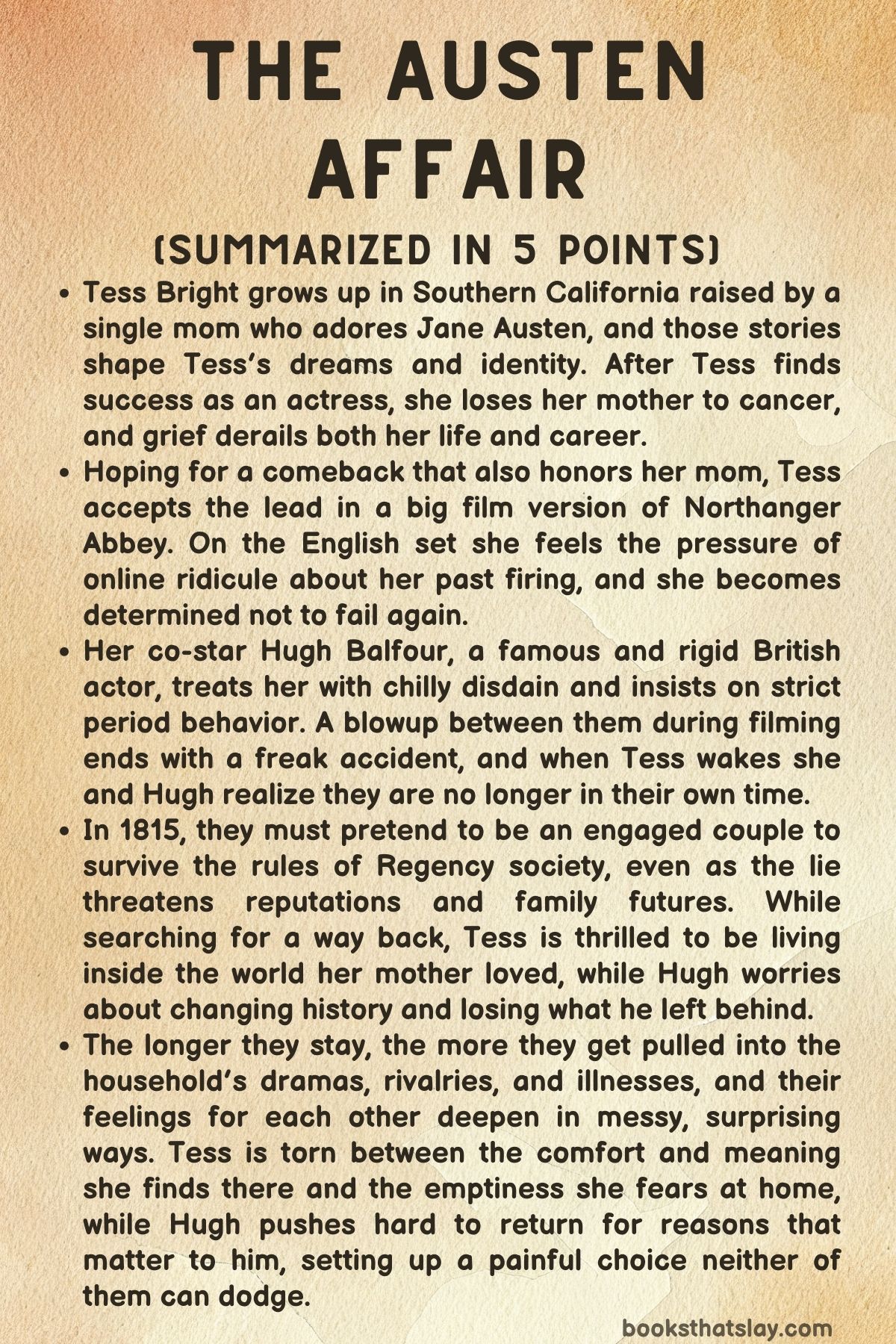
Tess Bright grows up in a cramped Southern California apartment where Jane Austen novels and their film versions are basically the soundtrack of her childhood. Her mother, raising Tess alone, builds their little world around Austen’s heroines, manners, and romance.
Tess never knows her father, and she learns early that stories can be both refuge and roadmap. That upbringing pushes her toward acting; she wants to live inside the kinds of dramas she watched with her mom.
As a teen she lands the lead on a hit TV show, Chuck Brown, and the money finally lets her buy her mother a cozy house in Thousand Oaks. Tess imagines years of quiet dinners there, but soon after the move her mother is diagnosed with cancer and dies within a year.
The loss knocks Tess off balance. She goes numb, drifts through her days, and her once-reliable performance on Chuck Brown collapses.
Producers write her out, and gossip sites paint her as unstable and difficult. Even after a public defense from her former showrunner, the narrative sticks.
Tess is left with grief, a bruised reputation, and no one close enough to steady her.
Nine months later she gets a lifeline: the role of Catherine Morland in a high-profile film adaptation of Northanger Abbey, her mother’s second-favorite Austen novel. Tess sees it as both career rescue and a way to honor her mom.
She flies to Hampshire anxious but determined. The set is enormous, the production prestigious, and the internet already hostile.
She checks Twitter and finds old headlines resurrected, with fans predicting she’ll ruin the movie. Tess tells herself she cannot fail again.
Her co-star, Hugh Balfour, plays Henry Tilney. Hugh is celebrated in Britain for intense “Method” work, and on set he is rigid to the point of parody.
He refuses rehearsals, avoids casual conversation, and stays in character so fiercely that he enforces Regency etiquette even between takes. Tess tries to break through his chill with humor and friendliness, because their leads need chemistry, but he shuts her down and retreats to his trailer.
One rainy day Tess sees Hugh called to the beauty trailer across from hers. On impulse, half curious and half petty, she sneaks in ahead of him and hides in a coat closet.
From inside she overhears Hugh on the phone with someone named Florence. He complains about Tess, assumes the tabloid stories are true, calls her annoying, and says acting opposite her feels like a curse.
Tess is furious and humiliated. She stays hidden until he leaves, then stumbles out and startles the hairstylist.
The next time they film a key carriage scene, Tess tries to focus on the work. Their exchange feels stiff, so she improvises intimacy by leaning in and adjusting Hugh’s cravat.
Hugh abruptly stops the horses and insists the gesture is improper for the period. The director calls cut.
A fight erupts in front of the crew: Tess accuses Hugh of sabotaging their connection and insulting her; Hugh fires back that she’s miscast and irresponsible. Tess, raw with grief and anger, slaps him.
She storms away in panic, terrified she’s just ended her last chance. Hugh follows her to demand an apology.
They trade sharper words until Tess trips over a heater cord and falls into a muddy puddle. The heater crashes into the water and sparks.
Hugh grabs her hand to pull her up, and both are electrocuted. Tess feels searing pain, then darkness.
She wakes in a bright wildflower field with Hugh beside her. The film set is gone—no trailers, no tents, no modern noise.
A village sits in the distance, smoke rising from chimneys. They walk toward it and meet a carriage carrying Dr. Goddard and his wife, dressed in early-nineteenth-century clothes. The couple recognizes Hugh as “Hugh Balfour, son of Edward Balfour,” a young man believed dead at Waterloo five years earlier.
Thinking fast, Hugh claims highwaymen robbed them and introduces Tess as Mrs. Bright, a respectable widow accompanying him home after he suffered a head injury.
Tess accidentally protests the “wife” assumption, causing scandal, but Hugh repairs the lie by emphasizing her widowhood and innocence.
Once they’re alone, Hugh insists the evidence is clear: they’re in 1815. The village has no modern roads or wires, the accents fit the era, and the locals believe Hugh is their long-lost relative.
Tess, stunned but strangely exhilarated, thinks of her mother’s beloved world made real. They ride with the Goddards to Highground Park, the estate Tess recognizes as the present-day hotel used for filming.
At Highground Park, servants and family greet Hugh with shock and joy. A parlor portrait looks like him.
The frail Edward Balfour, in a wheelchair, clings to Hugh in tears. Hugh’s aunt, Mrs. Campbell—called Aunt Fanny—treats him as her “baby,” and introduces little George as Hugh’s younger brother. Tess keeps up her widow story and is rewarded with sympathy.
Since their luggage was supposedly stolen, they’re given period clothing and rooms. Alone in her lavish chamber, Tess tests reality by pinching herself.
It doesn’t change.
Dinner that night is a gauntlet of manners and rich food. Tess is ravenous, spills soup on herself, then tries to recover politely.
Hugh avoids meat. When pressured into eating, he takes turtle soup and promptly vomits, revealing he’s vegetarian.
Tess reaches out instinctively to comfort him. The room reacts as if she has done something indecent.
The social rules here are a trap.
Those rules tighten at the end of dinner. Aunt Fanny and the neighbors point out that Tess and Hugh arrived together without a chaperone, have been corresponding, and were seen walking too closely.
To protect Tess’s reputation, they insist the pair must be engaged. Hugh protests; the room refuses to believe him.
Hugh’s father warns that gossip will destroy Tess unless they marry quickly. Cornered, Hugh goes silent.
Tess breaks the moment by fainting.
Upstairs, once alone, Hugh confronts her for faking it. Tess admits she did it to stop a forced agreement, but the problem remains.
Tess suggests recreating the electrical accident to send them home, but Hugh notes electricity isn’t in daily use here. Then he raises a bigger fear: history says the real Hugh Balfour died at Waterloo so that George would inherit.
If modern Hugh stays, he could derail the family line and erase his own future.
Tess tries to think like an Austen heroine and jokes about Romantic-era experiments. Hugh latches onto that: wealthy households sometimes used Galvani-inspired parlor machines that produced shocks for entertainment.
If they can get one, they might duplicate what happened. They decide to accept the engagement publicly while quietly arranging for a machine to be acquired before the wedding.
Aunt Fanny, softened by Tess’s staged grief over her late husband, throws herself into wedding plans and a new wardrobe for Tess. Tess meets local families, including the Dixons, whose daughter Phoebe is cool toward her.
Hugh, meanwhile, begins settling into his role as returned son, doting on Edward and George with a gentleness that startles Tess.
An engagement dinner brings more townspeople and militia officers, including Captain Armstrong and Lieutenant Dereham. Tess searches for gossip about electrical parties.
Colonel Foster scoffs at the fad, but Mrs. Foster says Dereham has attended one in London.
Tess finally has a lead. During the evening’s music, Tess plays piano and sings to general praise.
Then a new guest arrives: Jane Austen herself.
Tess nearly loses her composure.
She approaches Austen, careful not to reveal future publications, and speaks to her as an awed admirer.
Soon after, the Crawfords arrive—William and his sister Cecelia. Cecelia is shaken to see Hugh alive because she believes he is her dead fiancé, Hugh’s uncle from this era.
Tess sees tension in William’s stiff congratulations and in Cecelia’s grief-struck stare. That night Tess spots Cecelia slipping into Hugh’s room and assumes the worst.
Jealous and heartsick, she throws up and cries alone. In the morning Hugh explains Cecelia thinks he is her lost uncle and accuses him of abandoning her.
Tess feels ashamed for suspecting him, and her sympathy for Cecelia grows.
George then falls ill from a soaking rainstorm.
Tess and Hugh, alarmed by period medical practices, try home care first.
When Dr. Goddard arrives with chloroform, they refuse.
Hugh smashes the vial, and Tess bluffs that chloroform has killed soldiers, so Aunt Fanny demands gentler treatment.
After tense days, Tess realizes George is exaggerating for attention; when she withholds the end of Sense and Sensibility from him, he “recovers” instantly.
The household rejoices.
A Shakespeare performance is organized to lift spirits, with Tess as Viola and Cecelia as Olivia. Rehearsals stir fresh friction.
Cecelia, having read Sense and Sensibility, accuses Tess of being a Lucy Steele type who steals another woman’s man. Tess is humiliated.
Almost immediately she overhears Armstrong insulting her as vulgar and greedy. Hugh storms in and beats Armstrong bloody, defending Tess’s honor.
Later Tess cleans Hugh’s knuckles, shaken by his fierceness but moved by his loyalty.
During a walk to post another letter for the electrical machine, Hugh confides that in their own time his father is dying of early-onset Alzheimer’s. Being stuck in 1815 means missing a last goodbye.
Tess shares her own grief over her mother, and their bond deepens. Tess adds a flattering postscript to Hugh’s letter to motivate the London contact, then suggests they host a ball while they wait.
Their closeness turns physical, and afterward they speak frankly about fear, therapy, and the possibility of a shared future.
At the village post office, Hugh finally receives the parlor machine. Relief hits him at once; they can go home.
Tess hides her dread because their wedding in this era is scheduled for tomorrow. Back at Highground, while Hugh assembles the machine, William corners Tess in the rose garden and proposes.
He argues she should marry him so Hugh can marry Cecelia and restore her reputation. Tess refuses and blurts that she loves Hugh and that she and Hugh are leaving this time.
George overhears, panics, and runs inside shouting that they’re abandoning everyone.
The truth explodes. Aunt Fanny confronts Hugh, saying he isn’t really her nephew.
Hugh confesses he is a descendant from the future who fell into their time by accident. Fanny believes him based on his character and resemblance, and asks about her real nephew.
Hugh tells her the original Hugh died at Waterloo and never hurt Cecelia. He explains he must return because his father is dying in the future.
Fanny begs him to stay for Edward’s sake.
George, desperate to keep Hugh, smashes the machine against the wall. Hugh, devastated, yells at him.
Tess, grasping for meaning, suggests maybe it’s a sign they’re supposed to stay longer. Hugh hears it as betrayal.
When William repeats his marriage plan, Hugh attacks him. After being dragged apart, Hugh storms to the cliffs.
Tess follows. They argue bitterly: Tess admits the modern world feels empty and this past feels like a gift tied to her mother.
Hugh insists the past is not a place to live, only to visit. He leaves her alone with her guilt.
That night Cecelia visits Tess and urges her to fight for Hugh while they still can. Edward, too, quietly tells Tess not to live only in mourning.
Tess apologizes to Hugh, admitting her selfishness. Hugh apologizes for his cruelty.
They reconcile and recommit to getting home together.
At breakfast Hugh gives Aunt Fanny Edward’s memoirs he has been recording and leaves instructions for a story of a long honeymoon, so Edward won’t feel abandoned. Hugh also invents a thrilling “secret mission” for George so the boy can bear their departure.
They hide the memoirs under a floorboard in George’s room, hoping they’ll survive to the future.
On the wedding day, Tess reaches St. Nicholas Church but stops in the aisle.
She kisses Hugh, then publicly refuses to marry him there—she wants him to choose her freely, not because society forces it. She runs out, steals a horse, and rides to the stormy field where they first arrived.
Hugh follows, declares his love, and Tess tells him she wants a future with him anywhere, in any time. Lightning strikes, and they are thrown back onto the modern film set mid-scene.
The stunned crew watches as they realize they’re home. Tess and Hugh announce they’re together and engaged.
After filming ends, they marry in modern Gretna Green and hurry to London so Tess can meet Hugh’s family and Hugh can spend precious time with his father. Later they honeymoon in Hampshire at the Highground Hotel and find Edward Balfour’s hidden memoirs exactly where they left them, proof that what they lived was real and that the past can echo forward without being remade.
Hugh admits he was wrong to call the past dead. Tess carries her mother’s love with her not as a chain, but as a compass.
Together, they step into their shared life, still teasing each other, but now certain they belong in the same story.
Characters
Tess Bright
Tess is the emotional and narrative center of The Austen Affair, shaped by a childhood steeped in Jane Austen devotion and the absence of her father. Growing up with a single mother who used Austen as both comfort and worldview, Tess learns to equate stories with survival, romance with meaning, and performance with identity, which naturally pushes her toward acting.
Her success on Chuck Brown initially looks like a triumph, but after her mother’s death, Tess’s grief hollows out her sense of stability and self-worth. The public framing of her career collapse as “unreliable” makes that grief social as well as private, leaving her defensive, raw, and desperate for redemption when she accepts the Northanger Abbey role.
Tess’s impulsivity—slapping Hugh, improvising intimacy on set, fainting to derail engagement pressure—shows a personality that moves through instinct before calculation, yet those instincts are tethered to a deep moral core. In the Regency world, her modern frankness and empathy repeatedly break the rigid social script, but those same qualities also make her compelling and transformative to people around her.
Her arc bends from numb survival into active choosing: she learns to hold grief and joy together, to resist using the past as an escape hatch, and to love Hugh without forfeiting her own agency. By the end, Tess isn’t “rescued” by romance or time travel; she’s rebuilt by deciding she still wants a future, and that she can carry her mother forward without living inside loss.
Hugh Balfour
Hugh begins as a controlled, intimidating figure—a Method actor who treats performance as sacred discipline and distance as armor. On the modern set, his refusal to rehearse, his icy professionalism, and his obsession with Regency propriety read as arrogance, but the time-travel shift exposes those habits as coping structures built on fear of emotional messiness.
Hugh’s vegetarianism, his discomfort with turtle soup, and his strict boundary-keeping hint early at a man who lives by internal rules because his inner life feels unstable. In 1815, Hugh’s intelligence turns practical fast: he invents cover stories, assesses historical risk, and keeps sight of consequences when Tess is swept up in wonder.
Yet beneath the rational surface is a bruised tenderness—seen in how quickly he tends to Tess during her fainting, how devotedly he cares for his father and George, and how fiercely he defends Tess’s honor against Armstrong. His confession about his real father’s Alzheimer’s in the present anchors him as someone haunted by helplessness; time travel isn’t romantic adventure for him but an existential emergency.
Hugh’s emotional arc is about softening without collapsing: he learns that control is not the same as integrity, that loving Tess doesn’t require erasing himself, and that the past can be alive without becoming a prison. By the epilogue, his acceptance of Edward Balfour’s memoirs surviving into the modern world symbolizes Hugh’s final shift—he stops treating history and emotion as threats and lets them be part of his life.
Tess’s Mother
Though she dies early, Tess’s mother is the story’s gravitational force. She is a devoted Austen fan not in a casual sense, but as a way of structuring reality—filling their apartment with novels and films, raising Tess in a world where wit, romance, and moral clarity feel like shelter.
Her single parenting is portrayed as intimate and slightly insular, creating a bond so central that her death leaves Tess almost unmoored from adulthood itself. The mother’s love is not abstract; she makes Austen a shared language of affection that shapes Tess’s ambitions and her ideals of love.
Even after death, her presence continues as Tess’s interior compass and emotional haunting, especially when Tess interprets the time travel as a kind of maternal gift. What makes her character resonant is that she represents both comfort and risk: she gives Tess imagination and purpose, but also leaves her with a temptation to retreat into stories rather than face pain.
Tess’s eventual growth depends on transforming her mother’s influence from a sanctuary she hides inside into a legacy she carries forward.
Mrs. Campbell
Mrs. Campbell is the household’s social engine and the Regency world’s sharpest embodiment of propriety.
She is formidable, often intimidating, and relentlessly vigilant about reputation, yet her rigidity is not cruelty for its own sake; it is the survival logic of her era and her own widowhood. Her insistence that Tess and Hugh must marry reveals her real power: she can weaponize social rules to force outcomes, but she also believes those rules protect women.
The private conversation where she softens toward Tess’s grief shows her hidden empathy and loneliness, reframing her not as a villain but as a woman who has endured the same kinds of losses Tess is stumbling through. She becomes, unexpectedly, a bridge between worlds—capable of being shocked by modern behavior yet moved by sincerity.
When Hugh confesses the truth, she chooses to believe him because character matters more to her than impossible facts, and her willingness to help hide memoirs and preserve Edward’s peace shows a moral flexibility beneath her iron surface. Mrs.
Campbell’s arc turns her into a quiet ally, representing how tradition can contain compassion if someone chooses to look past form and toward intent.
Edward Balfour
Edward Balfour is a poignant figure of aging authority, a patriarch reduced physically but still emotionally central. His reunion with Hugh is drenched in longing, and through Edward the narrative explores what it means to hold love in the face of time’s erasures.
He is gentle, proud, and quietly perceptive—able to recognize Tess’s sincerity and to counsel her toward joy rather than permanent mourning. Edward’s trust in Hugh, despite the implausibility of his survival, suggests a man who values the heart over evidence.
The memoirs Hugh records with him become Edward’s way of reaching for immortality, not through status but through story and remembrance. His advice to Tess—essentially to live while she can—is a thematic anchor: he is the clearest voice insisting that grief should not become identity.
Even after death, his presence endures through the hidden memoirs, symbolizing how love, memory, and personal truth can thread through centuries.
Mr. Balfour
Mr. Balfour is the practical moral core of the Balfour household, more restrained than Edward’s tender emotionality but deeply principled.
He supports Hugh’s character when others doubt him, yet he also understands the brutal mechanics of gossip and how easily a woman’s reputation can be destroyed. His insistence on marriage for Tess’s protection reflects a fatherly responsibility shaped by his historical context, not a desire to control.
The quiet affection he shows Hugh, and his hopes for Hugh to settle down, reveal a man yearning for continuity and family stability after years of loss. He functions as a steady reminder that in this world love is inseparable from consequence.
George Balfour
George is the story’s child catalyst, simultaneously adorable and dangerous to the protagonists’ plans. He idolizes Hugh, clings to him with the hunger of a younger brother who lost a hero, and constantly demands attention in ways that expose the family’s emotional fractures.
His illness—part real, part performative—shows a child learning that vulnerability is a tool for connection, and Tess’s clever handling of it establishes her as a true caretaker. George’s smashing of the electrical machine is his most defining act: it is not malice but panic, the desperate logic of a child terrified of abandonment.
That moment forces Tess and Hugh to confront their competing desires honestly. George thus represents innocence colliding with history, and his arc softens when given reassurance and adventure myths, reminding us how much children depend on stories to survive frightening truths.
Dr. Goddard
Dr. Goddard is a lightly satirical but still plausible figure of early nineteenth-century medicine and authority.
His confident use of period treatments, and later his dangerous insistence on chloroform, show how science in this era is both earnest and perilously uninformed. He is not portrayed as evil; rather, he is a man of his time, anchored in certainty without humility.
His presence raises stakes around George’s illness and underscores how alien the Regency world is to modern sensibilities. By leaving angrily after being challenged, he reveals the fragility of professional pride beneath medical authority.
Mrs. Goddard
Mrs. Goddard serves as a social mirror and amplifier.
Her immediate assumptions about Tess and Hugh’s relationship, her scandalized reactions to physical contact, and her participation in gossip illustrate how propriety circulates through ordinary people, not just elites. Yet she is also warm in practical moments, a hostess and neighbor whose instincts are to belong to the social fabric rather than control it.
She helps normalize the Regency environment for Tess while also embodying its constraints.
Lea
Lea, the modern hairstylist, is a small but meaningful character because she anchors the opening tension in reality. Her startled encounter with Tess leaving the closet highlights how out of control Tess’s emotional life has become, and how public a film set is even when Tess feels desperately alone.
Lea functions less as a person with her own arc and more as a witness to Tess’s unraveling, which makes her important in establishing Tess’s vulnerability.
Phoebe Dixon
Phoebe is a portrait of restrained resentment and wounded expectation. Introduced as displeased by the engagement, she reflects the quiet rivalries and limited options of young Regency women.
Her later confrontation with Armstrong, ending in a slap, reveals her courage and refusal to be coerced into a scandalous narrative. Phoebe’s purpose is to show that even within tight social rules, women can assert boundaries, and that the “marriage market” is not romantic to those trapped inside it.
Isabella Dixon
Isabella is open-hearted and exuberant, a contrast to Phoebe’s guardedness. Her excitement about Dereham’s proposal situates her as someone who embraces the era’s romantic structure rather than resenting it.
She provides Tess with a rare female peer connection in the past, and her joy helps Tess remember that love and celebration can exist alongside fear.
Captain Armstrong
Armstrong is the clearest antagonist in interpersonal terms: entitled, predatory, and contemptuous of Tess’s perceived social inferiority. His harassment of Phoebe and his vulgar insults about Tess reveal the misogynistic undercurrent beneath polite society.
Armstrong’s cowardly flight from the duel completes his portrait as a man who relies on privilege and intimidation, not true honor. His violence catalyzes Hugh’s protective eruption, making Armstrong a narrative foil for what Hugh represents when he chooses integrity.
Lieutenant Dereham
Dereham is a gentler, more neutral piece of the social world—polite, eligible, and useful primarily as a link to the electrical parlor machine solution. His attended electrical party in London becomes the vital clue Tess needs, making him functionally a helper character.
His proposal to Isabella also reinforces the theme that in this world romance quickly becomes formal commitment.
Colonel Foster and Mrs. Foster
The Fosters operate as social texture and contrast. Colonel Foster’s dismissal of electrical amusements shows his skepticism and adherence to conventional seriousness, while Mrs. Foster’s casual mention of Dereham’s experience reveals her sharper awareness of fashionable trends. Together they embody the way Regency society contains both rigid conservatism and playful modernity within its own historical limits.
Kitty Foster
Kitty is a subtle study in constraint and hidden desire. Outwardly she is a respectable married woman, participating in gossip and social routine, but the revelation of her secret involvement with Armstrong adds complexity to the moral world of the story.
Her withdrawal from the play under her husband’s objection shows her limited autonomy, and her quiet scandal underscores how reputation binds women to choices they may not want. She represents the cost of living two lives in a society that leaves little space for female longing.
William Crawford
William is an antagonist of a different flavor than Armstrong: not predatory, but controlling through righteousness. His stiffness on arrival and anger toward Hugh signal old wounds tied to Cecelia’s heartbreak.
William frames his actions as protective—urging Tess to marry him to restore Cecelia and stabilize the family line—but his proposal in the garden reveals a deeper possessiveness and a willingness to override Tess’s choice for what he considers the greater good. He is a man who believes he is honorable while repeatedly denying other people agency, making him a sharp critique of paternalistic “virtue.
Cecelia Crawford
Cecelia is one of the most tragic figures in the Regency half of the story. She enters believing Hugh is her dead fiancé, and that misrecognition traps her in unresolved grief.
Her nighttime visit to Hugh’s room, seen through Tess’s jealous panic, is not seduction but a desperate demand for truth and meaning. Cecelia’s coldness toward Tess is fueled by pain, humiliation, and the fear of being replaced, and her Lucy Steele comparison shows how Austen narratives have shaped her defenses.
Yet Cecelia evolves: rather than clinging to bitterness, she ultimately urges Tess to fight for Hugh, a gesture of emotional generosity that releases her from the prison of her past. She embodies the damage of lost futures, and the dignity of choosing kindness anyway.
Jane Austen
Jane Austen appears briefly but with enormous symbolic weight. She is not merely a celebrity cameo; she is a living moral presence in the world Tess’s mother loved and Tess inherited.
Her arrival destabilizes Tess’s sense of reality, forcing her to confront that the past is inhabited by real people, not just stories, which deepens the ethical stakes around altering history. Austen’s warning to Tess at the church carries the voice of narrative consequence: she understands, perhaps intuitively, that choices ripple, and that running from one life into another has costs.
She stands as a bridge between art and living, reminding Tess that stories are made of human decisions.
Dr. Beckworth
Though offstage, Dr. Beckworth functions as the logistical key to the protagonists’ plan and as a symbol of prideful expertise.
Hugh’s anxiety around Beckworth’s response, and Tess’s strategic flattery in the postscript, show how social maneuvering operates even across time. Beckworth represents the fragile thread of hope they cling to, and his eventual delivery of the machine is a turning point that forces emotional truth into the open.
Charlotte
Charlotte, Hugh’s former fiancée in the modern world, is a shadow character who explains some of Hugh’s emotional patterns. Tess’s unsettled reaction to Cecelia resembling Charlotte hints that Hugh’s past relationships involved loss or complication, feeding his fear that he ruins what he touches.
Charlotte matters because she gives context to Hugh’s guardedness and to Tess’s insecurity, even without appearing directly.
Themes
Grief, Memory, and the Search for Continuity
Tess’s life is shaped by the gap her mother leaves behind, and the story follows what happens when that absence becomes the lens through which she sees everything else. After her mother’s death, Tess doesn’t simply feel sad; she becomes untethered, losing not only a parent but the person who organized her world, her routines, and even her sense of artistic purpose.
Her decline on The Austen Affair set in Los Angeles comes from this disorientation, and the public narrative about her “unreliability” deepens the wound by turning private grief into public shame. The move into 1815 operates less like a fantasy escape and more like Tess’s desperate need to find a place where her mother still feels present.
The Regency world is familiar because it was her mother’s comfort zone; stepping into it lets Tess pretend that what she loved with her mother can keep living in real time, not just in memory.
But the book refuses to let memory be a simple refuge. Tess discovers that holding on too tightly can freeze her in place.
She wants the past to heal her because the present feels empty, yet staying in that era risks becoming a way to avoid rebuilding her life. The narrative makes grief dynamic: it can guide you toward meaning, but it can also tempt you to stop moving.
Edward Balfour’s advice to take joy while she can pushes Tess toward a healthier version of remembrance—one that honors love without turning it into a cage. The final proof of the hidden memoirs surviving into the modern world beautifully reinforces this idea: memory can endure across time, not by trapping people in yesterday, but by being carried forward and reshaped.
Tess doesn’t “get over” her mother; she learns to live in a way that keeps her mother’s influence alive without needing to live where her mother once lived.
Identity Under Performance and Public Judgment
Tess is introduced as someone who has spent her whole adult life being watched, evaluated, and repackaged. Her acting career means she’s trained to inhabit roles, but the problem isn’t acting itself—it’s that the world keeps forcing roles onto her whether she chooses them or not.
After her breakdown, she becomes “unreliable Tess” in headlines, a flattened caricature that spreads faster than the truth. On the new film set, that reputation follows her into every interaction, even one as personal as Hugh’s private rant to Florence.
Tess’s panic about being miscast is not vanity; it’s fear that she will be defined by an image she can’t control.
In 1815, the pressure intensifies in a different form. Regency society is another stage, one where reputation is survival.
Tess must perform “respectable widow” convincingly, learning that even a comforting touch can be read as scandal. The irony is sharp: modern fandom and tabloids demand constant visibility while the past demands strict invisibility.
Both worlds judge her without caring about her interior life. This is why Tess’s growth feels hard-won.
She starts as someone trying to manage perception—win Hugh over for chemistry, win the crew over for her career, win society over for safety. Over time, she begins to care more about honesty than control.
Her decision to refuse the wedding in the church is the clearest moment of this shift. She chooses authenticity even though it risks humiliation and uncertainty.
Back on the film set, she and Hugh announcing their engagement no longer feels like a performance designed to silence rumors; it’s a claim of self-definition. The story suggests that identity becomes stable only when it stops orbiting other people’s narratives, whether those narratives come from gossiping neighbors or millions of strangers online.
Love as Mutual Care Rather Than Fantasy
Tess arrives at Highground Park carrying a romantic imagination shaped by her mother’s Austen devotion and her own loneliness. Hugh arrives carrying cynicism, discipline, and fear of repeating old failures.
At first, their relationship resembles the kind of staged romance Tess is expected to produce onscreen—spark, friction, and a sense of destiny produced by extraordinary circumstances. Yet the book steadily moves their bond away from fantasy and toward care.
The pivot comes through shared vulnerability: Tess sees Hugh’s tenderness with his father and George, and Hugh sees Tess’s instinct to protect people even while she’s breaking herself. Their attraction becomes meaningful not because the setting is idealized, but because they repeatedly show up for each other in unglamorous, frightening situations.
George’s illness is crucial here. It forces Tess and Hugh into partnership that is not about witty banter or longing glances but about responsibility, decision-making, and courage.
Hugh smashing the chloroform vial and Tess improvising a medical argument are acts of care that rebuild trust between them faster than any flirtation could. Later, when Hugh admits to his mental health history and his fear of sabotaging relationships, Tess responds with practical love—she doesn’t cast him as a brooding hero; she tells him to return to therapy and medication.
That’s a modern, grounded model of devotion. It frames love as a daily choice to support another person’s wellbeing, not as a dramatic rescue.
Even the jealousy plot with Cecelia avoids cheap melodrama. Tess’s first reaction is insecurity, but learning the truth pushes her toward empathy.
Hugh, too, chooses kindness over ego, recognizing Cecelia’s grief rather than blaming her. Their relationship strengthens through these moral decisions.
The final reconciliation on the cliff reveals the real core: love is not about choosing one perfect time or place. Tess wants to stay because her heart is hurting; Hugh wants to leave because his father is dying.
Their argument is not a lovers’ misunderstanding but a clash of needs. What heals it is their willingness to prioritize each other’s reality over their own comfort.
By the end, their love isn’t a product of time travel; it’s a partnership able to survive the return to ordinary life, where caring for Hugh’s declining father becomes an extension of their commitment.
Time, Choice, and the Ethics of Interfering With Lives
The time-travel premise isn’t treated as a gimmick; it becomes a moral problem that both expands and contracts the characters’ choices. Hugh’s immediate response is ethical caution.
He understands that being in 1815 is not neutral—his very presence could redirect inheritance, marriage, and births, possibly erasing people, including himself. This creates a tension that runs through their every decision.
Their fake engagement is not playful disguise; it’s a risky compromise designed to minimize social harm while they search for a way out. The book uses this to explore how often “small” choices are actually heavy with consequence.
The story also complicates the idea of destiny. Tess initially reads their arrival in the past as a sign, almost a gift meant for her.
That belief is understandable because grief makes meaning feel urgent. But the narrative tests it by showing collateral damage: Cecelia’s pain, George’s desperation, Edward Balfour’s heartbreak.
The past is not a museum set for Tess’s healing; real people live there, and their futures matter. When George destroys the electrical machine, the ethical stakes become personal.
Hugh’s fury is partly about his father, but also about the wrongness of being forced to stay at the expense of everyone’s timeline. Tess’s brief temptation to interpret the destruction as “meant to be” is framed as dangerous self-deception, and her later apology marks her acceptance that desire is not the same as moral rightness.
By the end, the book offers a balanced view. Hugh’s claim that the past is dead turns out to be too harsh, because the memoirs survive and the love they formed there shapes their present.
Yet Tess’s early belief that the past exists to save her is also corrected. The resolution suggests that time is not a place to live inside, but a continuum where choices echo.
You can respect history and still let it change you; you can carry what was meaningful without claiming ownership over it. The lightning return to the film set lands as more than a plot reset: it’s the moment their responsibility to both eras aligns with their personal hopes.
Their future together is not built by rewriting the past, but by leaving it intact and moving forward with what they learned.