The Academy by Elin Hilderbrand Summary, Characters and Themes
The Academy by Elin Hilderbrand, co-written with Shelby Cunningham, is a campus novel set at Tiffin Academy, an elite boarding school dealing with ambition, grief, scandal, secrecy, and social status. The story follows students and staff during one school year after the death of Cinnamon Peters, a tragedy that still shadows the campus.
When Tiffin suddenly rises to number two in a national ranking, the school seems ready for glory, but private misconduct, online gossip, hidden relationships, and dangerous student choices begin exposing the rot beneath its polished image. It is a sharp look at privilege, pressure, reputation, and the cost of pretending everything is fine.
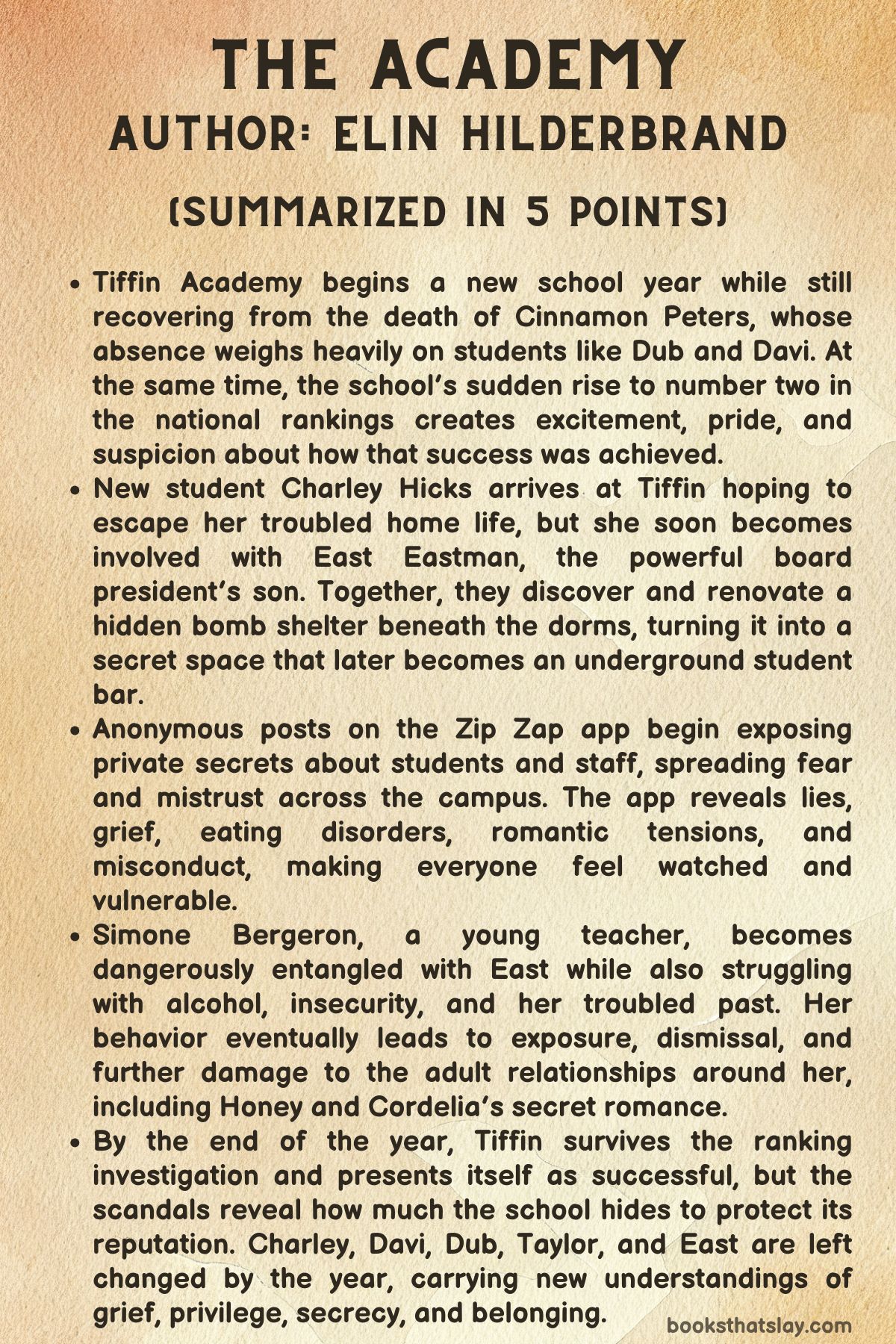
Summary
At the start of the school year, Tiffin Academy is still recovering from the death of Cinnamon Peters, a student who died by suicide at the end of the previous year. Head of School Audre Robinson watches the students return with both pride and dread.
She is deeply invested in Tiffin’s future, especially because the school has been climbing the national boarding school rankings after major renovations funded by Jesse “Big East” Eastman, the powerful board president. Audre is also alert to what she calls “the Feeling,” an inner warning that something is not right.
Several important students return under the shadow of Cinnamon’s absence. Webber “Dub” Austin, Tiffin’s quarterback and Cinnamon’s former boyfriend, is still mourning her.
Davi Banerjee, Cinnamon’s best friend and a famous social media influencer, has cut her hair and carries grief beneath her controlled public image. Andrew “East” Eastman, Big East’s son, arrives with his usual reputation for trouble, but he appears unusually composed.
A new student, Charlotte “Charley” Hicks, moves into Cinnamon’s old room. Charley is academically strong, socially awkward, and eager to escape her home life after her father’s death and her mother’s relationship with Joey, a man Charley distrusts.
On the first day, Tiffin learns that it has risen to number two in the America Today boarding school rankings. The news electrifies the campus.
The ranking gives students, parents, teachers, and administrators a sense that the school has entered a new era. Audre embraces the achievement, even though she privately wonders whether Big East’s influence may have helped.
The students enjoy the good news as a welcome distraction from grief. The football team also begins winning unexpectedly, increasing the sense that Tiffin is on the rise.
Meanwhile, new faculty members Rhode Rivera and Simone Bergeron try to establish themselves. Rhode, a former Tiffin student and struggling novelist, returns to the school hoping for a restart.
Simone, young and inexperienced, teaches history even though she wanted to teach French. Rhode becomes interested in Simone and takes her to the Alibi, a local bar, but his attention soon makes her uneasy.
Chef Haz, who works at Tiffin after being transferred from the Dewberry Club because of gambling-related theft, observes them and recognizes that secrets may become useful currency.
Charley begins the year isolated. Davi tries to pull her into Tiffin social life, partly out of kindness and partly because Charley’s transformation could become good social media content.
Charley resists, preferring books and solitude. At the First Dance, she skips the event and is drawn out by East, who shows her a hidden underground passage beneath the dorms.
The tunnel leads to an old bomb shelter with a sink, stove, bathroom, and enough space to become a secret student hideout. East wants to turn it into a private speakeasy.
Charley is cautious, but she is also intrigued by East’s intelligence and by the fact that he chooses her as his partner.
The tunnel also becomes the site of a dangerous encounter between East and Simone. When Simone searches for Charley, East appears and kisses her.
Simone knows she should stop him immediately, but her attraction and insecurity weaken her judgment. This begins a secret and improper dynamic between them.
East later enters Simone’s room, kisses her again, and initiates sexual contact. Simone feels guilt and fear afterward, knowing that she has failed as an adult and a teacher, yet she keeps the secret.
East uses the situation to keep her from disciplining him.
As the term continues, several students struggle privately. Dub remains haunted by Cinnamon and by an email she sent him on the morning of her death with an attachment he has promised not to open until after graduation.
Hakeem Pryce, Dub’s teammate, becomes jealous of Dub’s closeness with Taylor Wilson, Hakeem’s girlfriend. Taylor has feelings for Dub and eventually tells him she wants to lose her virginity to him, though Dub does not act on it.
Hakeem, insecure and angry, later cheats during a recruiting trip, damaging his relationship with Taylor and affecting his athletic performance.
Davi’s polished online presence hides pain. She is grieving Cinnamon and also feels alienated from her parents, Ruby and Vikram, whose fashion-world life has become complicated by Saylem, the creative director involved with them.
Davi begins showing signs of disordered eating, and Charley notices. At first, Davi reacts defensively, but their relationship gradually becomes more honest.
Charley also begins changing. She becomes more stylish, closer to Davi, and increasingly attached to East.
Their work on the underground room becomes both a secret project and the foundation of their romance.
A new anonymous app called Zip Zap begins spreading gossip across campus. The posts reveal private information about students and staff, including Cordelia Spooner, Annabelle Tuckerman, Chef Haz, Taylor, Davi, Simone, and even Audre.
The app creates paranoia because it seems to know information that should be private. The school newspaper staff, led by Ravenna, becomes interested in investigating it.
Audre initially dismisses Zip Zap as temporary drama, but when it begins threatening the school’s reputation and exposing her own doubts about the ranking, she takes it more seriously.
The app worsens existing tensions. Annabelle is exposed for lying in a senior speech about near-death experiences.
Davi’s eating disorder is posted publicly soon after she asks the school psychologist for help, leading her to suspect Charley. Charley is devastated when Davi turns against her, especially because Charley had encouraged Davi to seek help.
Charley herself is later targeted by a sexual rumor involving East, which isolates her further. Eventually, an IT consultant, Laurie Hummel, discovers that the version of Zip Zap operating at Tiffin only allows its creator to post and has been collecting communications sent over the school Wi-Fi.
The culprits are Grady Tish and Levi Volpere, younger members of the school newspaper.
While Zip Zap’s exposure brings relief, East and Charley’s secret project moves forward. East recruits Chef Haz to supply alcohol for the hidden speakeasy, which East names Priorities.
Haz, trapped by gambling debts and hoping to improve his situation, agrees. The space becomes luxurious, with a bar, furniture, and carefully arranged details.
East invites a select group of students, including Davi, Dub, Taylor, and others, to secret Saturday gatherings. The parties are controlled at first: phones are confiscated, students drink without going too far, and everyone leaves on time.
For many of them, Priorities becomes a glamorous escape from school rules, grief, and pressure.
The secret cannot remain hidden forever. Olivia, who has long been attached to Davi and jealous of Charley’s growing closeness with her, notices that several girls are sneaking out.
She tells Simone, believing students may be going to the Alibi. Simone, who already knows about the basement room, becomes determined to expose East.
By this time, she is drinking heavily and increasingly unstable. She goes to East’s room, steals a key, and later leads Rhode to Priorities.
The room has been cleared of alcohol and glasses, leaving no direct proof of student drinking. Rhode realizes that reporting it may hurt Simone more than East because East is protected by his father’s power, while Simone is drunk and has stolen from a student.
Audre soon receives a voice memo from Roy Ewanick, an older teacher who had received it from East. The recording captures East and Simone discussing their improper relationship.
When Audre confronts Simone, Simone admits what happened but tries to blame East. Audre insists that Simone, as the adult and teacher, was responsible for reporting and stopping it.
Simone then reveals the hidden bar, hoping to implicate East, but Audre finds the room impressive rather than scandalous because there is no proof of alcohol use. She fires Simone.
In desperation, Simone also claims that Honey Vandermeid made an unwanted sexual advance toward her.
Honey’s own secret life then unravels. She has been in a long-term secret relationship with Cordelia, but she has grown emotionally distant.
After Honey kisses Simone and Simone later reports it, Honey offers to resign. Cordelia sees that Honey only returns to her with warmth after losing stability elsewhere.
When Honey asks Cordelia to move with her to Florida, Cordelia refuses, choosing her own dignity and her place at Tiffin over a relationship that has become unequal.
The students spend the final weeks processing the fallout. Charley breaks up with East because she believes he used her as cover while pursuing Simone.
East insists that his involvement with Simone ended once he began a real relationship with Charley and that he only kept the situation hidden to protect Priorities. Charley does not fully trust him, but she is not untouched by his explanation.
Davi remains by Charley’s side, and their friendship becomes one of the steadier emotional connections in the closing section.
At commencement, Tiffin presents itself as successful and whole. The ranking inquiry has cleared the school, the students graduate, and Audre decides not to investigate Chef Haz’s role in Priorities because she values what he brings to campus.
The final image brings several students together on the Senior Sofa in the library. Charley, Davi, Dub, Taylor, and the others gather in a space reserved for seniors.
East asks to join them. After hesitating, Charley makes room for him.
The gesture does not erase the harm, secrecy, or betrayal of the year, but it suggests that Charley is still deciding what forgiveness, trust, and belonging will mean for her.
Characters
Audre Robinson
Audre Robinson is the Head of School at Tiffin Academy and one of the central adult figures in The Academy. She is intelligent, ambitious, polished, and deeply conscious of institutional reputation.
Her pride in Tiffin’s sudden rise to number two in the national rankings reveals both her dedication and her vulnerability. Audre wants the school to be seen as excellent, and she wants credit for helping make it excellent, especially because Big East’s money often overshadows her leadership.
At the same time, she has an intuitive sense that danger is building around her. Her “Feeling” shows that she is not blind, but her decisions often prove selective.
She is alert to threats that might damage Tiffin’s public image, yet she is willing to overlook misconduct when exposure would harm the school or powerful people. Her handling of Simone and East shows this clearly: she rightly holds Simone accountable as the adult, but she also protects the institution and avoids pursuing East, Haz, or Priorities too aggressively.
Audre represents leadership under pressure, where moral clarity is repeatedly compromised by reputation, money, and survival.
Charlotte “Charley” Hicks
Charley Hicks enters the book as an outsider, moving into Cinnamon Peters’s old room and arriving with outdated clothing, plants, books, and a defensive attitude. Her distance from others is not simple arrogance; it comes from grief, displacement, and distrust.
Her father’s death has changed her family life, and her mother’s relationship with Joey makes home feel unsafe and humiliating. Tiffin gives Charley the chance to become someone new, but that transformation comes with danger.
East sees her intelligence and invites her into the secret project beneath the dorms, making her feel chosen. Davi helps her change socially and aesthetically, and Charley slowly moves from isolation into visibility.
Yet her growth is uneven. She becomes more confident, but also more vulnerable to East’s charm and to the cruelty of campus rumor.
Her friendship with Davi is one of her most important emotional anchors because it teaches her to care for someone beyond herself. By the end, Charley is no longer simply the strange new girl.
She has learned how status, secrecy, desire, and betrayal operate inside Tiffin, and she must decide what kind of person she wants to be within that world.
Andrew “East” Eastman
East Eastman is charismatic, restless, clever, and morally slippery. At first, he appears to be the spoiled son of Big East, protected by wealth and family influence.
The book gradually shows that he is more capable than others assume. His work on the bomb shelter proves his imagination, planning ability, taste, and ambition.
Priorities is illegal and reckless, but it is also evidence that East can build something extraordinary when he cares. His relationship with Charley brings out his more sincere qualities, including his need to be seen as intelligent rather than dismissed as a rich troublemaker.
However, East’s actions with Simone reveal a darker side. He exploits her attraction, weakness, and fear, using their secret to protect himself.
Even if Simone is the responsible adult, East understands power better than he pretends. His charm often functions as a tool.
By the end, he is neither fully villain nor harmless romantic lead. He is a young man shaped by privilege, neglected discipline, and a craving to make an impact, but he leaves damage behind him because he assumes consequences can be managed.
Davi Banerjee
Davi Banerjee is a social media star, Cinnamon’s best friend, and one of the most layered students in the story. Publicly, she is glamorous, stylish, influential, and admired.
Privately, she is grieving, lonely, angry, and struggling with disordered eating. Her social media persona gives her power, but it also traps her in performance.
She is expected to remain attractive, entertaining, and enviable, even when she is emotionally unwell. Her family life adds to her instability.
Her parents’ fashion empire and their relationship with Saylem leave Davi feeling displaced inside her own home. Her bond with Charley becomes important because Charley sees past the brand image.
Davi initially tries to style Charley like a project, but their friendship becomes more honest when they begin sharing the pain they hide from others. Davi’s accusation that Charley exposed her eating disorder shows how fear can distort trust, yet her later apology proves that she can take responsibility.
She is not just a queen bee or influencer; she is a teenager trying to survive grief, body pressure, family confusion, and the constant demand to appear perfect.
Webber “Dub” Austin
Dub Austin is Tiffin’s quarterback and Cinnamon’s grieving boyfriend. His character is defined by restraint, loyalty, and unresolved pain.
He carries Cinnamon’s final email like a private burden, refusing to open the attachment before graduation because honoring her instruction gives structure to his grief. Dub is admired as an athlete, especially as Tiffin’s football team begins winning, but his inner life is marked by hesitation.
His closeness with Taylor creates moral tension because he knows she has feelings for him and knows Hakeem is insecure. Unlike Hakeem, Dub tries not to act selfishly.
He avoids Taylor for a time to protect her relationship, and when she expresses sexual interest in him, he does not take advantage of her vulnerability. Dub’s sadness makes him emotionally available to Taylor, but it also keeps him tied to Cinnamon.
His journey is quiet compared with East’s or Charley’s, yet it is important because he shows a different model of teenage masculinity: one based less on conquest and more on memory, restraint, and guilt.
Cinnamon Peters
Cinnamon Peters is absent in the present action, but her death shapes the entire book. She was Dub’s girlfriend and Davi’s best friend, and her suicide leaves a silence that others keep trying to fill.
Cinnamon’s old room becomes Charley’s room, making Charley’s arrival feel unsettling from the beginning. Her final email to Dub, with its unopened attachment, keeps her presence alive in a concrete way.
Cinnamon represents the part of Tiffin that cannot be fixed through rankings, renovations, dances, or football victories. Her death exposes the limits of institutional optimism.
While the school tries to move forward, individual students remain caught in grief. Through Cinnamon, the book asks whether elite communities truly care for vulnerable students or whether they too quickly turn suffering into something to manage, contain, and move past.
Hakeem Pryce
Hakeem Pryce is a talented football player whose confidence hides jealousy and insecurity. His friendship with Dub becomes strained because of Taylor’s feelings for Dub, and Hakeem responds with possessiveness rather than honest communication.
He wants Taylor’s loyalty but pressures her sexually when she is not ready, then cheats during his recruiting trip. This hypocrisy makes him one of the more flawed student characters.
Yet Hakeem is not written as simply cruel. He is under athletic pressure, eager for validation, and frightened of being second choice.
His poor choices damage both his relationship and his football performance, especially when emotional turmoil follows him onto the field. Hakeem shows how entitlement, insecurity, and competitive pressure can distort young love and friendship.
Taylor Wilson
Taylor Wilson is caught between loyalty, desire, and confusion. She is Hakeem’s girlfriend, but her emotional connection with Dub is stronger and more tender.
Her wish to lose her virginity to Dub comes after Hakeem pressures her, making her decision less about romance alone and more about wanting control over her own body and first sexual experience. Taylor is also perceptive in class, drawing connections between The Crucible and the hysteria around Zip Zap.
Her character shows how gossip turns private uncertainty into public humiliation. She makes mistakes, especially by leaning on Dub while still tied to Hakeem, but she also tries to understand her own needs in an environment where everyone is watching and judging.
Simone Bergeron
Simone Bergeron is one of the book’s most troubled adults. Young, inexperienced, and insecure, she arrives at Tiffin already unsure of her authority.
Her attraction to East becomes a catastrophic failure of judgment because she is the teacher and dorm parent. The book gives context for her instability through her past at McGill, where alcohol, poor boundaries, and a student medical emergency led to disciplinary consequences.
At Tiffin, those patterns return. She drinks heavily, feels threatened by Rhode, becomes jealous of Charley, and increasingly sees herself as a victim of everyone around her.
Simone is harmed by her own lack of support and by Rhode’s uncomfortable pursuit, but she also harms others by refusing accountability until she is exposed. Her story is a study of immaturity in an adult role.
She wants sympathy, protection, and desire, but she lacks the discipline and honesty required by her position.
Rhode Rivera
Rhode Rivera is a former Tiffin student whose return as a teacher is shaped by disappointment. His early literary promise has faded after a failed second novel, and he comes back to the school looking for a reset.
Rhode is observant and often thoughtful, especially about Charley’s talent, but his interest in Simone reveals self-absorption and poor judgment. He frames himself as protective, yet he repeatedly presses for closeness when Simone is uncomfortable.
His expensive date with her exposes his insecurity: he tries to create a romantic scene through money, performance, and control, then becomes resentful when she drinks too much and ruins it. Rhode is not as dangerous as East or as unstable as Simone, but he is still compromised.
He wants to be the sensitive writer and good man, yet he often fails to see how his own needs shape his behavior.
Chef Haz
Chef Haz is practical, talented, secretive, and morally flexible. His food makes him beloved at Tiffin, especially by students like Davi, but his backstory reveals gambling debts and theft from the Dewberry Club.
Big East’s decision to relocate rather than fire him places Haz in a dependent position, making him vulnerable to further compromise. When East offers him money to help supply Priorities, Haz recognizes the risk but also sees a route out of debt.
He understands leverage and secrecy; from his first encounter with Rhode and Simone at the Alibi, he knows information can become useful. Haz is not malicious, but survival and self-interest guide him.
Audre’s choice to ignore his likely role in Priorities confirms his value to the school and the selective morality of the institution.
Jesse “Big East” Eastman
Big East is the powerful board president whose money has transformed Tiffin. He is physically absent for much of the action, but his influence is everywhere: in the renovations, the rankings anxiety, Audre’s professional pressure, East’s protection, and Haz’s employment.
He represents donor power in elite schools. His wealth makes things possible, but it also distorts accountability.
People wonder whether he influenced the ranking, and even when the inquiry clears Tiffin, the suspicion matters because everyone knows he has the means to shape outcomes. As East’s father, he also indirectly explains some of East’s entitlement.
Big East is less a daily presence than a force field around the school.
Cordelia Spooner
Cordelia Spooner, the admissions director, is anxious, observant, and emotionally wounded by secrecy. Professionally, she understands how much Tiffin’s ranking will affect admissions, and she is one of the first adults to take Zip Zap seriously.
Personally, she is in a hidden relationship with Honey and longs for stability. Her jealousy of Simone comes partly from insecurity and partly from the pain of watching Honey drift away.
Cordelia’s strongest moment comes near the end when Honey asks her to move to Florida. Cordelia recognizes that Honey’s renewed affection is tied to crisis, not true commitment.
By refusing, she chooses self-respect over dependence. Her arc is quiet but meaningful: she begins as someone afraid of abandonment and ends by refusing to abandon herself.
Honey Vandermeid
Honey Vandermeid is Tiffin’s counselor, which makes her personal confusion especially important. She is supposed to help students manage emotional crises, yet she avoids honesty in her own life.
Her relationship with Cordelia has become stale, but she delays ending it because confrontation is uncomfortable. She becomes emotionally drawn to Simone, listens to Simone’s distorted account of Rhode, and then misreads the moment badly enough to kiss her.
Honey’s mistake costs her career and exposes the gap between professional competence and personal maturity. She is not cruel, but she is evasive.
Her inability to be direct with Cordelia leads to more pain than a clean ending would have caused.
Olivia
Olivia is Davi’s friend and admirer, but her attachment often turns needy and controlling. She wants Davi’s attention, approval, and social-media validation.
During Thanksgiving, she monitors Davi’s eating and behavior in ways that feel less like care and more like surveillance. Her jealousy grows as Davi becomes closer to Charley.
Olivia’s performance in Mean Girls reveals that she has been studying Davi closely, using that social dynamic to fuel her role as Regina. Later, her suspicion about the secret Saturday gatherings leads her to tell Simone that students are sneaking out.
Olivia does not know the full consequences of what she sets in motion, but her need to expose what excludes her becomes a major trigger near the end.
Ravenna
Ravenna is the editor of the school newspaper, the ‘Bred Bulletin, and she represents student journalism mixed with ambition and appetite for scandal. She is excited by Zip Zap because it gives her a mystery to investigate and a chance to make the paper relevant.
Her interest in exposing truth is real, but it is also fueled by drama. She wants to resist censorship when Audre tries to ban the app, and she understands that student voices matter.
By the end, however, she also shows discretion when she chooses not to spread everything she knows about Honey and Cordelia. Ravenna matures from chasing gossip toward understanding that not every truth needs to become public entertainment.
Grady Tish
Grady Tish is one of the younger students on the school newspaper and one of the creators behind Zip Zap. Though he seems minor at first, his role becomes central because the app’s posts create fear, shame, and chaos across campus.
Grady’s actions show the danger of technical skill without ethical judgment. He participates in turning private messages, emails, and secrets into public weapons.
As a younger student, he may not fully grasp the emotional consequences of exposure, but the damage is real. His character reflects how modern cruelty can hide behind screens, anonymity, and the thrill of being smarter than the adults.
Levi Volpere
Levi Volpere, like Grady, appears at first as a quiet newspaper staff member more absorbed in computers than journalism. His involvement in Zip Zap reveals that he is part of a serious breach of trust.
Levi helps create a system where only the creators can post while secretly collecting information from school Wi-Fi. His actions suggest curiosity, mischief, and power-seeking more than traditional bullying, but the effect is the same: students and adults are humiliated, relationships fracture, and mental health issues are exposed.
Levi’s role matters because he shows that the most disruptive people in a community are not always the loudest.
Fran Hicks
Fran Hicks is Charley’s mother, a grieving widow who makes choices that alienate her daughter. Her relationship with Joey is central to Charley’s desire to escape home.
Fran seems lonely and vulnerable, and her attachment to Joey makes her ignore Charley’s discomfort. When Joey appears during Family Weekend despite Charley’s request that he stay away, Fran’s failure to protect Charley’s boundaries becomes obvious.
Later, when Fran suspects Joey is cheating, she becomes more sympathetic because the reader sees her sadness and denial. Fran is not a villain, but she is emotionally dependent in a way that forces Charley to become stronger and colder than she should have to be.
Joey
Joey is Fran’s younger partner and one of the reasons Charley wants to be at Tiffin. He is not deeply developed, but his presence creates discomfort.
Charley distrusts him because he has shown inappropriate interest in her friend Beatrix, and his arrival at Family Weekend confirms his lack of sensitivity to Charley’s boundaries. Joey represents the unwanted intrusion of Charley’s home life into her new world.
His suspected cheating later confirms Charley’s belief that he is unreliable and unworthy of her mother’s devotion.
Beatrix
Beatrix is Charley’s friend from home and serves as a reminder of the life Charley has left behind. Their texts show that Charley is not simply antisocial; she had connections before Tiffin, but she associates home with grief and confinement.
Beatrix’s curiosity about Davi, boys, and Tiffin reflects the outside fascination with elite boarding school life. Charley’s choice not to tell Beatrix much about East shows how quickly her new life becomes private and separate.
Beatrix helps mark Charley’s transition from her old identity into the more complicated identity she builds at Tiffin.
Mr. James
Mr. James, the groundskeeper, is a minor but atmospheric figure. He appears calm and unconcerned when Simone is searching for Charley, which frustrates Simone.
His presence adds to the sense that Tiffin has older rhythms and hidden spaces that newer faculty do not fully understand. He is connected to the physical campus rather than its social drama, and this gives him a grounded quality.
His interactions also highlight Simone’s anxiety and lack of confidence; where he sees no crisis, she sees threat, partly because she is already entangled in secrets.
Taylor’s Classmates: Madison J. and Tilly
Madison J. and Tilly are part of the student social world around Davi, Olivia, Taylor, and Charley. They help create the atmosphere of observation that defines Tiffin.
Their comments, suspicions, and reactions show how quickly students track one another’s behavior. Tilly’s conversation with Olivia about Davi and Madison J. possibly being hungover helps Olivia realize that a secret pattern may exist.
These characters may not drive the main action alone, but they matter because gossip at Tiffin is collective. Social pressure comes not from one person but from many watchers.
Annabelle Tuckerman
Annabelle Tuckerman is a senior whose lie about near-death experiences is exposed through Zip Zap. Her storyline shows the pressure students feel to turn themselves into impressive narratives for speeches, college essays, and elite admissions.
After the exposure, she confesses to Honey and writes a more honest college essay about being caught in a lie. Her Princeton acceptance suggests that honesty, even after humiliation, can become a stronger form of self-presentation than performance.
Annabelle’s arc is small but thematically sharp because it connects reputation, truth, and college pressure.
Douglas Worth
Douglas Worth, head of Northmeadow and chair of ISNEC, is both rival and watchdog. His suspicion of Tiffin’s ranking reflects resentment, but it also raises fair questions about how elite institutions compete.
His comments about diversity, Davi’s influence, and Big East’s possible bribery are offensive in tone, but they unsettle Audre because they touch her private doubts. Worth represents the competitive ecosystem around prep schools, where reputation is guarded, questioned, and weaponized.
Royce
Royce is the student accused by Zip Zap of using ChatGPT on an English essay. His importance comes from his response: he admits the truth.
Rhode allows him to rewrite the essay because he respects the honesty. Royce’s brief storyline contrasts with the larger culture of secrecy at Tiffin.
In a school full of hidden misconduct, his confession shows that accountability is possible when shame does not immediately become destruction.
Coach Bosworth
Coach Bosworth is responsible for managing the football team during a season of unexpected success. His most important moment comes when he senses tension between Hakeem and Dub before a major game.
He asks whether there will be problems, but both players deny it. Coach Bosworth represents the adult who can detect trouble but cannot force honesty from students determined to hide it.
His role also connects athletics to the school’s larger reputation during Tiffin’s rise.
Vikram Banerjee
Vikram, Davi’s father, is worried about his daughter but constrained by his marriage and family business. He sees signs that Davi may be struggling and wants to attend the campus mental health presentation, but Ruby shuts him down because of appearances.
Vikram’s discomfort with Saylem also shows that he, like Davi, feels displaced by Ruby’s choices. He is sympathetic because he notices the emotional cost of the family’s glamorous world, but he is weak because he does not act decisively enough to protect Davi.
Ruby Banerjee
Ruby, Davi’s mother, controls the family fashion company and much of the family’s emotional climate. She dismisses Vikram’s concern about Davi’s mental health because she worries about how it will look.
Her relationship with Saylem and her dominance in the household leave Davi feeling alienated. Ruby represents image-based parenting, where success and appearance take priority over emotional presence.
Her failure is not lack of love alone; it is her inability to see Davi beyond brand, optics, and lifestyle.
Saylem
Saylem is the creative director involved with Ruby and Vikram, and her presence destabilizes Davi’s family life. Davi sees her as the person who has pulled both parents into a new romantic arrangement and changed the atmosphere of home.
Saylem is not explored as fully as Davi’s parents, but she functions as a symbol of adult self-indulgence. To Davi, Saylem is proof that the adults in her life are prioritizing their desires over her emotional security.
Dr. Pringle
Dr. Pringle is the school psychologist whom Davi contacts when she finally asks for help with disordered eating. The timing of the Zip Zap post after Davi’s email creates fear that even supposedly private help is unsafe.
Dr. Pringle’s role is brief but important because it shows how damaging surveillance can be in a school environment. When students cannot trust confidentiality, seeking help becomes frightening.
Jasper Stiefel
Jasper Stiefel is connected to Simone’s past at McGill. His apology email reopens Simone’s anger and shame about the night Lars nearly died from alcohol poisoning.
Jasper frames his actions as youthful ignorance, which enrages Simone because she still carries the consequences. His role helps explain Simone’s unresolved guilt, her tendency to blame others, and her complicated relationship with alcohol and authority.
Lars
Lars is the McGill student whose severe alcohol poisoning led to Simone being disciplined. Though he does not appear directly in the Tiffin action, he is central to Simone’s backstory.
His near-fatal intoxication shows the seriousness of Simone’s earlier failure as a student authority figure. Lars’s situation foreshadows Simone’s later inability to maintain boundaries at Tiffin, especially when alcohol and attraction are involved.
Laurie Hummel
Laurie Hummel is the IT consultant who exposes the mechanics of Zip Zap. Her investigation reveals that the app is not merely anonymous gossip but a targeted system with access to communications sent over Tiffin’s Wi-Fi.
Laurie’s role brings technical clarity to a mystery driven by fear and rumor. She represents the adult competence needed to pierce through digital chaos, although her arrival comes only after considerable harm has already been done.
Cassie Lee
Cassie Lee is linked to Hakeem through a rumor that he had sex with her, and later she tells Olivia that she became tired of the juniors’ secrecy. Her character shows how the effects of Priorities extend beyond the chosen group.
Those outside the secret feel excluded, suspicious, and resentful. Cassie’s connection to Hakeem also contributes to Taylor’s pain and to the breakdown of trust in that romantic circle.
Mikayla Ekubo
Mikayla Ekubo, ISNEC’s secretary, informs Audre that the inquiry into Tiffin’s ranking has found the number two placement legitimate. Her role is procedural, but the information she brings matters greatly to Audre.
It removes one public threat to Tiffin’s reputation, even while other private scandals continue unfolding. Mikayla’s message shows the difference between official legitimacy and moral health: the ranking may be valid, but the school is still full of concealed problems.
Roddick
Roddick is Olivia’s cousin and the lead singer in a band performing at Tiffinpalooza. He matters mainly because Olivia believes his presence may help her regain Davi’s attention, since Davi has a crush on him.
Roddick therefore functions as part of Olivia’s attempt to re-enter Davi’s inner circle. He also adds to the social atmosphere of Tiffinpalooza, where performance, attraction, and status all mix in public view.
Roy Ewanick
Roy Ewanick is the oldest teacher at Tiffin and the person who brings East’s voice memo to Audre. Because he rarely checks his old flip phone, the message reaches Audre later than expected, but when it does, it changes everything.
Ewanick’s role is crucial because he becomes the accidental channel through which East protects himself and exposes Simone. His old-fashioned distance from constant phone use contrasts with the rest of the book’s obsession with digital communication.
Doc Bellamy
Doc Bellamy gives the commencement speech near the end. His role is ceremonial, representing tradition, continuity, and the polished face Tiffin presents to families and graduates.
By the time he speaks, the school has survived scandal without fully confronting everything beneath it. His presence helps frame the ending as a return to institutional ritual, even though the reader knows how much has been hidden or quietly managed.
Mr. Chuy
Mr. Chuy directs the school musical, Mean Girls. His choice of musical becomes significant because the students recognize their own social world in it.
Olivia’s performance as Regina and Charley’s recognition of herself as a Cady-like figure deepen the parallel between performance and reality. Mr. Chuy is not central as an individual, but his production creates one of the book’s clearest mirrors for student hierarchy, reinvention, and cruelty.
Themes
Reputation and Institutional Image
Reputation controls nearly every layer of The Academy. Tiffin’s rise to number two in the national rankings should be a triumph, but it immediately creates anxiety because the school’s image becomes more valuable and more fragile.
Audre wants the ranking to prove that her leadership matters, but she also fears that any scandal could undo the progress. This pressure affects how adults respond to misconduct.
Problems are not judged only by whether they are right or wrong; they are judged by whether they can be contained. Simone’s firing, the ranking inquiry, Zip Zap, Priorities, and even Cinnamon’s death all show the difference between public order and private harm.
Tiffin can appear successful while students are grieving, drinking, lying, spying, and hurting one another. The school’s beautiful rituals, improved facilities, and college-focused culture create an image of excellence, but that image depends on selective attention.
The book criticizes institutions that protect prestige before people. It does not suggest that reputation is meaningless; reputation brings donations, applicants, and opportunity.
Instead, it shows the danger of letting reputation become the highest moral value. When image matters more than honesty, truth is managed rather than faced.
Secrecy, Surveillance, and Digital Cruelty
Secrets drive the story, but Zip Zap changes the nature of secrecy by making private information feel permanently unsafe. The anonymous app does not simply spread gossip; it turns hidden pain into public entertainment.
Davi’s eating disorder, Annabelle’s lie, Taylor’s message to Dub, Simone’s past, Haz’s gambling, and Audre’s doubts all become material for exposure. The cruelty lies not only in the posts themselves but in the atmosphere they create.
Everyone begins wondering who knows what, who is watching, and whether any conversation is truly private. The revelation that the app’s creators accessed communications through school Wi-Fi makes the violation even more serious.
Grady and Levi are not just repeating rumors; they are weaponizing technology against their community. The theme also reflects a wider truth about teenage life in a digital age: shame can spread instantly, context disappears, and private struggle becomes spectacle.
Yet the book does not excuse the secrets themselves. Some hidden truths involve real wrongdoing.
The problem is that anonymous exposure rarely produces justice. It produces fear, suspicion, and humiliation, often harming vulnerable people before anyone understands the full story.
Power, Privilege, and Unequal Consequences
The school is full of rules, but consequences are not distributed equally. East can break boundaries, build an illegal speakeasy, and manipulate adults because his father is one of the most powerful people connected to Tiffin.
Haz keeps his job despite past theft because Big East finds him useful. Audre can decide which truths matter because she controls the institution’s response.
Simone is rightly held responsible for her misconduct with East, yet the speed with which she is discarded also reveals how easily the school protects itself by sacrificing the person with less power. Students experience similar inequalities.
Some are shielded by wealth, athletic value, beauty, or popularity, while others are exposed to judgment more quickly. Charley’s outsider status makes her vulnerable until Davi and East pull her closer to the center.
Davi’s fame gives her influence but also traps her under constant attention. The theme shows that privilege is not only about money; it is also about who gets believed, who gets forgiven, who gets watched, and who gets erased.
Tiffin teaches its students lessons beyond academics: it teaches them how power moves quietly through rooms, rankings, relationships, and discipline.
Grief, Reinvention, and the Need to Belong
Cinnamon’s death leaves emotional damage that the school cannot fully name. Dub, Davi, and the wider campus all carry the loss, but Tiffin tries to move forward through rankings, football wins, dances, and traditions.
Grief becomes something students manage privately while performing normalcy in public. Charley’s arrival adds another kind of grief: she is mourning her father and the loss of a stable home.
Her transformation at Tiffin is partly liberating and partly dangerous because belonging comes at a cost. She changes her appearance, enters Davi’s world, falls for East, and becomes part of a secret social circle.
Davi also wants belonging, despite seeming socially dominant. Her fame does not protect her from loneliness, family pain, or body shame.
Dub’s bond with Taylor grows from shared sadness and emotional need, while Annabelle’s lie suggests that even achievement culture can come from a desperate wish to be seen as special. The book treats reinvention as both necessary and risky.
People need new identities after loss, but they can attach themselves to the wrong people, stories, or performances. True belonging appears only when characters are seen honestly, without the masks they create to survive.