The Secret of Orange Blossom Cake Summary, Characters and Themes
The Secret of Orange Blossom Cake by Rachel Linden is a contemporary novel set between Seattle and Italy. It follows Juliana “Jules” Costa, a young woman who hosts a quirky vintage-recipe Instagram show and is trying to turn her love of food into a real career.
When her plans stall and a cookbook deadline forces her to confront family history she has buried in grief, Jules travels to her grandmother’s olive farm on Lake Garda. There she reconnects with her roots, meets people from her past, and discovers that food can carry memory, hope, and even a hint of the unexpected.
Summary
Juliana “Jules” Costa lives in Seattle, where she and her best friend and roommate Drew cohost a small but devoted Instagram series called The Bygone Kitchen. They spend a Sunday filming batches of short episodes in their apartment, joking about retro dishes and cherishing the odd little community they’ve built.
For Jules, the show is more than fun. After her father’s death years earlier, cooking old recipes became the main thing that steadied her.
Drew dreams of breaking into performance, while Jules quietly hopes their show can grow into something lasting.
That night they meet Keith Garvey, a television developer who has been shopping their concept around. Keith delivers hard news: no streaming service wants The Bygone Kitchen as it is.
Executives think the format feels dated, and they don’t believe Jules’s gentle hosting style fits what younger audiences want. Jules is blindsided.
Before she can process that rejection, Keith pivots to a new opportunity. Peacock is testing a six-episode dance-competition series filmed in famous restaurants.
Drew is thrilled, but Jules doesn’t understand why this is being offered to them. Keith makes it clear: Peacock wants Drew as host, paired with a huge influencer named Desiree Reyes, and they want Jules removed from the project.
Worse, Drew already knew this was possible; Keith had asked him for a tape days earlier, and he kept it from her. Jules leaves in hurt and shock, feeling replaced both professionally and personally.
Outside, Drew tries to explain. He insists he didn’t want to betray her and hoped there would be a way to keep them together, but he also admits this job is everything he’s ever wanted.
Jules realizes he will likely take it and that her partnership with him is ending. Drew urges her not to quit on herself and points to her upcoming cookbook contract as her chance to prove she can lead her own work.
Still reeling, Jules contacts her literary agent, Michelle Harris, asking about the status of her cookbook with Epicure Press. The next morning Michelle calls with new demands from the publisher.
They like the idea of vintage recipes, but they want the book to be personal and centered on Jules’s own family story. She must deliver fifty recipes tied to her life, each with a narrative and photo spread, by September.
If she can’t meet the deadline, the contract can be canceled and her advance reclaimed. Jules panics.
She has already spent that money on work expenses, and, since her father died, she has avoided cooking family dishes because grief shuts her mind down. Now she must pull those memories back up or lose the career she has tried to build.
While Jules is staring helplessly into her refrigerator, Drew prepares to move to Los Angeles for the Peacock job. He needs to sublet his room.
Jules can’t afford the apartment alone, so she agrees. The subletters arrive early: Solomon, flamboyant and loud, and Sandra, a severe clay-covered artist.
They bring a white Persian-type cat, Ophelia, and instantly start acting like they own the place. Sandra burns sage, announces they are strict macrobiotic vegans, and refuses to share kitchen space with non-vegan cooking.
She begins rearranging shelves and talking down to Jules. Jules feels trapped, overwhelmed, and suddenly very alone as the summer she needs for her cookbook becomes a daily battle for peace and cooking space.
Trying to work, Jules attempts to recreate her grandmother Nonna Bruna’s Italian dishes and fails repeatedly. Her mother Lisa calls from New York with a problem: her fifteen-year-old half-sister Alessandra (“Alex”) wasn’t registered for summer camp, and Lisa doesn’t want her at home.
Lisa proposes that Jules take Alex to Italy to stay with Nonna Bruna for two months. Jules resists.
She has a job and a deadline, and Alex isn’t related to Nonna by blood. But Lisa offers to cover costs and guilt-pressures her by reminding her that Nonna is aging and Jules hasn’t visited in fifteen years.
The idea terrifies Jules for another reason. Italy is where her father drowned in Lake Garda, and where her teenage romance with Nicolo Fiore ended after a long family feud was reignited.
Yet she also understands that Italy may be her only source for the personal recipes she needs. After a call with her older sister Aurora, who encourages her to go and hints that Nonna might need help, Jules agrees.
Nonna is delighted and welcomes her home.
A week later Jules and Alex arrive in Italy. Alex is withdrawn, skeptical, and firmly vegetarian, which makes Jules worry about cooking together.
The farm on Lake Garda looks familiar but worn, and the drive along the lake hits Jules with old sorrow. Nonna greets them warmly, refuses to treat Alex as “half” family, and feeds them bread, olive oil, cheese, and figs.
Alex retreats upstairs, eyeing everything as strange and inconvenient. Jules asks after Nonna’s old recipe book, hoping it will solve her cookbook problem, but Nonna claims not to know where it is.
The next morning Nicolo Fiore turns up at the farm helping Nonna’s assistant Lorenzo with repairs. Nicolo is older now, confident and kind, and his arrival throws Jules off balance.
When she later finds Nonna’s recipe book hidden away, she discovers the pages appear blank. The only visible thing is half of a torn recipe labeled Orange Blossom Cake.
Nonna closes the book quickly and refuses to explain, saying that cake once brought trouble. Jules admits her deadline and desperation.
Nonna promises to help her cook what she remembers, insisting recipes can live in a person even when they’re not on paper.
As the weeks go on, the strange cookbook reveals itself in unsettling ways. Alex can read recipes on pages Jules sees as empty, and sometimes an ingredient list changes when Nonna touches it.
Nonna finally explains that the book offers different recipes to different people depending on what they need. She also reveals the legend of the Orange Blossom Cake: whoever takes the first bite sees a glimpse of the happiest moment still waiting for them.
The recipe is torn because the missing half is with Violetta Fiore, Nicolo’s grandmother and Nonna’s former best friend turned bitter enemy. Nonna says their friendship shattered years ago when Violetta betrayed her and stole something precious, refusing to give details.
Life on the farm pushes Jules into old feelings and new ones. She overhears that the olive farm is failing and that Nonna and Lorenzo expect her to return someday to save it.
Nicolo confides that he left a law career to rescue his family farm too, but Violetta blocks any changes. Their shared frustration and lingering affection grow.
Nonna impulsively enters Jules in a local cooking contest at the Luce del Sole festival. Jules makes her father’s beloved dumplings, places fourth, and feels a quiet pride she hasn’t felt in years.
The festival also opens Alex up; she shows off Italian she has been secretly learning and meets a boy, Tommaso, with shy excitement.
After the contest, Nicolo and Jules spend an evening talking by the lake. Jules admits she hasn’t swum there since her father died.
Nicolo comforts her, then listens as she tells him about the missing cake recipe. He suggests Violetta keeps valuables in a safe and offers to retrieve it with her.
They sneak into Violetta’s office, open the safe, and are caught. Furious at first, Violetta softens as Jules demands the half-recipe and accuses her of destroying Nonna’s chance at happiness.
Violetta calls Nonna to come, setting the stage for a painful reckoning.
Before that confrontation fully lands, another crisis forces honesty between Jules and Alex. Jules finds Alex floating in the lake and panics, thinking she’s drowning.
Alex is fine, but Jules breaks down, reliving her father’s death. The sisters finally speak openly: Jules admits she has kept Alex distant, and Alex admits she believed Jules resented her existence.
They choose each other in that moment, swim together, and share memories and laughter in the water. Jules feels herself reopening to both grief and joy, and she also sees the farm as more than a burden—it is home.
The family gathers to bake Orange Blossom Cake with the restored recipe. Just as they are about to take the first bite, Drew and Keith arrive uninvited, eager to film and claim the cookbook’s “magic” for television.
Nonna refuses to let Keith record. Violetta takes the first bite and is overwhelmed by what she sees, while Nonna reacts with sudden courage and affection toward Lorenzo.
Jules and Nicolo miss the first bite, so Jules never receives a vision. When she looks again, the cake recipe has disappeared from the book.
Keith then pressures Jules to sell access to the cookbook and agree to a show. Drew, caught between old loyalty and new ambition, tries to push her to comply.
Jules overhears Keith admitting he sees her as disposable. She refuses, and when Drew grabs her wrist in anger, Nicolo intervenes and punches him.
Jules ends the friendship and rejects Keith’s offer entirely. She will not sell the book or herself.
With Drew and Keith gone, Jules commits to staying in Italy to save the farm, even though she has no clear plan. Alex and Nonna promise to face it together.
They lay out the grim finances and brainstorm a future: converting rooms into an agriturismo, offering olive-oil tastings, and running cooking classes led by Nonna. Alex reveals her followers already want to visit and offers to handle social media, even asking to stay in Italy for school.
Jules agrees to try, believing Lisa will accept. The cookbook opens to a new idea—an agrumato olive oil infused with rare local citrus—and they decide to make it part of their revival.
Three years later the gamble has worked. The farm becomes a thriving destination, their citrus-infused olive oil gains fame, and guests come from around the world.
Jules has built a life rooted in family and work she loves, married Nicolo, and found a home she once feared returning to. Alex flourishes in Italy, and Nonna’s kitchen is again full of purpose.
Jules looks around at what they’ve made and understands that choosing the farm over a glossy career offer brought her the future she needed all along.
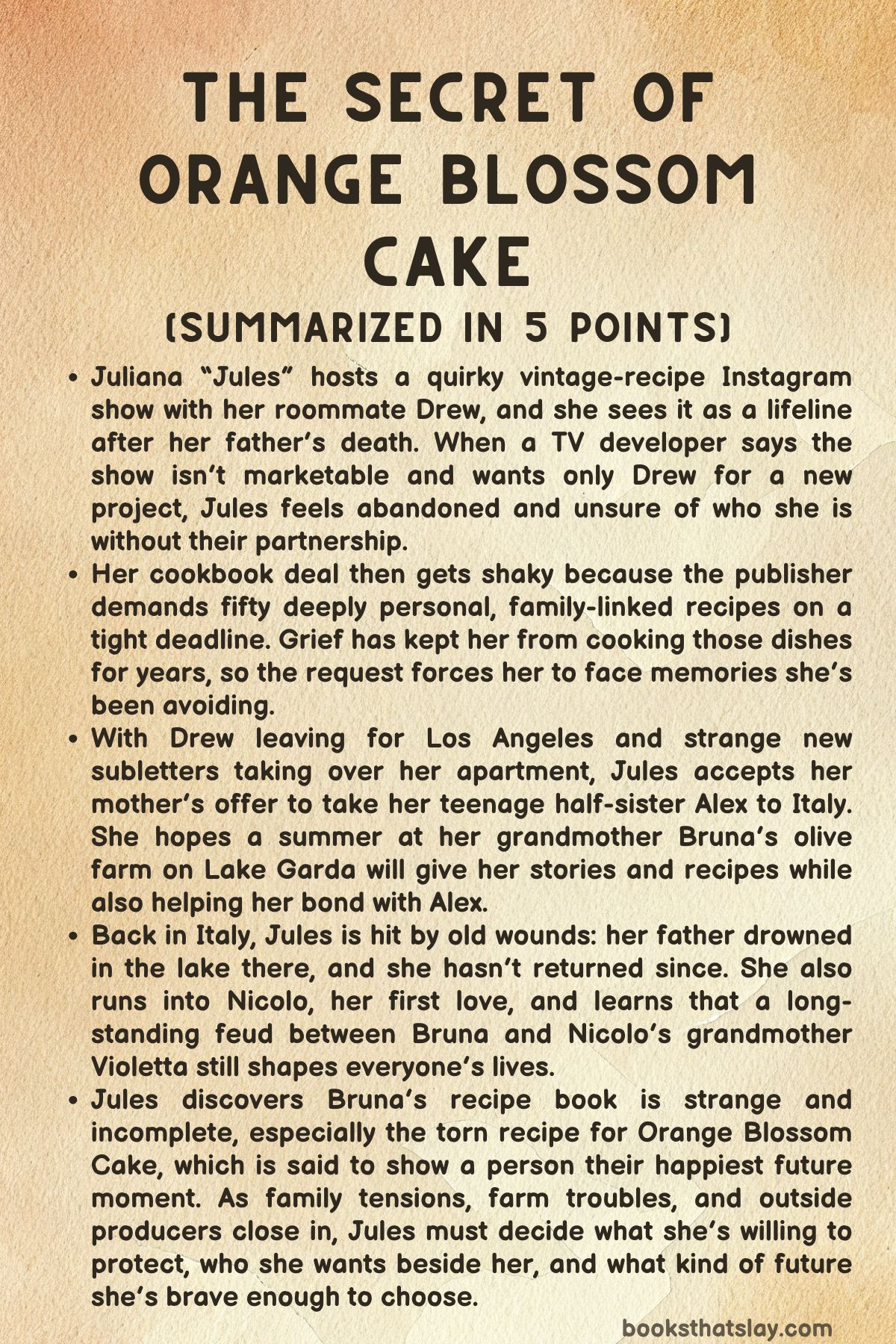
Characters
Juliana “Jules” Costa
Juliana is the emotional and narrative center of The Secret of Orange Blossom Cake, a woman whose love of food is inseparable from grief, memory, and identity. At the start she clings to The Bygone Kitchen as a lifeline after her father’s death, using vintage recipes as a way to stay close to him while also avoiding the rawness of cooking from her own family history.
This avoidance is crucial to her inner conflict: she is talented and hardworking, but frozen by trauma, so when her publisher demands personal stories, it forces her into the very territory she’s spent years protecting herself from. Her journey to Italy is therefore both practical and psychological—she needs recipes, but more deeply she needs to reclaim the part of herself that was lost with her father in Lake Garda.
Juliana’s arc is about moving from fear-driven stasis to chosen responsibility: she begins as someone who wants success but measures her worth through external validation (streaming deals, audience trends, deadlines), and ends as someone who defines success through belonging, love, and courage. Her final decision to stay and save the farm is not a tidy triumph but a leap into uncertainty, showing her growth into a person who can tolerate risk, grief, and joy existing together.
Drew
Drew begins as Juliana’s closest collaborator and emotional equal, the cohost who shares her playful chemistry and the day-to-day grind of building their show. He is ambitious, charming, and genuinely supportive in moments, but also deeply hungry for recognition in a way that makes him vulnerable to compromise.
His secret audition and willingness to entertain a future without Juliana reveal a fissure between friendship and career aspiration that he’s been avoiding. Drew’s conflict is not that he wants success—Juliana wants it too—but that he chooses it through concealment and replacement rather than honesty and partnership.
When he later arrives in Italy with Keith and tries to pressure Juliana into giving up the magical cookbook, the betrayal becomes physical and symbolic: he’s no longer just drifting away, he’s actively willing to hurt her to secure his own advancement. Drew functions as a foil to Juliana’s eventual integrity; he represents the seductive path of trend-chasing and commodifying intimacy, and his downfall is that he can’t see where ambition ends and exploitation begins.
By the end, he is less a villain than a cautionary portrait of someone who sacrifices human loyalty for career momentum, and loses both.
Keith Garvey
Keith is the polished industry gatekeeper in The Secret of Orange Blossom Cake, embodying the entertainment world’s obsession with marketability over authenticity. He is blunt, transactional, and skilled at reframing rejection as opportunity, which makes him effective—and dangerous—for vulnerable creators.
His decision to cut Juliana from the Peacock concept underscores how he treats people as interchangeable components of a pitch rather than artists with histories and relationships. Keith’s pursuit of the cookbook’s magic is the logical extension of that worldview: once he realizes the recipes carry a mystical hook, he sees it as property to acquire, not wonder to respect.
He escalates from dismissive to coercive, and his presence in Italy feels invasive because he carries a cultural logic that threatens to strip the farm and the family story into content. Keith is not nuanced in a sympathetic sense, but he is thematically important as the personification of the pressures Juliana must reject to become herself.
Desiree Reyes
Desiree is mostly offstage, but her shadow looms large as the influencer Peacock wants beside Drew. She represents a version of success built on scale, trend fluency, and hybrid performance—cooking merged with hip-hop dance and a huge following.
In Juliana’s eyes she is not personally antagonistic; instead she is a symbol of what the industry rewards and what Juliana fears she cannot be. Desiree’s role sharpens the book’s central tension between authenticity and algorithmic appeal.
Even without direct interaction, her popularity forces Juliana to confront whether her own voice is enough, and ultimately Desiree’s existence helps push Juliana toward a definition of success that doesn’t require fitting herself into someone else’s metric.
Michelle Harris
Michelle is Juliana’s literary agent and an early catalyst for the story’s main quest. She is pragmatic and protective in a professional way, pushing Juliana to meet industry demands while also outlining the stakes with clarity.
Michelle doesn’t sugarcoat the risk of losing the cookbook deal, and in doing so she unintentionally detonates Juliana’s suppressed grief. Her character represents the world of publishing that, unlike Keith’s TV sphere, still values personal narrative—yet it can be just as merciless in deadlines and contracts.
Michelle is not present long, but her function is vital: she forces Juliana to stop hiding behind nostalgia and to make her cooking personal again, triggering the journey that heals her.
Lisa Costa
Lisa is Juliana’s mother, flamboyant and often absent, moving through glamorous spaces like the charity circus benefit while leaving emotional cleanup to her daughters. She is well-intentioned in flashes but generally self-focused, treating family problems as logistical inconveniences to outsource.
Her request that Juliana take Alex to Italy is framed as help for Alex and Bruna, but it also reveals Lisa’s discomfort with caretaking—she wants her teenage daughter out of her way. Yet Lisa is not written as purely cold; she uses money and pressure as her language of support because she doesn’t know how to engage emotionally.
Her role exposes long-standing fractures in the Costa family, and her parenting style is part of why Juliana feels responsible for everyone else’s stability before her own.
Alessandra “Alex” Costa
Alex enters as a sullen, guarded half-sister who expects rejection and gives indifference first to avoid being hurt. Her vegetarianism and bluntness initially feel like obstacles to Juliana, but they quickly become signs of a young person building her own ethical identity in a family that has often treated her as an afterthought.
In Italy, Alex’s transformation is one of the book’s quiet joys: she shifts from defensive detachment to curiosity, affection, and rootedness. Her secret Italian practice and shy flirtation with Tommaso show a teenager hungry for belonging, and her bond with Juliana deepens through shared vulnerability at the lake.
Alex is also sharply modern—social-media fluent, strategic, and unafraid to imagine a life beyond the roles assigned to her. When she proposes the agriturismo and later asks to stay for school, she becomes a co-architect of the family’s renewal.
Alex’s arc mirrors Juliana’s in miniature: both start from displacement and fear, and both learn that family can be chosen and rebuilt, not just inherited.
Aurora Costa
Aurora, Juliana’s older sister, is a stabilizing presence even from afar. Living on a farm in Virginia with her own family, she represents an alternative model of adulthood—rooted, practical, and emotionally anchored.
Aurora encourages Juliana to go to Italy not out of nostalgia alone but because she senses Bruna’s decline and the importance of reconnection. She also gently needles Juliana about Nicolo, highlighting Aurora’s role as someone who can name truths Juliana avoids.
Though she appears briefly, Aurora acts as a moral compass and emotional safe harbor, reminding Juliana that a meaningful life can be built through commitment to place and people, not only through public success.
Nonna Bruna Costa
Bruna is the heart of the ancestral world Juliana returns to, a woman of deep warmth, stubborn pride, and protective secrecy. She welcomes Alex without hesitation, insisting on wholeness of family, which shows her generosity and her refusal to let old divisions persist.
Bruna also embodies tradition that is alive rather than museum-like: her kitchen magic makes recipes adaptive to the eater, suggesting that memory and love are not static archives but responsive forces. Her secrecy about the cookbook and Orange Blossom Cake reveals both trauma and agency—she has been guarding pain for decades, and her evasiveness comes from a conviction that some wounds are too dangerous to reopen casually.
Yet she is not paralyzed by the past; she pushes Juliana into the festival contest, scolds her into paying attention, and ultimately helps orchestrate reconciliation with Violetta. Bruna’s deepest drive is preserving the farm as a living legacy, and her joy at Juliana’s decision to stay is less about control than relief that the family story will continue with care.
Lorenzo
Lorenzo is Bruna’s steady partner and co-guardian of the olive farm. He is practical, loyal, and quietly anxious about the farm’s decline, which he discusses with Bruna in ways that Juliana doesn’t yet understand.
Lorenzo doesn’t dominate scenes, but his presence grounds the domestic life of the farm: he works, hosts, worries, and loves without drama. His tenderness surfaces most clearly when Bruna kisses him after her vision, showing that beneath his laboring exterior he longs for emotional connection and renewal too.
Lorenzo functions as a bridge between old and new, supporting the younger generation’s ideas while holding respect for Bruna’s traditions.
Nicolo Fiore
Nicolo is Juliana’s first love and her adult counterpart in the story’s second half. He returns as a man shaped by conflict between duty and desire: he abandoned a legal career to save his family’s farm, only to be blocked by Violetta’s rigidity.
His frustration mirrors Juliana’s creative blockage, and their renewed connection is built on shared history plus mutual recognition of each other’s current wounds. Nicolo’s gentleness on the beach, when he holds Juliana through her panic, reveals an emotionally attentive maturity that contrasts sharply with Drew’s self-centered ambition.
He is also willing to take risks for truth—sneaking into Violetta’s office is reckless, but motivated by loyalty to both women and by faith that the feud must end. Nicolo’s arc is about stepping out from his grandmother’s control and choosing partnership, both in love and in rebuilding the farm economy with Juliana.
By the end he is not a rescuer but a collaborator, someone who meets Juliana at eye level as they create a shared future.
Violetta Fiore
Violetta is formidable, proud, and the keeper of the feud’s bitterness. Her resistance to change on the Fiore farm and her long-held grudge against Bruna suggest a woman whose identity has been built around guarding loss.
She is initially framed as antagonistic, with her safe and her threats, but the story gradually reveals how much pain sits beneath that hardness. The half-recipe she keeps is not just a stolen object; it is a physical monument to betrayal, regret, and the life she didn’t get to live.
When she finally tastes the Orange Blossom Cake and sees her vision, her astonishment cracks her armor, allowing joy back into a self that has been locked into punishment for years. Violetta’s transformation is one of the book’s most important reconciliations: she moves from gatekeeper of suffering to participant in repair, and her willingness to bake alongside Bruna shows that forgiveness here is enacted through shared labor and taste, not speeches.
Ethel
Ethel, the elderly superfan of The Bygone Kitchen, appears only through comments and banter, yet she serves as a reminder of the show’s real impact. She represents the quiet, loyal audience that loves Jules’s sincerity even if executives don’t consider it “on trend.
” In a story where algorithms and industry tastes threaten to erase Juliana’s voice, Ethel stands for human connection that can’t be reduced to demographics. She’s a small but affectionate symbol that Juliana’s work already matters to someone.
Solomon
Solomon arrives in Seattle as an exaggerated, theatrical presence, and his flamboyance immediately destabilizes Juliana’s fragile sense of home. His loudness and entitlement make him feel like an invader, and the way he and Sandra critique the apartment suggests they view Juliana not as a co-tenant but as an obstacle.
Solomon’s narrative function is to heighten Juliana’s desperation and discomfort before Italy, showing how completely her safe routine is collapsing. He is less an individual character with an arc and more a pressure point: the kind of chaos that drives Juliana to accept transformation.
Sandra
Sandra is the sharper edge of the subletter duo, severe and controlling, using spiritual cleansing rituals and rigid vegan rules to claim territory. Her immediate rearranging of the apartment and refusal to share cooking space strikes at Juliana’s identity as a cook and host.
Like Solomon, Sandra mainly operates as a catalyst rather than a developed figure, embodying the way Juliana’s life is being squeezed from all sides. Sandra’s insistence on purity and control also parallels Juliana’s own fear-based attempts to keep grief contained, making her a kind of externalized version of the rigidity Juliana must outgrow.
Ophelia
Ophelia, the grumpy white Persian-type cat Sandra carries in, is a comic but pointed detail. She symbolizes the way unforeseen complications keep piling onto Juliana, from allergies to building rules, and her presence underscores how little agency Juliana feels in Seattle.
Ophelia is not important for plot, but she is part of the story’s texture of displacement and irritation that pushes Juliana toward leaving.
Tommaso
Tommaso is Alex’s light summer crush at the Luce del Sole festival. His role is small, but he matters because he draws Alex out of her withdrawn shell.
Their flirtation shows Alex testing confidence in a new language, new country, and new version of herself. Tommaso represents possibility and belonging for Alex, a gentle sign that Italy can become home rather than just a temporary exile.
Natalie
Natalie is Nicolo’s former fiancé, mentioned rather than present, yet her impact on him is lasting. She represents the heartbreak that taught Nicolo about abandonment and loneliness, shaping his caution and his longing for a partner who will stay.
Her leaving right before meeting his family reinforces Nicolo’s sense that love can vanish without warning, which makes his renewed trust in Juliana more meaningful.
Ina Garten
Ina Garten appears only in the epilogue as the famous figure who praises the agrumato and helps launch it into global visibility. She functions as a narrative symbol of external validation arriving only after Juliana chooses an internally grounded life.
In that sense, Ina represents fame that follows authenticity rather than dictating it, neatly reversing the story’s opening dynamic where Juliana chased approval first and meaning second.
Themes
Grief, memory, and the courage to return
Juliana’s life in The Secret of Orange Blossom Cake is shaped by a grief that never fully left the room after her father’s death. The loss is not presented as a past event that she “got over,” but as a continuing force that quietly steers her choices, her ambitions, and even her palate.
Back in Seattle she can perform vintage recipes for an audience, but the moment she is asked to connect food to her own family, her mind freezes. The blankness she experiences in front of the refrigerator is emotional, not culinary; it is the body’s refusal to touch a bruise.
Italy becomes the stage where that refusal is tested. The drive along Lake Garda hits her like a remembered impact, showing that place can carry grief the way a person does.
The lake is especially important because it holds both her worst memory and some of her happiest ones, and she has tried to preserve herself by cutting off the whole landscape of feeling. When she dives in to save Alex, her panic is not only about her sister’s safety but about being dragged into the same story again.
Yet that moment also breaks the spell of avoidance. In the water she remembers her father teaching her to swim, naming clouds, giving her joy.
She realizes that staying away from pain has also meant staying away from love. The theme is not simply that grief hurts, but that grief can shrink a life if it becomes the only measure of safety.
Healing here isn’t a neat arc or a single revelation; it is a sequence of small risks—cooking her father’s favorite dumplings, standing at the shore, floating with Alex, choosing the farm despite fear. The magical cake promises a vision of happiness, but Juliana’s real movement happens before any vision is granted.
By deciding to stay and save the farm without certainty, she shows that grief can be carried forward without being allowed to dictate every route. The story suggests that memory is not an anchor meant to keep her in place; it can be a compass if she stops treating joy as something dangerous.
Finding self-worth beyond trends and approval
The early Seattle scenes set up a quiet crisis of identity: Juliana has built her sense of value around being part of a duo and around the comforting rules of nostalgia. The Secret of Orange Blossom Cake shows how fragile that identity becomes when external gatekeepers dismiss her as “not on trend.
” Keith’s verdict isn’t just professional feedback; it lands on a long-standing insecurity about whether she is enough on her own. Drew’s secret audition and the offer that excludes her sharpen that wound, forcing her to face a truth she’s been avoiding: her career dream has been tied to someone else’s spotlight.
The publisher’s demand for personal recipes adds another layer, because it says her work matters only if it carries her own voice and history rather than borrowed charm. In other words, she can’t hide behind the safety of vintage blurbs or behind Drew’s charisma anymore.
Italy becomes a mirror for this struggle. The blank cookbook pages reflect Juliana’s internal blankness—her fear that she has nothing to say that is truly hers.
At the same time, Alex can read what Juliana can’t, which highlights how self-doubt can distort perception. The story keeps returning to a central tension: Juliana wants to be seen, but she is terrified of being seen too clearly.
Her eventual refusal to sell the cookbook or sign it away is pivotal, not because it rejects fame, but because it rejects the idea that her worth is a commodity other people can price. Keith’s language of replacement and profit is the clearest expression of the world she’s been trying to enter; her refusal is her first real act of authorship.
Even her choice to stay on the farm is part of this theme. It is not a retreat from ambition but a redefinition of it—choosing a life where her work, her family, and her face are not separable.
The future three-year glimpse reinforces that her success comes once she stops chasing other people’s categories. She builds something new out of tradition, social media, hospitality, and love, but on her own terms.
The theme therefore argues that identity rooted in trends will always feel unstable, while identity rooted in values and honest connection can support both creativity and visibility. Juliana doesn’t discover self-worth in a sudden burst; she earns it through boundary-setting, responsibility, and the willingness to risk being the main character of her own story.
Family as a living practice, not a fixed category
Family in The Secret of Orange Blossom Cake is complicated, blended, and at times painful, and the book treats it less as a label and more as something built through action. Juliana’s relationship with Alex begins in distrust and distance.
Alex is a reminder of her mother’s choices and of a household that fractured after the father’s death. Juliana assumes Alex doesn’t really belong to Bruna’s world, and Alex assumes Juliana resents her existence.
Their trip to Italy forces them into daily proximity where neither can hide behind assumptions. Bruna’s immediate acceptance of Alex—her refusal of the phrase “half family”—plants the story’s key idea: belonging is not measured by biology alone but by who claims you and how they show up.
This becomes real during the lake scene. Juliana’s desperate rescue attempt, even though Alex wasn’t drowning, is a bodily declaration that she would rather risk pain than abandon her sister.
Alex’s softened response shows how quickly family can become real when someone chooses you in a moment of fear. Their later floating together, naming clouds in Italian, is a tender form of practicing kinship, building a shared language where none existed before.
The older generation offers another dimension. Bruna and Violetta’s feud reveals how family-like bonds can also break and poison entire communities, and how unresolved betrayal can echo across decades.
Yet their eventual cooperation in baking the cake shows that repair is possible when people are willing to face what they lost and what they did to each other. Lorenzo, not always central, represents steady partnership and loyalty that doesn’t demand performance.
Even Nicolo becomes part of this expanding family shape, not only as a romantic partner but as someone who shares responsibility for land, tradition, and future. The final transformation of the farm into an agriturismo is crucial here, because it turns family heritage into a communal space.
Guests arrive, stories are told, recipes are taught, and the family’s survival depends on cooperation across ages and personalities. Alex asking to stay in Italy is the strongest statement of chosen family: she isn’t obligated to remain, but she wants to belong and contribute.
The theme argues that family is an ongoing set of decisions—who you protect, who you forgive, who you make room for at the table. It also suggests that the most healing kind of family is the one that allows people to re-enter after absence, to redefine roles, and to be loved without proving they deserve it.
Tradition, change, and the responsibility of inheritance
The Lake Garda farms represent more than scenery in The Secret of Orange Blossom Cake; they hold the weight of what previous generations built and what the current one must decide to do with it. Juliana arrives thinking of the farm mainly as a source of recipes for her cookbook, a kind of archive to mine.
But the reality she overhears—Bruna and Lorenzo expecting her to take over because the farm is failing—forces her to see inheritance as duty, not nostalgia. Nicolo’s parallel struggle with Violetta makes the theme broader: tradition can be both a shelter and a cage.
Violetta’s resistance to modernization comes from fear of losing identity, yet her rigidity also threatens the farm’s survival. Similarly, Bruna’s attachment to old ways contains love and wisdom, but it also hides secrets that have kept the family stuck.
The magical cookbook embodies this tension. It is a literal book of heritage, but it shifts depending on who reads it, implying that tradition doesn’t speak the same way to everyone.
It requires interpretation and renewal. The torn Orange Blossom Cake recipe dramatizes what happens when heritage is fractured by conflict; a missing piece can halt not only a recipe but a life path.
When the families finally bake the cake together, they temporarily step out of their old scripts and acknowledge that the past cannot be repaired by pretending it never happened. Juliana’s decision to stay is the clearest turning point in how tradition transforms.
She does not promise to preserve the farm exactly as it was; she commits to saving it by letting it evolve. The idea of turning rooms into an agriturismo, offering tastings, hosting classes, and blending social media with farming shows tradition as something that survives through adaptation.
Importantly, this change is not driven by outsiders who want to exploit the cookbook for spectacle. It comes from within the family and respects the spirit of what came before.
The new product, the citrus-olive agrumato, is a perfect symbol: it uses ancient olives and rare cedar fruit, but the combination is inventive, a fresh expression of legacy. The theme therefore insists that inheritance is not a museum item you dust off for comfort.
It is a living resource that demands stewardship, creativity, and humility. If you cling to it without change, it dies.
If you sell it to people who see only profit, it is hollowed out. But if you treat it as a starting point and a promise, it can become both livelihood and meaning for the next generation.
Hope, “magic,” and choosing a future without guarantees
The cookbook’s shifting pages and the promise of Orange Blossom Cake introduce a kind of magic, but The Secret of Orange Blossom Cake uses that magic less as spectacle and more as a language for hope. Characters are desperate for direction: Juliana wants a way out of her professional collapse and emotional stuckness, Bruna wants restoration of a happiness stolen long ago, Nicolo wants a path beyond his grandmother’s control, and Alex wants belonging and a clearer sense of herself.
The cake’s myth—that the first bite shows your happiest moment ahead—turns the future into something visible, and that is deeply tempting to people who feel lost. But the story is careful about what this promise means.
Even when Violetta receives a vision, it doesn’t solve everything by itself. It softens her, opens a door to reconciliation, but the hard work still comes afterward.
Juliana herself never gets the vision, and that absence is the point. She expects magic to hand her certainty, yet the recipe vanishes and she is left with nothing but her own decision to stay.
In that sense, the “magic” is a test of agency. The book suggests that hope is not real if it depends entirely on outside confirmation.
Keith’s arrival at the farm shows the danger of treating magic as a product. He wants the cookbook as a trick to package, something he can sell to audiences, and he assumes everything has a price.
Juliana’s refusal is therefore also a refusal to let hope be owned by someone else. The passing storm right after this confrontation subtly reinforces the idea that not every moment of relief needs a rational cause; sometimes protection arrives in ways you can’t control, but you still have to be ready to meet it.
The replacement of the cake recipe with a practical one for agrumato signals another core message: real hope is grounded. It points you toward work, not away from it.
By the epilogue, happiness comes not from a foretold vision but from years of choices—renovating the farm, building a business, nurturing relationships, letting Alex grow in a place where she feels wanted. The theme therefore frames magic as a metaphor for taking faith seriously: you act as if a good future is possible, even when you can’t see it yet.
The future in this story isn’t granted to the characters after they are proven worthy; it is built by those who decide to step forward while still afraid.