The Shattering Peace Summary, Characters and Themes
The Shattering Peace by John Scalzi is a fast, sharp-edged space-political thriller set after a fragile truce halts humanity’s expansion into the stars. The Colonial Union, Earth, and the alien Conclave have agreed to stop colonizing, but they secretly test a new model: a mixed-species settlement meant to prove cooperation can work.
When that colony vanishes without a trace, diplomat-analyst Gretchen Trujillo is pulled from training recruits into a covert mission that spirals into a confrontation with the Consu—an ancient species whose internal power struggles can topple civilizations. The book balances tactical action with messy diplomacy, asking what peace is worth when survival is on the line.
Summary
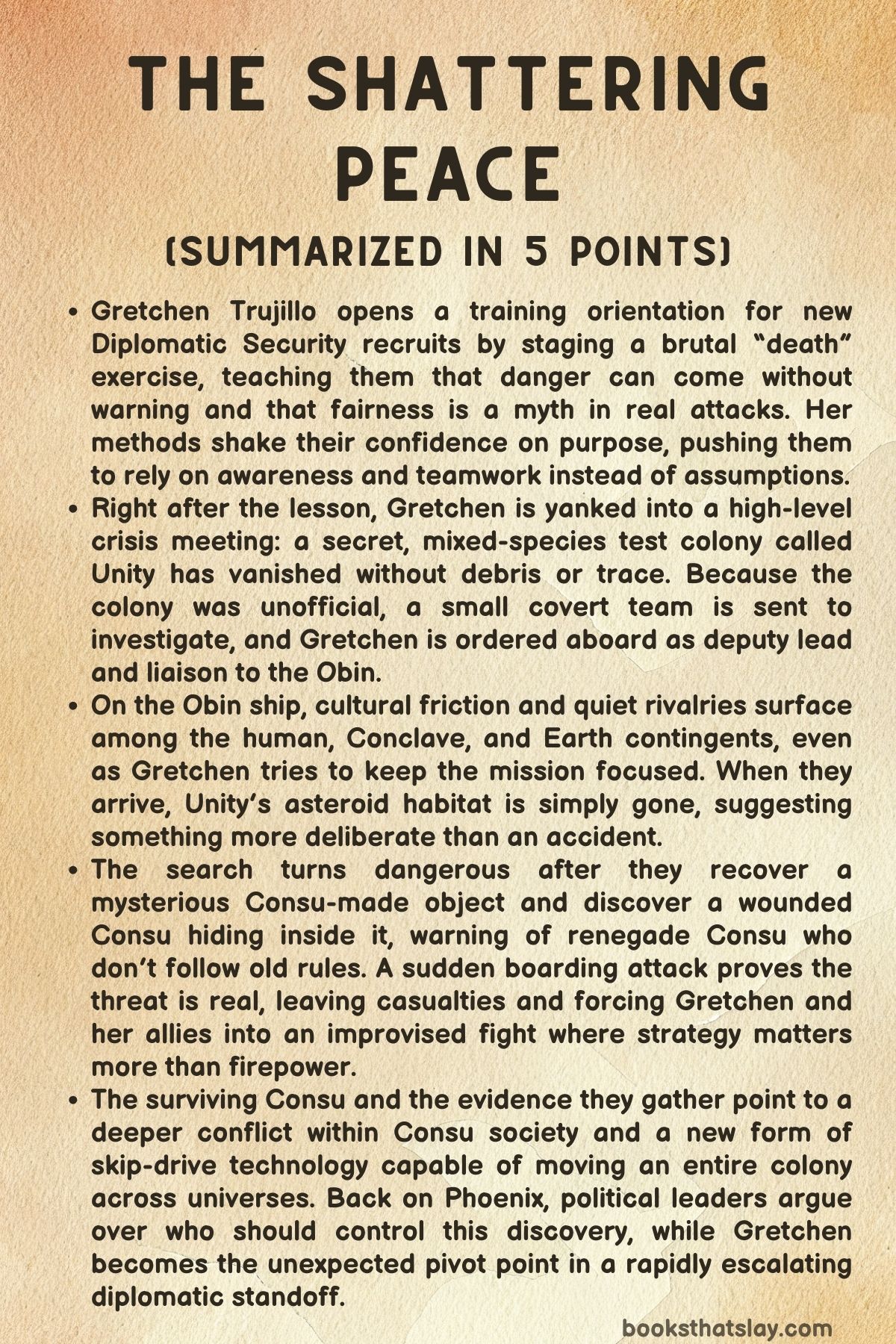
Gretchen Trujillo opens the story running orientation for six new recruits to the Colonial Union Diplomatic Security Force. She shocks them by announcing she will kill them today, then “shoots” each one with nanobotic paint rounds that stamp their bodies with glowing death marks.
The recruits are unharmed, but the point lands hard: danger is real even in safe places, and attackers never play fair. She repeats the lesson again and again, forcing them to feel how quickly hesitation and assumptions get people dead.
She outmaneuvers the strongest trainee, disarms the former soldier among them, and finishes by explaining the obvious truth they missed—numbers only matter if you work together. Gretchen isn’t even a combat teacher; she’s an Obin-desk analyst picked precisely because she looks like the last person you’d expect to be lethal.
As she leaves the training room, Assistant Deputy Undersecretary Hector Barber hustles her toward an emergency meeting. Gretchen detours to check in with Ran, her Obin assistant.
Ran—an artificial consciousness housed in a spider-giraffe-like body—reports frantic calls from Janine Chu-Ward, the deputy undersecretary, and from Gretchen’s father, Representative Manfred Trujillo. In a sealed conference room Gretchen finds senior Colonial Union and Earth officials, plus a Conclave representative.
A tense debate breaks out over why she’s there, but her qualifications win out: she leads Obin analysis, has field credibility from the Roanoke settlement, and knows the Consu better than most living humans.
They reveal the crisis. Under the table, the three powers built Unity, a fifty-thousand-person experimental colony inside an abandoned Obin hollowed asteroid in the Karna-Hlaven system.
Only five thousand residents are human; the rest are Conclave species. Unity was meant to be a quiet proof-of-concept for peaceful mixed colonization.
Two days ago its daily skip drone failed to arrive, and a follow-up probe found the asteroid missing from orbit—no debris, no dust, no gravitational trace. Because Unity never officially existed, the response must stay covert.
A small tripartite mission is being assembled aboard an Obin ship, and Gretchen is ordered to go as deputy lead and Obin liaison. Her father privately adds another reason: Roanoke veterans live on Unity, including Dr. Magdy Metwalli, Gretchen’s former partner. She’s being given a chance to find him alive—or learn what happened.
On the Obin ship, Gretchen keeps herself accessible in the common area so alien teammates can approach without fear. A translation mishap leads four Garvinn security officers to say they want to “probe” her; after the confusion clears, they poke her arm with friendly curiosity, fascinated by humans’ softness and combat reputation.
Gretchen also meets Earth delegates who know Roanoke through rumor and a flashy film. The conversation stirs old grief and highlights how years of political separation fractured friendships Gretchen once thought permanent.
A small incident on the ship exposes another fault line. Colonial Union security chief Bradley King brags he can beat a Garvinn in a fight.
Gretchen arranges a friendly grappling match and watches Tav, a Garvinn officer, drop King almost instantly three times, even after King tries a cheap attack. Ran explains the biology: Garvinn reaction speed makes human timing look slow.
Gretchen then challenges Tav herself—not to prove strength, but adaptability. She distracts him with chairs, closes distance before he resets, and uses observed balance cues to bring him down.
The lesson for everyone is clear: overconfidence is a species-level weakness.
When the ship reaches Karna-Hlaven, Unity is gone. The mission searches for days, turning up nothing: no propulsion signatures, no construction dust, no hidden gravity pocket, not even the gravity well an asteroid should leave.
With time running out, scientist Bethany Young finds a faintly cloaked object drifting toward the system’s star. A probe collapses the cloak and reveals a warm, seamless prism made of exotic bioceramic-metal, closest in composition to Consu material.
The Obin bring it aboard and chill it to near freezing. Gretchen and Ran enter the cold bay and discover that when Gretchen knocks, the prism opens into a tunnel.
Inside lies an injured Consu. It warns that Consu heretics are coming to seize it, that they’ll kill everyone if they find it, and that it will only explain Unity’s fate if Gretchen shelters it.
An incoming ship alarm cuts the bargain short.
A Consu vessel appears. A boarding transport slices through the hull and twelve heretic Consu storm in.
Garvinn defenders fire, but a sapper field makes their rifles burst in their hands, instantly neutralizing firearms—exactly the nightmare tactic Gretchen remembers from Roanoke. Bertk, a Garvinn officer, sacrifices himself to bait half the invaders into a cargo bay the captain vents to space.
With six heretics left, Gretchen and Ran cut gravity; the Consu float helplessly while they raid the transport. Ran kills the pilot and smashes the field’s power core.
Gravity snaps back, human guns work again, and the fight turns brutal. One heretic decapitates King and charges for the prism with an explosive.
Gretchen cuts gravity once more, body-checks the Consu in zero-g, then restores gravity at the last instant to slam it down. She’s badly slashed and blacks out as the attacker dies.
Gretchen wakes on Unity—alive. The vanished asteroid wasn’t destroyed; it was moved.
She reunites with Magdy, with Ran awkwardly blurting their past relationship in public. At the Obin hospital Gretchen tries to question the captured heretic Consu, whom she nicknames Bacon, but Obin guards block her until Ran terrorizes them in Obin speech and forces compliance.
Bacon calls Gretchen unclean and refuses answers beyond claiming another Consu is a traitor. Bacon is transferred to the cargo bay where the other Consu survivor, Kitty, is held.
Gretchen leaves hidden recorders and later watches as the two scream in a private dialect. From their argument, the team infers Kitty infiltrated Bacon’s faction and was supposed to use a prism command center and a new skip system to send Unity elsewhere.
Instead Kitty sent Unity into this universe and faked its disappearance, igniting a civil conflict among the Consu.
Bethany Young’s scans reveal the mechanism: 128 small satellites surrounding Unity, each hiding an advanced skip drive. Coordinated together, they could generate the field required to shift an asteroid—and the extreme universe jump may be a side effect of the scale.
The satellites’ computing needs look impossible, until Ran suggests Consu bodies themselves supply massive internal processing through distributed brain organs. A scan of a dead Consu confirms multiple brain-like structures throughout the body, apparently networked wirelessly.
Captain Mouse notes that such a system could be hacked.
Unity’s residents slide from denial into panic and anger. Food supplies are tight even with farms; they are on a starvation clock.
Tensions flare in a human pub when a drunk xenophobe tries to start a cross-species fight, and Gretchen and Ran shut it down by making clear only the instigator will pay. Gretchen sleeps, exhausted, knowing politics may be deadlier than any knife.
Back on Phoenix, Gretchen briefs leaders and presents a small cobalt-blue disk Kitty gave her. It is a summons keyed to Gretchen and a specific Consu; when Colonel Bridgers touches it, it burns him.
Gretchen explains the Consu she faced are on opposite sides of a civil war, and the disk compels Kitty’s parent to come. Officials admit they had quietly assumed Unity was destroyed—and some were relieved, because the experiment was failing.
Now Unity lives in another universe, starving, and Ran may still be marked for death if the colony returns.
Earth envoy Mateu Jordi hires a team to kidnap Gretchen and seize the disk. Gretchen, expecting betrayal, counter-ambushes with two trainees and captures them.
Bridgers reveals he allowed it to play out under surveillance, hoping to learn what the disk contained—because Kitty’s skip physics could become a civilization-ending weapon. Before the argument resolves, the Consu arrive in force: hundreds of ships violate Phoenix space, take Bacon and its module, and leave.
A lone Consu messenger confirms Gretchen holds the disk, orders her to wait for summons, warns Ran it is condemned, and then burns itself into ash.
Gretchen is taken alone to a Consu ship. Kitty’s parent—whom she names Fluffy—accepts the disk and explains its meaning: Kitty has ended its life journey and bequeathed its identity, authority, and obligations to Gretchen.
Under Consu law, heirship demands a duel to the death between Gretchen and Fluffy. If Gretchen forfeits or dies, Fluffy gains Kitty’s knowledge and political advantage.
Gretchen trains with Ran on Phoenix Station. Deputy Ambassador Clock reveals a hidden advantage: Kitty reprogrammed Ran via a consciousness harness, but the harness cached Kitty’s actions.
The Obin decoded the cache and learned to operate the return controls without killing Ran, keeping it secret so Kitty would underestimate them.
At the duel, Gretchen refuses blades. She declares Kitty’s command module her weapon, then at the signal tells Fluffy it is already dead.
She and Ran sprint into the module and activate a skip that drags Fluffy’s entire ship into an empty universe, stranding it forever. From an Obin bridge, Gretchen broadcasts victory and orders the Consu fleet out of Phoenix space.
They withdraw, bound by their own rules.
With Unity near collapse, Gretchen tows an Obin cargo ship of supplies through the module to Unity. Kitty protests, but Gretchen forces Kitty into the disabled module, vents the bay, and ejects the module into space to die—removing the last Consu threat and preventing the physics from spreading back home.
Unity is saved, but Gretchen tells the colonists they cannot return to their original universe; the new skip method would eventually enable genocide there. Instead, Obin support helps them use the satellite network to locate a habitable planet for permanent settlement.
Gretchen later reveals to Magdy that the planet is Earth itself—an Earth in this new universe, offering a second start built on the lessons of everything they survived.
Characters
Gretchen Trujillo
Gretchen is the gravitational center of The Shattering Peace, and Scalzi frames her as a diplomat who survives by thinking like a soldier without letting soldier-thinking rule her. Her opening “kill them to teach them” orientation isn’t sadism; it’s a philosophy of threat perception and a statement about her own identity: she’s an analyst by title, but is dangerous because she anticipates danger.
Across the mission, Gretchen repeatedly occupies the uncomfortable middle ground between factions — Colonial Union, Obin, Earth, Conclave species, and eventually the Consu — and her skill is not just in choosing sides but in holding space between them long enough to extract truth. She’s also emotionally complicated: a daughter navigating a powerful father’s shadow, a former Roanoke settler who still carries that trauma, and a professional trying to keep grief and nostalgia from shaping policy.
Her arc turns on adaptability. She beats Tav not by being stronger, but by observing and changing tactics; she confronts Consu not by matching ritual strength, but by exploiting their assumptions and the physics they underestimate.
The final duel shows her at peak form: she refuses the Consu’s definition of honor, chooses the battlefield, and wins through lateral diplomacy-as-war. Gretchen ends the story transformed into a political anomaly — a human Consu heir — but still fundamentally herself: a person who uses power to prevent larger violence, even when it costs her relationships and a way home.
Ran
Ran begins as a quietly comic figure, an Obin assistant with social misfires and blunt honesty, but steadily reveals itself as one of the story’s most critical moral and strategic agents. Its artificial consciousness and Obin cultural wiring make it literal-minded, which produces awkward moments about touch and sex, yet those same traits let Ran speak truths humans won’t.
Ran’s loyalty is complex: assigned covertly as Gretchen’s bodyguard, it grows into genuine partnership, demonstrating care through competence rather than sentiment. Ran embodies the Obin worldview of strict utility, but it is not cold; it experiences stress, guilt, and even shutdown after terrifying Obin guards into compliance.
In the wider plot, Ran is a living key to Consu technology, a reminder that knowledge often resides in the “supporting” characters. The Consu marking Ran for death makes it a sacrificial figure in political calculus, and the fact that Gretchen refuses to accept that sacrifice underscores their bond.
Ran’s final role is both tactical and symbolic: it helps Gretchen win not by amplifying her violence, but by enabling her strategy, and then it survives because the Obin quietly subvert Consu expectations. Ran stands for the theme that personhood isn’t about species or biology but about agency, loyalty, and the right to not be treated as expendable.
Manfred Trujillo
Manfred is a father and a politician first, a man whose love is real but filtered through institutional pragmatism. He pushes Gretchen into the mission partly because she’s the best Obin liaison available, but partly because Unity includes people he cares about — especially Magdy — and he wants his daughter to have a chance at saving someone who once mattered to her.
Manfred’s private confession later is revealing: he privately expected Unity to be dead and recognizes that some leaders preferred that outcome. This makes him morally gray rather than villainous; he isn’t celebrating tragedy, he’s acknowledging political relief at a failed experiment ending cleanly.
His role in Gretchen’s life is similarly double-edged: he advocates for her competence against accusations of nepotism, yet his presence ensures those accusations will never fully vanish. Manfred functions as the book’s lens on realpolitik: even well-meaning leaders can become complicit in hoping inconvenient people disappear.
Hector Barber
Hector is a small but telling portrait of the professional bureaucrat who lives in the corridors between crises. As assistant deputy undersecretary, he knows where the pressure points are, how bosses feel before they speak, and how to move people quickly through systems that are usually slow.
His interactions with Gretchen show respect mixed with urgency; he’s not her friend, but he’s also not a cynical operator. Hector’s main narrative job is to escort the reader from the shock of Gretchen’s training room into the higher-level machinery of government, and to show how even insiders can be blindsided by secrets kept “off the books.
Janine Chu-Ward
Janine is the face of institutional anxiety and controlled anger. She is upset not just because Unity vanished, but because its vanishing threatens a fragile political architecture and exposes a secret program to catastrophic embarrassment.
Her presence in the meeting where Gretchen is drafted underscores the political cost of the mission: Janine needs competence, discretion, and someone who can talk to Obin without causing an incident. She represents the high-wire act of diplomacy in The Shattering Peace — leaders compelled to gamble on people like Gretchen because procedure can’t handle what’s happening.
Undersecretary Zawadi Mbalenhle
Zawadi is a steadying institutional force: cautious, formal, and deeply aware that every decision will echo across species and governments. She doesn’t dominate scenes, but her authority gives shape to the stakes, especially in Phoenix debriefings where panic could easily become militarism.
Zawadi’s role is to embody the Colonial Union’s attempt to act like a legitimate interstellar polity rather than a conquering army, even while being surrounded by those eager to slide back into old war habits.
Caspar Merrin
Merrin, as mission head, functions as a pressure-testing counterpart to Gretchen. He is competent, tired, and conscious of deadlines that diplomacy can’t delay.
Merrin’s frustration with Gretchen’s withheld Consu intel is justified, and importantly the book doesn’t soften that conflict; it uses it to show how even allies damage trust when they play information too close. Merrin’s two-week timer before cover stories begin is one of the clearest expressions of the story’s political reality: truth has an expiration date when governments need narratives.
Fris
Fris is the Garvinn leader who brings tactical clarity to chaos. Where many humans posture, Fris analyzes.
Its willingness to explore multiple hypotheses for Unity’s disappearance and to act decisively during the boarding attack shows a commander balancing curiosity with survival. Fris also highlights a recurring Scalzi theme: species with different bodies bring different advantages, but good leadership is still recognizable across biology.
Fris respects Gretchen’s competence, uses her when necessary, and doesn’t indulge human arrogance.
Tav
Tav is the Garvinn Gretchen uses to puncture Colonial Union bravado. Tav does not need to boast; its physical and neurological advantages make short work of King, and it wins without malice.
Yet Tav is not a brute mechanism. It is curious about humans, polite after misunderstanding, and open to being part of Gretchen’s demonstration.
When Gretchen beats Tav by distracting, adapting, and exploiting observational learning, Tav becomes a measuring stick: it shows that humans survive not by raw superiority but by improvisation. Tav therefore represents both Conclave strength and the humility humans must learn.
Gil, Eyah, and Bertk
These Garvinn officers flesh out Tav’s unit and the Garvinn culture of directness and curiosity. They treat Gretchen as an interesting being rather than a diplomatic figurehead, which helps normalize interspecies interaction beyond sterile protocol.
Bertk’s sacrifice during the heretic boarding is a defining moment: it shows loyalty to the mission and a willingness to die for a mixed-species crew, reinforcing the idea that Unity’s experiment was not naïve — it was already producing real solidarity.
Bradley King
King is the story’s clearest avatar of Colonial Union arrogance and insecurity. His boasting about fighting Garvinns is less about actual belief and more about asserting dominance in a setting where humans are no longer physically top-tier.
His humiliation by Tav and death at the hands of a heretic Consu complete a sharp narrative function: pride kills, especially when it blinds someone to the true threat. King is not purely a villain; he’s a casualty of an old human story about being the toughest in the room, a story that no longer matches reality.
Feruza Olimova
Feruza is a scientist anchored in the human side of the tripartite alliance, and she represents disciplined, collaborative inquiry. Her role in monitoring Consu arguments and interpreting partial translations underlines the book’s reliance on science as a diplomatic tool.
Feruza is less a dramatic personality than a dependable intellect, showing how essential noncombat specialists are when violence and politics collide.
Bethany Young
Bethany is one of the mission’s most important problem-solvers. She discovers the cloaked prism, reads the satellite swarm with remote sensors, and keeps pressing for concrete data when others spiral into theory or blame.
Bethany also illustrates the ethical tightrope of scientific curiosity: her work has the potential to unlock a genocide-capable physics, and the narrative uses her competence to make that risk feel frighteningly plausible. Socially, she is conscientious, apologizing to Gretchen after an accidental emotional jab, which marks her as empathetic as well as brilliant.
Ong Vannak
Ong is a quiet diplomatic presence among the Earth delegation, serving mostly to broaden the cultural and political texture of the human side. In conversations about Roanoke and the Perrys, Ong reflects how historical memory is unevenly distributed: Earth delegates know the myth, Gretchen knows the lived cost.
Ong’s function is to show Earth’s attempt to re-enter interstellar space with interest and awkwardness, rather than mastery.
Mateu Jordi
Jordi is a polished representative of Earth’s strategic self-interest, and one of the book’s principal human antagonists. His early accusation of nepotism toward Gretchen is less about fairness than about undermining a Colonial Union voice he can’t control.
The kidnapping scheme exposes his deeper motive: control of Consu knowledge for Earth’s advantage. Jordi is dangerous because he sees a civilization-level weapon and chooses possession over restraint.
Unlike King’s arrogance, Jordi’s is calculated, institutional, and willing to destabilize alliances to gain leverage.
CDF Colonel Bridgers
Bridgers is the military realist whose paranoia is almost rational. He recognizes immediately what others hesitate to say: new skip physics is existentially dangerous.
His surveillance of Jordi and willingness to allow a kidnapping attempt to proceed show a ruthless utilitarian streak, but one the narrative frames as born from fear of species-wide annihilation. Bridgers represents the military’s perpetual dilemma in The Shattering Peace: protect civilization without becoming the thing that ends it.
Deputy Ambassador Clock
Clock is a subtle engine of the plot. Their rescheduled meeting request foreshadows that they are watching the Unity situation more closely than public channels suggest.
Clock’s later revelation about Ran’s reprogramming and the harness cache is crucial, because it provides the workaround that saves Ran and enables Gretchen’s final maneuver. Clock embodies diplomacy at its craftiest: withholding a secret not for power, but to keep all options alive until the right moment.
Captain Mouse
Mouse is a combat leader who, unlike King, matches confidence with competence. In the boarding action, Mouse’s command of gravity control, venting maneuvers, and timing is decisive.
Mouse also has an analytical eye, noticing the Consu brain layout is a security weakness, which foreshadows how the Obin might exploit Consu internals. Mouse is the example of a soldier who has adapted to a universe where technology, physics, and alien tactics change the rules every day.
Dr. Magdy
Magdy is Gretchen’s emotional mirror and the human face of Unity’s stakes. As a Roanoke veteran and former lover, he carries shared history with Gretchen, but he’s not reduced to romance; he’s a doctor with practical urgency about starvation, morale, and survival.
His banter with Gretchen shows unresolved hurt mixed with affection, and their renewed intimacy is less a tidy rekindling than a moment of mutual vulnerability under apocalypse-grade stress. Magdy’s tour of the agri-park, his concern for timelines, and his refusal to posture make him the book’s grounded conscience.
He helps Gretchen stay human while she becomes something politically inhuman.
Keiward Eongen
Keiward is part of the scientific trio parsing the Consu dialect fight and piecing together political history from scraps. Their main narrative role is to demonstrate how interpretation is collective work, especially when direct knowledge is denied.
Keiward helps turn hostile alien theater into usable intelligence.
Arturo Lavagna
Lavagna provides the technical leap that makes the satellite swarm comprehensible. His discovery that the drives are vastly more advanced than modern tech reframes Unity’s disappearance from “attack” to “engineering miracle with terrible implications.
” Lavagna is methodical, fascinated, and slightly unnerved, embodying the scientist who realizes that understanding something might be as dangerous as not understanding it.
Ghen Horvni
Ghen represents speculative science at the edge of what the alliance can handle. Their antimatter-tapping hypothesis shows imaginative reach, but also highlights the limits of current models.
Ghen functions as a reminder that even smart people are guessing when the Consu are involved, and that dangerous breakthroughs can arrive before anyone is ready to explain them.
Dr. Gurrrrv
Gurrrrv is the moral brake on scientific intrusion. As chief medical examiner, they are less concerned with curiosity than with survival history: species who disrespect Consu dead get erased.
Gurrrrv’s refusal to perform an autopsy is a moment where professional ethics intersect with interstellar anthropology. They are cautious not because they fear knowledge, but because they know the price knowledge can demand.
Councilwoman Haimi Bava
Bava is Unity’s political custodian and a practical leader under siege. She balances colonist anger, cross-species tension, and the need for Obin cooperation.
Her decision to allow a noninvasive scan, then to back Obin custody of bodies, shows a leader who trades ideal transparency for collective safety. Bava isn’t sentimental about Unity’s dream; she’s focused on keeping it alive.
Paulo
Paulo is a localized antagonist whose xenophobia acts as a microcosm of Unity’s broader strain. He’s not a strategic threat like Jordi or Consu heretics, but he is a social infection, the kind that can fracture a starving colony from within.
Gretchen’s handling of him — controlled force, narrow accountability, no escalation — demonstrates her diplomatic instincts in the most intimate arena: keeping frightened humans from making their fear everyone’s problem.
Arvik Hasid
Arvik is a hired operative, and his brief role sharpens the story’s theme of moral outsourcing. He’s not ideologically driven; he’s a tool in Jordi’s plan.
His capture and confession show how easily political actors recruit violence to gain knowledge, and how Gretchen’s caution about threats remains justified even at home.
“Kitty” (Consu heretic)
Kitty is a Consu outcast whose actions drive nearly every major event. As a heretic, Kitty rejects Consu orthodoxy not by becoming moral, but by becoming strategic in a new way.
Kitty orchestrates Unity’s displacement, not to save it, but to fulfill factional goals within a civil war. Yet Kitty is also capable of bonding, even love, as seen in its history with Bacon and its decision to bequeath identity to Gretchen.
That inheritance is both gift and trap: Kitty forces Gretchen into Consu law, making a human carry Consu obligations. Kitty’s end is grim and fitting; it cannot understand the difference between literal death and political death, and Gretchen exploits that gap.
Kitty represents how revolutionary actors can still be tyrannical, and how power without empathy remains lethal even when it opposes worse power.
“Bacon” (captured Consu)
Bacon is the Consu captive whose pride is as enormous as its body. It is wounded, furious, and contemptuous of humans, clinging to Consu superiority even while dependent on alien mercy.
Bacon’s refusal to share knowledge unless on its own terms illustrates Consu culture: information as dominance. Yet Bacon’s presence also cracks Consu mystique.
Once imprisoned, it becomes a source of accidental truth through its arguments with Kitty. Bacon is simultaneously victim, aggressor, and political pawn; its parent’s retrieval underscores the Consu’s internal stakes, and its watching of Gretchen’s duel hints at a dawning recognition that humans can be unpredictable equals, not guided pets.
“Fluffy” (Bacon’s parent)
Fluffy is Consu authority in its purest, chilling form: calm certainty backed by fleets. It arrives not to negotiate, but to enforce law and reclaim property.
Fluffy’s explanation of the disk as a life-command shows how Consu treat identity as transferable office, and how inheritance is inseparable from violence. Fluffy is not personally sadistic; it is systemically inevitable, a creature so aligned with its rules that it cannot imagine an outcome except duel.
Gretchen’s victory over Fluffy is less about killing a monster and more about breaking a legal machine by refusing to play inside it.
Jensen Aguilera
Jensen is the recruit who first challenges Gretchen’s threat and gets “killed” for it. His brief appearance is significant because he embodies normal human disbelief in safe spaces.
Gretchen uses him as the first lesson: the universe will not wait for you to accept danger before it acts.
Owais Hartley
Hartley is the vocal critic of Gretchen’s unfair training methods, and therefore the second proof of her point. His insistence on rules and fairness makes him sympathetic, but also naive in the environment he’s entering.
Gretchen’s repeated “kills” of Hartley train him, and the reader, to see that moral arguments don’t stop ambushes.
Kostantino Karagkounis
Kostantino is the physically imposing recruit whose hesitation reveals another blind spot: thinking size equals safety. Gretchen topples him with a grotesquely simple tactic, demonstrating that preparedness beats physique.
He represents the kind of confidence that cannot survive first contact with real asymmetry.
Faiza Vega
Faiza is the recruit with real combat background, and her defeat by Gretchen emphasizes the story’s broader claim that experience without contextual awareness becomes liability. Faiza expects a certain kind of fight, from a certain kind of opponent, and Gretchen shows her that danger doesn’t announce itself in familiar uniforms.
Themes
Trust, Threat Perception, and the Cost of Complacency
From the opening orientation stunt to the final duel, The Shattering Peace keeps returning to how people decide what is dangerous and what is safe. Gretchen’s first lesson to the recruits is brutal precisely because it is theatrical: the “kills” are fake, but the emotional shock is real.
The point isn’t to toughen them up for its own sake; it is to rewire their instincts away from comfort-based assumptions. Over and over, characters face situations where the surface signals peace or normalcy while the underlying reality is volatile.
Diplomatic duty, supposedly the clean and controlled side of empire, is framed as a space where violence can erupt faster than anyone is prepared for. The recruits’ expectation of fairness mirrors later institutional expectations that treaties or pauses in colonization equal stability.
Unity Colony is built on the belief that a political agreement can suspend historical patterns of conflict. Its disappearance exposes how fragile that belief is, and how quickly unseen actors can turn a “test case” into a battlefield.
People keep underrating threats because they are attached to narratives of progress: the Colonial Union wants peace to mean the danger is over; Earth wants to believe diplomacy makes colonial experiments morally safer; Conclave species want to believe coexistence proves their maturity. The Consu heretics shatter all of those stories in a single boarding action, showing that violence doesn’t need permission to return.
Even after survival and rescue, the temptation to relax persists—officials privately prefer Unity’s destruction because it would make their political lives simpler. Gretchen’s arc pushes against that complacency.
Her approach is not paranoia for its own sake, but disciplined attention: she treats mistranslations, cultural misunderstandings, and diplomatic arrogance as threat vectors because small errors scale into lethal outcomes. The theme lands hardest at the end, when the new skip physics could reopen old wars on a worse scale.
The choice to stay in a new universe isn’t idealism; it is threat perception matured into policy, a refusal to pretend that peace is the default condition of power.
Power, Arrogance, and the Ethics of Control
Nearly every major group in The Shattering Peace believes it has the right to steer others, and the story keeps exposing what that belief does to both rulers and ruled. The Colonial Union’s quiet off-the-books colony is a prime example: officials frame Unity as a noble experiment, but its secrecy reveals the real logic of empire.
Peace is treated like a managerial opportunity rather than a shared moral project, and colonists become variables in a political test. Even well-meaning leaders slip into this mindset.
Manfred Trujillo wants to save people he cares about, but he also treats Gretchen as an asset to deploy, mixing parental love with institutional leverage. The Earth delegation arrives with its own superior posture: Jordi dismisses Gretchen as nepotism at the moment when her expertise is essential, and later tries to kidnap her to seize knowledge.
That act lays bare a pattern familiar in the series’ universe: political actors rationalize coercion as necessity, and “necessity” nearly always means consolidating advantage. The Conclave members are not exempt.
Garvinn officers may be personally respectful, yet they come from cultures shaped by conquest and armed prestige, and their instinct is still to measure status through dominance. The Consu embody control at its most extreme.
Their self-image as caretakers of lesser species is not a quirk; it is the purest statement of imperial entitlement. Even internal Consu conflict is about who gets to command and who deserves to inherit authority.
When Kitty’s bequest makes Gretchen an heir, the exercise is not generosity but a rigged mechanism of succession that forces violence to maintain hierarchy. What makes the theme bite is that coercion is not shown only in distant villains.
It appears in casual boasting, in bureaucratic cover-story planning, and in the subtle ways characters assume they know what others need. Gretchen’s role is to puncture that arrogance without pretending she stands outside power.
She is a diplomat of an empire, an ex-colonist, and a trained fighter; she benefits from the same structures she critiques. Yet her decisions consistently aim to limit the harm that power tends to justify.
She checks King’s bravado not to embarrass him but to protect mission cohesion. She refuses a simple revenge path against Jordi because the real danger is the politics that produced him.
The final ethical stance—keeping Unity in a new universe to prevent future genocide—reads as the book’s clearest rejection of power-as-entitlement. It is not a triumphal ending but a boundary placed on what any faction, even her own, should be allowed to control.
Identity, Inheritance, and Becoming Someone Else’s Responsibility
Gretchen’s journey in The Shattering Peace is framed less as a rise to authority than as an increasingly complicated negotiation with what she owes to others and what others claim she is. She begins as a professional analyst and diplomat whose competence is constantly filtered through lineage: being Manfred Trujillo’s daughter is both a door-opener and a stain others want to apply.
Jordi’s accusation of nepotism is the obvious form of this, but the more important point is how quickly public identity becomes a battlefield. Gretchen is forced to justify not only her skill but her right to be present, as if personal history invalidates expertise.
That pressure continues with Roanoke. She is remembered through a mythic past—Zoë, Enzo, the film—and those memories shape how people approach her, even when she wants to operate in the present.
Her reconnection with Zoë after twenty years is not sentimental closure; it is a reminder that identity in this universe is shaped by embargoes, political separation, and the stories that survive those gaps. The Consu inheritance twist makes this theme literal.
Kitty’s disk is not a gift of knowledge without cost; it is a transfer of personhood, authority, and obligation. By Consu law she becomes a bearer of Kitty’s political weight, whether she wants it or understands it.
Identity here is shown as something that can be imposed, weaponized, and used to trap people into roles designed by others. Yet the story also shows Gretchen actively remaking those roles.
She refuses the traditional duel weapons because she rejects the premise that Consu identity must be proven by ritual slaughter. She chooses a strategy that splits “being an heir” from “being Consu,” redefining inheritance as responsibility to protect lives rather than a license to dominate.
Ran’s situation parallels this. As an artificial consciousness, Ran is repeatedly treated as a tool—assigned bodyguard, reprogrammed by Kitty, threatened with death by Consu law.
But its identity is not static; it changes through relationship and stress, even to the point of emotional collapse after confronting Obin guards. The book insists that identity is lived inside systems of power, not outside them.
The closing move—settling on an Earth that is not their Earth—extends the theme to an entire population. Unity’s people lose the identities they expected to carry home and must accept a future where their “origin universe” is more memory than destination.
What they inherit is not land or triumph, but the obligation to build a society without exporting catastrophic knowledge. In this way, the novel ties personal identity to collective ethics: who you become is inseparable from what you decide to safeguard.
Cross-Species Communication and the Fragility of Understanding
Much of the tension in The Shattering Peace comes not from overt hostility but from the ways meaning slips between cultures. The Garvinn “probe” misunderstanding is a small, almost comic moment, yet it signals how easily fear can be triggered by a single mistranslated word.
That fragility matters because their mission depends on trust across species under pressure. Even when everyone has good intentions, assumptions distort perception.
Humans see Garvinn as bulky fighters and underestimate their reflexes; Garvinn view humans as soft yet oddly formidable; Obin interpret social norms through utility; Consu interpret all other species through a hierarchy that makes genuine dialogue feel impossible. The shipboard grappling scene becomes a physical proof of this problem.
King’s arrogance isn’t only personal ego; it is the cultural habit of thinking your own benchmarks define reality. Gretchen’s win against Tav is not a “humans are special” moment so much as a demonstration that learning another being’s movement and attention patterns is a kind of translation.
She reads Tav correctly by watching, adapting, and refusing to rely on species stereotypes. This theme expands when Unity disappears and the delegations try to infer what happened from the absence of evidence.
Science becomes another form of translation: they interpret physics clues the way diplomats interpret gestures, both limited by what their frameworks allow them to imagine. The Consu prism and the satellite swarm show how incomplete shared knowledge is.
Even the best scientists can only approximate what they are seeing because the technology comes from a civilization that refuses to teach, and sometimes actively punishes curiosity. The private argument between Bacon and Kitty is crucial here.
The translation is imperfect, the dialect layered, the emotional stakes opaque, and yet meaning still leaks through. The team relies on inference, context, and pattern recognition to build a coherent picture.
That process mirrors diplomacy itself: you rarely get clean statements; you assemble understanding from fragments. Ran’s blunt sexual comment on the colony transport adds another angle.
It is not malicious—it is an Obin AI applying literal logic to human history. Gretchen’s correction is not just etiquette.
It marks the boundary between knowledge and intimacy, between what is true and what is socially safe to say, reminding us that communication isn’t only about facts but about norms that protect dignity. The climax depends on this theme too.
Gretchen survives Consu law by understanding it better than the Consu expect her to, exploiting their rules without accepting their worldview. And when she tells Unity they cannot return home, she is translating an abstract, terrifying risk into a political reality a frightened population can accept.
The novel’s quiet claim is that survival in a multicultural universe doesn’t come from perfect mutual comprehension—it comes from relentless, careful effort to reduce misunderstanding before it turns lethal.
Loyalty, Betrayal, and the Limits of Alliance
The story’s political backdrop is a formal peace, but The Shattering Peace is skeptical about what alliances actually mean when interests diverge. Unity itself is built as a loyalty test between three powers that recently fought each other.
Its secrecy implies that trust is still provisional: the agreement is public, but the real experiment is hidden because leaders doubt their partners’ patience and their own citizens’ approval. When the colony vanishes, the investigative mission becomes a smaller version of that same fragile coalition.
Each faction arrives with a stake, a fear, and a contingency plan for blame. That instability becomes explicit after days of searching without results.
Merrin’s deadline is not framed as a moral clock but a political one: once leaders start drafting cover stories, truth becomes secondary to alliance management. The Consu civil war takes betrayal to a higher scale.
Bacon and Kitty’s history—once lovers, now enemies—shows betrayal not as melodrama but as strategy. Kitty infiltrates Bacon’s faction, learns its methods, and then uses that access to redirect Unity.
Bacon’s rage is personal, but also political: betrayal is the tool by which Consu factions gain leverage in a species that defines honor as dominance. The human and Conclave response to this dynamic is messy because they aren’t outside it.
Gretchen withholds intelligence about Consu presence in Karna-Hlaven, partly from caution and partly from habit, and that withholding nearly costs lives. Jordi’s attempted kidnapping is betrayal masked as statecraft, and Bridgers’ decision to let it play out is betrayal nested inside betrayal.
Both men justify their actions through the same logic: knowledge is too dangerous to let allies hold first. The twist is that the book does not pretend alliances can be purified by better intentions.
It treats mistrust as a predictable outcome of unequal power, historical trauma, and strategic temptation. What matters is how people handle that reality.
Gretchen doesn’t respond by demanding impossible purity; she responds by designing outcomes that reduce the incentive to betray. Her duel strategy removes Fluffy’s claim to Kitty’s work without requiring a slaughter that would strengthen another Consu faction.
Her decision to keep Unity in a new universe removes the most destabilizing knowledge from the old power game entirely. At the interpersonal level, loyalty is portrayed as earned through action rather than declared through titles.
Ran’s steadfast protection, Magdy’s willingness to help despite their history, Tav’s respect after being fought fairly—these moments show alliances that grow from shared risk. The theme lands in a sober place: betrayal will keep happening wherever power can be gained by it, but loyalty can still exist as a deliberate practice.
The “shattering” of peace is not the end of alliance; it is the test that reveals which bonds are merely convenient and which are chosen at real cost.