A Sea of Unspoken Things Summary, Characters and Themes
A Sea of Unspoken Things by Adrienne Young is a moody mystery about grief, memory, loyalty, and the secrets that can bind a small town for decades. The story follows James Golden, an artist who returns to her isolated hometown after the sudden death of her twin brother, Johnny.
What looks like a hunting accident soon becomes something far more troubling. As James looks into Johnny’s final days, she is forced to face the past she ran from, including an old death, a lost love, and the difficult truth that loving someone does not mean fully knowing them.
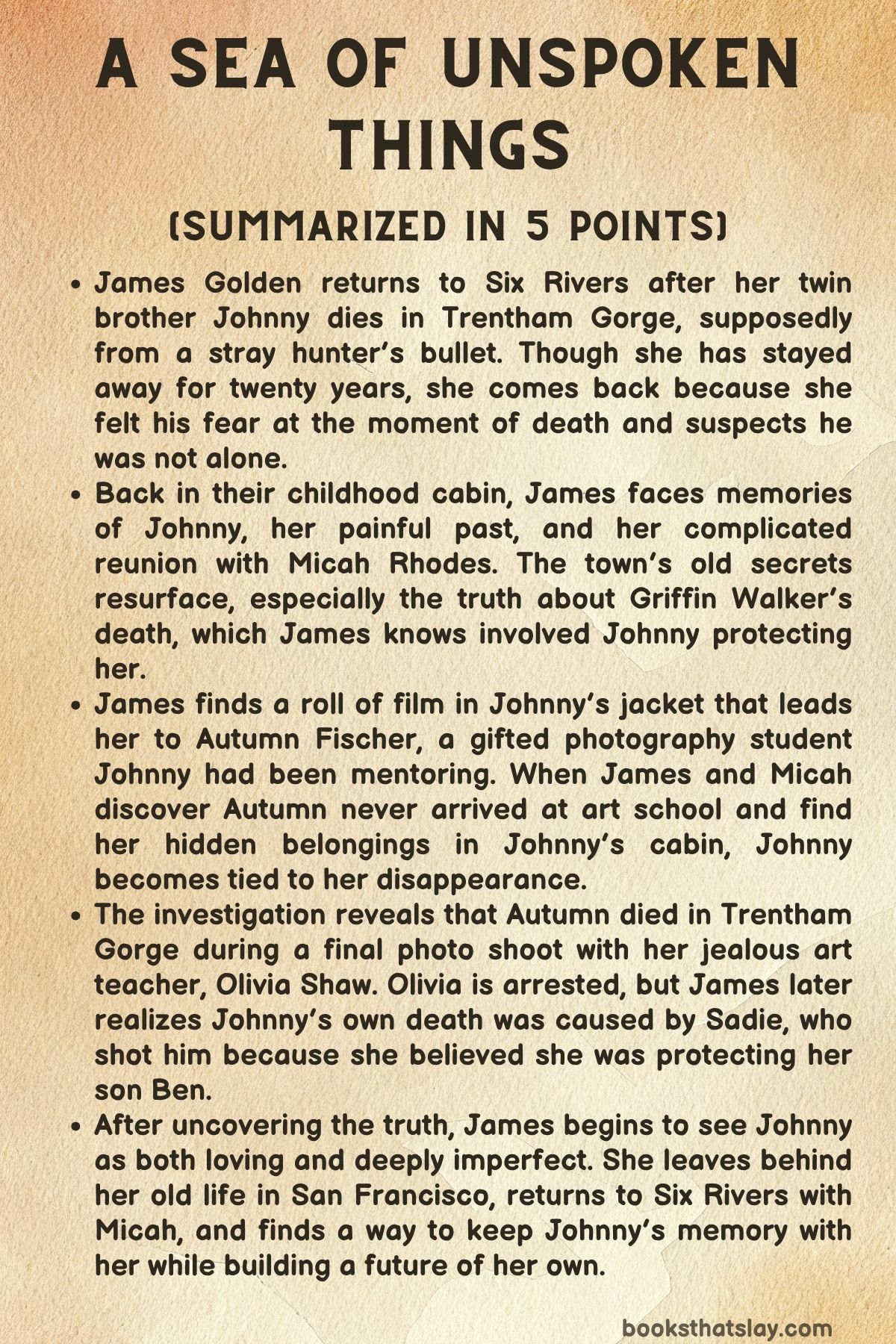
Summary
James Golden has spent twenty years away from Six Rivers, the remote logging town where she and her twin brother, Johnny, grew up. She built a life for herself in San Francisco as an artist, far from the forest, the old cabin, and the painful memories that shaped her childhood.
But when Johnny dies in Trentham Gorge, supposedly from a stray hunter’s bullet while photographing owls for a conservation project, James is pulled back to the place she tried to leave behind.
Johnny’s death does not feel ordinary to her. As twins, James and Johnny shared a bond that was difficult to explain, and at the moment he died, she felt something was wrong.
She sensed his fear. She believed he was not alone.
That feeling stays with her as she returns to Six Rivers to handle his possessions and understand what happened in the final days of his life.
The cabin where they grew up is filled with Johnny’s presence. His work, his habits, and his unfinished life seem to wait for her in every room.
James is also reunited with Smoke, Johnny’s dog, and with Micah Rhodes, Johnny’s best friend and the man James once loved. Micah brings supplies and helps her settle in, but their reunion is strained.
They share too much history, and much of it remains unspoken.
The greatest shadow between them is the death of Griffin Walker, a popular local boy who died in Trentham Gorge when they were teenagers. The official story was that Griffin had been drunk and had fallen.
James, Johnny, and Micah all helped support that version of events. But James knows the truth is more complicated.
Griffin had threatened her, and Johnny had shoved him. Griffin’s death was the secret that changed everything.
Soon after, James left Six Rivers and did not return.
As James begins dealing with Johnny’s belongings, she speaks with Amelia Travis, the local ranger investigating his death. Amelia tells her that the shooting appears accidental.
The bullet likely came from an old, unregistered rifle, and because hunting season had brought people into the area, the case seems difficult to solve. Amelia gives James Johnny’s personal effects, including the jacket he was wearing when he died.
Inside the bloodstained jacket, James finds a roll of film labeled “TG 11/10,” meaning Trentham Gorge, November 10. That date is two days before Johnny died.
When James has the film developed, she finds a photograph of a pink backpack in the gorge. The image suggests Johnny saw or found something shortly before he was killed.
It also suggests that the official story of his death may be missing something important.
James begins looking through Johnny’s records and learns that he had been mentoring Autumn Fischer, a gifted high school photography student. Autumn had been accepted to Byron, the same art school James once attended.
Johnny had believed in Autumn’s talent so strongly that he paid part of her tuition. At first, everyone assumes Autumn has already left for San Francisco to begin school.
But James becomes uneasy when she cannot reach her.
Her concern grows when she discovers that Autumn never arrived in San Francisco. James and Micah search further and find Autumn’s backpack, phone, wallet, and other belongings hidden in Johnny’s cabin.
The discovery is disturbing. It makes it look as though Johnny knew Autumn was missing and may have been hiding evidence.
James struggles with the possibility that her brother, whom she loved deeply, may have been involved in something terrible.
James and Micah take what they have found to Amelia. Autumn is officially declared missing, and suspicion begins to settle on Johnny.
The town, which had first treated him as the victim of a tragic accident, starts to wonder whether he had harmed Autumn before he died. James feels torn between defending her brother and admitting that Johnny had always carried darkness in him.
She knew he was capable of violence, because she had seen what happened with Griffin. But she also knew his loyalty, his love, and his need to protect the people he cared about.
Attention turns to Ben Cross, the son of Sadie, who owns the local diner. Ben is believed to be Johnny’s son, though the truth has never been openly acknowledged.
Rhett Walker, Griffin’s brother, saw Autumn leaving Johnny’s cabin with Ben the night before she disappeared. Ben admits that he was jealous of Autumn’s relationship with Johnny.
He felt replaced by her and worried that people would misunderstand Johnny’s support of Autumn as romantic. He had taken a note from Johnny’s corkboard because he did not want people gossiping about them.
Still, Ben insists he did not hurt Autumn.
James keeps searching for answers. Eventually, she learns that Autumn’s final morning was spent with Olivia Shaw, the high school art teacher.
Olivia had taken Autumn to Trentham Gorge for one last photo shoot before Autumn left for Byron. Autumn was talented and on the edge of escaping Six Rivers, while Olivia felt trapped in the town and bitter over her own failed artistic dreams.
Autumn represented everything Olivia had wanted and lost.
When confronted, Olivia admits that Autumn fell from the cliffs while photographing a lightning-struck tree. Olivia claims it was an accident, but her own account is uncertain.
She is not fully able to say whether she pushed Autumn, failed to help her, or allowed the moment to happen because of envy and resentment. Amelia arrests Olivia, and the town begins to shift its opinion of Johnny.
Instead of seeing him as a suspect, people start to view him as someone who had been looking for Autumn and trying to uncover the truth.
James and Micah scatter Johnny’s ashes in the forest, giving him a farewell that feels connected to the land he never left. Later, at Johnny’s memorial in Sadie’s diner, another truth begins to surface.
Micah realizes something that does not fit: the diner had been closed during the weekend Johnny died, even though Sadie had claimed it never closed during hunting season. This small detail leads James to a terrible conclusion.
James realizes Johnny must have found Autumn’s backpack and understood that something had happened to her. He likely told Sadie, and Sadie panicked.
Because Ben had been seen with Autumn, Sadie feared her son might be responsible. To protect him, she followed Johnny to Trentham Gorge with an old hunting rifle and shot him.
She killed Johnny not because he had harmed Autumn, but because she believed he was a threat to Ben’s future.
When confronted, Sadie breaks down and admits the truth. She thought she was protecting her son.
Her confession reveals the final piece of the mystery and shows how fear, secrecy, and parental love can become destructive. Johnny died because he found evidence, and because Sadie acted before knowing what had really happened.
After the truth is revealed, James returns to San Francisco for her art show. Yet the city no longer feels like home.
The life she built there seems distant from the person she has become through her return to Six Rivers. She has faced the truth about Johnny, Griffin, Autumn, Sadie, and herself.
She has also reconnected with Micah, whose place in her life has never fully disappeared.
Micah comes to the gallery, and James chooses to return with him to Six Rivers. In time, she builds a new life there.
She is pregnant, living with Micah, and continuing her work as an artist. Her grief for Johnny remains, but it no longer traps her.
She accepts that Johnny was both flawed and beloved, capable of harm and worthy of love. She understands that losing him does not mean losing herself.
She can live without him while still carrying his memory, his influence, and their bond into the future.
Characters
James Golden
James Golden is the emotional center of A Sea of Unspoken Things, and her character is shaped by grief, guilt, memory, and the painful pull of the past. Her return to Six Rivers is not simply a practical visit to settle Johnny’s possessions; it is a forced confrontation with everything she has spent twenty years trying to escape.
James is deeply tied to her twin brother in a way that feels almost spiritual, as shown by her belief that she felt his fear and death as it happened. This connection makes her grief especially intense because Johnny is not just a sibling to her, but a part of her identity.
Throughout the story, James struggles with the difference between loving someone and fully understanding them. She wants to defend Johnny, but she also has to face the possibility that he kept secrets and made choices she did not know about.
James is also a character haunted by silence. Her past with Griffin Walker, Johnny, and Micah created a wound that never truly healed, and her decision to leave Six Rivers was an act of survival as much as escape.
She carries guilt over what happened in the gorge when they were teenagers, even though she was also a victim of Griffin’s threat and violence. This makes her return emotionally dangerous because the town is full of people who remember fragments of the past but not the whole truth.
As James investigates Johnny’s death and Autumn’s disappearance, she becomes more active and courageous. She is no longer only reacting to grief; she is choosing to search for truth, even when that truth may destroy the image she has of her brother.
By the end of the story, James’s growth lies in her ability to accept complexity. She learns that Johnny was neither innocent nor monstrous, neither purely a victim nor purely a protector.
This helps her understand herself as well. Her return to Micah and Six Rivers does not mean she forgets the pain of the past; instead, it shows that she has found a way to live with it.
Her pregnancy and continued art suggest renewal, but not a simple happy ending. James’s journey is about learning that love can survive truth, and that carrying someone with you does not mean being trapped by them.
Johnny Golden
Johnny Golden is one of the most complicated figures in the book because he is dead before the main events unfold, yet his presence dominates nearly every relationship and revelation. He exists through memory, evidence, rumor, and the emotional marks he left on others.
To James, Johnny is beloved, inseparable, and almost impossible to judge clearly. To the town, he becomes first a victim, then a suspect, and finally a tragic hero.
This shifting view of him shows how easily people reshape the dead according to what they need to believe.
Johnny’s character is defined by contradiction. He is protective of James, especially in the past when Griffin threatened her, but that protectiveness also led him to violence.
He shoved Griffin, and the secret surrounding that act shaped the lives of James, Micah, and Johnny for decades. In adulthood, Johnny appears to have become a quieter, more solitary man, connected to photography, the forest, Smoke, and his mentorship of Autumn.
His support of Autumn’s talent shows kindness and generosity, especially because he pays part of her tuition and encourages her escape from Six Rivers. At the same time, his secrecy creates suspicion after Autumn disappears.
The belongings hidden in his cabin make him seem guilty, even though the truth is more tragic and complicated.
Johnny’s importance in A Sea of Unspoken Things comes from the way he forces other characters to reveal themselves. His death exposes Olivia’s jealousy, Sadie’s fear, Ben’s insecurity, James’s unresolved grief, and Micah’s lingering loyalty.
Johnny is not presented as a flawless lost brother, but as a flawed person who loved deeply, acted impulsively, and carried secrets. His final role in the story is heartbreaking because he seems to have been trying to find the truth about Autumn when he was killed.
This makes him both a victim of violence and a symbol of how buried secrets can keep harming the living.
Micah Rhodes
Micah Rhodes is a character shaped by loyalty, restraint, and unfinished love. As Johnny’s best friend and James’s former love, he stands at the crossing point between James’s past and present.
His reunion with James is tense because both of them are carrying the weight of what happened years earlier. Micah is not simply a romantic figure; he is someone who stayed behind, lived with the consequences of silence, and remained connected to Johnny when James could not.
This makes his relationship with James emotionally layered because affection, resentment, guilt, and longing all exist between them at once.
Micah’s loyalty is one of his defining traits. He cares for Johnny’s dog, brings supplies to James, and helps her investigate even when the truth threatens to reopen old wounds.
He is steady in a story filled with uncertainty. While James is often overwhelmed by memory and instinct, Micah provides a grounded presence.
However, his steadiness does not mean he is untouched by pain. He also participated in the old lie about Griffin’s death, and that shared secret shaped the distance between him and James.
His love for her has survived, but it has matured into something quieter and more patient.
By the end of the story, Micah represents the possibility of returning without being destroyed by the past. His appearance at James’s art show is important because it shows that he is willing to meet her in the world she built after leaving Six Rivers, not only pull her back into the world she escaped.
Their final life together suggests healing based on truth rather than denial. Micah’s role is not to rescue James, but to stand beside her as she chooses where she belongs.
Autumn Fischer
Autumn Fischer is a tragic character whose life represents talent, escape, and the vulnerability of young women in a town shaped by envy and secrets. She is introduced through absence, much like Johnny, but the search for her reveals how deeply she affected those around her.
Autumn is gifted, ambitious, and on the edge of leaving Six Rivers for a larger life. Her acceptance to Byron makes her a mirror of James’s younger self, and this connection helps explain why Johnny becomes invested in helping her.
Autumn represents the possibility of escape, but also the danger that comes when others cannot bear to see someone leave.
Autumn’s relationship with Johnny is misunderstood by the town, which shows how quickly suspicion can distort kindness. Johnny’s mentorship of her is meaningful because he recognizes her talent and supports her future.
Ben’s jealousy and Olivia’s envy both grow from the same painful truth: Autumn has something they feel they lack. She has promise, attention, and a way out.
This makes her a powerful presence even though she is not alive during much of the story’s investigation.
Autumn’s death is especially tragic because it happens at the threshold of transformation. She is about to begin a new chapter, and that possibility is violently cut short.
Whether Olivia pushed her, failed to save her, or created the conditions for her fall, Autumn becomes a victim of another person’s jealousy and emotional collapse. Her character exposes the darker side of admiration, showing how praise can turn into resentment when someone else’s potential reflects one’s own disappointments.
Olivia Shaw
Olivia Shaw is one of the most morally disturbing characters in the story because her crime grows out of jealousy, insecurity, and emotional failure rather than simple cruelty. As the high school art teacher, she should be a protector and guide for Autumn.
Instead, she becomes someone who cannot bear the sight of Autumn’s talent and future. Olivia’s tragedy is that she recognizes beauty and promise, but instead of nurturing it, she feels diminished by it.
Her position as a teacher makes this betrayal especially painful.
Olivia’s confession reveals a woman who is deeply unstable in her understanding of her own actions. She insists that Autumn’s fall was an accident, yet she cannot fully say whether she pushed Autumn or simply allowed the moment to happen.
This uncertainty is central to her character. Olivia may not fit the image of a deliberate murderer, but she is still responsible because her envy brought Autumn to a dangerous place and shaped the fatal moment.
Her inability to clearly face what she did shows how people protect themselves from the truth when the truth is unbearable.
Olivia also serves as a contrast to James. Both women are artists connected to the possibility of leaving or being trapped by Six Rivers.
James left and built a life elsewhere, while Olivia remained and became consumed by bitterness. Through Olivia, the story shows how unfulfilled dreams can become destructive when they turn into resentment of the young and hopeful.
She is not only guilty because of what happened to Autumn; she is guilty because she allowed her own disappointment to become more important than another person’s life.
Sadie
Sadie is a deeply tragic and morally compromised character whose actions are driven by fear, maternal love, and panic. As the owner of the diner and Ben’s mother, she appears at first to be part of the familiar fabric of Six Rivers.
She is connected to the town’s routines, gossip, and history. However, beneath this ordinary role is a woman capable of violence when she believes her child is in danger.
Her decision to kill Johnny is not born from hatred of him, but from a desperate and terrible need to protect Ben.
Sadie’s character shows how love can become destructive when it is ruled by fear instead of truth. When she believes Ben may have killed Autumn, she does not seek justice or clarity.
Instead, she acts to bury the danger before it can reach her son. This makes her both sympathetic and horrifying.
Her love for Ben is real, but it leads her to murder an innocent man. Sadie’s breakdown when confronted suggests that she has been living under the weight of what she did, but remorse does not erase the damage.
Sadie also reflects the larger pattern of the story: people in Six Rivers often choose secrecy over truth because they believe silence will protect someone. Her crime echoes the old secret surrounding Griffin’s death, but with even more devastating consequences.
Sadie’s role reveals that the instinct to protect loved ones can become a form of destruction when it denies reality and sacrifices others.
Ben Cross
Ben Cross is a young man caught between insecurity, longing, and the burden of family secrets. As Sadie’s son and likely Johnny’s child, Ben has an uncertain place in the emotional structure of the story.
His connection to Johnny is complicated because Johnny seems to matter to him, but Autumn’s bond with Johnny makes Ben jealous. This jealousy causes him to behave suspiciously, especially when he removes the note from Johnny’s corkboard.
His actions make him look guilty, even though he is not responsible for Autumn’s death.
Ben’s character is important because he shows how easily emotional immaturity can be mistaken for violence. He is jealous and impulsive, but he is not the killer others fear him to be.
His resentment of Autumn comes from feeling displaced. Autumn receives Johnny’s attention, support, and belief, all things Ben may have wanted for himself.
This makes him a sad figure because his anger comes from a deeper wound: the desire to be seen and chosen.
Ben also becomes the reason for Sadie’s crime, even though he does not ask her to protect him in that way. His existence shows how parents can project fear onto their children and act destructively in the name of saving them.
Ben is not innocent in every sense, but he is innocent of the worst suspicion placed on him. His character helps reveal how suspicion can spread through a town and how incomplete truths can endanger people.
Amelia Travis
Amelia Travis is the character most closely associated with law, order, and investigation. As a ranger, she provides an official presence in a story where many people rely on memory, instinct, and suspicion.
She initially presents Johnny’s death as accidental, but she does not remain closed to new evidence. When James brings forward the film, the backpack, and the signs of Autumn’s disappearance, Amelia becomes part of the search for the truth.
Amelia’s importance lies in her contrast with the town’s culture of secrecy. While many characters hide, distort, or emotionally interpret events, Amelia works through evidence.
She is not portrayed as all-knowing, and she does not immediately solve everything, but she gives the investigation structure and legitimacy. Her willingness to arrest Olivia after the truth about Autumn emerges shows that she is capable of acting decisively when the evidence becomes clear.
Amelia also helps move the story beyond personal grief into public accountability. Without her involvement, Autumn’s disappearance might remain another buried tragedy, and Johnny might remain wrongly suspected.
Her character reminds readers that truth needs more than emotion; it also needs someone willing to document it, name it, and act on it.
Griffin Walker
Griffin Walker is a character whose influence remains powerful even after his death. As a teenager, he was seen as a local golden boy, which means the town likely protected or admired him in ways that made it harder for others to see his cruelty.
His threat toward James reveals the violence beneath his public image. Griffin’s death in the gorge becomes the original secret that shapes James, Johnny, and Micah for years.
Griffin represents the danger of reputation. Because he is remembered publicly in one way and privately in another, his character exposes how communities can preserve false images of people.
The official story says he drunkenly fell, but the hidden truth is that Johnny shoved him after Griffin threatened James. This does not make Griffin a simple villain, but it does make him the source of a trauma that forces the other characters into silence.
His role in the story is less about who he might have become and more about what his death created. Griffin’s death teaches James, Johnny, and Micah that truth can be altered, hidden, and survived, but never truly erased.
The old lie surrounding him becomes a pattern that repeats later with Autumn and Johnny. In this way, Griffin is central to the story’s moral structure because his death is the first buried truth that makes later secrets possible.
Rhett Walker
Rhett Walker is a smaller but important character because he contributes to the suspicion surrounding Ben and Johnny. As someone connected to the Walker family, his presence also keeps the memory of Griffin and the old history alive.
Rhett’s statement that he saw Autumn leaving Johnny’s cabin with Ben becomes a key detail in the investigation, shaping how others interpret Ben’s role in Autumn’s disappearance.
Rhett represents the power of partial witness. What he sees is not meaningless, but it is incomplete.
His observation helps move the investigation forward, yet it also contributes to suspicion that does not reveal the full truth. This makes him important to the story’s atmosphere of uncertainty.
In Six Rivers, people see pieces of events, remember fragments, and draw conclusions that may be emotionally convincing but factually wrong.
Although Rhett is not as deeply explored as James, Johnny, or Micah, his role matters because he shows how the past continues to echo through families and community memory. His connection to the Walker name makes every detail he provides feel tied to the older wound of Griffin’s death.
Through Rhett, the story reinforces how a town’s history can shape the way people interpret the present.
Smoke
Smoke, Johnny’s dog, is not a human character, but he carries emotional significance in the story. He represents Johnny’s lingering presence after death and becomes one of the living things James inherits when she returns to Six Rivers.
Smoke’s presence makes Johnny’s absence feel more physical because the dog belonged to his everyday life. Through Smoke, James encounters a quieter form of grief, one rooted not in evidence or secrets but in ordinary attachment.
Smoke also helps soften the harshness of the investigation. In a story filled with death, suspicion, and betrayal, he offers continuity and loyalty.
His bond with Johnny suggests the private, gentler side of Johnny’s life, the side not defined by old violence or town rumors. For James, Smoke becomes part of the process of reconnecting with her brother as a whole person rather than only as a mystery to solve.
As a symbolic figure, Smoke represents what remains after loss. He cannot explain what happened, but his presence reminds James that love leaves traces in daily life.
He is part of Johnny’s world, and by accepting him, James begins to accept the complicated inheritance of returning home.
Themes
Grief, Memory, and the Burden of an Unfinished Bond
Grief in A Sea of Unspoken Things is shown as something active, physical, and unfinished rather than something that can be neatly accepted after a death. James does not return to Six Rivers only because Johnny has died; she returns because his death feels incomplete, as if part of him is still demanding to be understood.
Their twin connection makes grief more intense because Johnny is not simply a lost sibling but a part of James’s identity. The cabin, Smoke, the photographs, and the forest all force her to face memories she has tried to keep buried for twenty years.
Her sorrow is complicated by anger, guilt, love, and disappointment because Johnny was both deeply important to her and deeply flawed. The novel shows that mourning someone honestly means accepting the whole person, not turning them into a perfect memory.
By the end, James learns that living without Johnny does not mean leaving him behind; it means carrying him in a way that no longer controls her life.
Secrets, Silence, and the Damage of Protection
Silence in the story often begins as a form of protection, but it slowly becomes a source of harm. James, Johnny, and Micah keep the truth about Griffin Walker’s death hidden because they believe silence will save them from punishment and preserve their lives in Six Rivers.
Sadie later makes a similar choice when she kills Johnny because she thinks she is protecting Ben. Even Ben hides information, not because he is guilty of murder, but because he fears what people will assume.
These choices reveal how secrecy can grow beyond its original purpose and trap people in fear, suspicion, and guilt. The town itself is shaped by what people refuse to say, and every hidden truth creates space for another misunderstanding.
The desire to protect loved ones becomes dangerous when it removes honesty and accountability. The story suggests that silence may delay consequences, but it does not erase them.
Instead, it allows pain to deepen until the truth finally forces itself into the open.
Small-Town Judgment and the Power of Reputation
Six Rivers is a place where reputation can decide a person’s guilt before the truth is fully known. Johnny is first remembered through suspicion once Autumn’s disappearance becomes public, and the town quickly reshapes him into a possible predator because the evidence appears to point in that direction.
Later, after Olivia’s confession, the same town recasts him as a hero who was searching for a missing girl. This shift shows how easily public opinion changes when people are guided by fear, gossip, and incomplete information.
The past also continues to define James, Micah, Sadie, and the Walkers because old stories remain powerful in a place where everyone knows one another. Griffin’s reputation as a golden boy protected him even after his cruelty, while Johnny’s troubled image made people ready to believe the worst.
The novel presents community as both intimate and dangerous: people are closely connected, but that closeness can create pressure, judgment, and false certainty before justice has a chance to emerge.
Returning Home and Redefining Belonging
James’s return to Six Rivers forces her to question what home actually means. For years, San Francisco represents escape, independence, and survival, while Six Rivers represents trauma, guilt, and the life she left behind.
Yet once she comes back, the forest, the cabin, Micah, and Johnny’s memory make her realize that leaving a place physically does not always free a person from it emotionally. Her old life in the city begins to feel distant because it was built partly on avoidance.
Returning home does not mean pretending the past was safe or simple; it means facing what happened and deciding whether a future can still be made there. Micah’s presence is important because he represents both the pain James fled and the possibility of a more honest life.
By choosing to return, James is not surrendering to the past. She is reclaiming the place on new terms, with truth acknowledged, grief accepted, and love allowed to exist without denial.