Bat Eater and Other Names for Cora Zeng Summary, Characters and Themes
Bat Eater and Other Names for Cora Zeng by Kylie Lee Baker is a horror novel set in New York during the first year of the COVID-19 pandemic. It follows Cora Zeng, a young Chinese American woman whose life is shattered after she witnesses her sister’s racist murder in a subway station.
As Cora takes work cleaning crime scenes, she begins to notice a pattern of murdered Asian women, strange bats, hidden evidence, and a hungry ghost that keeps returning to her. The book blends supernatural horror with the real terror of anti-Asian violence, grief, public neglect, and the damage caused by silence.
Summary
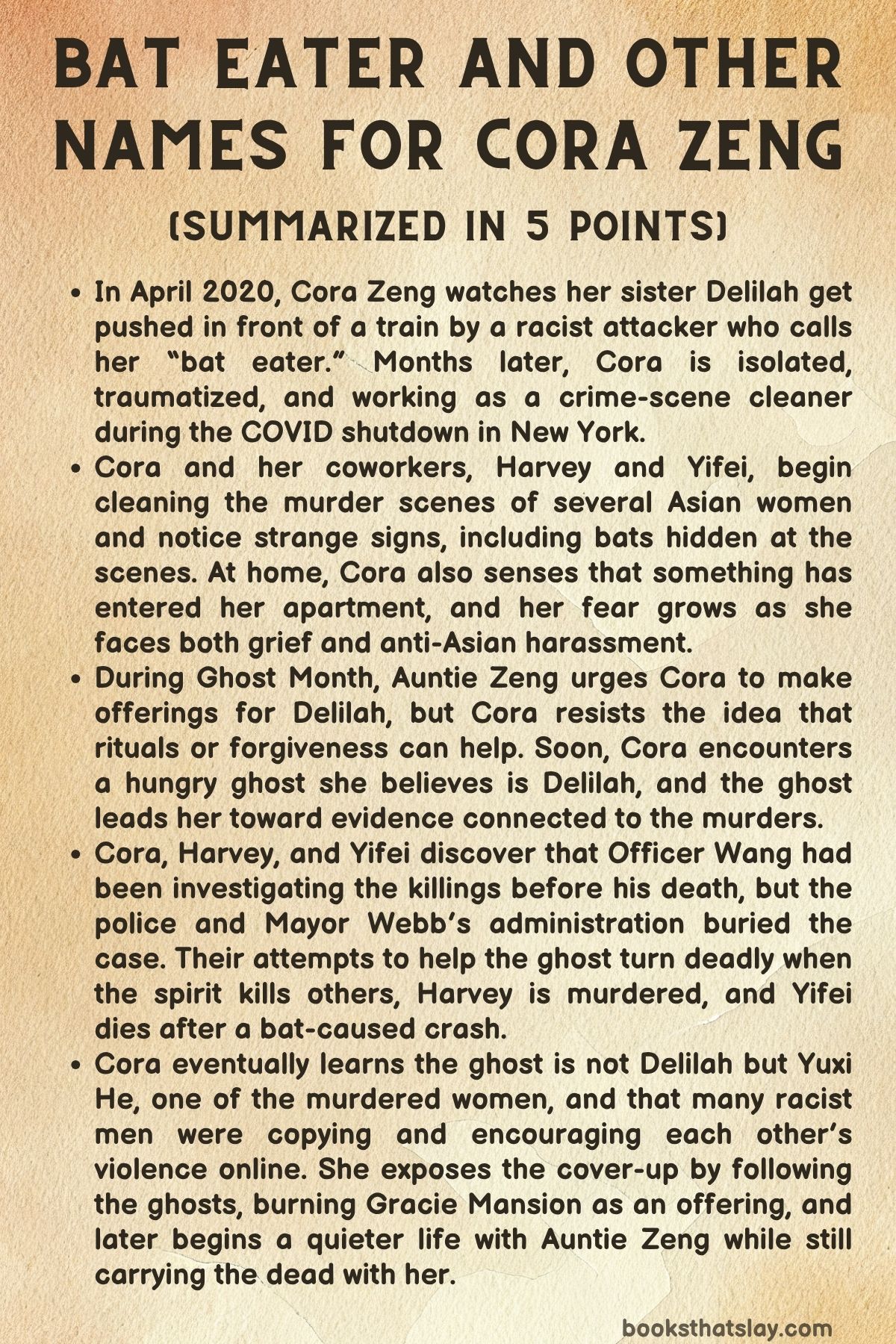
Bat Eater and Other Names for Cora Zeng begins in April 2020, during the early shutdown days of the COVID-19 pandemic in New York City. Cora Zeng and her older sister, Delilah, are out in the rain trying to buy toilet paper, one of the many small emergencies that defined the beginning of the pandemic.
Their relationship is already strained. Delilah is beautiful, confident, and restless, while Cora feels left behind and overshadowed.
At East Broadway station, Delilah tells Cora that she has been thinking about moving to China to live with their father and try modeling. To Cora, this feels like another abandonment.
Before Cora can make sense of what Delilah has said, a masked white man appears. He grabs Delilah, calls her a racist slur, and shoves her onto the subway tracks.
A train hits Delilah and kills her while Cora watches helplessly. The scene becomes the defining horror of Cora’s life.
She survives, but she is left with trauma, guilt, anger, and a deep fear of contamination, violence, and the city around her.
By August, Cora is living alone. Her sister is dead, her family is fractured, and the pandemic has made the world feel hostile and unclean.
She works for a dry-cleaning business that has changed direction during the pandemic and now handles biohazard and crime-scene cleanup. Her coworkers are Harvey Chen and Yifei Liu.
Harvey deals with gore through nervous humor, while Yifei is more guarded, practical, and sharp. Together, they clean blood, tissue, and other remains from apartments and buildings after deaths.
As the work continues, Cora begins to notice a disturbing pattern. The victims they clean up after are often Asian women, and their deaths are unusually brutal.
Bats appear in strange places: drains, vents, and even bodies. The cases do not feel random.
Cora suspects something is being missed or ignored, but she is also struggling to trust her own mind. Her trauma makes her alert to every sign of danger.
She becomes obsessed with dirt and germs, and she starts to believe that something has been entering her apartment. Food goes missing.
Furniture is damaged. Bite marks appear.
Cora’s family offers different explanations for what is happening. Auntie Zeng warns her about Ghost Month and tells her to make offerings for Delilah.
According to her, people who die violently may not rest easily, and the living have duties to the dead. Cora rejects this.
She does not want to burn joss paper or perform rituals. She is angry, frightened, and unwilling to accept a world where ghosts might need feeding.
Auntie Lois, meanwhile, tries to push Cora toward church and forgiveness. Cora tries to confess, but the attempt goes badly when she accidentally gives a priest a graphic crime-scene photo.
Instead of comfort, she receives more shame and confusion.
The racism around Cora does not fade after Delilah’s death. A man spits in her face and tells her to go back to China, intensifying her fear and rage.
The pandemic has made Asian people targets, and Cora feels that danger everywhere. The violence that killed Delilah is not isolated.
It is part of the city’s atmosphere, repeated in words, looks, attacks, and silence.
Soon Cora begins seeing a ghost. The figure is skeletal and starved, with a long neck and an endless hunger.
Cora believes it may be Delilah because the ghost wears a jade bracelet that seems familiar. The ghost eats fruit from Cora’s hand and later leads her toward clues.
Cora is terrified, but she also wants to believe that some part of her sister has returned. Her grief makes her willing to follow the ghost, even when its hunger and power become increasingly dangerous.
Cora, Harvey, and Yifei begin to investigate the deaths of the Asian women whose crime scenes they have cleaned. They come to believe there may be an anti-Asian serial killer operating in the city.
One of the most important scenes they clean is the apartment of Officer Wang, a murdered police officer. Wang had been investigating the pattern before his death, and he secretly left behind evidence.
Guided by the ghost, Cora finds a USB drive and shredded documents. These records reveal that Wang had identified several suspects connected to the murdered women.
They also show that the police department and Mayor Webb’s administration suppressed the investigation to avoid political damage.
The discovery changes everything. Cora, Harvey, and Yifei are no longer just cleaners passing through the aftermath of violence.
They are holding evidence of a cover-up. They realize that the victims were ignored because they were Asian women, and because admitting the pattern would expose failure, racism, and public danger at the highest levels of the city.
Still believing the ghost may be Delilah, Cora tries to help her. She, Harvey, and Yifei search the subway tracks for Delilah’s missing head, hoping that recovering it will bring peace.
They also prepare a Ghost Month feast at Yifei’s apartment. The ritual is meant to feed and honor the dead, but it goes wrong when Yifei’s roommates, Ryan and Paisley, interrupt and eat the food intended for the ghost.
The hungry spirit appears and devours them. Cora, Harvey, and Yifei are horrified, but they use their crime-scene cleaning skills to cover up the deaths.
Afterward, all three catch COVID. Their bodies weaken, and their fear grows.
The horror is no longer only supernatural or investigative; it is also physical, ordinary, and everywhere. Harvey later discovers something important and asks Cora and Yifei to meet him.
When they arrive, they find him murdered inside an industrial dry-cleaning machine. His death is cruel and shocking, and it leaves Cora and Yifei more isolated than before.
Cora and Yifei try to flee, but bats swarm their car and cause a crash. Yifei dies in a terrible way, leaving Cora as the only survivor among the group.
Cora escapes and calls Auntie Zeng, who helps her understand the truth. The ghost is not Delilah.
The bracelet Cora saw did not belong to her sister. Auntie Zeng had already made offerings for Delilah, so Delilah would not have become a hungry ghost.
The spirit haunting Cora is actually Yuxi He, one of the murdered Asian women.
This revelation forces Cora to confront her grief more honestly. She had wanted the ghost to be Delilah because she could not let go, but the dead surrounding her are many.
Delilah is one victim, but she is not the only one. Yuxi and the other murdered women have been denied justice, recognition, and peace.
Their hunger is tied to the violence done to them and to the institutions that allowed that violence to continue.
Cora studies Wang’s files and discovers another devastating truth. There is no single killer called the “White Spider.” Instead, multiple racist men have been killing Asian women, sharing photos online, encouraging one another, and copying each other’s crimes.
The idea of one monster is too simple. The real horror is a network of hatred, enabled by police neglect and political cover-up.
Cora decides to act. Guided by Yuxi and other hungry ghosts, she steals propane tanks from the church crypt and sets fire to Gracie Mansion.
The act becomes an offering to the dead and an attack on the people who helped bury the truth. Mayor Webb dies in the fire.
At the same time, Wang’s backup files reach the press, exposing the suppressed investigation and the larger cover-up.
After the fire, Cora’s life changes. She moves in with Auntie Zeng and leaves crime-scene cleaning behind, choosing apartment cleaning instead.
She stops attending Auntie Lois’s church and turns away from the version of forgiveness that asks victims to swallow their anger. She remembers Harvey, Yifei, Delilah, Yuxi, and the other women whose lives were taken.
The ghosts do not fully disappear. Cora continues living near them, aware of their presence and their hunger.
By the end, she is not healed in a simple way, but she is no longer denying what happened. She has faced the truth of her sister’s death, the scale of the violence around her, and the cost of being unheard.
The novel closes with Cora still marked by grief, but also more awake to the dead, the living, and the demands of memory.
Characters
Cora Zeng
Cora Zeng is the central character of Bat Eater and Other Names for Cora Zeng, and her journey is shaped by trauma, fear, grief, anger, and survival. At the beginning of the book, she witnesses the brutal death of her older sister Delilah, an event that permanently changes the way she sees the world.
Cora is not simply sad after Delilah’s death; she becomes deeply unsettled, paranoid, and overwhelmed by contamination, dirt, blood, disease, and violence. Her work as a crime-scene cleaner forces her to confront physical horror every day, but the emotional horror inside her is even more intense.
She lives with guilt over surviving, resentment over Delilah’s possible abandonment, and fear that the same hatred that killed her sister could reach her too.
Cora’s character is complex because she is both vulnerable and harsh. She is frightened, but she is also angry.
She is grieving, but she is not gentle in her grief. Her fear of contamination reflects more than anxiety about germs; it represents her sense that the entire world has become unsafe and polluted by racism, violence, sickness, and betrayal.
As the story develops, Cora’s connection to the hungry ghost forces her to face the dead instead of avoiding them. She begins by thinking the ghost belongs to Delilah, which shows how desperately she wants a connection to her sister, even a terrifying one.
Later, when she learns the ghost is actually Yuxi He, Cora’s understanding expands beyond her own personal grief. She realizes that Delilah’s death is part of a larger pattern of violence against Asian women.
By the end of the book, Cora changes from someone who is almost paralyzed by fear into someone who acts with purpose, even if her actions are extreme. Her decision to burn Gracie Mansion is not just revenge; it is an offering to the dead and a refusal to let their suffering remain hidden.
Cora does not become completely healed, and the story does not pretend that trauma disappears easily. Instead, she learns to live with memory, grief, ghosts, and survival.
Her character represents the lasting psychological damage of racist violence, but also the possibility of reclaiming agency after being made powerless.
Delilah Zeng
Delilah Zeng is Cora’s older sister, and even though she dies early in the story, her presence shapes nearly everything that follows. Delilah is important not only because of her death but because of the complicated emotional relationship she has with Cora before she dies.
When she tells Cora that she is thinking of moving to China to live with their father and pursue modeling, Cora experiences it as a betrayal. This moment makes Delilah more than an idealized victim.
She is a person with her own desires, ambitions, and restlessness, and her choices hurt Cora deeply even before the violence occurs.
Delilah’s death is the wound at the center of Cora’s life. The fact that Cora witnesses it directly makes the trauma even more devastating.
Delilah is murdered in a racist attack, and the insult used against her turns her into a symbol of the anti-Asian hatred spreading during the COVID period. However, Delilah should not be seen only as a symbol.
In the book, she is also a sister, a daughter, and a young woman who had plans for a different life. Her absence becomes almost as powerful as a physical presence because Cora keeps interpreting events through the pain of losing her.
Delilah also functions as a mistaken identity in the ghostly part of the story. Cora believes the hungry ghost may be Delilah, which shows how grief can distort perception.
Cora wants the ghost to be her sister because that would mean Delilah is still reachable in some form. The revelation that Delilah is not the hungry ghost is emotionally significant because it forces Cora to separate her private mourning from the broader suffering of other murdered women.
Delilah’s character therefore represents both personal loss and the beginning of Cora’s larger awakening to collective injustice.
Yuxi He
Yuxi He is one of the most tragic and powerful figures in the book. For much of the story, she is misunderstood because Cora believes the hungry ghost is Delilah.
In reality, Yuxi is one of the murdered Asian women whose death has been hidden, ignored, and absorbed into a larger pattern of racist violence. Her ghostly hunger reflects more than supernatural need.
It represents the hunger of the neglected dead, the hunger for justice, and the hunger created when society refuses to properly mourn its victims.
As a ghost, Yuxi is frightening, but she is not simply evil. Her violence is disturbing, especially when she devours Ryan and Paisley, yet her existence is rooted in the violence done to her first.
She has been denied peace, recognition, and justice. Her long-necked, skeletal form makes her seem monstrous, but the real monstrosity belongs to the people who killed her and the institutions that buried the truth.
Yuxi’s character complicates the idea of victimhood because she is both victim and avenger. She frightens Cora, but she also guides her toward hidden evidence and the truth about the murders.
Yuxi’s role becomes especially meaningful when Cora discovers that she is not Delilah. This shift expands the emotional focus of the story.
Cora’s grief begins with her sister, but Yuxi forces her to acknowledge many other women whose lives were also destroyed. Through Yuxi, the book shows that the dead are not silent simply because the living refuse to listen.
Her hunger becomes a form of testimony, and her presence pushes Cora toward action. Yuxi is therefore a symbol of erased victims returning with force, demanding to be seen, fed, remembered, and avenged.
Harvey Chen
Harvey Chen is one of Cora’s coworkers and one of the few people who shares her daily exposure to death, blood, and horror. He often responds to gore with nervous jokes, which makes him seem lighter and more humorous than Cora or Yifei.
However, his humor does not mean he is untouched by fear. Instead, joking becomes his way of coping with the unbearable.
Harvey’s character brings moments of human warmth into a story filled with brutality, but his presence also shows how people working close to death must create emotional defenses in order to function.
Harvey is important because he becomes part of Cora’s small circle of trust. Along with Yifei, he helps investigate the murders and accepts that something larger and more dangerous is happening.
His willingness to stay involved shows courage, especially because the danger is not abstract. He is not a detective or a powerful official; he is an ordinary worker caught in a terrifying situation.
His friendship with Cora matters because she is isolated after Delilah’s death, and Harvey helps form a temporary chosen family around shared fear and shared purpose.
Harvey’s death is one of the most painful moments in the book because it destroys the fragile sense of safety that Cora has begun to build. His murder inside the industrial dry-cleaning machine is especially cruel because it turns the workplace, already associated with death cleanup, into the site of his own death.
Harvey’s fate shows how dangerous the truth has become. He discovers something important, but before he can fully share it, he is killed.
His character represents kindness, nervous resilience, and the terrible cost paid by ordinary people who try to expose hidden violence.
Yifei Liu
Yifei Liu is sharp, guarded, and emotionally controlled, making her an important contrast to both Cora and Harvey. While Harvey often uses humor and Cora is overwhelmed by fear and grief, Yifei appears more composed and practical.
Her guarded personality suggests that she has learned not to expose too much of herself, especially in a world where vulnerability can be dangerous. She does not immediately seem soft, but her loyalty becomes clear through her actions.
Yifei’s role in the story grows as she becomes more deeply involved in the investigation and in Cora’s supernatural experiences. She is not merely a coworker; she becomes someone who shares the burden of the truth.
Her apartment becomes the site of the Ghost Month feast, which is a major turning point in the book. The interruption by Ryan and Paisley and the ghost’s violent response force Yifei into a horrifying cover-up with Cora and Harvey.
This moment binds the three characters together through fear, guilt, and complicity.
Yifei’s death is devastating because she survives so much only to be killed in a chaotic and horrifying way after the bats swarm the car. Her end reinforces the sense that the violence surrounding Cora cannot be controlled or neatly escaped.
Yifei represents guarded strength, intelligence, and the tragedy of people who become victims not because they are careless, but because they are close to the truth. Her character also deepens the emotional cost of Cora’s survival, since Cora must carry the memory of yet another person she could not save.
Auntie Zeng
Auntie Zeng is one of the most important guiding figures in Cora’s life. She represents cultural memory, ancestral responsibility, and a practical understanding of the spiritual world.
Unlike Cora, who initially refuses to burn joss paper for Delilah, Auntie Zeng takes rituals seriously. Her warnings about Ghost Month are not treated as empty superstition within the story.
Instead, they become part of a deeper truth about grief, violent death, and the obligations the living have toward the dead.
Auntie Zeng’s strength lies in her ability to understand what Cora cannot yet accept. She recognizes that violent deaths can leave ghosts unsettled, and she understands the importance of offerings.
She also eventually helps Cora realize that the ghost is not Delilah. This revelation is crucial because it corrects Cora’s grief-driven misunderstanding.
Auntie Zeng had already made offerings for Delilah, which means Delilah would not be hungry in the same way. Her knowledge protects Cora from remaining trapped in a false belief.
Auntie Zeng also becomes a figure of care and refuge. Later, Cora lives with her, suggesting that Auntie Zeng offers a form of home that is more honest and healing than the isolated apartment where Cora had been unraveling.
She does not erase Cora’s trauma, but she gives Cora a place where memory, ritual, and survival can exist together. Auntie Zeng’s character represents the wisdom of tradition, the necessity of mourning properly, and the quiet strength of family care.
Auntie Lois
Auntie Lois represents a different kind of response to suffering. She pushes Cora toward church, confession, and forgiveness, offering a religious framework that does not fully meet Cora’s emotional needs.
Her intentions may not be cruel, but her approach often feels inadequate because Cora’s pain is too raw and specific to be solved through simple ideas of spiritual release. Auntie Lois wants Cora to move toward forgiveness, but Cora is surrounded by active danger, racism, murder, and unresolved grief.
Her role is important because she shows how certain forms of comfort can become pressure. For someone like Cora, who is angry and traumatized, being pushed toward forgiveness can feel like being asked to soften the reality of what happened.
Auntie Lois’s church environment does not provide the clarity or safety Cora needs. The disastrous confession scene, where Cora accidentally gives the priest a graphic crime-scene photo, captures the mismatch between Cora’s lived reality and the kind of spiritual language being offered to her.
Auntie Lois is not simply a villainous figure, but she is limited. Her version of care is shaped by religious belief and the desire for moral order, while Cora’s world is chaotic, bloody, and full of ghosts that demand recognition rather than forgiveness.
Auntie Lois helps highlight one of the book’s central tensions: whether healing comes from forgiving violence or from confronting it. For Cora, Auntie Lois’s path ultimately does not fit, which is why Cora stops attending her church.
Officer Wang
Officer Wang is a crucial character because he represents suppressed truth. Even after his death, his hidden evidence continues to guide Cora, Harvey, and Yifei toward the reality behind the murders.
As a murdered police officer whose apartment the cleaners enter, Wang becomes part of the pattern of violence, but he is also distinct because he had been investigating what others wanted ignored. His secret documents and USB drive reveal that he understood the murders were connected and that powerful people were helping bury the case.
Wang’s character exposes the failure of institutions from within. He appears to have tried to do the right thing, but his work was hidden, and he was killed before the truth could be made public.
This makes him a tragic figure because he had knowledge but not enough power to overcome the system around him. His evidence becomes more important than his physical presence, showing how the dead can still influence the living through what they leave behind.
Officer Wang also complicates the portrayal of law enforcement in the book. The police as an institution are shown as suppressing evidence and protecting political interests, but Wang stands apart as someone who pursued the truth.
Still, his death suggests that individual decency is not enough when the larger system is corrupt. His character represents moral responsibility, hidden resistance, and the danger faced by those who try to expose institutional failure.
Mayor Webb
Mayor Webb is one of the major symbols of institutional corruption in the story. His administration suppresses evidence about the murders to avoid political damage, making him responsible not only for silence but for the continued vulnerability of the victims.
He represents the kind of public authority that values reputation, control, and image over the lives of marginalized people. In the world of the book, the danger does not come only from individual racist killers; it also comes from officials who decide that exposing the truth is inconvenient.
Mayor Webb’s importance lies in what he represents rather than in emotional complexity. He is the face of political neglect and calculated denial.
By helping bury the case, his administration allows violence against Asian women to remain hidden and therefore continue. This makes him morally responsible even if he is not the person physically committing the murders.
His power makes his wrongdoing especially serious because he has the ability to protect people and instead protects himself.
His death in the fire at Gracie Mansion is symbolic. Cora’s act turns a place associated with political power into an offering for the dead.
The burning of the mansion is not only an attack on one man but also an attack on the system that allowed the murdered women to disappear from public concern. Mayor Webb’s character represents authority without justice, and his downfall becomes part of the story’s larger demand that hidden crimes be exposed.
Ryan
Ryan is one of Yifei’s roommates, and his role becomes important during the Ghost Month feast. He interrupts the ritual and eats food that was meant for the ghost, showing disrespect for something he does not understand.
His behavior is careless and invasive, and it reveals a lack of seriousness toward the grief and spiritual obligations surrounding the dead. In a story where rituals matter deeply, Ryan’s thoughtlessness has fatal consequences.
Ryan’s character does not need a long personal history to be meaningful. He represents the kind of ordinary disrespect that becomes dangerous when people dismiss cultures, rituals, or warnings as meaningless.
His actions are not as morally monstrous as the murders committed by the racist killers, but his carelessness still matters. He enters a sacred moment and treats it casually, consuming what was meant for someone else.
His death at the hands of the ghost is shocking and gruesome, but it also fits the moral logic of the story. The dead are hungry, and Ryan has interfered with an offering meant to feed that hunger.
His character shows that the supernatural world in the book is not decorative. It has rules, consequences, and demands.
Ryan’s role is brief but important because it marks the moment when Cora, Harvey, and Yifei become directly involved in covering up death rather than only cleaning after it.
Paisley
Paisley, like Ryan, is one of Yifei’s roommates and becomes significant during the interrupted Ghost Month ritual. She participates in eating the food meant for the ghost, and this act places her in direct violation of the ritual’s purpose.
Paisley’s character helps intensify the scene because the interruption is not accidental in its consequences. It shows a failure to respect boundaries, mourning, and the unseen presence of the dead.
Paisley represents casual ignorance and intrusion. She may not fully understand what she is doing, but the story does not treat ignorance as protection.
In the world of the book, rituals carry weight whether outsiders understand them or not. Her actions help trigger the ghost’s violent appearance, turning what was meant to be an offering into a scene of horror.
Through Paisley, the book shows that disrespect can be dangerous even when it comes from foolishness rather than open malice.
Her death also changes the moral position of Cora, Harvey, and Yifei. After the ghost kills Ryan and Paisley, the three cleaners use their skills to cover up the deaths.
This forces them into a darker and more compromised role. Paisley’s character is therefore important not because she is deeply developed, but because her fate pushes the main characters across a line.
She becomes part of the story’s movement from victimhood and investigation into secrecy, guilt, and survival.
Cora’s Father
Cora’s father is mostly significant through absence. He lives in China, and Delilah’s desire to move there and live with him creates tension between the sisters shortly before Delilah’s death.
Because of this, he becomes connected to Cora’s feelings of abandonment. Delilah’s plan to leave is not only about modeling or personal ambition; for Cora, it feels like being left behind for another family life that does not include her.
His absence helps shape the emotional loneliness that surrounds Cora after Delilah dies. With Delilah gone and her father distant, Cora’s family structure feels fractured.
This makes Auntie Zeng’s later role even more important, because she becomes the family presence that remains active in Cora’s life. Cora’s father is not developed as a central character, but his distance affects the choices and emotions of others.
He also represents another possible life that Delilah imagined for herself. The idea of moving to China suggests escape, reinvention, and connection to a different future.
That future is destroyed before it can happen. In this way, Cora’s father matters less as a direct participant and more as a symbol of distance, separation, and the life Delilah never gets to pursue.
Themes
Racism, Scapegoating, and Public Fear
Anti-Asian racism shapes Cora’s world through both sudden violence and everyday hostility. Delilah’s death is not shown as a random accident but as the result of a society that has allowed fear to turn into hatred.
The insult thrown at her reduces her identity to a racist stereotype, showing how public panic during the COVID shutdown gives violent people a language for cruelty. Cora later faces the same hatred when a stranger spits in her face and tells her to go back to China, making it clear that racism is not limited to one attacker.
It exists in public spaces, institutions, online communities, and casual encounters. Bat Eater and Other Names for Cora Zeng presents racism as something that spreads when people in power refuse to name it honestly.
The murders of Asian women show how prejudice can become organized violence, especially when victims are treated as politically inconvenient rather than fully human.
Trauma, Grief, and the Body’s Memory
Cora’s grief is not quiet or symbolic; it lives in her body, her routines, and her fear of contamination. After watching Delilah die in a horrific way, Cora becomes trapped in a cycle of dirt, blood, cleaning, and dread.
Her work as a crime-scene cleaner forces her to face death repeatedly, but it does not help her process her sister’s death. Instead, every stain and smell seems to bring her closer to the violence she wants to escape.
Her obsession with cleanliness reflects a deeper need to control a world that has become unsafe. Grief also becomes confused by guilt, anger, and betrayal because Delilah had been planning to leave her.
Cora does not simply mourn a loving sister; she mourns someone who hurt her, abandoned her emotionally, and then died before anything could be resolved. This makes her grief heavier because there is no clean ending, apology, or closure.
The Failure of Institutions
The police, city leadership, and religious authority all fail Cora and the dead in different ways. The authorities suppress evidence of murdered Asian women because the truth would damage public image and political power.
This cover-up shows that institutions often protect themselves before they protect vulnerable people. Officer Wang’s hidden evidence becomes important because it reveals that someone inside the system tried to act with conscience, but even that effort had to happen secretly.
The church also fails to give Cora comfort because its language of forgiveness feels empty beside the scale of violence she has witnessed. Auntie Lois’s religious approach asks Cora to confess, forgive, and accept peace, but Cora needs justice before peace can mean anything.
The novel suggests that official systems can become dangerous when they care more about order, reputation, and public calm than truth. When institutions refuse responsibility, the burden of justice falls onto the wounded.
Ghosts, Justice, and Unfinished Death
The hungry ghosts represent deaths that have not been honored, explained, or avenged. At first, Cora believes the ghost belongs to Delilah because her grief makes her desperate for a connection to her sister.
This mistake reveals how trauma can make people see what they need to see. When the ghost is revealed as Yuxi He, the story expands from one family tragedy to a larger community of murdered women.
The supernatural does not exist only to frighten Cora; it forces hidden crimes into the open. The ghosts are hungry because the living world has denied them justice, memory, and proper care.
Traditional rituals, offerings, and Ghost Month beliefs become ways of recognizing that the dead still have claims on the living. Cora’s final act of burning Gracie Mansion is violent, but it also becomes an offering to those ignored by the powerful.
Justice here is not peaceful or pure; it is born from rage, grief, and remembrance.