A Fate Forged in Fire Summary, Characters and Themes
A Fate Forged in Fire by Hazel McBride is a fantasy novel about hidden power, disputed inheritance, dragon bonds, and the cost of claiming a throne in a kingdom ruled by fear and rigid religion. The story follows Aemyra, a young woman raised in the lower city of Àird Lasair, who has spent her life concealing the strength of her fire magic.
When her true bloodline is revealed, she becomes the center of a dangerous struggle between old goddess worship, dragon-born rule, and the rising True Religion. At its core, A Fate Forged in Fire is about power, survival, rage, loyalty, and a woman forced to decide what kind of queen she wants to become.
Summary
Aemyra lives in the lower city of Àird Lasair, far from the royal court but never free from its shadow. She works among ordinary people as a midwife and helps in her adoptive family’s forge, where she has been raised by Orlagh and Pàdraig alongside her twin brother Adarian and younger brother Lachlann.
Though she appears to be an unbound Dùileach with limited magic, she hides a far stronger gift: powerful fire magic that could place her in terrible danger if discovered.
During a difficult birth, Aemyra loses control for a moment and reveals more power than she should possess. Adarian warns her that carelessness could expose her, but Aemyra is tired of living quietly.
She watches King Haedren’s golden dragon, Kolreath, flying over the city and makes it clear that she believes the throne is hers by birthright. Her ambition is not sudden; it has been burning beneath her life in the lower city for years.
The kingdom around her is unstable. Rumors spread that King Haedren is losing his mind, and the True Religion is gaining influence.
Its priests insult the old goddesses, condemn Dùileach magic, and treat women with open contempt. Aemyra’s anger flares when she and Adarian meet these priests at Sorcha’s tavern.
She threatens them, uses her fire, and helps ignite a violent brawl. The clash shows how close the city is to open conflict.
Soon after, Aemyra and Adarian watch a theater troupe perform the history of Tìr Teine. The play recalls the old matriarchal order, the fading of dragons, and the exile of Draevan Daercathian after his rebellion.
The troupe praises Draevan and warns against the growing control of the True Religion. Sir Nairn and the guards break up the performance with violence, making it clear that dissent is becoming dangerous.
Aemyra’s life changes completely when she discovers a desecrated shrine and is seized by Draevan Daercathian, her real father. He takes her to Brigid’s temple, where High Priestess Kenna, priestesses, and loyal soldiers recognize her as the first female Daercathian heir in a century.
Through a blood ritual, they swear loyalty to her as the true queen of Tìr Teine. Aemyra is no longer only a hidden girl from the lower city; she is a claimant to the crown.
When King Haedren dies, Aemyra appears at his funeral and places her blood over his body. Brigid’s eternal fire responds, confirming her claim before the court and the people.
Queen Katherine rejects her, but Aemyra declares herself queen and challenges the male line of succession. She then tries to bond with Kolreath, believing the golden dragon should belong to her.
Instead, Kolreath rejects her, and Prince Fiorean warns her that ambition can ruin those who let it rule them.
Katherine strikes back. Evander attacks Aemyra’s family home, forcing her to flee.
She escapes by jumping into Loch Lorna and boards a ship with Draevan and Adarian bound for Penryth, the island of sunset. Orlagh, Pàdraig, and Lachlann fail to reach the ship, leaving Aemyra afraid that she has lost them.
In exile, she prepares for war and learns that Covenanters of the True Religion have killed people loyal to her. Refusing to wait helplessly, she climbs a mountain to seek the legendary black dragon known as the Terror.
She finds him, bonds with him, and names him Terrea. With that bond, she gains the power and legitimacy of a true dragon rider.
Aemyra returns stronger, but the news waiting for her is devastating. Lachlann is dead, and Orlagh and Pàdraig have been taken.
Driven by grief and fury, she flies east with Terrea to confront Fiorean and Evander. In battle, she fights Fiorean but is defeated and captured.
She wakes inside Caisteal Lasair, drugged with magiebann, a potion that suppresses her magic. Katherine and the priest Alfred do not plan to execute her.
Instead, they intend to use her alive.
Their plan is to force Aemyra into marriage with Fiorean. By making her a Daercathian princess under their control, they hope to secure her claim and use her captivity to weaken Draevan.
Aemyra is taken to a tower of the True Religion and made to stand beside Fiorean for a ceremony conducted by Athair Alfred. Her wrists are bound to Fiorean’s with a white ribbon, and they are forced to swear vows before the Erlöser.
Aemyra is furious, terrified, and disgusted by the way Fiorean seems to look at her as though she now belongs to him.
At the wedding feast, Evander’s cruelty becomes even clearer. He is drunk, unstable, and eager to humiliate her.
News also reaches the hall that Balnain’s fleet is blocking the Forc, giving Aemyra hope that her allies are moving. She considers killing Fiorean and escaping, but the situation worsens when Evander announces that the marriage must be consummated.
The nobles cheer, priests pray, and Aemyra is dragged toward Fiorean’s rooms. Men mock and touch her as Evander strips away her wedding clothes before the court.
Once alone with her, Fiorean does not assault her. Instead, he tells her he will not touch her.
To deceive those outside, he shakes the bed and cuts his own hand, leaving blood on the sheets as false proof. Evander accepts the evidence and leaves.
The next morning, Fiorean joins Aemyra in bed only so the servants will believe they spent the night together. Their marriage remains a prison, but Fiorean’s actions show that he is not as simple as the enemies around him.
Aemyra and Fiorean argue often. They clash over family, religion, magic, and the sick children at court.
Aemyra insists she did not poison them and offers practical healing advice. Maggie, Nael’s pregnant wife, is assigned as her companion, though Aemyra understands that Maggie is also there to watch her.
As the magiebann begins to wear off, Aemyra senses her magic returning and looks for a chance to escape.
While walking through the Caisteal with Fiorean, Aemyra meets his brothers and their wives. She offers help for the sick children, recommending charcoal and herbs, but Elear and Elizabeth reject her.
She also sees that starving townspeople are being fed only if they move toward conversion to the Erlöser. Among them, she recognizes Marilde, a secret ally, who hints that Aemyra should come to the kitchens when the moment is right.
In the private gardens, Fiorean asks whether Aemyra truly knows how to help his nephews. As she gathers herbs, her magic returns enough for her to attack him.
She reveals that she has bonded with Terrea and tries to flee. Sir Nairn stops her with a magic-resistant pendant and powder that suppresses her power again.
Fiorean realizes she must have found a dragon egg, and Aemyra is brought before Evander, Katherine, Alfred, and Nairn. Evander attacks her, but Fiorean stops him from strangling her.
Alfred then decides to use hostages to force Aemyra and her dragon into submission.
At the Loch, Aemyra finds Sorcha and Orlagh alive but bound. Seeing Orlagh overwhelms her, and Aemyra agrees to obey in order to save her.
Orlagh refuses to let Aemyra surrender her cause and prays to Brigid. Even after Aemyra promises cooperation, Nairn murders Orlagh by cutting her throat.
Aemyra attacks him in rage, and he wounds her. Then Terrea arrives, massive and terrifying, killing a guard and frightening everyone present.
Evander threatens Sorcha, forcing Aemyra to send Terrea away with Orlagh’s body. Aemyra collapses from grief and blood loss.
Fiorean later tends Aemyra’s wounds and apologizes for bringing her before Evander and Alfred. While he stitches her injury, they speak with more honesty.
Aemyra explains the truth of dragon bonds, and Fiorean admits he does not feel that kind of bond with Aervor. Aemyra understands then that Fiorean did not personally kill Lachlann; Aervor did.
Three days later, Aemyra remains trapped, grieving, and drugged. She waits for Marilde’s promised help while forming a cautious bond with Maggie.
Then Elizabeth arrives in panic because another son, Hamysh, has died. Elear accuses Aemyra, but Fiorean defends her, pointing out that she was watched.
He also reveals that the other children recovered after he followed Aemyra’s advice, meaning Hamysh must have been poisoned separately. Aemyra and Fiorean realize that someone at court is murdering the children.
As Fiorean’s birthday Cèilidh approaches, Aemyra begins to consider how the gathering might become an opportunity.
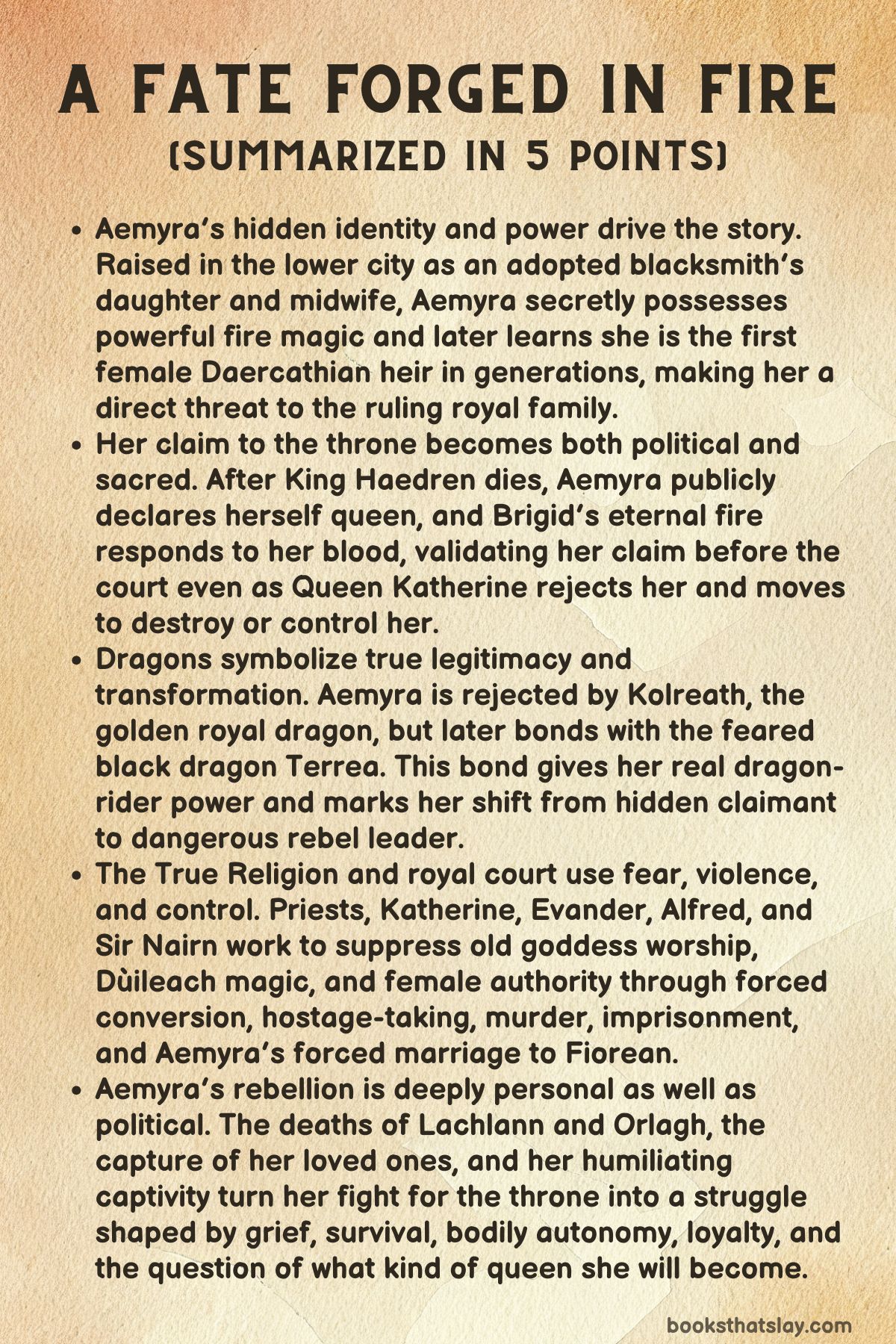
Characters
In A Fate Forged in Fire, the characters are shaped by power, inheritance, religion, grief, loyalty, and survival. Their conflicts are not only personal but also political, because each major figure is connected to the struggle over Tìr Teine’s throne, the old goddesses, Dùileach magic, dragon bonds, and the growing threat of the True Religion.
Aemyra
Aemyra is the central force of the book, a young woman whose identity is divided between the ordinary life she has been given and the royal destiny she believes belongs to her by birth. At the beginning, she lives in the lower city of Àird Lasair as a midwife and the adopted daughter of a blacksmith’s family, but even in that humble life, she cannot fully hide her unusual strength.
Her fire magic is far greater than what an ordinary unbound Dùileach should possess, and this hidden power reflects the larger truth about her bloodline. Aemyra is restless, proud, and deeply aware that the world has denied her something important.
Her declaration that she will take what is hers when the king dies shows that ambition is part of her from the start, but it is not simple greed. Her ambition comes from dispossession, from anger at a male-dominated succession, and from the belief that Tìr Teine has forgotten its older, more powerful traditions.
Aemyra’s personality is fiery in every sense. She is brave, confrontational, impulsive, and unwilling to remain silent when people insult magic, women, or the goddesses.
Her clash with the priests at Sorcha’s tavern shows her refusal to submit to religious intimidation, but it also reveals her dangerous lack of restraint. She acts from instinct, emotion, and conviction, often before considering the consequences.
This makes her compelling because her strength is also one of her greatest risks. She does not simply want safety; she wants recognition, justice, and power.
Her claim to the throne at Haedren’s funeral is a defining moment because she steps out of hiding and forces the kingdom to confront her existence. When Brigid’s eternal fire responds to her blood, Aemyra’s claim becomes more than political rebellion.
It becomes sacred validation.
Her failed attempt to bond with Kolreath is important because it wounds her pride and challenges her belief that destiny will unfold exactly as she imagines. Aemyra expects the golden dragon to accept her, but his rejection teaches her that birthright does not guarantee obedience from the world.
Later, her bond with Terrea is much more meaningful because it is forged through risk, courage, and desperation rather than ceremony. By climbing the mountain and seeking the black dragon known as the Terror, Aemyra proves that she is not only an heir but also someone willing to face death for power and purpose.
Her bond with Terrea marks her transformation into a true dragon rider, giving her both symbolic and military strength.
Aemyra is also defined by love and loss. Her bond with her adoptive family is one of the emotional foundations of the story.
She is devastated when she is separated from Orlagh, Pàdraig, and Lachlann, and Lachlann’s death becomes a source of grief that sharpens her hatred toward her enemies. Orlagh’s murder before her eyes is one of the most brutal turning points in Aemyra’s arc because it breaks through her political ambitions and exposes the raw human cost of the conflict.
Aemyra’s rage after Orlagh’s death shows how deeply she loves, but her collapse afterward shows that even her immense power cannot protect her from grief.
Her forced marriage to Fiorean places her in a different kind of battlefield. Instead of open rebellion, she must survive humiliation, imprisonment, surveillance, and religious control.
Yet Aemyra remains mentally resistant even when her magic is suppressed. She observes, plans, argues, heals, and searches for allies.
Her knowledge as a midwife and healer becomes just as important as her fire magic because it allows her to challenge the court’s accusations and recognize that the children are being poisoned. This makes her more than a warrior or claimant; she is also intelligent, skilled, and compassionate, especially when children’s lives are involved.
Aemyra’s arc is one of power tested by captivity, grief, and betrayal, but she remains one of the most dynamic figures in the book because she refuses to let anyone define her as a prisoner, wife, heretic, or pawn.
Prince Fiorean
Fiorean is one of the most conflicted characters in the book because he stands between cruelty and conscience, loyalty and doubt, privilege and captivity. At first, he appears arrogant and entitled, especially when Aemyra mocks the ornate sword made for him.
His pride is easily wounded, and he seems to represent the royal world that Aemyra despises: decorative power, inherited status, and masculine authority. However, as the story develops, Fiorean becomes more complex than a simple enemy prince.
He is trapped inside a violent family, a corrupted court, and a religious-political system that expects him to perform dominance even when he is morally uneasy.
His forced marriage to Aemyra reveals the deepest contradictions in his character. In public, he participates in a ceremony meant to control her, legitimize her captivity, and turn her bloodline into a political tool.
In private, however, he refuses to assault her, even though Evander and the court expect the marriage to be consummated. His decision to fake the proof by cutting his own hand is significant because it shows that Fiorean still possesses moral boundaries.
He does not free Aemyra, and he remains part of the machinery that imprisons her, but he also refuses to cross one of its most violent lines. This makes him morally complicated rather than purely heroic.
Fiorean’s relationship with Aemyra develops through argument, suspicion, and reluctant honesty. He sees her first as a threat, then as a captive wife, and gradually as a person whose knowledge and pain he cannot ignore.
Their conversations expose his uncertainty about religion, magic, dragon bonds, and the deaths within his family. He initially believes many of the accusations made against Aemyra, but he is also willing to notice evidence that contradicts them.
When her advice helps some of the sick children recover, he defends her against Elizabeth and Elear’s accusations. This shows that Fiorean is capable of changing his judgment when facts challenge court prejudice.
His dragon bond, or lack of a true bond, is also important. Fiorean rides Aervor, but he admits that he does not feel the kind of bond Aemyra describes with Terrea.
This confession suggests that his royal identity is built on something hollow or incomplete. He has the appearance of dragon-rider legitimacy without the spiritual connection that Aemyra possesses.
His connection to Aervor also places him near Lachlann’s death, even though Aemyra realizes he did not personally kill her brother. This distinction matters because it opens space for tension, guilt, and possible transformation without erasing the harm caused by his side.
Fiorean is not innocent, but he is not as monstrous as Evander, Katherine, Alfred, or Nairn. His tragedy lies in his hesitation.
He sees cruelty, sometimes resists it, but often too late or too weakly. He protects Aemyra from certain immediate harms, but he also brings her before people who intend to break her.
He apologizes after Orlagh’s murder, but the apology cannot undo the consequences of his choices. Fiorean is therefore a character of moral struggle, someone whose humanity survives inside a brutal system but has not yet fully defeated his fear, conditioning, or loyalty.
Adarian
Adarian is Aemyra’s twin brother and one of her closest emotional anchors. As her twin, he understands her in ways most other people do not, and he is often more cautious than she is.
His early warning after she reveals too much magic during the difficult birth shows that he knows both her strength and the danger it creates. Adarian is protective, practical, and aware of the political world around them.
He does not try to extinguish Aemyra’s ambition, but he understands that recklessness can expose the family to deadly consequences.
As a blacksmith’s son and swordmaker, Adarian also represents craft, discipline, and grounded skill. The ornate sword he makes for Fiorean connects the lower city to the royal court, placing Adarian’s work at the center of a social divide.
His craftsmanship is valued by the powerful, but he and his family remain vulnerable to that same power. This contradiction helps show the injustice of Àird Lasair: the lower city produces beauty and strength, yet its people can still be crushed by kings, princes, guards, and priests.
Adarian’s loyalty to Aemyra is tested when her true identity is revealed. He follows her into exile with Draevan, leaving behind the rest of the family when they fail to reach the ship.
This moment places him in a painful position because survival requires separation. Adarian becomes part of Aemyra’s rebel future, but that future is shadowed by guilt and fear for those left behind.
His presence in exile helps keep Aemyra connected to her old life, reminding her that she is not only a Daercathian heir but also a sister and daughter of the family that raised her.
Adarian’s role is quieter than Aemyra’s, but his importance lies in emotional continuity. He knows the girl beneath the crown, the sister beneath the rebel queen, and the danger beneath her confidence.
In a story full of political manipulation and religious violence, Adarian represents intimate loyalty. He is one of the people who loved Aemyra before her claim, before Terrea, and before war made her a symbol.
Orlagh
Orlagh is Aemyra’s adoptive mother and one of the strongest moral presences in the book. She represents maternal love, old faith, courage, and sacrifice.
Though she is not Aemyra’s birth mother, her bond with Aemyra is deeply real. Orlagh’s importance comes not from blood but from care, protection, and the family life she helped build in the lower city.
She is part of the ordinary world Aemyra risks losing when her royal identity emerges.
Orlagh’s faith in Brigid and the old goddesses gives her character spiritual strength. When she is held hostage at the Loch, she refuses to let Aemyra surrender everything to save her.
This is one of her most powerful moments because she chooses dignity and faith over survival purchased through Aemyra’s enslavement. Her prayer to Brigid before her death makes her a figure of resistance.
She does not fight with fire or dragons, but she resists by refusing to become a tool of Alfred, Evander, and Nairn.
Her murder by Sir Nairn is devastating because it is both personal and political. Nairn kills her after Aemyra has already agreed to cooperate, proving that the enemy’s cruelty is not about negotiation but domination.
Orlagh’s death is meant to break Aemyra, but it also exposes the moral emptiness of the forces opposing her. Orlagh becomes a martyr-like figure in Aemyra’s emotional journey, and Terrea carrying away her body gives her death a solemn, almost sacred weight.
Orlagh’s character shows that motherhood in the book is not passive. She loves fiercely, warns through example, and dies resisting the misuse of her daughter’s love.
Her influence continues after her death because Aemyra’s grief becomes inseparable from her struggle for freedom and justice.
Pàdraig
Pàdraig is Aemyra’s adoptive father and the blacksmith at the heart of the family’s working-class life. Although he is less visibly central than Orlagh or Adarian, his presence matters because the forge represents the home where Aemyra learned labor, skill, family loyalty, and restraint.
Pàdraig’s world is one of physical craft rather than royal inheritance, and this gives Aemyra’s upbringing a grounded quality despite her hidden bloodline.
As a father figure, Pàdraig helps define the family Aemyra fears losing. His inability to reach the ship during Aemyra’s escape creates one of the story’s major emotional wounds.
Aemyra’s terror for him, Orlagh, and Lachlann shows that her adoptive family is not secondary to her royal identity. They are the people whose lives make her claim meaningful and whose suffering makes the conflict personal.
Pàdraig also represents the vulnerability of ordinary people during political upheaval. He is not a prince, priest, or dragon rider, yet he is pulled into the violence because of Aemyra’s identity and the crown’s retaliation.
Through him, the book shows that rebellion and tyranny do not only affect leaders; they tear apart households, workshops, and families.
Lachlann
Lachlann is Aemyra’s younger adoptive brother, and his role is emotionally significant because his death becomes one of the clearest symbols of innocent suffering. He is part of the home Aemyra leaves behind when she flees, and the fear that he may be harmed becomes reality when she later learns he has died.
His death deepens the personal cost of Aemyra’s claim and makes the conflict with the royal family even more painful.
Lachlann’s importance is not measured by how much direct action he takes but by what he represents. He is youth, family, vulnerability, and the life Aemyra wanted to protect.
His death shows that the violence of kings, dragons, and religious fanatics reaches those least able to defend themselves. This makes Aemyra’s grief more than personal sorrow; it becomes an indictment of the world that allowed such a loss.
The later revelation that Aervor, not Fiorean personally, caused Lachlann’s death complicates Aemyra’s hatred. It does not erase her grief, but it forces her to distinguish between direct guilt and broader responsibility.
Lachlann therefore continues to shape Aemyra’s emotional and moral decisions even after his death.
Draevan Daercathian
Draevan Daercathian is Aemyra’s birth father and a figure of rebellion, exile, and political legacy. Before he appears directly, he exists as a controversial historical figure through the theater troupe’s performance.
His failed rebellion and exile make him both dangerous and legendary. To supporters of the old ways, he represents resistance against the current royal order; to the crown, he is a traitor whose return threatens the stability of Tìr Teine.
When Draevan seizes Aemyra and brings her to Brigid’s temple, he changes her life completely. His actions reveal the truth of her birth and place her inside a larger political movement.
He does not introduce her gently to her heritage; he pulls her into ritual, allegiance, and destiny. This makes him a powerful but unsettling father figure.
He gives Aemyra legitimacy and a path to queenship, but he also places enormous expectations on her.
Draevan’s role in the blood ritual shows his commitment to restoring Daercathian power through Aemyra. He recognizes her as the first female Daercathian heir in a century, which makes her both his daughter and his political instrument.
His support is essential, but his motivations may not be purely paternal. He believes in her claim, but he also needs her claim.
This creates tension in his character because love, pride, ambition, and strategy are intertwined.
In exile, Draevan becomes part of Aemyra’s preparation for war. He is a link to the past and to the rebel cause, but Aemyra’s bond with Terrea proves that she is not merely his extension.
Draevan may reveal her identity, but Aemyra must earn her own power. His character represents the burden of inheritance: he gives Aemyra a name and a cause, but she must decide what kind of ruler and woman she will become.
King Haedren
King Haedren is central to the political crisis even though his direct presence is limited. His rule is marked by rumors of madness, and those rumors create an atmosphere of instability in Àird Lasair.
The fact that people discuss his condition openly suggests that the kingdom is already uneasy before Aemyra makes her claim. Haedren’s weakness or decline leaves a vacuum into which ambition, religion, rebellion, and succession struggles rush.
His death becomes the event that allows Aemyra to step into public view. The funeral is not simply a moment of mourning; it becomes a stage for contested legitimacy.
When Aemyra offers her blood over his body and Brigid’s eternal fire responds, Haedren’s death transforms into the symbolic end of one order and the possible beginning of another. His body becomes the site where divine power challenges male succession.
Haedren is also important because of Kolreath. The golden dragon flying above the city represents royal magnificence and old authority, but Haedren’s failing rule suggests that outward symbols of power do not guarantee strength or justice.
His reign leaves behind a fractured court dominated by Katherine, Evander, Alfred, and rising religious extremism. In this way, Haedren’s character functions as the decaying center of a kingdom ready to burn.
Queen Katherine
Queen Katherine is one of the book’s most dangerous political figures because she combines royal authority, strategic intelligence, and ruthless self-preservation. When Aemyra publicly claims the throne, Katherine immediately denounces her.
This reaction shows that Katherine understands the threat Aemyra poses not only to one prince but to the entire structure of male succession and royal control. Katherine’s opposition is not emotional panic alone; it is political calculation.
Katherine’s retaliation against Aemyra’s family reveals her willingness to weaponize personal relationships. By targeting the people Aemyra loves, she shows that she understands power as control through fear.
Later, Katherine helps plan to keep Aemyra alive rather than execute her, proving that she is pragmatic. A dead Aemyra might become a martyr, but a captive Aemyra can be used as a royal asset.
The forced marriage to Fiorean is part of this strategy, reducing Aemyra from rival queen to controlled Daercathian princess.
Her alliance with Athair Alfred also reveals the merging of monarchy and religious authority. Katherine benefits from the True Religion’s ideology because it supports control over women, magic, and dissent.
She does not need to be the loudest or most visibly violent character to be terrifying. Her power lies in planning, legitimizing cruelty, and turning institutions into weapons.
Katherine represents a form of queenship that contrasts sharply with Aemyra’s. Aemyra’s claim is tied to fire, blood, old goddesses, and rebellion, while Katherine’s power is tied to court politics, dynastic preservation, and religious control.
Their conflict is therefore not only between two women but between two visions of rule.
Evander
Evander is one of the most openly brutal characters in the book. He is cruel, unstable, entitled, and intoxicated by power.
His attack on Aemyra’s family home shows that he is willing to use direct violence to punish and intimidate. Later, at the forced wedding feast, his drunken behavior and public humiliation of Aemyra reveal his sadism.
Evander does not merely want obedience; he wants spectacle, degradation, and domination.
His insistence that Aemyra and Fiorean’s marriage be consummated in front of a cheering court exposes the ugliness of the royal culture around him. Evander uses sexual humiliation as a political weapon, and the crowd’s participation shows that his cruelty is enabled by the nobles and priests.
He drags Aemyra from the hall and strips away her clothing before others, turning her body into a battlefield for royal control. This moment makes him one of the clearest embodiments of patriarchal violence in the story.
Evander is also dangerous because his cruelty is unpredictable. He threatens Sorcha to control Aemyra and Terrea, proving that he will use any hostage available.
His instability makes every scene with him tense because he is capable of sudden escalation. Unlike Katherine, whose danger is strategic, Evander’s danger is immediate and physical.
Yet Evander is not merely a random villain. He represents what happens when royal power is combined with insecurity, misogyny, and religious entitlement.
His violence reveals the moral corruption of the regime Aemyra opposes. He is one of the clearest reasons the existing order feels impossible to reform peacefully.
Sir Nairn
Sir Nairn is a disciplined and deeply menacing servant of royal and religious power. He appears early as a guard connected to Fiorean, but his role grows darker as the story develops.
He is not as openly chaotic as Evander, but his controlled violence makes him equally dangerous. He enforces the will of the crown and the True Religion with cold efficiency.
Nairn’s use of magic-resistant religious tools and suppressing powder shows that he is prepared specifically to neutralize Dùileach power. This makes him a frightening opponent for Aemyra because he represents a system that has studied how to weaken people like her.
He is not simply a soldier; he is part of an organized campaign against magic, old faith, and rebellion.
His murder of Orlagh is one of the most defining acts of cruelty in the book. What makes it especially horrifying is that Aemyra has already agreed to obey in order to save her.
Nairn kills Orlagh anyway, which proves that his violence is not a last resort but a method of terror. He wounds Aemyra afterward, showing no hesitation in harming a woman already devastated by grief.
Nairn’s character represents institutional brutality. He does not need the theatrical sadism of Evander because his loyalty to order makes him terrifying in a different way.
He kills, suppresses, and controls in the name of authority. Through him, the book shows that cruelty can wear the face of discipline, duty, and religious conviction.
Athair Alfred
Athair Alfred is one of the key representatives of the True Religion and a major architect of Aemyra’s captivity. He is dangerous because he cloaks political violence in sacred language.
His religion rejects the old goddesses, condemns Dùileach magic, and supports a worldview in which women and magical traditions are treated as threats to be controlled. Alfred’s power comes from ideology as much as from position.
During the forced marriage, Alfred conducts the ceremony before the Erlöser, binding Aemyra and Fiorean with religious authority. This makes him more than a priest performing a ritual.
He helps transform captivity into legitimacy. By making Aemyra swear vows within his faith, he participates in an attempt to overwrite her identity, her goddess-centered heritage, and her claim to power.
Alfred’s plan to use hostages to force Terrea into submission shows his strategic cruelty. He understands that Aemyra’s dragon bond is powerful, so he targets her emotional attachments instead.
This reveals that his religion is not truly merciful or morally pure. It uses suffering as a tool of obedience.
Alfred’s role in the story shows how religious systems can become instruments of political domination when compassion is replaced by control.
He is also important because he represents the growing threat beyond the royal family. The True Religion is spreading through priests, forced conversion, and social pressure.
Alfred gives that movement a face. He is calm, purposeful, and convinced of his right to rule over others’ bodies, beliefs, and magic.
High Priestess Kenna
High Priestess Kenna is the spiritual counterforce to Athair Alfred. While Alfred represents the True Religion’s oppressive authority, Kenna represents the older sacred traditions of Tìr Teine.
She recognizes Aemyra as the first female Daercathian heir in a century and helps conduct the blood ritual through which allegiance is sworn to her. This gives Kenna a crucial role in legitimizing Aemyra’s claim.
Kenna’s power is ceremonial, spiritual, and political at the same time. She does not simply bless Aemyra privately; she participates in an act that makes Aemyra’s identity public among those loyal to the old ways.
Her recognition matters because it connects Aemyra to Brigid, the priestesses, and a suppressed tradition of female power. Kenna helps frame Aemyra’s claim as something older and deeper than ambition.
Her character also shows that the old faith is organized, not merely nostalgic. The priestesses, soldiers, and ritual structure around Aemyra indicate that resistance to the True Religion has roots, leadership, and sacred authority.
Kenna’s presence gives the rebellion spiritual seriousness. She reminds the reader that Aemyra’s fight is about belief and cultural survival as much as a throne.
Brigid
Brigid is not a mortal character in the ordinary sense, but her presence shapes the book’s spiritual and political world. She represents the old goddess tradition, sacred fire, female power, and divine recognition.
When her eternal fire responds to Aemyra’s blood at Haedren’s funeral, Brigid becomes an active force in the question of succession. The fire’s response turns Aemyra’s claim from a disputed bloodline into a sacred challenge.
Brigid’s importance is also seen through Orlagh’s prayer before her death. In that moment, Brigid represents faith that cannot be conquered by fear.
Orlagh’s prayer gives dignity to her final moments and links her sacrifice to the old religion Aemyra is fighting to preserve. Brigid therefore functions as both symbol and spiritual presence.
Through Brigid, the book contrasts two religious worlds. The True Religion uses conversion, shame, and control, while Brigid’s worship is associated with fire, inheritance, women’s authority, and resistance.
Her presence gives Aemyra’s struggle mythic weight, suggesting that the conflict is not only between political factions but between sacred visions of the world.
Kolreath
Kolreath, the golden dragon of King Haedren, represents royal legitimacy, old majesty, and the dream Aemyra initially believes is hers. When she watches him fly above the city, he embodies the visible power of the throne.
To Aemyra, bonding with Kolreath seems like the natural confirmation of her birthright. She expects him to be part of her destiny.
His rejection of Aemyra is therefore deeply important. It punctures her certainty and forces her to confront the difference between wanting power and being chosen by it.
Kolreath’s refusal suggests that dragons are not mere royal symbols to be claimed by blood or ambition. They possess will, judgment, and mystery.
This makes dragon bonding more spiritual and complex than political inheritance.
Kolreath’s role also prepares the way for Terrea. Aemyra does not gain the dragon she expected; she gains the dragon others fear.
This contrast helps define her path. She is not the golden continuation of the old royal order.
She becomes something darker, wilder, and more disruptive.
Terrea
Terrea, first known as the Terror, is one of the most powerful symbols in the book. As the legendary black dragon, he represents fear, hidden strength, and the kind of power that has been pushed into myth.
Aemyra’s decision to seek him on the mountain shows her willingness to embrace danger when passivity would mean defeat. Bonding with him is one of her most important transformations.
Unlike Kolreath, Terrea does not represent inherited royal approval. He represents power earned through courage, risk, and recognition.
When Aemyra names him Terrea, she also changes the meaning of his identity. He is no longer only the Terror of legend; he becomes her bonded dragon, companion, and force of liberation.
Their bond is true in a way Fiorean’s bond with Aervor is not, and that difference strengthens Aemyra’s claim to authentic dragon-rider power.
Terrea’s arrival at the Loch after Orlagh’s murder is terrifying and emotionally charged. He kills a guard and frightens Aemyra’s enemies, proving that he is not symbolic power alone but a real military and physical threat.
Yet Aemyra is forced to send him away with Orlagh’s body because Evander threatens Sorcha. This moment shows the pain of having immense power but still being vulnerable through love.
Terrea deepens Aemyra’s character because he reflects her own nature. Both are feared, underestimated, wounded, and capable of destruction.
Their bond suggests that Aemyra’s path will not be gentle or easily controlled. Together, they represent a challenge to the crown, the True Religion, and the idea that female power can be contained.
Aervor
Aervor is Fiorean’s dragon, but the bond between them is notably incomplete. This makes Aervor important as a contrast to Terrea.
While Aemyra experiences her bond with Terrea as deep, true, and mutual, Fiorean admits that he does not feel that same connection with Aervor. This weakens the appearance of royal dragon-rider authority and suggests that the current ruling family’s power may be more performative than sacred.
Aervor is also connected to Lachlann’s death, which makes the dragon emotionally significant in Aemyra and Fiorean’s relationship. Aemyra initially associates Fiorean with the killing, but later realizes that Aervor was responsible rather than Fiorean personally.
This distinction complicates blame without removing pain. Aervor becomes part of the moral tension between human command, dragon action, and royal responsibility.
As a character-like presence, Aervor represents power without intimacy. He is attached to Fiorean’s status, but not to the kind of living bond that defines Aemyra and Terrea.
This makes him part of the book’s broader question about legitimacy: is power real if it lacks true connection?
Sorcha
Sorcha is connected to the lower city, tavern life, and the network of people who support Aemyra outside the formal structures of power. Her tavern is the setting for the confrontation with the priests, making her world one where ordinary people, old beliefs, and political anger collide.
Sorcha’s presence helps show that resistance does not exist only in temples or royal bloodlines; it also exists in public houses, streets, and communities.
Later, Sorcha’s capture makes her a hostage used against Aemyra. Evander threatens her in order to force Aemyra to send Terrea away, proving that Sorcha matters emotionally and strategically.
Aemyra’s enemies understand that her love for others is one of the few ways to control her. Sorcha’s survival matters because she remains one of the living links between Aemyra and the people she is trying to protect.
Sorcha represents community loyalty. She is not a royal heir or dragon rider, but she belongs to the social world that gives Aemyra’s rebellion meaning.
Through Sorcha, the book reminds the reader that revolutions are sustained not only by leaders but by friends, hosts, witnesses, and ordinary allies.
Marilde
Marilde is a secret ally within the hostile environment of the Caisteal. As a cook, she occupies a position that may seem ordinary, but that ordinary role gives her access to spaces, information, and timing that more visible rebels might not have.
When Aemyra recognizes her among the starving townspeople and Marilde hints that Aemyra should come to the kitchens when the time is right, she becomes a sign that resistance still exists inside the enemy’s walls.
Her character is important because she represents hidden networks of loyalty. Aemyra is watched, drugged, and controlled, but Marilde’s presence suggests that the court is not as unified as it appears.
The kitchens become a possible route of survival or escape, and Marilde’s quiet message gives Aemyra hope when open power is unavailable.
Marilde also shows how women in domestic or servant roles can possess political importance. She may not command armies, but she can move beneath the attention of the powerful.
In a book where women are repeatedly underestimated or controlled, Marilde’s subtle resistance is meaningful.
Maggie
Maggie begins as a companion assigned to Aemyra, but Aemyra immediately recognizes that this companionship is also surveillance. As Nael’s pregnant wife, Maggie occupies a vulnerable position at court.
She is close enough to Aemyra to observe her, but she is not powerful enough to be entirely free herself. This makes her relationship with Aemyra cautious from the beginning.
Over time, Maggie and Aemyra begin forming a fragile friendship. This development matters because it shows Aemyra’s ability to connect with people even under captivity.
Maggie is not simply a spy or servant; she becomes someone whose presence softens the isolation around Aemyra. Her pregnancy also connects her to the book’s themes of motherhood, birth, and bodily vulnerability.
Maggie’s character adds emotional nuance to the court. Not everyone around Aemyra is openly cruel.
Some are trapped inside the same system in quieter ways. Maggie’s growing closeness with Aemyra suggests that compassion can emerge even in spaces designed for control.
Nael
Nael is mainly significant through his connection to Maggie, but that connection still places him within the court’s social and political world. As Maggie’s husband, he belongs to the network surrounding Aemyra’s captivity.
His presence helps establish that the Caisteal is not only a place of rulers and prisoners but also of marriages, pregnancies, servants, guards, and families who live under the influence of royal and religious power.
Although Nael is not developed as fully as other characters, his role matters because Maggie’s position cannot be separated from him. Her identity as his pregnant wife affects how she is assigned to Aemyra and how she moves through court life.
Nael therefore represents the wider household structure that surrounds the main conflict.
Elear
Elear is one of the royal family members who reacts to Aemyra with suspicion and hostility. When Aemyra offers to help the sick children with charcoal and herbs, Elear rejects her assistance, showing the depth of prejudice against Aemyra.
This rejection is not only personal dislike; it reflects fear of Dùileach magic, distrust of the Daercathian claim, and loyalty to the court’s version of events.
After Hamysh dies, Elear accuses Aemyra despite the fact that Aemyra was watched. This accusation reveals how easily grief can be turned into blame when prejudice already exists.
Elear’s pain may be real, but it is shaped by the court’s willingness to see Aemyra as a monster. Elear therefore represents the emotional consequences of propaganda and fear.
Elear’s character also helps expose the danger Aemyra faces even when she tries to heal rather than harm. In the court’s eyes, her knowledge can be dismissed as witchcraft and her innocence can be ignored.
Elear’s hostility shows that Aemyra must fight not only physical imprisonment but also the stories others have been taught to believe about her.
Elizabeth
Elizabeth is a grieving mother whose fear and pain make her vulnerable to suspicion. Like Elear, she rejects Aemyra’s offer to help the sick children, and her reaction reflects the court’s distrust of Aemyra.
Elizabeth is not presented simply as cruel; she is also a woman surrounded by dying children, religious fear, and political lies. Her grief makes her volatile.
When Hamysh dies, Elizabeth appears hysterical, which gives emotional intensity to the mystery of the poisoned children. Her accusation against Aemyra is wrong, but it emerges from terror and loss.
This makes her different from characters like Evander or Alfred, who use suffering as a weapon. Elizabeth is shaped by suffering, even when she misdirects her anger.
Her role deepens the book’s treatment of motherhood. Aemyra, a midwife and healer, tries to save children; Elizabeth, a mother, sees Aemyra as a threat.
Their conflict shows how fear can divide women who might otherwise share concern for life and children. Elizabeth’s grief also helps reveal that someone within the court is murdering children, making her pain part of a larger mystery.
Hamysh
Hamysh is one of the royal children whose death exposes the hidden violence inside the court. His death is especially important because Fiorean reveals that Aemyra’s advice helped the other children recover, meaning Hamysh must have been poisoned separately.
This shifts the suspicion away from Aemyra and toward someone within the court itself.
As a child victim, Hamysh represents innocence destroyed by adult schemes. His death is not only a tragedy for his mother but also evidence that the court’s corruption is deeper than Aemyra’s enemies admit.
The fact that children are being murdered suggests that the struggle for power has become morally diseased at its core.
Hamysh’s role also allows Aemyra and Fiorean to begin thinking together. Their shared realization that someone is killing the children creates a moment of reluctant alliance.
In that sense, Hamysh’s death becomes a turning point in the mystery and in the shifting dynamic between captor and captive.
The Sick Royal Children
The sick royal children are not individually developed, but collectively they are central to the court mystery. Their illness is first used as another reason to suspect Aemyra, but her healing knowledge reveals that the truth is more complicated.
When her advice helps some of them recover, it becomes clear that she is not the poisoner and that her skills as a midwife and healer are valuable even to those who fear her.
The children represent the vulnerability of the next generation. They are surrounded by adults who use religion, politics, and bloodlines as weapons, yet they are the ones who suffer in their bodies.
Their illness exposes the hypocrisy of the court: those who claim moral and religious superiority fail to protect their own children.
They also allow Aemyra to show compassion in a place where she is treated as an enemy. Her concern for them proves that she is not defined only by vengeance or ambition.
Even while imprisoned and grieving, she responds to sickness with knowledge and care.
The Priests of the True Religion
The priests of the True Religion function as a collective antagonist in the book. Their insults toward the old goddesses, Dùileach magic, and women reveal the ideology behind the religious movement spreading through Tìr Teine.
They are not merely believers with different customs; they are agents of cultural replacement and social control.
Their confrontation with Aemyra at Sorcha’s tavern shows how openly aggressive their movement has become. They provoke anger because they attack the foundations of Aemyra’s world: magic, female power, and goddess worship.
The brawl that follows is not simply a tavern fight but a sign of the kingdom’s growing religious fracture.
Later, the True Religion’s influence appears in forced conversions, starving townspeople being fed only after pressure to accept the Erlöser, and Alfred’s control over Aemyra’s marriage and captivity. The priests represent a system that turns hunger, shame, and fear into tools of conversion.
Through them, the book explores how faith can become oppressive when it is joined to political ambition and hatred of older traditions.
The Covenanters
The Covenanters are the violent extension of the True Religion’s ideology. Their slaughter of people loyal to Aemyra shows that the religious conflict has moved beyond words and pressure into massacre.
They represent fanaticism in action, where belief becomes justification for killing.
Their violence also pushes Aemyra toward action. When she learns of their attacks in exile, she refuses to remain passive.
This helps lead her to seek the black dragon. The Covenanters therefore function as a catalyst in her transformation from claimant to dragon rider.
Their brutality makes neutrality impossible.
As a group, they show that the threat facing Tìr Teine is not limited to the palace. The True Religion has followers willing to enforce its beliefs through bloodshed across the land.
This widens the stakes of the story beyond Aemyra’s personal claim.
The Theater Troupe
The theater troupe plays an important role because they preserve and perform forbidden or dangerous history. Their performance about Tìr Teine’s old matriarchy, the decline of dragons, and Draevan’s exile presents history as a weapon against the official order.
By praising Draevan and warning about the True Religion, they turn art into political resistance.
Their interruption by Sir Nairn and the guards shows that the crown fears stories. The violent stopping of the performance proves that history, memory, and public speech are dangerous under an insecure regime.
The troupe may not fight with swords or magic, but their performance challenges the version of reality the powerful want people to accept.
They also help prepare the reader for Aemyra’s reveal. By reminding the public of the old matriarchy and Daercathian rebellion, they create the historical context in which Aemyra’s claim becomes meaningful.
Their presence shows that rebellion begins not only with armies but with memory.
The Starving Townspeople
The starving townspeople represent the suffering of ordinary people under religious and political pressure. Their hunger is exploited by those who offer food only after pressuring them to convert to the Erlöser.
This makes their suffering a clear example of how the True Religion uses need as a means of control.
Aemyra’s encounter with them is important because it reminds her that the conflict is not only about her throne or family. The people of Tìr Teine are being forced to choose between survival and faith.
Their condition reveals the cruelty of a system that turns charity into coercion.
They also help expose the moral difference between Aemyra’s ideals and the court’s rule. Aemyra is angry when she sees how they are treated, and her recognition of Marilde among them shows that allies and victims can be hidden in the same crowd.
The starving townspeople give the political conflict a human face.
Themes
Power, Inheritance, and the Burden of Claiming Authority
Aemyra’s claim to power is not presented as a simple desire for a throne; it is tied to blood, history, magic, gender, and the broken political order of Tìr Teine. In A Fate Forged in Fire, her identity as the first female Daercathian heir in generations immediately challenges a system that has pushed women away from rule and treated male succession as natural law.
Her public claim after King Haedren’s death is powerful because it forces the kingdom to confront a truth it has tried to bury: authority does not become legitimate simply because men have controlled it for years. Yet Aemyra’s journey also shows that inheritance alone is not enough.
She must face rejection, exile, loss, and captivity before she begins to understand what leadership costs. Her bond with Terrea strengthens her claim, but it also increases the danger around her.
Power becomes both a birthright and a burden, demanding courage, sacrifice, and the ability to survive being used, feared, and hunted.
Religion, Control, and the Suppression of Older Beliefs
The conflict between the old goddess-centered faith and the True Religion shows how belief can be turned into a tool of political control. The priests do not merely preach a new faith; they insult Dùileach magic, degrade women, attack old shrines, and pressure starving people to convert before giving them food.
This makes religion a weapon that controls bodies, hunger, loyalty, and public behavior. The True Religion grows more dangerous because it presents cruelty as righteousness.
Its followers justify violence, humiliation, and forced marriage through sacred language, making oppression appear lawful and holy. Against this, the old ways represent memory, female power, magic, and connection to land and dragonkind.
Aemyra’s claim is therefore not only political but spiritual. When Brigid’s fire responds to her blood, it directly challenges the authority of the priests and the royal family.
The struggle over religion becomes a struggle over who gets to define truth, legitimacy, womanhood, and power.
Family, Grief, and the Cost of Rebellion
Aemyra’s rebellion is shaped by family as much as by ambition. Her adoptive family gives her love, protection, identity, and ordinary human attachments before she is pulled into royal conflict.
Because of this, the political war never feels distant or abstract; every act of resistance carries personal consequences. The attack on her home, her separation from Orlagh, Pàdraig, and Lachlann, and the later revelation of Lachlann’s death turn her claim into something soaked in grief.
Orlagh’s murder is especially painful because it shows how enemies use love as a chain. Aemyra is willing to surrender to protect her, but the violence happens anyway, proving that obedience cannot guarantee safety under a cruel regime.
Grief does not weaken Aemyra’s role in the story; it hardens her understanding of what she is fighting against. Her losses reveal the brutal cost of rebellion, but they also make her resistance more urgent, personal, and morally charged.
Forced Marriage, Bodily Autonomy, and Survival Under Captivity
Aemyra’s forced marriage to Fiorean becomes one of the clearest examples of how power tries to control women through their bodies. The ceremony is not about love, consent, or unity; it is a political trap designed to reduce her from claimant to possession.
The public demand for consummation makes the violence even more disturbing because the nobles and priests treat her humiliation as entertainment and duty. Aemyra’s fear is not weakness; it reflects the real danger of being surrounded by people who believe they have a right to use her.
Fiorean’s refusal to touch her complicates the situation without erasing his place within the system that imprisons her. His act protects her in one moment, but she remains watched, drugged, trapped, and displayed.
This theme shows survival as a constant calculation. Aemyra must control her anger, read every threat, hide her intentions, and search for small openings of power even when her freedom has been taken.