It Came From Neverland Summary, Characters and Themes
It Came From Neverland by Cynthia Pelayo reimagines the familiar Peter Pan story as a dark account of manipulation, memory, survival, and stolen childhood.
Wendy Darling is no longer the cheerful storyteller remembered by the public but an adult woman carrying the consequences of what truly happened in Neverland. Set during the First World War, the book follows Wendy as Peter returns to claim her and another generation of vulnerable children. By transforming childhood fantasy into psychological and supernatural horror, the novel examines how charming stories can conceal cruelty and how survivors reclaim experiences that others have rewritten or denied.
Summary
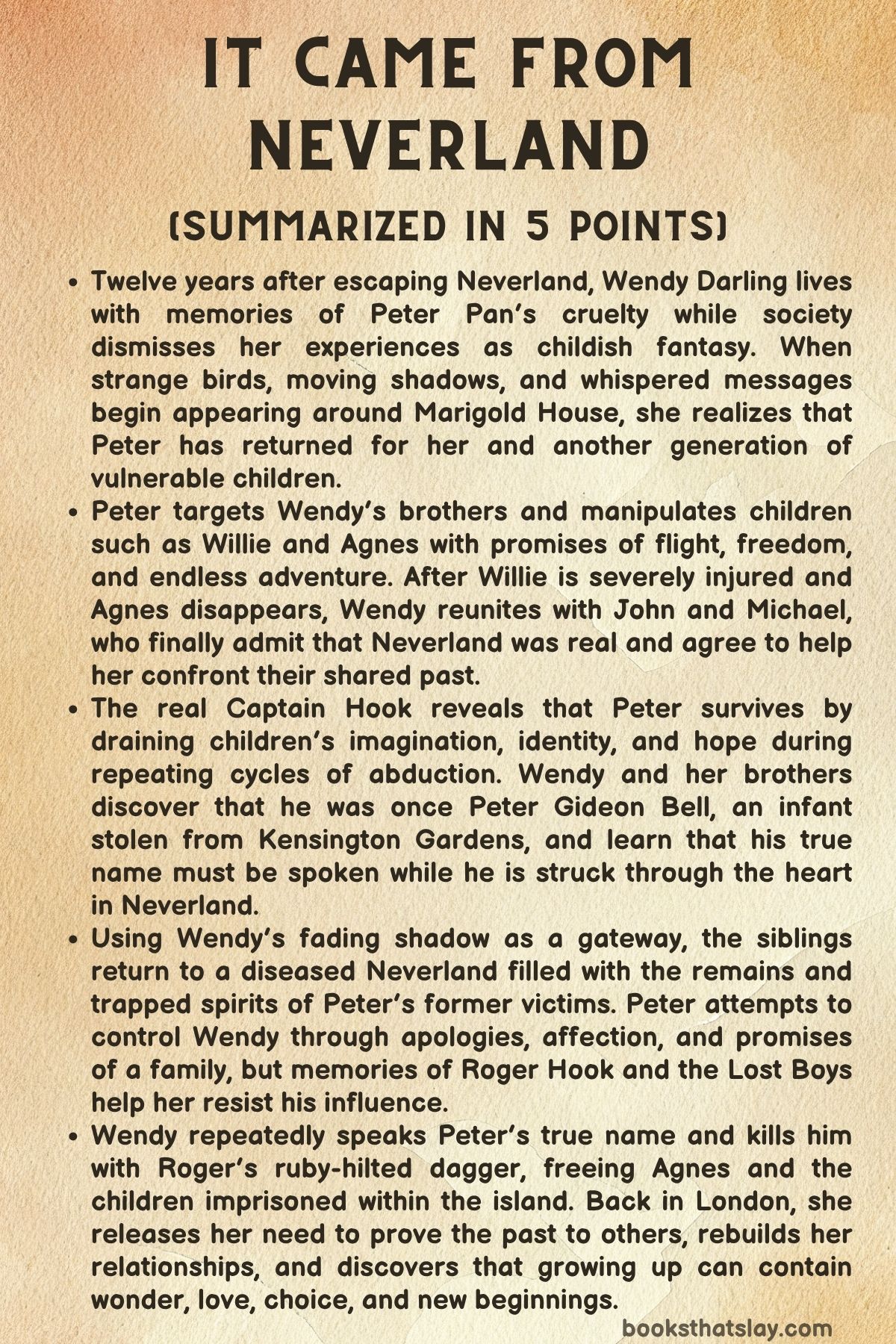
Twelve years after escaping Neverland, Wendy Darling remains haunted by Peter Pan. She remembers him not as an innocent boy but as a beautiful, demanding figure who promised freedom while gradually requiring complete obedience from everyone around him.
When Wendy, John, and Michael returned to London, adults refused to believe their stories of enchanted islands, flying children, strange creatures, and murdered boys. Public fascination soon became suspicion, and J. M. Barrie transformed their suffering into a popular adventure that replaced Wendy’s account with a charming version of Peter.
By October 1914, Wendy works as a teacher at Marigold House, a refuge for abandoned and displaced children. She has created a useful life there, yet she remains fearful of crows, open windows, moving shadows, and anything that reminds her of Neverland.
Miss Eleanor, who runs the home, offers Wendy an upstairs flat and the position of head teacher. Wendy hesitates because she still feels responsible for guarding the Darling family home, particularly the nursery that has remained sealed since the siblings returned.
Strange events soon begin around the children. Agnes, a troubled nine-year-old, buries a bird’s skull after a dream-boy tells her that bones grow like seeds, while Willie repeatedly hears noises and begins believing that he can fly.
A dead black bird covered in honey appears outside Marigold House, and Wendy watches the shadow of a tree move independently. Something taps at the window and calls her name, while her own shadow seems to answer.
The disturbances become more direct during lessons. Children see a mysterious man outside, chant verses taught by an unidentified boy, and draw figures with sharp faces and black wings.
Wendy also volunteers at a hospital treating wounded soldiers. There she reunites with Beatrice, her closest friend from childhood, who encourages her to stop living as though her survival is something for which she must apologize.
An unconscious soldier named Edward becomes the focus of Peter’s supernatural influence. While Wendy reads beside him, Edward speaks in voices from the battlefield and eventually repeats Peter’s name in the same unmistakable voice Wendy remembers.
Wendy’s missing journal is returned by Willie, who has accidentally read a forbidden rhyme from its pages: “Peter, Peter, shadow eater.” Roger Hook once warned Wendy that names could act as doors, making her fear that Willie’s words have strengthened Peter’s connection to London.
At home, Wendy learns that Michael intends to enlist. The sealed nursery begins glowing, its doorknob moves by itself, and the scent of salt and blood escapes through the keyhole.
Wendy’s memories reveal that Roger Hook was the person who truly protected her in Neverland. Adopted by Captain James Hook after Peter abandoned him, Roger taught Wendy how the island worked, warned her that Peter fed on children’s imagination and hope, and showed her a possible route home.
Peter had originally attracted Wendy by recognizing her loneliness and resentment toward the responsibilities placed upon her. He offered a place without adults, rules, death, or growing older, presenting captivity as freedom.
Michael and John have spent years suppressing their memories, but Peter begins targeting them as well. Michael sees the decaying spirit of Nibs, a Lost Boy who died after Peter dared him to swim in crocodile-filled waters, while John is confronted by Peter through the mirror in his daughter Margot’s nursery.
Peter tells John that iron, herbs, and other protections cannot stop him because he enters through memory and belief. He threatens Margot and explains that he wants Wendy returned to Neverland so she can become the mother and storyteller for a new collection of boys.
At Marigold House, Willie’s obsession with flight ends in disaster. After Agnes tells him that black feathers will help him fly, he falls down the stairs and suffers injuries that may permanently affect his movement.
Wendy is forced to leave before the authorities arrive because her childhood history makes her an easy suspect. The accident confirms that Peter is not merely haunting her memories but is actively using vulnerable children.
Wendy recalls more of what happened to the Lost Boys. Peter regularly encouraged dangerous games, refused responsibility when boys were harmed, and became jealous when Wendy gave care or attention to anyone other than him.
Curly died after eating poisonous berries on Peter’s dare. When Wendy tried to nurse him, Peter blamed her for his suffering and later killed the weakened boy rather than tolerate illness or admit his own cruelty.
At the hospital, Peter speaks through Edward and declares that he has come for Wendy’s shadow. Wendy resists him, and Edward briefly awakens as himself, but the situation worsens when Agnes disappears from Marigold House.
Wendy finally reunites with John and Michael. The brothers admit that they remember more than they previously acknowledged, apologize for leaving Wendy alone with the past, and agree that they must return to Neverland to rescue Agnes.
They are approached by the real Captain James Hook, who is an aging father rather than the theatrical villain created by Barrie. Hook explains that Peter survives in twelve-year cycles, attracting frightened children, draining their imagination, and leaving their bodies dead or spiritually empty.
Hook reveals that Roger was his adopted son. His years of fighting Peter were driven not by vanity or jealousy but by grief and a determination to prevent other children from sharing Roger’s fate.
Peter was once an ordinary infant stolen from Kensington Gardens by a crow-like being called Solomon. The child was transformed into something suspended between human and bird, childhood and adulthood, life and death, allowing him to exist across dreams, memories, reflections, and physical reality.
To destroy Peter permanently, Wendy must discover the name he possessed before his transformation. She must then speak that name in Neverland while striking him through the heart.
The Darlings investigate records at Scotland Yard and recover the real names of several Lost Boys. Nibs was Ernest, Curly was Stanley, and the Twins were Archibald and Ambrose, restoring identities that Peter had taken from them.
Their search leads them to Mrs. Bell, a woman confined at Bethlem after insisting that a crow stole her infant from a pram near the Round Pond. Her story mirrors Wendy’s experience of being called mad because society found denial more comfortable than belief.
Mrs. Bell reveals that her missing son was named Peter Gideon Bell. The moment she speaks the name, crows burst through the windows and kill her, proving that Peter fears the recovery of his original identity.
Hook returns from Neverland with confirmation that Agnes remains alive but is rapidly losing her memories and sense of self. Before the group can act, an arrow strikes Hook, and he dies after giving Wendy Roger’s ruby-hilted dagger.
Wendy then remembers the complete story of her original escape. She, John, Michael, and Roger had planned to flee through an ash-tree gateway, but Peter discovered the plan and shot Roger while pretending that the killing was an accident.
Wendy attacked Peter with an emerald dagger and struck his chest. As Roger died beneath the ash tree, he gave her his pocket watch and urged her to live rather than allowing guilt to become another form of imprisonment.
With Wendy’s shadow nearly separated from her body, the Darling siblings use its connection to Peter to cross back into Neverland. They find an island that is diseased, unstable, and filled with the bones of children Peter consumed or abandoned.
They discover that Peter separated many victims into two forms. Their dreaming selves remained trapped in Neverland, believing they were still playing, while their waking bodies returned to London dead, damaged, or emptied of life.
The island creates illusions designed to divide the siblings. Michael sees their dead mother offering him comfort, while John and Michael are drawn into a battlefield that exploits their fear, guilt, and anxiety about the war.
Peter offers them eternal childhood as an escape from death, duty, and grief. Wendy breaks the illusion by reminding her brothers that growing up can be painful, but pain does not have to be faced alone.
Peter finally appears as a beautiful young man and presents Agnes as the child he and Wendy could raise together. He apologizes, claims he has matured, and uses physical affection to drain Wendy’s memories and weaken her resistance.
Wendy initially struggles against his influence, but memories of Roger and the Lost Boys restore her awareness. John seizes Roger’s dagger, Michael carries Agnes to safety, and Wendy repeatedly calls Peter by the name Peter Gideon Bell.
Each repetition damages the identity Peter created for himself. His beauty cracks, his authority weakens, and the frightened child beneath the supernatural king begins to appear.
Wendy drives Roger’s dagger into Peter’s heart and declares that he is not a god or ruler but a story that has reached its end. When Peter attempts one final display of remorse, she recognizes the manipulation behind it and twists the blade until he collapses into ash.
As Neverland dies, the spirits of the Lost Boys guide Wendy, John, Michael, and Agnes to the ash-tree gateway. Agnes carries Wendy’s detached shadow, and the group returns safely to London.
Back in the nursery, the siblings burn objects associated with Peter and release the need to prove their experiences to people determined not to believe them. Wendy destroys her journal because she finally trusts her own memory without requiring written evidence.
Agnes gradually recovers at Marigold House, while Willie learns to walk with crutches. Wendy accepts the upstairs flat, strengthens her relationship with her brothers, and allows herself to build a life beyond fear.
Roger’s repaired pocket watch later appears among the roses, showing Wendy that moving forward does not require forgetting the person who saved her. Edward also recovers and remembers Wendy’s voice guiding him through darkness.
Wendy ends the story surrounded by children, friends, and family. She rediscovers wonder not as an escape from adulthood but as something that can exist within an ordinary life shaped by love, responsibility, and choice.
Characters
Wendy Darling
Wendy is the central consciousness of the novel and a woman forced to live with experiences that society has converted into entertainment. Her fear of birds, windows, shadows, honey, and the sealed nursery demonstrates how deeply Neverland remains present in her body even when she tries to live rationally.
Her greatest struggle is not simply defeating Peter but recovering authority over her own memories. Adults, doctors, journalists, and writers have repeatedly told her that she imagined or misunderstood what happened, leaving her uncertain whether she can trust her own mind.
At Marigold House, Wendy turns the nurturing role Peter imposed upon her into a freely chosen vocation. She cares for children without surrendering her identity, showing the difference between genuine compassion and the forced motherhood Peter demanded.
Her guilt over Roger and the Lost Boys makes her believe that survival was a form of betrayal. Over time, she understands that Peter alone was responsible for their deaths and that honoring the lost does not require destroying her own future.
In It Came From Neverland, Wendy’s final victory comes when she refuses Peter’s definitions of love, childhood, and power. By naming him, rejecting his authority, and ending his story, she becomes the author of her own life rather than a character trapped inside his fantasy.
Peter Pan
Peter is presented as a predator whose beauty and charm conceal a consuming need for worship, control, and emotional possession. He studies the loneliness of children and offers exactly what they believe they need, turning their desire for freedom into the means of their captivity.
His refusal to grow up is not innocence but a rejection of consequence. He treats injury, death, and abandonment as temporary games because accepting responsibility would destroy the identity he has created as the eternal ruler of Neverland.
Peter’s treatment of Wendy reveals his need to possess not only her physical presence but also her thoughts, stories, memories, and attention. He becomes violent whenever she cares for another child, remembers London, writes privately, or imagines a future beyond him.
The recovery of his birth name exposes the weakness beneath his supernatural identity. Peter Pan is a role built through stolen belief, while Peter Gideon Bell was once an abandoned human child whose pain became cruelty rather than compassion.
His final apology is another attempt to manipulate Wendy through pity. Even when dying, he tries to make her responsible for his loneliness, proving that his apparent vulnerability cannot be separated from his desire to regain control.
John Darling
John represents the effort to survive trauma through respectability, order, and denial. He becomes a barrister, creates a family, and surrounds his daughter’s nursery with protective objects, yet he avoids speaking openly about the experiences that made those protections necessary.
His silence leaves Wendy isolated and allows the public version of Neverland to replace their shared truth. Although he has not forgotten everything, he has chosen a form of selective memory that protects his social position at the cost of his relationship with his sister.
Peter’s invasion of Margot’s nursery destroys John’s belief that adulthood can keep the past contained. Once his child is threatened, he understands that silence cannot protect the next generation.
John’s decision to return to Neverland marks his acceptance of responsibility. He supports Wendy during the final confrontation, uses Roger’s dagger against Peter, and acknowledges that his sister carried a burden that should have belonged to all three siblings.
Michael Darling
Michael is shaped by uncertainty, suppressed memory, and a desire to prove his value. His plan to enlist reflects both patriotic feeling and the hope that war will give him a clear identity after years spent avoiding the unresolved confusion of childhood.
The visions that attack Michael transform toys and games into images of death. Tin soldiers point their weapons at him, Nibs returns as a decaying corpse, and Neverland creates a battlefield that connects Peter’s deadly games with the real violence awaiting him in Europe.
Michael is especially vulnerable to illusions of safety and maternal comfort. The vision of his dead mother offers him relief from fear, but choosing Wendy requires him to accept that love cannot be recovered by abandoning reality.
His growth lies in replacing avoidance with loyalty. He helps rescue Agnes, remains beside Wendy during the island’s collapse, and proves that adulthood can include courage without requiring emotional numbness.
Roger Hook
Roger is the moral opposite of Peter and the emotional center of Wendy’s memories. Although he also experienced abandonment and danger, he responds by protecting others rather than demanding that they suffer with him.
He teaches Wendy how to survive in Neverland, restores her memories of home, feeds her, warns her about Peter, and gives her the knowledge required to escape. His care never depends on ownership, obedience, or worship.
Roger’s love for Wendy is expressed through sacrifice and respect. Even while dying, he urges her to live and asks for no permanent debt in return.
His pocket watch and dagger carry different parts of his legacy. The dagger enables Wendy to end Peter’s violence, while the repaired watch allows her to remember Roger without remaining trapped in the moment of his death.
Captain James Hook
Captain Hook is reconstructed as a grieving father whose public image has been distorted by the same story that distorted Wendy’s. He is not motivated by wounded pride but by the loss of Roger, the son he adopted and failed to protect.
Hook’s knowledge comes from years of sacrifice. He has lost his hand, crew, health, and reputation while repeatedly attempting to understand Peter’s nature and interrupt the cycle of disappearances.
His relationship with Wendy is based on shared grief and mutual purpose. He does not dismiss her memories, romanticize Neverland, or demand that she forgive herself before she is ready.
In It Came From Neverland, Hook’s death transfers the responsibility for ending Peter’s cycle to Wendy and her brothers. By giving Wendy Roger’s dagger, he entrusts her with both his final hope and the surviving symbol of his son.
Agnes
Agnes is a vulnerable child whose imagination makes her both sensitive and susceptible to Peter’s influence. Her dreams, fascination with bird bones, and willingness to accept supernatural instructions reveal a child searching for meaning in a world marked by abandonment and war.
Peter exploits her curiosity rather than approaching her through open violence. He turns games, feathers, rhymes, and promises into tools that separate her from trustworthy adults.
Her disappearance repeats Wendy’s childhood experience, making her both a victim and a reflection of the danger Wendy could not prevent years earlier. Rescuing Agnes allows Wendy to protect a child without accepting responsibility for every harm Peter causes.
Agnes’s recovery is gradual rather than miraculous. Her nightmares and fear of windows remain, but eating, laughing, gardening, and helping Wendy restore her shadow show that identity can return through patience and safety.
Beatrice
Beatrice is Wendy’s strongest connection to ordinary human companionship. Unlike those who treat Wendy as unstable or embarrassing, she respects her emotional reality even when she does not fully understand the supernatural events behind it.
Her work as a nurse places her among soldiers whose suffering is visible but often difficult to express. This makes her especially capable of recognizing that wounds do not need to be obvious before they deserve care.
Beatrice repeatedly encourages Wendy to stop treating her existence as an apology. She challenges Wendy’s belief that guilt is a duty and reminds her that survival includes the right to friendship, work, affection, and personal space.
By bringing Edward back to Marigold House, Beatrice helps connect Wendy’s past acts of care with a possible future. She supports Wendy without demanding that she become dependent on that support.
Edward
Edward initially appears as an unconscious soldier whose body becomes a doorway for Peter. His condition connects the supernatural horror of Neverland with the psychological devastation of modern warfare.
Because he cannot speak for himself, Wendy confides in him without fear of judgment. Peter’s use of Edward therefore becomes a serious violation, turning Wendy’s private honesty into information that can be used against her.
Edward’s eventual awakening separates him from Peter’s control. He remembers Wendy’s voice and stories as a source of companionship while he was trapped in darkness, confirming that her care reached the real man beneath the possession.
His return introduces the possibility of a relationship based on mutual respect rather than fantasy or domination. He does not ask Wendy to forget what happened; he asks her to continue telling stories in a safer setting.
Miss Eleanor
Miss Eleanor gives Wendy the opportunity to rebuild her life after confinement and public rejection. By allowing her to read, teach, and work among children, she treats Wendy as capable rather than broken.
Her offer of the upstairs flat symbolizes a future Wendy can claim for herself. Eleanor understands that Wendy belongs at Marigold House, but she does not force her to accept the position before she is ready.
When Willie falls, Eleanor protects Wendy from immediate arrest without denying the seriousness of the situation. Her loyalty is practical, compassionate, and grounded in years of observing Wendy’s character.
Eleanor also represents a healthier form of adult authority. She creates structure for vulnerable children without suppressing their individuality or using care as a means of control.
Willie
Willie is a lonely boy whose father is fighting and whose mother can no longer support him. His emotional vulnerability makes Peter’s promise of flight and escape especially attractive.
His repeated jumps initially appear playful, but they reveal how dangerous fantasy becomes when guided by someone who does not care whether a child survives. Peter encourages Willie to treat gravity, injury, and fear as failures of belief.
The fall leaves Willie seriously injured and becomes a major source of guilt for Wendy. However, his later appearance on crutches shows that his life is not defined entirely by Peter’s attack.
Willie’s recovery also challenges Peter’s view that damaged or weakened children are disposable. He remains part of the Marigold House community and continues growing despite what was taken from him.
Mrs. Bell
Mrs. Bell is Peter’s biological mother and one of the clearest parallels to Wendy. Both women tell the truth about a supernatural abduction, and both are confined because their accounts disturb society’s preferred version of reality.
Her room filled with clippings and books shows a life consumed by the search for recognition. She has spent years trying to prove that the creature who took her child existed, even as that search separated her from the rest of the world.
Mrs. Bell’s refusal to view Peter as the innocent baby she lost is important. She understands that origin does not erase responsibility and that the adult creature Peter has become cannot be excused simply because he was once harmed.
By revealing the name Peter Gideon Bell, she gives Wendy the means to end the cycle. Her death demonstrates both the power of true names and Peter’s determination to erase anyone capable of defining him outside his chosen story.
The Lost Boys
The Lost Boys represent children whose identities have been reduced to roles inside Peter’s games. Names such as Nibs, Curly, and the Twins make them sound interchangeable, preventing them from being remembered as individual people with families and histories.
The discovery that they were Ernest, Stanley, Archibald, and Ambrose restores some of what Peter stole. Speaking their real names challenges the idea that they existed only as Peter’s followers.
Their deaths expose Peter’s complete lack of responsibility. He dares them into danger, blames others when they suffer, and removes anyone whose weakness interrupts his fantasy of endless play.
Their spirits eventually help Wendy escape the dying island. This final act allows them to participate in Peter’s defeat and guide another child home, transforming them from forgotten victims into agents of release.
Nibs
Nibs demonstrates how Peter turns loyalty into a weapon against the loyal. He accepts a dangerous challenge because Peter has built a culture in which fear is shameful and obedience is treated as courage.
His death in crocodile-filled water is followed by Peter’s refusal to accept responsibility. Returning as a decaying figure, Nibs forces Michael to confront the reality hidden behind their childhood adventures.
Recovering his real name, Ernest, gives him a history beyond his role as a Lost Boy. He becomes one of the children whose humanity Wendy and her brothers must acknowledge before Neverland can finally release them.
Curly
Curly’s death reveals Peter’s jealousy and hostility toward weakness. After daring the boy to eat poisonous berries, Peter expects Wendy to repair the damage while resenting the attention she gives the suffering child.
When Curly fails to recover quickly, Peter kills him and invents a story about mermaids. His actions show how easily he replaces truth with fantasy whenever reality threatens his authority.
Curly’s spirit later helps Wendy recognize Peter’s deception during the final confrontation. The memory of the boy Peter tried to erase becomes one of the forces that prevents Peter from controlling her again.
J. M. Barrie
Barrie functions as a symbol of the storyteller who benefits from another person’s pain. He turns the Darling children’s experiences into entertainment while removing the fear, violence, and moral responsibility at the center of their account.
His fictional Peter becomes more powerful than Wendy’s testimony because the public prefers a charming adventure to an accusation against childhood innocence. The book he creates therefore assists Peter by keeping belief in the false version alive.
Barrie is not presented as Peter’s supernatural accomplice, but his work demonstrates how cultural narratives can silence survivors. A beautiful story can become another form of disbelief when it replaces the voice of the person who lived through the events.
Solomon
Solomon is the crow-like figure responsible for taking the infant Peter from Kensington Gardens. Although his motives remain mysterious, his actions begin the transformation that produces Peter Pan.
He represents an older supernatural force that treats human identity as something removable and replaceable. By taking Peter’s true name and placing him between opposing states, Solomon creates a being who can move through dreams, memory, life, and death.
His limited presence increases his disturbing effect. He suggests that Neverland and Peter belong to a larger world of predatory forces whose rules humans understand only partially.
George Hale
George Hale provides Wendy with an unexpected experience of respect during the research at the British Museum. As someone connected to her earlier life, he could easily have repeated the mockery and suspicion surrounding the Darling case.
Instead, his courteous treatment shows that Wendy’s identity is no longer controlled entirely by scandal. His presence briefly reconnects her with ordinary society at a moment when she is preparing to reenter the supernatural world.
George’s role is small but meaningful because he demonstrates that not every encounter with the past must end in humiliation. Respect can exist without complete understanding.
Baby Jane
Jane represents the possibility of care without coercion. Her immediate trust in Wendy reflects Wendy’s natural ability to comfort children, but the relationship is not built around an imposed role.
Unlike Peter, Jane does not demand that Wendy abandon herself in order to become a permanent mother figure. Her presence helps Wendy see that nurturing can be part of a chosen life rather than a prison.
Jane also connects Wendy to the future of Marigold House. By accepting the flat and remaining near the baby, Wendy chooses attachment without surrendering freedom.
Themes
The Manipulation of Childhood Fantasy
Fantasy becomes dangerous when it is controlled by someone who refuses responsibility for its consequences. Peter offers flight, eternal youth, games, and freedom from adult rules, but each promise conceals a demand for obedience and an increasing separation from home.
Children are drawn to him because he understands what they lack. Wendy wants relief from caregiving, Willie wants escape from family hardship, Agnes wants meaning, and the Lost Boys want belonging, allowing Peter to present himself as the answer to private loneliness.
The novel does not reject imagination itself. Storytelling helps Wendy comfort wounded soldiers, calm frightened children, preserve the Lost Boys’ names, and create emotional connections that remain grounded in reality.
The difference lies in whether fantasy expands a person’s life or consumes it. Peter’s stories require children to forget their homes, names, fears, and independent desires, while Wendy’s stories allow listeners to recognize suffering and return safely to themselves.
By the end, wonder is separated from escape. Wendy learns that adventure and possibility can exist among friends, work, family, grief, and responsibility rather than requiring permanent retreat from the world.
Memory, Testimony, and Disbelief
Wendy’s memories are repeatedly challenged by institutions that claim greater authority over her experience. Her parents, doctors, police officers, journalists, and the reading public prefer to treat Neverland as childish fantasy because accepting her testimony would require them to acknowledge murdered children and adult failure.
The transformation of her experiences into a popular story intensifies this violation. Barrie’s version does not merely misunderstand Wendy; it occupies the cultural space where her truth might otherwise have been heard.
Her journal initially protects her from complete erasure. Recording names, rules, deaths, and memories allows her to resist both Peter’s supernatural influence and society’s insistence that she imagined everything.
Yet the journal also becomes tied to her belief that truth requires external proof. Burning it at the end shows that she no longer needs public acceptance in order to trust what she survived.
Recovering the Lost Boys’ real names performs a similar act of restoration. Ernest, Stanley, Archibald, and Ambrose are returned to history as children rather than fictional companions, showing that remembrance can challenge the power of those who reduce people to convenient roles.
Trauma, Guilt, and Survival
Survival leaves Wendy with gratitude, shame, anger, fear, and a sense that she abandoned those who did not escape. She treats guilt as a permanent responsibility, believing that a peaceful life would dishonor Roger and the Lost Boys.
Her habits show that trauma is not confined to conscious memory. She checks windows, fears crows, guards the sealed nursery, reacts intensely to honey and feathers, and remains physically connected to Peter through her shadow.
John and Michael respond differently by suppressing their memories and building respectable adult identities. Their avoidance does not remove the past; it simply forces Wendy to carry the shared burden alone.
It Came From Neverland presents healing as a process of reconnecting rather than forgetting. Wendy confronts the island, accepts help from her brothers, releases responsibility for Peter’s crimes, and allows Roger’s memory to exist beside new relationships.
The repaired watch expresses this balance. Wendy does not erase grief, but she no longer permits the moment of Roger’s death to define every possible future.
Growing Up as Freedom
Peter treats adulthood as corruption, limitation, and death. His promise of eternal childhood sounds attractive because the adult world contains war, poverty, social expectations, bereavement, and responsibilities that often feel unbearable.
The island reveals the cost of refusing growth. Peter remains emotionally fixed, incapable of accountability, empathy, change, or genuine attachment, while the children around him lose their memories and identities.
Wendy once viewed adulthood mainly as a collection of duties imposed upon her because she was a girl. Her return to Neverland allows her to distinguish forced responsibility from chosen commitment.
She chooses to teach, care for children, reconnect with her brothers, remember Roger, and build a home at Marigold House. These decisions are meaningful because they come from her own values rather than Peter’s demands or society’s expectations.
Growing up therefore becomes the ability to change without losing imagination. Wendy accepts grief and uncertainty while still finding wonder in stories, friendships, gardens, children, and future possibilities.