The Raven at the Ash Door Summary, Characters and Themes
The Raven at the Ash Door (Oak & Holly Cycle #3) by K. A. Linde is a fantasy novel built around magical rivalries, ancient artifacts, supernatural politics, dangerous bargains, and the struggle to control one’s own future.
At its center is Kierse McKenna, a thief and surviving Fae whose life has become entangled with the centuries-old conflict between Graves, the Holly King, and Lorcan, the Oak King. Kierse is searching for answers about the destruction of her people while also trying to escape a magical bond she never chose. As old enemies reappear and hidden truths surface, questions of love, power, guilt, loyalty, and personal freedom become increasingly difficult to separate.
Summary
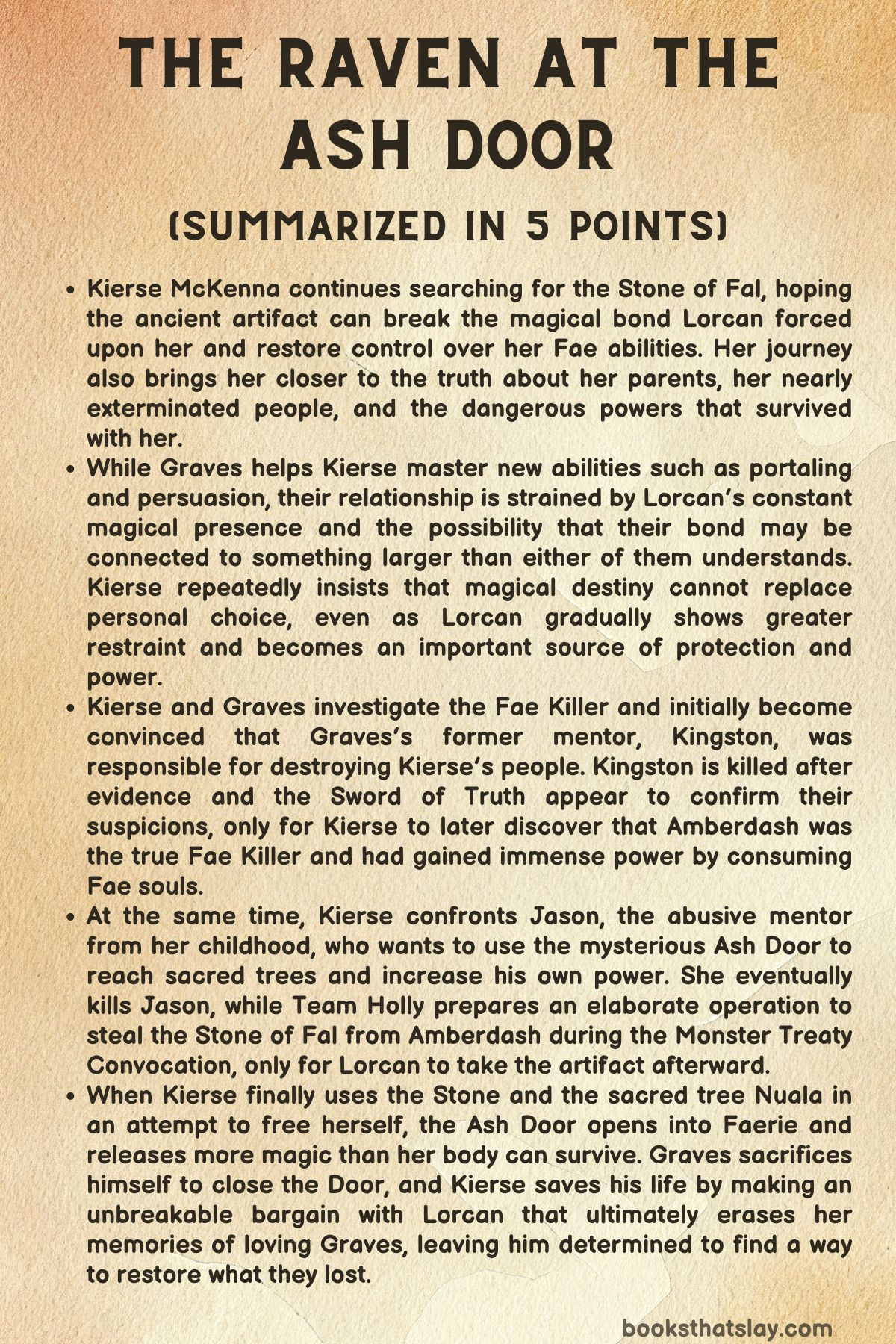
Kierse McKenna begins the story beneath Edinburgh, attempting to steal the legendary Stone of Fal with Graves, Walter, and George. Three months earlier, Lorcan Flynn had bound himself magically to her, sealing away most of her original Fae abilities, although the Cauldron of Dagda has since given her secondary powers such as magical intuition, pixie lights, and eventually portaling and persuasion.
The Edinburgh mission quickly goes wrong when Kierse discovers that Lorcan has reached Archie Blair’s vault before them. Lorcan possesses what appears to be the Stone of Fal, but Kierse immediately realizes that the object is a fake because the true ancient artifact should respond magically to her.
Lorcan explains that the real Stone disappeared years earlier, destroying Kierse’s immediate hope of using it to break the binding between them. Their confrontation is interrupted when Archie awakens, summons terrifying supernatural creatures, and forces Graves and Lorcan into temporary cooperation while Kierse uses the Spear of Lugh and unexpectedly regains access to some of her sealed Fae magic.
With Lorcan feeding power through their connection, Kierse discovers that her abilities become far stronger than they were before. She freezes time and absorbs Archie’s magical circle, but she cannot stop herself quickly enough and drains Archie completely, killing him and revealing the deadly historical relationship between wisps and warlocks.
The group secretly disposes of Archie’s body with the help of Bram, a Scottish monster hunter who recognizes Kierse because he knew her parents. Bram had been close to her father, Adair McKenna, and confirms that he helped Adair and Kierse’s Fae mother, Shannon, when they were fleeing the Fae Council, giving Kierse a rare living connection to the family she lost.
Soon afterward, Graves takes Kierse to London, where his former mentor Kingston agrees to teach her portaling. Kingston explains that portals depend upon clear knowledge of destinations and magical intention, and after repeated failure Kierse finally succeeds when genuine danger forces her instincts to take control.
Returning to New York restores the pressure of her bond with Lorcan, which becomes stronger whenever he is physically close. Kierse nevertheless remains committed to Graves and refuses to accept the idea that magical compatibility automatically gives Lorcan the right to determine her future.
At Druid headquarters, Kierse reunites with Gen and Ethan, the other members of the magical triskel they created together. Their sacred tree has grown dramatically and now contains a mysterious doorway known as the Ash Door, which seems connected to Kierse’s new powers and to something much older than ordinary Druid magic.
Lorcan offers information about the Door while gradually becoming more respectful of Kierse’s boundaries. He explains the significance of ash trees within Druid and Fae traditions and believes the Door may connect their combined magical histories, but Kierse remains suspicious because Lorcan repeatedly interprets ancient magic as proof that they belong together.
Meanwhile, Graves’s investigation into the destruction of the Fae leads his team to Dallas Llewellyn, a Las Vegas warlock whose ability to perceive magic could have helped someone locate the hidden Fae population. Kierse and Graves arrive too late because Dallas has already been murdered, yet her records lead them to Rosetta Davis, who confirms that Dallas suffered serious magical interference with her memories.
Evidence gradually begins pointing toward Kingston. Dallas’s writings connect his appearances to her missing memories, Rosetta had professional links to him, and Lorcan reveals that Kingston once reacted violently after learning that Saoirse was a wisp, giving him an apparent motive for targeting Kierse’s people.
At the same time, Amberdash becomes an increasingly serious threat within New York’s supernatural political world. Kierse infiltrates one of his gatherings to steal a ledger, where she encounters Jason, the abusive mentor who controlled and brutalized her when she was younger.
Amberdash possesses an amulet capable of suppressing nearby magic and begins openly tempting Kierse with promises of freedom and greater power. When he catches her inside his private territory, she escapes by forcing a portal through the magical suppression, nearly draining herself in the process.
Lorcan stabilizes her afterward through their bond, once again proving how efficiently their powers support each other. Graves sees the magical closeness between them and struggles with the fear that the connection might eventually overpower Kierse’s conscious choice to remain with him.
Amberdash later publicly humiliates Graves while revealing that he possesses the real Stone of Fal and presents himself as New York’s rightful ruler. Kierse steals and destroys Amberdash’s magic-suppressing amulet, allowing Graves and Lorcan to recover their strength and escape, but the Stone remains behind.
The strain caused by Lorcan finally damages Kierse and Graves’s relationship. Graves admits that he fears ancient magic may eventually draw Kierse toward Lorcan regardless of what she currently wants, and Kierse is devastated that declaring her love for Graves cannot remove his uncertainty.
After their separation, Lorcan finds Kierse drunk and emotionally vulnerable but does not exploit her condition. He feeds her, gives her a safe place to sleep, and respects her boundaries, complicating Kierse’s view of him without erasing the violation that began their relationship.
Kierse and Graves are soon brought together again when George disappears into Sansara. Their rescue mission reveals that Maya used persuasion to amplify desires George already possessed, and Kierse learns that Jason has magically joined himself to the ancient sacred tree Sansara, gaining protection and power from it.
Maya also teaches Kierse that persuasion works more effectively by strengthening existing desires than by attempting to dominate another person completely. This lesson later helps Kierse understand the secondary power she has struggled to control.
George is injured during another encounter with Jason, forcing Kierse to portal him to safety. The crisis also pushes Kierse and Graves toward reconciliation, and Graves admits that fear and jealousy led him to withdraw because he was horrified by his own temptation to interfere magically with Lorcan or Kierse.
Kierse makes clear that she chooses Graves while refusing to pretend he is innocent of everything he has done in his long life. Their relationship resumes with greater honesty, based not on moral perfection but on accountability, trust, and their willingness to make better choices together.
The team then prepares to confront Kingston and steal the Stone from Amberdash. Walter develops magical containment capable of interfering with portals while Kierse masters persuasion by drawing upon painful memories and contrasting them with the trust and acceptance she has found among her chosen companions.
At a Halloween gathering, Kingston is trapped inside Walter’s anti-portal defenses. When Lorcan uses the Sword of Truth, Kingston is identified as a Fae killer, and because the accumulated evidence already appears conclusive, the group interprets this as confirmation that he is responsible for the extermination Kierse has spent years trying to understand.
Kingston fights back and succeeds in saving Andrew before Graves finally kills his former mentor. What appears to be justice immediately becomes tragedy when Jason attacks Walter and later kidnaps Kierse with enchanted cuffs designed to suppress and torment Fae magic.
During her captivity, Jason reveals the truth. Kingston had killed Fae and carried a violent prejudice against wisps, but he was not the person responsible for the genocide; the true Fae Killer is Amberdash, who gained extraordinary power by consuming the souls of Kierse’s people.
Kierse manages to kill Jason using her father’s knife and is rescued by Graves and Lorcan. The group realizes that the Sword of Truth had answered their question literally: Kingston was a Fae killer, not necessarily the Fae Killer they were hunting, and their assumptions had completed the accusation.
Graves must now live with killing his mentor for crimes Kingston did not commit, even though Kingston was guilty of murderous acts of his own. Kierse also learns more about Graves’s past with Lorcan’s sister Emilie and understands that Lorcan’s hatred began with a legitimate grievance, because Graves’s mind magic harmed Emilie and contributed to her death.
Despite injuries and depleted magic, Team Holly prepares for the Monster Treaty Convocation, where Amberdash intends to consolidate his political power while displaying the Stone of Fal. Kierse develops an elaborate deception in which Gen impersonates her while the real Kierse manipulates security procedures into evacuating the assembly.
The plan works. Kierse portals back into the empty chamber, steals the Stone, and transfers it to Lyra, but the artifact disappears before reaching their escape vehicle.
The thief is Lorcan, who takes the Stone to Druid headquarters and positions himself beside the sacred tree and the Ash Door. He gives Kierse access to the artifact and challenges her to use it against their binding if she truly believes freedom is what the Stone will provide.
The Stone recognizes Kierse but refuses simply to remove the bond, telling her that the connection feels correct within a larger cosmic order. It nevertheless confirms that a way exists to escape the binding without dying, although Kierse must discover that solution herself.
Kierse turns to the sacred tree, which reveals its name as Nuala and gives her access to tremendous power. Even that strength cannot destroy the bond, so Kierse opens the Ash Door and discovers that it leads directly into Faerie.
Believing Faerie’s limitless magic might finally give her enough strength, Kierse begins drawing power through the Door. The energy rapidly exceeds what her body can survive, and even Lorcan cannot absorb enough of it through their connection to save her.
Graves moves directly into the magical storm despite knowing that Fae power is particularly dangerous to a warlock. He reaches the Door and closes it, stopping the flow but absorbing fatal damage in the process.
When Graves lies dead beneath Nuala, Kierse begs Lorcan to use the ancient connection between the Oak and Holly Kings to restore him. Lorcan refuses to risk the attempt without sufficient power, so Kierse offers the one thing she knows he wants: she promises to go with Lorcan and abandon her relationship with Graves if he brings Graves back.
The agreement becomes an unbreakable geas sworn upon the Stone of Fal. Empowered by the Stone, Lorcan channels enormous energy through the seasonal connection between the two kings and succeeds in restoring Graves to life.
Kierse is overjoyed, but the cost of the bargain soon becomes clear. To complete the geas, she must go with Lorcan and forget her romantic relationship with Graves.
After one final moment with the man she loves, Kierse seals the promise. Magic rewrites her memories so thoroughly that Graves becomes only Brannon, the Holly King and enemy of the Druids, while the love and history they shared disappear from her conscious understanding.
Graves hides his devastation and promises Lorcan that he will find a way to undo what has happened. Kierse orders him away, yet as she watches him leave after he calls her his queen, she is left with a faint sense that something precious has been taken from her, ending The Raven at the Ash Door with freedom, love, fate, and memory still unresolved.
Characters
Kierse McKenna
Kierse is the emotional and narrative center of The Raven at the Ash Door, and nearly every conflict in the book forces her to confront the difference between possessing power and possessing control over her own life. She begins as an exceptionally skilled thief who has survived through instinct, adaptability, and distrust, but her discovery that she is a surviving Fae wisp transforms personal survival into a larger question of identity and responsibility.
Her greatest struggle is not simply mastering new magic but preventing others from defining what that magic means for her future. Lorcan interprets their bond as destiny, Graves fears destiny may overpower her decisions, Amberdash sees her as a source of power, and Jason repeatedly treats her as someone who can be controlled, yet Kierse consistently insists that capability, ancestry, prophecy, and magical compatibility do not replace consent.
Kierse also develops significantly as a strategist. Her growing command of portaling, persuasion, absorption, time manipulation, and magical intuition complements rather than replaces the instincts that made her an extraordinary thief, culminating in elaborate operations where she manipulates expectations instead of simply reacting to danger.
Her final bargain exposes both her greatest strength and her deepest vulnerability. Kierse values the freedom to choose above almost everything, yet she willingly sacrifices that freedom when Graves dies, showing that love can lead her to surrender the very autonomy she spends the entire book defending.
Graves / Brannon
Graves is one of the most morally complicated figures in The Raven at the Ash Door, functioning simultaneously as Kierse’s partner, protector, teacher, lover, strategist, and a man burdened by centuries of destructive choices. His personality combines arrogance, intelligence, violence, loyalty, humor, possessiveness, and genuine tenderness, making his development depend less on becoming innocent than on learning how to use power differently.
His past remains essential to understanding him. Graves damaged Emilie through mind magic, helped create Lorcan’s centuries-long hatred, developed a reputation for manipulation, and learned many of his methods under Kingston, yet the present version of Graves increasingly rejects the assumption that superior power gives him the right to control other people.
His relationship with Kierse reveals that transformation most clearly. He learns to include others in plans, respects Kierse’s decisions even when they frighten him, admits his jealousy instead of disguising it as strategy, and eventually recognizes that withdrawing from her to protect her from his own fears is another way of making a decision on her behalf.
His death at the Ash Door completes that development in physical form. Graves walks knowingly into magic capable of destroying him because Kierse cannot survive it, placing her life above his own without demanding anything in return.
Lorcan Flynn
Lorcan is both antagonist and essential ally, and the book refuses to reduce him to either role. His decision to bind Kierse without her consent remains a fundamental violation, and his insistence that their magical compatibility proves the relationship is natural demonstrates how easily belief in destiny can become a justification for control.
At the same time, Lorcan develops through his growing willingness to respect limits. He stops constantly entering Kierse’s thoughts, honors conditions she places on meetings, refuses to exploit her when she is intoxicated and heartbroken, shares power when she is dangerously depleted, and repeatedly helps protect her even when her conscious choice continues to favor Graves.
His history with Graves also gives his anger genuine foundations. Graves harmed Emilie, and Lorcan has carried that loss for centuries, yet the legitimacy of his original grief cannot justify the ways vengeance distorts his later actions.
Lorcan ultimately becomes most dangerous when love, fate, and possession become indistinguishable to him. His final bargain saves Graves but also gives Lorcan the result he has desired, leaving open the question of whether his capacity for restraint can survive finally having Kierse bound to him by something even stronger than the original connection.
Kingston
Kingston initially appears as one of the most charismatic and entertaining older figures in the book. He is powerful enough to treat portaling casually, affectionate enough toward Graves to tease him without fear, and generous enough to train Kierse despite knowing comparatively little about her true nature.
His relationship with Graves makes his eventual death especially painful. Kingston is not merely a teacher but one of the people who shaped Graves over centuries, making the accusation that he exterminated the Fae emotionally devastating before it is even proven.
The later revelation that Kingston was not responsible for the genocide does not make him innocent. His hatred of wisps, his attempted murder of Saoirse, and the Sword of Truth identifying him as someone who had killed Fae reveal genuine prejudice and violence.
His death therefore becomes a study in incomplete truth. Graves kills a guilty man for the wrong crime, and Kingston becomes the central example of how prejudice, circumstantial evidence, emotional expectation, and technically accurate information can combine into a terrible conclusion.
Jason
Jason represents Kierse’s most personal experience of abuse and domination. Long before ancient artifacts or supernatural politics became central to her life, Jason taught her survival through violence, fear, manipulation, and control, shaping the defensive instincts she carries into adulthood.
His greatest power over Kierse is initially psychological rather than magical. She remembers him as the authority figure who could punish, train, or exploit her whenever he wished, and seeing him again reactivates the fear beneath her anger.
As Kierse grows stronger, Jason gradually becomes smaller in her perception. Once she recognizes that his authority depended on keeping her frightened, she can confront him as a dangerous man rather than an unbeatable figure from her childhood.
His connection to Sansara reveals his limitless hunger for power, while his final attempt to use Kierse and the Ash Door exposes how little he has changed. Kierse killing him with Adair’s knife gives his death symbolic importance because the weapon connects the family Jason could never erase with the woman Kierse chose to become.
Amberdash
Amberdash operates through power, spectacle, temptation, and institutional authority rather than simple open violence. He presents himself as a ruler capable of imposing order on New York while using magical suppression, political influence, ancient artifacts, and carefully staged humiliation to weaken opponents.
His interest in Kierse is particularly disturbing because he understands that she feels constrained by several powerful men and uses that frustration as part of his recruitment strategy. He offers freedom while behaving like someone who intends to convert her power into another resource under his control.
The revelation that Amberdash is the true Fae Killer transforms his political ambitions into something far darker. His strength was built partly by consuming the souls of the people he exterminated, making his authority literally dependent upon the destruction of Kierse’s species.
Amberdash therefore becomes the clearest example of power sustained by concealed atrocity. His public image depends on controlling the story of who he is, while the truth reveals that the order he promises others is founded on exploitation and mass murder.
Niamh
Niamh develops from a magical ally into an important political and emotional support for Kierse. As leader of the Druids after Lorcan’s removal, she must govern a community divided between those willing to accept change and those still loyal to the former Oak King.
Her position makes her relationship with Kierse especially important because she supports Kierse without demanding ownership over her abilities. Niamh participates in rituals designed to restore access to Kierse’s sealed magic and later helps her develop persuasion, but she also warns against using trauma as the only pathway to power.
Her leadership is repeatedly challenged, particularly when Lorcan returns with loyalists. Even then, Niamh refuses to treat his history as automatic proof that he deserves authority.
She represents a model of leadership based more on responsibility than inherited status. Through her, the novel shows that maintaining a community may require resisting both external threats and the comforting pull of older hierarchies.
Gen
Gen is one of Kierse’s most important emotional anchors. Their friendship provides a form of intimacy that is not based on romance, destiny, obligation, or political advantage, giving Kierse a place where she can be angry, exhausted, frightened, or heartbroken without becoming someone else’s magical problem.
As part of the triskel with Kierse and Ethan, Gen also contributes directly to the creation and development of Nuala. Her magic therefore participates in one of the largest supernatural developments in the story.
Gen is especially important during Kierse’s separation from Graves. She recognizes Kierse’s distress, allows her to break down, and tries to give her an ordinary evening when constant magical crises have made normal emotional recovery almost impossible.
Her willingness to impersonate Kierse during the Stone heist further demonstrates her courage. Gen is not merely a comforting friend; she accepts significant danger because she believes in the people around her.
Ethan
Ethan completes the triskel formed with Kierse and Gen and serves as one of the quieter stabilizing forces within their magical group. His presence helps establish that Kierse’s strongest sources of power are increasingly communal rather than solitary.
Through the triskel, Ethan contributes to Nuala’s extraordinary growth and the emergence of the Ash Door. His role reinforces the idea that significant magical achievements can arise from cooperation among different traditions rather than domination by a single powerful individual.
Ethan also participates in the friendship network that gives Kierse an identity outside her relationships with Graves and Lorcan. During periods of emotional upheaval, that friendship becomes essential because it reminds her that she belongs to more than one bond.
His character may occupy less narrative space than Kierse, Graves, or Lorcan, but his reliability helps make the Druid headquarters feel like a genuine community rather than merely another strategic location.
Walter
Walter develops into one of Team Holly’s most valuable members because his intelligence, loyalty, and technical magical work repeatedly determine whether larger plans succeed. His contributions include surveillance, concealment, force-field construction, security manipulation, and the anti-portal defenses required to contain Kingston.
His training against Kierse is especially revealing. Rather than remaining a background specialist, Walter tests his magic under pressure and learns to strengthen his barriers while Kierse learns how to exploit them.
Walter’s near-fatal attack by Jason also demonstrates the personal cost of belonging to Team Holly. He is targeted precisely because his work threatens extremely powerful figures, and his injuries turn strategy into something painfully immediate for Kierse.
His character represents competence without grandiosity. Walter rarely seeks symbolic status, yet several of the group’s most ambitious operations would be impossible without him.
George
George brings warmth and vulnerability to the group while also becoming a useful example of how magical influence can operate without completely erasing personal desire. His disappearance into Sansara initially appears to be a kidnapping, but the reality is more complicated because Maya has amplified things George already wanted.
His experience forces the others to confront difficult questions about consent. George genuinely desires adventure, belonging, and discovery, yet those authentic desires have been magically intensified until his freedom becomes difficult to measure.
His willingness to let Graves examine his mind shows considerable trust. Later, his serious injury during the confrontation with Jason becomes the immediate reason Kierse pushes her portaling beyond safe limits.
George matters because he reminds the more powerful characters that manipulation does not need to feel like imprisonment to compromise freedom. His storyline mirrors Kierse’s larger fear that desire itself can be influenced until choice becomes difficult to separate from magic.
Bram
Bram gives Kierse something no ancient artifact can provide: living memory of her parents. Having grown up beside Adair and fought alongside him, Bram can speak about Kierse’s family as real people rather than distant names reconstructed from fragmented memories.
His recognition of Kierse as resembling Shannon makes their first meeting especially significant. For Kierse, who believed nearly every connection to her original family had been destroyed, Bram represents continuity with a life stolen from her.
He also joins the confrontation with Kingston because the destruction of the Fae affected human families as well as supernatural ones. His presence widens the emotional meaning of the investigation beyond Kierse’s private vengeance.
Bram represents inheritance in its most humane form. He does not define Kierse by her parents, but his knowledge gives her access to a history she can choose to incorporate into her own identity.
Isolde
Isolde helps create the domestic stability of Graves’s brownstone, making the house feel like more than the residence of an ancient and dangerous warlock. Her presence gives Kierse moments of ordinary care within a life dominated by violence, supernatural politics, and urgent missions.
She also assists Kierse before important social encounters, including politically dangerous gatherings. These acts may appear small beside battles and ancient magic, but they reinforce the sense that Kierse has gained a household and community rather than simply an alliance.
Isolde also helps reveal a different side of Graves. His relationship with those who live and work around him suggests that beneath his reputation for manipulation exists an ability to maintain long-term loyalty.
Through her, the story gives emotional texture to the idea of home. The brownstone becomes significant because of the people inside it, not because of Graves’s power.
Lyra
Lyra combines confidence, political access, and personal vulnerability. Her relationship with her formidable vampire parents shows that even highly capable supernatural figures can become uncertain when family expectations and old histories are involved.
Her importance grows through her willingness to participate in Team Holly’s increasingly dangerous plans. She helps with the Stone operation and uses her access within powerful supernatural circles to support objectives that could put her at odds with larger institutions.
Lyra also connects Graves’s current alliances with his older history. Through Beckham, Reyna, and the Vampire Syndicate, Kierse sees that Graves’s past continues to influence relationships he must now renegotiate through cooperation rather than intimidation.
Her character demonstrates that loyalty often requires crossing political boundaries. She repeatedly chooses specific people over the safer position offered by neutrality.
Maya
Maya initially appears suspicious because of her connection to Sansara, Jason, and George’s altered behavior. Her use of persuasion is ethically questionable, particularly because she amplifies existing desires until the distinction between influence and free choice becomes uncertain.
Yet Maya is also a teacher and source of essential information. She explains the true mechanics of persuasion to Kierse and reveals Jason’s magical connection to Sansara, preventing Kierse from attacking him in a way that could destroy an ancient sacred tree.
Her loyalty appears directed less toward conventional factions than toward Sansara itself. This makes her difficult to classify because her decisions arise from priorities that do not always align with human or political expectations.
Maya functions as a morally ambiguous guide. She helps Kierse understand that influence can be subtle, that sacred magic may possess intentions of its own, and that even justified anger can produce catastrophic consequences if acted upon without sufficient knowledge.
Dallas Llewellyn
Dallas becomes one of the story’s most important characters despite being dead before Kierse can question her. Her unusual ability to perceive magic makes her the likely person who once helped locate hidden Fae, placing her at the center of the investigation into their destruction.
Her missing memories suggest that she was both participant and victim. Someone powerful repeatedly interfered with her mind, leaving Dallas unable to understand significant portions of her own history.
Her journals ultimately contribute to the mistaken conclusion about Kingston. They contain meaningful evidence, but that evidence becomes dangerous when combined with assumptions that are never properly separated from established fact.
Dallas represents the vulnerability of memory as evidence. Her damaged mind becomes a warning that information can be genuine yet still incomplete enough to lead others toward disaster.
Rosetta Davis
Rosetta is an unusually self-possessed magical practitioner who refuses to be intimidated by Graves. Her healing, spiritual knowledge, divination, and familiarity with Dallas make her one of the few people capable of helping the investigation move forward after Dallas’s death.
Her tarot reading does not provide simple answers. Instead, it reflects difficult choices, bindings, transformations, and consequences, forcing Kierse and Graves to consider possibilities that cannot be reduced to evidence they can immediately verify.
Rosetta’s connections to Kingston also contribute to the suspicion surrounding him. Because she treated Dallas and accepted Kingston’s involvement in that treatment, her information becomes part of a larger pattern whose interpretation later proves dangerously incomplete.
She functions as a reminder that knowing pieces of the truth does not mean understanding the whole truth. Her knowledge is substantial, but even she cannot remove the responsibility of interpretation from the people seeking answers.
Laz
Laz is a practical member of Team Holly whose contributions become increasingly valuable as Graves begins operating through collaboration rather than solitary control. He assists with routes, logistics, infiltration, and the coordination needed for complicated operations.
His presence helps show the evolution of Graves’s leadership. Instead of relying only upon his own abilities, Graves begins trusting specialists to manage parts of plans independently.
Laz is therefore important less because of an individual magical conflict than because of what his inclusion represents. Team Holly works because different people contribute specific skills without requiring Graves to dominate every decision.
That cooperative model becomes one of the group’s greatest strengths against opponents whose authority depends upon concentrating power in themselves.
Schwartz
Schwartz works alongside Walter and others on the technological and security elements of Team Holly’s operations. His skills allow the group to challenge enemies whose strength cannot be defeated through magic alone.
His role reinforces the hybrid nature of their strategy. Ancient artifacts, portals, supernatural abilities, surveillance systems, digital security, and ordinary criminal planning all become equally useful depending upon the situation.
Schwartz also reflects Graves’s increasing willingness to delegate. The old Graves might have preferred complete personal control, while the developing leader recognizes that trust can produce greater effectiveness than domination.
Although he remains more operational than emotionally central, Schwartz contributes to the sense that Team Holly is a functioning network rather than a collection of followers.
Archie Blair
Archie Blair serves as the first major casualty of Kierse’s newly expanded understanding of her own abilities. As a respected Scottish warlock, he possesses enough power to summon dangerous creatures when Kierse, Graves, and Lorcan invade his property.
His death is accidental, but it changes Kierse’s understanding of herself. By absorbing his conjuring circle and then continuing beyond the spell into Archie’s personal magic, she discovers that a wisp can completely drain a warlock.
Archie therefore becomes proof that forgotten historical hostility between wisps and warlocks had a biological and magical foundation. His death also creates the danger that Kierse’s survival as a Fae could become publicly known.
Although he appears briefly, the consequences of his encounter affect Kierse’s fear of her own power long afterward.
Beckham
Beckham is Lyra’s father and an immensely dangerous vampire whose history with Graves contains unresolved hostility. His instinct is to protect his family from becoming entangled in another supernatural conflict.
His initial refusal to help Graves reflects experience rather than cowardice. Beckham has survived enough violence to understand that old debts can become excuses for endless wars.
Yet his concern for Lyra ultimately influences his willingness to cooperate. The negotiation reveals that family loyalty can move him more effectively than intimidation.
Beckham also serves as evidence of Graves’s changing methods. Their agreement becomes possible because Graves chooses bargaining over the threats and coercion people from his past expect him to use.
Reyna
Reyna balances affection, authority, and diplomacy within Lyra’s powerful vampire family. She repeatedly prevents the hostility between Beckham and Graves from escalating into unnecessary violence.
Her influence demonstrates a form of power based on control of conflict rather than dominance over opponents. Reyna understands the history surrounding the people in the room but remains focused on what arrangement best protects her family in the present.
Her willingness to acknowledge the existence of an old passage becomes critical to Team Holly’s escape from Amberdash’s gala. A decision made through negotiation therefore saves lives later.
Reyna represents the practical value of diplomacy in a story where many ancient figures are accustomed to solving problems through force.
Quint / Alexander
Quint, also known as Alexander, enters the story as a representative of the Vampire Syndicate rather than simply a member of Lyra’s family circle. His presence makes it clear that apparently private meetings among powerful supernatural figures are rarely free from institutional politics.
He helps widen the scale of the coming Monster Treaty conflict. Decisions involving Graves, Amberdash, or Lyra cannot remain personal because their actions affect alliances among larger factions.
Quint functions primarily as a political presence, showing how organizations attempt to maintain influence by placing representatives inside conversations where power may shift.
His inclusion reinforces the idea that nearly every relationship in the supernatural world operates simultaneously on personal and political levels.
Maureen
Maureen is a loyal Druid aligned with Lorcan, and her reactions reveal how deeply loyalty to the former Oak King survives within the community. She provides transportation during the escape from Amberdash’s gala and is visibly surprised to see Lorcan and Graves cooperating.
That surprise is important because their feud has lasted so long that even temporary collaboration appears almost unnatural to those who know their history. Kierse repeatedly becomes the reason ancient enemies must work together.
Maureen also helps demonstrate why Niamh’s leadership remains unstable. Lorcan’s absence did not eliminate the emotional and political structures that supported him.
Through Maureen, the story shows that changes in leadership do not automatically change the loyalties of a community.
Vale
Vale provides a secure environment when Graves and Kierse need to interrogate a captured Sansara cultist. His unusual appearance and formidable preparedness add a touch of humor without diminishing his usefulness.
His role is another example of the broad network Graves can call upon. These relationships suggest centuries of connections extending far beyond the central group.
Vale also represents the hidden infrastructure required for supernatural operations. Battles may receive more attention, but safe locations, reliable allies, weapons, and private spaces often determine whether information can actually be obtained.
His contribution is limited in duration but strategically important because it helps Kierse and Graves reach Sansara and locate George.
Rio
Rio is a goblin information broker whose knowledge becomes essential when George disappears. Operating within the Goblin Market, he understands routes and hidden structures that ordinary investigation cannot easily penetrate.
His role reinforces the idea that information itself is a form of power. Graves and Kierse cannot simply fight their way toward George because they first need someone who understands a system designed to resist outsiders.
Rio also adds texture to the Goblin Market as a place with its own economy, hierarchies, dangers, and specialists. His usefulness depends upon navigating that world according to its rules rather than imposing outside ones.
Through him, the story repeatedly emphasizes that intelligence gathering is often as important as magical strength.
Nova
Nova belongs to the wider network of powerful supernatural figures surrounding Amberdash and the Monster Treaty conflict. Kierse deliberately provokes her during Amberdash’s gala because understanding how individuals will react is often more useful than confronting them directly.
Nova therefore becomes part of Kierse’s strategic growth. Kierse learns to control situations by manipulating attention and emotional responses, techniques that later become even more important during the Stone heist.
Her presence also illustrates the density of rivalries surrounding Amberdash. Every gathering contains individuals with competing loyalties, histories, and personal weaknesses.
Although Nova remains a supporting figure, she contributes to the social danger of environments where a single provocation can reshape an entire room.
Fury
Fury is primarily defined through physical violence and his participation in Amberdash’s humiliation of Graves. His brass knuckles leave magical wounds that prevent Graves from healing normally, making the attack more dangerous than ordinary supernatural combat.
He represents the type of power Amberdash uses through others. Amberdash creates the conditions for violence, suppresses stronger opponents, and allows figures such as Fury to carry out the physical punishment.
The lasting damage Fury causes contributes directly to the later conflict between Kierse and Graves because physical injury and emotional insecurity occur simultaneously after the gala.
His role demonstrates how violence can continue affecting characters long after the immediate fight ends.
Andrew
Andrew reveals Kingston’s capacity for genuine attachment. Kingston arrives at the Halloween gathering with him and becomes protective when the confrontation turns into a trap.
During the battle, Kingston expends precious effort forcing open a portal so Andrew can escape. That decision matters because it humanizes Kingston at the exact moment the other characters are prepared to view him only as a genocidal enemy.
Andrew therefore intensifies the tragedy of Kingston’s death. The reader sees evidence that Kingston can love and protect someone even while learning about his genuine hatred and violence toward wisps.
His survival preserves a living connection to Kingston after Graves has killed him, potentially carrying the emotional consequences of that decision beyond the confrontation itself.
Adair McKenna
Adair is Kierse’s father and one of the central figures in the family history she is trying to recover. Through Bram, Kierse learns that Adair was a monster hunter, loyal friend, and man willing to flee powerful enemies in order to protect Shannon and their family.
His knife becomes an important symbol of inheritance. When Kierse uses it to kill Jason, the weapon connects her confrontation with the man who shaped her childhood through abuse to the father whose life was stolen before he could help shape her differently.
Adair exists largely through memory, but those memories give Kierse a stronger sense of origin. Learning about him helps her build an identity rooted in knowledge rather than absence.
His legacy offers Kierse connection without demanding that she become a copy of him.
Shannon
Shannon is Kierse’s Fae mother and one of the last links between Kierse and the people Amberdash destroyed. Bram’s immediate recognition of Kierse because of her resemblance to Shannon gives Kierse tangible confirmation of a family she remembers only incompletely.
Her decision to flee the Fae Council with Adair suggests courage and a willingness to defy powerful institutions for the sake of family. That history parallels Kierse’s own refusal to let supernatural authorities determine how she should live.
Shannon also connects Kierse’s personal grief with the larger destruction of the Fae. Amberdash did not simply eliminate an abstract magical population; he destroyed mothers, fathers, families, and entire histories.
Through Shannon, the political crime becomes deeply personal.
Emilie
Emilie is central to the original break between Graves and Lorcan despite being absent from the present action. Graves used mind magic against her, damaged her, and contributed to circumstances that ended in her death.
Her fate explains why Lorcan’s hatred cannot simply be dismissed as irrational jealousy. He lost his sister because of Graves’s actions and spent centuries carrying that grievance.
Emilie also forces Graves’s moral growth to be understood without rewriting his history. He regrets what happened and even searched for impossible methods of restoring her, but remorse cannot undo the harm.
Her memory keeps accountability present within Graves and Lorcan’s conflict. Neither man can move forward honestly without acknowledging what happened to her.
Saoirse
Saoirse is crucial to understanding Kingston’s prejudice against wisps. When Kingston discovered what she was, he attempted to kill her, and she survived by absorbing his magic.
The encounter proves that Kingston possessed genuine hostility toward Kierse’s species long before the later investigation began. It therefore makes the mistaken accusation against him believable even after the story reveals that he was not responsible for the genocide.
Saoirse also reflects the historical danger of being a wisp. Her survival depended upon using exactly the ability that later horrifies Kierse when Archie dies.
Through her, the book connects forgotten supernatural history with Kierse’s present fear that rediscovering her species could also revive the hatred once directed against them.
Casey
Casey becomes significant during the aftermath of Jason’s death because her horror is focused not only on Jason himself but on what his death could mean for Sansara. Her reaction reminds Kierse that Jason’s magical union with the sacred tree made killing him more complicated than killing an ordinary enemy.
Casey therefore reflects one of the story’s recurring complications: individuals can become connected to systems, communities, or magical structures so deeply that removing them may have consequences beyond personal justice.
Her response also prevents Jason’s death from feeling entirely uncomplicated. Kierse may feel justified in killing her abuser, but the surrounding magical consequences still require attention.
Casey helps preserve that distinction between moral certainty and practical consequence.
Edgar
Edgar plays a supporting logistical role within the network surrounding Team Holly. His most important moment comes after the successful theft of the Stone when he reports that Lyra never delivered the artifact to the intended vehicle.
That information instantly transforms apparent victory into a new crisis. Without it, the group might have wasted crucial time believing the Stone was safely in their possession.
Edgar therefore represents the value of reliable communication during complex operations. Major plans depend not only on thieves and magical fighters but also on people capable of tracking whether each part of an operation actually occurred.
His brief intervention becomes the bridge between the Convocation heist and Lorcan’s move at the Ash Door.
Nuala
Nuala is more than a magical tree because she possesses awareness, identity, judgment, and the ability to communicate with Kierse. Created through the combined magic of Kierse, Gen, and Ethan, she embodies the power produced when distinct magical traditions cooperate.
When Kierse asks for help against Lorcan’s bond, Nuala gives her enormous strength but also warns her when continuing to demand more could destroy her. Unlike many powerful figures in Kierse’s life, Nuala does not interpret power as permission to decide everything for her.
Her connection to the Ash Door makes her central to the final crisis. Through Nuala, Kierse reaches Faerie, but she also learns that unlimited access to power is not the same as unlimited capacity to survive it.
Nuala therefore functions as both source of strength and corrective voice, reminding Kierse that some problems cannot be solved simply by increasing force.
Themes
Choice, Fate, and the Meaning of Consent
The central struggle in The Raven at the Ash Door concerns whether destiny has any moral authority when it contradicts personal choice. Kierse’s magical connection to Lorcan may be ancient, unusually powerful, and recognized by forces such as the Stone of Fal, but none of those qualities erase the fact that Lorcan created the binding without her consent.
Kierse repeatedly separates compatibility from permission. She acknowledges that her magic works extraordinarily well with Lorcan’s, accepts that she can imagine a life in which their connection might have developed differently, and even recognizes moments of genuine care from him, yet she refuses to treat those realities as retroactive approval of what he did.
Graves approaches the same conflict from another direction. He believes Kierse when she says she chooses him, but his knowledge of ancient myths makes him fear that magical fate may ultimately overpower intention, and his inability to trust choice completely becomes one of the greatest threats to their relationship.
The ending makes the issue even more severe because Kierse voluntarily chooses an unbreakable geas in order to save Graves. Her decision is freely made, yet the consequence is the destruction of her memories and romantic agency, showing that a choice can be authentic while still producing a condition in which future choice becomes impossible.
Power and the Danger of Possession
Power throughout the story becomes dangerous whenever someone begins treating another person, community, artifact, or magical force as something that can be possessed. Lorcan attempts to secure Kierse through a bond, Amberdash builds authority by consuming Fae souls, Jason combines himself with Sansara in pursuit of greater strength, and political factions repeatedly compete for control of artifacts that can legitimize rulers or alter supernatural relationships.
Kierse’s own development offers a contrasting model because her expanding abilities repeatedly force her to ask whether having the capacity to do something gives her the right to do it. Archie’s death teaches her that absorption can become lethal before she consciously intends it, while persuasion raises difficult questions about how much influence remains ethical when magic can amplify another person’s existing desires.
The sacred trees further complicate the idea of ownership because Nuala and Sansara possess consciousness and purposes of their own. Jason’s attempt to treat sacred trees as sources of power he can collect becomes especially disturbing because he refuses to recognize that these ancient beings are not objects waiting to be absorbed.
The story therefore separates strength from rightful authority. Characters who accumulate power through domination become increasingly isolated, while the most constructive uses of power emerge through cooperation, restraint, shared responsibility, and recognition that other beings retain claims over themselves.
Guilt, Accountability, and the Possibility of Change
Graves’s history creates one of the book’s strongest examinations of whether someone guilty of terrible actions can become meaningfully different without pretending the past never happened. He harmed Emilie, manipulated minds, built a reputation around control, and spent centuries using methods that the present version of himself increasingly recognizes as destructive.
Kierse does not excuse those actions in order to love him. Instead, she distinguishes between declaring someone innocent and believing that someone who has done serious harm can still choose differently in the future, allowing their relationship to depend upon Graves’s willingness to acknowledge guilt rather than rewrite history.
Kingston’s death complicates the question further. He is wrongly killed for the genocide of the Fae, yet he is genuinely guilty of violent prejudice and of attempting to murder Saoirse, leaving Graves with the terrible burden of having killed a guilty person on the basis of a false accusation.
Lorcan also belongs inside this moral problem. His anger toward Graves begins with genuine grief over Emilie, but legitimate suffering eventually becomes justification for revenge, control, and Kierse’s forced binding, demonstrating that being wronged does not give someone unlimited moral permission afterward.
Change therefore requires more than regret. It demands recognition of specific harm, respect for the autonomy of others, altered behavior, and an acceptance that improvement cannot erase responsibility for what came before.
Memory, Identity, and the Stories People Tell About Themselves
Memory determines identity throughout the novel because characters repeatedly depend upon the past to understand who they are in the present. Kierse begins with incomplete knowledge of her parents and Fae heritage, Dallas loses crucial portions of her history through magical interference, and Graves carries centuries of memories that continuously shape his guilt, relationships, and expectations.
Recovering memory gives Kierse strength because learning about Adair, Shannon, the Fae, and her own abilities allows her to replace uncertainty with a more complete understanding of herself. Yet the investigation into Dallas demonstrates that memory can also be manipulated, fragmented, or interpreted so selectively that it produces disastrous conclusions.
The mistaken killing of Kingston is partly a failure of narrative construction. The group possesses several true facts, but once those facts are organized around the belief that Kingston must be the Fae Killer, every new piece of evidence appears to confirm the story they have already accepted.
The ending turns memory from evidence into identity itself. When Kierse’s memories of loving Graves are magically removed, the person looking at him afterward interprets him through an entirely different history, even though an unexplained emotional trace remains.
That final transformation raises a disturbing question about whether love and identity exist only inside remembered experience. Kierse may consciously forget Graves, but the unexplained sense of absence suggests that something within her continues to resist the story magic has imposed upon her.